CLASSIFICATION OF
VITAMINS
BIOMOLECULES
C
B4
B3
E
B5
B6
B1
B2
SUBMITTED TO
● DR . MURUGAN SIR
● GUEST LECTURE
● DEPARTMENT OF BIOCHEMISTRY
● BHARATHIDASAN UNIVERSITY
● TRICHY
SARAVANA MOORTHY.C
M .SC LIFE SCIENCE
LS22022 ( 2 YEAR )
BHARATHIDASAN UNIVERSITY
TRICHY - 24
SUBMITTED BY
Introduction CLASSIFICATION Conclusion
01 02 03
contents
 Vitamin is a micronutrients .
 Vitamin is a Greek latter .( vita mean life )
 vitamins as organic compounds .
 Required in the diet small amount .
 Vitamins are not synthesized in the body
 Except E.coli (before evolution)
INTRODUCTION OF VITAMINS
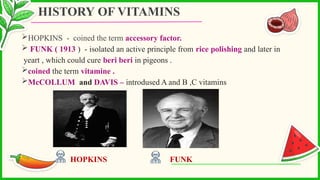
HOPKINS - coined the term accessory factor.
 FUNK ( 1913 ) - isolated an active principle from rice polishing and later in
yeart , which could cure beri beri in pigeons .
coined the term vitamine .
McCOLLUM and DAVIS – introdused A and B ,C vitamins
HOPKINS FUNK
HISTORY OF VITAMINS
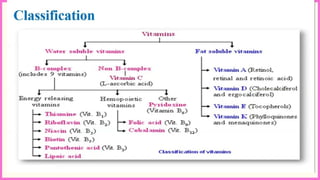
Classification of vitamos
● Lipid soluble vitamins – A D K E.
● Absorption and transport are associated with fat .
● Stored – liver and adipose tissue .
● Excess – toxic effects
● Compounds – isoprenoid , since they are made up
of one or five carbon units namely isoprene units (
-CH = C . CH3 – CH = CH - ).
● Vitamin K – specific co- enzyme function .
FAT SOLUBLE VITAMINS
A
K
D E
 HISTORY AND INTRO OF VITAMIN A
 Elmer Mccollum – first recognized as an essential factor ( VA) IN
1915 .
 Holmes in 1917 – isolated from fish liver oil .
 Role – visual process , often called as antixerophthalmic factor
or bright eyes vitamin .
 Milas – first synthesized in 1946 .
VITAMIN A
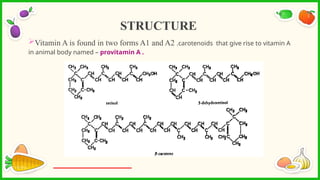
Vitamin A is found in two forms A1 and A2 .carotenoids that give rise to vitamin A
in animal body named – provitamin A .
STRUCTURE
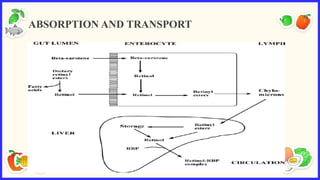
ABSORPTION AND TRANSPORT
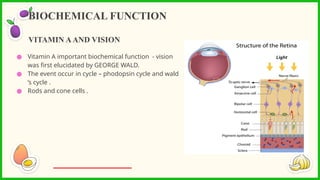
● Vitamin A important biochemical function - vision
was first elucidated by GEORGE WALD.
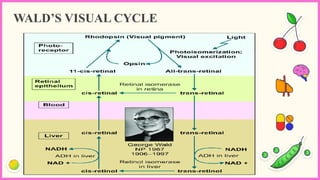
● The event occur in cycle – phodopsin cycle and wald
’s cycle .
● Rods and cone cells .
BIOCHEMICAL FUNCTION
VITAMIN AAND VISION
WALD’S VISUAL CYCLE
Retinal acid function almost like steroids hormones .
Vitamin A is essential to maintain healthy epithelial tissue .
Synthesis of certain glycoprotein ,required for growth and mucus secretion .
Retinol is necessary for normal reproduction .
Proper immune system to fight against various infection.
Cholesterol synthesis requires vitamin A.
Carotenoids function as antioxidants .
RDA( recommended dietary allowence)
Adults – 0.3 mg of retinol . It requirement increase in pregnant women And
lactating mothers .
Other biological function
● Animals source contain vitamin A .
● Liver
● Kidney
● Egg yolk
● Milk , cheese , butter
● Fish ( cod or shark ) liver oils
● Vegetable source contain the provitamin
● A – carotenes – provitamin
● Yellow and dark green vegetables and fruits - corrots , mango , papaya
pumpkins ,etc .
DIETARY SOURCE OF VITAMINA
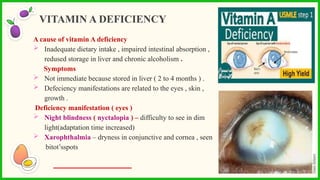
A cause of vitamin A deficiency
 Inadequate dietary intake , impaired intestinal absorption ,
redused storage in liver and chronic alcoholism .
Symptoms
 Not immediate because stored in liver ( 2 to 4 months ) .
 Defeciency manifestations are related to the eyes , skin ,
growth .
Deficiency manifestation ( eyes )
 Night blindness ( nyctalopia ) – difficulty to see in dim
light(adaptation time increased)
 Xarophthalmia – dryness in conjunctive and cornea , seen
bitot’sspots
VITAMIN A DEFICIENCY
● Effect on growth
● Effect on skin and epithelial cells
● Effect on reproduction .
Hypervitamionosis A
Excessive consumption of vitamin A lead to toxicity .
Total serum vitamin A level ( normal 20 – 50 )
Elevanted in hyper vitaminosis A .
B- CAROTENE
Ingestion of high does of B-carotene for long periods - not toxic
like vitamin A .
Decreased heart attack , skin and lung cancer .
Role in antioxidant .
OTHER DEFICEINCY MANIFESTATIONS
HISTORY OF VITAMIN D
 The first demonstration of the existence of vitamin D was shows by
ELMER
McCOLLUM in 1992 .
 Vitamin D3 was first isolated – BROCKMANN
INTRODUCTION
 Vitamin D preventive rickets, ofter called ‘antirachitic
factor ’
And ‘sunshine vitamins ’.
 D1 – ergocalciferol and D 3 – cholecalciferol .
 Sterols like structure and function – hormone .
VITAMIN D
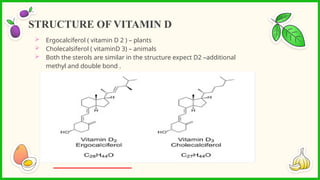
 Ergocalciferol ( vitamin D 2 ) – plants
 Cholecalsiferol ( vitaminD 3) – animals
 Both the sterols are similar in the structure expect D2 –additional
methyl and double bond .
STRUCTURE OF VITAMIN D
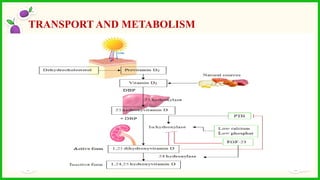
TRANSPORT AND METABOLISM
● Calcitriol (1 , 25 – DHCC ) is the biologically active from of vitamin D . It regulates
the plasma levels of calcium and phosphate .
● Action of calcitriol on the intestine ;
calcitriol increase the intestinal absorption of calcium and phosphate .
● Action of calciferol on the bone ;
● In the ostroblast of bone , calcitriol stimulates calcium uptake for deposition as
calcium phosphate . Thus calcitriol is essential for bone formation .
● Action of calcitriol on the kidney ;
● Calcitiol is also involved in minimizing the excretion of calcium and phosphate
through the kiney , by decreasing their excretion and enhancing reabsorption .
BIOLOGICAL FUNCTION
● synthesized in the skin by ultra – violet rays of sunlight
● Vitamin D , calcitriol is prodused in the kidney .
● Calcitriol has target organs – intestine , bone and kidney .
● Calcitrinol action is similar to steroid hormones .m
● Calciferiol synthesis is self – self –regulateds by a feedback of mechanism .
● RDA of vitamin D
● The daily requirement of vitamin D is 400 IU .
● In counties with good sunlight RDA of vitamin D - 200IU
VITAMIN D is a hormone - justification
● Fatty fish , fish liver oil , egg yolk , but milk is not a good source .
● Exposure sunlight – synthesis of vitamin D .
● Consumption of natural foods .
● By irradiating foods like yeast .
● A cause of vitamin D deficiency ;
● Strict vegetarians
● chronic alcoholism
● Individuals with liver and kidney disease
● Cover the entire body ( burka) for religious customs .
● Insufficient exposure to sunlight and lacking vitamin D
DIETARY SOURCE
● Rickets
● It is derived from an old English world ‘wrickken’ ( mean- twist) .
● It is attacted to children .
● Result in soft and pliable bones
● Delay in teeth formation and the weight bearing bones are bent
to form bow-legs .
● Osteomalacia
● It is attacted to adult
● It is derived from Greek word ( osteom – bone and malakia –
softness ) .
● Demineralization of the bones occur ( bones become soft ) .
● Susceptibility to fractures .
VITAMIN CAUSE DISEASES
● Most toxic in overdoses ( 10 -100 times RDA ).
● Effects of demineralization of bones
● Hypercalcema – increased calcium absorption from the intestine ,leading to
elevated calcium in plasma.
● But excessive exposure to sunlight does not result in vitamin D poisoning .
HYPERVITAMINOSIS D
HISTORY OF VITAMIN E
 The presence of this active principle was first
demonstrated in vegetables oils by EVANS and
MATTILL in 1920 .
 Introduction of vitamin E ;
 It is naturally occurring antioxidant .
 It is essential for normal reproduction in many
animals – called anti – sterility .
 Described as a ‘vitamin in search of a disease’.
 Tocopherols ( greek ; tokos – child borth ;pheros-
to ; ol-alcohol )
VITAMIN E
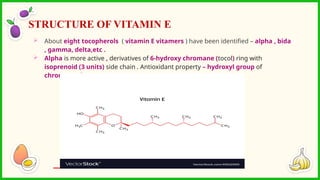
 About eight tocopherols ( vitamin E vitamers ) have been identified – alpha , bida
, gamma, delta,etc .
 Alpha is more active , derivatives of 6-hydroxy chromane (tocol) ring with
isoprenoid (3 units) side chain . Antioxidant property – hydroxyl group of
chromane ring .
STRUCTURE OF VITAMIN E
 Membrane structure and integrity iof the cell .
 It is prevents the preoxidation of PUFA in various tissue and membrane .
 Reproduction function – prevents sterility .
 ‘Icreases the synthesis of heme ’and it protects RBC from hemolysis by
oxidative agents .
 Required for cellular reproduction .
 Prevents the oxidation of vitamin A and carotenes .
 Proper synthesis of nucleic acids .
 Protects liver – toxic compounds ( carbon , tetrachloride ) .
 Preventions of chronic disease such as cancer and heart disease .
 It is needed for for optimal absorption of amino acids from the intestine .
BIOCHEMICAL FUNCTION
● Related to the consumption of PUFA .
● Daily requirement of alpha tocoferol
● Man – 10mg (151IU) and woman – 8mg ( 121 IU)
DIETARY SOURCES
 Wheat germ oil
 Cotton seed oil
 Peanut oil
 Sunflower oil
 Meat , milk , butter , eggs .
RDA OF VITAMIN E
● Vary from one animal species to another .
● Deficiency associated with sterility .
● Degeneration change in muscles and megaloblastic animea .
● Minor neurological symptoms .
TOXICITY OF VITAMIN E
 Vitamin E is least toxic .
DEFICEINCY SYMPTOMS
● HISTORY
● Henrik dam – proposed the term vitamin K and isolated K1 .
● Doisy – isolated other form of K2 in fish meal .
● INTRODUCTION
● Vitamin K – specific co-enzyme function .
● Required for the production of blood clotting factors .
● Essential for coagulation ( German – koagulation) .
VITAMIN K
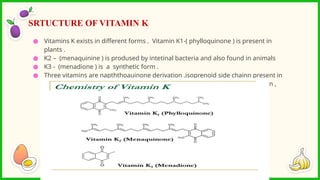
● Vitamins K exists in different forms . Vitamin K1-( phylloquinone ) is present in
plants .
● K2 – (menaquinine ) is prodused by intetinal bacteria and also found in animals
● K3 - (menadione ) is a synthetic form .
● Three vitamins are napththoauinone derivation .isoprenoid side chainn present in
K1AND k2.all vitamins re stable to heat . activity – oxidation agents , irradiation ,
strong acids
SRTUCTURE OF VITAMIN K
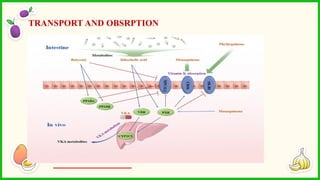
TRANSPORT AND OBSRPTION
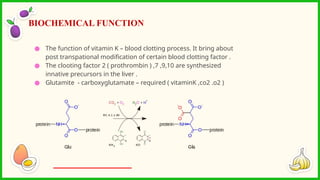
● The function of vitamin K – blood clotting process. It bring about
post transpational modification of certain blood clotting factor .
● The clooting factor 2 ( prothrombin ) ,7 ,9,10 are synthesized
innative precursors in the liver .
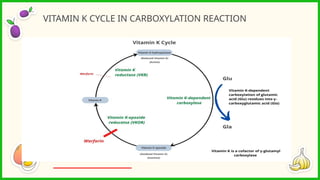
● Glutamite - carboxyglutamate – required ( vitaminK ,co2 .o2 )
BIOCHEMICAL FUNCTION
VITAMIN K CYCLE IN CARBOXYLATION REACTION
● No RDA for vitamin K , since it can be adequately synthesized in the gut .
● It is however , recommended that half of the body requiredment is provided in
the diet .
● Suggested RDA for an adult is 70 -100 ug / day .
● DIETARY SOURCES ;
● Cabbage , cauliflower , tomatoes , alfa alfa , spinach and other green vegetables
and good source ,
● Present – egg yoik , meat , liver .
● DEFICIENCY SYMPTOMS
● The blood clotting time is increased .
● HYPERVITAMINOSIS
● Hemolytic anaemia and jaundine ,particularly in infant
● Toxic effect is due to increased breakdown of RBC.
RDA OF VITAMIN K
 Heterogonous group – differ chemically from each others
.
 Common characteristics – soluble in water . Excreted in
the urine and not toxic to the body .
 Not stored large quantities – expect B12 .
 Generally ,vitamin deficiencies are multiple rather then
individual with overlapping symptoms .
 vitamins form co – enzymes - variety of biological
reaction .
 The common symptoms
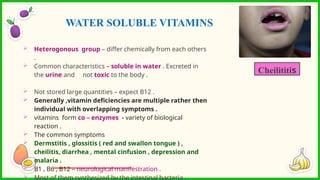
 Dermstitis , glossitis ( red and swallon tongue ) ,
cheilitis, diarrhea , mental cinfusion , depression and
malaria .
 B1 , B6 , B12 – neurological manifestration .
 Most of them synthesized by the intestinal bacteria .
WATER SOLUBLE VITAMINS
Cheilititis
HISTORY OF VITAMIN C
 Albert isolated a substance from adrenal glands in 1928 .
 he called 'hexuronic acid'.
 Charles Glen King isolated vitamin C in his laboratory and concluded that it was the
same as 'hexuronic acid'.
INTRODUCTION ;
 Vitamin c is a water soluble versatile vitamins .
 It plat an important role in human health and disease .
VITAMIN C
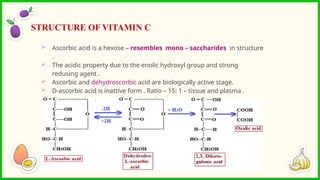
 Ascorbic acid is a hexose – resembles mono – saccharides in structure
.
 The acidic property due to the enolic hydroxyl group and strong
redusing agent .
 Ascorbic and dehydroscorbic acid are biologically active stage.
 D-ascorbic acid is inattive form . Ratio – 15: 1 – tissue and plasma .
 Vitamin c – becomes inactive if the foods are prepared in copper
vessels .
STRUCTURE OF VITAMIN C
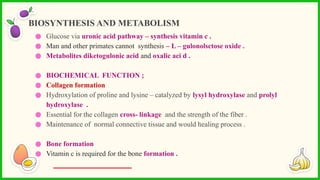
● Glucose via uronic acid pathway – synthesis vitamin c .
● Man and other primates cannot synthesis – L – gulonolsctose oxide .
● Metabolites diketogulonic acid and oxalic aci d .
● BIOCHEMICAL FUNCTION ;
● Collagen formation
● Hydroxylation of proline and lysine – catalyzed by lysyl hydroxylase and prolyl
hydroxylase .
● Essential for the collagen cross- linkage and the strength of the fiber .
● Maintenance of normal connective tissue and would healing process .
● Bone formation
● Vitamin c is required for the bone formation .
BIOSYNTHESIS AND METABOLISM
● Iron and hemoglobin metabolism
● Tryptophan metabolism
● Tyrosine metabolism folic acid metabolism
● Folic acid metabolism .
● Synthesis of corticosteroid hormones .
● Sparing action of other molecules .
● Immunological function preventive action on cataract .
● Preventive action of cataract .
● Preventive action on chronic disease .
● RDA
● About 40 -50 mg per day . Additional intake ( 20-40%
increase) – woman during pregnancy and lactation .
● Citrus fruits , gooseberry , guava , green vegetables , tomatoes ,
potatoes – rich ascorbic acid .
● High constant of vitamin c bound in adrenal gland and gonads .
● Milk – is poor source .
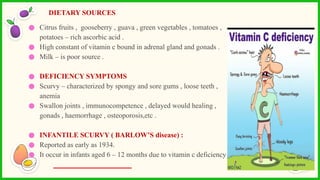
● DEFICIENCY SYMPTOMS
● Scurvy – characterized by spongy and sore gums , loose teeth ,
anemia
● Swallon joints , immunocompetence , delayed would healing ,
gonads , haemorrhage , osteoporosis,etc .
● INFANTILE SCURVY ( BARLOW’S disease) :
● Reported as early as 1934.
● It occur in infants aged 6 – 12 months due to vitamin c deficiency .
DIETARY SOURCES
● INTRODUCTION
● Thiamine ( anti-beri-beri or antineuritic vitamins ) is water soluble .
● It si specific co – enzyme , thiamine pyrophosphate (TPP ) which is mostly
associated with carbohydrates metabolism .
THIAMINE ( VITAMIN B1)
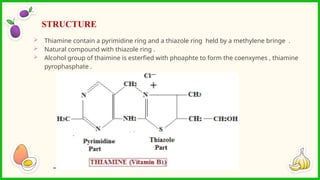
 Thiamine contain a pyrimidine ring and a thiazole ring held by a methylene bringe .
 Natural compound with thiazole ring .
 Alcohol group of thaimine is esterfied with phoaphte to form the coenxymes , thiamine
pyrophasphate .
STRUCTURE
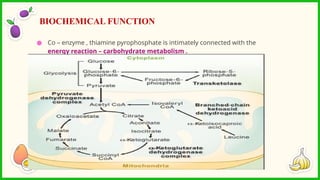
● Co – enzyme , thiamine pyrophosphate is intimately connected with the
energy reaction – carbohydrate metabolism .
BIOCHEMICAL FUNCTION
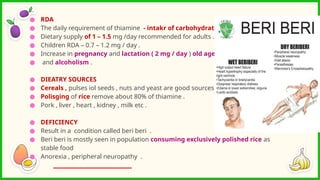
● RDA
● The daily requirement of thiamine - intakr of carbohydrate .
● Dietary supply of 1 – 1.5 mg /day recommended for adults .
● Children RDA – 0.7 – 1.2 mg / day .
● Increase in pregnancy and lactation ( 2 mg / day ) old age
● and alcoholism .
● DIEATRY SOURCES
● Cereals , pulses iol seeds , nuts and yeast are good sources .
● Polisging of rice remove about 80% of thiamine .
● Pork , liver , heart , kidney , milk etc .
● DEFICIENCY
● Result in a condition called beri beri .
● Beri beri is mostly seen in population consuming exclusively polished rice as
stable food
● Anorexia , peripheral neuropathy .
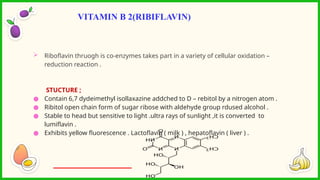
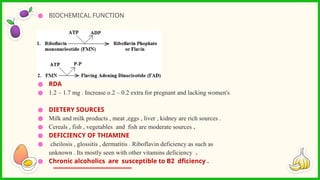
 Riboflavin thruogh is co-enzymes takes part in a variety of cellular oxidation –
reduction reaction .
STUCTURE ;
● Contain 6,7 dydeimethyl isollaxazine addched to D – rebitol by a nitrogen atom .
● Ribitol open chain form of sugar ribose with aldehyde group rdused alcohol .
● Stable to head but sensitive to light .ultra rays of sunlight ,it is converted to
lumiflavin .
● Exhibits yellow fluorescence . Lactoflavin ( milk ) , hepatoflavin ( liver ) .
VITAMIN B 2(RIBIFLAVIN)
● BIOCHEMICAL FUNCTION
● RDA
● 1.2 – 1.7 mg . Increase o.2 – 0.2 extra for pregnant and lacking women's
● DIETERY SOURCES
● Milk and milk products , meat ,eggs , liver , kidney are rich sources .
● Cereals , fish , vegetables and fish are moderate sources .
● DEFICIENCY OF THIAMINE
● cheilosis , glossitis , dermatitis . Riboflavin deficiency as such as
unknown . Its mostly seen with other vitamins deficiency .
● Chronic alcoholics are susceptible to B2 dficiency .
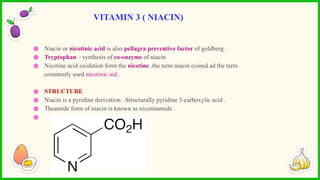
● Niacin or nicotinic acid is also pellagra preventive factor of goldberg .
● Tryptophan – synthesis of co-enzyme of niacin
● Nicotine acid oxidation form the nicotine .the term niacin coined ad the term
commonly used nicotinic aid .
● STRUCTURE
● Niacin is a pyridine derivation . Structurally pyridine 3-carboxylic acid .
● Theamide form of niacin is known as nicotinamide .
●
VITAMIN 3 ( NIACIN)
● Biologically active forms
● NAD+ , Nicotinamide adenine dinucleotide – NADP+ – Nicotinamide
(readily deaminated, also in diet)
• Function
● Coenzymes in redox reactions (TCA, FA synthesis, gluconeogenesis, etc.)
– DNA repair •
Sources
Unrefined grains, fortified cereal, meat, fish, tomatoes, mushrooms, milk, liver,
rice – Metabolism of tryptophan when AA is abundant (needs riboflavin
and B6)
● RDA
● 14-16 NE/day (NE = niacin equivalents = 1 mg niacin or 60 mg tryptophan) •
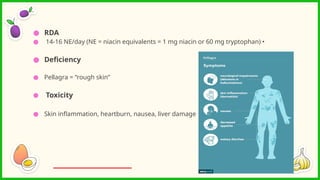
● Deficiency
● Pellagra = “rough skin”
● Toxicity
● Skin inflammation, heartburn, nausea, liver damage
Vitamin B6 , pyridoxal, pyridoxamine •
BIOLOGYCAL ACTIVE FORM
● pyridoxal phosphate (PLP) •
FUNCTIOM
● Coenzyme for transamination reactions, esp. AAs (neurotransmitters) –
Decarboxylation of carboxylic acids •
● SOURCE
● Wheat, corn, egg
DEFICIENCY
Induced by TB drug isoniazid (supplement given) – Dermatitis, fatigue – Depression,
confusion – Convulsions, seizures – Microcytic hypochromic anemia – Epidemic in
1950
TOXICITY - Neurological disorders at > 2 g /day
VITAMIN 6 (PYRIDOXINE
BIOLOGICAL ACTIVE FORM
● Binds to lysine residue of enzyme
FUNCTION
● Cofactor in carboxylation reactions, carrier of CO2 (acetyl-CoA to malonyl-CoA,
synthesis of fatty acids) – Regulation of gene expression
SOURCE
● Almost all food, esp. milk, egg yolk, tomato, almond, peanuts, avocado, mushroom –
Also synthesized by intestinal bacteria
RDA
● At least 30 mg/day •
DEFICIENCY – Deficiency does not occur naturally unless eat 20 raw egg whites per day
(protein avidin binds biotin irreversibly and excreted)
VITAMIN 7 ( BIOTIN)
 BIOLOGICALLYACTIVE FORM – Tetrahydrofolate(THF) •
 FUNCTION
● Stimulates digestive acids; appetite – Receive one carbon fragments from donors and
transfer them in AA synthesis and nucleotide synthesis •
 SOURCES
● Green leafy veggies (“foliage”), organ meats, legumes, okra, whole grain cereal.
 RDA
● 400 mg/day, more during pregnancy and lactation •
DEFICIENCY
 Megaloblastic /macrocytic anemia and growth failure – Once, most common vitamin
deficiencein US; now fortified cereals – Absorption inhibited by many medicines, so a
problem with the elderly .
FOLIC ACID
 Corrin ring system with Co in center (Corrin is an heterocyclic compound. It is the
parent macrocycle related to substituted derivative that is found in vitamin B12. Its
name reflects that it is the "core" of vitamin B12.
 FUNCTIOM
• Synthesis of Met – Methylmalonyl-CoA to succinyl-CoA • Degradation of odd-
chain FA, enter TCA – Transfer of methyl groups – Produce red blood cells
 SOURCES
• Liver, whole milk, cottage cheese, oysters, salmon, clams, eggs, shrimp, pork,
chicken (animal sources) •
 RDA
● 2.4 mg/day.
 Deficiency
● Caused by pernicious anemia – Methylmalonic acidemia (MMA)
VITAMIN B12 ( COBALAMIN )
● CONCLUTION
 understanding the classification of vitamins, their sources,
functions, and potential health implications is essential for
maintaining good health and preventing vitamin deficiency or
toxicity.
 important to maintain a balanced diet and, in some cases,
consult a healthcare professional or registered dietitian to
ensure proper vitamin intake, especially if you have specific
dietary restrictions or health concerns..
● Biochemistry , U.Sathyanarayana ,
multicolour edition , 2018 .
● Text if of biochemisrty , nithin , multicolour
edition , 2017 .
● Aamir Ali Khan M.Phil Biochemistry , Head
of Pathology Department ,Northwest
Institute of Health sciences .
REFFERENCE

VITAMINS

  • 1.
  • 2.
    SUBMITTED TO ● DR. MURUGAN SIR ● GUEST LECTURE ● DEPARTMENT OF BIOCHEMISTRY ● BHARATHIDASAN UNIVERSITY ● TRICHY SARAVANA MOORTHY.C M .SC LIFE SCIENCE LS22022 ( 2 YEAR ) BHARATHIDASAN UNIVERSITY TRICHY - 24 SUBMITTED BY
  • 3.
  • 4.
     Vitamin isa micronutrients .  Vitamin is a Greek latter .( vita mean life )  vitamins as organic compounds .  Required in the diet small amount .  Vitamins are not synthesized in the body  Except E.coli (before evolution) INTRODUCTION OF VITAMINS
  • 5.
    HOPKINS - coinedthe term accessory factor.  FUNK ( 1913 ) - isolated an active principle from rice polishing and later in yeart , which could cure beri beri in pigeons . coined the term vitamine . McCOLLUM and DAVIS – introdused A and B ,C vitamins HOPKINS FUNK HISTORY OF VITAMINS
  • 6.
  • 7.
    ● Lipid solublevitamins – A D K E. ● Absorption and transport are associated with fat . ● Stored – liver and adipose tissue . ● Excess – toxic effects ● Compounds – isoprenoid , since they are made up of one or five carbon units namely isoprene units ( -CH = C . CH3 – CH = CH - ). ● Vitamin K – specific co- enzyme function . FAT SOLUBLE VITAMINS A K D E
  • 8.
     HISTORY ANDINTRO OF VITAMIN A  Elmer Mccollum – first recognized as an essential factor ( VA) IN 1915 .  Holmes in 1917 – isolated from fish liver oil .  Role – visual process , often called as antixerophthalmic factor or bright eyes vitamin .  Milas – first synthesized in 1946 . VITAMIN A
  • 9.
    Vitamin A isfound in two forms A1 and A2 .carotenoids that give rise to vitamin A in animal body named – provitamin A . STRUCTURE
  • 10.
  • 11.
    ● Vitamin Aimportant biochemical function - vision was first elucidated by GEORGE WALD. ● The event occur in cycle – phodopsin cycle and wald ’s cycle . ● Rods and cone cells . BIOCHEMICAL FUNCTION VITAMIN AAND VISION
  • 12.
  • 13.
    Retinal acid functionalmost like steroids hormones . Vitamin A is essential to maintain healthy epithelial tissue . Synthesis of certain glycoprotein ,required for growth and mucus secretion . Retinol is necessary for normal reproduction . Proper immune system to fight against various infection. Cholesterol synthesis requires vitamin A. Carotenoids function as antioxidants . RDA( recommended dietary allowence) Adults – 0.3 mg of retinol . It requirement increase in pregnant women And lactating mothers . Other biological function
  • 14.
    ● Animals sourcecontain vitamin A . ● Liver ● Kidney ● Egg yolk ● Milk , cheese , butter ● Fish ( cod or shark ) liver oils ● Vegetable source contain the provitamin ● A – carotenes – provitamin ● Yellow and dark green vegetables and fruits - corrots , mango , papaya pumpkins ,etc . DIETARY SOURCE OF VITAMINA
  • 15.
    A cause ofvitamin A deficiency  Inadequate dietary intake , impaired intestinal absorption , redused storage in liver and chronic alcoholism . Symptoms  Not immediate because stored in liver ( 2 to 4 months ) .  Defeciency manifestations are related to the eyes , skin , growth . Deficiency manifestation ( eyes )  Night blindness ( nyctalopia ) – difficulty to see in dim light(adaptation time increased)  Xarophthalmia – dryness in conjunctive and cornea , seen bitot’sspots VITAMIN A DEFICIENCY
  • 16.
    ● Effect ongrowth ● Effect on skin and epithelial cells ● Effect on reproduction . Hypervitamionosis A Excessive consumption of vitamin A lead to toxicity . Total serum vitamin A level ( normal 20 – 50 ) Elevanted in hyper vitaminosis A . B- CAROTENE Ingestion of high does of B-carotene for long periods - not toxic like vitamin A . Decreased heart attack , skin and lung cancer . Role in antioxidant . OTHER DEFICEINCY MANIFESTATIONS
  • 17.
    HISTORY OF VITAMIND  The first demonstration of the existence of vitamin D was shows by ELMER McCOLLUM in 1992 .  Vitamin D3 was first isolated – BROCKMANN INTRODUCTION  Vitamin D preventive rickets, ofter called ‘antirachitic factor ’ And ‘sunshine vitamins ’.  D1 – ergocalciferol and D 3 – cholecalciferol .  Sterols like structure and function – hormone . VITAMIN D
  • 18.
     Ergocalciferol (vitamin D 2 ) – plants  Cholecalsiferol ( vitaminD 3) – animals  Both the sterols are similar in the structure expect D2 –additional methyl and double bond . STRUCTURE OF VITAMIN D
  • 19.
  • 20.
    ● Calcitriol (1, 25 – DHCC ) is the biologically active from of vitamin D . It regulates the plasma levels of calcium and phosphate . ● Action of calcitriol on the intestine ; calcitriol increase the intestinal absorption of calcium and phosphate . ● Action of calciferol on the bone ; ● In the ostroblast of bone , calcitriol stimulates calcium uptake for deposition as calcium phosphate . Thus calcitriol is essential for bone formation . ● Action of calcitriol on the kidney ; ● Calcitiol is also involved in minimizing the excretion of calcium and phosphate through the kiney , by decreasing their excretion and enhancing reabsorption . BIOLOGICAL FUNCTION
  • 21.
    ● synthesized inthe skin by ultra – violet rays of sunlight ● Vitamin D , calcitriol is prodused in the kidney . ● Calcitriol has target organs – intestine , bone and kidney . ● Calcitrinol action is similar to steroid hormones .m ● Calciferiol synthesis is self – self –regulateds by a feedback of mechanism . ● RDA of vitamin D ● The daily requirement of vitamin D is 400 IU . ● In counties with good sunlight RDA of vitamin D - 200IU VITAMIN D is a hormone - justification
  • 22.
    ● Fatty fish, fish liver oil , egg yolk , but milk is not a good source . ● Exposure sunlight – synthesis of vitamin D . ● Consumption of natural foods . ● By irradiating foods like yeast . ● A cause of vitamin D deficiency ; ● Strict vegetarians ● chronic alcoholism ● Individuals with liver and kidney disease ● Cover the entire body ( burka) for religious customs . ● Insufficient exposure to sunlight and lacking vitamin D DIETARY SOURCE
  • 23.
    ● Rickets ● Itis derived from an old English world ‘wrickken’ ( mean- twist) . ● It is attacted to children . ● Result in soft and pliable bones ● Delay in teeth formation and the weight bearing bones are bent to form bow-legs . ● Osteomalacia ● It is attacted to adult ● It is derived from Greek word ( osteom – bone and malakia – softness ) . ● Demineralization of the bones occur ( bones become soft ) . ● Susceptibility to fractures . VITAMIN CAUSE DISEASES
  • 24.
    ● Most toxicin overdoses ( 10 -100 times RDA ). ● Effects of demineralization of bones ● Hypercalcema – increased calcium absorption from the intestine ,leading to elevated calcium in plasma. ● But excessive exposure to sunlight does not result in vitamin D poisoning . HYPERVITAMINOSIS D
  • 25.
    HISTORY OF VITAMINE  The presence of this active principle was first demonstrated in vegetables oils by EVANS and MATTILL in 1920 .  Introduction of vitamin E ;  It is naturally occurring antioxidant .  It is essential for normal reproduction in many animals – called anti – sterility .  Described as a ‘vitamin in search of a disease’.  Tocopherols ( greek ; tokos – child borth ;pheros- to ; ol-alcohol ) VITAMIN E
  • 26.
     About eighttocopherols ( vitamin E vitamers ) have been identified – alpha , bida , gamma, delta,etc .  Alpha is more active , derivatives of 6-hydroxy chromane (tocol) ring with isoprenoid (3 units) side chain . Antioxidant property – hydroxyl group of chromane ring . STRUCTURE OF VITAMIN E
  • 27.
     Membrane structureand integrity iof the cell .  It is prevents the preoxidation of PUFA in various tissue and membrane .  Reproduction function – prevents sterility .  ‘Icreases the synthesis of heme ’and it protects RBC from hemolysis by oxidative agents .  Required for cellular reproduction .  Prevents the oxidation of vitamin A and carotenes .  Proper synthesis of nucleic acids .  Protects liver – toxic compounds ( carbon , tetrachloride ) .  Preventions of chronic disease such as cancer and heart disease .  It is needed for for optimal absorption of amino acids from the intestine . BIOCHEMICAL FUNCTION
  • 28.
    ● Related tothe consumption of PUFA . ● Daily requirement of alpha tocoferol ● Man – 10mg (151IU) and woman – 8mg ( 121 IU) DIETARY SOURCES  Wheat germ oil  Cotton seed oil  Peanut oil  Sunflower oil  Meat , milk , butter , eggs . RDA OF VITAMIN E
  • 29.
    ● Vary fromone animal species to another . ● Deficiency associated with sterility . ● Degeneration change in muscles and megaloblastic animea . ● Minor neurological symptoms . TOXICITY OF VITAMIN E  Vitamin E is least toxic . DEFICEINCY SYMPTOMS
  • 30.
    ● HISTORY ● Henrikdam – proposed the term vitamin K and isolated K1 . ● Doisy – isolated other form of K2 in fish meal . ● INTRODUCTION ● Vitamin K – specific co-enzyme function . ● Required for the production of blood clotting factors . ● Essential for coagulation ( German – koagulation) . VITAMIN K
  • 31.
    ● Vitamins Kexists in different forms . Vitamin K1-( phylloquinone ) is present in plants . ● K2 – (menaquinine ) is prodused by intetinal bacteria and also found in animals ● K3 - (menadione ) is a synthetic form . ● Three vitamins are napththoauinone derivation .isoprenoid side chainn present in K1AND k2.all vitamins re stable to heat . activity – oxidation agents , irradiation , strong acids SRTUCTURE OF VITAMIN K
  • 32.
  • 33.
    ● The functionof vitamin K – blood clotting process. It bring about post transpational modification of certain blood clotting factor . ● The clooting factor 2 ( prothrombin ) ,7 ,9,10 are synthesized innative precursors in the liver . ● Glutamite - carboxyglutamate – required ( vitaminK ,co2 .o2 ) BIOCHEMICAL FUNCTION
  • 34.
    VITAMIN K CYCLEIN CARBOXYLATION REACTION
  • 35.
    ● No RDAfor vitamin K , since it can be adequately synthesized in the gut . ● It is however , recommended that half of the body requiredment is provided in the diet . ● Suggested RDA for an adult is 70 -100 ug / day . ● DIETARY SOURCES ; ● Cabbage , cauliflower , tomatoes , alfa alfa , spinach and other green vegetables and good source , ● Present – egg yoik , meat , liver . ● DEFICIENCY SYMPTOMS ● The blood clotting time is increased . ● HYPERVITAMINOSIS ● Hemolytic anaemia and jaundine ,particularly in infant ● Toxic effect is due to increased breakdown of RBC. RDA OF VITAMIN K
  • 36.
     Heterogonous group– differ chemically from each others .  Common characteristics – soluble in water . Excreted in the urine and not toxic to the body .  Not stored large quantities – expect B12 .  Generally ,vitamin deficiencies are multiple rather then individual with overlapping symptoms .  vitamins form co – enzymes - variety of biological reaction .  The common symptoms  Dermstitis , glossitis ( red and swallon tongue ) , cheilitis, diarrhea , mental cinfusion , depression and malaria .  B1 , B6 , B12 – neurological manifestration .  Most of them synthesized by the intestinal bacteria . WATER SOLUBLE VITAMINS Cheilititis
  • 37.
    HISTORY OF VITAMINC  Albert isolated a substance from adrenal glands in 1928 .  he called 'hexuronic acid'.  Charles Glen King isolated vitamin C in his laboratory and concluded that it was the same as 'hexuronic acid'. INTRODUCTION ;  Vitamin c is a water soluble versatile vitamins .  It plat an important role in human health and disease . VITAMIN C
  • 38.
     Ascorbic acidis a hexose – resembles mono – saccharides in structure .  The acidic property due to the enolic hydroxyl group and strong redusing agent .  Ascorbic and dehydroscorbic acid are biologically active stage.  D-ascorbic acid is inattive form . Ratio – 15: 1 – tissue and plasma .  Vitamin c – becomes inactive if the foods are prepared in copper vessels . STRUCTURE OF VITAMIN C
  • 39.
    ● Glucose viauronic acid pathway – synthesis vitamin c . ● Man and other primates cannot synthesis – L – gulonolsctose oxide . ● Metabolites diketogulonic acid and oxalic aci d . ● BIOCHEMICAL FUNCTION ; ● Collagen formation ● Hydroxylation of proline and lysine – catalyzed by lysyl hydroxylase and prolyl hydroxylase . ● Essential for the collagen cross- linkage and the strength of the fiber . ● Maintenance of normal connective tissue and would healing process . ● Bone formation ● Vitamin c is required for the bone formation . BIOSYNTHESIS AND METABOLISM
  • 40.
    ● Iron andhemoglobin metabolism ● Tryptophan metabolism ● Tyrosine metabolism folic acid metabolism ● Folic acid metabolism . ● Synthesis of corticosteroid hormones . ● Sparing action of other molecules . ● Immunological function preventive action on cataract . ● Preventive action of cataract . ● Preventive action on chronic disease . ● RDA ● About 40 -50 mg per day . Additional intake ( 20-40% increase) – woman during pregnancy and lactation .
  • 41.
    ● Citrus fruits, gooseberry , guava , green vegetables , tomatoes , potatoes – rich ascorbic acid . ● High constant of vitamin c bound in adrenal gland and gonads . ● Milk – is poor source . ● DEFICIENCY SYMPTOMS ● Scurvy – characterized by spongy and sore gums , loose teeth , anemia ● Swallon joints , immunocompetence , delayed would healing , gonads , haemorrhage , osteoporosis,etc . ● INFANTILE SCURVY ( BARLOW’S disease) : ● Reported as early as 1934. ● It occur in infants aged 6 – 12 months due to vitamin c deficiency . DIETARY SOURCES
  • 42.
    ● INTRODUCTION ● Thiamine( anti-beri-beri or antineuritic vitamins ) is water soluble . ● It si specific co – enzyme , thiamine pyrophosphate (TPP ) which is mostly associated with carbohydrates metabolism . THIAMINE ( VITAMIN B1)
  • 43.
     Thiamine containa pyrimidine ring and a thiazole ring held by a methylene bringe .  Natural compound with thiazole ring .  Alcohol group of thaimine is esterfied with phoaphte to form the coenxymes , thiamine pyrophasphate . STRUCTURE
  • 44.
    ● Co –enzyme , thiamine pyrophosphate is intimately connected with the energy reaction – carbohydrate metabolism . BIOCHEMICAL FUNCTION
  • 45.
    ● RDA ● Thedaily requirement of thiamine - intakr of carbohydrate . ● Dietary supply of 1 – 1.5 mg /day recommended for adults . ● Children RDA – 0.7 – 1.2 mg / day . ● Increase in pregnancy and lactation ( 2 mg / day ) old age ● and alcoholism . ● DIEATRY SOURCES ● Cereals , pulses iol seeds , nuts and yeast are good sources . ● Polisging of rice remove about 80% of thiamine . ● Pork , liver , heart , kidney , milk etc . ● DEFICIENCY ● Result in a condition called beri beri . ● Beri beri is mostly seen in population consuming exclusively polished rice as stable food ● Anorexia , peripheral neuropathy .
  • 46.
     Riboflavin thruoghis co-enzymes takes part in a variety of cellular oxidation – reduction reaction . STUCTURE ; ● Contain 6,7 dydeimethyl isollaxazine addched to D – rebitol by a nitrogen atom . ● Ribitol open chain form of sugar ribose with aldehyde group rdused alcohol . ● Stable to head but sensitive to light .ultra rays of sunlight ,it is converted to lumiflavin . ● Exhibits yellow fluorescence . Lactoflavin ( milk ) , hepatoflavin ( liver ) . VITAMIN B 2(RIBIFLAVIN)
  • 47.
    ● BIOCHEMICAL FUNCTION ●RDA ● 1.2 – 1.7 mg . Increase o.2 – 0.2 extra for pregnant and lacking women's ● DIETERY SOURCES ● Milk and milk products , meat ,eggs , liver , kidney are rich sources . ● Cereals , fish , vegetables and fish are moderate sources . ● DEFICIENCY OF THIAMINE ● cheilosis , glossitis , dermatitis . Riboflavin deficiency as such as unknown . Its mostly seen with other vitamins deficiency . ● Chronic alcoholics are susceptible to B2 dficiency .
  • 48.
    ● Niacin ornicotinic acid is also pellagra preventive factor of goldberg . ● Tryptophan – synthesis of co-enzyme of niacin ● Nicotine acid oxidation form the nicotine .the term niacin coined ad the term commonly used nicotinic aid . ● STRUCTURE ● Niacin is a pyridine derivation . Structurally pyridine 3-carboxylic acid . ● Theamide form of niacin is known as nicotinamide . ● VITAMIN 3 ( NIACIN)
  • 49.
    ● Biologically activeforms ● NAD+ , Nicotinamide adenine dinucleotide – NADP+ – Nicotinamide (readily deaminated, also in diet) • Function ● Coenzymes in redox reactions (TCA, FA synthesis, gluconeogenesis, etc.) – DNA repair • Sources Unrefined grains, fortified cereal, meat, fish, tomatoes, mushrooms, milk, liver, rice – Metabolism of tryptophan when AA is abundant (needs riboflavin and B6)
  • 50.
    ● RDA ● 14-16NE/day (NE = niacin equivalents = 1 mg niacin or 60 mg tryptophan) • ● Deficiency ● Pellagra = “rough skin” ● Toxicity ● Skin inflammation, heartburn, nausea, liver damage
  • 51.
    Vitamin B6 ,pyridoxal, pyridoxamine • BIOLOGYCAL ACTIVE FORM ● pyridoxal phosphate (PLP) • FUNCTIOM ● Coenzyme for transamination reactions, esp. AAs (neurotransmitters) – Decarboxylation of carboxylic acids • ● SOURCE ● Wheat, corn, egg DEFICIENCY Induced by TB drug isoniazid (supplement given) – Dermatitis, fatigue – Depression, confusion – Convulsions, seizures – Microcytic hypochromic anemia – Epidemic in 1950 TOXICITY - Neurological disorders at > 2 g /day VITAMIN 6 (PYRIDOXINE
  • 52.
    BIOLOGICAL ACTIVE FORM ●Binds to lysine residue of enzyme FUNCTION ● Cofactor in carboxylation reactions, carrier of CO2 (acetyl-CoA to malonyl-CoA, synthesis of fatty acids) – Regulation of gene expression SOURCE ● Almost all food, esp. milk, egg yolk, tomato, almond, peanuts, avocado, mushroom – Also synthesized by intestinal bacteria RDA ● At least 30 mg/day • DEFICIENCY – Deficiency does not occur naturally unless eat 20 raw egg whites per day (protein avidin binds biotin irreversibly and excreted) VITAMIN 7 ( BIOTIN)
  • 53.
     BIOLOGICALLYACTIVE FORM– Tetrahydrofolate(THF) •  FUNCTION ● Stimulates digestive acids; appetite – Receive one carbon fragments from donors and transfer them in AA synthesis and nucleotide synthesis •  SOURCES ● Green leafy veggies (“foliage”), organ meats, legumes, okra, whole grain cereal.  RDA ● 400 mg/day, more during pregnancy and lactation • DEFICIENCY  Megaloblastic /macrocytic anemia and growth failure – Once, most common vitamin deficiencein US; now fortified cereals – Absorption inhibited by many medicines, so a problem with the elderly . FOLIC ACID
  • 54.
     Corrin ringsystem with Co in center (Corrin is an heterocyclic compound. It is the parent macrocycle related to substituted derivative that is found in vitamin B12. Its name reflects that it is the "core" of vitamin B12.  FUNCTIOM • Synthesis of Met – Methylmalonyl-CoA to succinyl-CoA • Degradation of odd- chain FA, enter TCA – Transfer of methyl groups – Produce red blood cells  SOURCES • Liver, whole milk, cottage cheese, oysters, salmon, clams, eggs, shrimp, pork, chicken (animal sources) •  RDA ● 2.4 mg/day.  Deficiency ● Caused by pernicious anemia – Methylmalonic acidemia (MMA) VITAMIN B12 ( COBALAMIN )
  • 55.
    ● CONCLUTION  understandingthe classification of vitamins, their sources, functions, and potential health implications is essential for maintaining good health and preventing vitamin deficiency or toxicity.  important to maintain a balanced diet and, in some cases, consult a healthcare professional or registered dietitian to ensure proper vitamin intake, especially if you have specific dietary restrictions or health concerns..
  • 56.
    ● Biochemistry ,U.Sathyanarayana , multicolour edition , 2018 . ● Text if of biochemisrty , nithin , multicolour edition , 2017 . ● Aamir Ali Khan M.Phil Biochemistry , Head of Pathology Department ,Northwest Institute of Health sciences . REFFERENCE