DEEP FASCIAL SPACE 
INFECTIONS 
PART-2 
ARJUN SHENOY 
DEPT OF OMFS
• MASSETRIC SPACE 
• LUDWIGS ANGINA 
• PHARYNGEAL SPACE 
• RETROPHARYNGEAL SPACE 
• CAVERNOUS SINUS THROMBOSIS 
• MEDIASTINITIS 
• CONCLUSION 
• REFERENCES
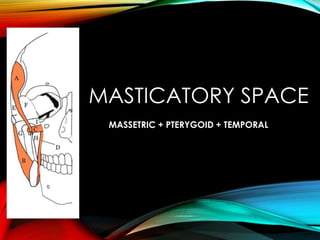
MASTICATORY SPACE 
MASSETRIC + PTERYGOID + TEMPORAL
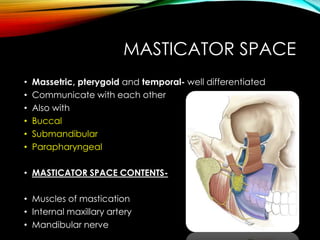
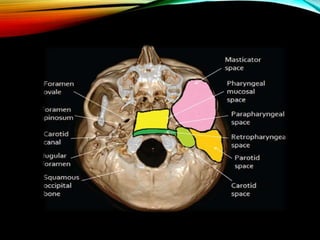
MASTICATOR SPACE 
• Massetric, pterygoid and temporal- well differentiated 
• Communicate with each other 
• Also with 
• Buccal 
• Submandibular 
• Parapharyngeal 
• MASTICATOR SPACE CONTENTS- 
• Muscles of mastication 
• Internal maxillary artery 
• Mandibular nerve
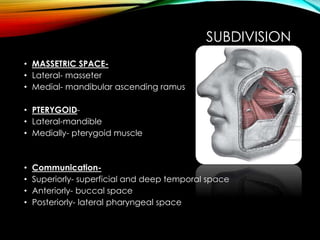
SUBDIVISION 
• MASSETRIC SPACE- 
• Lateral- masseter 
• Medial- mandibular ascending ramus 
• PTERYGOID- 
• Lateral-mandible 
• Medially- pterygoid muscle 
• Communication- 
• Superiorly- superficial and deep temporal space 
• Anteriorly- buccal space 
• Posteriorly- lateral pharyngeal space
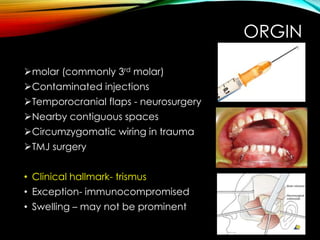
ORGIN 
molar (commonly 3rd molar) 
Contaminated injections 
Temporocranial flaps - neurosurgery 
Nearby contiguous spaces 
Circumzygomatic wiring in trauma 
TMJ surgery 
• Clinical hallmark- trismus 
• Exception- immunocompromised 
• Swelling – may not be prominent
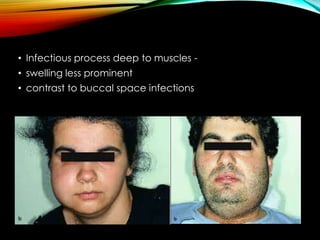
• Infectious process deep to muscles - 
• swelling less prominent 
• contrast to buccal space infections 
•
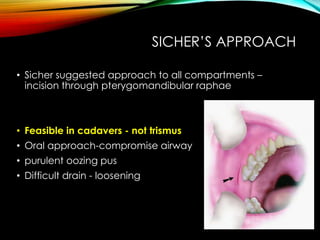
SICHER’S APPROACH 
• Sicher suggested approach to all compartments – 
incision through pterygomandibular raphae 
• Feasible in cadavers - not trismus 
• Oral approach-compromise airway 
• purulent oozing pus 
• Difficult drain - loosening
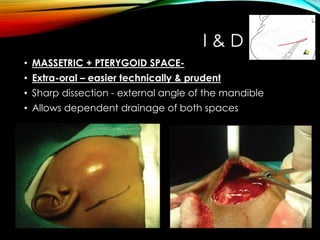
I & D 
• MASSETRIC + PTERYGOID SPACE- 
• Extra-oral – easier technically & prudent 
• Sharp dissection - external angle of the mandible 
• Allows dependent drainage of both spaces
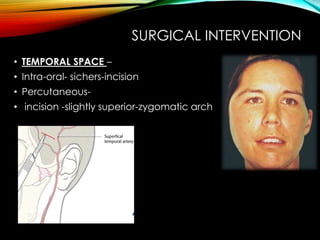
SURGICAL INTERVENTION 
• TEMPORAL SPACE – 
• Intra-oral- sichers-incision 
• Percutaneous- 
• incision -slightly superior-zygomatic arch
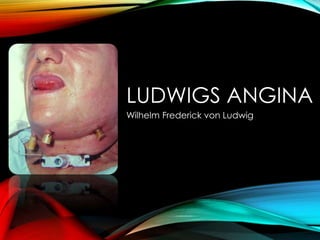
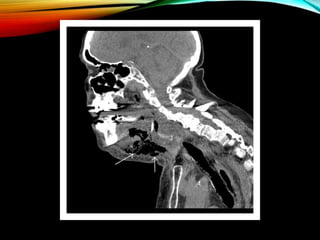
LUDWIGS ANGINA 
Wilhelm Frederick von Ludwig
DEFINITION 
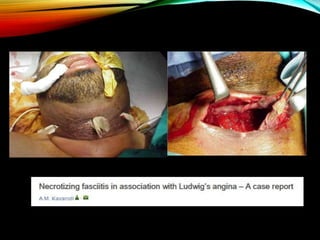
• Ludwigs angina is a firm , acute, toxic cellulitis of the 
submandibular and sublingual spaces bilaterally and of 
the submental space 
• Three F’s 
• Feared 
• Not fluctuant 
• Fatal
HISTORICAL PERSPECTIVE 
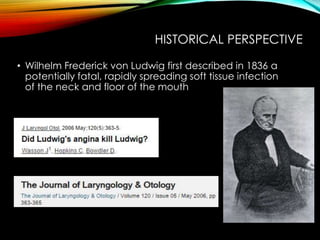
• Wilhelm Frederick von Ludwig first described in 1836 a 
potentially fatal, rapidly spreading soft tissue infection 
of the neck and floor of the mouth
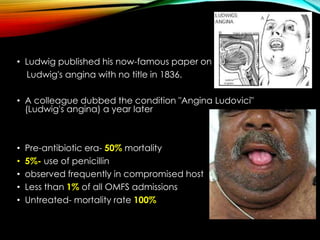
• Ludwig published his now-famous paper on 
Ludwig's angina with no title in 1836. 
• A colleague dubbed the condition "Angina Ludovici" 
(Ludwig's angina) a year later 
• Pre-antibiotic era- 50% mortality 
• 5%- use of penicillin 
• observed frequently in compromised host 
• Less than 1% of all OMFS admissions 
• Untreated- mortality rate 100%
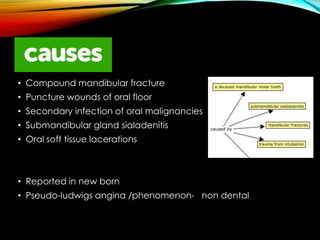
• Compound mandibular fracture 
• Puncture wounds of oral floor 
• Secondary infection of oral malignancies 
• Submandibular gland sialadenitis 
• Oral soft tissue lacerations 
• Reported in new born 
• Pseudo-ludwigs angina /phenomenon- non dental
CLINICAL FEATURES 
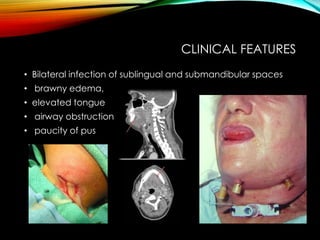
• Bilateral infection of sublingual and submandibular spaces 
• brawny edema, 
• elevated tongue 
• airway obstruction 
• paucity of pus
MICROBIOLOGY 
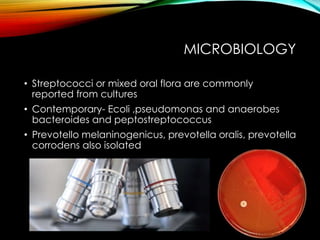
• Streptococci or mixed oral flora are commonly 
reported from cultures 
• Contemporary- Ecoli ,pseudomonas and anaerobes 
bacteroides and peptostreptococcus 
• Prevotello melaninogenicus, prevotella oralis, prevotella 
corrodens also isolated
DIFFERENTIAL DIAGNOSIS 
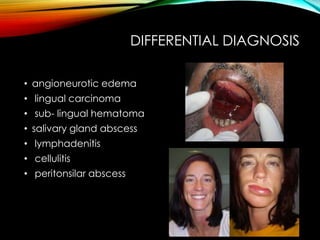
• angioneurotic edema 
• lingual carcinoma 
• sub- lingual hematoma 
• salivary gland abscess 
• lymphadenitis 
• cellulitis 
• peritonsilar abscess
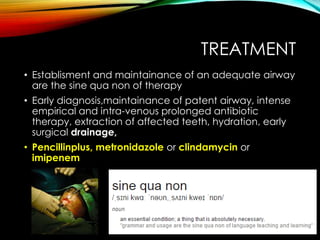
TREATMENT 
• Establisment and maintainance of an adequate airway 
are the sine qua non of therapy 
• Early diagnosis,maintainance of patent airway, intense 
empirical and intra-venous prolonged antibiotic 
therapy, extraction of affected teeth, hydration, early 
surgical drainage, 
• Pencillinplus, metronidazole or clindamycin or 
imipenem
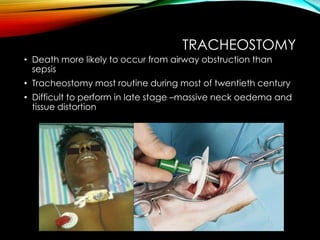
TRACHEOSTOMY 
• Death more likely to occur from airway obstruction than 
sepsis 
• Tracheostomy most routine during most of twentieth century 
• Difficult to perform in late stage –massive neck oedema and 
tissue distortion
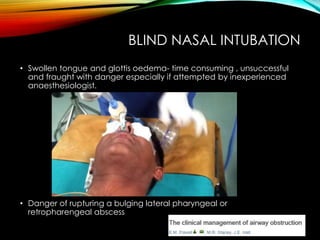
BLIND NASAL INTUBATION 
• Swollen tongue and glottis oedema- time consuming , unsuccessful 
and fraught with danger especially if attempted by inexperienced 
anaesthesiologist. 
• Danger of rupturing a bulging lateral pharyngeal or 
retropharengeal abscess
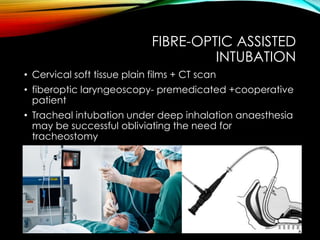
FIBRE-OPTIC ASSISTED 
INTUBATION 
• Cervical soft tissue plain films + CT scan 
• fiberoptic laryngeoscopy- premedicated +cooperative 
patient 
• Tracheal intubation under deep inhalation anaesthesia 
may be successful obliviating the need for 
tracheostomy
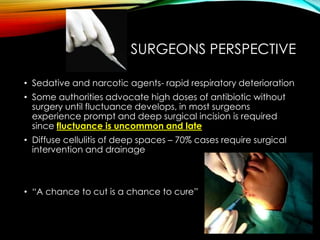
SURGEONS PERSPECTIVE 
• Sedative and narcotic agents- rapid respiratory deterioration 
• Some authorities advocate high doses of antibiotic without 
surgery until fluctuance develops, in most surgeons 
experience prompt and deep surgical incision is required 
since fluctuance is uncommon and late 
• Diffuse cellulitis of deep spaces – 70% cases require surgical 
intervention and drainage 
• “A chance to cut is a chance to cure”
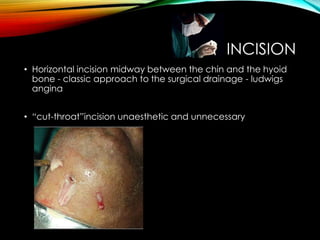
INCISION 
• Horizontal incision midway between the chin and the hyoid 
bone - classic approach to the surgical drainage - ludwigs 
angina 
• “cut-throat”incision unaesthetic and unnecessary
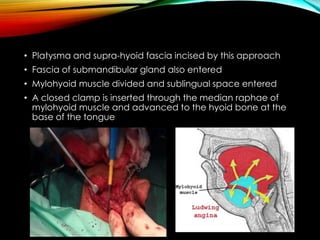
• Platysma and supra-hyoid fascia incised by this approach 
• Fascia of submandibular gland also entered 
• Mylohyoid muscle divided and sublingual space entered 
• A closed clamp is inserted through the median raphae of 
mylohyoid muscle and advanced to the hyoid bone at the 
base of the tongue
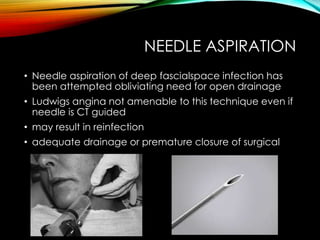
NEEDLE ASPIRATION 
• Needle aspiration of deep fascialspace infection has 
been attempted obliviating need for open drainage 
• Ludwigs angina not amenable to this technique even if 
needle is CT guided 
• may result in reinfection 
• adequate drainage or premature closure of surgical
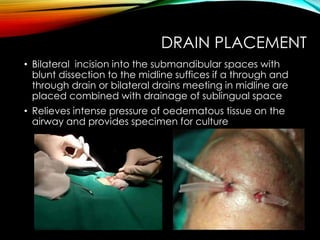
DRAIN PLACEMENT 
• Bilateral incision into the submandibular spaces with 
blunt dissection to the midline suffices if a through and 
through drain or bilateral drains meeting in midline are 
placed combined with drainage of sublingual space 
• Relieves intense pressure of oedematous tissue on the 
airway and provides specimen for culture
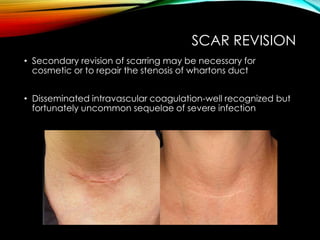
SCAR REVISION 
• Secondary revision of scarring may be necessary for 
cosmetic or to repair the stenosis of whartons duct 
• Disseminated intravascular coagulation-well recognized but 
fortunately uncommon sequelae of severe infection
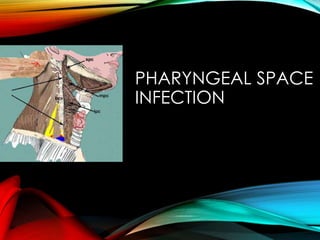
PHARYNGEAL SPACE 
INFECTION
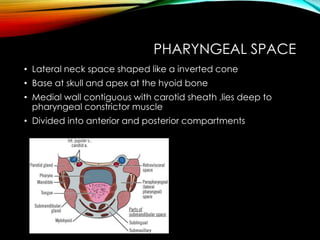
PHARYNGEAL SPACE 
• Lateral neck space shaped like a inverted cone 
• Base at skull and apex at the hyoid bone 
• Medial wall contiguous with carotid sheath ,lies deep to 
pharyngeal constrictor muscle 
• Divided into anterior and posterior compartments
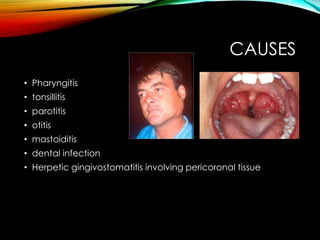
CAUSES 
• Pharyngitis 
• tonsillitis 
• parotitis 
• otitis 
• mastoiditis 
• dental infection 
• Herpetic gingivostomatitis involving pericoronal tissue
CLINICAL FEATURES 
• Anterior compartment- 
• Pain, fever,chills 
• Medial bulging of the lateral pharengeal wall 
• Deviation of palatal uvula from midline 
• Dysphagia, swelling below angle of mandible 
• Posterior compartment- 
• Visible swelling with absence of trismus 
• Respiratory obstruction 
• Septic thrombosis of internal jugular vein 
• Carotid artery haemorrhage - later stage
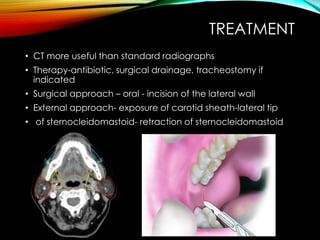
TREATMENT 
• CT more useful than standard radiographs 
• Therapy-antibiotic, surgical drainage, tracheostomy if 
indicated 
• Surgical approach – oral - incision of the lateral wall 
• External approach- exposure of carotid sheath-lateral tip 
• of sternocleidomastoid- retraction of sternocleidomastoid
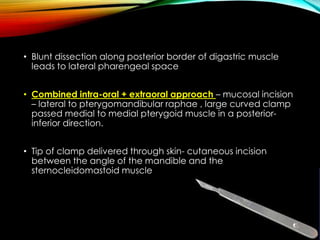
• Blunt dissection along posterior border of digastric muscle 
leads to lateral pharengeal space 
• Combined intra-oral + extraoral approach – mucosal incision 
– lateral to pterygomandibular raphae , large curved clamp 
passed medial to medial pterygoid muscle in a posterior-inferior 
direction. 
• Tip of clamp delivered through skin- cutaneous incision 
between the angle of the mandible and the 
sternocleidomastoid muscle
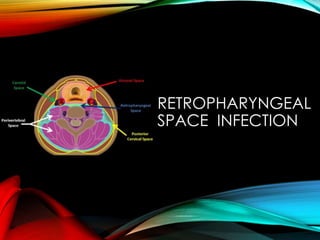
RETROPHARYNGEAL 
SPACE INFECTION
RETROPHARYNGEAL 
SPACE 
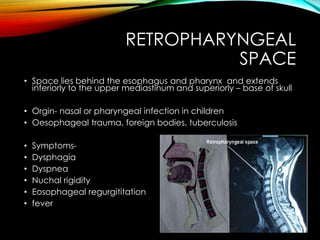
• Space lies behind the esophagus and pharynx and extends 
inferiorly to the upper mediastinum and superiorly – base of skull 
• Orgin- nasal or pharyngeal infection in children 
• Oesophageal trauma, foreign bodies, tuberculosis 
• Symptoms- 
• Dysphagia 
• Dyspnea 
• Nuchal rigidity 
• Eosophageal regurgititation 
• fever
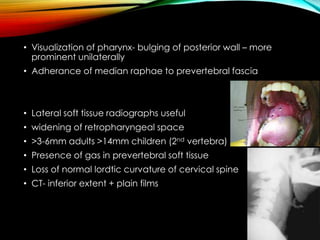
• Visualization of pharynx- bulging of posterior wall – more 
prominent unilaterally 
• Adherance of median raphae to prevertebral fascia 
• Lateral soft tissue radiographs useful 
• widening of retropharyngeal space 
• >3-6mm adults >14mm children (2nd vertebra) 
• Presence of gas in prevertebral soft tissue 
• Loss of normal lordtic curvature of cervical spine 
• CT- inferior extent + plain films
TREATMENT 
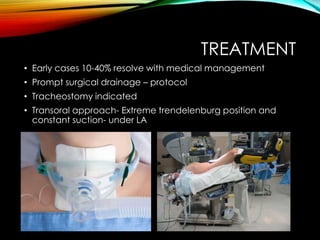
• Early cases 10-40% resolve with medical management 
• Prompt surgical drainage – protocol 
• Tracheostomy indicated 
• Transoral approach- Extreme trendelenburg position and 
constant suction- under LA
CONTINUED 
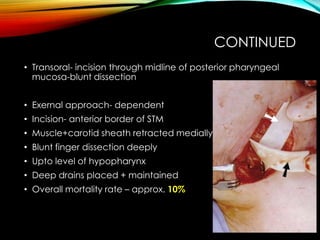
• Transoral- incision through midline of posterior pharyngeal 
mucosa-blunt dissection 
• Exernal approach- dependent 
• Incision- anterior border of STM 
• Muscle+carotid sheath retracted medially 
• Blunt finger dissection deeply 
• Upto level of hypopharynx 
• Deep drains placed + maintained 
• Overall mortality rate – approx. 10%
CAVERNOUS SINUS 
THROMBOSIS 
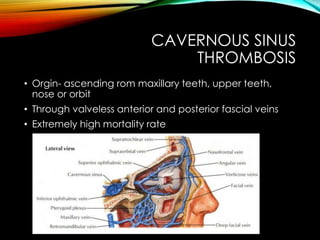
• Orgin- ascending rom maxillary teeth, upper teeth, 
nose or orbit 
• Through valveless anterior and posterior fascial veins 
• Extremely high mortality rate
INITIAL SIGNS 
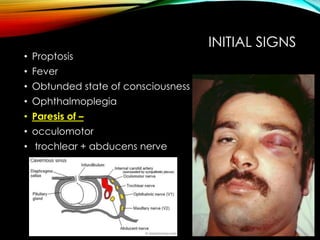
• Proptosis 
• Fever 
• Obtunded state of consciousness 
• Ophthalmoplegia 
• Paresis of – 
• occulomotor 
• trochlear + abducens nerve
MEDIASTINITIS 
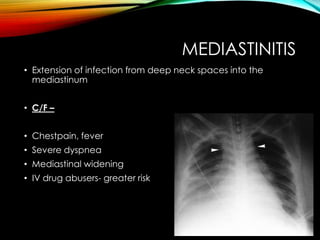
• Extension of infection from deep neck spaces into the 
mediastinum 
• C/F – 
• Chestpain, fever 
• Severe dyspnea 
• Mediastinal widening 
• IV drug abusers- greater risk
CONTINUED 
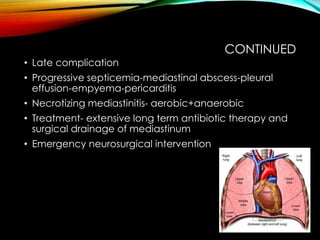
• Late complication 
• Progressive septicemia-mediastinal abscess-pleural 
effusion-empyema-pericarditis 
• Necrotizing mediastinitis- aerobic+anaerobic 
• Treatment- extensive long term antibiotic therapy and 
surgical drainage of mediastinum 
• Emergency neurosurgical intervention
CONCLUSION 
• Incidence and severity have diminished with advent of 
antibiotic therapy 
• To be alert to the potential seriousness of these infections-never 
to be dismissed as simple dental abscess 
• Deep fascial infections must be recognized promptly and 
treated as an emergency 
• Repeat diagnostic and therapeutic measures may be 
necessary until the very end point
REFERENCES 
• R.G Topazian , Oral & Maxillofacial Infections 4th edition 
• Journal of Oral and Maxillofacial Surgery, Volume 72, Issue 9, 
Supplement, September 2014, Pages e83-e84 
• The Journal of Emergency Medicine, Volume 43, Issue 4, 
October 2012, Pages 605-611 
• Journal of Plastic, Reconstructive & Aesthetic Surgery, 
Volume 60, Issue 4, April 2007, Pages 372-378 
• Journal of Infection, Volume 50, Issue 1, January 2005, Pages 
34-40 
• Emergency Medicine Clinics of North America, Volume 18, 
Issue 3, 1 August 2000, Pages 481-519
Fascial Space Infection part  2

Fascial Space Infection part 2

  • 1.
    DEEP FASCIAL SPACE INFECTIONS PART-2 ARJUN SHENOY DEPT OF OMFS
  • 2.
    • MASSETRIC SPACE • LUDWIGS ANGINA • PHARYNGEAL SPACE • RETROPHARYNGEAL SPACE • CAVERNOUS SINUS THROMBOSIS • MEDIASTINITIS • CONCLUSION • REFERENCES
  • 3.
    MASTICATORY SPACE MASSETRIC+ PTERYGOID + TEMPORAL
  • 4.
    MASTICATOR SPACE •Massetric, pterygoid and temporal- well differentiated • Communicate with each other • Also with • Buccal • Submandibular • Parapharyngeal • MASTICATOR SPACE CONTENTS- • Muscles of mastication • Internal maxillary artery • Mandibular nerve
  • 6.
    SUBDIVISION • MASSETRICSPACE- • Lateral- masseter • Medial- mandibular ascending ramus • PTERYGOID- • Lateral-mandible • Medially- pterygoid muscle • Communication- • Superiorly- superficial and deep temporal space • Anteriorly- buccal space • Posteriorly- lateral pharyngeal space
  • 7.
    ORGIN molar (commonly3rd molar) Contaminated injections Temporocranial flaps - neurosurgery Nearby contiguous spaces Circumzygomatic wiring in trauma TMJ surgery • Clinical hallmark- trismus • Exception- immunocompromised • Swelling – may not be prominent
  • 8.
    • Infectious processdeep to muscles - • swelling less prominent • contrast to buccal space infections •
  • 9.
    SICHER’S APPROACH •Sicher suggested approach to all compartments – incision through pterygomandibular raphae • Feasible in cadavers - not trismus • Oral approach-compromise airway • purulent oozing pus • Difficult drain - loosening
  • 10.
    I & D • MASSETRIC + PTERYGOID SPACE- • Extra-oral – easier technically & prudent • Sharp dissection - external angle of the mandible • Allows dependent drainage of both spaces
  • 11.
    SURGICAL INTERVENTION •TEMPORAL SPACE – • Intra-oral- sichers-incision • Percutaneous- • incision -slightly superior-zygomatic arch
  • 12.
    LUDWIGS ANGINA WilhelmFrederick von Ludwig
  • 13.
    DEFINITION • Ludwigsangina is a firm , acute, toxic cellulitis of the submandibular and sublingual spaces bilaterally and of the submental space • Three F’s • Feared • Not fluctuant • Fatal
  • 14.
    HISTORICAL PERSPECTIVE •Wilhelm Frederick von Ludwig first described in 1836 a potentially fatal, rapidly spreading soft tissue infection of the neck and floor of the mouth
  • 15.
    • Ludwig publishedhis now-famous paper on Ludwig's angina with no title in 1836. • A colleague dubbed the condition "Angina Ludovici" (Ludwig's angina) a year later • Pre-antibiotic era- 50% mortality • 5%- use of penicillin • observed frequently in compromised host • Less than 1% of all OMFS admissions • Untreated- mortality rate 100%
  • 16.
    • Compound mandibularfracture • Puncture wounds of oral floor • Secondary infection of oral malignancies • Submandibular gland sialadenitis • Oral soft tissue lacerations • Reported in new born • Pseudo-ludwigs angina /phenomenon- non dental
  • 18.
    CLINICAL FEATURES •Bilateral infection of sublingual and submandibular spaces • brawny edema, • elevated tongue • airway obstruction • paucity of pus
  • 19.
    MICROBIOLOGY • Streptococcior mixed oral flora are commonly reported from cultures • Contemporary- Ecoli ,pseudomonas and anaerobes bacteroides and peptostreptococcus • Prevotello melaninogenicus, prevotella oralis, prevotella corrodens also isolated
  • 20.
    DIFFERENTIAL DIAGNOSIS •angioneurotic edema • lingual carcinoma • sub- lingual hematoma • salivary gland abscess • lymphadenitis • cellulitis • peritonsilar abscess
  • 21.
    TREATMENT • Establismentand maintainance of an adequate airway are the sine qua non of therapy • Early diagnosis,maintainance of patent airway, intense empirical and intra-venous prolonged antibiotic therapy, extraction of affected teeth, hydration, early surgical drainage, • Pencillinplus, metronidazole or clindamycin or imipenem
  • 22.
    TRACHEOSTOMY • Deathmore likely to occur from airway obstruction than sepsis • Tracheostomy most routine during most of twentieth century • Difficult to perform in late stage –massive neck oedema and tissue distortion
  • 23.
    BLIND NASAL INTUBATION • Swollen tongue and glottis oedema- time consuming , unsuccessful and fraught with danger especially if attempted by inexperienced anaesthesiologist. • Danger of rupturing a bulging lateral pharyngeal or retropharengeal abscess
  • 24.
    FIBRE-OPTIC ASSISTED INTUBATION • Cervical soft tissue plain films + CT scan • fiberoptic laryngeoscopy- premedicated +cooperative patient • Tracheal intubation under deep inhalation anaesthesia may be successful obliviating the need for tracheostomy
  • 26.
    SURGEONS PERSPECTIVE •Sedative and narcotic agents- rapid respiratory deterioration • Some authorities advocate high doses of antibiotic without surgery until fluctuance develops, in most surgeons experience prompt and deep surgical incision is required since fluctuance is uncommon and late • Diffuse cellulitis of deep spaces – 70% cases require surgical intervention and drainage • “A chance to cut is a chance to cure”
  • 27.
    INCISION • Horizontalincision midway between the chin and the hyoid bone - classic approach to the surgical drainage - ludwigs angina • “cut-throat”incision unaesthetic and unnecessary
  • 28.
    • Platysma andsupra-hyoid fascia incised by this approach • Fascia of submandibular gland also entered • Mylohyoid muscle divided and sublingual space entered • A closed clamp is inserted through the median raphae of mylohyoid muscle and advanced to the hyoid bone at the base of the tongue
  • 29.
    NEEDLE ASPIRATION •Needle aspiration of deep fascialspace infection has been attempted obliviating need for open drainage • Ludwigs angina not amenable to this technique even if needle is CT guided • may result in reinfection • adequate drainage or premature closure of surgical
  • 30.
    DRAIN PLACEMENT •Bilateral incision into the submandibular spaces with blunt dissection to the midline suffices if a through and through drain or bilateral drains meeting in midline are placed combined with drainage of sublingual space • Relieves intense pressure of oedematous tissue on the airway and provides specimen for culture
  • 31.
    SCAR REVISION •Secondary revision of scarring may be necessary for cosmetic or to repair the stenosis of whartons duct • Disseminated intravascular coagulation-well recognized but fortunately uncommon sequelae of severe infection
  • 32.
  • 33.
    PHARYNGEAL SPACE •Lateral neck space shaped like a inverted cone • Base at skull and apex at the hyoid bone • Medial wall contiguous with carotid sheath ,lies deep to pharyngeal constrictor muscle • Divided into anterior and posterior compartments
  • 34.
    CAUSES • Pharyngitis • tonsillitis • parotitis • otitis • mastoiditis • dental infection • Herpetic gingivostomatitis involving pericoronal tissue
  • 35.
    CLINICAL FEATURES •Anterior compartment- • Pain, fever,chills • Medial bulging of the lateral pharengeal wall • Deviation of palatal uvula from midline • Dysphagia, swelling below angle of mandible • Posterior compartment- • Visible swelling with absence of trismus • Respiratory obstruction • Septic thrombosis of internal jugular vein • Carotid artery haemorrhage - later stage
  • 36.
    TREATMENT • CTmore useful than standard radiographs • Therapy-antibiotic, surgical drainage, tracheostomy if indicated • Surgical approach – oral - incision of the lateral wall • External approach- exposure of carotid sheath-lateral tip • of sternocleidomastoid- retraction of sternocleidomastoid
  • 37.
    • Blunt dissectionalong posterior border of digastric muscle leads to lateral pharengeal space • Combined intra-oral + extraoral approach – mucosal incision – lateral to pterygomandibular raphae , large curved clamp passed medial to medial pterygoid muscle in a posterior-inferior direction. • Tip of clamp delivered through skin- cutaneous incision between the angle of the mandible and the sternocleidomastoid muscle
  • 38.
  • 39.
    RETROPHARYNGEAL SPACE •Space lies behind the esophagus and pharynx and extends inferiorly to the upper mediastinum and superiorly – base of skull • Orgin- nasal or pharyngeal infection in children • Oesophageal trauma, foreign bodies, tuberculosis • Symptoms- • Dysphagia • Dyspnea • Nuchal rigidity • Eosophageal regurgititation • fever
  • 40.
    • Visualization ofpharynx- bulging of posterior wall – more prominent unilaterally • Adherance of median raphae to prevertebral fascia • Lateral soft tissue radiographs useful • widening of retropharyngeal space • >3-6mm adults >14mm children (2nd vertebra) • Presence of gas in prevertebral soft tissue • Loss of normal lordtic curvature of cervical spine • CT- inferior extent + plain films
  • 41.
    TREATMENT • Earlycases 10-40% resolve with medical management • Prompt surgical drainage – protocol • Tracheostomy indicated • Transoral approach- Extreme trendelenburg position and constant suction- under LA
  • 42.
    CONTINUED • Transoral-incision through midline of posterior pharyngeal mucosa-blunt dissection • Exernal approach- dependent • Incision- anterior border of STM • Muscle+carotid sheath retracted medially • Blunt finger dissection deeply • Upto level of hypopharynx • Deep drains placed + maintained • Overall mortality rate – approx. 10%
  • 43.
    CAVERNOUS SINUS THROMBOSIS • Orgin- ascending rom maxillary teeth, upper teeth, nose or orbit • Through valveless anterior and posterior fascial veins • Extremely high mortality rate
  • 44.
    INITIAL SIGNS •Proptosis • Fever • Obtunded state of consciousness • Ophthalmoplegia • Paresis of – • occulomotor • trochlear + abducens nerve
  • 45.
    MEDIASTINITIS • Extensionof infection from deep neck spaces into the mediastinum • C/F – • Chestpain, fever • Severe dyspnea • Mediastinal widening • IV drug abusers- greater risk
  • 46.
    CONTINUED • Latecomplication • Progressive septicemia-mediastinal abscess-pleural effusion-empyema-pericarditis • Necrotizing mediastinitis- aerobic+anaerobic • Treatment- extensive long term antibiotic therapy and surgical drainage of mediastinum • Emergency neurosurgical intervention
  • 47.
    CONCLUSION • Incidenceand severity have diminished with advent of antibiotic therapy • To be alert to the potential seriousness of these infections-never to be dismissed as simple dental abscess • Deep fascial infections must be recognized promptly and treated as an emergency • Repeat diagnostic and therapeutic measures may be necessary until the very end point
  • 48.
    REFERENCES • R.GTopazian , Oral & Maxillofacial Infections 4th edition • Journal of Oral and Maxillofacial Surgery, Volume 72, Issue 9, Supplement, September 2014, Pages e83-e84 • The Journal of Emergency Medicine, Volume 43, Issue 4, October 2012, Pages 605-611 • Journal of Plastic, Reconstructive & Aesthetic Surgery, Volume 60, Issue 4, April 2007, Pages 372-378 • Journal of Infection, Volume 50, Issue 1, January 2005, Pages 34-40 • Emergency Medicine Clinics of North America, Volume 18, Issue 3, 1 August 2000, Pages 481-519