Ludwig's angina
Presented by / Mostafa Heeba
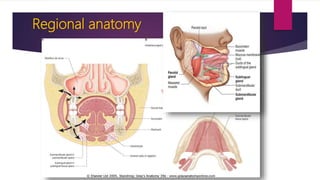
Regional anatomy
Ludwig's angina
Etiology
Clinical features
Investigation
Management
conclusion
Regional anatomy
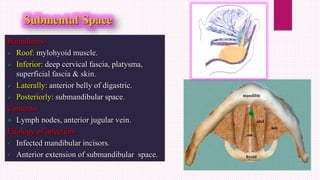
Boundaries-
 Roof: mylohyoid muscle.
 Inferior: deep cervical fascia, platysma,
superficial fascia & skin.
 Laterally: anterior belly of digastric.
 Posteriorly: submandibular space.
Contents-
 Lymph nodes, anterior jugular vein.
Etiology of infection-
 Infected mandibular incisors.
 Anterior extension of submandibular space.
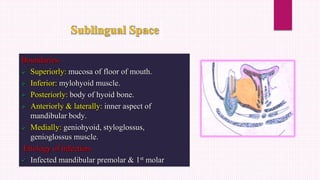
Boundaries-
 Superiorly: mucosa of floor of mouth.
 Inferior: mylohyoid muscle.
 Posteriorly: body of hyoid bone.
 Anteriorly & laterally: inner aspect of
mandibular body.
 Medially: geniohyoid, styloglossus,
genioglossus muscle.
Etiology of infection-
 Infected mandibular premolar & 1st molar
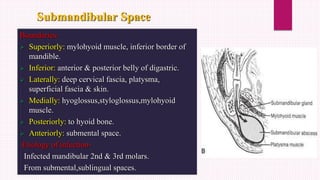
Submandibular Space
Boundaries-
 Superiorly: mylohyoid muscle, inferior border of
mandible.
 Inferior: anterior & posterior belly of digastric.
 Laterally: deep cervical fascia, platysma,
superficial fascia & skin.
 Medially: hyoglossus,styloglossus,mylohyoid
muscle.
 Posteriorly: to hyoid bone.
 Anteriorly: submental space.
Etiology of infection-
Infected mandibular 2nd & 3rd molars.
From submental,sublingual spaces.
S Ludwig's angina’What
 An acute spreading , potentially life-threatening form of cellulitis in
the region of the submandibular glands, causing severe swelling and
tenderness, with fever, pain and difficulty in opening the mouth and in
swallowing. There is some danger that the swelling might extend to
the voice box (LARYNX) and cause ASPHYXIA. The usual source of
infection is grossly neglected teeth. Antibiotics are necessary.
(Wilhelm Friedrich von Ludwig, 1790–1865, German surgeon).
Etiology
 Dental caries, recent dental treatment, poor dental hygiene (accounts for
75-90% of cases)
 Oral soft tissue lacerations.
 Puncture wounds of the floor of the mouth.
 Secondary Infections of oral malignancy
 Submandibular sialadenitis
 Systemic compromise such as AIDS, glomerulonephritis, diabetes mellitus,
aplastic anemia, transplant recipients, chemotherapy etc…..
Clinical features
 Bilateral ‘wood like’ swelling in the submandibular, sublingual and
submental spaces (rapid onset )
 Skin is tense and tends to pit and blanch on pressure
 Rapidly spreading edema
 Double chin appearance
Clinical features
 Elevation and protrusion of tongue, drooling of saliva
 Elevation of the tongue is associated with dysphagia, odynophagia, dysphonia and
cyanosis
 Patients may exhibit muffled voice due to edema of vocal apparatus (hot potato voice)
 Septicemia, High grade fever, Malaise, Body aches, Leukocytosis
 Infection can spread to involve the masticator space and Para pharyngeal space
in the latter stages of the disease
Clinical features
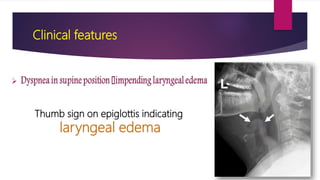
Thumb sign on epiglottis indicating
laryngeal edema
INVESTIGATIONS
 Panoramic x-ray – to identify possible odontogenic sources
 Cervical, profile and posterior-anterior radiographs – to observe the volume
increasing in the soft tissues and any deviation of the trachea
 Ultra sound has been recommended to differentiate between cellulitis,
abscess and adenopathy in head and neck infection
CT scan
 CT scan is most widely used modality
Ultrasound
 Ultrasonography is very sensitive in detecting fluid collection
 Quick, widely available, relatively inexpensive, painless
 Involves no radiation
 An effective diagnostic tool to confirm abscess formation in the superficial
facial spaces and is highly predictable in detecting the stage of infection
Differential diagnosis
 Angioneuretic edema
 Cellulitis
 Lingual carcinoma
 Lynmphadenitis
 Peritonsillar abscess
 Salivary gland abscess
 sublingual haematoma
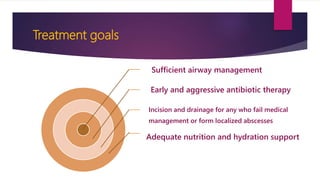
Treatment goals
Sufficient airway management
Early and aggressive antibiotic therapy
Incision and drainage for any who fail medical
management or form localized abscesses
Adequate nutrition and hydration support
MANAGEMENT
Airway
management
Airway management
 tracheostomy
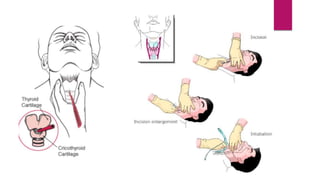
 Cricothyroidotomy
 BNI
 fiber-optic nasotracheal intubation
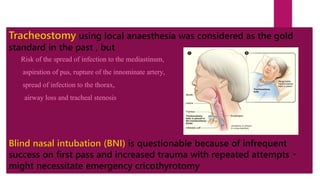
Tracheostomy using local anaesthesia was considered as the gold
standard in the past , but
Risk of the spread of infection to the mediastinum,
aspiration of pus, rupture of the innominate artery,
spread of infection to the thorax,
airway loss and tracheal stenosis
Blind nasal intubation (BNI) is questionable because of infrequent
success on first pass and increased trauma with repeated attempts
might necessitate emergency cricothyrotomy
cricothyroidotomy
 sometimes performed instead of tracheostomy
 perceived lower risk of spreading infection to mediastinum
Fibreoptic intubation is a sophisticated and less invasive method of
securing airway in patients with deep neck infection
Medical management
 Intravenous access, fluid resuscitation, and administration of IV antibiotics
 Antibiotic therapy should be administered empirically and tailored to culture and
sensitivity results
 Antibiotic therapy should be administered empirically and tailored to culture and
sensitivity results
Other regimens –
 Penicillins with β-lactamase inhibitor,
 Second, third, or fourth generation Cephalosporins and Metranidazole
SURGICAL MANAGEMENT
INCISION & DRAINAGE
Bilateral submandibular incisions as well as a midline submental incision
Incision approximately 3 to 4 cm below the angle of the mandible and below
the inferior extent of swelling roughly parallel to the inferior border of
mandible
Principles (Topazian & Goldberg)
 Incise in healthy skin and mucosa when possible, not at the site of
maximum fluctuance, because these wounds tend to heal with an
unsightly scar;
 Place the incision in a natural skin fold;
 Place the incision in a dependent position;
 Dissect bluntly;
 Place a drain; and
 Remove drains when drainage becomes minimal
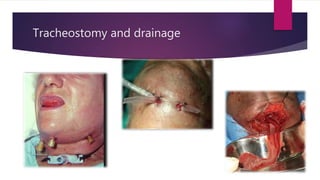
Tracheostomy and drainage
CONCLUSION
 Ludwig’s angina is a life-threatening infection
 Early diagnosis and immediate treatment is the key for successful
management
 Antibiotic therapy should be administered empirically and tailored to culture
and sensitivity results
 Prompt and early surgical intervention is required to provide a higher control
of the patient’s health.
Thank you

Ludwig's angina

  • 1.
  • 2.
    Regional anatomy Ludwig's angina Etiology Clinicalfeatures Investigation Management conclusion
  • 3.
  • 4.
    Boundaries-  Roof: mylohyoidmuscle.  Inferior: deep cervical fascia, platysma, superficial fascia & skin.  Laterally: anterior belly of digastric.  Posteriorly: submandibular space. Contents-  Lymph nodes, anterior jugular vein. Etiology of infection-  Infected mandibular incisors.  Anterior extension of submandibular space.
  • 5.
    Boundaries-  Superiorly: mucosaof floor of mouth.  Inferior: mylohyoid muscle.  Posteriorly: body of hyoid bone.  Anteriorly & laterally: inner aspect of mandibular body.  Medially: geniohyoid, styloglossus, genioglossus muscle. Etiology of infection-  Infected mandibular premolar & 1st molar
  • 6.
    Submandibular Space Boundaries-  Superiorly:mylohyoid muscle, inferior border of mandible.  Inferior: anterior & posterior belly of digastric.  Laterally: deep cervical fascia, platysma, superficial fascia & skin.  Medially: hyoglossus,styloglossus,mylohyoid muscle.  Posteriorly: to hyoid bone.  Anteriorly: submental space. Etiology of infection- Infected mandibular 2nd & 3rd molars. From submental,sublingual spaces.
  • 7.
    S Ludwig's angina’What An acute spreading , potentially life-threatening form of cellulitis in the region of the submandibular glands, causing severe swelling and tenderness, with fever, pain and difficulty in opening the mouth and in swallowing. There is some danger that the swelling might extend to the voice box (LARYNX) and cause ASPHYXIA. The usual source of infection is grossly neglected teeth. Antibiotics are necessary. (Wilhelm Friedrich von Ludwig, 1790–1865, German surgeon).
  • 8.
    Etiology  Dental caries,recent dental treatment, poor dental hygiene (accounts for 75-90% of cases)  Oral soft tissue lacerations.  Puncture wounds of the floor of the mouth.  Secondary Infections of oral malignancy  Submandibular sialadenitis  Systemic compromise such as AIDS, glomerulonephritis, diabetes mellitus, aplastic anemia, transplant recipients, chemotherapy etc…..
  • 9.
    Clinical features  Bilateral‘wood like’ swelling in the submandibular, sublingual and submental spaces (rapid onset )  Skin is tense and tends to pit and blanch on pressure  Rapidly spreading edema  Double chin appearance
  • 10.
    Clinical features  Elevationand protrusion of tongue, drooling of saliva  Elevation of the tongue is associated with dysphagia, odynophagia, dysphonia and cyanosis  Patients may exhibit muffled voice due to edema of vocal apparatus (hot potato voice)  Septicemia, High grade fever, Malaise, Body aches, Leukocytosis  Infection can spread to involve the masticator space and Para pharyngeal space in the latter stages of the disease
  • 11.
    Clinical features Thumb signon epiglottis indicating laryngeal edema
  • 12.
    INVESTIGATIONS  Panoramic x-ray– to identify possible odontogenic sources  Cervical, profile and posterior-anterior radiographs – to observe the volume increasing in the soft tissues and any deviation of the trachea  Ultra sound has been recommended to differentiate between cellulitis, abscess and adenopathy in head and neck infection
  • 13.
    CT scan  CTscan is most widely used modality
  • 14.
    Ultrasound  Ultrasonography isvery sensitive in detecting fluid collection  Quick, widely available, relatively inexpensive, painless  Involves no radiation  An effective diagnostic tool to confirm abscess formation in the superficial facial spaces and is highly predictable in detecting the stage of infection
  • 15.
    Differential diagnosis  Angioneureticedema  Cellulitis  Lingual carcinoma  Lynmphadenitis  Peritonsillar abscess  Salivary gland abscess  sublingual haematoma
  • 16.
    Treatment goals Sufficient airwaymanagement Early and aggressive antibiotic therapy Incision and drainage for any who fail medical management or form localized abscesses Adequate nutrition and hydration support
  • 17.
  • 18.
    Airway management  tracheostomy Cricothyroidotomy  BNI  fiber-optic nasotracheal intubation
  • 19.
    Tracheostomy using localanaesthesia was considered as the gold standard in the past , but Risk of the spread of infection to the mediastinum, aspiration of pus, rupture of the innominate artery, spread of infection to the thorax, airway loss and tracheal stenosis Blind nasal intubation (BNI) is questionable because of infrequent success on first pass and increased trauma with repeated attempts might necessitate emergency cricothyrotomy
  • 20.
    cricothyroidotomy  sometimes performedinstead of tracheostomy  perceived lower risk of spreading infection to mediastinum Fibreoptic intubation is a sophisticated and less invasive method of securing airway in patients with deep neck infection
  • 22.
    Medical management  Intravenousaccess, fluid resuscitation, and administration of IV antibiotics  Antibiotic therapy should be administered empirically and tailored to culture and sensitivity results  Antibiotic therapy should be administered empirically and tailored to culture and sensitivity results Other regimens –  Penicillins with β-lactamase inhibitor,  Second, third, or fourth generation Cephalosporins and Metranidazole
  • 23.
    SURGICAL MANAGEMENT INCISION &DRAINAGE Bilateral submandibular incisions as well as a midline submental incision Incision approximately 3 to 4 cm below the angle of the mandible and below the inferior extent of swelling roughly parallel to the inferior border of mandible
  • 24.
    Principles (Topazian &Goldberg)  Incise in healthy skin and mucosa when possible, not at the site of maximum fluctuance, because these wounds tend to heal with an unsightly scar;  Place the incision in a natural skin fold;  Place the incision in a dependent position;  Dissect bluntly;  Place a drain; and  Remove drains when drainage becomes minimal
  • 25.
  • 26.
    CONCLUSION  Ludwig’s anginais a life-threatening infection  Early diagnosis and immediate treatment is the key for successful management  Antibiotic therapy should be administered empirically and tailored to culture and sensitivity results  Prompt and early surgical intervention is required to provide a higher control of the patient’s health.
  • 27.