SOFT TISSUE CHANGES IN
PREPROSTHETIC SURGERY
By –
Dr. Chirag Patil
M.D.S in oral and maxillofacial
surgery
CONTENTS
• History
• Introduction
• Unfavorable situation
• Goals of preprosthetic surgery
• Intraoral soft tissue examination
• Soft tissue preprosthetic surgey
technique
• VESTIBULOPLASTY
• Obwegeser’s Submucous
Vestibuloplasty
• Open view submucosal
vestibuloplasty
• Maxillary pocket inlay
vestibuloplasty
• Vestibuloplasty by Secondary
Epithelization
•Kazanjian Technique
•Godwin Technique
•Cooley Technique
•Collett Technique
•Lipswitch technique
•Clark’s Technique
•Obwegerser’s modification
•Obwegeser Secondary
Epithelization Vestibuloplasty
• Lingual Sulcoplasty
•Trauner Technique
•Obwegeser technique for skin
grafting
• Moore modification of
Obwegeser technique
•caldwell’s technique
CONTENTS • Frenectomy
• Labial frenectomy
- Z- plasty
- v-y type incision
• Lingual frenotomy
• Double lip
• Inflammatory papillary hyperplasia of
the palate
• Inflammatory hyperplasia of the
vestibular mucosa
• Denture granuloma
• Unsupported and hypermobile gingiva
• Mandibular retromolar pad reduction
HISTORY
 Willard (1853) was the first person to
recommend preprosthetic surgery as an aid in
preparation of the patient for complete
dentures.
 Preprosthetic surgery emerged from a ridge
trimming service to a truly reconstructive
service.
PREPROSTHETIC SURGERY
 Deals with preparation of oral tissues and
structures favorable to placement of subsequent
prosthesis for their proper placement, retention,
stability, function and cosmesis.
 Elimination of pathology in the denture-
bearing soft and hard tissue, and making the
edentulous ridges and supporting structures
favorable for receiving prosthesis.
 UNFAVORABLE SITUATIONS SUCH AS-
 Bone loss with inregularities
 High frenal attachments
 Sharp bony ridges
 Undercuts
 Abnormal muscle attachments
 Flabby soft tissue
 Hypertrophied maxillary tuberosity
 Exostosis
 Tori
 Superficial location of mental nerve & foramen
GOALS OF PREPROSTHETIC
SURGERY
 Satisfy aesthetic concern of patient
 To provide adequate residual tissue with ridge &
withstand masticatory stress
 Proper speech & deglutination
 Remove all hard & soft tissue protuberance & undercuts
 Adequate vestibular depth
GOALS OF PREPROSTHETIC
SURGERY
• Appropriate frenal attachments
• Proper jaw relationship
• Relocate the mental nerve
• Reduce pain & discomfort
INTRAORAL SOFT TISSUE
EXAMINATION
• Quantity & quality of overlying tissue
• Mucosa should be firm (Not flabby)
• Palpation of vestibule-
- Adequate depth
- Self cleansability
- Inflammation
- Ulceration
- Growth
• Muscle & frenal attachement with alveolar crest
INTRAORAL SOFT TISSUE
EXAMINATION
• Lingual vestibular depth and attachment
• Movement of tongue
• Soft tissue & bony pathologies if present
• Through examination-
- Palatal vault
- Soft palate for lesion
- Papillary hyperplasia
- Abnormalities interfering with
denture placement
Vestibuloplasty
(Ridge extension procedure)
 Surgical procedure where oral vestibule is
deepened by changing the soft tissue
attachments
or
 Deeping of the vestibule without any addition
of the bone
Types of Vestibuloplasty
Mucosal advancement (submucous) vestibuloplasty:
The mucous membrane of the vestibule is
undermined and advanced to line both sides of the
extended vestibule
Secondary epithelization (reepithelization)
vestibuloplasty:
The mucosa of the vestibule is used to line one side
of the extended vestibule, and the other side heals by
growing a new epithelial surface
MOUTH MIRROR TEST
 Obwegeser 1967
 Simple clinical test
 Adequancy of mucossa
available
 Lips in a relaxed position
 Mouth mirror is inserted into the
sulcus
 If the upper lip is not displaced
upward or inward then , there is
sufficient mucosa for an
advancement procedure
 Can be used in the lower labial
vestibule
Obwegeser’s Submucous Vestibuloplasty
 Macintosh & Obwegeser 1959
 Closed submucosal vestibuloplasty
 Applicable to the entire maxillary
sulcus and anterior mandibular
sulcus
 Can be performed with local
anesthesia
 A vertical incision is made,
extending from the mucogingival
junction
 Blunt spreading dissection carried
out
 A tunnel is formed between the
mucosa and the submucosa, till
zygomatic buttresses on either side
Incison in vestibule
Blunt dissection by scissors;
Obwegeser’s Submucous Vestibuloplasty
 Supraperiosteal tunneling is done.
 A strip of connective tissue remains
between the two tunnels.
 Strip of connective tissue is excised
 Freely movable mucosa is adapted into
the deepened sulcus
 Blood is milked out of the surgical field.
 Repositioned superiorly
 New depth is maintained
 A new denture can be made after 2 or 3
weeks
Tunnel formed
Denture/splint with extended
flanges secured to alveolar bone
Open view submucosal vestibuloplasty
 Wallenius (open-view) technique (1963)
 He used an ‘open view’ procedure instead of a ‘tunneling’
technique.
 Horizontal incision is made along the mucogingival junction
 Supraperiosteal dissection is performed
 Not to cut or tear the periosteum
 A thin mucosal flap is elevated by submucosal dissection
 Excision of muscle & subcutaneous tissue
 Stay suture are used to fix the flap to the periosteum deep in
vestibule
 Free margin of the flap is then returned to its original position
and sutured
Maxillary pocket inlay vestibuloplasty
 Used for extension of ridge in atrophic maxilla
 Pockets are created on either side of the pyriform aperture &
denture flanges are extended into these pockets for stability
 preoperatively patients upper denture is modified with
extended labial flanges
 Advantages-
- Better retention of the denture
- Deficiency in the nasolabial fold can be improve
Maxillary pocket inlay vestibuloplasty
 Technique-
 Intraoral insicion is made along the vestibule from one zygomatic buttress
to the other
 supraperiosteal dissection to creat two pockets on either side of pyriform
apperture
 Extended superiorly to the level of the attachment of levator anguli oris
muscle
 Medially to base of pyriform apperture
 Perforation of the nasal cavity should be avoided
 Impression of the newly created pouches is taken
 The labial flanges of the denture are then covered with split thickness skin
graft ( Raw surface facing pyriform aperture)
 Denture is then into the place
 Bilateral circumzygomatic wires
 Wound margin sutured to the graft
 Wire remain for a week
 New denture are constructed after a period of 6 weeks
 To prevent contraction of the pouches denture should be worn for an year
Vestibuloplasty by Secondary Epithelization
• Inflammatory hyperplasia and scar tissue are present
• Secondary epithelization techniques should
be considered as the first alternative.
• Raw surface is heals by secondary epithelialization
Kazanjian Technique 1935
• Incision is made in the mucosa of the lip
• Large flap of labial and vestibular
mucosa retracted
• Supraperiosteal dissection to deepen the
sulcus
• The flap of mucosa was turned
downward from its attachment on the
alveolar ridge and placed directly against
the periosteum to which it was sutured.
• The labial donor site was left raw to
granulate and heal by secondary
epithelization
• Disadvantage
• Raw area is in the soft tissue
• Scarring of the vestibule and relapse is
common
Godwin Technique 1947
• Similar to kazanjian method
• Labial mucosa flap raised
• Sulcus is deepened & subperiosteal stripping.
• Periosteum and the attached connective tissue was either excised or
pushed downward
• Labial and vestibular mucosa directly placed against the bone and
sutured it to the connective tissue beyond the deepened sulcus,
using absorbable suture
• Godwin exposed the bone and was able to smoothen the bone
• Raw tissues healed by granulation and secondary epithelization
• Disadvantage –
- Scar on the labial side of sulcus.
- Bone resorption by removing the periosteum
Cooley Technique 1952
• Deepening the mandibular and maxillary sulcus
• To smooth any bony irregularities on the crest of the ridge and
reposition the mental nerve.
• Incision on the crest of the mandibular ridge from second molar area
on one side to other side
• Short lateral relaxing incisions at the posterior ends of the primary
incision.
• A full thickness labiobuccal mucoperiosteal flap was reflected down
• Mental nerve was repositioned inferiorly on each side.
• Three drill holes were placed through the alveolar ridge, one in the
midline and one in each cuspid area
Cooley Technique 1952
• The gingival margin of the labial flap was sutured through the
peralveolar holes to the lingual mucoperiosteum leaving the crest of
the ridge bare.
• previously prepared acrylic splint with extended flanges was secured
to the mandible for 6 days with circumferential wires
• Cooley’s maxillary sulcoplasty where primary incision, was made to
the palatal side of the crest.
Advantages-
• Bony irregularities on the crest and labial surface of the ridge can be
corrected
• No scar contracture over bone
• Mental nerve can be repositioned bilaterally, if indicated.
Collett Technique 1954
• Previously prepared denture with overextended flange borders to support
full-thickness labiobuccal mucoperiosteal flaps
• An incision is made on the crest of the maxillary ridge from one tuberosity
to the other.
• Large full-thickness flap is reflected.
• Transparent template is inserted to reposition the flaps higher in the
vestibular sulcus.
• Position of the flaps can be observed through the template.
• No sutures are placed.
• Denture is inserted to support the newly deepened sulcus.
• Bone is protected by the denture until granulation tissue forms and surface
epithelization occurs.
• Disadvantage-
• Entire external surface of the maxillary ridge is left bare
• Infection
• Additional bone resorption of a previously resorbed ridge.
LIPSWITCH TECHNIQUE
• Kethley & gamble.
• Mucosal flap containing labial and vestibular mucosa is similar way as
kazanjian’s & Godwin’s technique
• Free margin in the lip & base attached to crest of alveolar ridge
• Periosteum is incised high in alveolar ridge below the crest & reflected from
bone
• Flap consisting of periosteum, connective tissue & muscle is turned
outwardly & sutured to the margins of the raw labial surface
• Mucosal flap is turned downwards againts the bare bone & sutured to the
periosteum deep in the vestibule
LIPSWITCH TECHNIQUE
Clark’s Technique 1953
• Reverse of Kazanjian technique
• Based on following principles-
1) Raw surfaces on connective tissue contract, whereas the same
surfaces undergo minimal contraction when covered with
epithelium.
2)Raw surfaces overlying bone cannot contract.
3) For repositioning & fixation, epithelial flap must be undermined
adequately
4) Soft tissues which are repositioned have a tendency to return to
their former position so that overcorrection and firm fixation are
necessary.
• The raw surface on bone is left exposed
Clark’s Technique 1953
• Incision is made on the alveolar
ridge
• Supraperiosteal dissection is done
• Mucosa of the lip is undermined to
the vermilion border
• Free edge of the mucosal flap is
secured to the periosteum deep in
the sulcus
• The raw surface on the bone heals
by granulation tissue formation and
epithelialisation without contracture
Flap harvested from
alveolar mucosa
Flap sutured to
Obwegeser Secondary EpithelizationVestibuloplasty 1967
• Used secondary epithelization in cases in which there is enough bone,
but insufficient healthy mucosa
• Incision is made at the mucogingival junction
• Supraperiosteal dissection is extended to the infraorbital foramen.
• Labial and buccal mucosa are undermined.
• Mucosal flap is sutured to the periosteum.
• Denture flange be shortened so there is no contact with the raw
periosteal surface
• Irritation from the flange that could cause proliferation of an excessive
amount of granulation tissue
• Tissues healed upto 3 or 4 weeks.
• 4 to 5 weeks postoperatively a flange is added to the denture
• Better results with this procedure in cases of maxillary vestibuloplasty
than in mandibular.
Obwegerser’s modification
1963,1967
• Similar to clarks method except
the area of the alveolar bone with
its periosteal attachment is
covered with a split thickness skin
graft & held in position by suture
or stent
• Covers the bone & ensure faster
healing
• Reduced chances of postoperative
infection
• Less bone loss & scaring
Lingual Sulcoplasty
• Grossly resorbed mandible
• Extend the denture foundation and improve the
stability, surface area and retention of the mandibular
denture.
• Mylohyoid , genioglossus muscles and the mucosa of
the floor of the mouth can be repositioned inferiorly
without undue impairment of function.
Trauner Technique
1952
• Incision is given in the floor of the mouth
• From the third molar region of one side
to opposite side
• Connective tissue was separated from
the periosteum
• Till inferior border of the mandible
• Mucosa of the floor of the mouth and
the mylohyoid muscle were sutured with
heavy nylon mattress sutures through
the skin to buttons under the mandible.
• Medial periosteal surface of the
mandible was left bare to granulate and
epithelized.
• Healing period- 2 months
• Trauner also suggested that split-
thickness skin grafts could be used to
cover the raw periosteal surfaces.
Obwegeser technique
for skin grafting
• Obwegeser (1963, 1967)
modified trauner technique.
• Combined a ridge skin
grafting vestibuloplasty
with a lingual sulcoplasty
Obwegeser’s modified linguosulcoplasty:
(A) Incision sparing mucosa at crest of ridge;
(B) Labial and lingual ridge extensions;
(C) Raw bone is skin grafted and covered with
surgical stent;
(D) Final result
CALDWELL’S
TECHNIQUE
1955
• Incision is made in the crest of the posterior
mandibular ridge from molar to molar region
• Subperiosteal dissection is carried out
• Mylohyoid muscle is detached & mylohyoid ridge
is removed or reduced along with reduction of
genial tubercle
• Mylohyoid muscle & superficial fibers of
genioglossus muscles are pushed inferiorly
• Sutured with precutaneous suture
• Left in place for 7-10 days
CALDWELL’S TECHNIQUE 1955
Frenectomy
• Band of fibrous connective tissue, covered with mucous
membrane that binds the lip to the alveolar process.
• Indiacation -
• High frenum attachment
• Displacement of denture
• Ulceration due to impingement of denture
• Midline diastema
Labial Frenectomy
• Lip is elevated, everted and
tensed
• Frenum becomes prominent.
• Using two hemostats the fibers of
the frenum are locked
• Frenum is excised by cutting the
outer surface of both the
hemostats
• Frenectomy is performed to aid
the orthodontic closure of a
median diastema, the apex of the
v should be at or near the incisive
papilla on the palate
V shaped incision
Frenum detached from bone
Labial Frenectomy
• Resulting diamond-shaped defect
• Closed with interrupted sutures.
• First suture should be placed across
the middle of the wound (widest part)
• Should engage both mucosal margins
and the periosteum at the midline
• Helps to maintain the height of the
vestibular sulcus
• Sutures should be removed in 7 days.
Diamond shaped defect
Closure
Z- PLASTY
• Frenum is broad & vestibule is short
• Simultaneously eliminate the frenum and deepen the
vestibule
• The length of the secondary incision should be
approximately two thirds that of the vertical incision
• Vertical lengthing can be obtained
• Lessen the tension on scar band
Z- PLASTY
V-Y TYPE INCISION
• Lengthing of localized area
• Broad area in premolar –molar area
• Semilunar incision at mucogingival junction
• Supraperiosteal dissection
• Superior edge of the flap is sutured to the periosteum at the
greatest possible depth.
• Exposed area is allowed to granulate & heal by secondary
intention.
• Prefabrication stent is necessary
V-Y TYPE INCISION
LINGUAL FRENOTOMY
• Ankyloglossia, or Tongue-tie
• Dense fibrous septum that binds the tip of the tongue to the
alveolar process.
• AIMS-
• To correct speech
• Prior to denture construction
• Improve tongue mobility
LINGUAL FRENOTOMY
• A traction suture is placed to elevate, improve visibility
,control & stability of tongue
• Frenum become tensed.
• Using two hemostats the fibers of the frenum are locked
• Cross-diamound incision along the edge of both the
hemostat is made
• Dissection of genioglossus muscle is done if necessary
• Care not to damage to submandibular duct orifices
• Suture done in vertical manner
LINGUAL FRENOTOMY
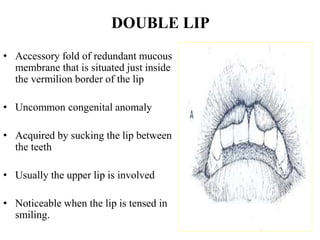
DOUBLE LIP
• Accessory fold of redundant mucous
membrane that is situated just inside
the vermilion border of the lip
• Uncommon congenital anomaly
• Acquired by sucking the lip between
the teeth
• Usually the upper lip is involved
• Noticeable when the lip is tensed in
smiling.
DOUBLE LIP:
Redundant folds of labial mucosa are
grasped gently with allis forceps
Elliptical incisions are made around the
masses
Incisions are carried deep into the
submucosa
Wedge-shaped in cross section, are removed
A few small bleeders are ligated/cauterized
Wounds are closed in layers with 4 ‘0’
absorbable sutures
Inflammatory Papillary Hyperplasia of the
Palate
• Painless, irreversible disease of the oral mucous membrane
• Most commonly on the hard palate
• Etiology-
• Poorly fitting denture.
• Wearing the denture 24 hours a day.
• Poor oral hygiene.
• Use of palatal relief.
Inflammatory Papillary Hyperplasia of
the Palate•Initial treatments involve
Removal of the denture for
several days
•Split-thickness, supraperiosteal
excision is the treatment of
choice for most lesions
•Small lesions can be removed
with sharp curettes or by
mucoabrasion with a rotary
instrument
•Use of electrocautery and
cryosurgery by liquid nitrogen
•Require several procedure for
complete removal
•patient’s denture or a specially
prepared surgical splint should
be used to cover the raw wound
Inflammatory Hyperplasia of the Vestibular Mucosa
• Chronic irritation from a poorly fitting denture
• Hyperplastic enlargement of the alveolar mucosa and the mucous
membrane of the vestibular sulcus.
• Composed of fibrous connective tissue with a mucous membrane
covering
• Inflammation is a common feature.
• Excised with minimal scarring of the vestibule
• Depth of the sulcus is maintained.
• Wound margins cannot be sutured together without reducing the
depth of the sulcus.
• Many of these wounds heal by granulation and secondary
epithelization
Inflammatory Hyperplasia of the Vestibular
Mucosa
DENTURE GRANULOMA OR
HYPERPLASIA
• Ill fitting denture and flanges
• Chronic denture irritation
• Ulcers & granulation tissue
• affect the stability & comfort of denture
• Discontinue the denture for a period of 2 weeks
• Elliptical incision are taken
• Submucosal resection (excess tissue)
• Two parallel incision are taken on buccal & lingual aspect of
the tissue for excision
• repositioned and sutured
DENTURE GRANULOMA OR
HYPERPLASIA
Unsupported and Hypermobile Gingiva
• Denture becomes unstable ( rocking
movement)
• Treatment is providing a firm basal seat
area for the denture.
• surgery may done under local
anesthesia.
• MAXILLA-
• Two incisions are made along the crest of
the ridge,
• labial and palatal side.
• Incisions are carried to bone
• long strip of gingiva is removed.
• wound margins are approximated and
sutured.
• soft denture-lining material may be
placed inside the denture to compensate
for the change in tissue contour.
Unsupported and Hypermobile Gingiva
MANDIBLE-
• complicated by the presence of a very thin and short residual ridge.
• deficiency of mandibular gingiva
• not to excise too much of gingiva after hypermobile gingival crest is
removed.
• Sutures are rarely necessary.
• soft denture-lining material may be placed
• to improve the tissue-denture contact and to protect the tender
mandibular ridge,
• heals in a week.
• Disadvantages –
-does not give good results
-short ridge with a soft mucosal covering.
-Sulcus-deepening procedures
limitations of surgical reduction of the
hypermobile ridge, Laskin (1970)
• Injected a sclerosing solution into the hypermobile gingiva
• to produce fibrosis within the soft tissue
• Result reduction in the mobility of the ridge.
• He recommends that the patient should not wear his denture after the
injections
• lest tissue movement interfere with the fibrosis of the ridge.
• After 4 to 6 weeks, the ridge should be sufficiently rigid that a new
denture may be made.
Mandibular Retromolar Pad Reduction
• Fibrous hyperplasia of mandibular retromolar pad region
• infrequent
• Complete excision permits excessive settling of the denture
and ridge resorption.
• can be performed with local anesthesia in the dental office.
• Elliptical incisions are made around the soft tissue mass.
• incisions should converge and be carried to bone
• block of mandibular gingiva removed.
• gingival flaps are approximated and sutured.
.
Mandibular Retromolar Pad
Reduction
THANK YOU

Soft tissue changes in preprosthetic surgery

  • 1.
    SOFT TISSUE CHANGESIN PREPROSTHETIC SURGERY By – Dr. Chirag Patil M.D.S in oral and maxillofacial surgery
  • 2.
    CONTENTS • History • Introduction •Unfavorable situation • Goals of preprosthetic surgery • Intraoral soft tissue examination • Soft tissue preprosthetic surgey technique • VESTIBULOPLASTY • Obwegeser’s Submucous Vestibuloplasty • Open view submucosal vestibuloplasty • Maxillary pocket inlay vestibuloplasty • Vestibuloplasty by Secondary Epithelization •Kazanjian Technique •Godwin Technique •Cooley Technique •Collett Technique •Lipswitch technique •Clark’s Technique •Obwegerser’s modification •Obwegeser Secondary Epithelization Vestibuloplasty • Lingual Sulcoplasty •Trauner Technique •Obwegeser technique for skin grafting • Moore modification of Obwegeser technique •caldwell’s technique
  • 3.
    CONTENTS • Frenectomy •Labial frenectomy - Z- plasty - v-y type incision • Lingual frenotomy • Double lip • Inflammatory papillary hyperplasia of the palate • Inflammatory hyperplasia of the vestibular mucosa • Denture granuloma • Unsupported and hypermobile gingiva • Mandibular retromolar pad reduction
  • 4.
    HISTORY  Willard (1853)was the first person to recommend preprosthetic surgery as an aid in preparation of the patient for complete dentures.  Preprosthetic surgery emerged from a ridge trimming service to a truly reconstructive service.
  • 5.
    PREPROSTHETIC SURGERY  Dealswith preparation of oral tissues and structures favorable to placement of subsequent prosthesis for their proper placement, retention, stability, function and cosmesis.  Elimination of pathology in the denture- bearing soft and hard tissue, and making the edentulous ridges and supporting structures favorable for receiving prosthesis.
  • 6.
     UNFAVORABLE SITUATIONSSUCH AS-  Bone loss with inregularities  High frenal attachments  Sharp bony ridges  Undercuts  Abnormal muscle attachments  Flabby soft tissue  Hypertrophied maxillary tuberosity  Exostosis  Tori  Superficial location of mental nerve & foramen
  • 7.
    GOALS OF PREPROSTHETIC SURGERY Satisfy aesthetic concern of patient  To provide adequate residual tissue with ridge & withstand masticatory stress  Proper speech & deglutination  Remove all hard & soft tissue protuberance & undercuts  Adequate vestibular depth
  • 8.
    GOALS OF PREPROSTHETIC SURGERY •Appropriate frenal attachments • Proper jaw relationship • Relocate the mental nerve • Reduce pain & discomfort
  • 9.
    INTRAORAL SOFT TISSUE EXAMINATION •Quantity & quality of overlying tissue • Mucosa should be firm (Not flabby) • Palpation of vestibule- - Adequate depth - Self cleansability - Inflammation - Ulceration - Growth • Muscle & frenal attachement with alveolar crest
  • 10.
    INTRAORAL SOFT TISSUE EXAMINATION •Lingual vestibular depth and attachment • Movement of tongue • Soft tissue & bony pathologies if present • Through examination- - Palatal vault - Soft palate for lesion - Papillary hyperplasia - Abnormalities interfering with denture placement
  • 11.
    Vestibuloplasty (Ridge extension procedure) Surgical procedure where oral vestibule is deepened by changing the soft tissue attachments or  Deeping of the vestibule without any addition of the bone
  • 12.
    Types of Vestibuloplasty Mucosaladvancement (submucous) vestibuloplasty: The mucous membrane of the vestibule is undermined and advanced to line both sides of the extended vestibule Secondary epithelization (reepithelization) vestibuloplasty: The mucosa of the vestibule is used to line one side of the extended vestibule, and the other side heals by growing a new epithelial surface
  • 13.
    MOUTH MIRROR TEST Obwegeser 1967  Simple clinical test  Adequancy of mucossa available  Lips in a relaxed position  Mouth mirror is inserted into the sulcus  If the upper lip is not displaced upward or inward then , there is sufficient mucosa for an advancement procedure  Can be used in the lower labial vestibule
  • 14.
    Obwegeser’s Submucous Vestibuloplasty Macintosh & Obwegeser 1959  Closed submucosal vestibuloplasty  Applicable to the entire maxillary sulcus and anterior mandibular sulcus  Can be performed with local anesthesia  A vertical incision is made, extending from the mucogingival junction  Blunt spreading dissection carried out  A tunnel is formed between the mucosa and the submucosa, till zygomatic buttresses on either side Incison in vestibule Blunt dissection by scissors;
  • 15.
    Obwegeser’s Submucous Vestibuloplasty Supraperiosteal tunneling is done.  A strip of connective tissue remains between the two tunnels.  Strip of connective tissue is excised  Freely movable mucosa is adapted into the deepened sulcus  Blood is milked out of the surgical field.  Repositioned superiorly  New depth is maintained  A new denture can be made after 2 or 3 weeks Tunnel formed Denture/splint with extended flanges secured to alveolar bone
  • 16.
    Open view submucosalvestibuloplasty  Wallenius (open-view) technique (1963)  He used an ‘open view’ procedure instead of a ‘tunneling’ technique.  Horizontal incision is made along the mucogingival junction  Supraperiosteal dissection is performed  Not to cut or tear the periosteum  A thin mucosal flap is elevated by submucosal dissection  Excision of muscle & subcutaneous tissue  Stay suture are used to fix the flap to the periosteum deep in vestibule  Free margin of the flap is then returned to its original position and sutured
  • 17.
    Maxillary pocket inlayvestibuloplasty  Used for extension of ridge in atrophic maxilla  Pockets are created on either side of the pyriform aperture & denture flanges are extended into these pockets for stability  preoperatively patients upper denture is modified with extended labial flanges  Advantages- - Better retention of the denture - Deficiency in the nasolabial fold can be improve
  • 18.
    Maxillary pocket inlayvestibuloplasty  Technique-  Intraoral insicion is made along the vestibule from one zygomatic buttress to the other  supraperiosteal dissection to creat two pockets on either side of pyriform apperture  Extended superiorly to the level of the attachment of levator anguli oris muscle  Medially to base of pyriform apperture  Perforation of the nasal cavity should be avoided  Impression of the newly created pouches is taken  The labial flanges of the denture are then covered with split thickness skin graft ( Raw surface facing pyriform aperture)  Denture is then into the place  Bilateral circumzygomatic wires  Wound margin sutured to the graft  Wire remain for a week  New denture are constructed after a period of 6 weeks  To prevent contraction of the pouches denture should be worn for an year
  • 19.
    Vestibuloplasty by SecondaryEpithelization • Inflammatory hyperplasia and scar tissue are present • Secondary epithelization techniques should be considered as the first alternative. • Raw surface is heals by secondary epithelialization
  • 20.
    Kazanjian Technique 1935 •Incision is made in the mucosa of the lip • Large flap of labial and vestibular mucosa retracted • Supraperiosteal dissection to deepen the sulcus • The flap of mucosa was turned downward from its attachment on the alveolar ridge and placed directly against the periosteum to which it was sutured. • The labial donor site was left raw to granulate and heal by secondary epithelization • Disadvantage • Raw area is in the soft tissue • Scarring of the vestibule and relapse is common
  • 21.
    Godwin Technique 1947 •Similar to kazanjian method • Labial mucosa flap raised • Sulcus is deepened & subperiosteal stripping. • Periosteum and the attached connective tissue was either excised or pushed downward • Labial and vestibular mucosa directly placed against the bone and sutured it to the connective tissue beyond the deepened sulcus, using absorbable suture • Godwin exposed the bone and was able to smoothen the bone • Raw tissues healed by granulation and secondary epithelization • Disadvantage – - Scar on the labial side of sulcus. - Bone resorption by removing the periosteum
  • 22.
    Cooley Technique 1952 •Deepening the mandibular and maxillary sulcus • To smooth any bony irregularities on the crest of the ridge and reposition the mental nerve. • Incision on the crest of the mandibular ridge from second molar area on one side to other side • Short lateral relaxing incisions at the posterior ends of the primary incision. • A full thickness labiobuccal mucoperiosteal flap was reflected down • Mental nerve was repositioned inferiorly on each side. • Three drill holes were placed through the alveolar ridge, one in the midline and one in each cuspid area
  • 23.
    Cooley Technique 1952 •The gingival margin of the labial flap was sutured through the peralveolar holes to the lingual mucoperiosteum leaving the crest of the ridge bare. • previously prepared acrylic splint with extended flanges was secured to the mandible for 6 days with circumferential wires • Cooley’s maxillary sulcoplasty where primary incision, was made to the palatal side of the crest. Advantages- • Bony irregularities on the crest and labial surface of the ridge can be corrected • No scar contracture over bone • Mental nerve can be repositioned bilaterally, if indicated.
  • 24.
    Collett Technique 1954 •Previously prepared denture with overextended flange borders to support full-thickness labiobuccal mucoperiosteal flaps • An incision is made on the crest of the maxillary ridge from one tuberosity to the other. • Large full-thickness flap is reflected. • Transparent template is inserted to reposition the flaps higher in the vestibular sulcus. • Position of the flaps can be observed through the template. • No sutures are placed. • Denture is inserted to support the newly deepened sulcus. • Bone is protected by the denture until granulation tissue forms and surface epithelization occurs. • Disadvantage- • Entire external surface of the maxillary ridge is left bare • Infection • Additional bone resorption of a previously resorbed ridge.
  • 25.
    LIPSWITCH TECHNIQUE • Kethley& gamble. • Mucosal flap containing labial and vestibular mucosa is similar way as kazanjian’s & Godwin’s technique • Free margin in the lip & base attached to crest of alveolar ridge • Periosteum is incised high in alveolar ridge below the crest & reflected from bone • Flap consisting of periosteum, connective tissue & muscle is turned outwardly & sutured to the margins of the raw labial surface • Mucosal flap is turned downwards againts the bare bone & sutured to the periosteum deep in the vestibule
  • 26.
  • 27.
    Clark’s Technique 1953 •Reverse of Kazanjian technique • Based on following principles- 1) Raw surfaces on connective tissue contract, whereas the same surfaces undergo minimal contraction when covered with epithelium. 2)Raw surfaces overlying bone cannot contract. 3) For repositioning & fixation, epithelial flap must be undermined adequately 4) Soft tissues which are repositioned have a tendency to return to their former position so that overcorrection and firm fixation are necessary. • The raw surface on bone is left exposed
  • 28.
    Clark’s Technique 1953 •Incision is made on the alveolar ridge • Supraperiosteal dissection is done • Mucosa of the lip is undermined to the vermilion border • Free edge of the mucosal flap is secured to the periosteum deep in the sulcus • The raw surface on the bone heals by granulation tissue formation and epithelialisation without contracture Flap harvested from alveolar mucosa Flap sutured to
  • 29.
    Obwegeser Secondary EpithelizationVestibuloplasty1967 • Used secondary epithelization in cases in which there is enough bone, but insufficient healthy mucosa • Incision is made at the mucogingival junction • Supraperiosteal dissection is extended to the infraorbital foramen. • Labial and buccal mucosa are undermined. • Mucosal flap is sutured to the periosteum. • Denture flange be shortened so there is no contact with the raw periosteal surface • Irritation from the flange that could cause proliferation of an excessive amount of granulation tissue • Tissues healed upto 3 or 4 weeks. • 4 to 5 weeks postoperatively a flange is added to the denture • Better results with this procedure in cases of maxillary vestibuloplasty than in mandibular.
  • 30.
    Obwegerser’s modification 1963,1967 • Similarto clarks method except the area of the alveolar bone with its periosteal attachment is covered with a split thickness skin graft & held in position by suture or stent • Covers the bone & ensure faster healing • Reduced chances of postoperative infection • Less bone loss & scaring
  • 31.
    Lingual Sulcoplasty • Grosslyresorbed mandible • Extend the denture foundation and improve the stability, surface area and retention of the mandibular denture. • Mylohyoid , genioglossus muscles and the mucosa of the floor of the mouth can be repositioned inferiorly without undue impairment of function.
  • 32.
    Trauner Technique 1952 • Incisionis given in the floor of the mouth • From the third molar region of one side to opposite side • Connective tissue was separated from the periosteum • Till inferior border of the mandible • Mucosa of the floor of the mouth and the mylohyoid muscle were sutured with heavy nylon mattress sutures through the skin to buttons under the mandible. • Medial periosteal surface of the mandible was left bare to granulate and epithelized. • Healing period- 2 months • Trauner also suggested that split- thickness skin grafts could be used to cover the raw periosteal surfaces.
  • 33.
    Obwegeser technique for skingrafting • Obwegeser (1963, 1967) modified trauner technique. • Combined a ridge skin grafting vestibuloplasty with a lingual sulcoplasty Obwegeser’s modified linguosulcoplasty: (A) Incision sparing mucosa at crest of ridge; (B) Labial and lingual ridge extensions; (C) Raw bone is skin grafted and covered with surgical stent; (D) Final result
  • 34.
    CALDWELL’S TECHNIQUE 1955 • Incision ismade in the crest of the posterior mandibular ridge from molar to molar region • Subperiosteal dissection is carried out • Mylohyoid muscle is detached & mylohyoid ridge is removed or reduced along with reduction of genial tubercle • Mylohyoid muscle & superficial fibers of genioglossus muscles are pushed inferiorly • Sutured with precutaneous suture • Left in place for 7-10 days
  • 35.
  • 36.
    Frenectomy • Band offibrous connective tissue, covered with mucous membrane that binds the lip to the alveolar process. • Indiacation - • High frenum attachment • Displacement of denture • Ulceration due to impingement of denture • Midline diastema
  • 37.
    Labial Frenectomy • Lipis elevated, everted and tensed • Frenum becomes prominent. • Using two hemostats the fibers of the frenum are locked • Frenum is excised by cutting the outer surface of both the hemostats • Frenectomy is performed to aid the orthodontic closure of a median diastema, the apex of the v should be at or near the incisive papilla on the palate V shaped incision Frenum detached from bone
  • 38.
    Labial Frenectomy • Resultingdiamond-shaped defect • Closed with interrupted sutures. • First suture should be placed across the middle of the wound (widest part) • Should engage both mucosal margins and the periosteum at the midline • Helps to maintain the height of the vestibular sulcus • Sutures should be removed in 7 days. Diamond shaped defect Closure
  • 39.
    Z- PLASTY • Frenumis broad & vestibule is short • Simultaneously eliminate the frenum and deepen the vestibule • The length of the secondary incision should be approximately two thirds that of the vertical incision • Vertical lengthing can be obtained • Lessen the tension on scar band
  • 40.
  • 41.
    V-Y TYPE INCISION •Lengthing of localized area • Broad area in premolar –molar area • Semilunar incision at mucogingival junction • Supraperiosteal dissection • Superior edge of the flap is sutured to the periosteum at the greatest possible depth. • Exposed area is allowed to granulate & heal by secondary intention. • Prefabrication stent is necessary
  • 42.
  • 43.
    LINGUAL FRENOTOMY • Ankyloglossia,or Tongue-tie • Dense fibrous septum that binds the tip of the tongue to the alveolar process. • AIMS- • To correct speech • Prior to denture construction • Improve tongue mobility
  • 44.
    LINGUAL FRENOTOMY • Atraction suture is placed to elevate, improve visibility ,control & stability of tongue • Frenum become tensed. • Using two hemostats the fibers of the frenum are locked • Cross-diamound incision along the edge of both the hemostat is made • Dissection of genioglossus muscle is done if necessary • Care not to damage to submandibular duct orifices • Suture done in vertical manner
  • 45.
  • 46.
    DOUBLE LIP • Accessoryfold of redundant mucous membrane that is situated just inside the vermilion border of the lip • Uncommon congenital anomaly • Acquired by sucking the lip between the teeth • Usually the upper lip is involved • Noticeable when the lip is tensed in smiling.
  • 47.
    DOUBLE LIP: Redundant foldsof labial mucosa are grasped gently with allis forceps Elliptical incisions are made around the masses Incisions are carried deep into the submucosa Wedge-shaped in cross section, are removed A few small bleeders are ligated/cauterized Wounds are closed in layers with 4 ‘0’ absorbable sutures
  • 48.
    Inflammatory Papillary Hyperplasiaof the Palate • Painless, irreversible disease of the oral mucous membrane • Most commonly on the hard palate • Etiology- • Poorly fitting denture. • Wearing the denture 24 hours a day. • Poor oral hygiene. • Use of palatal relief.
  • 49.
    Inflammatory Papillary Hyperplasiaof the Palate•Initial treatments involve Removal of the denture for several days •Split-thickness, supraperiosteal excision is the treatment of choice for most lesions •Small lesions can be removed with sharp curettes or by mucoabrasion with a rotary instrument •Use of electrocautery and cryosurgery by liquid nitrogen •Require several procedure for complete removal •patient’s denture or a specially prepared surgical splint should be used to cover the raw wound
  • 50.
    Inflammatory Hyperplasia ofthe Vestibular Mucosa • Chronic irritation from a poorly fitting denture • Hyperplastic enlargement of the alveolar mucosa and the mucous membrane of the vestibular sulcus. • Composed of fibrous connective tissue with a mucous membrane covering • Inflammation is a common feature. • Excised with minimal scarring of the vestibule • Depth of the sulcus is maintained. • Wound margins cannot be sutured together without reducing the depth of the sulcus. • Many of these wounds heal by granulation and secondary epithelization
  • 51.
    Inflammatory Hyperplasia ofthe Vestibular Mucosa
  • 52.
    DENTURE GRANULOMA OR HYPERPLASIA •Ill fitting denture and flanges • Chronic denture irritation • Ulcers & granulation tissue • affect the stability & comfort of denture • Discontinue the denture for a period of 2 weeks • Elliptical incision are taken • Submucosal resection (excess tissue) • Two parallel incision are taken on buccal & lingual aspect of the tissue for excision • repositioned and sutured
  • 53.
  • 54.
    Unsupported and HypermobileGingiva • Denture becomes unstable ( rocking movement) • Treatment is providing a firm basal seat area for the denture. • surgery may done under local anesthesia. • MAXILLA- • Two incisions are made along the crest of the ridge, • labial and palatal side. • Incisions are carried to bone • long strip of gingiva is removed. • wound margins are approximated and sutured. • soft denture-lining material may be placed inside the denture to compensate for the change in tissue contour.
  • 55.
    Unsupported and HypermobileGingiva MANDIBLE- • complicated by the presence of a very thin and short residual ridge. • deficiency of mandibular gingiva • not to excise too much of gingiva after hypermobile gingival crest is removed. • Sutures are rarely necessary. • soft denture-lining material may be placed • to improve the tissue-denture contact and to protect the tender mandibular ridge, • heals in a week. • Disadvantages – -does not give good results -short ridge with a soft mucosal covering. -Sulcus-deepening procedures
  • 56.
    limitations of surgicalreduction of the hypermobile ridge, Laskin (1970) • Injected a sclerosing solution into the hypermobile gingiva • to produce fibrosis within the soft tissue • Result reduction in the mobility of the ridge. • He recommends that the patient should not wear his denture after the injections • lest tissue movement interfere with the fibrosis of the ridge. • After 4 to 6 weeks, the ridge should be sufficiently rigid that a new denture may be made.
  • 57.
    Mandibular Retromolar PadReduction • Fibrous hyperplasia of mandibular retromolar pad region • infrequent • Complete excision permits excessive settling of the denture and ridge resorption. • can be performed with local anesthesia in the dental office. • Elliptical incisions are made around the soft tissue mass. • incisions should converge and be carried to bone • block of mandibular gingiva removed. • gingival flaps are approximated and sutured. .
  • 58.
  • 59.