Dr ARJUN SHENOY 
DEPT OF OMFS 
*
*HISTORY 
*HOW PIEZOELECTRICITY WORKS 
*PIEZOSURGERY EQUIPMENT 
*DESIGN OF INSTRUMENTS 
*APLLICATION IN MAXILLOFACIAL SURGERY 
*ADVANTAGES AND FEATURES 
*DISADVANTAGES 
*LEARNING CURVE FOR A SURGEON 
*REFERENCES
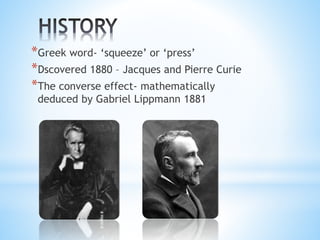
*Greek word- ‘squeeze’ or ‘press’ 
*Dscovered 1880 – Jacques and Pierre Curie 
*The converse effect- mathematically 
deduced by Gabriel Lippmann 1881
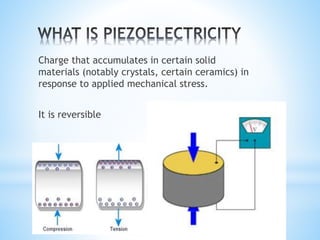
Charge that accumulates in certain solid 
materials (notably crystals, certain ceramics) in 
response to applied mechanical stress. 
It is reversible
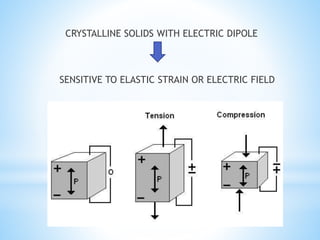
CRYSTALLINE SOLIDS WITH ELECTRIC DIPOLE 
SENSITIVE TO ELASTIC STRAIN OR ELECTRIC FIELD
* 
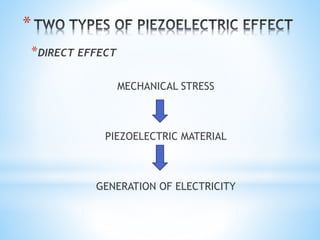
*DIRECT EFFECT 
MECHANICAL STRESS 
PIEZOELECTRIC MATERIAL 
GENERATION OF ELECTRICITY
* 
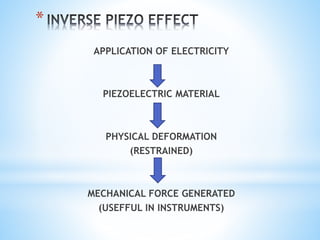
APPLICATION OF ELECTRICITY 
PIEZOELECTRIC MATERIAL 
PHYSICAL DEFORMATION 
(RESTRAINED) 
MECHANICAL FORCE GENERATED 
(USEFFUL IN INSTRUMENTS)
* 
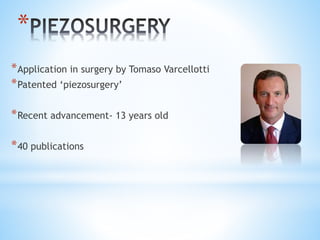
*Application in surgery by Tomaso Varcellotti 
*Patented ‘piezosurgery’ 
*Recent advancement- 13 years old 
*40 publications
* 
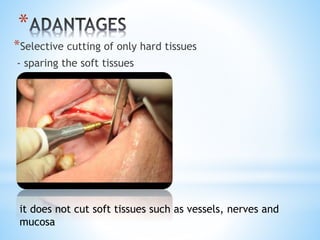
*Selective cutting of only hard tissues 
- sparing the soft tissues 
it does not cut soft tissues such as vessels, nerves and 
mucosa
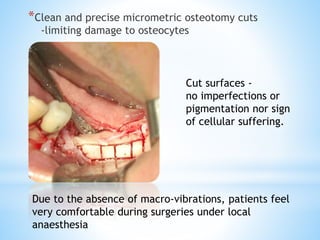
*Clean and precise micrometric osteotomy cuts 
-limiting damage to osteocytes 
Cut surfaces - 
no imperfections or 
pigmentation nor sign 
of cellular suffering. 
* 
Due to the absence of macro-vibrations, patients feel 
very comfortable during surgeries under local 
anaesthesia
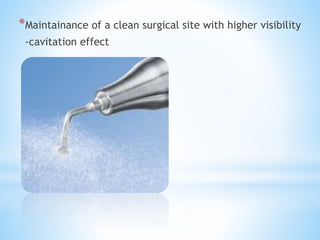
*Maintainance of a clean surgical site with higher visibility 
-cavitation effect
* 
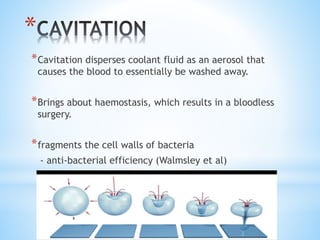
*Cavitation disperses coolant fluid as an aerosol that 
causes the blood to essentially be washed away. 
*Brings about haemostasis, which results in a bloodless 
surgery. 
*fragments the cell walls of bacteria 
- anti-bacterial efficiency (Walmsley et al)
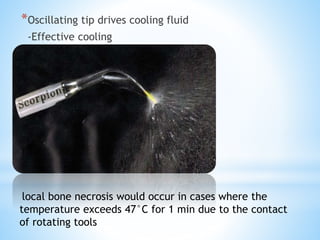
*Oscillating tip drives cooling fluid 
-Effective cooling 
local bone necrosis would occur in cases where the 
temperature exceeds 47°C for 1 min due to the contact 
of rotating tools
*
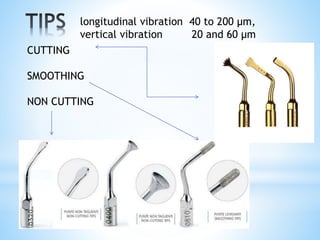
CUTTING 
longitudinal vibration 40 to 200 μm, 
vertical vibration 20 and 60 μm 
SMOOTHING 
NON CUTTING
* 
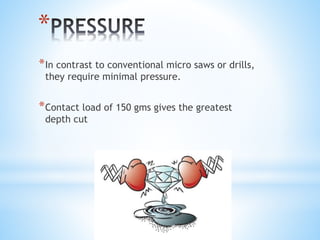
*In contrast to conventional micro saws or drills, 
they require minimal pressure. 
*Contact load of 150 gms gives the greatest 
depth cut
*
cylindrical diamond-coated insert 
with 2.4-mm diameter used for 
differential preparation 
cutting insert with 3-mm diameter 
-final preparation 
There is still a need of using the final drill of the selected 
implant system in order to tightly accommodate the 
implant into its socket.
* 
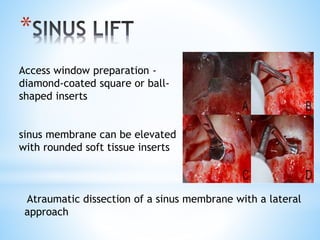
Access window preparation - 
diamond-coated square or ball-shaped 
inserts 
sinus membrane can be elevated 
with rounded soft tissue inserts 
Atraumatic dissection of a sinus membrane with a lateral 
approach
* 
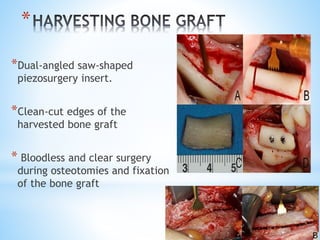
*Dual-angled saw-shaped 
piezosurgery insert. 
*Clean-cut edges of the 
harvested bone graft 
* Bloodless and clear surgery 
during osteotomies and fixation 
of the bone graft
* 
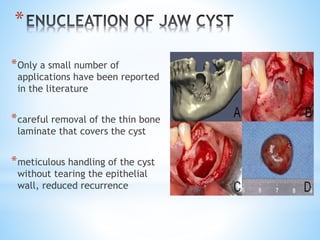
*Only a small number of 
applications have been reported 
in the literature 
*careful removal of the thin bone 
laminate that covers the cyst 
*meticulous handling of the cyst 
without tearing the epithelial 
wall, reduced recurrence
* 
*Dentoalveolar procedures 
*Hemisection 
*Apical resections 
*Alveolar ridge splitting 
*Mental nerve repositioning 
*TMJ ankylosis resections 
*Head and Neck 
*Craniofacial
* 
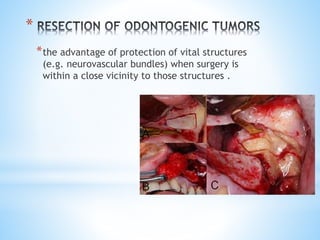
*the advantage of protection of vital structures 
(e.g. neurovascular bundles) when surgery is 
within a close vicinity to those structures .
* 
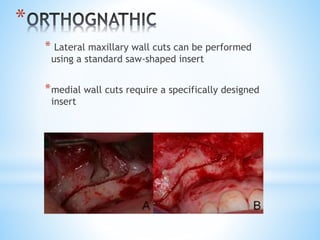
* Lateral maxillary wall cuts can be performed 
using a standard saw-shaped insert 
*medial wall cuts require a specifically designed 
insert
*Fifty patients had orthognathic surgery procedures in typical 
distribution using piezosurgical osteotomy 
* Controls were 86 patients with conventional saw and chisel 
osteotomies 
*Conclusions: reduced blood loss and inferior alveolar nerve 
injury at no extra time investment. single cases require 
auxiliary chiseling or sawing. 
*J Oral Maxillofac Surg. 2008 Apr;66(4):657-74.
* 
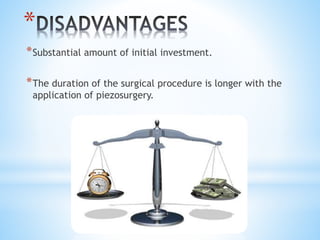
*Substantial amount of initial investment. 
*The duration of the surgical procedure is longer with the 
application of piezosurgery.
* 
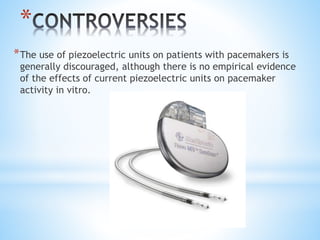
*The use of piezoelectric units on patients with pacemakers is 
generally discouraged, although there is no empirical evidence 
of the effects of current piezoelectric units on pacemaker 
activity in vitro.
* 
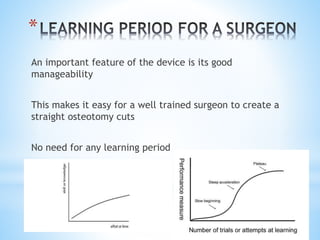
An important feature of the device is its good 
manageability 
This makes it easy for a well trained surgeon to create a 
straight osteotomy cuts 
No need for any learning period
* 
* Piezosurgery, with its precision and intra-operatory safety, 
today, seems to be the only evidence based alternative to 
traditional bone surgical tools. 
*Further research needs to be conducted to clarify any 
misconception.
* 
* Pavlikova G, Foltan R, Horka M, Hanzelka T, Borunska H, Sedy J. 
Piezosurgery in oral and maxillofacial surgery. Int J Oral Maxillofac 
Surg 2011 May;40(5):451-7. 
* Landes CA, Stubinger S, Rieger J, Williger B, Ha TK, Sader R. Critical 
evaluation of piezoelectric osteotomy in orthognathic surgery: 
operative technique, blood loss, time requirement, nerve and vessel 
integrity. J Oral Maxillofac Surg 2008 Apr;66(4):657-74. 
* Kocyigit ID, Atil F, Alp YE, Tekin U, Tuz HH. Piezosurgery versus 
conventional surgery in radicular cyst enucleation. J Craniofac Surg 
2012 Nov;23(6):1805-8. 
* Landes CA, Stübinger S, Laudemann K, Rieger J, Sader R. Bone 
harvesting at the anterior iliac crest using piezo osteotomy versus 
conventional open harvesting: a pilot study. Oral Surg Oral Med Oral 
Pathol Oral Radiol Endod 2008 Mar;105(3):e19-28.
* Horton JE, Tarpley TMJr, Jacoway JR. Clinical applications of 
ultrasonic instrumentation in the surgical removal of bone. Oral Surg 
Oral Med Oral Pathol 1981 Mar;51(3):236-42. 
* Pekovits K, Wildburger A, Payer M, Hutter H, Jakse N, Dohr G. 
Evaluation of graft cell viability-efficacy of piezoelectric versus 
manual bone scraper technique. J Oral Maxillofac Surg 2012 
Jan;70(1):154-62. 
* Ueki K, Nakagawa K, Marukawa K, Yamamoto E. Le Fort I osteotomy 
using an ultrasonic bone curette to fracture the pterygoid plates. J 
Craniomaxillofac Surg 2004 Dec;32(6):381-6. 
* Ultrasonic osteotomy as a new technique in craniomaxillofacial 
surgery. Int J Oral Maxillofac Surg. 2007 Jun;36(6):493-500.
Piezosurgery in oral and maxillofacial surgery

Piezosurgery in oral and maxillofacial surgery

  • 1.
    Dr ARJUN SHENOY DEPT OF OMFS *
  • 2.
    *HISTORY *HOW PIEZOELECTRICITYWORKS *PIEZOSURGERY EQUIPMENT *DESIGN OF INSTRUMENTS *APLLICATION IN MAXILLOFACIAL SURGERY *ADVANTAGES AND FEATURES *DISADVANTAGES *LEARNING CURVE FOR A SURGEON *REFERENCES
  • 3.
    *Greek word- ‘squeeze’or ‘press’ *Dscovered 1880 – Jacques and Pierre Curie *The converse effect- mathematically deduced by Gabriel Lippmann 1881
  • 4.
    Charge that accumulatesin certain solid materials (notably crystals, certain ceramics) in response to applied mechanical stress. It is reversible
  • 5.
    CRYSTALLINE SOLIDS WITHELECTRIC DIPOLE SENSITIVE TO ELASTIC STRAIN OR ELECTRIC FIELD
  • 6.
    * *DIRECT EFFECT MECHANICAL STRESS PIEZOELECTRIC MATERIAL GENERATION OF ELECTRICITY
  • 7.
    * APPLICATION OFELECTRICITY PIEZOELECTRIC MATERIAL PHYSICAL DEFORMATION (RESTRAINED) MECHANICAL FORCE GENERATED (USEFFUL IN INSTRUMENTS)
  • 8.
    * *Application insurgery by Tomaso Varcellotti *Patented ‘piezosurgery’ *Recent advancement- 13 years old *40 publications
  • 9.
    * *Selective cuttingof only hard tissues - sparing the soft tissues it does not cut soft tissues such as vessels, nerves and mucosa
  • 10.
    *Clean and precisemicrometric osteotomy cuts -limiting damage to osteocytes Cut surfaces - no imperfections or pigmentation nor sign of cellular suffering. * Due to the absence of macro-vibrations, patients feel very comfortable during surgeries under local anaesthesia
  • 11.
    *Maintainance of aclean surgical site with higher visibility -cavitation effect
  • 12.
    * *Cavitation dispersescoolant fluid as an aerosol that causes the blood to essentially be washed away. *Brings about haemostasis, which results in a bloodless surgery. *fragments the cell walls of bacteria - anti-bacterial efficiency (Walmsley et al)
  • 13.
    *Oscillating tip drivescooling fluid -Effective cooling local bone necrosis would occur in cases where the temperature exceeds 47°C for 1 min due to the contact of rotating tools
  • 14.
  • 15.
    CUTTING longitudinal vibration40 to 200 μm, vertical vibration 20 and 60 μm SMOOTHING NON CUTTING
  • 16.
    * *In contrastto conventional micro saws or drills, they require minimal pressure. *Contact load of 150 gms gives the greatest depth cut
  • 17.
  • 18.
    cylindrical diamond-coated insert with 2.4-mm diameter used for differential preparation cutting insert with 3-mm diameter -final preparation There is still a need of using the final drill of the selected implant system in order to tightly accommodate the implant into its socket.
  • 19.
    * Access windowpreparation - diamond-coated square or ball-shaped inserts sinus membrane can be elevated with rounded soft tissue inserts Atraumatic dissection of a sinus membrane with a lateral approach
  • 20.
    * *Dual-angled saw-shaped piezosurgery insert. *Clean-cut edges of the harvested bone graft * Bloodless and clear surgery during osteotomies and fixation of the bone graft
  • 21.
    * *Only asmall number of applications have been reported in the literature *careful removal of the thin bone laminate that covers the cyst *meticulous handling of the cyst without tearing the epithelial wall, reduced recurrence
  • 22.
    * *Dentoalveolar procedures *Hemisection *Apical resections *Alveolar ridge splitting *Mental nerve repositioning *TMJ ankylosis resections *Head and Neck *Craniofacial
  • 23.
    * *the advantageof protection of vital structures (e.g. neurovascular bundles) when surgery is within a close vicinity to those structures .
  • 24.
    * * Lateralmaxillary wall cuts can be performed using a standard saw-shaped insert *medial wall cuts require a specifically designed insert
  • 25.
    *Fifty patients hadorthognathic surgery procedures in typical distribution using piezosurgical osteotomy * Controls were 86 patients with conventional saw and chisel osteotomies *Conclusions: reduced blood loss and inferior alveolar nerve injury at no extra time investment. single cases require auxiliary chiseling or sawing. *J Oral Maxillofac Surg. 2008 Apr;66(4):657-74.
  • 26.
    * *Substantial amountof initial investment. *The duration of the surgical procedure is longer with the application of piezosurgery.
  • 27.
    * *The useof piezoelectric units on patients with pacemakers is generally discouraged, although there is no empirical evidence of the effects of current piezoelectric units on pacemaker activity in vitro.
  • 28.
    * An importantfeature of the device is its good manageability This makes it easy for a well trained surgeon to create a straight osteotomy cuts No need for any learning period
  • 29.
    * * Piezosurgery,with its precision and intra-operatory safety, today, seems to be the only evidence based alternative to traditional bone surgical tools. *Further research needs to be conducted to clarify any misconception.
  • 30.
    * * PavlikovaG, Foltan R, Horka M, Hanzelka T, Borunska H, Sedy J. Piezosurgery in oral and maxillofacial surgery. Int J Oral Maxillofac Surg 2011 May;40(5):451-7. * Landes CA, Stubinger S, Rieger J, Williger B, Ha TK, Sader R. Critical evaluation of piezoelectric osteotomy in orthognathic surgery: operative technique, blood loss, time requirement, nerve and vessel integrity. J Oral Maxillofac Surg 2008 Apr;66(4):657-74. * Kocyigit ID, Atil F, Alp YE, Tekin U, Tuz HH. Piezosurgery versus conventional surgery in radicular cyst enucleation. J Craniofac Surg 2012 Nov;23(6):1805-8. * Landes CA, Stübinger S, Laudemann K, Rieger J, Sader R. Bone harvesting at the anterior iliac crest using piezo osteotomy versus conventional open harvesting: a pilot study. Oral Surg Oral Med Oral Pathol Oral Radiol Endod 2008 Mar;105(3):e19-28.
  • 31.
    * Horton JE,Tarpley TMJr, Jacoway JR. Clinical applications of ultrasonic instrumentation in the surgical removal of bone. Oral Surg Oral Med Oral Pathol 1981 Mar;51(3):236-42. * Pekovits K, Wildburger A, Payer M, Hutter H, Jakse N, Dohr G. Evaluation of graft cell viability-efficacy of piezoelectric versus manual bone scraper technique. J Oral Maxillofac Surg 2012 Jan;70(1):154-62. * Ueki K, Nakagawa K, Marukawa K, Yamamoto E. Le Fort I osteotomy using an ultrasonic bone curette to fracture the pterygoid plates. J Craniomaxillofac Surg 2004 Dec;32(6):381-6. * Ultrasonic osteotomy as a new technique in craniomaxillofacial surgery. Int J Oral Maxillofac Surg. 2007 Jun;36(6):493-500.