-- Dr. Hardik Vora
PG OMFS
MRADC
LUDWIG’S ANGINA
Regional anatomy
Ludwig’s angina
Etiology
Clinical presentation
Microflora
Investigations
Treatment
 Airway management
 Definitive treatment
CONTENTS
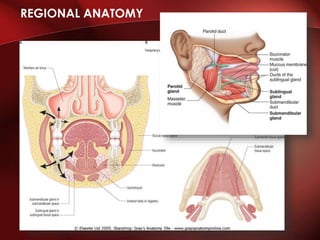
REGIONAL ANATOMY
First described in 1836 by Wilhelm Frederick von Ludwig as
a cellulitis of fast evolution involving the region of the
submandibular gland which is disseminated through
anatomic contiguity without tendency towards abscess
formation
3 Fs
It was to be feared
Rarely became fluctuant
Often was fatal
LUDWIG’S ANGINA (LATIN TERM ANGERE = “TO STRANGLE”)
Grodinsky stated in a 1939 paper that Ludwig’s angina was
a unique deep neck abscess characterized by
 occurrence bilaterally in more than one space,
 production of gangrenous serosanguineous infiltration with or
without pus,
 involvement of connective tissue and muscle but not glandular
structures,
 Spread by continuity, not via lymphatics
Airway compromise has been recognised as the leading
cause of death
Mortality rate – 50% in preantibiotic era
8% currently
LUDWIG’S ANGINA
Dental caries, recent dental treatment, poor dental
hygiene (accounts for 75-90% of cases)
Trauma: mandibular fracture, facial trauma, tongue
piercing, frenuloplasty
Infections of oral malignancy
Submandibular sialadenitis
Systemic compromise such as AIDS, glomerulonephritis,
diabetes mellitus, aplastic anemia, transplant recipients,
chemotherapy; IVDA (Soares et al. and Tavares et al.)
ETIOLOGY
CLINICAL FEATURES
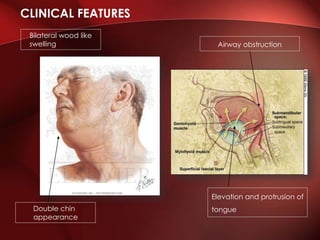
Bilateral wood like
swelling
Double chin
appearance
Elevation and protrusion of
tongue
Airway obstruction
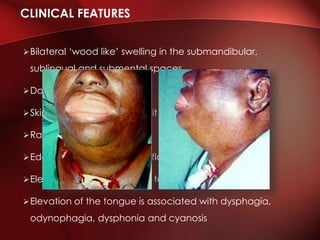
Bilateral ‘wood like’ swelling in the submandibular,
sublingual and submental spaces
Double chin appearance
Skin is tense and tends to pit and blanch on pressure
Rapidly spreading edema
Edema and congestion of floor of the mouth
Elevation and protrusion of tongue
Elevation of the tongue is associated with dysphagia,
odynophagia, dysphonia and cyanosis
CLINICAL FEATURES
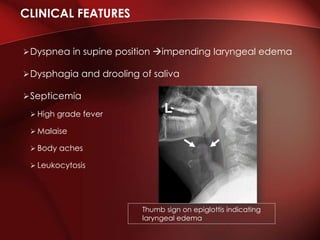
Dyspnea in supine position impending laryngeal edema
Dysphagia and drooling of saliva
Septicemia
 High grade fever
 Malaise
 Body aches
 Leukocytosis
CLINICAL FEATURES
Thumb sign on epiglottis indicating
laryngeal edema
 Staphylococcus aureus in the pre-antibiotic era
 Change in the microbial flora – aerobic streptococcal species
and nonstreptococcal anaerobes
 The bacteria that commonly cause deep neck infections
represent the normal oral flora that becomes pathogenic when
normal host defenses are ineffective
MICROBIOLOGY
Oral Maxillofacial Surg Clin N Am 20 (2008) 353–365
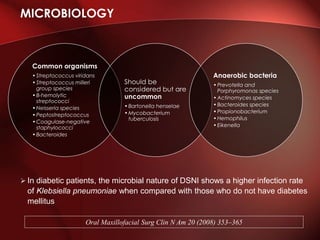
Common organisms
•Streptococcus viridans
•Streptococcus milleri
group species
•B-hemolytic
streptococci
•Neisseria species
•Peptostreptococcus
•Coagulase-negative
staphylococci
•Bacteroides
Should be
considered but are
uncommon
•Bartonella henselae
•Mycobacterium
tuberculosis
Anaerobic bacteria
•Prevotella and
Porphyromonas species
•Actinomyces species
•Bacteroides species
•Propionobacterium
•Hemophilus
•Eikenella
MICROBIOLOGY
Oral Maxillofacial Surg Clin N Am 20 (2008) 353–365
 In diabetic patients, the microbial nature of DSNI shows a higher infection rate
of Klebsiella pneumoniae when compared with those who do not have diabetes
mellitus
Laboratory tests – hemogram, blood glucose, etc.
Panoramic x-ray – to identify possible odontogenic sources
Cervical, profile and posterior-anterior radiographs – to
observe the volume increasing in the soft tissues and any
deviation of the trachea
Ultra sound has been recommended to differentiate
between cellulitis, abscess and adenopathy in head and
neck infection
USG has a sensitivity of 95% and specificity of 75%
INVESTIGATIONS
INVESTIGATIONS
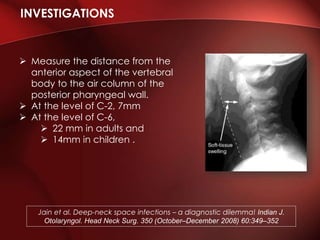
 Measure the distance from the
anterior aspect of the vertebral
body to the air column of the
posterior pharyngeal wall.
 At the level of C-2, 7mm
 At the level of C-6,
 22 mm in adults and
 14mm in children .
Jain et al. Deep-neck space infections – a diagnostic dilemma! Indian J.
Otolaryngol. Head Neck Surg. 350 (October–December 2008) 60:349–352
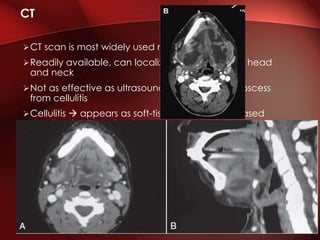
CT scan is most widely used modality
Readily available, can localize abscesses in the head
and neck
Not as effective as ultrasound in determining abscess
from cellulitis
Cellulitis  appears as soft-tissue swelling, increased
density of surrounding fat, enhancement of involved
muscles and obliteration of fat planes
Abscess  low density area with a peripheral
enhancement
CT has been reported to have sensitivity of 91% and
specifi city of 60%
CT
Ultrasonography is very sensitive in detecting fluid
collection
Quick, widely available, relatively inexpensive, painless
Involves no radiation
An effective diagnostic tool to confirm abscess
formation in the superficial facial spaces and is highly
predictable in detecting the stage of infection
ULTRASOUND
S. Pallagatti et al. / European Journal of Radiology 81 (2012) 1821–1827
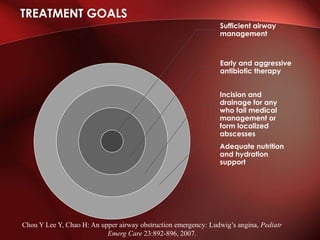
Sufficient airway
management
Early and aggressive
antibiotic therapy
Incision and
drainage for any
who fail medical
management or
form localized
abscesses
Adequate nutrition
and hydration
support
TREATMENT GOALS
Chou Y Lee Y, Chao H: An upper airway obstruction emergency: Ludwig’s angina, Pediatr
Emerg Care 23:892-896, 2007.
Airway management in Ludwig’s angina can be
challenging
No consensus regarding the airway management in the
available literature
Suggested methods include tracheostomy, conventional
laryngoscopy and intubation (after administration of
muscle relaxant), awake blind nasal intubation and
awake fibreoptic intubation.
AIRWAY MANAGEMENT
Tracheostomy using local anaesthesia was considered as
the gold standard in the past
Risk of the spread of infection to the mediastinum,
aspiration of pus, rupture of the innominate artery,
spread of infection to the thorax, airway loss and
tracheal stenosis
Blind nasal intubation (BNI) is questionable because of
infrequent success on first pass and increased trauma
with repeated attempts  might necessitate emergency
cricothyrotomy
AIRWAY MANAGEMENT
The first successful fibreoptic nasotracheal intubation in a
patient was first reported in the year 1974 (Schwartz et al)
Fibreoptic intubation is a sophisticated and less invasive
method of securing airway in patients with deep neck
infection
AIRWAY MANAGEMENT
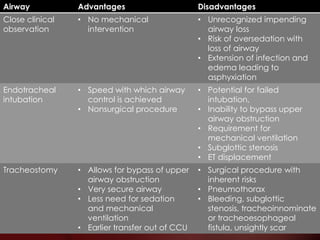
Airway Advantages Disadvantages
Close clinical
observation
• No mechanical
intervention
• Unrecognized impending
airway loss
• Risk of oversedation with
loss of airway
• Extension of infection and
edema leading to
asphyxiation
Endotracheal
intubation
• Speed with which airway
control is achieved
• Nonsurgical procedure
• Potential for failed
intubation,
• Inability to bypass upper
airway obstruction
• Requirement for
mechanical ventilation
• Subglottic stenosis
• ET displacement
Tracheostomy • Allows for bypass of upper
airway obstruction
• Very secure airway
• Less need for sedation
and mechanical
ventilation
• Earlier transfer out of CCU
• Surgical procedure with
inherent risks
• Pneumothorax
• Bleeding, subglottic
stenosis, tracheoinnominate
or tracheoesophageal
fistula, unsightly scar
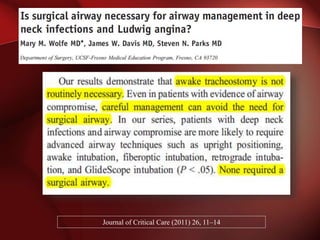
Journal of Critical Care (2011) 26, 11–14
Intravenous access, fluid resuscitation, and administration
of IV antibiotics
Antibiotic therapy should be administered empirically and
tailored to culture and sensitivity results
Antibiotic therapy should be administered empirically and
tailored to culture and sensitivity results
Other regimens –
 Penicillins with β-lactamase inhibitor,
 Second, third, or fourth generation Cephalosporins and
 Metranidazole
MEDICAL MANAGEMENT
Ampicillin/Sulbactam and clindamycin – effective for
anaerobic infections
Pipercillin/Tazobactam has shown efficacy in treating
polymicrobial infections as a single agent
Comorbid medical conditions require thorough workup
and monitoring because they can be exacerbated by the
infection, and can also lead to more severe infections
Addition of gentamicin to the empirical therapy should be
strongly considered for diabetic patients
Control of blood sugar below 200 mg/dL is imperative for
good control of infection
MEDICAL MANAGEMENT
Principles (Topazian & Goldberg)
Incise in healthy skin and mucosa when possible, not at
the site of maximum fluctuance, because these wounds
tend to heal with an unsightly scar;
Place the incision in a natural skin fold;
Place the incision in a dependent position;
Dissect bluntly;
Place a drain; and
Remove drains when drainage becomes minimal
SURGICAL TREATMENT
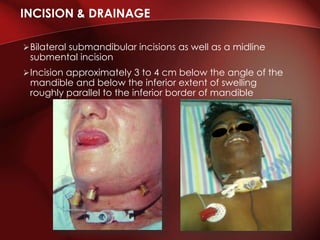
Bilateral submandibular incisions as well as a midline
submental incision
Incision approximately 3 to 4 cm below the angle of the
mandible and below the inferior extent of swelling
roughly parallel to the inferior border of mandible
INCISION & DRAINAGE
 Ludwig’s angina is a life-threatening infection
 Early diagnosis and immediate treatment is the key for successful
management
 Antibiotic therapy should be administered empirically and
tailored to culture and sensitivity results
Prompt and early surgical intervention is required to provide a
higher control of the patient’s health.
CONCLUSION
 Topazian RG, Goldberg MH, Hupp JR. Oral and Maxillofacial
Infections. 4th ed. Philadelphia, Pa: W. B. Saunders; 2002.
 Bagheri SC, Bell RB, Khan HA. Current Therapy in Oral and
Maxillofacial Surgery - Saunders; 1 edition;2011
 Osborn et al. Deep space neck infection. Oral Maxillofacial Surg
Clin N Am 20 (2008) 353–365
 Bahl, et al.: Microflora in odontogenic infections. Contemporary
Clinical Dentistry | Jul-Sep 2014 | Vol 5 | Issue 3
 S. Pallagatti et al. / European Journal of Radiology 81 (2012) 1821–
1827
 Jain et al. Deep-neck space infections – a diagnostic dilemma!
Indian J. Otolaryngol. Head Neck Surg. (October–December 2008)
60:349–352
 M.M. Wolfe et al. Surgical airway in deep neck infections and
ludwig angina. Journal of Critical Care (2011) 26, 11–14
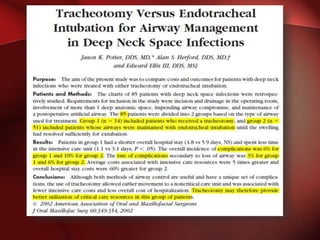
 Potter, Herford, and Ellis. Tracheotomy Versus Endotracheal
Intubation for Airway Management in Deep Neck Space
Infections.J Oral Maxillofac Surg 60:349-354, 2002
REFERENCES
Ludwig’s angina

Ludwig’s angina

  • 2.
    -- Dr. HardikVora PG OMFS MRADC LUDWIG’S ANGINA
  • 3.
    Regional anatomy Ludwig’s angina Etiology Clinicalpresentation Microflora Investigations Treatment  Airway management  Definitive treatment CONTENTS
  • 4.
  • 5.
    First described in1836 by Wilhelm Frederick von Ludwig as a cellulitis of fast evolution involving the region of the submandibular gland which is disseminated through anatomic contiguity without tendency towards abscess formation 3 Fs It was to be feared Rarely became fluctuant Often was fatal LUDWIG’S ANGINA (LATIN TERM ANGERE = “TO STRANGLE”)
  • 6.
    Grodinsky stated ina 1939 paper that Ludwig’s angina was a unique deep neck abscess characterized by  occurrence bilaterally in more than one space,  production of gangrenous serosanguineous infiltration with or without pus,  involvement of connective tissue and muscle but not glandular structures,  Spread by continuity, not via lymphatics Airway compromise has been recognised as the leading cause of death Mortality rate – 50% in preantibiotic era 8% currently LUDWIG’S ANGINA
  • 7.
    Dental caries, recentdental treatment, poor dental hygiene (accounts for 75-90% of cases) Trauma: mandibular fracture, facial trauma, tongue piercing, frenuloplasty Infections of oral malignancy Submandibular sialadenitis Systemic compromise such as AIDS, glomerulonephritis, diabetes mellitus, aplastic anemia, transplant recipients, chemotherapy; IVDA (Soares et al. and Tavares et al.) ETIOLOGY
  • 8.
    CLINICAL FEATURES Bilateral woodlike swelling Double chin appearance Elevation and protrusion of tongue Airway obstruction
  • 9.
    Bilateral ‘wood like’swelling in the submandibular, sublingual and submental spaces Double chin appearance Skin is tense and tends to pit and blanch on pressure Rapidly spreading edema Edema and congestion of floor of the mouth Elevation and protrusion of tongue Elevation of the tongue is associated with dysphagia, odynophagia, dysphonia and cyanosis CLINICAL FEATURES
  • 10.
    Dyspnea in supineposition impending laryngeal edema Dysphagia and drooling of saliva Septicemia  High grade fever  Malaise  Body aches  Leukocytosis CLINICAL FEATURES Thumb sign on epiglottis indicating laryngeal edema
  • 11.
     Staphylococcus aureusin the pre-antibiotic era  Change in the microbial flora – aerobic streptococcal species and nonstreptococcal anaerobes  The bacteria that commonly cause deep neck infections represent the normal oral flora that becomes pathogenic when normal host defenses are ineffective MICROBIOLOGY Oral Maxillofacial Surg Clin N Am 20 (2008) 353–365
  • 12.
    Common organisms •Streptococcus viridans •Streptococcusmilleri group species •B-hemolytic streptococci •Neisseria species •Peptostreptococcus •Coagulase-negative staphylococci •Bacteroides Should be considered but are uncommon •Bartonella henselae •Mycobacterium tuberculosis Anaerobic bacteria •Prevotella and Porphyromonas species •Actinomyces species •Bacteroides species •Propionobacterium •Hemophilus •Eikenella MICROBIOLOGY Oral Maxillofacial Surg Clin N Am 20 (2008) 353–365  In diabetic patients, the microbial nature of DSNI shows a higher infection rate of Klebsiella pneumoniae when compared with those who do not have diabetes mellitus
  • 13.
    Laboratory tests –hemogram, blood glucose, etc. Panoramic x-ray – to identify possible odontogenic sources Cervical, profile and posterior-anterior radiographs – to observe the volume increasing in the soft tissues and any deviation of the trachea Ultra sound has been recommended to differentiate between cellulitis, abscess and adenopathy in head and neck infection USG has a sensitivity of 95% and specificity of 75% INVESTIGATIONS
  • 14.
    INVESTIGATIONS  Measure thedistance from the anterior aspect of the vertebral body to the air column of the posterior pharyngeal wall.  At the level of C-2, 7mm  At the level of C-6,  22 mm in adults and  14mm in children . Jain et al. Deep-neck space infections – a diagnostic dilemma! Indian J. Otolaryngol. Head Neck Surg. 350 (October–December 2008) 60:349–352
  • 15.
    CT scan ismost widely used modality Readily available, can localize abscesses in the head and neck Not as effective as ultrasound in determining abscess from cellulitis Cellulitis  appears as soft-tissue swelling, increased density of surrounding fat, enhancement of involved muscles and obliteration of fat planes Abscess  low density area with a peripheral enhancement CT has been reported to have sensitivity of 91% and specifi city of 60% CT
  • 16.
    Ultrasonography is verysensitive in detecting fluid collection Quick, widely available, relatively inexpensive, painless Involves no radiation An effective diagnostic tool to confirm abscess formation in the superficial facial spaces and is highly predictable in detecting the stage of infection ULTRASOUND S. Pallagatti et al. / European Journal of Radiology 81 (2012) 1821–1827
  • 17.
    Sufficient airway management Early andaggressive antibiotic therapy Incision and drainage for any who fail medical management or form localized abscesses Adequate nutrition and hydration support TREATMENT GOALS Chou Y Lee Y, Chao H: An upper airway obstruction emergency: Ludwig’s angina, Pediatr Emerg Care 23:892-896, 2007.
  • 18.
    Airway management inLudwig’s angina can be challenging No consensus regarding the airway management in the available literature Suggested methods include tracheostomy, conventional laryngoscopy and intubation (after administration of muscle relaxant), awake blind nasal intubation and awake fibreoptic intubation. AIRWAY MANAGEMENT
  • 19.
    Tracheostomy using localanaesthesia was considered as the gold standard in the past Risk of the spread of infection to the mediastinum, aspiration of pus, rupture of the innominate artery, spread of infection to the thorax, airway loss and tracheal stenosis Blind nasal intubation (BNI) is questionable because of infrequent success on first pass and increased trauma with repeated attempts  might necessitate emergency cricothyrotomy AIRWAY MANAGEMENT
  • 20.
    The first successfulfibreoptic nasotracheal intubation in a patient was first reported in the year 1974 (Schwartz et al) Fibreoptic intubation is a sophisticated and less invasive method of securing airway in patients with deep neck infection AIRWAY MANAGEMENT
  • 21.
    Airway Advantages Disadvantages Closeclinical observation • No mechanical intervention • Unrecognized impending airway loss • Risk of oversedation with loss of airway • Extension of infection and edema leading to asphyxiation Endotracheal intubation • Speed with which airway control is achieved • Nonsurgical procedure • Potential for failed intubation, • Inability to bypass upper airway obstruction • Requirement for mechanical ventilation • Subglottic stenosis • ET displacement Tracheostomy • Allows for bypass of upper airway obstruction • Very secure airway • Less need for sedation and mechanical ventilation • Earlier transfer out of CCU • Surgical procedure with inherent risks • Pneumothorax • Bleeding, subglottic stenosis, tracheoinnominate or tracheoesophageal fistula, unsightly scar
  • 23.
    Journal of CriticalCare (2011) 26, 11–14
  • 24.
    Intravenous access, fluidresuscitation, and administration of IV antibiotics Antibiotic therapy should be administered empirically and tailored to culture and sensitivity results Antibiotic therapy should be administered empirically and tailored to culture and sensitivity results Other regimens –  Penicillins with β-lactamase inhibitor,  Second, third, or fourth generation Cephalosporins and  Metranidazole MEDICAL MANAGEMENT
  • 25.
    Ampicillin/Sulbactam and clindamycin– effective for anaerobic infections Pipercillin/Tazobactam has shown efficacy in treating polymicrobial infections as a single agent Comorbid medical conditions require thorough workup and monitoring because they can be exacerbated by the infection, and can also lead to more severe infections Addition of gentamicin to the empirical therapy should be strongly considered for diabetic patients Control of blood sugar below 200 mg/dL is imperative for good control of infection MEDICAL MANAGEMENT
  • 26.
    Principles (Topazian &Goldberg) Incise in healthy skin and mucosa when possible, not at the site of maximum fluctuance, because these wounds tend to heal with an unsightly scar; Place the incision in a natural skin fold; Place the incision in a dependent position; Dissect bluntly; Place a drain; and Remove drains when drainage becomes minimal SURGICAL TREATMENT
  • 27.
    Bilateral submandibular incisionsas well as a midline submental incision Incision approximately 3 to 4 cm below the angle of the mandible and below the inferior extent of swelling roughly parallel to the inferior border of mandible INCISION & DRAINAGE
  • 28.
     Ludwig’s anginais a life-threatening infection  Early diagnosis and immediate treatment is the key for successful management  Antibiotic therapy should be administered empirically and tailored to culture and sensitivity results Prompt and early surgical intervention is required to provide a higher control of the patient’s health. CONCLUSION
  • 29.
     Topazian RG,Goldberg MH, Hupp JR. Oral and Maxillofacial Infections. 4th ed. Philadelphia, Pa: W. B. Saunders; 2002.  Bagheri SC, Bell RB, Khan HA. Current Therapy in Oral and Maxillofacial Surgery - Saunders; 1 edition;2011  Osborn et al. Deep space neck infection. Oral Maxillofacial Surg Clin N Am 20 (2008) 353–365  Bahl, et al.: Microflora in odontogenic infections. Contemporary Clinical Dentistry | Jul-Sep 2014 | Vol 5 | Issue 3  S. Pallagatti et al. / European Journal of Radiology 81 (2012) 1821– 1827  Jain et al. Deep-neck space infections – a diagnostic dilemma! Indian J. Otolaryngol. Head Neck Surg. (October–December 2008) 60:349–352  M.M. Wolfe et al. Surgical airway in deep neck infections and ludwig angina. Journal of Critical Care (2011) 26, 11–14  Potter, Herford, and Ellis. Tracheotomy Versus Endotracheal Intubation for Airway Management in Deep Neck Space Infections.J Oral Maxillofac Surg 60:349-354, 2002 REFERENCES

Editor's Notes

  • #5 The sublingual glands, deep lobes and ducts of the submandibular glands, lingual arteries, nerves and veins, V3 branches from the trigeminal nerve, genioglossus, geniohyoid, styloglossus, palatoglossus, hyoglossus, and fat superficial lobes of the submandibular glands, anterior bellies of the diagastric muscles, and level 1A and 1B lymph nodes.
  • #15 Rarely used coz of 33% false negative rates
  • #24 Of 29 patients, 6 (20%) had symptoms consistent with true Ludwig angina. 19(65.5%) had evidence of airway compromise. 8(42%) of these 19 patients required advanced airway control techniques. No patient required a surgical airway, and no mortality resulted from airway compromise. Advance airway control techniques were required more often in patients with airway compromise
  • #26  IV antibiotics (immunocompetent patients) Ampicillin/sulbactam 2 g IV q4hr Penicillin G 2-4 MU IV q4-6hr plus metronidazole 500 mg IV q6hr Clindamycin 600 mg IV q6hr for PCN allergy IV antibiotics (immunocompromised host) Cefotaxime 2 g IV q6hr Ceftizoxime 3 g IV q8hr Imipenem 500 mg IV q6hr Piperacillin-tazobactam 3.375 g q6hr Dexamethasone 10 mg IV x1, then 4 mg q6hr x48hr o Nebulized epinephrine 1 ml of 1:1000 diluted to 5 ml with 0.9% NS