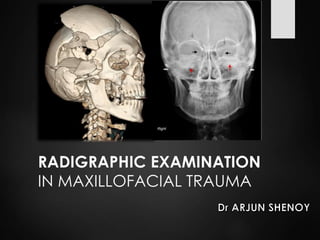
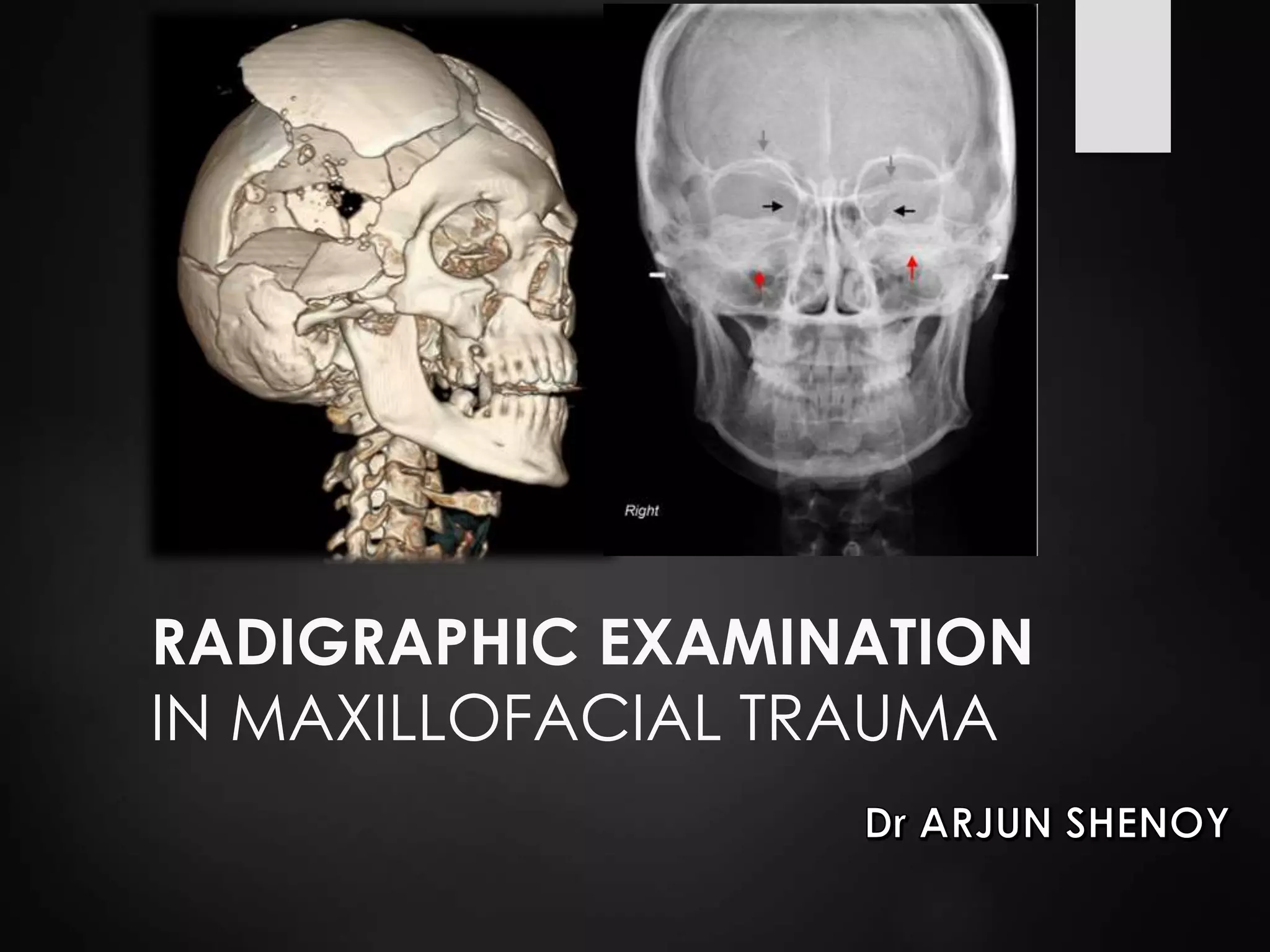
RADIGRAPHIC EXAMINATION
IN MAXILLOFACIAL TRAUMA
Radiological examination
 Useful diagnostic aid.
 Radiation cost
 Financial cost
 Urgency of the treatment.
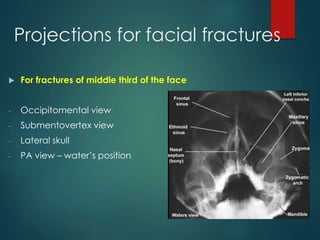
Projections for facial fractures
 For fractures of middle third of the face
- Occipitomental view
- Submentovertex view
- Lateral skull
- PA view – water’s position
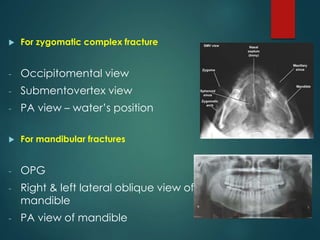
 For zygomatic complex fracture
- Occipitomental view
- Submentovertex view
- PA view – water’s position
 For mandibular fractures
- OPG
- Right & left lateral oblique view of
mandible
- PA view of mandible
Radiological interpretation of
facial trauma
You see what you look for…!!!!
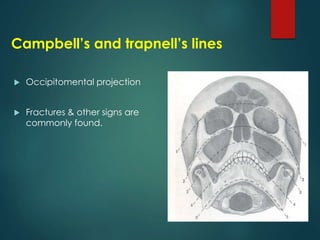
 Occipitomental projection
 Fractures & other signs are
commonly found.
Campbell’s and trapnell’s lines
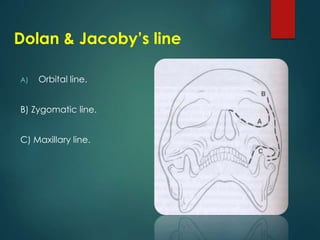
Dolan & Jacoby’s line
A) Orbital line.
B) Zygomatic line.
C) Maxillary line.
4 ‘S’ by Delbalso et al
 Symmetry.
 Sharpness – Bright sign, Trapdoor sign.
 Sinus.
 Soft tissues.
foreign bodies, emphysema.
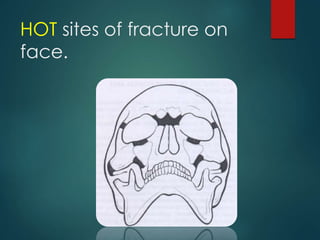
HOT sites of fracture on
face.
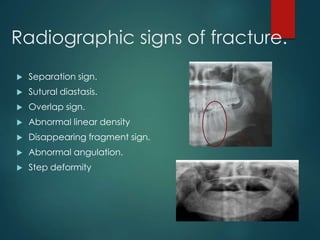
Radiographic signs of fracture.
 Separation sign.
 Sutural diastasis.
 Overlap sign.
 Abnormal linear density
 Disappearing fragment sign.
 Abnormal angulation.
 Step deformity
Indirect signs.
 Soft tissue swelling.
localized – attention to that part
 Paranasal sinus opacification.
 Air in the soft tissues.
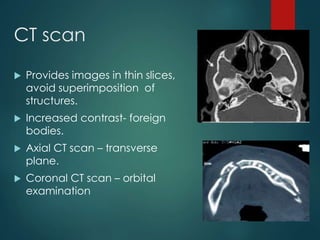
CT scan
 Provides images in thin slices,
avoid superimposition of
structures.
 Increased contrast- foreign
bodies.
 Axial CT scan – transverse
plane.
 Coronal CT scan – orbital
examination
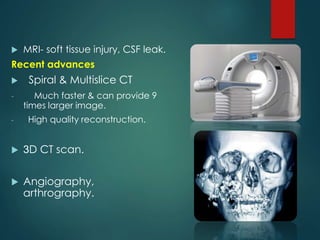
 MRI- soft tissue injury, CSF leak.
Recent advances
 Spiral & Multislice CT
- Much faster & can provide 9
times larger image.
- High quality reconstruction.
 3D CT scan.
 Angiography,
arthrography.
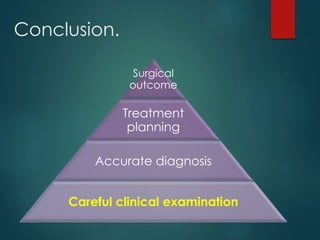
Conclusion.
Surgical
outcome
Treatment
planning
Accurate diagnosis
Careful clinical examination
References.
 Oral & maxillofacial trauma- Fonseca,vol 1
 Maxillofacial Injuries- Rowe & Williams
 Textbook of oral & maxillofacial surgery by Peter
Ward Booth.
Radigraphic Imaging in Maxillofacial Trauma

Radigraphic Imaging in Maxillofacial Trauma

  • 1.
  • 2.
    Radiological examination  Usefuldiagnostic aid.  Radiation cost  Financial cost  Urgency of the treatment.
  • 3.
    Projections for facialfractures  For fractures of middle third of the face - Occipitomental view - Submentovertex view - Lateral skull - PA view – water’s position
  • 4.
     For zygomaticcomplex fracture - Occipitomental view - Submentovertex view - PA view – water’s position  For mandibular fractures - OPG - Right & left lateral oblique view of mandible - PA view of mandible
  • 5.
    Radiological interpretation of facialtrauma You see what you look for…!!!!
  • 6.
     Occipitomental projection Fractures & other signs are commonly found. Campbell’s and trapnell’s lines
  • 7.
    Dolan & Jacoby’sline A) Orbital line. B) Zygomatic line. C) Maxillary line.
  • 8.
    4 ‘S’ byDelbalso et al  Symmetry.  Sharpness – Bright sign, Trapdoor sign.  Sinus.  Soft tissues. foreign bodies, emphysema.
  • 9.
    HOT sites offracture on face.
  • 10.
    Radiographic signs offracture.  Separation sign.  Sutural diastasis.  Overlap sign.  Abnormal linear density  Disappearing fragment sign.  Abnormal angulation.  Step deformity
  • 11.
    Indirect signs.  Softtissue swelling. localized – attention to that part  Paranasal sinus opacification.  Air in the soft tissues.
  • 12.
    CT scan  Providesimages in thin slices, avoid superimposition of structures.  Increased contrast- foreign bodies.  Axial CT scan – transverse plane.  Coronal CT scan – orbital examination
  • 13.
     MRI- softtissue injury, CSF leak. Recent advances  Spiral & Multislice CT - Much faster & can provide 9 times larger image. - High quality reconstruction.  3D CT scan.  Angiography, arthrography.
  • 14.
  • 15.
    References.  Oral &maxillofacial trauma- Fonseca,vol 1  Maxillofacial Injuries- Rowe & Williams  Textbook of oral & maxillofacial surgery by Peter Ward Booth.