Abscesses of
Pharynx
Dr.T.Dinesh Singh
Professor
MRIMS
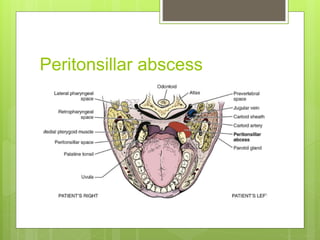
Peritonsillar Abscess [Quinsy]
 Definition – acute inflammation of the
peritonsillar space.
 Place – lies between superior constrictor
muscle & the tonsillar capsule.
 Etiology – Recurrent attacks of tonsillitis
- Trauma or Foreign body
- Dental infections & surrounding areas
- Immunocompromised status
Peritonsillar abscess
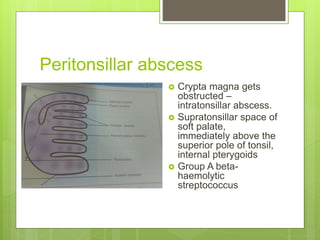
 Crypta magna gets
obstructed –
intratonsillar abscess.
 Supratonsillar space of
soft palate,
immediately above the
superior pole of tonsil,
internal pterygoids
 Group A beta-
haemolytic
streptococcus
Clinical features
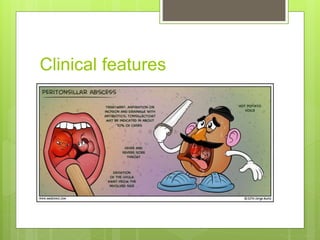
 Symptoms –
 General – fever, chills & rigor, malaise, body
aches & toxic features
 Local –odynophagia [ severe ]
 Otalgia
 Neck pain
 Trismus – pterygoid muscle spasm
 Muffled speech – hot potato voice
Clinical features
Clinical features
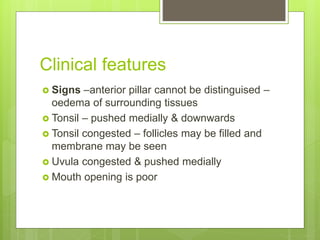
 Signs –anterior pillar cannot be distinguised –
oedema of surrounding tissues
 Tonsil – pushed medially & downwards
 Tonsil congested – follicles may be filled and
membrane may be seen
 Uvula congested & pushed medially
 Mouth opening is poor
Clinical features
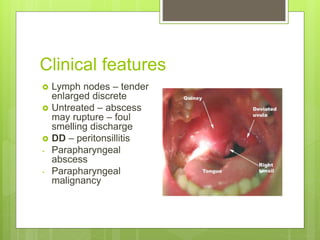
 Lymph nodes – tender
enlarged discrete
 Untreated – abscess
may rupture – foul
smelling discharge
 DD – peritonsillitis
- Parapharyngeal
abscess
- Parapharyngeal
malignancy
Investigations & Treatment
 Throat swab for culture
sensitivity
 CBP
 DM & CT Scan
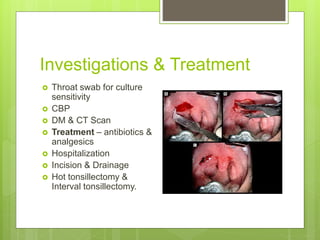
 Treatment – antibiotics &
analgesics
 Hospitalization
 Incision & Drainage
 Hot tonsillectomy &
Interval tonsillectomy.
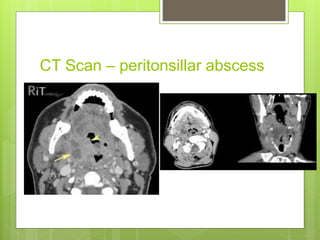
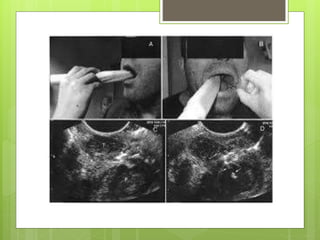
CT Scan – peritonsillar abscess
Parapharyngeal abscess
 Synonyms – pharyngomaxillary space
- Lateral pharyngeal space
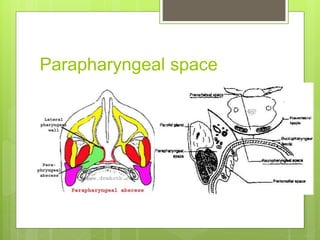
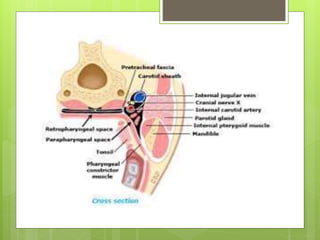
 Anatomy – potential space lateral to pharynx
 Inverted Pyramid or V shaped – base of skull
to level of hyoid bone
 Content – carotid sheath and surroundings
Boundaries
 Anterior – interpterygoid fascia &
pterygomandibular raphe
 Posterior – prevertebral division of deep layer &
posterior aspect of carotid sheath
 Medial – middle layer of deep cervical fascia
around the pharyngeal constrictor & the fascia of
the tensor & levator muscles of the velum palatani
& the styloglossus.
 Lateral – superficial layer of deep cervical fascia –
overlies the mandible, medial pterygoid & parotid.
Parapharyngeal space
Compartments & Contents
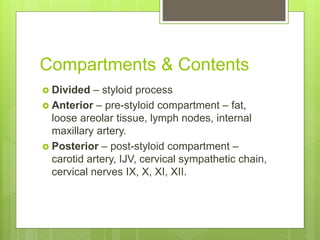
 Divided – styloid process
 Anterior – pre-styloid compartment – fat,
loose areolar tissue, lymph nodes, internal
maxillary artery.
 Posterior – post-styloid compartment –
carotid artery, IJV, cervical sympathetic chain,
cervical nerves IX, X, XI, XII.
Clinical features
 Etiology - Dental infections, tonsillitis,
sialadenitis, lymph node suppuration
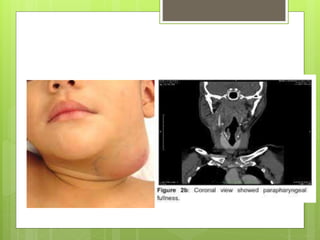
 Firm induration [ swelling ], erythema – seen
lateral and anterior to sterocleidomastoid
muscle
 Difficulty in flexing & turning neck
 Trismus – pterygoid muscle
 Dysphagia & dyspnea
 Bulge – lateral wall of pharynx
Investigations & treatment
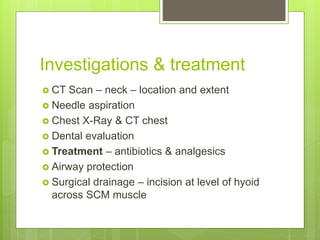
 CT Scan – neck – location and extent
 Needle aspiration
 Chest X-Ray & CT chest
 Dental evaluation
 Treatment – antibiotics & analgesics
 Airway protection
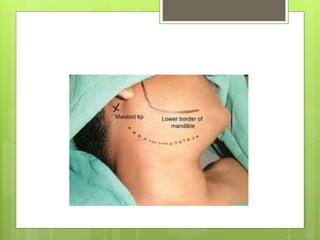
 Surgical drainage – incision at level of hyoid
across SCM muscle
DD
 Peritonsillar abscess
 Cervical adenitis
 Masticator space infection
 Submandibular space infection
Complications
 1] IJV – thrombosis
 Shaking chills, spiking fever, prostration
 Tenderness at angle of mandible & along SCM
muscle
 Asso. Bacteremia, pulmonary emboli, suppurative
subclavian phlebitis, lateral sinus thrombosis,
brain abscess, metastatic abscess
 Treatment – prolonged antibiotics, surgical
drainage, ligation of involved vein.
Complications
 2] Carotid artery rupture
- false aneurysm formation
- herald bleeds – before major bleed
- ICA – common involvement
 3] Laryngeal edema
 4] Mediastinitis
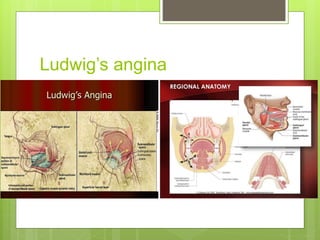
Submandibular space abscess [
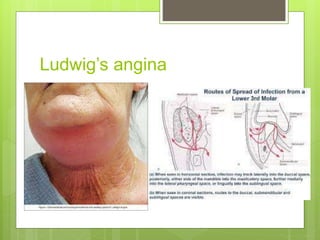
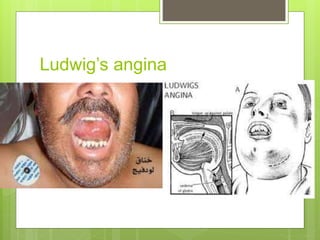
LUDWIG’S ANGINA ]
 Inflammation of the submaxillary and
sublingual space
 Cellulitis without lymphatic involvement –
causing massive swelling of tongue & floor of
mouth.
 Fatal – respiratory obstruction
Ludwig’s angina
Etiology
 Age - 20 to 50 yrs
 Dental caries – 2nd & 3rd molar
 Trauma of tongue & floor of mouth
 Lingual tonsillitis
 Post dental extraction
 Post radiotherapy
Clinical features
 Toxic – high fever & malaise
 Painful swelling – region below the mandible
 Dysphagia, difficulty in mouth opening,
dysarthria, & dyspnea
 Trismus
 Absence of lymphadenitis
 Drooling of saliva & rare stridor
Ludwig’s angina
Clinical features
 Baruny edema of the floor of mouth & tongue
pushing tongue posteriorly
 Laryngeal edema – forces the patient to sit up
& lean forwards.
 DD – submental space infection
- Submandibular sialadenitis
- Plunging ranula
- Tumors.
Investigations & Treatment
 Dental X-Rays
 CT-Scan – extent of disease, extension to
other neck spaces, airway.
 Treatment – antibiotics & analgesics
 Surgical drainage – mylohyoid opened
 Tracheostomy
 Treat – underlying cause
Ludwig’s angina
Complications
 Airway obstruction
 Aspiration pneumonia
 Lung abscess
 Tongue necrosis
 Spread to other spaces.

Abscesses of pharynx

  • 1.
  • 2.
    Peritonsillar Abscess [Quinsy] Definition – acute inflammation of the peritonsillar space.  Place – lies between superior constrictor muscle & the tonsillar capsule.  Etiology – Recurrent attacks of tonsillitis - Trauma or Foreign body - Dental infections & surrounding areas - Immunocompromised status
  • 3.
  • 4.
    Peritonsillar abscess  Cryptamagna gets obstructed – intratonsillar abscess.  Supratonsillar space of soft palate, immediately above the superior pole of tonsil, internal pterygoids  Group A beta- haemolytic streptococcus
  • 5.
    Clinical features  Symptoms–  General – fever, chills & rigor, malaise, body aches & toxic features  Local –odynophagia [ severe ]  Otalgia  Neck pain  Trismus – pterygoid muscle spasm  Muffled speech – hot potato voice
  • 6.
  • 7.
    Clinical features  Signs–anterior pillar cannot be distinguised – oedema of surrounding tissues  Tonsil – pushed medially & downwards  Tonsil congested – follicles may be filled and membrane may be seen  Uvula congested & pushed medially  Mouth opening is poor
  • 8.
    Clinical features  Lymphnodes – tender enlarged discrete  Untreated – abscess may rupture – foul smelling discharge  DD – peritonsillitis - Parapharyngeal abscess - Parapharyngeal malignancy
  • 9.
    Investigations & Treatment Throat swab for culture sensitivity  CBP  DM & CT Scan  Treatment – antibiotics & analgesics  Hospitalization  Incision & Drainage  Hot tonsillectomy & Interval tonsillectomy.
  • 10.
    CT Scan –peritonsillar abscess
  • 12.
    Parapharyngeal abscess  Synonyms– pharyngomaxillary space - Lateral pharyngeal space  Anatomy – potential space lateral to pharynx  Inverted Pyramid or V shaped – base of skull to level of hyoid bone  Content – carotid sheath and surroundings
  • 13.
    Boundaries  Anterior –interpterygoid fascia & pterygomandibular raphe  Posterior – prevertebral division of deep layer & posterior aspect of carotid sheath  Medial – middle layer of deep cervical fascia around the pharyngeal constrictor & the fascia of the tensor & levator muscles of the velum palatani & the styloglossus.  Lateral – superficial layer of deep cervical fascia – overlies the mandible, medial pterygoid & parotid.
  • 14.
  • 16.
    Compartments & Contents Divided – styloid process  Anterior – pre-styloid compartment – fat, loose areolar tissue, lymph nodes, internal maxillary artery.  Posterior – post-styloid compartment – carotid artery, IJV, cervical sympathetic chain, cervical nerves IX, X, XI, XII.
  • 17.
    Clinical features  Etiology- Dental infections, tonsillitis, sialadenitis, lymph node suppuration  Firm induration [ swelling ], erythema – seen lateral and anterior to sterocleidomastoid muscle  Difficulty in flexing & turning neck  Trismus – pterygoid muscle  Dysphagia & dyspnea  Bulge – lateral wall of pharynx
  • 19.
    Investigations & treatment CT Scan – neck – location and extent  Needle aspiration  Chest X-Ray & CT chest  Dental evaluation  Treatment – antibiotics & analgesics  Airway protection  Surgical drainage – incision at level of hyoid across SCM muscle
  • 21.
    DD  Peritonsillar abscess Cervical adenitis  Masticator space infection  Submandibular space infection
  • 22.
    Complications  1] IJV– thrombosis  Shaking chills, spiking fever, prostration  Tenderness at angle of mandible & along SCM muscle  Asso. Bacteremia, pulmonary emboli, suppurative subclavian phlebitis, lateral sinus thrombosis, brain abscess, metastatic abscess  Treatment – prolonged antibiotics, surgical drainage, ligation of involved vein.
  • 23.
    Complications  2] Carotidartery rupture - false aneurysm formation - herald bleeds – before major bleed - ICA – common involvement  3] Laryngeal edema  4] Mediastinitis
  • 24.
    Submandibular space abscess[ LUDWIG’S ANGINA ]  Inflammation of the submaxillary and sublingual space  Cellulitis without lymphatic involvement – causing massive swelling of tongue & floor of mouth.  Fatal – respiratory obstruction
  • 25.
  • 26.
    Etiology  Age -20 to 50 yrs  Dental caries – 2nd & 3rd molar  Trauma of tongue & floor of mouth  Lingual tonsillitis  Post dental extraction  Post radiotherapy
  • 27.
    Clinical features  Toxic– high fever & malaise  Painful swelling – region below the mandible  Dysphagia, difficulty in mouth opening, dysarthria, & dyspnea  Trismus  Absence of lymphadenitis  Drooling of saliva & rare stridor
  • 28.
  • 29.
    Clinical features  Barunyedema of the floor of mouth & tongue pushing tongue posteriorly  Laryngeal edema – forces the patient to sit up & lean forwards.  DD – submental space infection - Submandibular sialadenitis - Plunging ranula - Tumors.
  • 30.
    Investigations & Treatment Dental X-Rays  CT-Scan – extent of disease, extension to other neck spaces, airway.  Treatment – antibiotics & analgesics  Surgical drainage – mylohyoid opened  Tracheostomy  Treat – underlying cause
  • 31.
  • 32.
    Complications  Airway obstruction Aspiration pneumonia  Lung abscess  Tongue necrosis  Spread to other spaces.