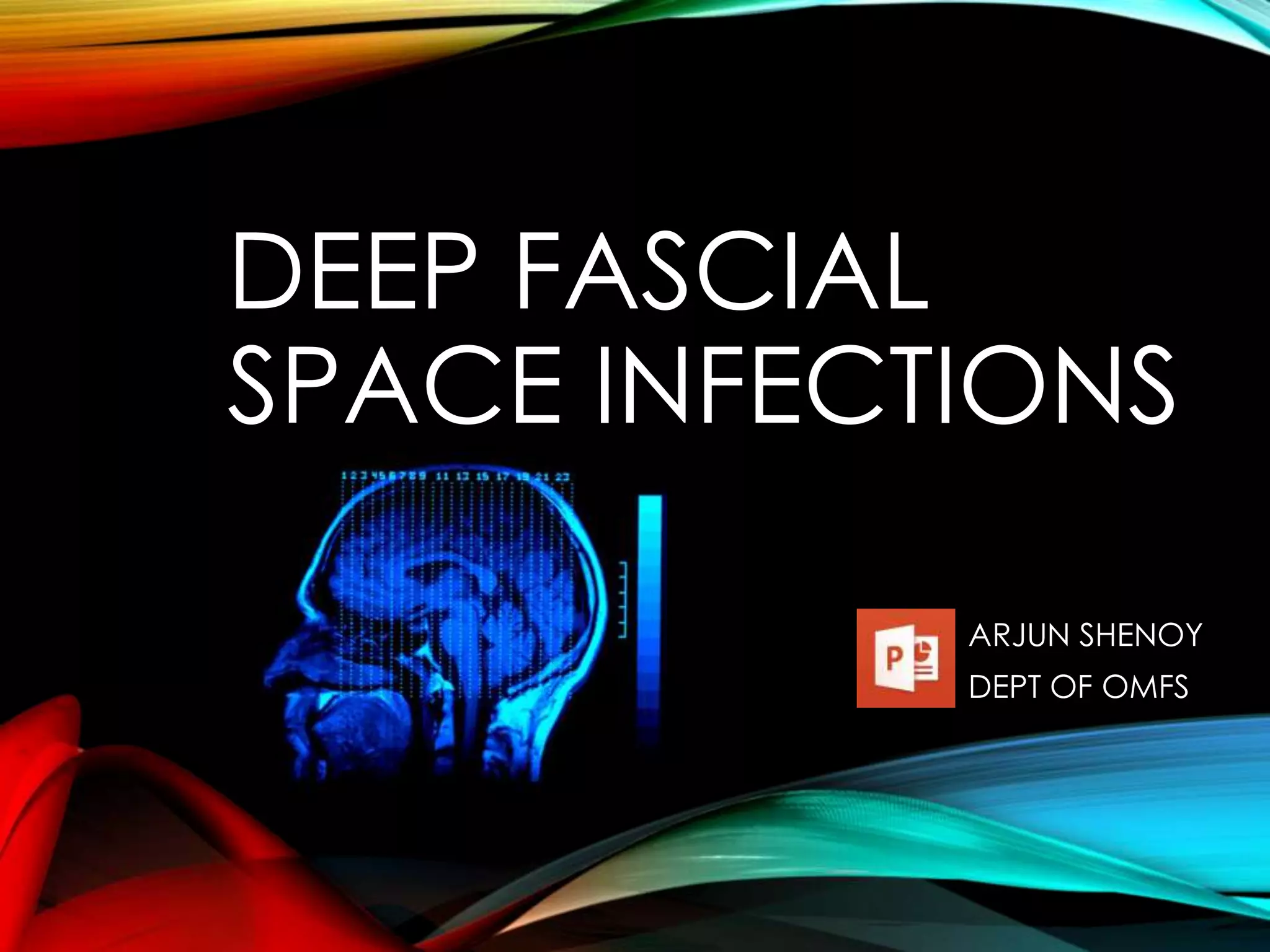
DEEP FASCIAL 
SPACE INFECTIONS 
ARJUN SHENOY 
DEPT OF OMFS
• HISTORY 
• PRINCIPLES OF EXAMINATION 
• CLASSIFICATION OF SPACES 
• ANATOMICAL CONSIDERATIONS 
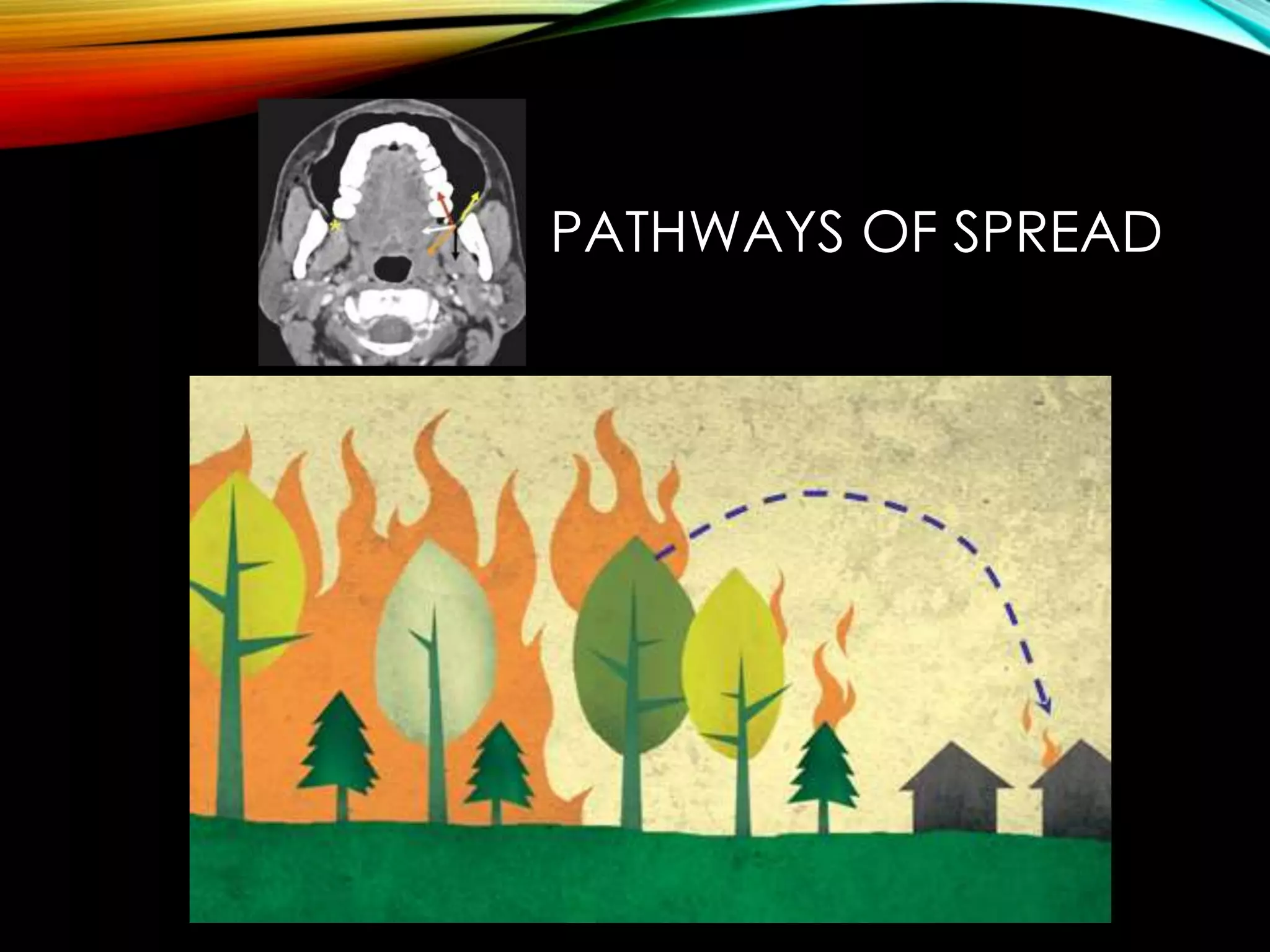
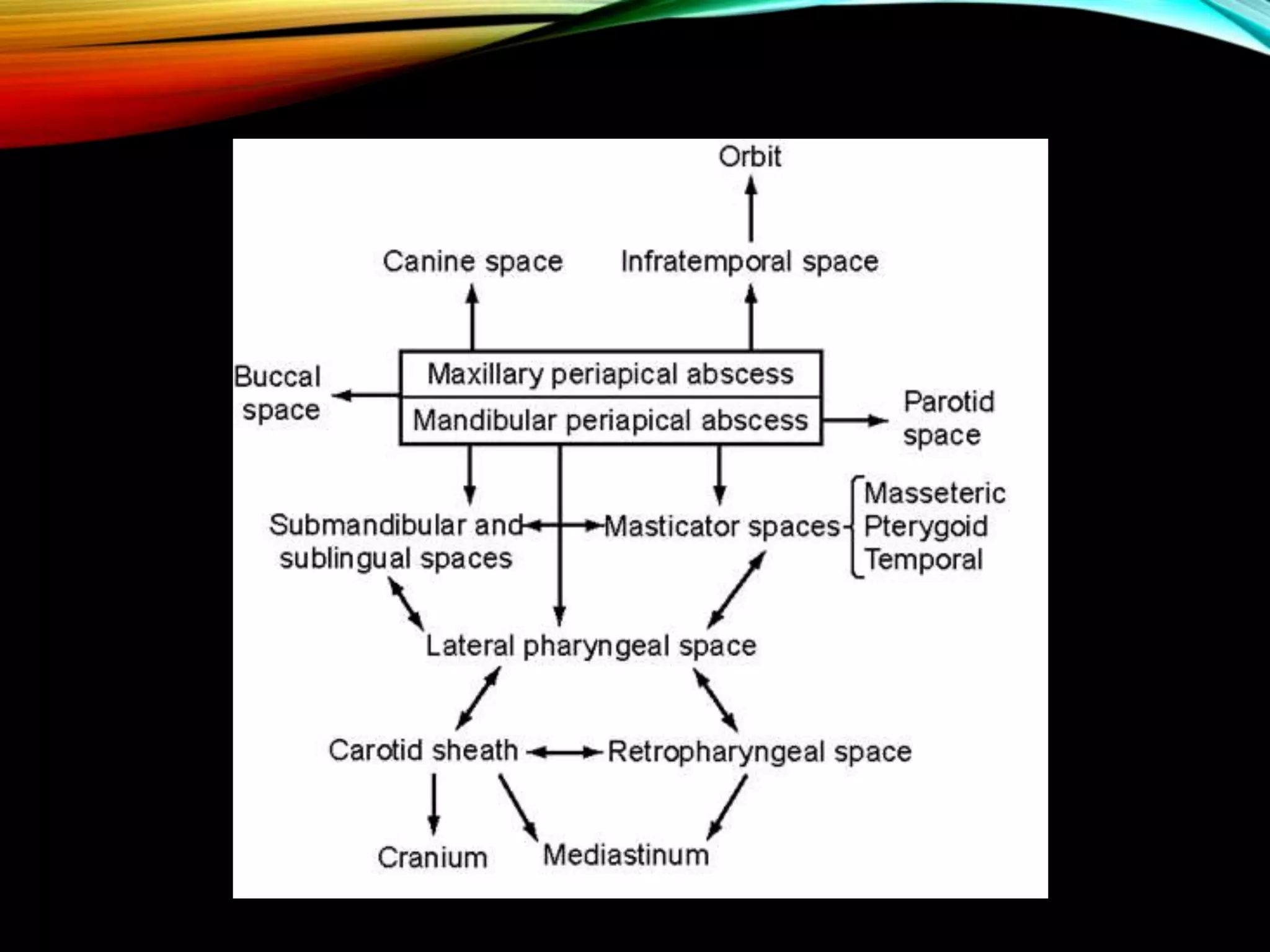
• PATHWAYS OF SPREAD 
• DIAGNOSTIC AIDS 
• SPACES 
• COMPLICATIONS 
• CONCLUSION 
• REFERENCES
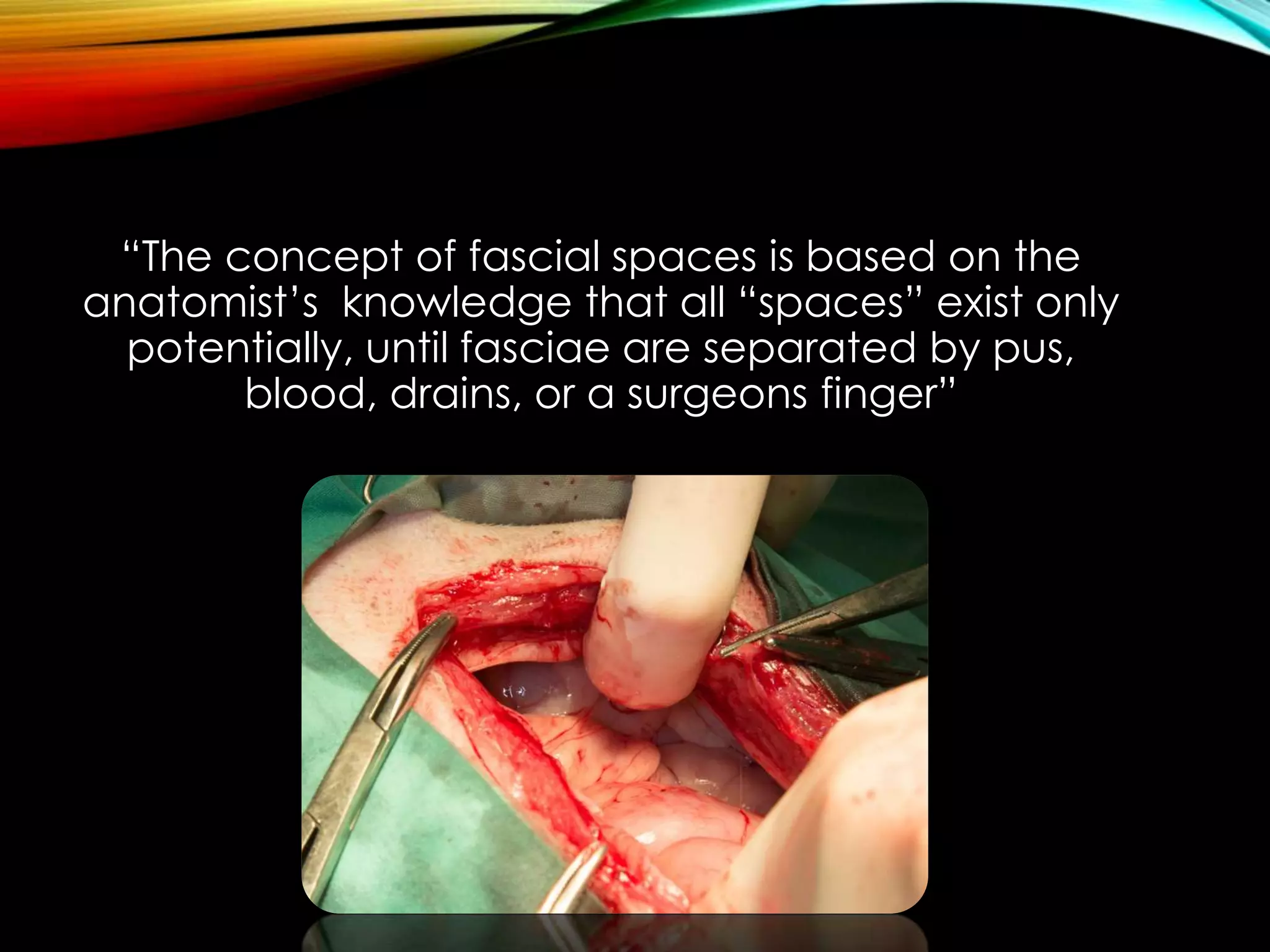
“The concept of fascial spaces is based on the 
anatomist’s knowledge that all “spaces” exist only 
potentially, until fasciae are separated by pus, 
blood, drains, or a surgeons finger”
INTRODUCTION 
Shapiro defined fascial spaces as potential spaces 
between the layers of the fascia 
Filled by connective tissue
HISTORY 
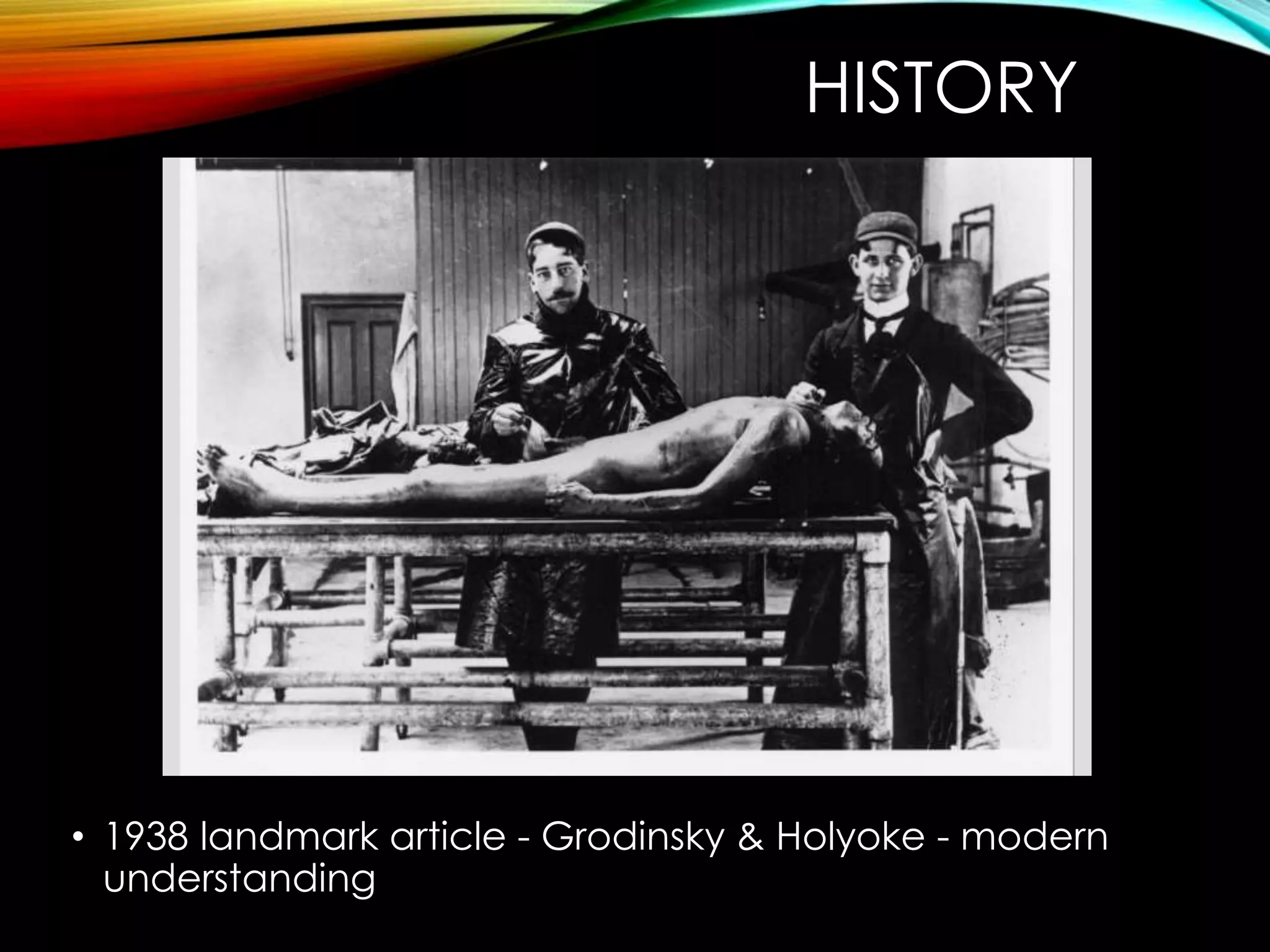
• 1938 landmark article - Grodinsky & Holyoke - modern 
understanding
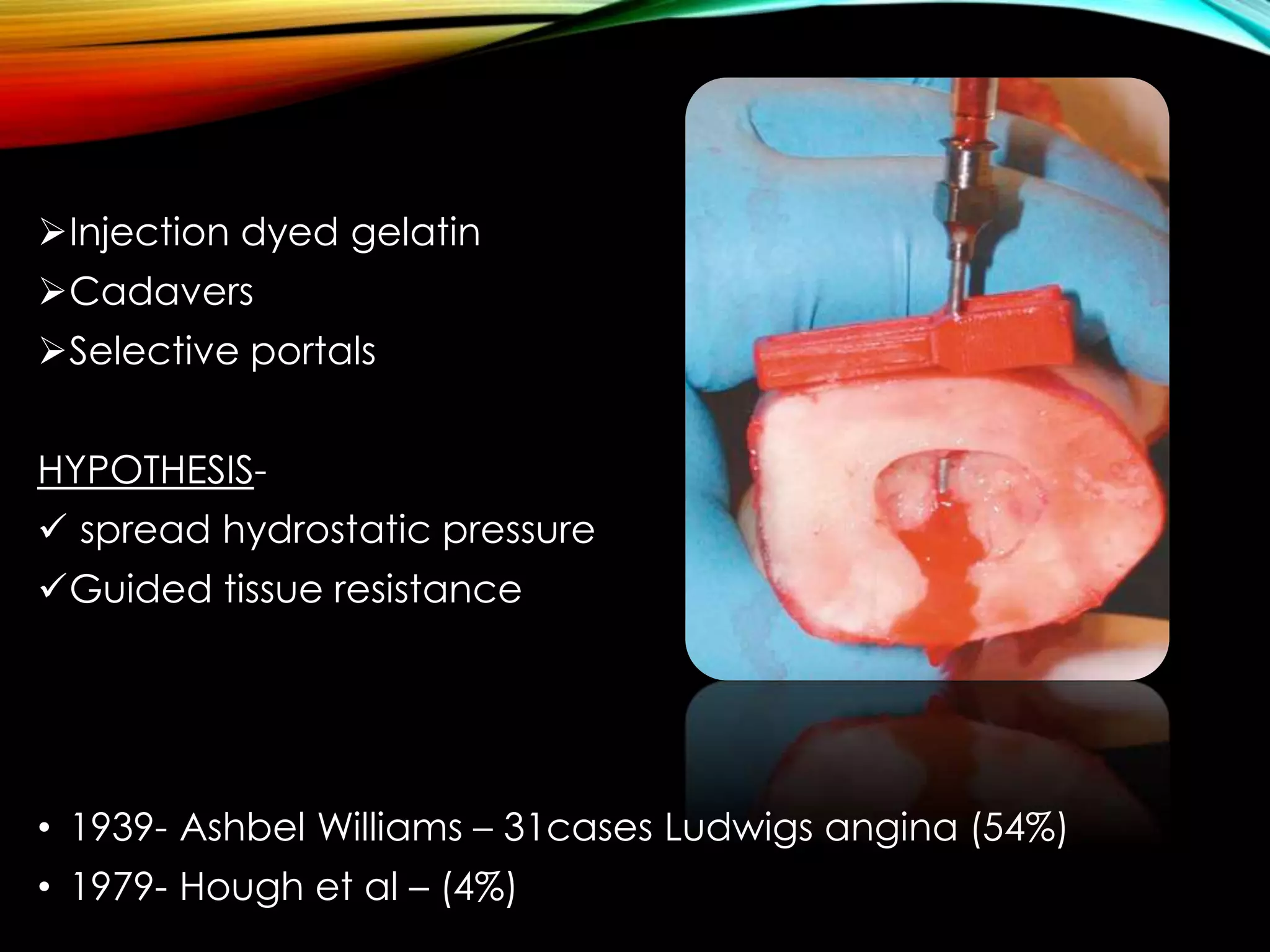
Injection dyed gelatin 
Cadavers 
Selective portals 
HYPOTHESIS- 
 spread hydrostatic pressure 
Guided tissue resistance 
• 1939- Ashbel Williams – 31cases Ludwigs angina (54%) 
• 1979- Hough et al – (4%)
PRINCIPLES OF 
EXAMINATION 
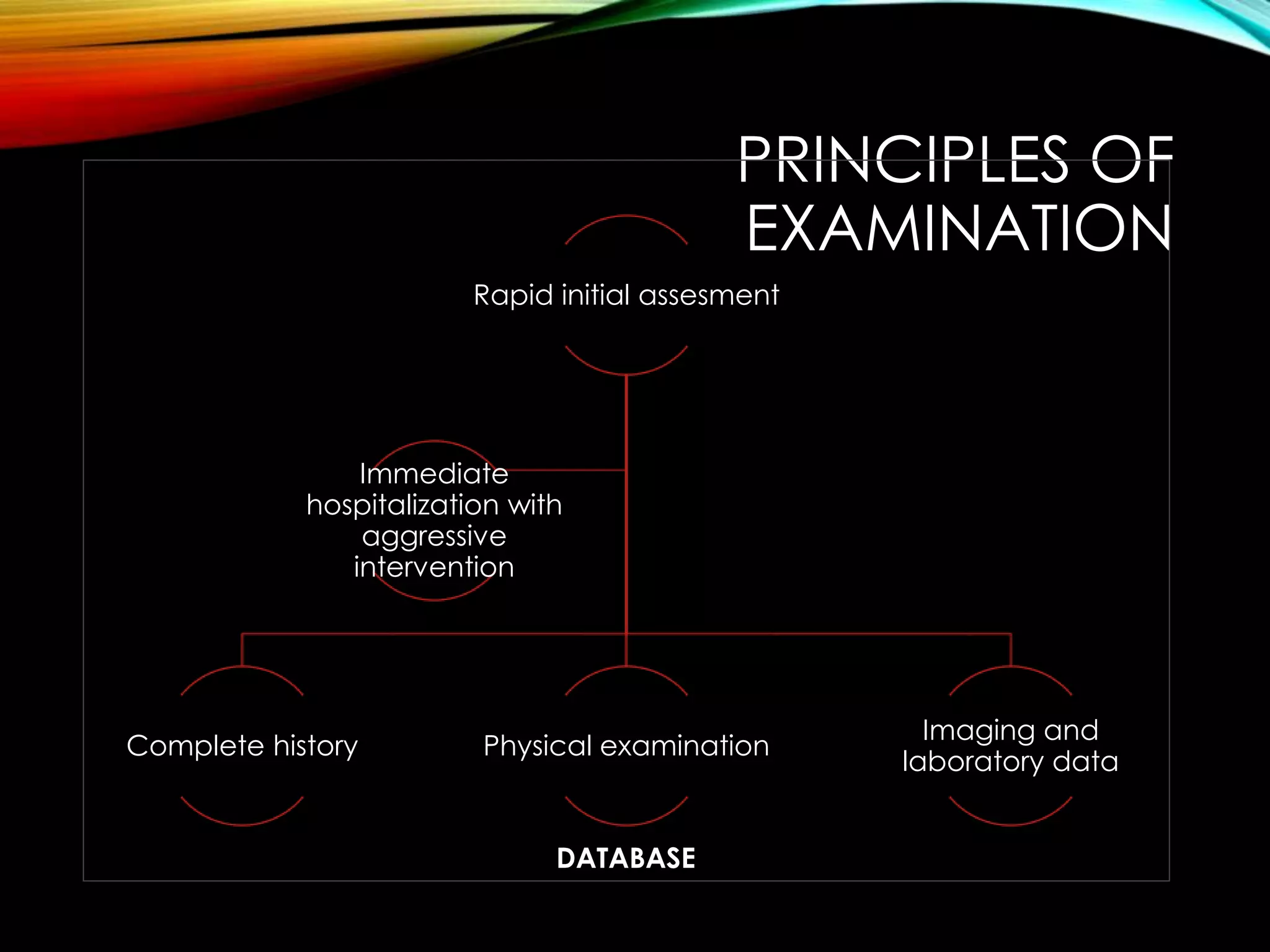
Rapid initial assesment 
Complete history Physical examination 
Imaging and 
laboratory data 
Immediate 
hospitalization with 
aggressive 
intervention 
DATABASE
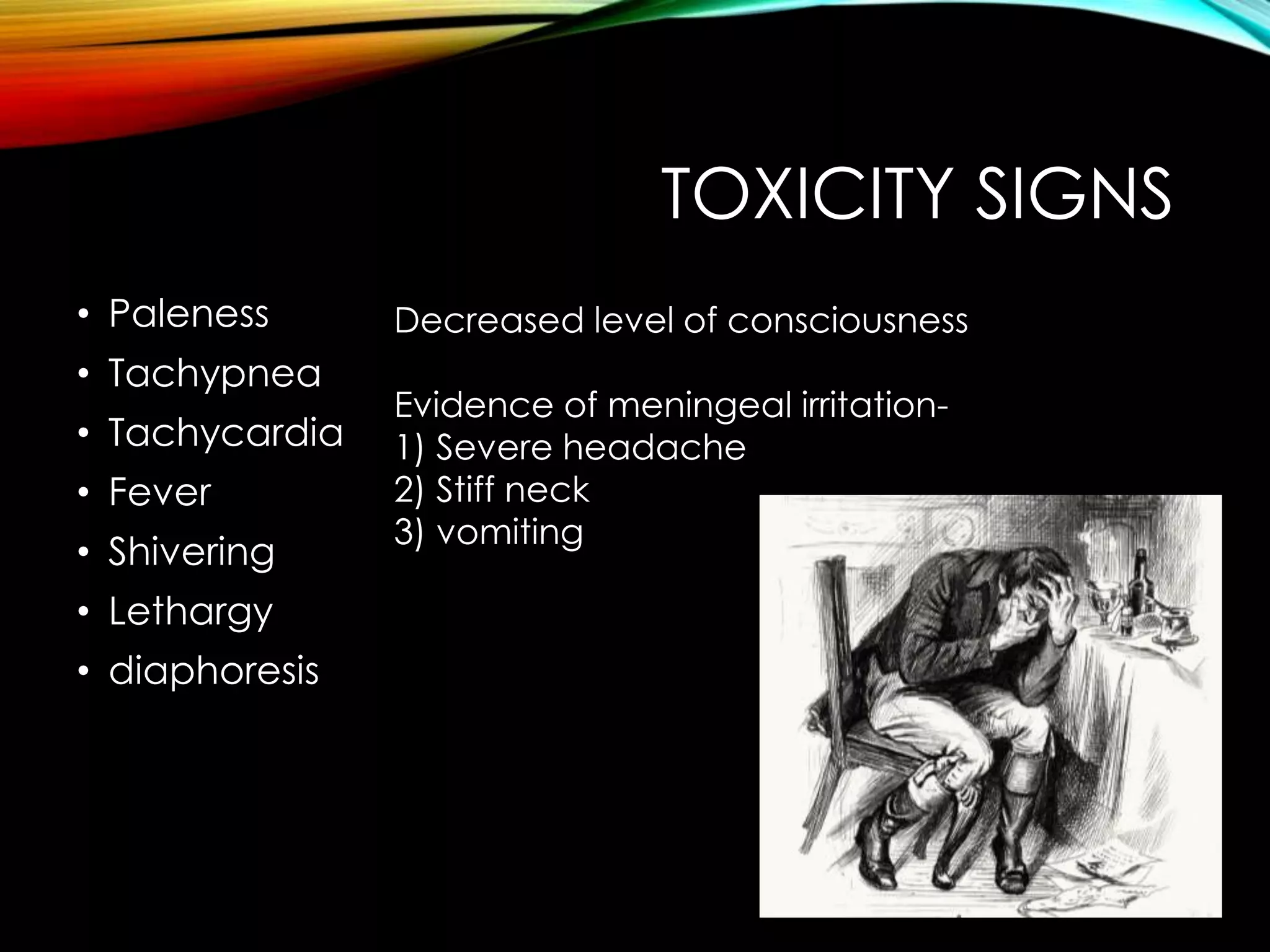
TOXICITY SIGNS 
• Paleness 
• Tachypnea 
• Tachycardia 
• Fever 
• Shivering 
• Lethargy 
• diaphoresis 
Decreased level of consciousness 
Evidence of meningeal irritation- 
1) Severe headache 
2) Stiff neck 
3) vomiting
PATHWAYS OF SPREAD
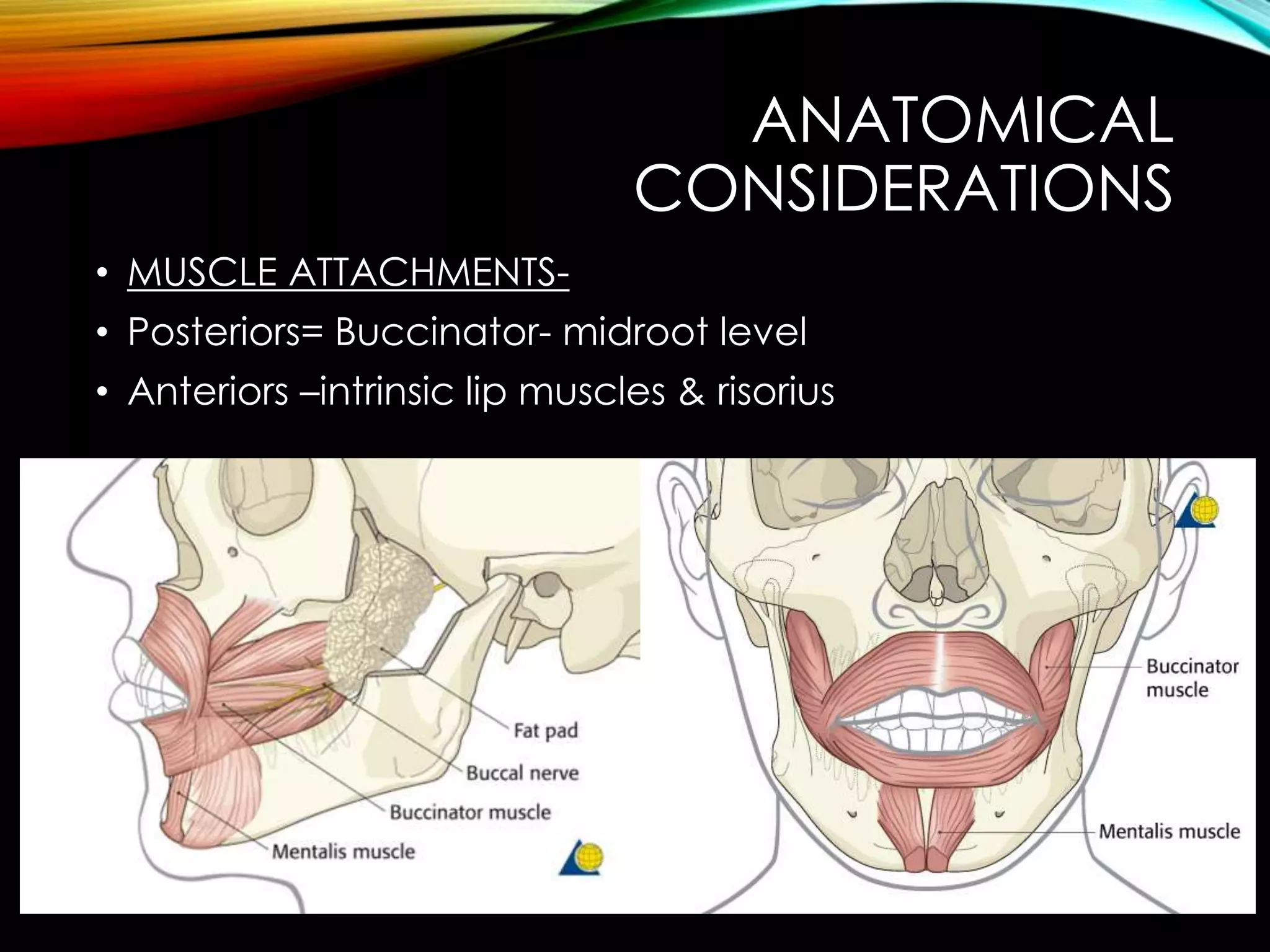
ANATOMICAL 
CONSIDERATIONS 
• MUSCLE ATTACHMENTS- 
• Posteriors= Buccinator- midroot level 
• Anteriors –intrinsic lip muscles & risorius
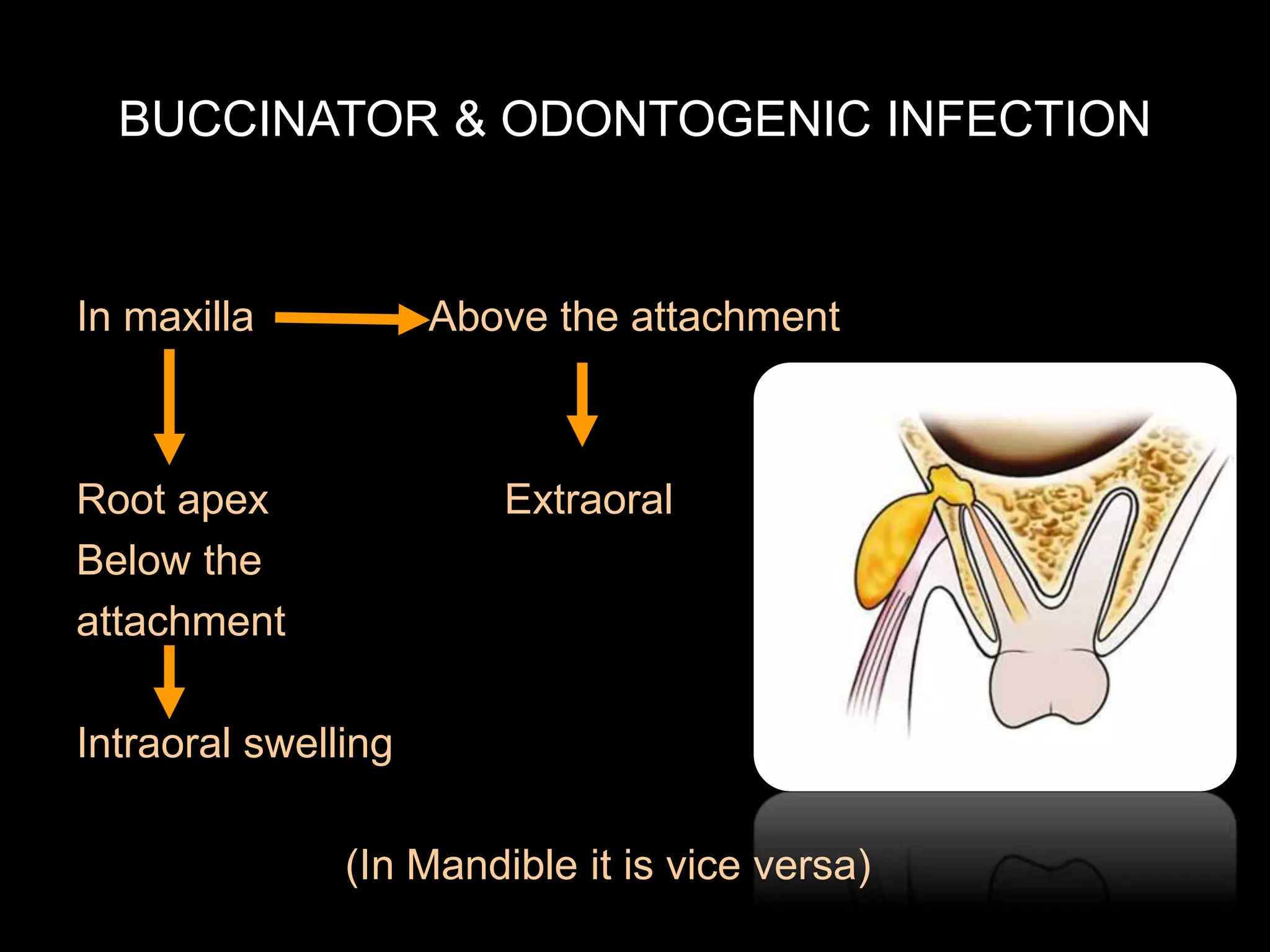
BUCCINATOR & ODONTOGENIC INFECTION 
In maxilla Above the attachment 
Root apex Extraoral 
Below the 
attachment 
Intraoral swelling 
(In Mandible it is vice versa)
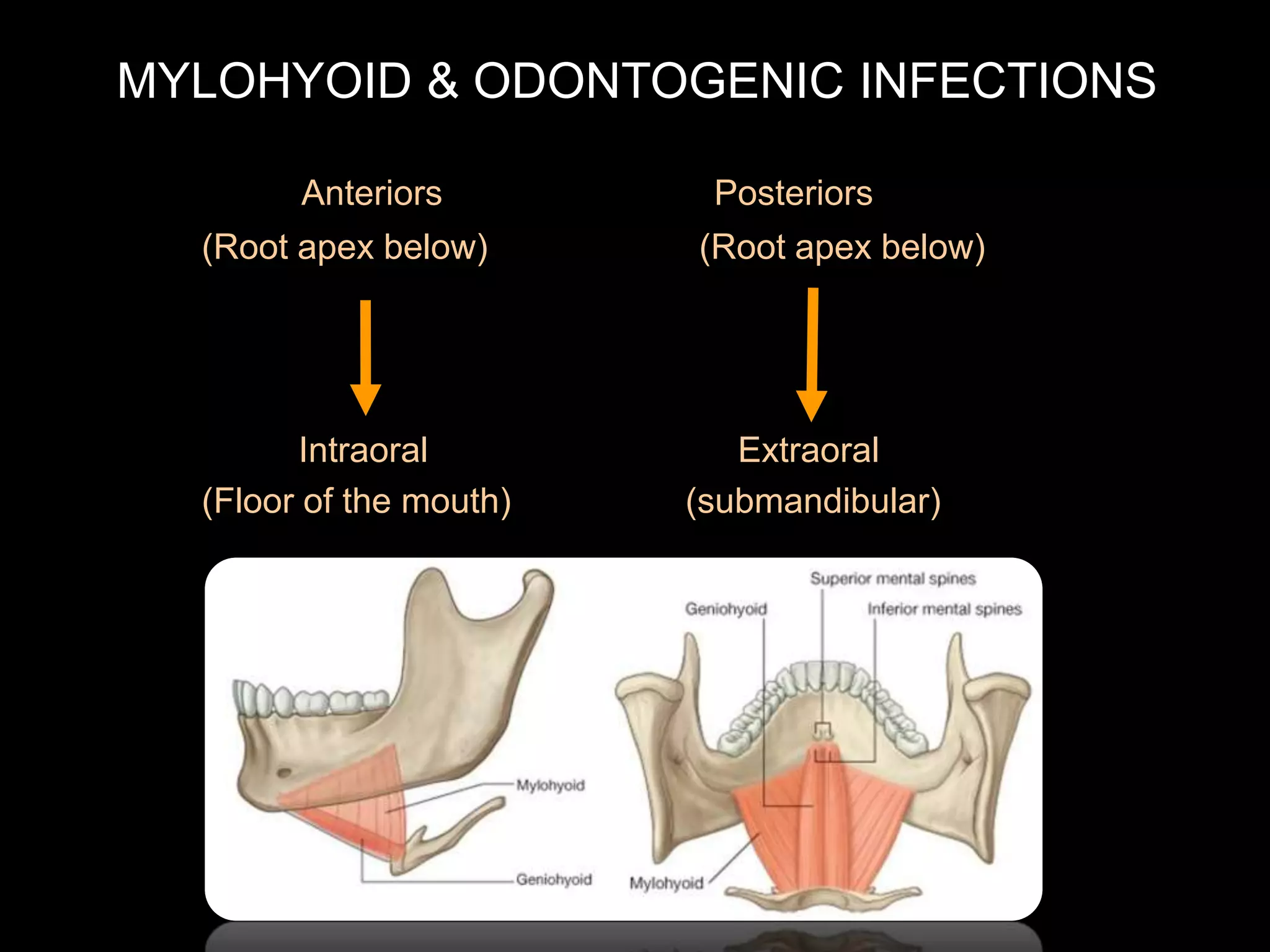
MYLOHYOID & ODONTOGENIC INFECTIONS 
Anteriors Posteriors 
(Root apex below) (Root apex below) 
Intraoral Extraoral 
(Floor of the mouth) (submandibular)
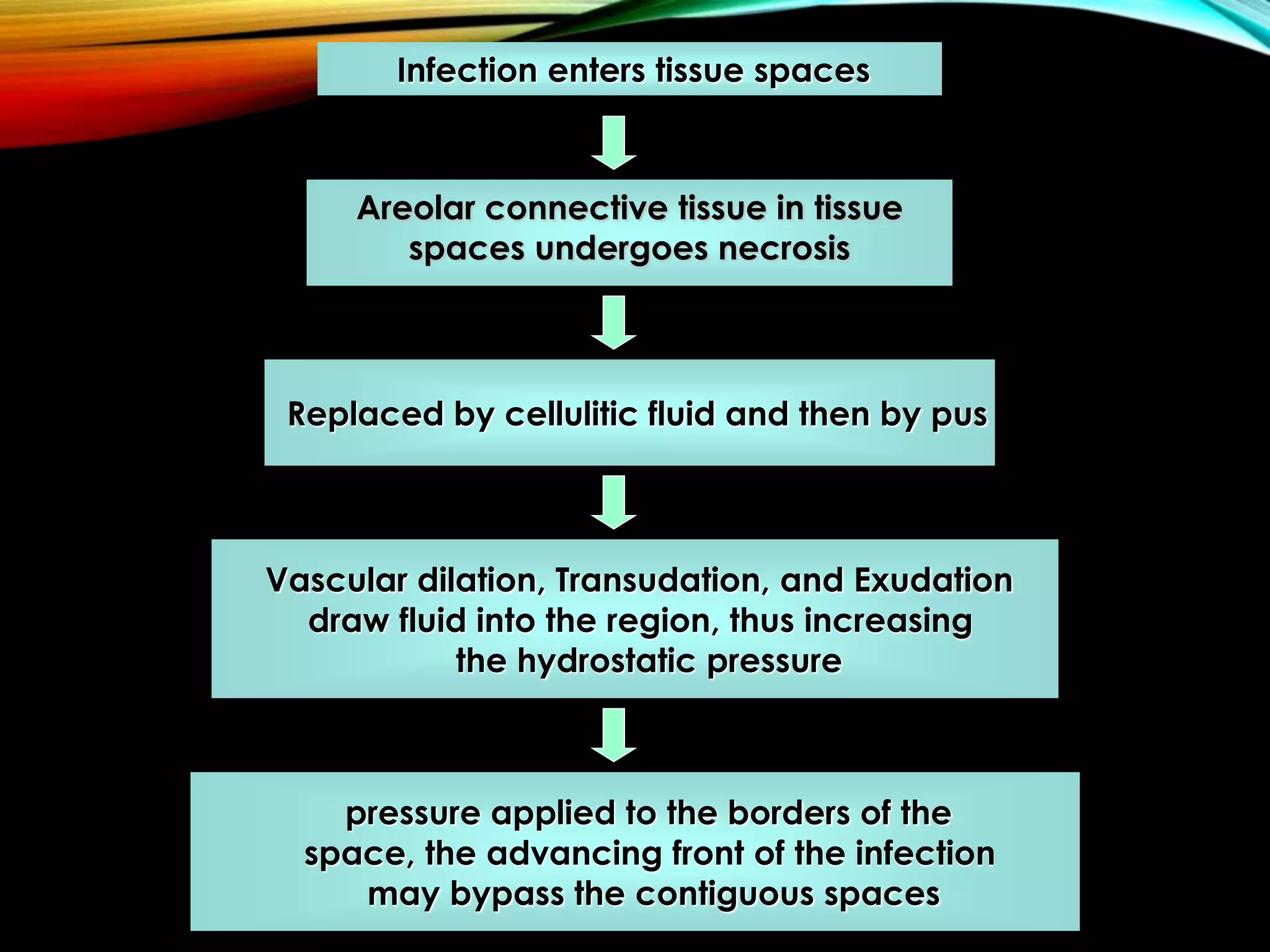
Infection enters tissue spaces 
Areolar connective tissue in tissue 
spaces undergoes necrosis 
Replaced by cellulitic fluid and then by pus 
Vascular dilation, Transudation, and Exudation 
draw fluid into the region, thus increasing 
the hydrostatic pressure 
pressure applied to the borders of the 
space, the advancing front of the infection 
may bypass the contiguous spaces
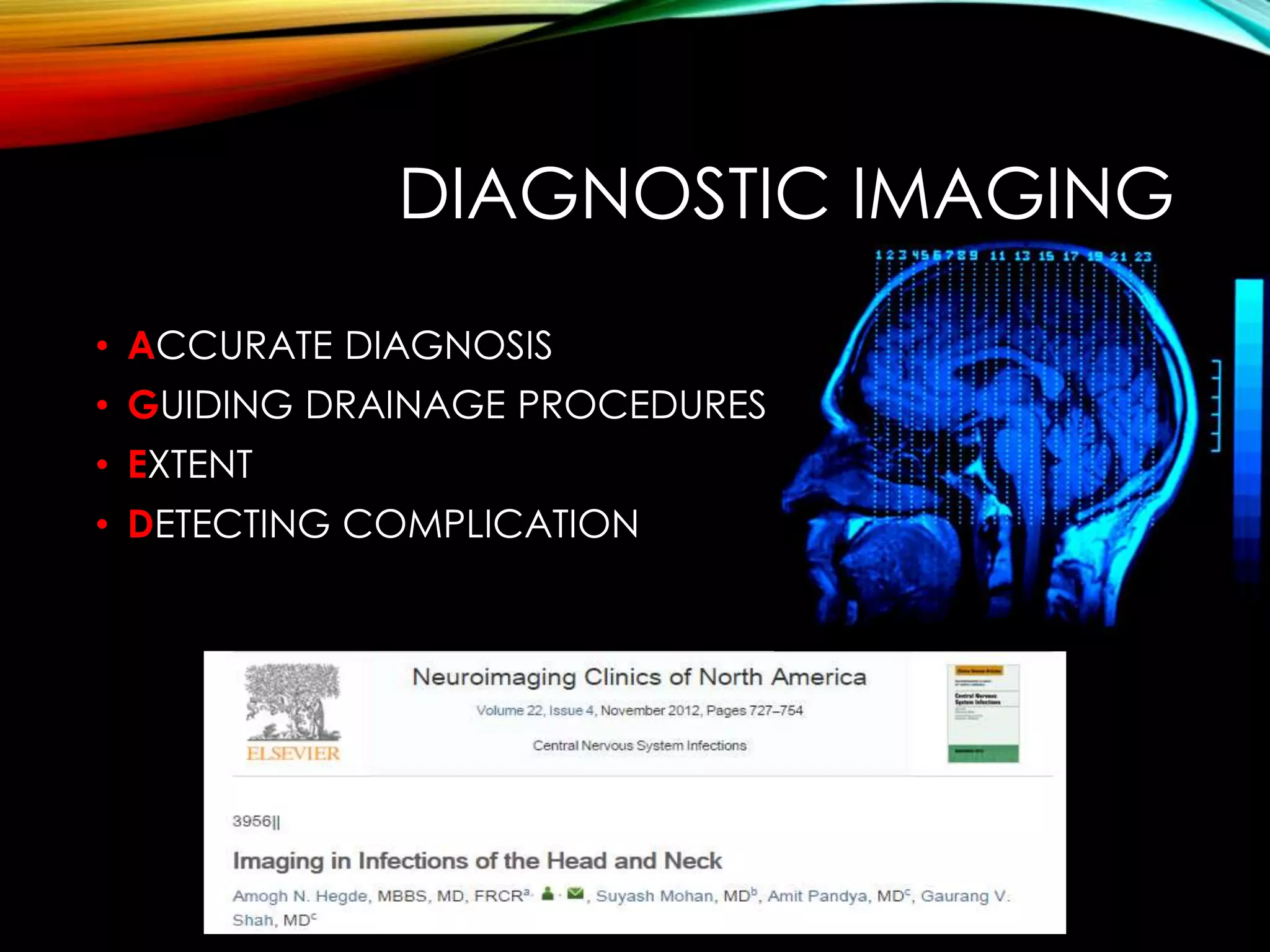
DIAGNOSTIC IMAGING 
• ACCURATE DIAGNOSIS 
• GUIDING DRAINAGE PROCEDURES 
• EXTENT 
• DETECTING COMPLICATION
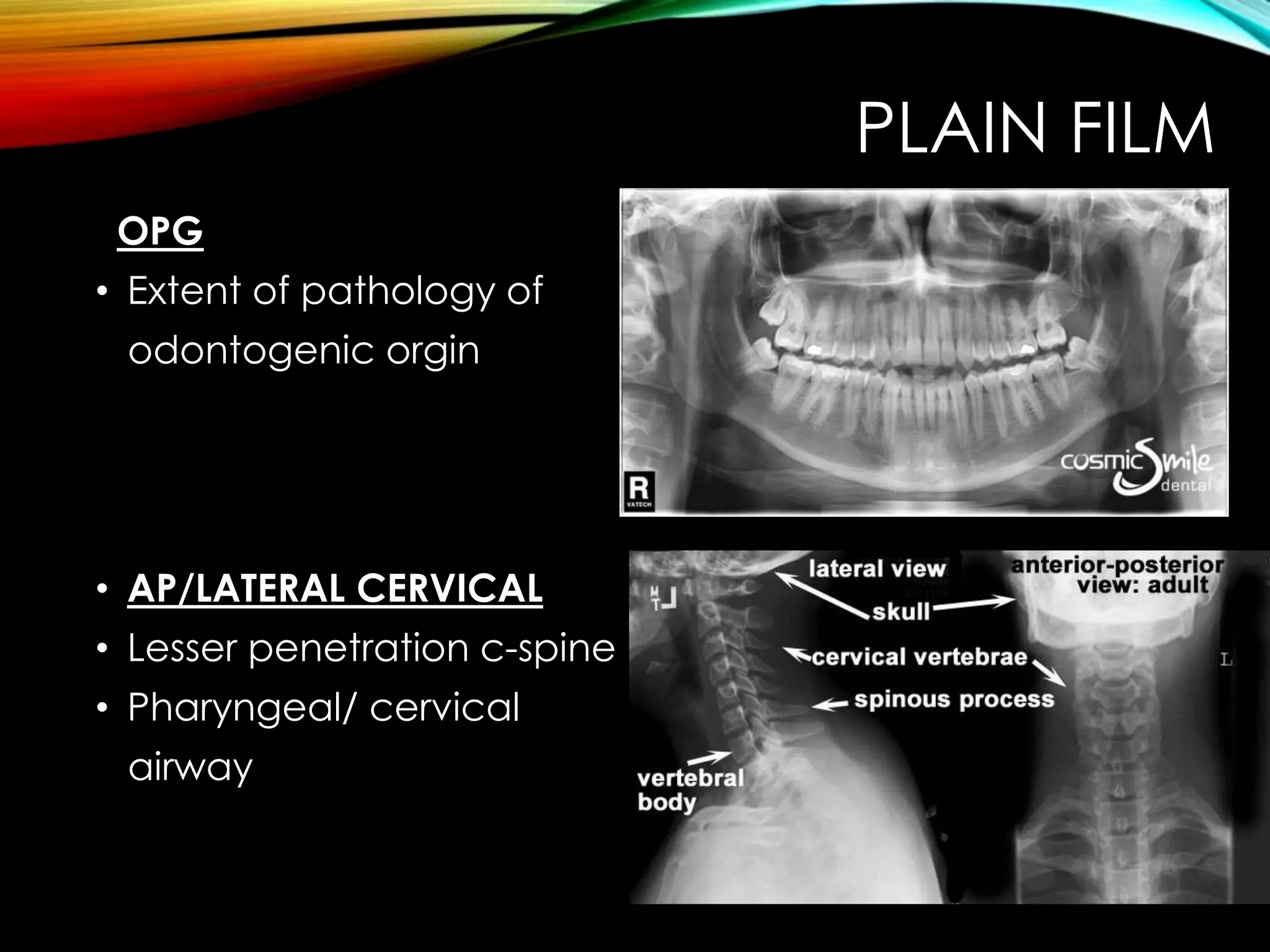
PLAIN FILM 
OPG 
• Extent of pathology of 
odontogenic orgin 
• AP/LATERAL CERVICAL 
• Lesser penetration c-spine 
• Pharyngeal/ cervical 
airway
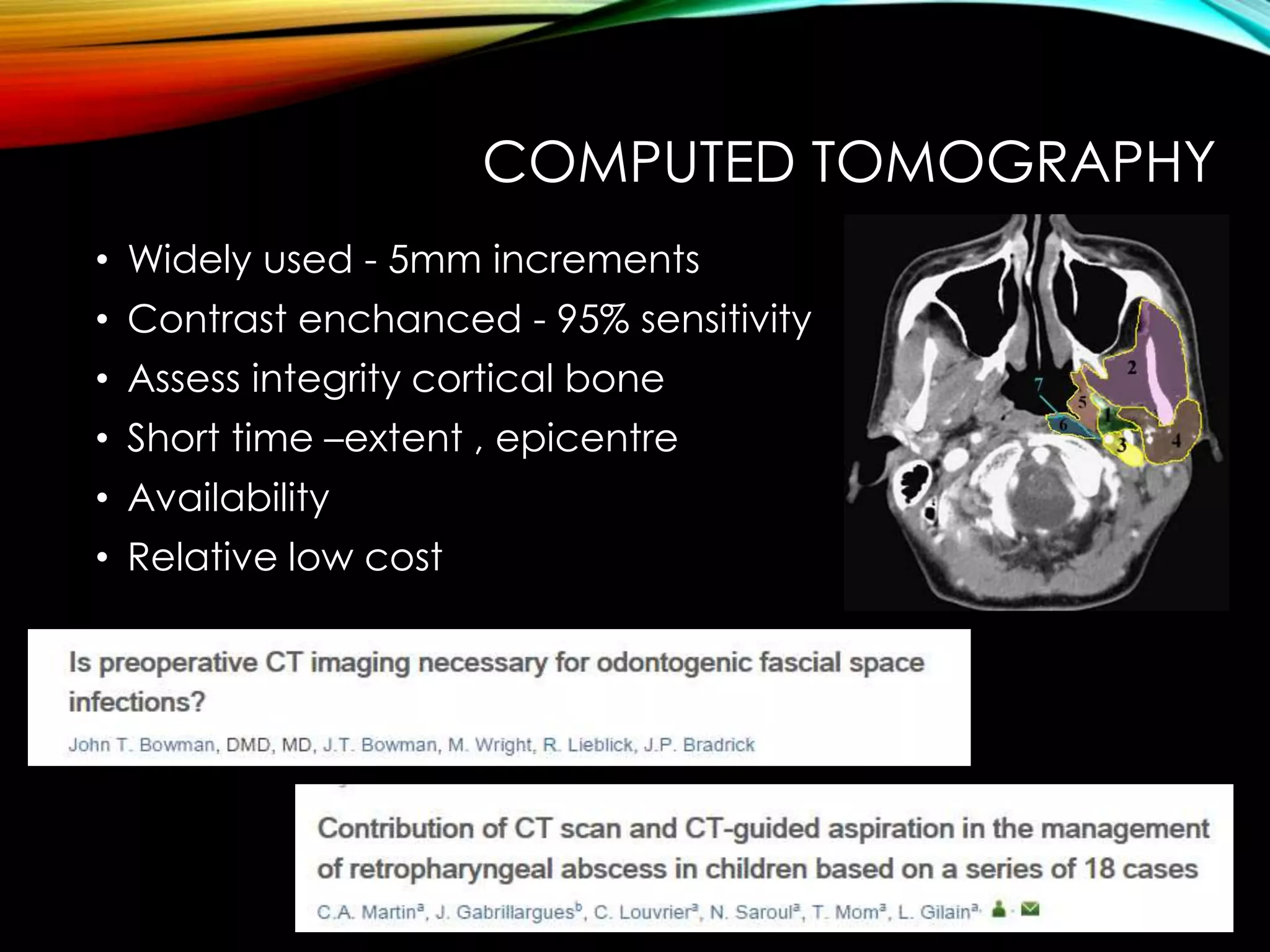
COMPUTED TOMOGRAPHY 
• Widely used - 5mm increments 
• Contrast enchanced - 95% sensitivity 
• Assess integrity cortical bone 
• Short time –extent , epicentre 
• Availability 
• Relative low cost
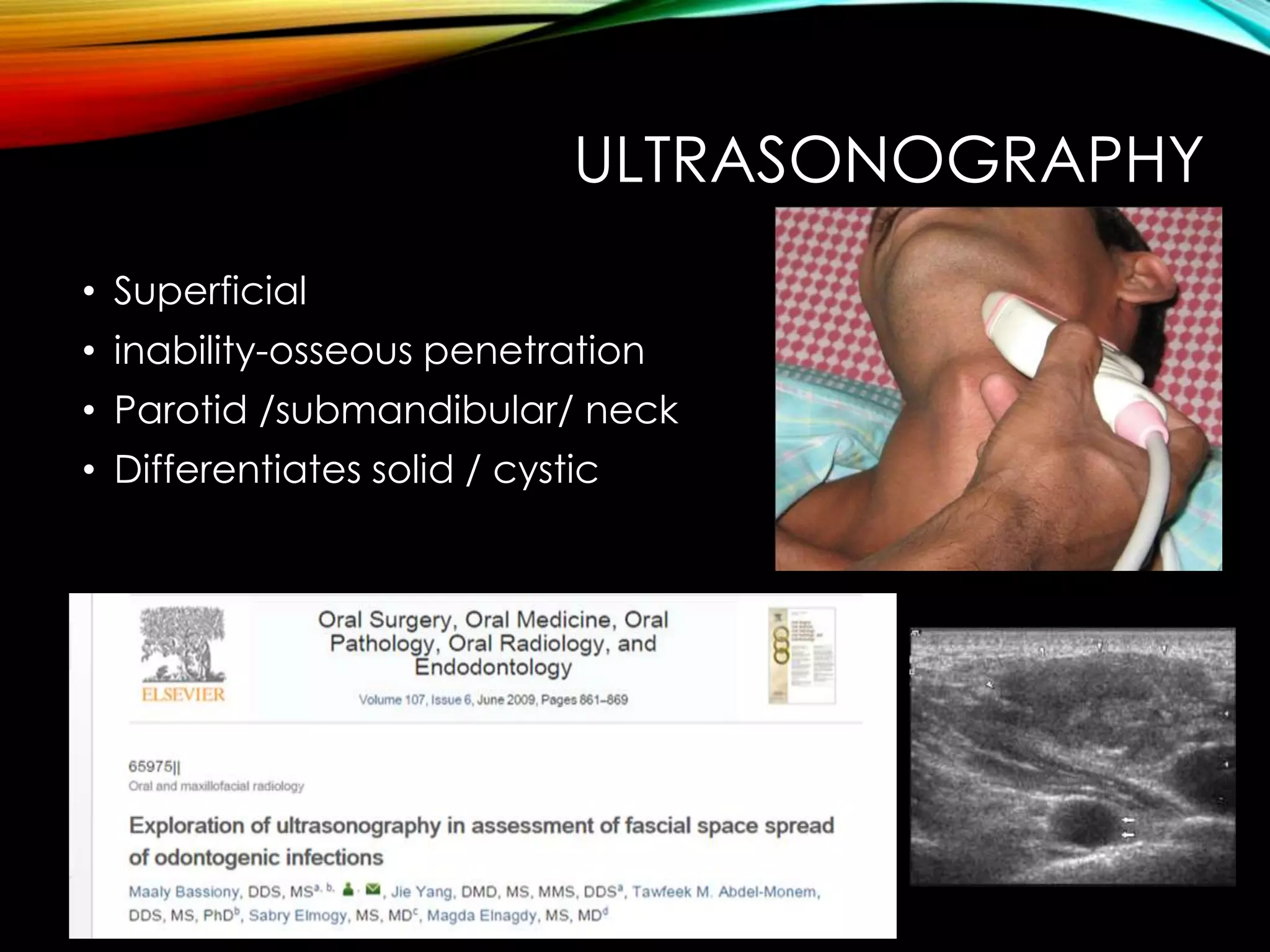
ULTRASONOGRAPHY 
• Superficial 
• inability-osseous penetration 
• Parotid /submandibular/ neck 
• Differentiates solid / cystic
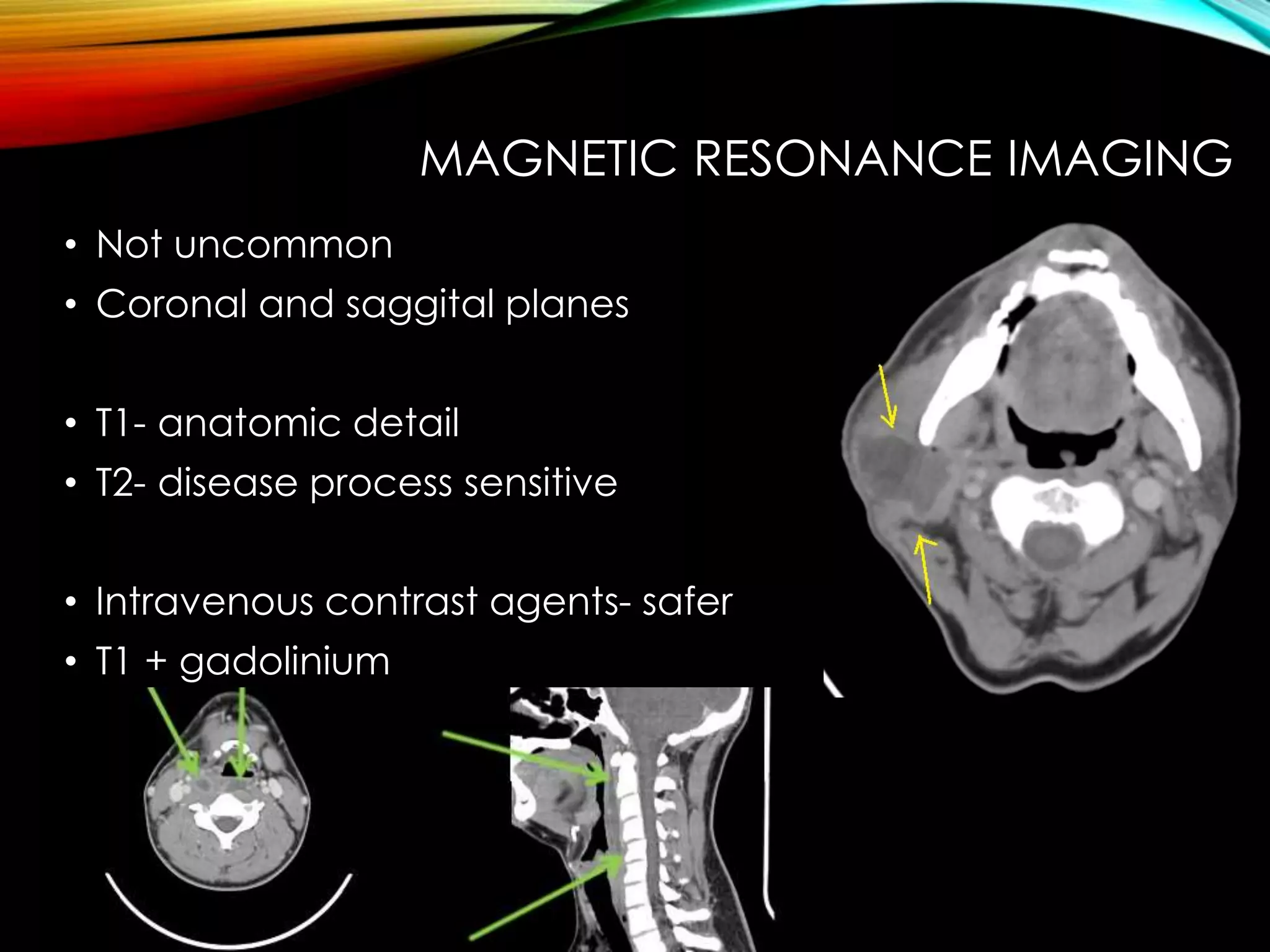
MAGNETIC RESONANCE IMAGING 
• Not uncommon 
• Coronal and saggital planes 
• T1- anatomic detail 
• T2- disease process sensitive 
• Intravenous contrast agents- safer 
• T1 + gadolinium
FASCIAL SPACES OF CLINICAL 
FACE SIGNIFICANCE* 
o Buccal 
o Canine 
o Masticator 
 Massetric compartment 
 Pterygoid compartment 
 Zygomaticotemporal compartment 
SUPRAHYOID 
Sublingual 
Submandibular 
Lateral pharyngeal 
Peritonsillar 
* RICHARD G TOPAZIAN , ORAL & MAXILLOFACIAL INFECTION 4TH EDITION
CONTINUED 
INFRAHYOID 
 Anterovisceral (paratracheal) 
SPACE OF TOTAL NECK 
Retropharyngeal 
Danger space 
Space of carotid sheath 
 RICHARD G TOPAZIAN , ORAL & MAXILLOFACIAL INFECTION 4TH EDITION
Based on mode of involvement 
 DIRECT INVOLVEMENT (Primary spaces) 
Maxillary spaces - canine, buccal, and infratemporal . . 
Mandibular spaces - submental, buccal, submandibular, and 
sublingual . 
 INDIRECT INVOLVEMENT (Secondary spaces) 
Masseteric, 
Pterygomandibular, 
Parotid, 
Superficial and deep temporal, 
Lateral pharyngeal, 
Retropharyngeal and 
Prevertebral spaces
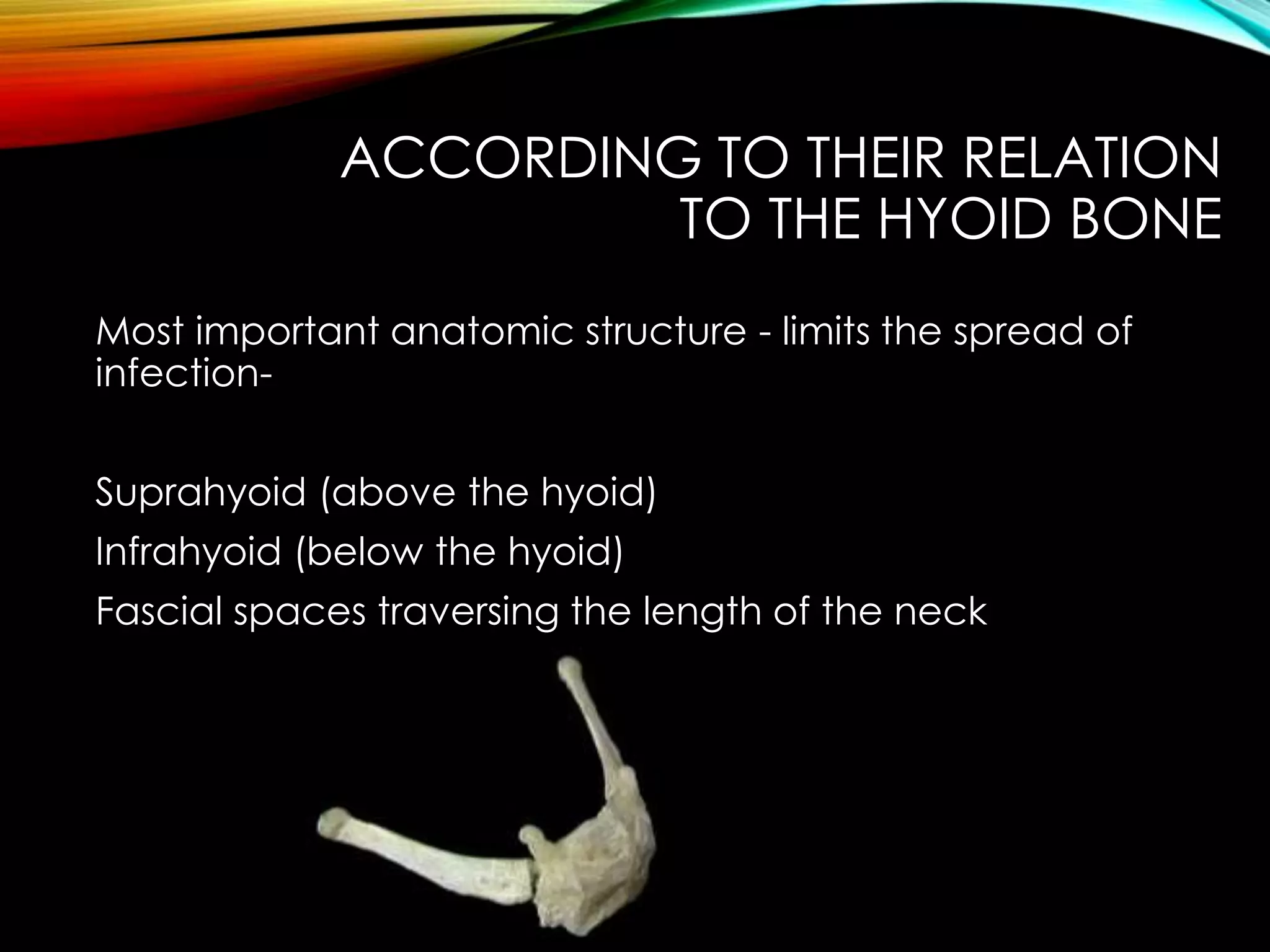
ACCORDING TO THEIR RELATION 
TO THE HYOID BONE 
Most important anatomic structure - limits the spread of 
infection- 
Suprahyoid (above the hyoid) 
Infrahyoid (below the hyoid) 
Fascial spaces traversing the length of the neck
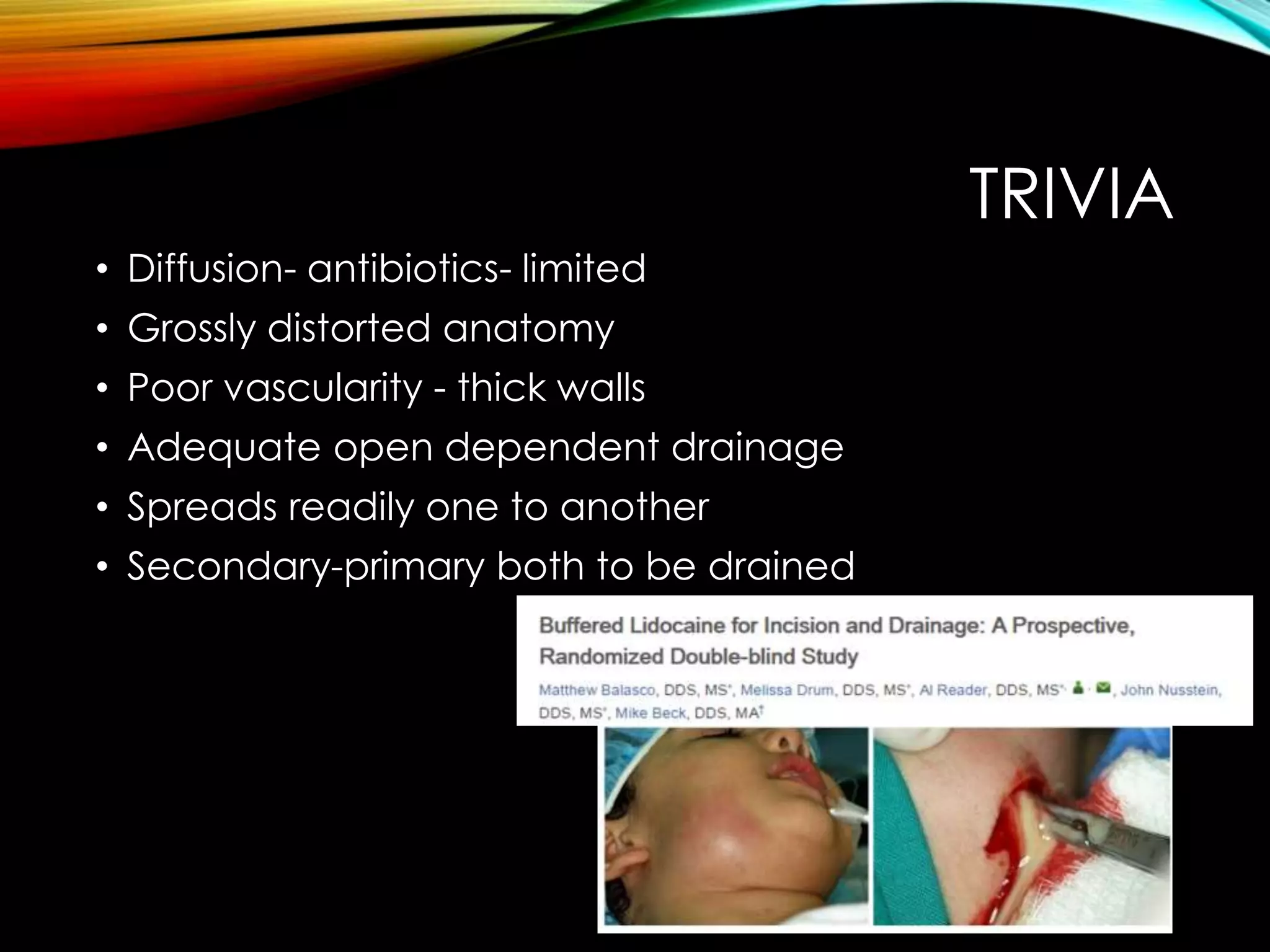
TRIVIA 
• Diffusion- antibiotics- limited 
• Grossly distorted anatomy 
• Poor vascularity - thick walls 
• Adequate open dependent drainage 
• Spreads readily one to another 
• Secondary-primary both to be drained
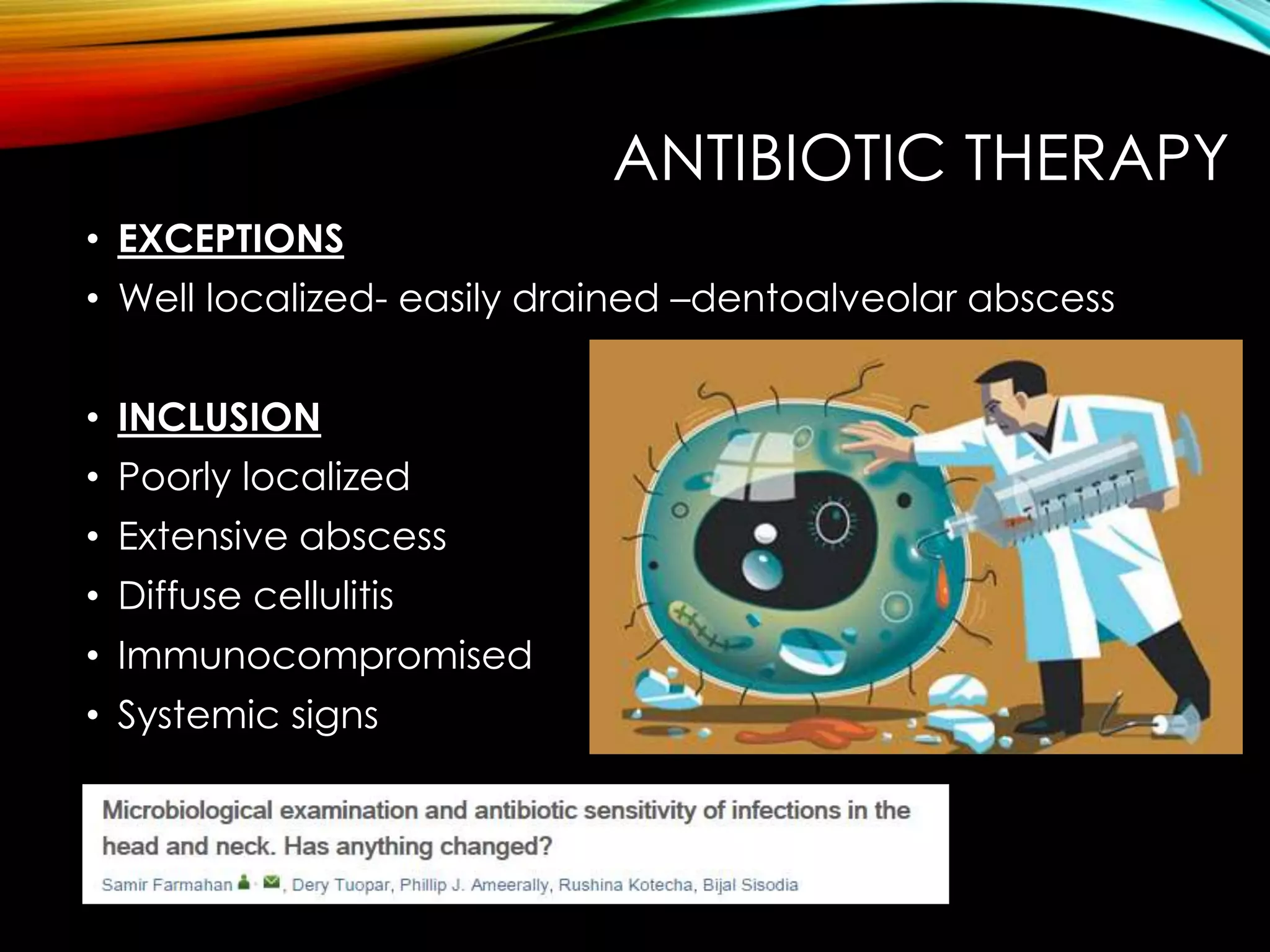
ANTIBIOTIC THERAPY 
• EXCEPTIONS 
• Well localized- easily drained –dentoalveolar abscess 
• INCLUSION 
• Poorly localized 
• Extensive abscess 
• Diffuse cellulitis 
• Immunocompromised 
• Systemic signs
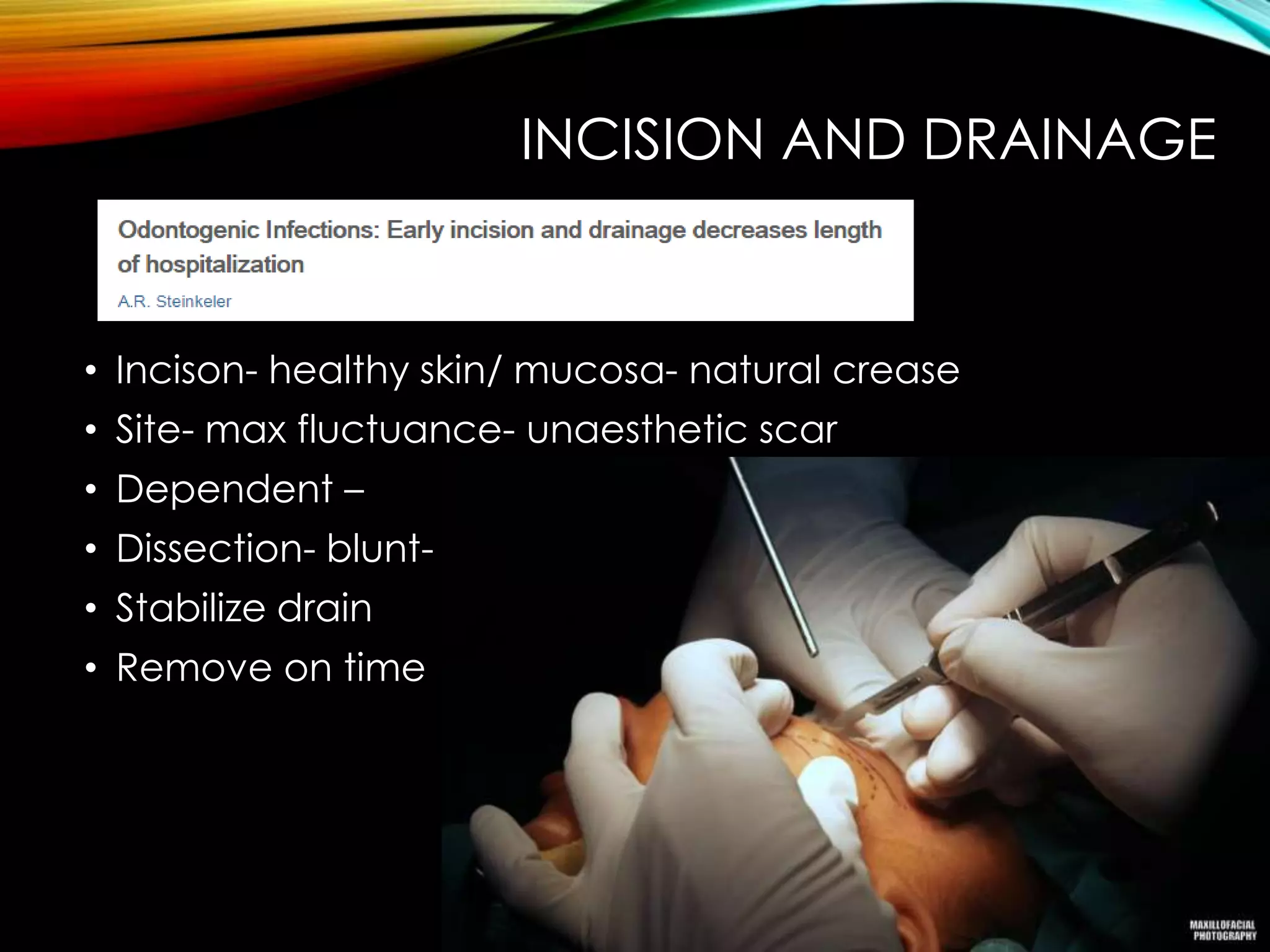
INCISION AND DRAINAGE 
• Incison- healthy skin/ mucosa- natural crease 
• Site- max fluctuance- unaesthetic scar 
• Dependent – 
• Dissection- blunt- full extent 
• Stabilize drain 
• Remove on time
RECENT ADVANCES 
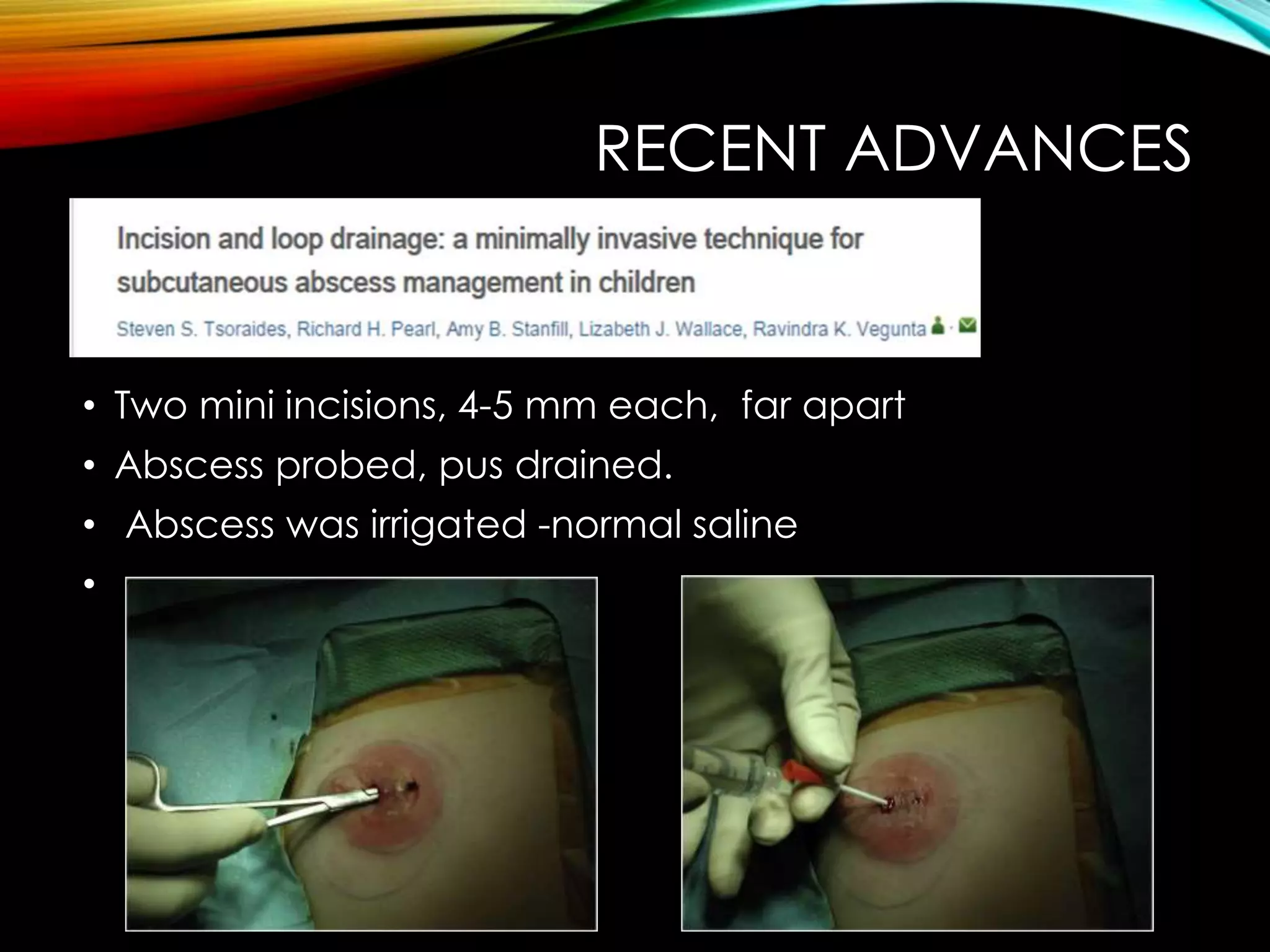
• Two mini incisions, 4-5 mm each, far apart 
• Abscess probed, pus drained. 
• Abscess was irrigated -normal saline 
•
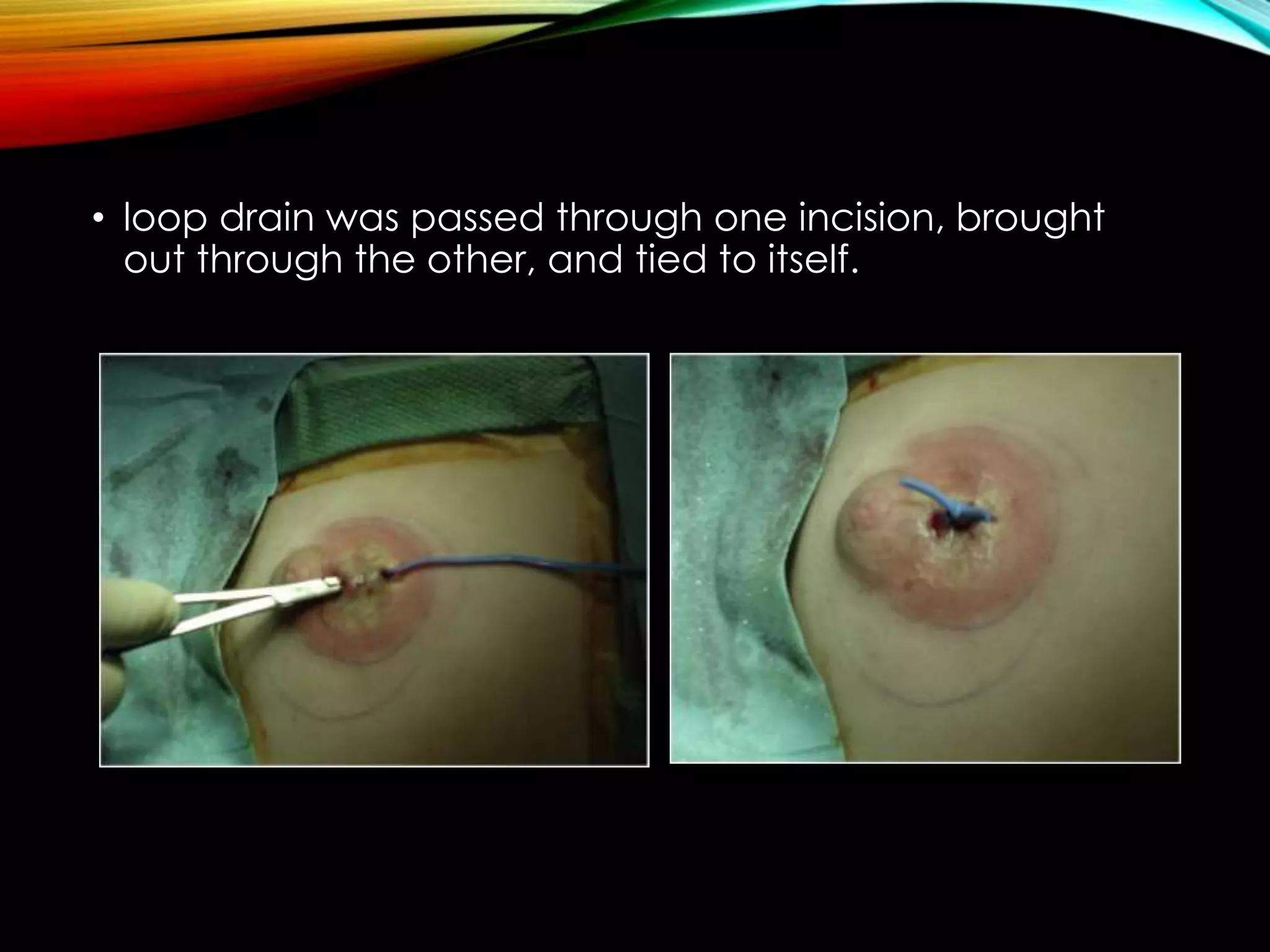
• loop drain was passed through one incision, brought 
out through the other, and tied to itself.
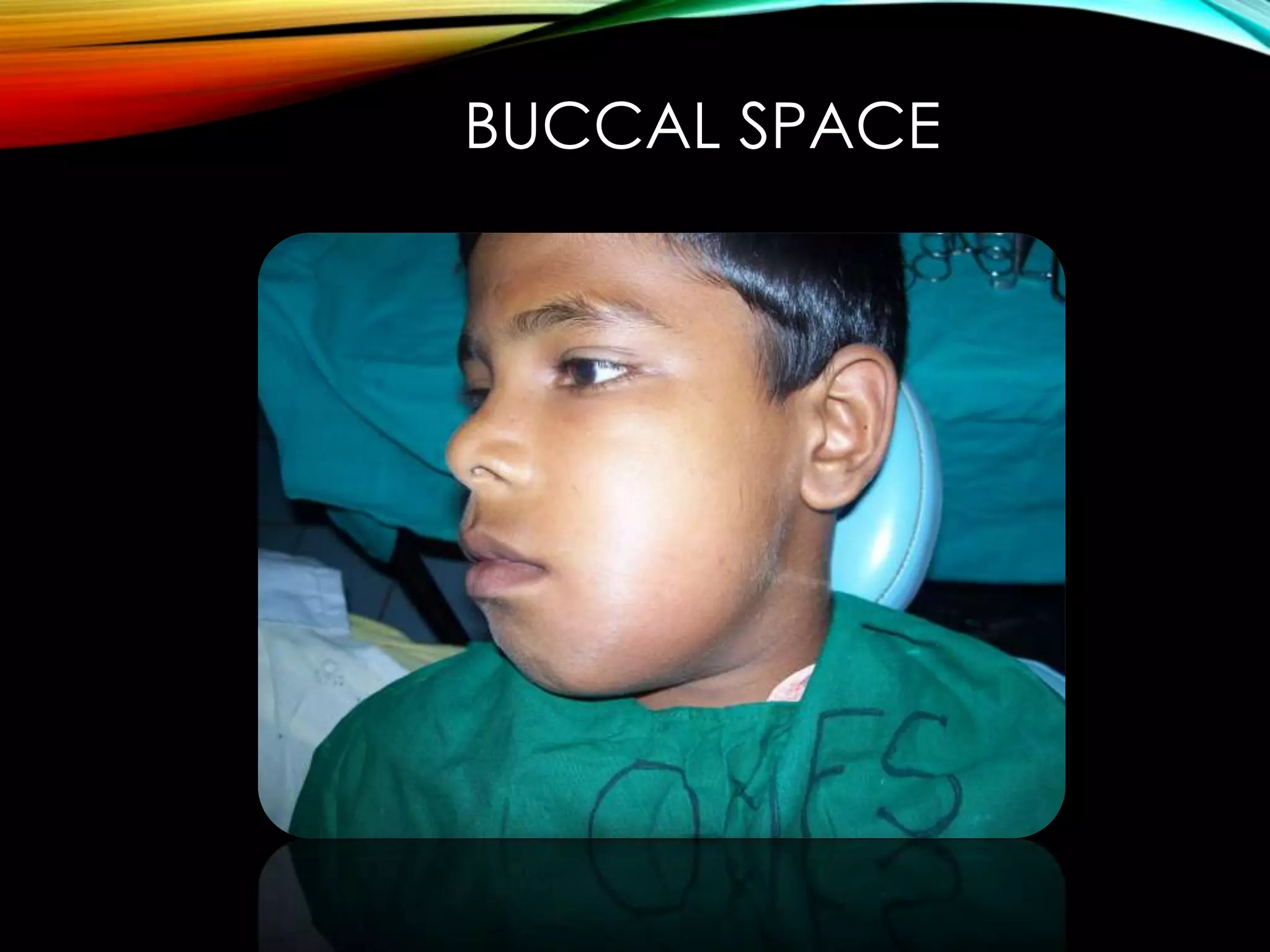
BUCCAL SPACE
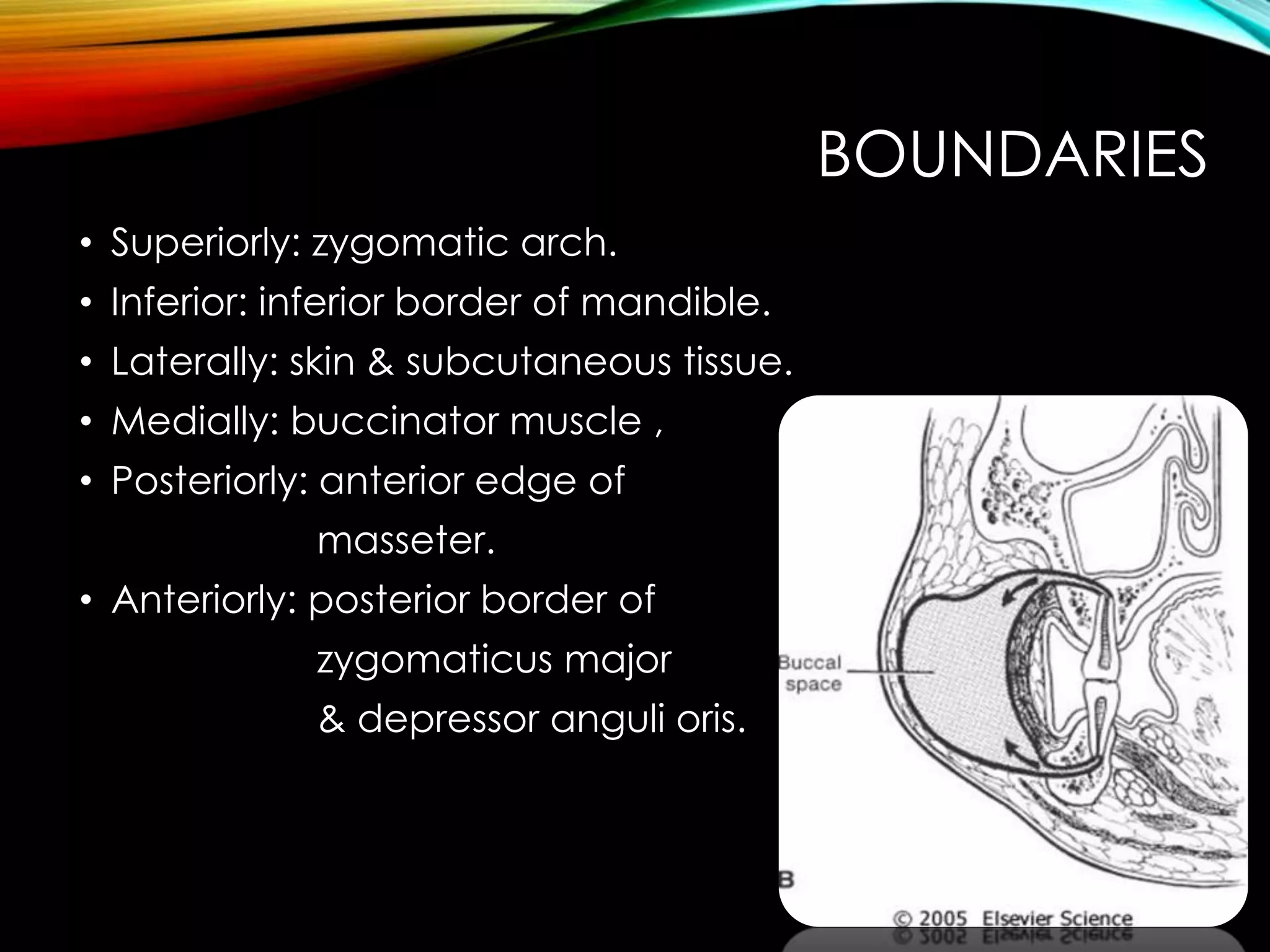
BOUNDARIES 
• Superiorly: zygomatic arch. 
• Inferior: inferior border of mandible. 
• Laterally: skin & subcutaneous tissue. 
• Medially: buccinator muscle , 
• Posteriorly: anterior edge of 
masseter. 
• Anteriorly: posterior border of 
zygomaticus major 
& depressor anguli oris.
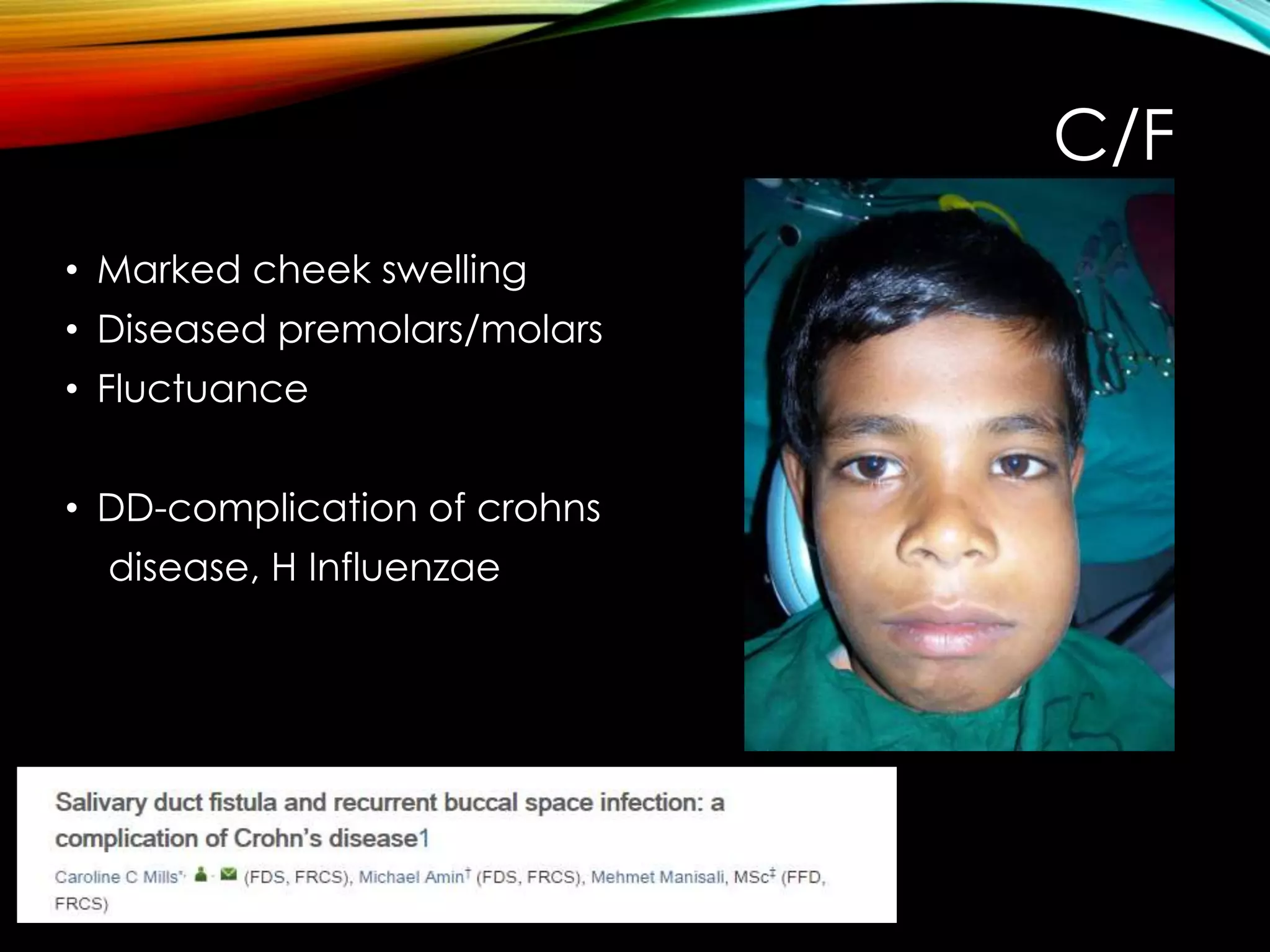
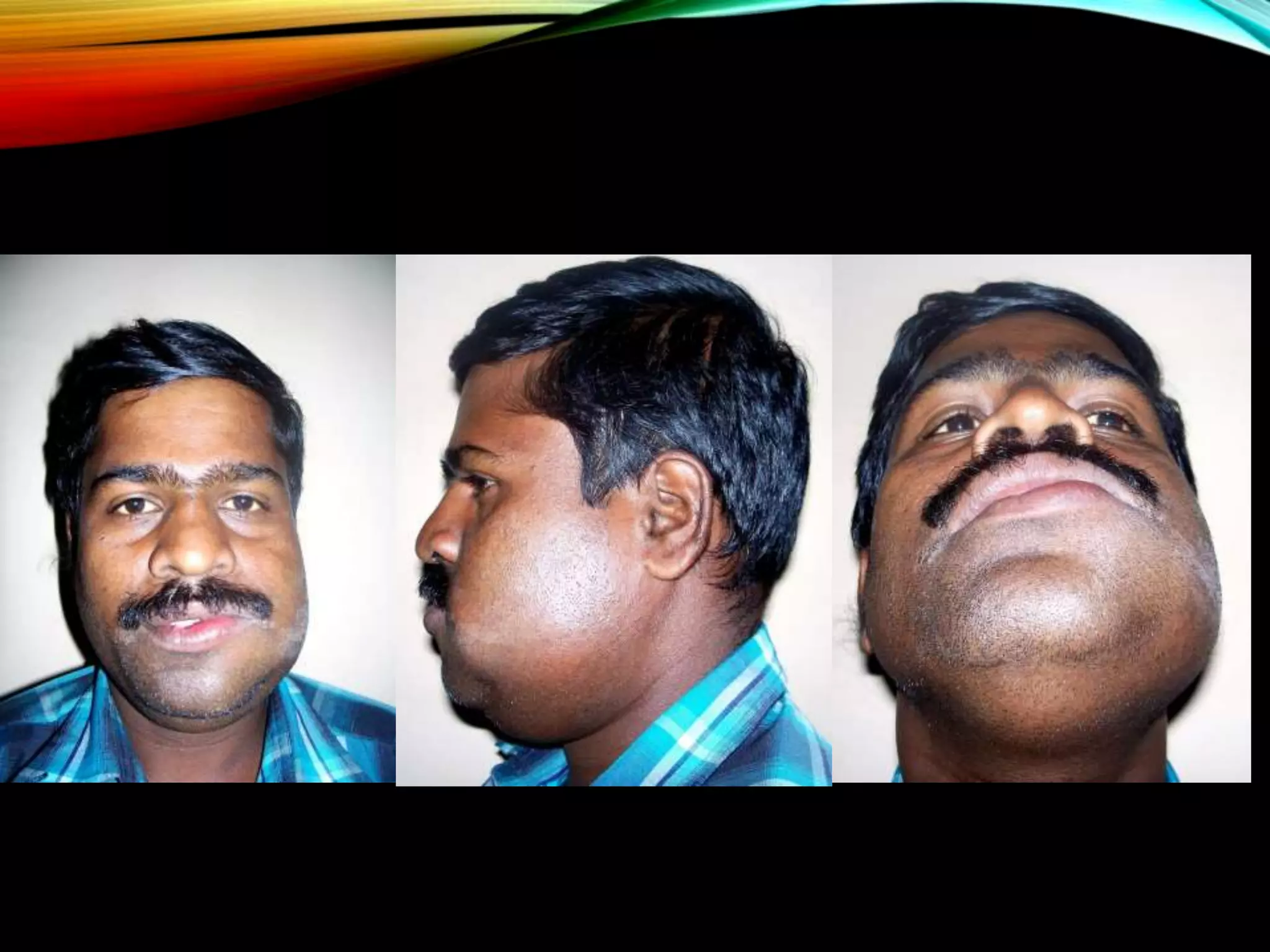
C/F 
• Marked cheek swelling 
• Diseased premolars/molars 
• Fluctuance 
• DD-complication of crohns 
disease, H Influenzae
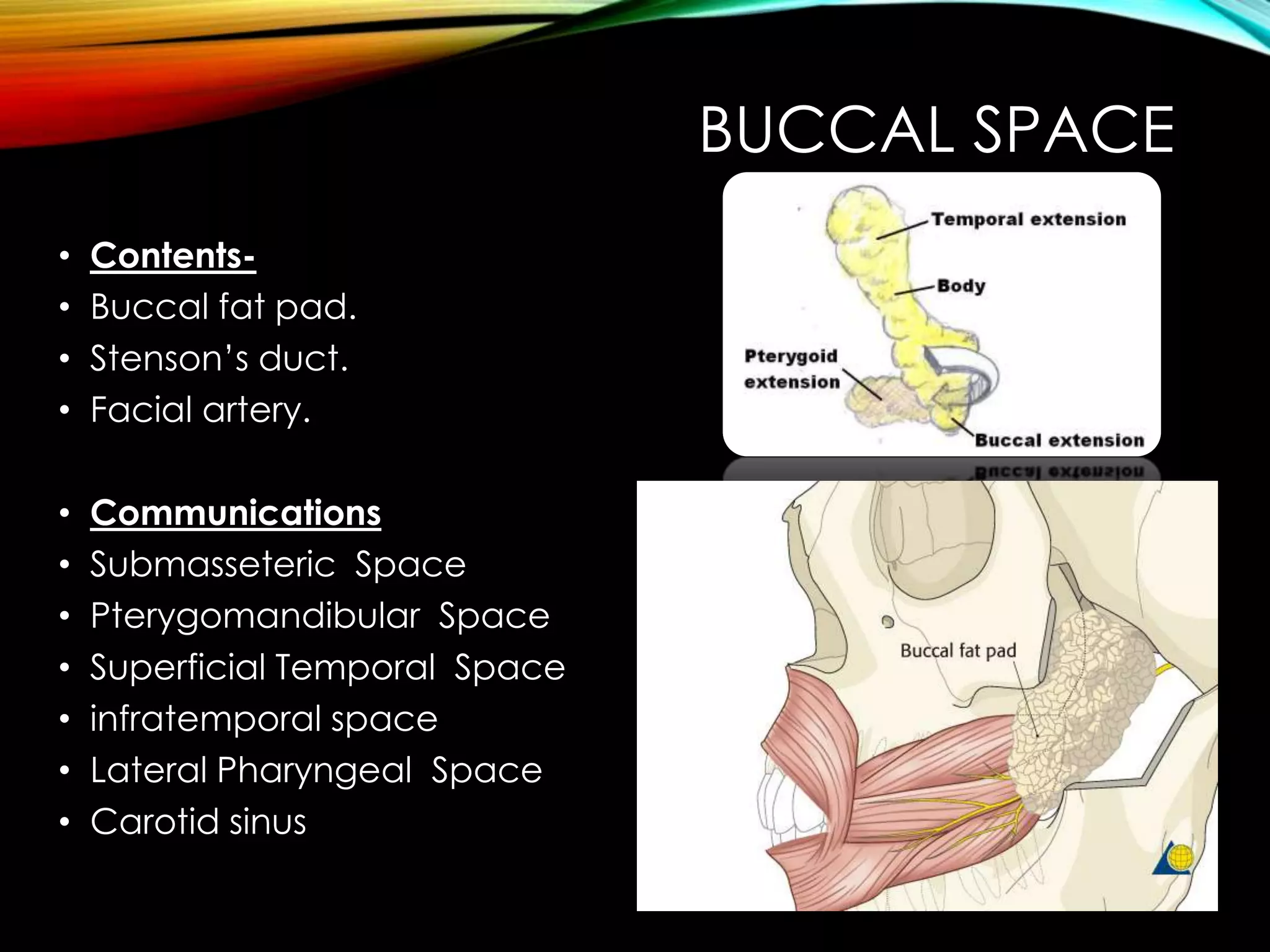
BUCCAL SPACE 
• Contents- 
• Buccal fat pad. 
• Stenson’s duct. 
• Facial artery. 
• Communications 
• Submasseteric Space 
• Pterygomandibular Space 
• Superficial Temporal Space 
• infratemporal space 
• Lateral Pharyngeal Space 
• Carotid sinus
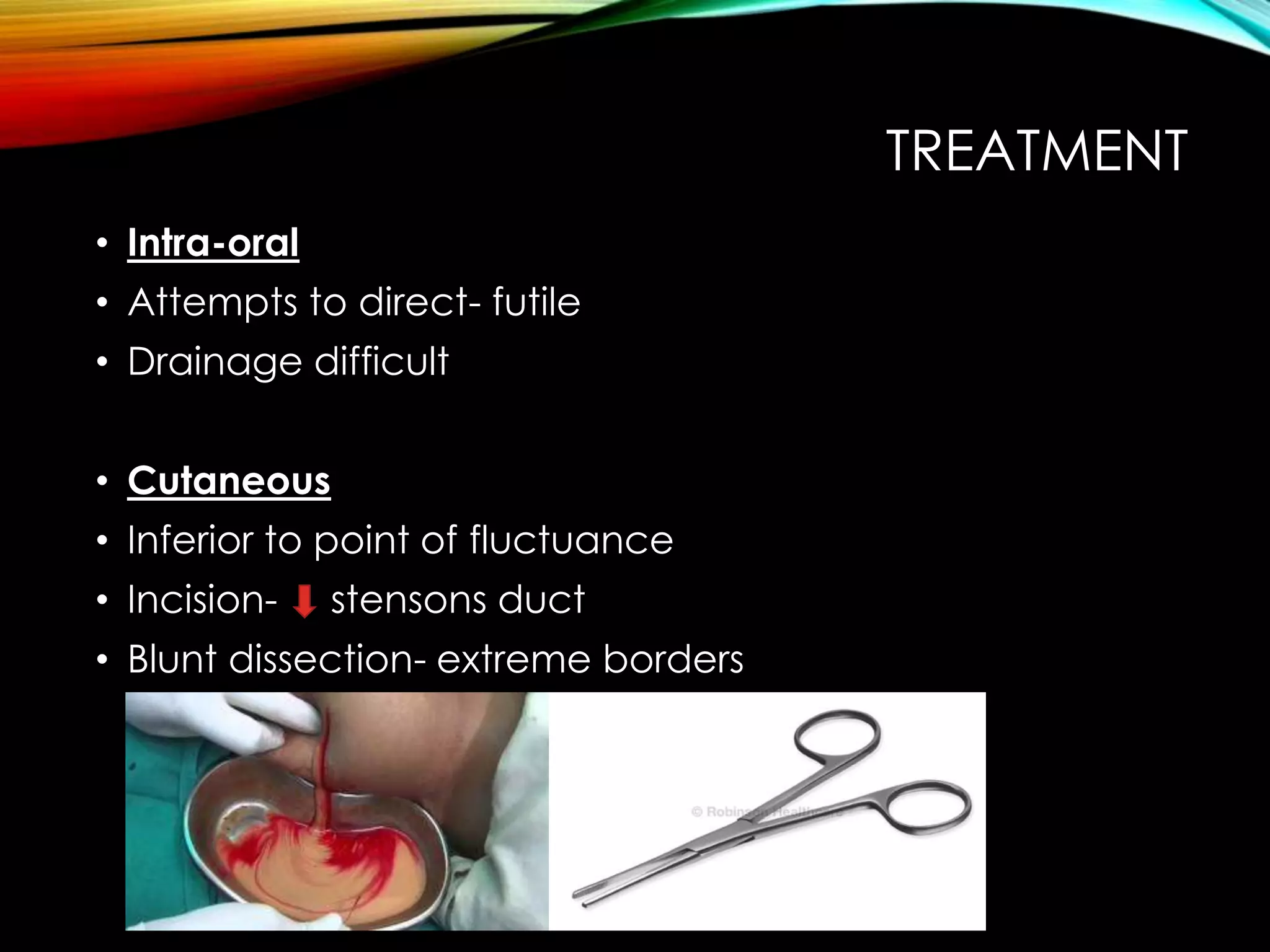
TREATMENT 
• Intra-oral 
• Attempts to direct- futile 
• Drainage difficult 
• Cutaneous 
• Inferior to point of fluctuance 
• Incision- stensons duct 
• Blunt dissection- extreme borders
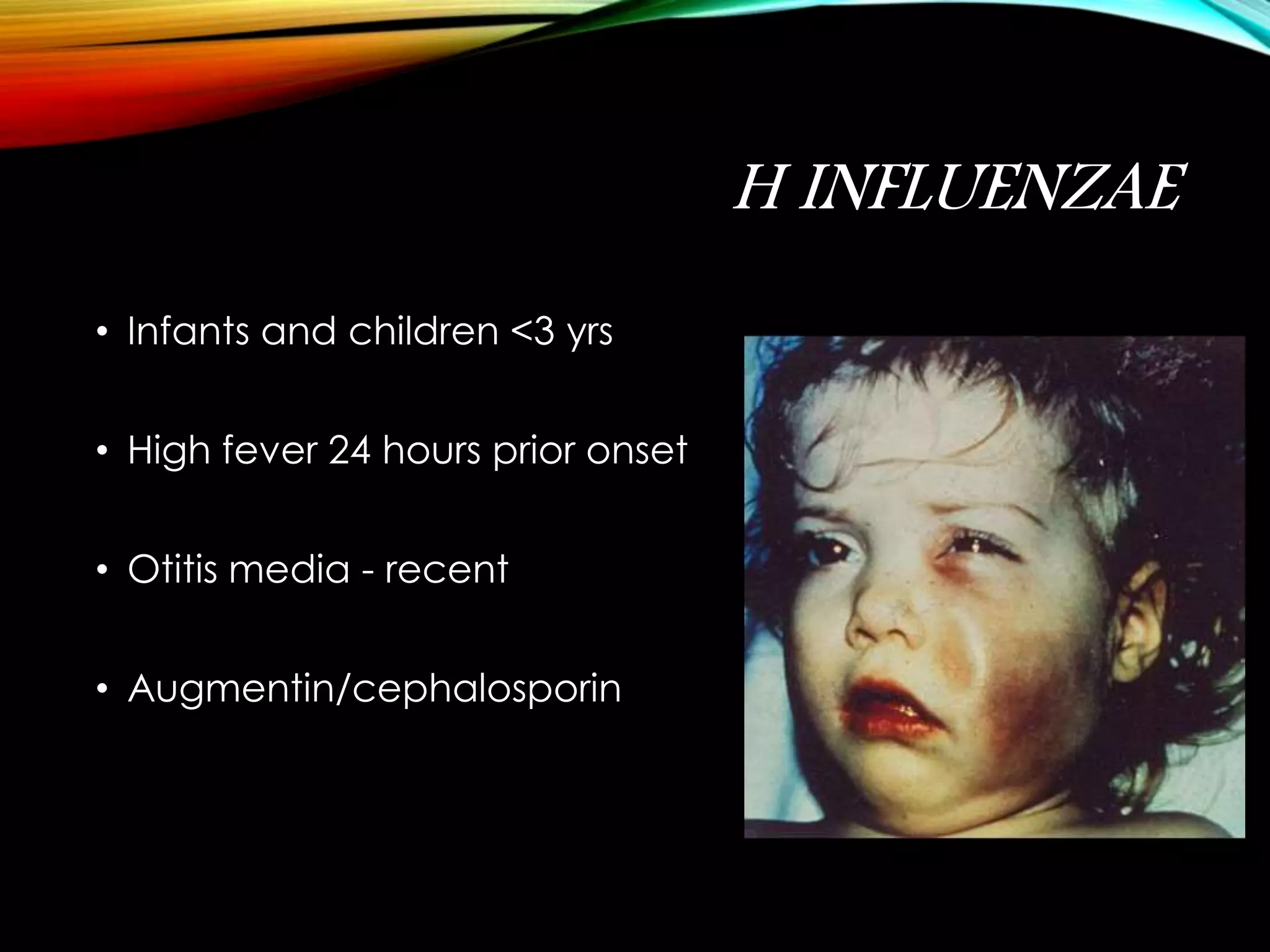
H INFLUENZAE 
• Infants and children <3 yrs 
• High fever 24 hours prior onset 
• Otitis media - recent 
• Augmentin/cephalosporin
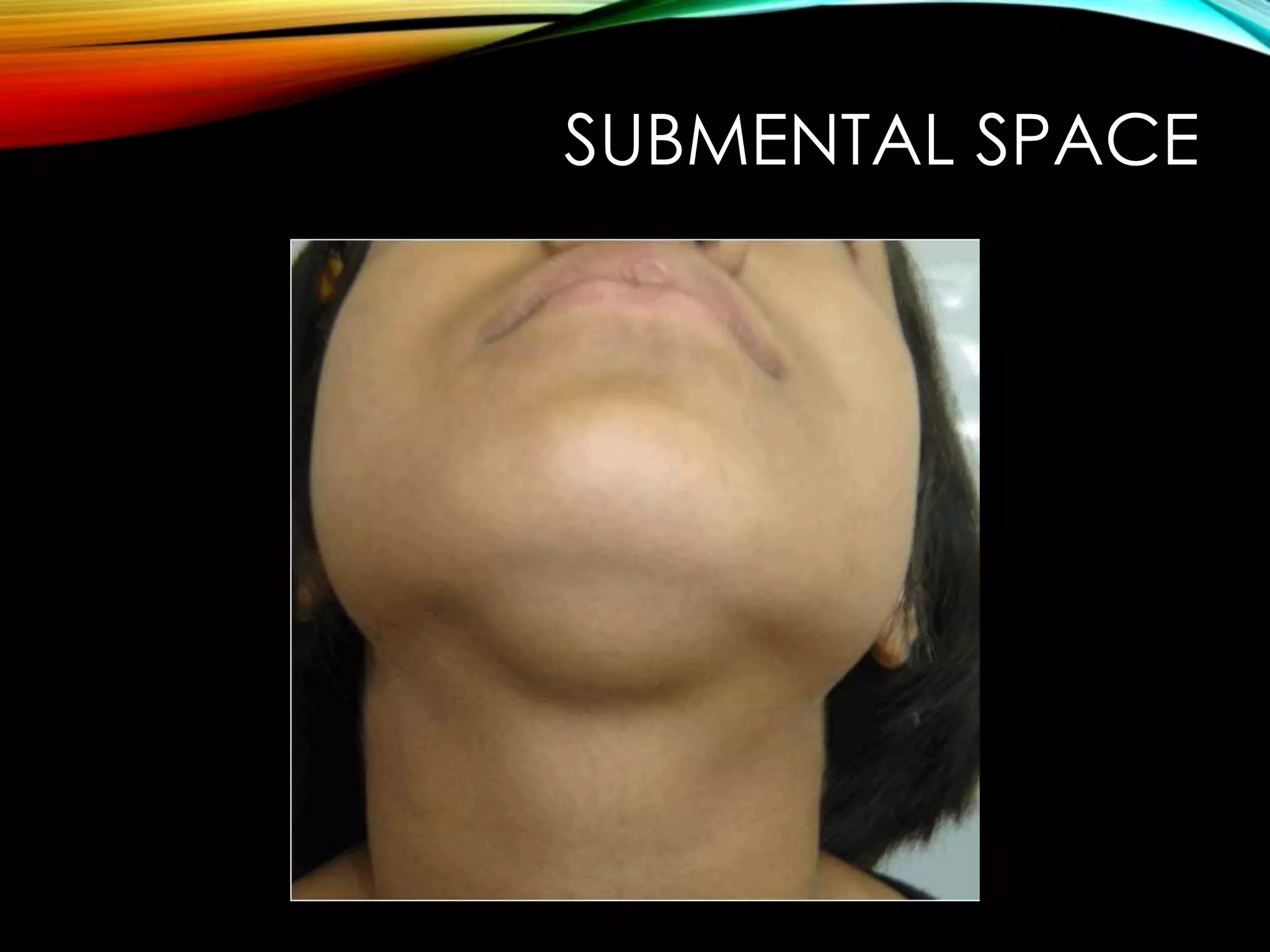
SUBMENTAL SPACE
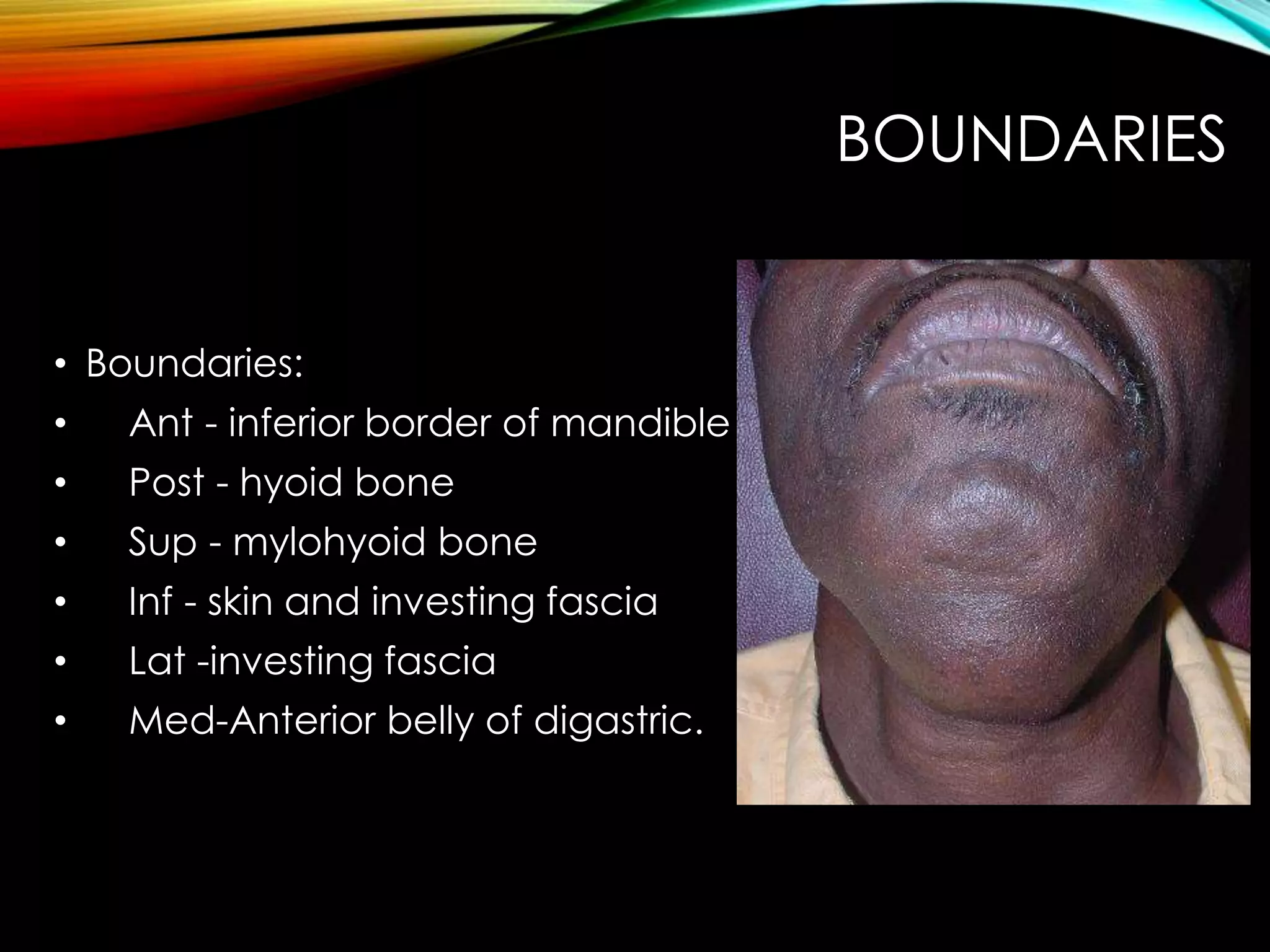
BOUNDARIES 
• Boundaries: 
• Ant - inferior border of mandible 
• Post - hyoid bone 
• Sup - mylohyoid bone 
• Inf - skin and investing fascia 
• Lat -investing fascia 
• Med-Anterior belly of digastric.
Source of infection 
incisors submandibular 
• Intra-oral – non dependent 
• Through mentalis –labialvestibule 
• Percutaneous- 
• horizontal incision- 
• most inferior portion of the chin- natural skin crease
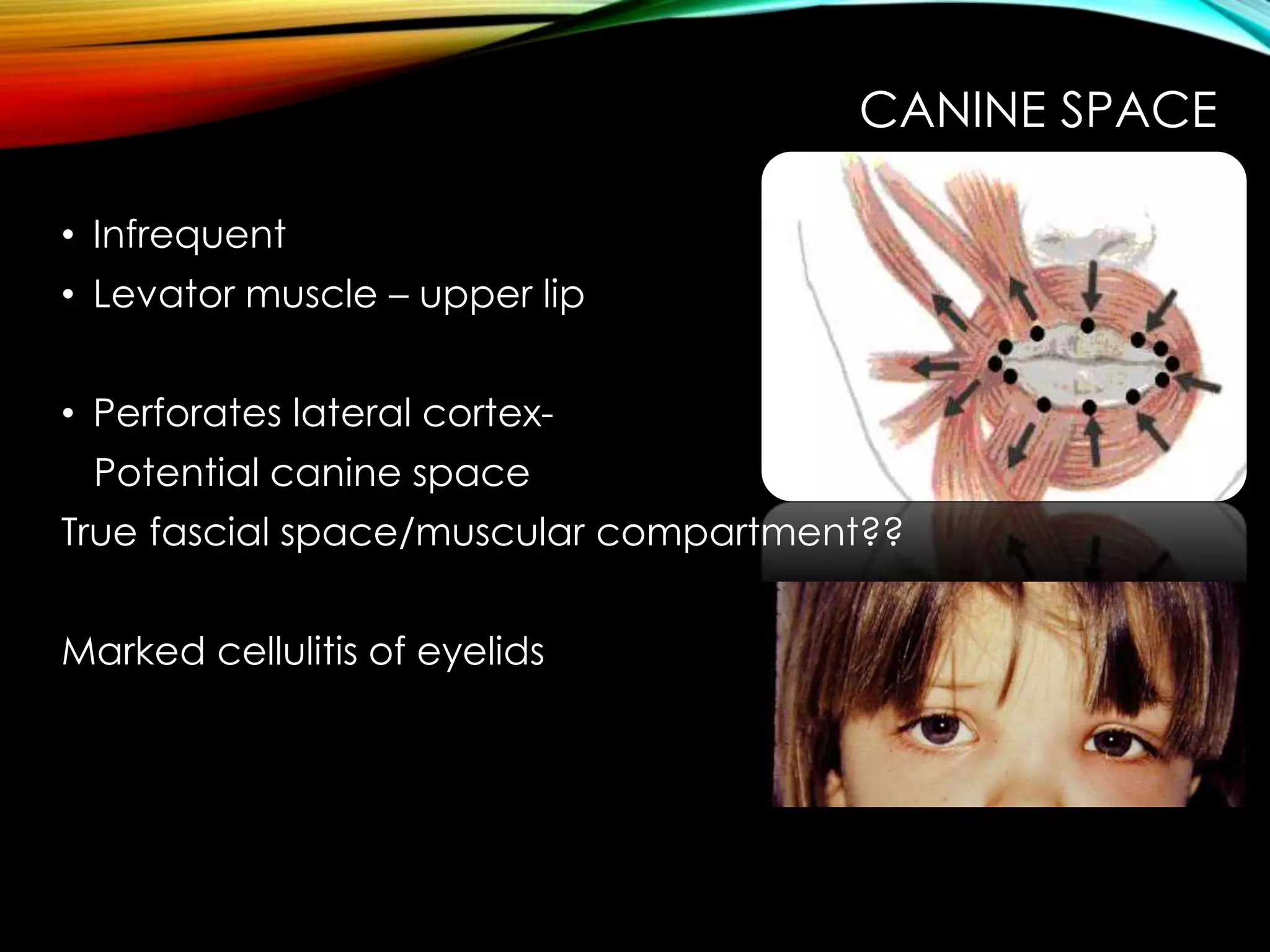
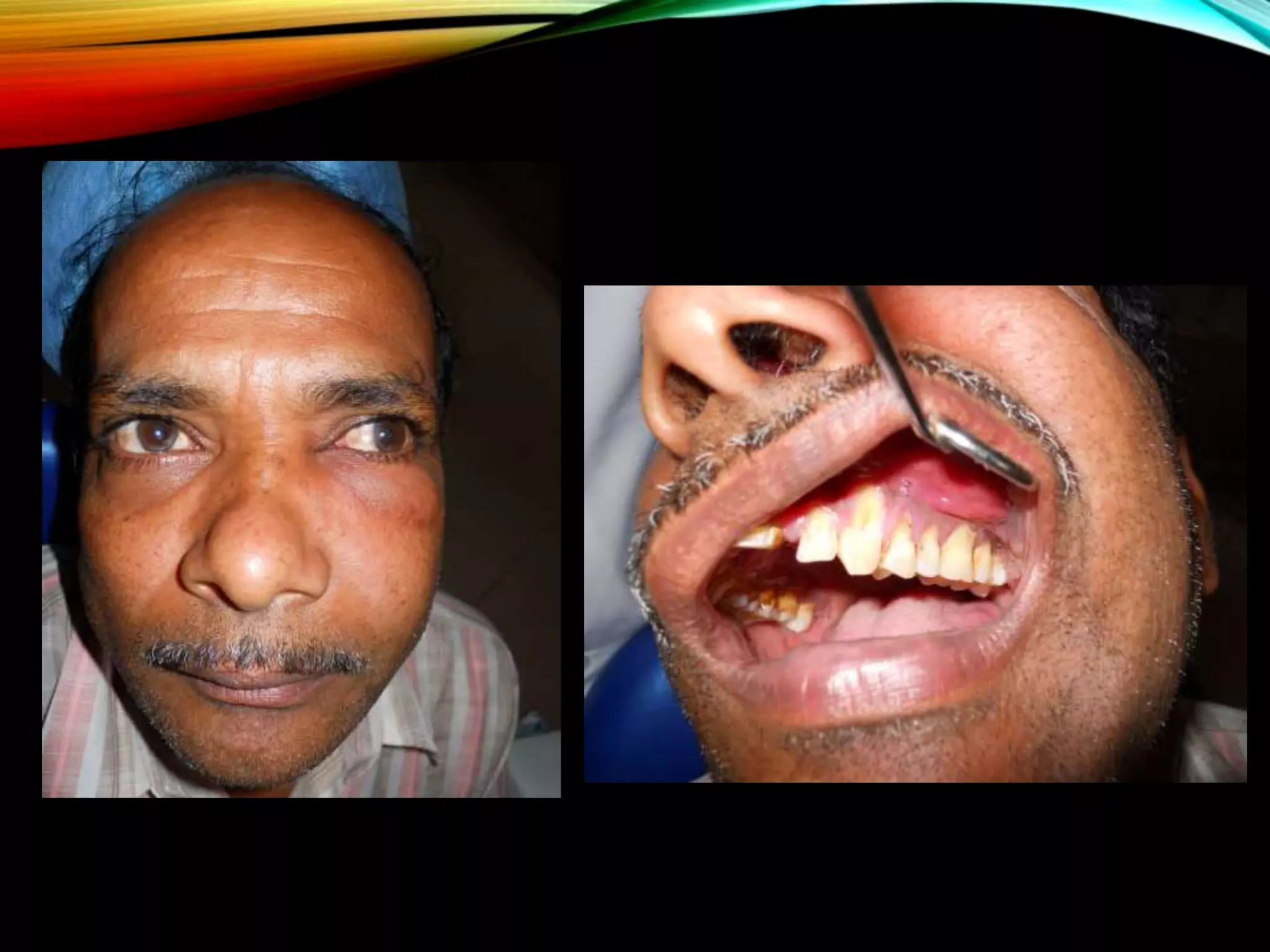
CANINE SPACE 
• Infrequent 
• Levator muscle – upper lip 
• Perforates lateral cortex- 
Potential canine space 
True fascial space/muscular compartment?? 
Marked cellulitis of eyelids
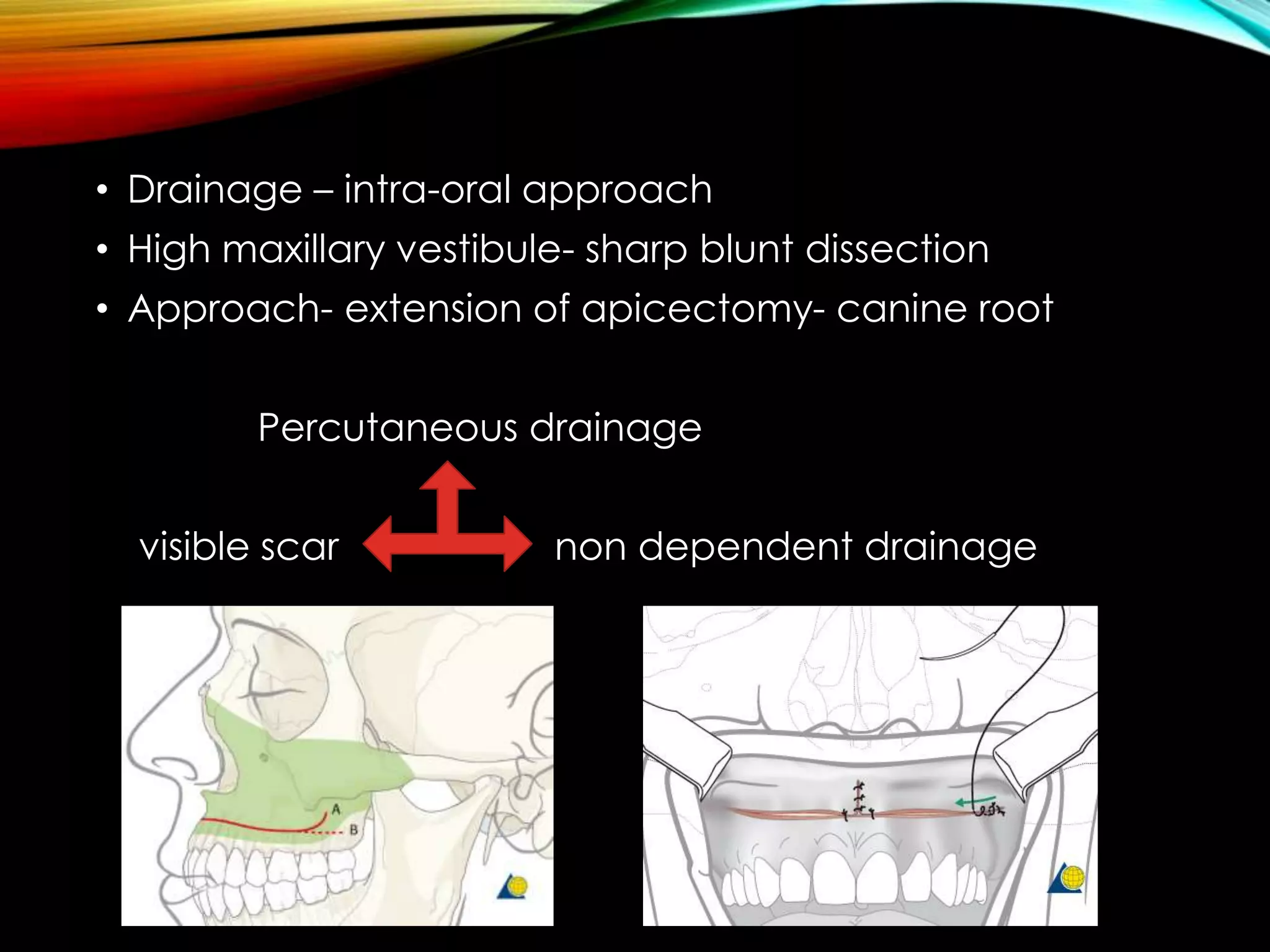
• Drainage – intra-oral approach 
• High maxillary vestibule- sharp blunt dissection 
• Approach- extension of apicectomy- canine root 
Percutaneous drainage 
visible scar non dependent drainage
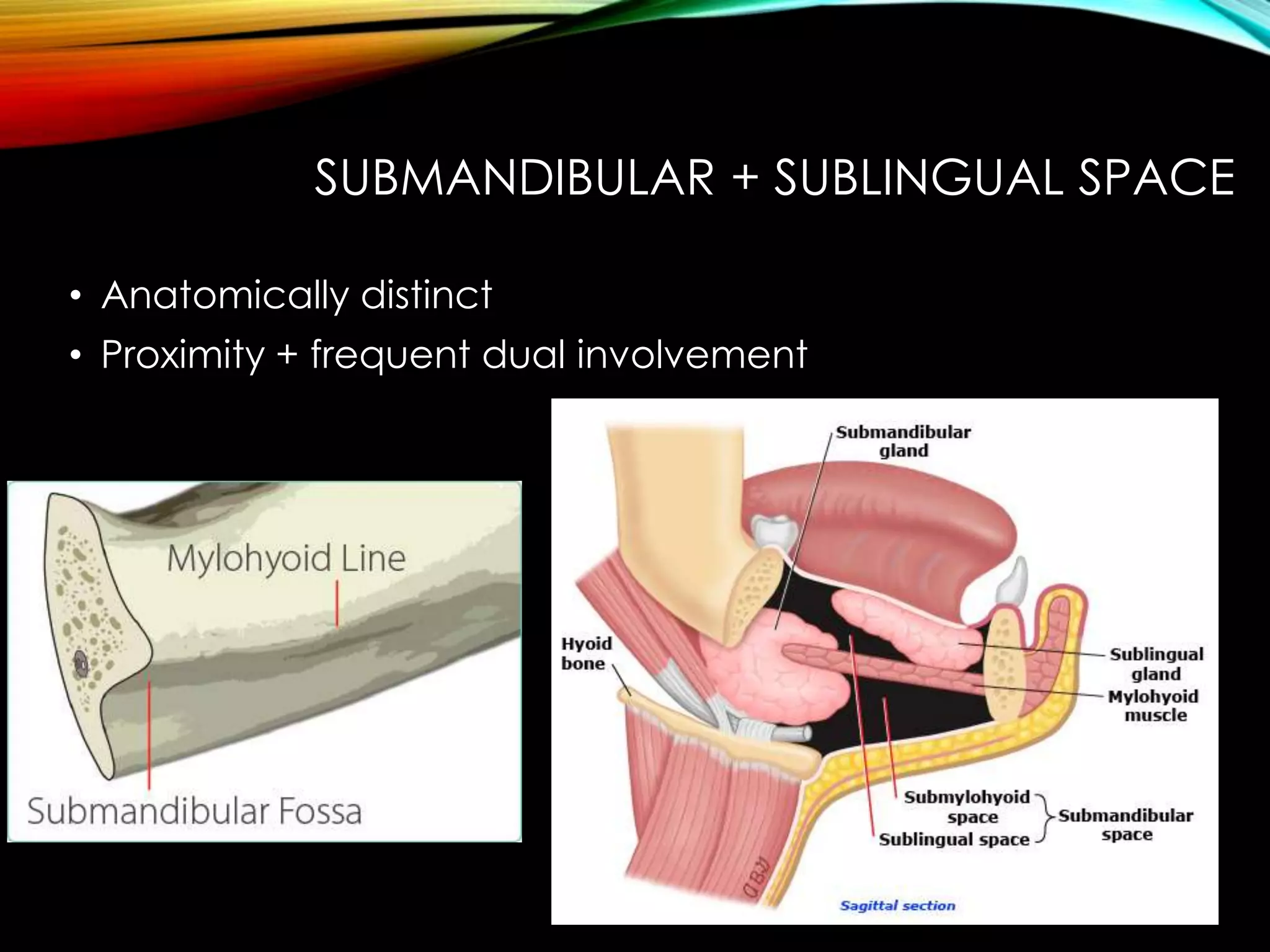
SUBMANDIBULAR + SUBLINGUAL SPACE 
• Anatomically distinct 
• Proximity + frequent dual involvement
SUBLINGUAL SPACE 
• Sublingual space is defined superiorly by the mucosa of 
the mouth floor and inferiorly by the mylohyoid muscle 
• Boundaries: 
• Ant – Lingual surface of mandible 
• Post - Submandibular space 
• Lat - Muscles of tongue 
• Med - Lingual surface of mandible 
• Sup - Oral mucosa 
• Inf - Mylohyoid muscle
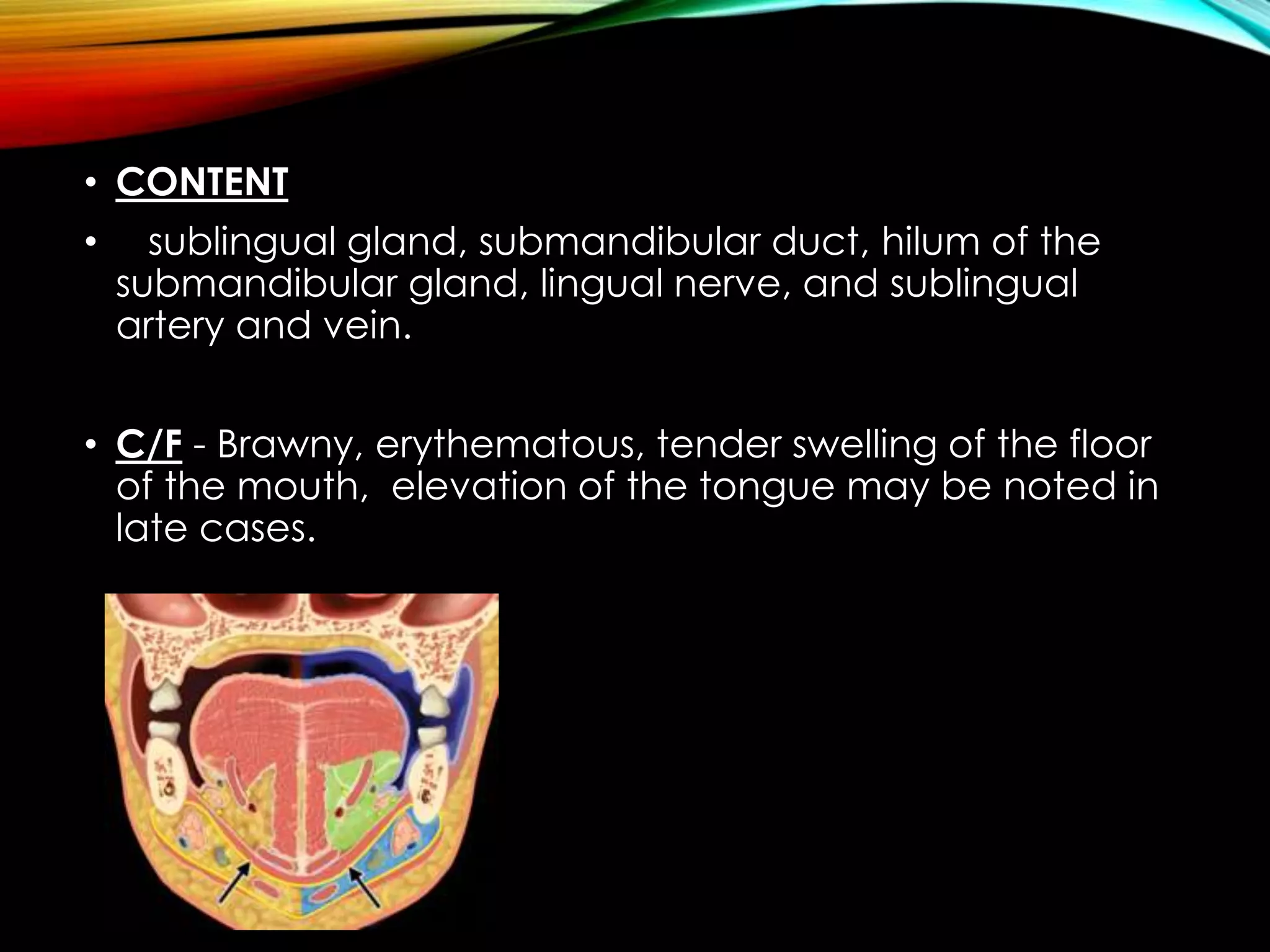
• CONTENT 
• sublingual gland, submandibular duct, hilum of the 
submandibular gland, lingual nerve, and sublingual 
artery and vein. 
• C/F - Brawny, erythematous, tender swelling of the floor 
of the mouth, elevation of the tongue may be noted in 
late cases.
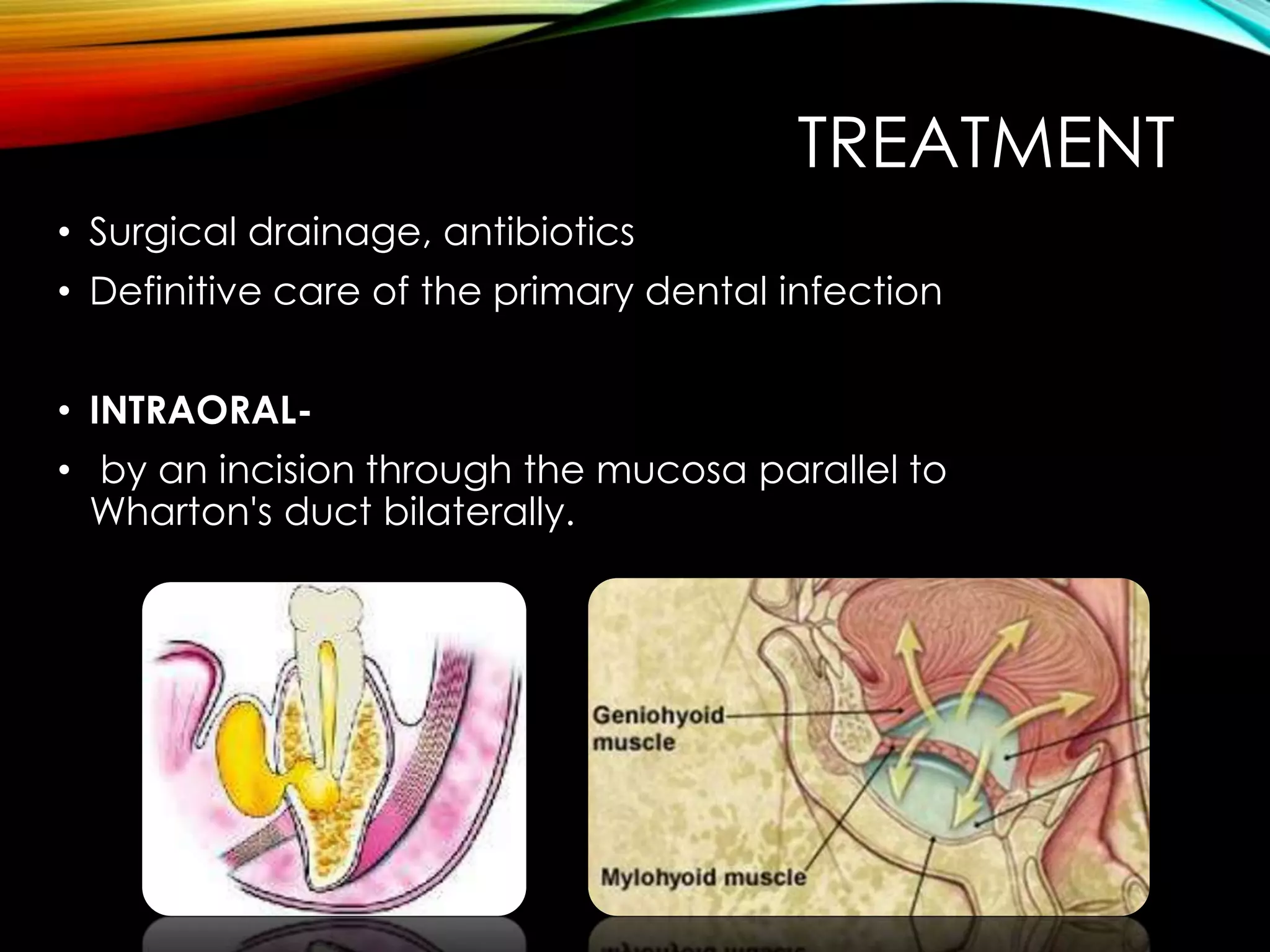
TREATMENT 
• Surgical drainage, antibiotics 
• Definitive care of the primary dental infection 
• INTRAORAL- 
• by an incision through the mucosa parallel to 
Wharton's duct bilaterally.
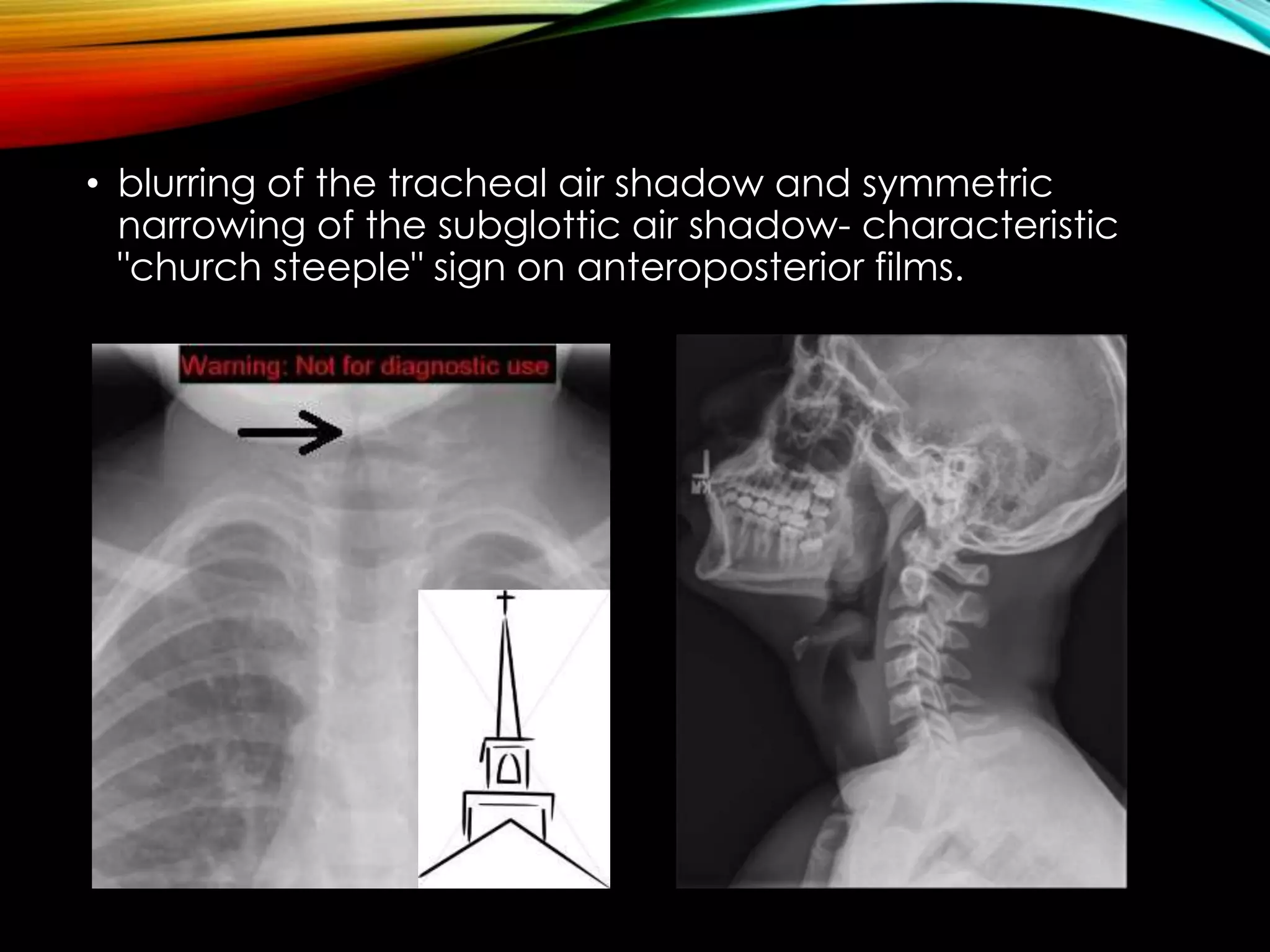
• blurring of the tracheal air shadow and symmetric 
narrowing of the subglottic air shadow- characteristic 
"church steeple" sign on anteroposterior films.
SUBMANDIBULAR SPACE 
• Odontogenic infections of this space commonly are 
caused by the second and third molar teeth 
• Infection beginning in the mandibular molars is likely to 
perforate the thin lingual plate of the mandible to enter 
the submandibular space directly 
• Influence of mylohyoid muscle attachment
BOUNDARIES 
• Ant - Anterior belly of digastric muscle 
• Post - Posterior belly of digastric muscle, 
• Stylohyoid Stylopharyngeus muscle 
• Med - Mylohyoid, hypoglosus, superior constricting muscles 
• Lat - Platysma muscle, Investing fascia 
• Sup - Inferior and medial surfaces of mandible 
• Inf - Digastric tendon 
• Contents - submandibular salivary gland and its lymph nodes, 
• the facial artery, 
• -the proximal portion of Wharton's duct, 
• -lingual and hypoglossal nerves
TREATMENT 
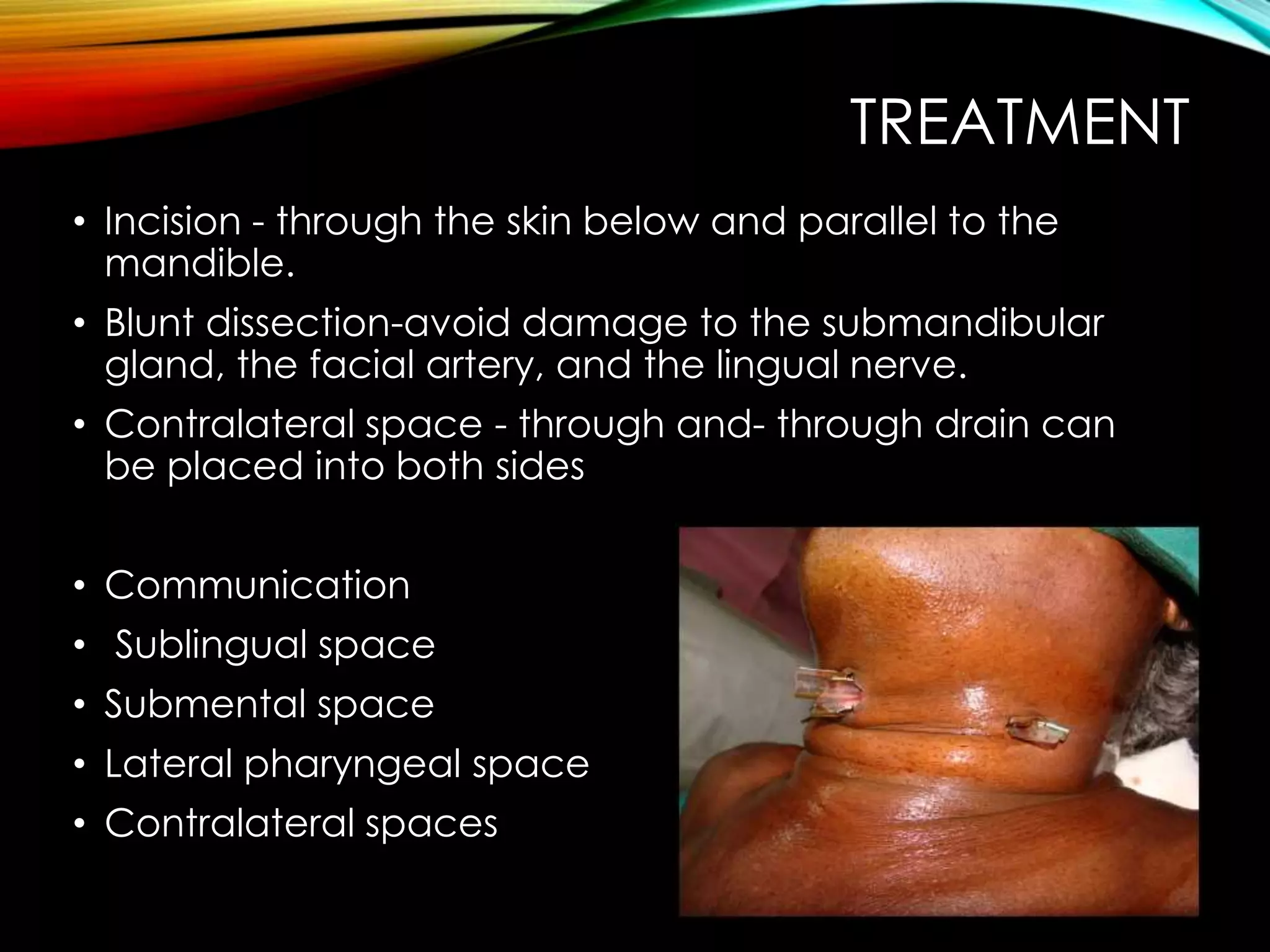
• Incision - through the skin below and parallel to the 
mandible. 
• Blunt dissection-avoid damage to the submandibular 
gland, the facial artery, and the lingual nerve. 
• Contralateral space - through and- through drain can 
be placed into both sides 
• Communication 
• Sublingual space 
• Submental space 
• Lateral pharyngeal space 
• Contralateral spaces
REFERENCES 
• R.G Topazian , Oral & Maxillofacial Infections 4th edition 
• Journal of Oral and Maxillofacial Surgery, Volume 72, Issue 9, 
Supplement, September 2014, Pages e83-e84 
• The Journal of Emergency Medicine, Volume 43, Issue 4, 
October 2012, Pages 605-611 
• Journal of Plastic, Reconstructive & Aesthetic Surgery, 
Volume 60, Issue 4, April 2007, Pages 372-378 
• Journal of Infection, Volume 50, Issue 1, January 2005, Pages 
34-40 
• Emergency Medicine Clinics of North America, Volume 18, 
Issue 3, 1 August 2000, Pages 481-519
Fascial Space Inection - Part 1

Fascial Space Inection - Part 1

  • 1.
    DEEP FASCIAL SPACEINFECTIONS ARJUN SHENOY DEPT OF OMFS
  • 2.
    • HISTORY •PRINCIPLES OF EXAMINATION • CLASSIFICATION OF SPACES • ANATOMICAL CONSIDERATIONS • PATHWAYS OF SPREAD • DIAGNOSTIC AIDS • SPACES • COMPLICATIONS • CONCLUSION • REFERENCES
  • 3.
    “The concept offascial spaces is based on the anatomist’s knowledge that all “spaces” exist only potentially, until fasciae are separated by pus, blood, drains, or a surgeons finger”
  • 4.
    INTRODUCTION Shapiro definedfascial spaces as potential spaces between the layers of the fascia Filled by connective tissue
  • 5.
    HISTORY • 1938landmark article - Grodinsky & Holyoke - modern understanding
  • 6.
    Injection dyed gelatin Cadavers Selective portals HYPOTHESIS-  spread hydrostatic pressure Guided tissue resistance • 1939- Ashbel Williams – 31cases Ludwigs angina (54%) • 1979- Hough et al – (4%)
  • 7.
    PRINCIPLES OF EXAMINATION Rapid initial assesment Complete history Physical examination Imaging and laboratory data Immediate hospitalization with aggressive intervention DATABASE
  • 8.
    TOXICITY SIGNS •Paleness • Tachypnea • Tachycardia • Fever • Shivering • Lethargy • diaphoresis Decreased level of consciousness Evidence of meningeal irritation- 1) Severe headache 2) Stiff neck 3) vomiting
  • 9.
  • 11.
    ANATOMICAL CONSIDERATIONS •MUSCLE ATTACHMENTS- • Posteriors= Buccinator- midroot level • Anteriors –intrinsic lip muscles & risorius
  • 12.
    BUCCINATOR & ODONTOGENICINFECTION In maxilla Above the attachment Root apex Extraoral Below the attachment Intraoral swelling (In Mandible it is vice versa)
  • 13.
    MYLOHYOID & ODONTOGENICINFECTIONS Anteriors Posteriors (Root apex below) (Root apex below) Intraoral Extraoral (Floor of the mouth) (submandibular)
  • 14.
    Infection enters tissuespaces Areolar connective tissue in tissue spaces undergoes necrosis Replaced by cellulitic fluid and then by pus Vascular dilation, Transudation, and Exudation draw fluid into the region, thus increasing the hydrostatic pressure pressure applied to the borders of the space, the advancing front of the infection may bypass the contiguous spaces
  • 17.
    DIAGNOSTIC IMAGING •ACCURATE DIAGNOSIS • GUIDING DRAINAGE PROCEDURES • EXTENT • DETECTING COMPLICATION
  • 18.
    PLAIN FILM OPG • Extent of pathology of odontogenic orgin • AP/LATERAL CERVICAL • Lesser penetration c-spine • Pharyngeal/ cervical airway
  • 19.
    COMPUTED TOMOGRAPHY •Widely used - 5mm increments • Contrast enchanced - 95% sensitivity • Assess integrity cortical bone • Short time –extent , epicentre • Availability • Relative low cost
  • 20.
    ULTRASONOGRAPHY • Superficial • inability-osseous penetration • Parotid /submandibular/ neck • Differentiates solid / cystic
  • 21.
    MAGNETIC RESONANCE IMAGING • Not uncommon • Coronal and saggital planes • T1- anatomic detail • T2- disease process sensitive • Intravenous contrast agents- safer • T1 + gadolinium
  • 22.
    FASCIAL SPACES OFCLINICAL FACE SIGNIFICANCE* o Buccal o Canine o Masticator  Massetric compartment  Pterygoid compartment  Zygomaticotemporal compartment SUPRAHYOID Sublingual Submandibular Lateral pharyngeal Peritonsillar * RICHARD G TOPAZIAN , ORAL & MAXILLOFACIAL INFECTION 4TH EDITION
  • 23.
    CONTINUED INFRAHYOID Anterovisceral (paratracheal) SPACE OF TOTAL NECK Retropharyngeal Danger space Space of carotid sheath  RICHARD G TOPAZIAN , ORAL & MAXILLOFACIAL INFECTION 4TH EDITION
  • 24.
    Based on modeof involvement  DIRECT INVOLVEMENT (Primary spaces) Maxillary spaces - canine, buccal, and infratemporal . . Mandibular spaces - submental, buccal, submandibular, and sublingual .  INDIRECT INVOLVEMENT (Secondary spaces) Masseteric, Pterygomandibular, Parotid, Superficial and deep temporal, Lateral pharyngeal, Retropharyngeal and Prevertebral spaces
  • 25.
    ACCORDING TO THEIRRELATION TO THE HYOID BONE Most important anatomic structure - limits the spread of infection- Suprahyoid (above the hyoid) Infrahyoid (below the hyoid) Fascial spaces traversing the length of the neck
  • 26.
    TRIVIA • Diffusion-antibiotics- limited • Grossly distorted anatomy • Poor vascularity - thick walls • Adequate open dependent drainage • Spreads readily one to another • Secondary-primary both to be drained
  • 27.
    ANTIBIOTIC THERAPY •EXCEPTIONS • Well localized- easily drained –dentoalveolar abscess • INCLUSION • Poorly localized • Extensive abscess • Diffuse cellulitis • Immunocompromised • Systemic signs
  • 28.
    INCISION AND DRAINAGE • Incison- healthy skin/ mucosa- natural crease • Site- max fluctuance- unaesthetic scar • Dependent – • Dissection- blunt- full extent • Stabilize drain • Remove on time
  • 29.
    RECENT ADVANCES •Two mini incisions, 4-5 mm each, far apart • Abscess probed, pus drained. • Abscess was irrigated -normal saline •
  • 30.
    • loop drainwas passed through one incision, brought out through the other, and tied to itself.
  • 31.
  • 32.
    BOUNDARIES • Superiorly:zygomatic arch. • Inferior: inferior border of mandible. • Laterally: skin & subcutaneous tissue. • Medially: buccinator muscle , • Posteriorly: anterior edge of masseter. • Anteriorly: posterior border of zygomaticus major & depressor anguli oris.
  • 33.
    C/F • Markedcheek swelling • Diseased premolars/molars • Fluctuance • DD-complication of crohns disease, H Influenzae
  • 35.
    BUCCAL SPACE •Contents- • Buccal fat pad. • Stenson’s duct. • Facial artery. • Communications • Submasseteric Space • Pterygomandibular Space • Superficial Temporal Space • infratemporal space • Lateral Pharyngeal Space • Carotid sinus
  • 36.
    TREATMENT • Intra-oral • Attempts to direct- futile • Drainage difficult • Cutaneous • Inferior to point of fluctuance • Incision- stensons duct • Blunt dissection- extreme borders
  • 37.
    H INFLUENZAE •Infants and children <3 yrs • High fever 24 hours prior onset • Otitis media - recent • Augmentin/cephalosporin
  • 38.
  • 39.
    BOUNDARIES • Boundaries: • Ant - inferior border of mandible • Post - hyoid bone • Sup - mylohyoid bone • Inf - skin and investing fascia • Lat -investing fascia • Med-Anterior belly of digastric.
  • 40.
    Source of infection incisors submandibular • Intra-oral – non dependent • Through mentalis –labialvestibule • Percutaneous- • horizontal incision- • most inferior portion of the chin- natural skin crease
  • 41.
    CANINE SPACE •Infrequent • Levator muscle – upper lip • Perforates lateral cortex- Potential canine space True fascial space/muscular compartment?? Marked cellulitis of eyelids
  • 43.
    • Drainage –intra-oral approach • High maxillary vestibule- sharp blunt dissection • Approach- extension of apicectomy- canine root Percutaneous drainage visible scar non dependent drainage
  • 44.
    SUBMANDIBULAR + SUBLINGUALSPACE • Anatomically distinct • Proximity + frequent dual involvement
  • 45.
    SUBLINGUAL SPACE •Sublingual space is defined superiorly by the mucosa of the mouth floor and inferiorly by the mylohyoid muscle • Boundaries: • Ant – Lingual surface of mandible • Post - Submandibular space • Lat - Muscles of tongue • Med - Lingual surface of mandible • Sup - Oral mucosa • Inf - Mylohyoid muscle
  • 46.
    • CONTENT •sublingual gland, submandibular duct, hilum of the submandibular gland, lingual nerve, and sublingual artery and vein. • C/F - Brawny, erythematous, tender swelling of the floor of the mouth, elevation of the tongue may be noted in late cases.
  • 47.
    TREATMENT • Surgicaldrainage, antibiotics • Definitive care of the primary dental infection • INTRAORAL- • by an incision through the mucosa parallel to Wharton's duct bilaterally.
  • 48.
    • blurring ofthe tracheal air shadow and symmetric narrowing of the subglottic air shadow- characteristic "church steeple" sign on anteroposterior films.
  • 49.
    SUBMANDIBULAR SPACE •Odontogenic infections of this space commonly are caused by the second and third molar teeth • Infection beginning in the mandibular molars is likely to perforate the thin lingual plate of the mandible to enter the submandibular space directly • Influence of mylohyoid muscle attachment
  • 50.
    BOUNDARIES • Ant- Anterior belly of digastric muscle • Post - Posterior belly of digastric muscle, • Stylohyoid Stylopharyngeus muscle • Med - Mylohyoid, hypoglosus, superior constricting muscles • Lat - Platysma muscle, Investing fascia • Sup - Inferior and medial surfaces of mandible • Inf - Digastric tendon • Contents - submandibular salivary gland and its lymph nodes, • the facial artery, • -the proximal portion of Wharton's duct, • -lingual and hypoglossal nerves
  • 51.
    TREATMENT • Incision- through the skin below and parallel to the mandible. • Blunt dissection-avoid damage to the submandibular gland, the facial artery, and the lingual nerve. • Contralateral space - through and- through drain can be placed into both sides • Communication • Sublingual space • Submental space • Lateral pharyngeal space • Contralateral spaces
  • 52.
    REFERENCES • R.GTopazian , Oral & Maxillofacial Infections 4th edition • Journal of Oral and Maxillofacial Surgery, Volume 72, Issue 9, Supplement, September 2014, Pages e83-e84 • The Journal of Emergency Medicine, Volume 43, Issue 4, October 2012, Pages 605-611 • Journal of Plastic, Reconstructive & Aesthetic Surgery, Volume 60, Issue 4, April 2007, Pages 372-378 • Journal of Infection, Volume 50, Issue 1, January 2005, Pages 34-40 • Emergency Medicine Clinics of North America, Volume 18, Issue 3, 1 August 2000, Pages 481-519

Editor's Notes

  • #33 Superiorly: zygomatic arch. Inferior: inferior border of mandible. Laterally: skin & subcutaneous tissue. Medially: buccinator muscle ,buccopharyngeal fascia. Posteriorly: anterior edge of masseter muscle. Anteriorly: posterior border of zygomaticus major & depressor anguli oris.