ODONTOGENIC
 INFECTIONS


     Prepared by:
          Dr. Rea Corpuz
Odontogenic Infections

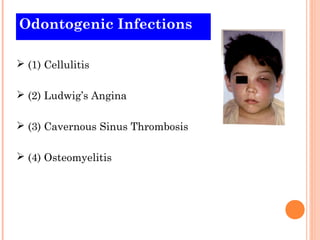
 (1) Cellulitis

 (2) Ludwig’s Angina

 (3) Cavernous Sinus Thrombosis

 (4) Osteomyelitis
(1) Cellulitis

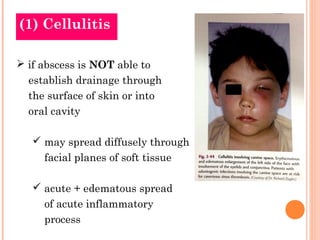
 if abscess is NOT able to
  establish drainage through
  the surface of skin or into
  oral cavity

    may spread diffusely through
     facial planes of soft tissue

    acute + edematous spread
     of acute inflammatory
     process
(1) Cellulitis

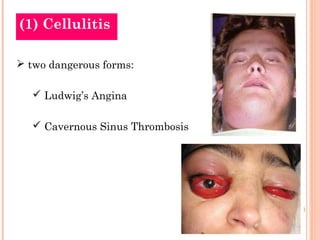
 two dangerous forms:

   Ludwig’s Angina

   Cavernous Sinus Thrombosis
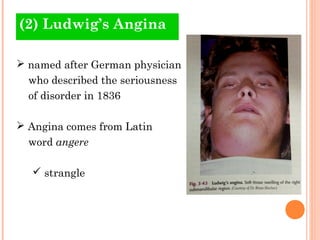
(2) Ludwig’s Angina

 named after German physician
  who described the seriousness
  of disorder in 1836

 Angina comes from Latin
  word angere

   strangle
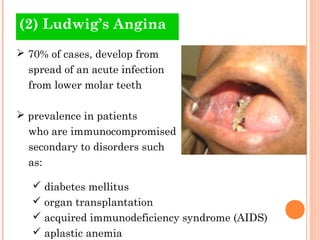
(2) Ludwig’s Angina
 70% of cases, develop from
  spread of an acute infection
  from lower molar teeth

 prevalence in patients
  who are immunocompromised
  secondary to disorders such
  as:

    diabetes mellitus
    organ transplantation
    acquired immunodeficiency syndrome (AIDS)
    aplastic anemia
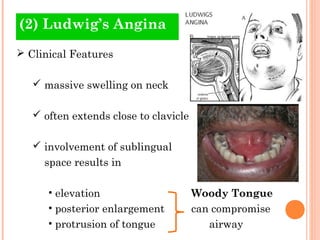
(2) Ludwig’s Angina
 Clinical Features

    massive swelling on neck

    often extends close to clavicle

    involvement of sublingual
     space results in

      • elevation                      Woody Tongue
      • posterior enlargement          can compromise
      • protrusion of tongue              airway
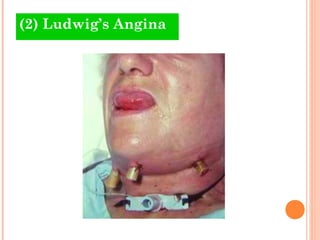
(2) Ludwig’s Angina
(2) Ludwig’s Angina
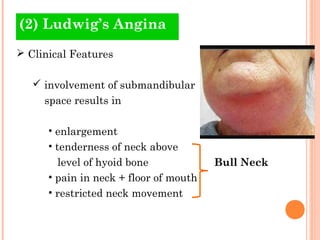
 Clinical Features

    involvement of submandibular
     space results in

      • enlargement
      • tenderness of neck above
        level of hyoid bone             Bull Neck
      • pain in neck + floor of mouth
      • restricted neck movement
(2) Ludwig’s Angina
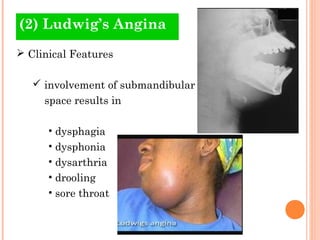
 Clinical Features

    involvement of submandibular
     space results in

      • dysphagia
      • dysphonia
      • dysarthria
      • drooling
      • sore throat
(2) Ludwig’s Angina
 Clinical Features

    involvement of lateral
     pharyngeal space

      • respiratory obstruction
        secondary to laryngeal edema

      • tachypnea
      • dyspnea
      • tachycardia
      • patient needs to maintain erect position
(2) Ludwig’s Angina
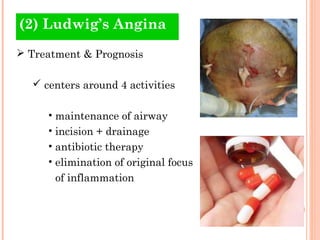
 Treatment & Prognosis

   centers around 4 activities

     • maintenance of airway
     • incision + drainage
     • antibiotic therapy
     • elimination of original focus
       of inflammation
(2) Ludwig’s Angina
 Treatment & Prognosis

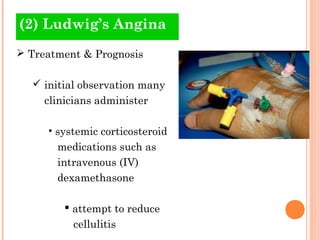
   initial observation many
     clinicians administer

     • systemic corticosteroid
       medications such as
       intravenous (IV)
       dexamethasone

          attempt to reduce
          cellulitis
(2) Ludwig’s Angina
 Treatment & Prognosis

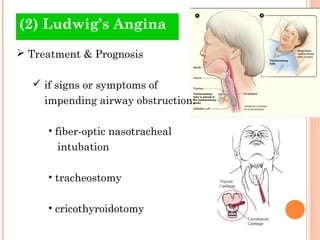
   if signs or symptoms of
     impending airway obstruction:

     • fiber-optic nasotracheal
       intubation

     • tracheostomy

     • cricothyroidotomy
(2) Ludwig’s Angina
 Treatment & Prognosis

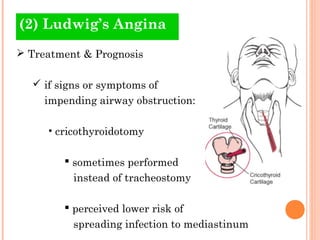
   if signs or symptoms of
     impending airway obstruction:

     • cricothyroidotomy

         sometimes performed
          instead of tracheostomy

         perceived lower risk of
          spreading infection to mediastinum
(2) Ludwig’s Angina
 Treatment & Prognosis

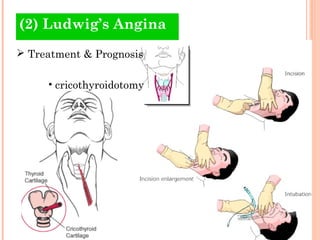
     • cricothyroidotomy
(2) Ludwig’s Angina
 Treatment & Prognosis

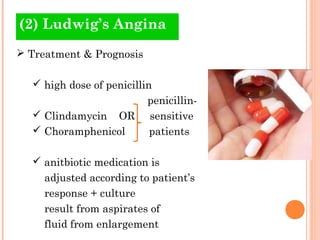
   high dose of penicillin
                          penicillin-
   Clindamycin OR        sensitive
   Choramphenicol        patients

   anitbiotic medication is
     adjusted according to patient’s
     response + culture
     result from aspirates of
     fluid from enlargement
(2) Ludwig’s Angina
 Treatment & Prognosis

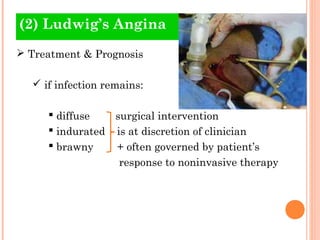
   if infection remains:

      diffuse   surgical intervention
      indurated is at discretion of clinician
      brawny    + often governed by patient’s
                  response to noninvasive therapy
(2) Ludwig’s Angina
 Treatment & Prognosis

   complications:

     • Pericarditis
     • Pneumonia
     • Mediastinitis
     • Sepsis
     • Empyema
     • Respiratory Obstruction
(3) Cavernous Sinus

     Thrombosis
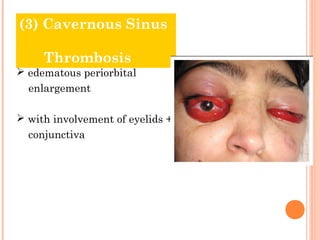
 edematous periorbital
  enlargement

 with involvement of eyelids +
  conjunctiva
(3) Cavernous Sinus

     Thrombosis
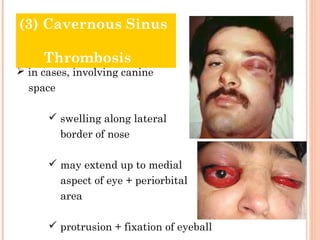
 in cases, involving canine
  space

       swelling along lateral
          border of nose

       may extend up to medial
          aspect of eye + periorbital
          area

       protrusion + fixation of eyeball
(3) Cavernous Sinus

     Thrombosis
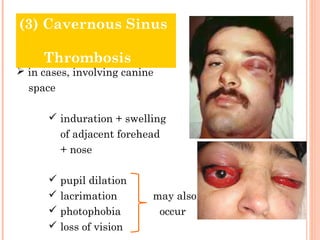
 in cases, involving canine
  space

       induration + swelling
          of adjacent forehead
          + nose

       pupil dilation
       lacrimation         may also
       photophobia          occur
       loss of vision
(3) Cavernous Sinus

     Thrombosis
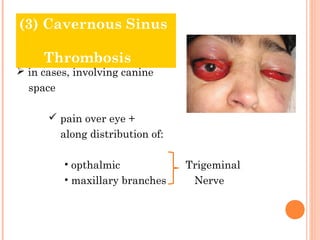
 in cases, involving canine
  space

       pain over eye +
          along distribution of:

          • opthalmic              Trigeminal
          • maxillary branches      Nerve
(3) Cavernous Sinus

     Thrombosis
 Treatment & Prognosis

   surgical drainage +
     high-dose antibiotic
     medication similar to
     those administered for
     patient’s with Ludwig’s
     Angina
(4) Osteomyelitis

 an acute or chronic
  inflammatory process in
                               extends
    medullary spaces OR       away from
    cortical surfaces of bone initial site of
                                involvement
(4) Osteomyelitis

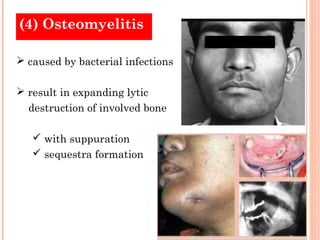
 caused by bacterial infections

 result in expanding lytic
  destruction of involved bone

    with suppuration
    sequestra formation
(4) Osteomyelitis

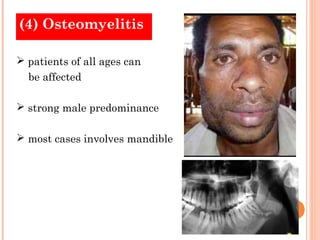
 patients of all ages can
  be affected

 strong male predominance

 most cases involves mandible
(4) Osteomyelitis

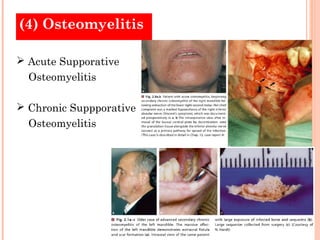
 Acute Supporative
  Osteomyelitis

 Chronic Suppporative
  Osteomyelitis
(4) Osteomyelitis
  (Acute Supporative Osteomyelitis)
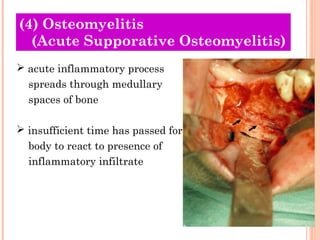
 acute inflammatory process
  spreads through medullary
  spaces of bone

 insufficient time has passed for
  body to react to presence of
  inflammatory infiltrate
(4) Osteomyelitis
  (Acute Supporative Osteomyelitis)
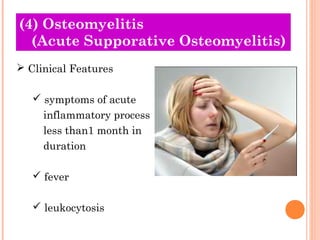
 Clinical Features

    symptoms of acute
     inflammatory process
     less than1 month in
     duration

    fever

    leukocytosis
(4) Osteomyelitis
  (Acute Supporative Osteomyelitis)
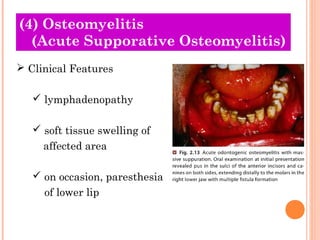
 Clinical Features

    lymphadenopathy

    soft tissue swelling of
     affected area

    on occasion, paresthesia
     of lower lip
(4) Osteomyelitis
  (Acute Supporative Osteomyelitis)
 Histopathologic Features

    biopsy material from
     patients

      • liquid content
      • lack of soft tissue component
      • consist predominantly of
       necrotic bone
(4) Osteomyelitis
  (Acute Supporative Osteomyelitis)
 Histopathologic Features

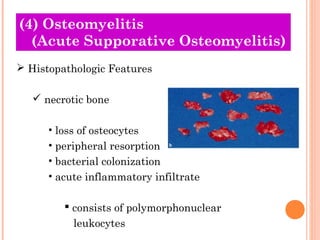
    necrotic bone

      • loss of osteocytes
      • peripheral resorption
      • bacterial colonization
      • acute inflammatory infiltrate

          consists of polymorphonuclear
           leukocytes
(4) Osteomyelitis
  (Acute Supporative Osteomyelitis)
 Radiographic Features

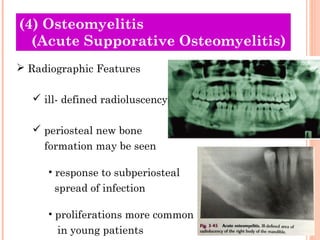
   ill- defined radioluscency

   periosteal new bone
     formation may be seen

     • response to subperiosteal
       spread of infection

     • proliferations more common
       in young patients
(4) Osteomyelitis
  (Acute Supporative Osteomyelitis)
 Radiographic Features

   periosteal new bone
     formation may be seen

     • single-layered radioopaque
       line

     • separated from normal cortex
       by an intervening radiolucent
       band
(4) Osteomyelitis
  (Acute Supporative Osteomyelitis)
 Radiographic Features

   on occasion, exfoliation
     of fragments of necrotic
     bone

   fragment of necrotic bone
     that has separated from
     adjacent vital bone is
     teremed sequestrum
(4) Osteomyelitis
  (Acute Supporative Osteomyelitis)
 Radiographic Features

   on occasion, fragments
    of necrotic bone may become
    surrounded by new vital
    bone, known as involucrum
(4) Osteomyelitis
  (Acute Supporative Osteomyelitis)
 Treatment

   if obvious abscess formation,

     • antibiotics
          penicillin
          clindamycin
          cephalexin
          cefotaxime
          gentamicin

     • drainage
(4) Osteomyelitis
  (Chronic Supporative Osteomyelitis)
 defensive response leads
  to production of granulation
  tissue

    subsequent forms dense
     scar tissue

      • attempt to wall off
       infected area
(4) Osteomyelitis
  (Chronic Supporative Osteomyelitis)
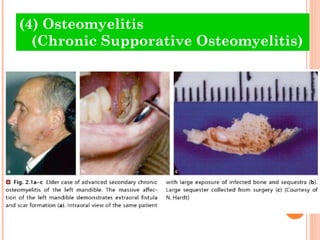
(4) Osteomyelitis
  (Chronic Supporative Osteomyelitis)
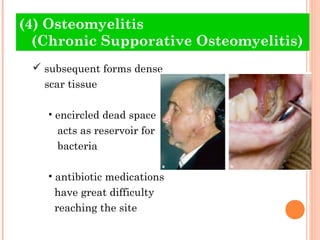
  subsequent forms dense
   scar tissue

   • encircled dead space
     acts as reservoir for
     bacteria

   • antibiotic medications
     have great difficulty
     reaching the site
(4) Osteomyelitis
  (Chronic Supporative Osteomyelitis)
 Clinical Features

    if acute osteomyelitis
     is not resolved expeditiously

    entrenchment of chronic
    osteomyelitis occurs

    sometimes may arise without
     previous acute episode
(4) Osteomyelitis
  (Chronic Supporative Osteomyelitis)
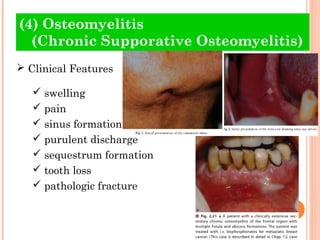
 Clinical Features

    swelling
    pain
    sinus formation
    purulent discharge
    sequestrum formation
    tooth loss
    pathologic fracture
(4) Osteomyelitis
  (Chronic Supporative Osteomyelitis)
 Clinical Features

    may experience acute exacerbations
     or periods of decreased pain
     associated with chronic
     smoldering progression
(4) Osteomyelitis
  (Chronic Supporative Osteomyelitis)
 Histophathologic Features

    biopsy material from patient

      • soft tissue component
      • consists of chronically
        or subacutely inflammed
        connective tissue filling
        the intertrabecular areas
        of bone
      • scattered sequestra + pockets
         of abscess formation
(4) Osteomyelitis
  (Chronic Supporative Osteomyelitis)
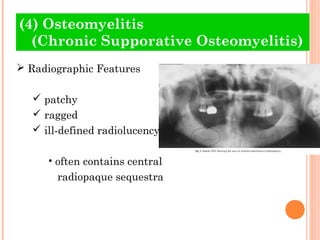
 Radiographic Features

   patchy
   ragged
   ill-defined radiolucency

     • often contains central
       radiopaque sequestra
(4) Osteomyelitis
  (Chronic Supporative Osteomyelitis)
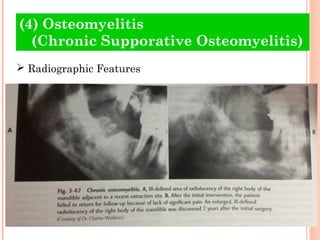
 Radiographic Features
(4) Osteomyelitis
  (Chronic Supporative Osteomyelitis)
 Treatment

   difficult to manage medically

     • pockets of dead bone
     • organisms are protected
      from antibiotic drugs

         due to surrounding
          wall of fibrous connective
          tissue
(4) Osteomyelitis
  (Chronic Supporative Osteomyelitis)
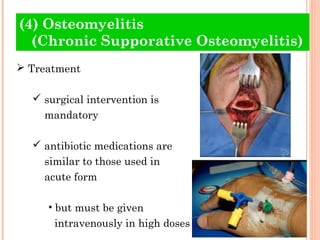
 Treatment

   surgical intervention is
    mandatory

   antibiotic medications are
    similar to those used in
    acute form

     • but must be given
      intravenously in high doses
References:
 Books
  Neville, et. al: Oral and Maxillofacial Pathology
        3rd Edition
        • (pages 138-144)

Odontogenic infections (4)

  • 1.
    ODONTOGENIC INFECTIONS Prepared by: Dr. Rea Corpuz
  • 2.
    Odontogenic Infections  (1)Cellulitis  (2) Ludwig’s Angina  (3) Cavernous Sinus Thrombosis  (4) Osteomyelitis
  • 3.
    (1) Cellulitis  ifabscess is NOT able to establish drainage through the surface of skin or into oral cavity  may spread diffusely through facial planes of soft tissue  acute + edematous spread of acute inflammatory process
  • 4.
    (1) Cellulitis  twodangerous forms:  Ludwig’s Angina  Cavernous Sinus Thrombosis
  • 5.
    (2) Ludwig’s Angina named after German physician who described the seriousness of disorder in 1836  Angina comes from Latin word angere  strangle
  • 6.
    (2) Ludwig’s Angina 70% of cases, develop from spread of an acute infection from lower molar teeth  prevalence in patients who are immunocompromised secondary to disorders such as:  diabetes mellitus  organ transplantation  acquired immunodeficiency syndrome (AIDS)  aplastic anemia
  • 7.
    (2) Ludwig’s Angina Clinical Features  massive swelling on neck  often extends close to clavicle  involvement of sublingual space results in • elevation Woody Tongue • posterior enlargement can compromise • protrusion of tongue airway
  • 8.
  • 9.
    (2) Ludwig’s Angina Clinical Features  involvement of submandibular space results in • enlargement • tenderness of neck above level of hyoid bone Bull Neck • pain in neck + floor of mouth • restricted neck movement
  • 10.
    (2) Ludwig’s Angina Clinical Features  involvement of submandibular space results in • dysphagia • dysphonia • dysarthria • drooling • sore throat
  • 11.
    (2) Ludwig’s Angina Clinical Features  involvement of lateral pharyngeal space • respiratory obstruction secondary to laryngeal edema • tachypnea • dyspnea • tachycardia • patient needs to maintain erect position
  • 12.
    (2) Ludwig’s Angina Treatment & Prognosis  centers around 4 activities • maintenance of airway • incision + drainage • antibiotic therapy • elimination of original focus of inflammation
  • 13.
    (2) Ludwig’s Angina Treatment & Prognosis  initial observation many clinicians administer • systemic corticosteroid medications such as intravenous (IV) dexamethasone  attempt to reduce cellulitis
  • 14.
    (2) Ludwig’s Angina Treatment & Prognosis  if signs or symptoms of impending airway obstruction: • fiber-optic nasotracheal intubation • tracheostomy • cricothyroidotomy
  • 15.
    (2) Ludwig’s Angina Treatment & Prognosis  if signs or symptoms of impending airway obstruction: • cricothyroidotomy  sometimes performed instead of tracheostomy  perceived lower risk of spreading infection to mediastinum
  • 16.
    (2) Ludwig’s Angina Treatment & Prognosis • cricothyroidotomy
  • 17.
    (2) Ludwig’s Angina Treatment & Prognosis  high dose of penicillin penicillin-  Clindamycin OR sensitive  Choramphenicol patients  anitbiotic medication is adjusted according to patient’s response + culture result from aspirates of fluid from enlargement
  • 18.
    (2) Ludwig’s Angina Treatment & Prognosis  if infection remains:  diffuse surgical intervention  indurated is at discretion of clinician  brawny + often governed by patient’s response to noninvasive therapy
  • 19.
    (2) Ludwig’s Angina Treatment & Prognosis  complications: • Pericarditis • Pneumonia • Mediastinitis • Sepsis • Empyema • Respiratory Obstruction
  • 20.
    (3) Cavernous Sinus Thrombosis  edematous periorbital enlargement  with involvement of eyelids + conjunctiva
  • 21.
    (3) Cavernous Sinus Thrombosis  in cases, involving canine space  swelling along lateral border of nose  may extend up to medial aspect of eye + periorbital area  protrusion + fixation of eyeball
  • 22.
    (3) Cavernous Sinus Thrombosis  in cases, involving canine space  induration + swelling of adjacent forehead + nose  pupil dilation  lacrimation may also  photophobia occur  loss of vision
  • 23.
    (3) Cavernous Sinus Thrombosis  in cases, involving canine space  pain over eye + along distribution of: • opthalmic Trigeminal • maxillary branches Nerve
  • 24.
    (3) Cavernous Sinus Thrombosis  Treatment & Prognosis  surgical drainage + high-dose antibiotic medication similar to those administered for patient’s with Ludwig’s Angina
  • 25.
    (4) Osteomyelitis  anacute or chronic inflammatory process in extends  medullary spaces OR away from  cortical surfaces of bone initial site of involvement
  • 26.
    (4) Osteomyelitis  causedby bacterial infections  result in expanding lytic destruction of involved bone  with suppuration  sequestra formation
  • 27.
    (4) Osteomyelitis  patientsof all ages can be affected  strong male predominance  most cases involves mandible
  • 28.
    (4) Osteomyelitis  AcuteSupporative Osteomyelitis  Chronic Suppporative Osteomyelitis
  • 29.
    (4) Osteomyelitis (Acute Supporative Osteomyelitis)  acute inflammatory process spreads through medullary spaces of bone  insufficient time has passed for body to react to presence of inflammatory infiltrate
  • 30.
    (4) Osteomyelitis (Acute Supporative Osteomyelitis)  Clinical Features  symptoms of acute inflammatory process less than1 month in duration  fever  leukocytosis
  • 31.
    (4) Osteomyelitis (Acute Supporative Osteomyelitis)  Clinical Features  lymphadenopathy  soft tissue swelling of affected area  on occasion, paresthesia of lower lip
  • 32.
    (4) Osteomyelitis (Acute Supporative Osteomyelitis)  Histopathologic Features  biopsy material from patients • liquid content • lack of soft tissue component • consist predominantly of necrotic bone
  • 33.
    (4) Osteomyelitis (Acute Supporative Osteomyelitis)  Histopathologic Features  necrotic bone • loss of osteocytes • peripheral resorption • bacterial colonization • acute inflammatory infiltrate  consists of polymorphonuclear leukocytes
  • 34.
    (4) Osteomyelitis (Acute Supporative Osteomyelitis)  Radiographic Features  ill- defined radioluscency  periosteal new bone formation may be seen • response to subperiosteal spread of infection • proliferations more common in young patients
  • 35.
    (4) Osteomyelitis (Acute Supporative Osteomyelitis)  Radiographic Features  periosteal new bone formation may be seen • single-layered radioopaque line • separated from normal cortex by an intervening radiolucent band
  • 36.
    (4) Osteomyelitis (Acute Supporative Osteomyelitis)  Radiographic Features  on occasion, exfoliation of fragments of necrotic bone  fragment of necrotic bone that has separated from adjacent vital bone is teremed sequestrum
  • 37.
    (4) Osteomyelitis (Acute Supporative Osteomyelitis)  Radiographic Features  on occasion, fragments of necrotic bone may become surrounded by new vital bone, known as involucrum
  • 38.
    (4) Osteomyelitis (Acute Supporative Osteomyelitis)  Treatment  if obvious abscess formation, • antibiotics  penicillin  clindamycin  cephalexin  cefotaxime  gentamicin • drainage
  • 39.
    (4) Osteomyelitis (Chronic Supporative Osteomyelitis)  defensive response leads to production of granulation tissue  subsequent forms dense scar tissue • attempt to wall off infected area
  • 40.
    (4) Osteomyelitis (Chronic Supporative Osteomyelitis)
  • 41.
    (4) Osteomyelitis (Chronic Supporative Osteomyelitis)  subsequent forms dense scar tissue • encircled dead space acts as reservoir for bacteria • antibiotic medications have great difficulty reaching the site
  • 42.
    (4) Osteomyelitis (Chronic Supporative Osteomyelitis)  Clinical Features  if acute osteomyelitis is not resolved expeditiously  entrenchment of chronic osteomyelitis occurs  sometimes may arise without previous acute episode
  • 43.
    (4) Osteomyelitis (Chronic Supporative Osteomyelitis)  Clinical Features  swelling  pain  sinus formation  purulent discharge  sequestrum formation  tooth loss  pathologic fracture
  • 44.
    (4) Osteomyelitis (Chronic Supporative Osteomyelitis)  Clinical Features  may experience acute exacerbations or periods of decreased pain associated with chronic smoldering progression
  • 45.
    (4) Osteomyelitis (Chronic Supporative Osteomyelitis)  Histophathologic Features  biopsy material from patient • soft tissue component • consists of chronically or subacutely inflammed connective tissue filling the intertrabecular areas of bone • scattered sequestra + pockets of abscess formation
  • 46.
    (4) Osteomyelitis (Chronic Supporative Osteomyelitis)  Radiographic Features  patchy  ragged  ill-defined radiolucency • often contains central radiopaque sequestra
  • 47.
    (4) Osteomyelitis (Chronic Supporative Osteomyelitis)  Radiographic Features
  • 48.
    (4) Osteomyelitis (Chronic Supporative Osteomyelitis)  Treatment  difficult to manage medically • pockets of dead bone • organisms are protected from antibiotic drugs  due to surrounding wall of fibrous connective tissue
  • 49.
    (4) Osteomyelitis (Chronic Supporative Osteomyelitis)  Treatment  surgical intervention is mandatory  antibiotic medications are similar to those used in acute form • but must be given intravenously in high doses
  • 50.
    References:  Books Neville, et. al: Oral and Maxillofacial Pathology 3rd Edition • (pages 138-144)