GENIOPLASTY
Dr.Padmasree Patowary
Contents
• INTRODUCTION
• SURGICAL ANATOMY
• CLASSIFICATION OF CHIN DEFORMITY
• DIAGNOSIS
• SURGICAL PROCEDURE
• COMPLICATION
• RECENT ADVANCES
• CONCLUSION
INTRODUCTION
• Successful treatment of the orthognathic surgical patient is dependent on
careful diagnosis
• Cephalometrics can be an aid in the diagnosis of skeletal and dental
problems and a tool for simulating surgery and orthodontics treatment.
• While patients seeking about facial cosmetic surgery often focus on
structures such as the nose, the eyes, and the laxity of their skin, but the
lower third of the face is an area that could be surgically modified to
improve overall facial appearance and harmony.
• The profile of a patient can be significantly altered with either a chin
augmentation or reduction procedure. This, in turn, has a significant
effect on overall facial symmetry.
What is deformity?
• Jaw deformities are a common condition, ranging from mild abnormalities to
more severe defects that can be surgically corrected. In some instances, the upper
or lower jaw — or both — may grow too little or too much, resulting in
malocclusion, the improper alignment of the teeth in relation to the first molars.
• The chin represents one of the most recognizable structures on the human face.
Numerous methods to alter the contour and appearance of the chin and lower
facial esthetic subunit have been described in the past.
• Chin deformity can be corrected by genioplasty approaches.
HISTORY OF GENIAL PROCEDURES
• Hofer in 1942 described horizontal sliding osteotomy.
• Trauner & Obwegesser in 1957 described horizontal sliding osteotomy
with intraoral incision.
• Reichenbach in 1965 described wedge osteotomy & vertical shortening
of chin.
DEFINITION
• Chin augmentation, known as genioplasty, is performed to enhance chin
projection and improve facial proportions and aesthetics . It is performed
through incisions hidden in the mouth by using either alloplastic
materials (a chin implant) or by creating a bone cut in the chin and
sliding the chin forward (osteoplastic genioplasty). These procedures
may be done alone or in combination with other cosmetic procedures.
Chin
• The chin should, however, be evaluated in all three dimensions. The width of
the chin should be assessed in relation to the overall facial shape.
• A narrow chin often has a knobby appearance, and if surgical advancement of
the chin is planned, widening of the chin should be contemplated.
• The labiomental fold, chin shape, relation to the dental midline, symmetry,
and cant of the lower border should be considered.
SURGICAL ANATOMY
The primary sensory innervation to the chin area is from the paired mental
nerves that exit the body of the mandible near the apices of the premolar teeth.
The primary motor component to the muscles associated with the anterior
aspect of the chin are from the buccal and marginal mandibular branches of the
facial nerve. These muscles include the depressor labii inferioris, depressor
anguli oris, mentalis and orbicularis oris muscles.
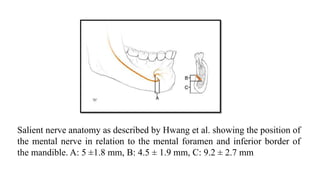
Salient nerve anatomy as described by Hwang et al. showing the position of
the mental nerve in relation to the mental foramen and inferior border of
the mandible. A: 5 ±1.8 mm, B: 4.5 ± 1.9 mm, C: 9.2 ± 2.7 mm
• The primary muscle involved with the genioplasty procedure itself is the
mentalis muscle, which provides the primary vertical support to the
lower lip.
• The depth of labiomental fold may dictate which technique is suitable.
Alloplastic implants tend to deepen the mentolabial sulcus. The
mentolabial sulcus becomes less pronounced in a vertical lengthening of
the chin.
• Position of mental foramen is utmost importance during surgery. The
mentalis muscle elevates the chin at a place just below the tooth roots.
• The arterial supply to the muscles of the chin area is from the inferior
labial arteries, which are terminal extensions from the facial arteries.
Biologic foundation of osseous genioplasty
• When carrying out an osseous genioplasty, a horizontal osteotomy below
the roots of the anterior teeth and the mental foramen on either side is
completed.
• After osteotomy, the distal segment of the chin remains attached to a
mucoperiosteal pedicle.
• Healing is optimal when the circulation of blood to bone and its
enveloping soft tissue is continuously maintained.
• In 1988, Bell and colleagues completed microangiographic and
histologic studies in adult rhesus monkeys that indicated that an intraoral
pedicle flap that involved an osteotomy of the inferior border of
mandible maintains circulation and osseous viability after manipulation
and repositioning of the chin segment.
• According to Bell’s experimental work, circulation to the dental pulp
should not be affected during the process.
CLASSIFICATION OF CHIN DEFORMITIES
• Class I macrogenia
a. Horizontal
b. Vertical
c. Combination of both
• Class II microgenia
a. Horizontal
b. Vertical
c. Combination of both
• Class III combined
a. Horizontal macrogenia with vertical microgenia
b. Horizontal microgenia with vertical macrogenia
• Class IV asymmetric chin
a. Short anterior facial height
b. Normal anterior facial height
c. Long anterior facial height
• Class V Witch’s chin(soft tissue ptosis)
• Class VI Pseudomacrogenia
• Class VII Pseudomicrogenia
INDICATIONS
• Surgical goals include creating an aesthetically pleasing facial contour
and establishing proportionate facial height.
CONTRAINDICATIONS
• Carefully evaluate the teeth and the height of the mandible prior to
surgery. Long teeth with a short mandibular height is a relative
contraindication for an osseous genioplasty or an aggressive bony
reduction.
PREOPERATIVE ASSESSMENT
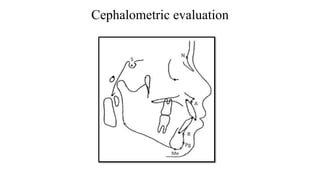
• Cephalometric evaluation
• Soft Tissue Analysis
 Lip competence
 Facial height
 Facial symmetry
 Labiomental fold
 Lip–chin relationship
 Cervicomental angle
 Nose–chin evaluation
• The skin of the lower face
Cephalometric evaluation
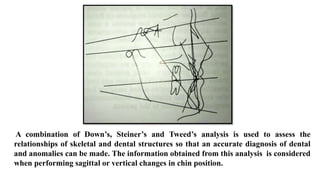
A combination of Down’s, Steiner’s and Tweed’s analysis is used to assess the
relationships of skeletal and dental structures so that an accurate diagnosis of dental
and anomalies can be made. The information obtained from this analysis is considered
when performing sagittal or vertical changes in chin position.
Soft Tissue Analysis
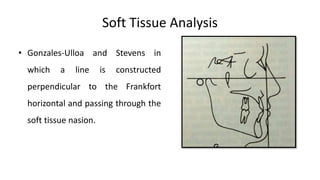
• Gonzales-Ulloa and Stevens in
which a line is constructed
perpendicular to the Frankfort
horizontal and passing through the
soft tissue nasion.
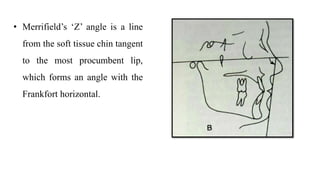
• Merrifield’s ‘Z’ angle is a line
from the soft tissue chin tangent
to the most procumbent lip,
which forms an angle with the
Frankfort horizontal.
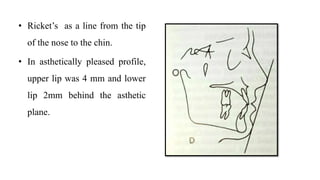
• Ricket’s as a line from the tip
of the nose to the chin.
• In asthetically pleased profile,
upper lip was 4 mm and lower
lip 2mm behind the asthetic
plane.
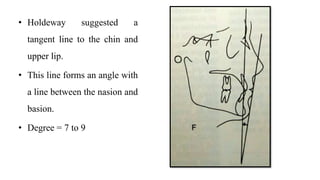
• Holdeway suggested a
tangent line to the chin and
upper lip.
• This line forms an angle with
a line between the nasion and
basion.
• Degree = 7 to 9
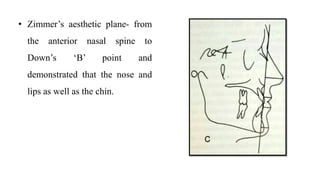
• Zimmer’s aesthetic plane- from
the anterior nasal spine to
Down’s ‘B’ point and
demonstrated that the nose and
lips as well as the chin.
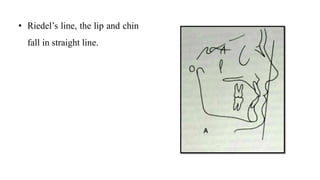
• Riedel’s line, the lip and chin
fall in straight line.
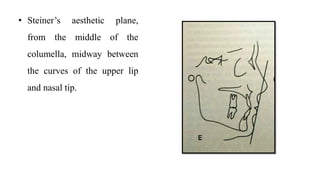
• Steiner’s aesthetic plane,
from the middle of the
columella, midway between
the curves of the upper lip
and nasal tip.
• Lastly, the skin of the lower face should be examined in both frontal and
profile views, noting the quality, thickness, and laxity as well as any
irregularities.
• Because these factors can impact outcome, a patient’s expectations
should be managed by discussing these factors in the preoperative
setting.
Surgical technique
• Infiltration with vasoconstrictor
The area of dissection is infiltrated with a local anesthetic containing a
vasoconstrictor 10 minutes before surgery.
• Mucosal incision-
The mucosal incision is placed roughly 5 mm superior to the buccal
sulcus in the labial mucosa from canine to canine.
 Care must be taken to identify the branches of the mental nerve,
which are often visible.
 Placement of the incision must provide for a soft tissue cuff of
mucosa and muscle to suture and should be placed well away from the
attached mucosa of the teeth to prevent gingival recession.
• Muscular incision
– The incision is then completed down to the bone.
– The mental nerve should be avoided.
• Periosteal stripping
⁻ Stripping of the periosteum should strive to maintain the periosteum
intact, and avoid total denudation of the chin as this will result in
unpredictable soft tissue changes
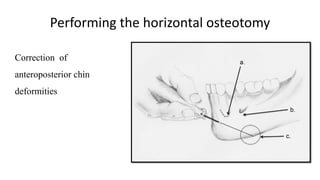
Performing the horizontal osteotomy
Correction of
anteroposterior chin
deformities
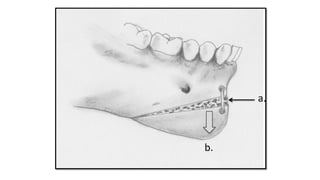
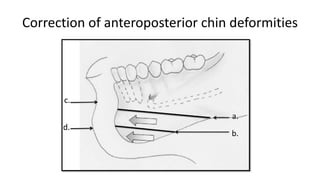
Correction of anteroposterior chin deformities
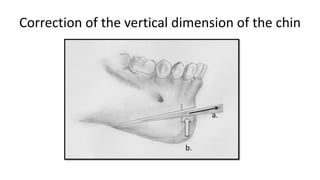
Correction of the vertical dimension of the chin
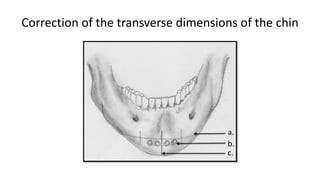
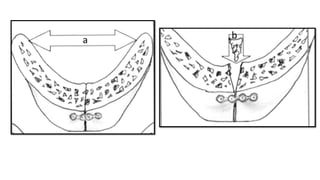
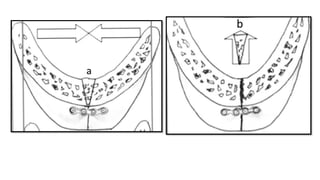
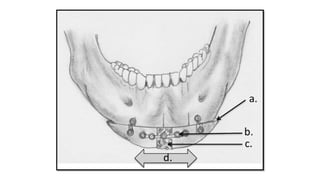
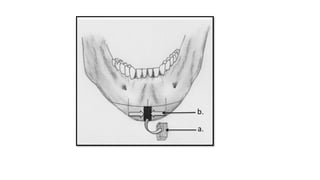
Correction of the transverse dimensions of the chin
A B
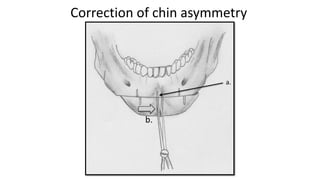
Correction of chin asymmetry
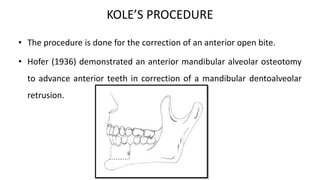
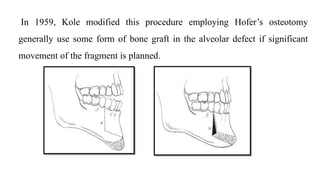
KOLE’S PROCEDURE
• The procedure is done for the correction of an anterior open bite.
• Hofer (1936) demonstrated an anterior mandibular alveolar osteotomy
to advance anterior teeth in correction of a mandibular dentoalveolar
retrusion.
In 1959, Kole modified this procedure employing Hofer’s osteotomy
generally use some form of bone graft in the alveolar defect if significant
movement of the fragment is planned.
Tenon technique
• Michelet and associated described this techenique in 1974.
• A U shaped monocortical osteotomy is created on the center of the
symphysis.
• Lateral extensions are developed below the mental nerves, which
connect to the superior aspects of the tenon corticotomy.
• Full thickness osteotomies are completed on the lateral extensions and
only through the lingual cortex on the superior aspect of the tenon.
• The resultant full thickness of bone behind the tenon facilitates the
mortising of the tenon and lag-screw fixation.
Advantages of Chin Osteotomy
i. Very versatile procedure
ii. Corrects vertical problems
iii. Stable over time
iv. Increases submental length and cervicomental angle
v. Advances genial-tongue-hyoid position, of benefit in sleep apnea
Disadvantages of Chin Osteotomy
i. Requires osteotomy, adding risk from surgery and anesthesia
ii. Vascular injury risk
iii. Airway problem risk
iv. Not easily reversible
v. Increased expense for anesthesia, OR time and fixation materials
when compared to implants
Augmentation using implants
• Autologous
Calvarial bone
• Metals
Corrosive
High rate of bone erosion
• Polymers – most commonly used
• Polymers – carbon chain based molecules with cross linking
– Dimethylsiloxanes
• Silicone based
• Silastic
• Polyamide
– Supramid
• Polyethylene (polyester fiber)
– Mersilene (Polyethylene terephthalate)
– Dacron
– Medpor (porous polyethylene)
• Expanded polytetrafluoroethylene (PTFE)
– Gore-Tex
– Avanta
• PTFE
– Teflon
– Proplast I and II
• Polymethylmethacrylate (PMMA)
• Composite polymer implants
 Hard Tissue Replacement (HTR)
Polymethylmethacrylate (PMMA) +
polyhydroxyethylmethacrylate and calcium hydroxide
• Hydrophilic outer layer for osseointegration
• Silastic implant with Dacron backing
 Increase interface soft tissue ingrowth
Advantages of Chin Implants
Quick procedure
Requires minimal instrumentation
Less dissection than osteotomy
No risk to floor of mouth vasculature
“Easily” reversible procedure
Wide selection of implant options
Customizable
Disadvantages of Chin Implants
 Capsular contracture
 Infection
 Bone resorption
 Dislodgement/malposition
 Soft tissue chin pad issues
 Vertical changes are difficult
 Lower lip retraction
COMPLICATIONS OF GENIOPLASTY
• Soft tissue
i. Hematoma
ii. Scar
iii. Wound dehiscence
iv. Cellulitis
• Nerve
 Hypoesthesia/dysesthesia
v. Draining fistula
vi. Capsular contracture
vii. Skin bunching/dimpling
viii. Skin necrosis
• Muscle
a. Chin ptosis
b. Mentalis muscle dysfunction
c. Lower lip retraction
• Bone/tooth Abscess
a. Tooth root damage
b. Mandibular bone resorption
• Technical
a. Implant malposition
b. Underaugmentation/overaugmentation
RECENT ADVANCES
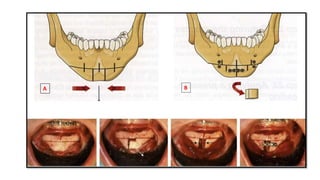
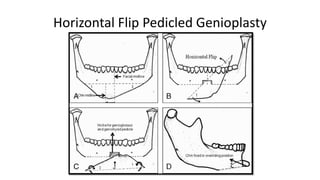
Horizontal Flip Pedicled Genioplasty
CONCLUSION
• Genial procedure or genioplasty afford the surgeon the ability to make
small but necessary changes or dramatic alteration in the overall form of
the lower third of the face.
• This can be accomplished with detailed preoperative planning and
application of good surgical technique.
THANK YOU

Genioplasty

  • 1.
  • 2.
    Contents • INTRODUCTION • SURGICALANATOMY • CLASSIFICATION OF CHIN DEFORMITY • DIAGNOSIS • SURGICAL PROCEDURE • COMPLICATION • RECENT ADVANCES • CONCLUSION
  • 3.
    INTRODUCTION • Successful treatmentof the orthognathic surgical patient is dependent on careful diagnosis • Cephalometrics can be an aid in the diagnosis of skeletal and dental problems and a tool for simulating surgery and orthodontics treatment.
  • 4.
    • While patientsseeking about facial cosmetic surgery often focus on structures such as the nose, the eyes, and the laxity of their skin, but the lower third of the face is an area that could be surgically modified to improve overall facial appearance and harmony. • The profile of a patient can be significantly altered with either a chin augmentation or reduction procedure. This, in turn, has a significant effect on overall facial symmetry.
  • 5.
    What is deformity? •Jaw deformities are a common condition, ranging from mild abnormalities to more severe defects that can be surgically corrected. In some instances, the upper or lower jaw — or both — may grow too little or too much, resulting in malocclusion, the improper alignment of the teeth in relation to the first molars. • The chin represents one of the most recognizable structures on the human face. Numerous methods to alter the contour and appearance of the chin and lower facial esthetic subunit have been described in the past. • Chin deformity can be corrected by genioplasty approaches.
  • 6.
    HISTORY OF GENIALPROCEDURES • Hofer in 1942 described horizontal sliding osteotomy. • Trauner & Obwegesser in 1957 described horizontal sliding osteotomy with intraoral incision. • Reichenbach in 1965 described wedge osteotomy & vertical shortening of chin.
  • 7.
    DEFINITION • Chin augmentation,known as genioplasty, is performed to enhance chin projection and improve facial proportions and aesthetics . It is performed through incisions hidden in the mouth by using either alloplastic materials (a chin implant) or by creating a bone cut in the chin and sliding the chin forward (osteoplastic genioplasty). These procedures may be done alone or in combination with other cosmetic procedures.
  • 8.
    Chin • The chinshould, however, be evaluated in all three dimensions. The width of the chin should be assessed in relation to the overall facial shape. • A narrow chin often has a knobby appearance, and if surgical advancement of the chin is planned, widening of the chin should be contemplated. • The labiomental fold, chin shape, relation to the dental midline, symmetry, and cant of the lower border should be considered.
  • 9.
    SURGICAL ANATOMY The primarysensory innervation to the chin area is from the paired mental nerves that exit the body of the mandible near the apices of the premolar teeth. The primary motor component to the muscles associated with the anterior aspect of the chin are from the buccal and marginal mandibular branches of the facial nerve. These muscles include the depressor labii inferioris, depressor anguli oris, mentalis and orbicularis oris muscles.
  • 10.
    Salient nerve anatomyas described by Hwang et al. showing the position of the mental nerve in relation to the mental foramen and inferior border of the mandible. A: 5 ±1.8 mm, B: 4.5 ± 1.9 mm, C: 9.2 ± 2.7 mm
  • 11.
    • The primarymuscle involved with the genioplasty procedure itself is the mentalis muscle, which provides the primary vertical support to the lower lip. • The depth of labiomental fold may dictate which technique is suitable. Alloplastic implants tend to deepen the mentolabial sulcus. The mentolabial sulcus becomes less pronounced in a vertical lengthening of the chin. • Position of mental foramen is utmost importance during surgery. The mentalis muscle elevates the chin at a place just below the tooth roots.
  • 12.
    • The arterialsupply to the muscles of the chin area is from the inferior labial arteries, which are terminal extensions from the facial arteries.
  • 13.
    Biologic foundation ofosseous genioplasty • When carrying out an osseous genioplasty, a horizontal osteotomy below the roots of the anterior teeth and the mental foramen on either side is completed. • After osteotomy, the distal segment of the chin remains attached to a mucoperiosteal pedicle. • Healing is optimal when the circulation of blood to bone and its enveloping soft tissue is continuously maintained.
  • 14.
    • In 1988,Bell and colleagues completed microangiographic and histologic studies in adult rhesus monkeys that indicated that an intraoral pedicle flap that involved an osteotomy of the inferior border of mandible maintains circulation and osseous viability after manipulation and repositioning of the chin segment. • According to Bell’s experimental work, circulation to the dental pulp should not be affected during the process.
  • 15.
    CLASSIFICATION OF CHINDEFORMITIES • Class I macrogenia a. Horizontal b. Vertical c. Combination of both • Class II microgenia a. Horizontal b. Vertical c. Combination of both • Class III combined a. Horizontal macrogenia with vertical microgenia b. Horizontal microgenia with vertical macrogenia
  • 16.
    • Class IVasymmetric chin a. Short anterior facial height b. Normal anterior facial height c. Long anterior facial height • Class V Witch’s chin(soft tissue ptosis) • Class VI Pseudomacrogenia • Class VII Pseudomicrogenia
  • 17.
    INDICATIONS • Surgical goalsinclude creating an aesthetically pleasing facial contour and establishing proportionate facial height.
  • 18.
    CONTRAINDICATIONS • Carefully evaluatethe teeth and the height of the mandible prior to surgery. Long teeth with a short mandibular height is a relative contraindication for an osseous genioplasty or an aggressive bony reduction.
  • 19.
  • 20.
    • Cephalometric evaluation •Soft Tissue Analysis  Lip competence  Facial height  Facial symmetry  Labiomental fold  Lip–chin relationship  Cervicomental angle  Nose–chin evaluation • The skin of the lower face
  • 21.
  • 22.
    A combination ofDown’s, Steiner’s and Tweed’s analysis is used to assess the relationships of skeletal and dental structures so that an accurate diagnosis of dental and anomalies can be made. The information obtained from this analysis is considered when performing sagittal or vertical changes in chin position.
  • 23.
    Soft Tissue Analysis •Gonzales-Ulloa and Stevens in which a line is constructed perpendicular to the Frankfort horizontal and passing through the soft tissue nasion.
  • 24.
    • Merrifield’s ‘Z’angle is a line from the soft tissue chin tangent to the most procumbent lip, which forms an angle with the Frankfort horizontal.
  • 25.
    • Ricket’s asa line from the tip of the nose to the chin. • In asthetically pleased profile, upper lip was 4 mm and lower lip 2mm behind the asthetic plane.
  • 26.
    • Holdeway suggesteda tangent line to the chin and upper lip. • This line forms an angle with a line between the nasion and basion. • Degree = 7 to 9
  • 27.
    • Zimmer’s aestheticplane- from the anterior nasal spine to Down’s ‘B’ point and demonstrated that the nose and lips as well as the chin.
  • 28.
    • Riedel’s line,the lip and chin fall in straight line.
  • 29.
    • Steiner’s aestheticplane, from the middle of the columella, midway between the curves of the upper lip and nasal tip.
  • 30.
    • Lastly, theskin of the lower face should be examined in both frontal and profile views, noting the quality, thickness, and laxity as well as any irregularities. • Because these factors can impact outcome, a patient’s expectations should be managed by discussing these factors in the preoperative setting.
  • 31.
  • 32.
    • Infiltration withvasoconstrictor The area of dissection is infiltrated with a local anesthetic containing a vasoconstrictor 10 minutes before surgery.
  • 33.
    • Mucosal incision- Themucosal incision is placed roughly 5 mm superior to the buccal sulcus in the labial mucosa from canine to canine.  Care must be taken to identify the branches of the mental nerve, which are often visible.  Placement of the incision must provide for a soft tissue cuff of mucosa and muscle to suture and should be placed well away from the attached mucosa of the teeth to prevent gingival recession.
  • 34.
    • Muscular incision –The incision is then completed down to the bone. – The mental nerve should be avoided. • Periosteal stripping ⁻ Stripping of the periosteum should strive to maintain the periosteum intact, and avoid total denudation of the chin as this will result in unpredictable soft tissue changes
  • 36.
    Performing the horizontalosteotomy Correction of anteroposterior chin deformities
  • 37.
  • 39.
    Correction of thevertical dimension of the chin
  • 41.
    Correction of thetransverse dimensions of the chin
  • 46.
  • 47.
  • 51.
    KOLE’S PROCEDURE • Theprocedure is done for the correction of an anterior open bite. • Hofer (1936) demonstrated an anterior mandibular alveolar osteotomy to advance anterior teeth in correction of a mandibular dentoalveolar retrusion.
  • 52.
    In 1959, Kolemodified this procedure employing Hofer’s osteotomy generally use some form of bone graft in the alveolar defect if significant movement of the fragment is planned.
  • 53.
    Tenon technique • Micheletand associated described this techenique in 1974. • A U shaped monocortical osteotomy is created on the center of the symphysis. • Lateral extensions are developed below the mental nerves, which connect to the superior aspects of the tenon corticotomy.
  • 54.
    • Full thicknessosteotomies are completed on the lateral extensions and only through the lingual cortex on the superior aspect of the tenon. • The resultant full thickness of bone behind the tenon facilitates the mortising of the tenon and lag-screw fixation.
  • 55.
    Advantages of ChinOsteotomy i. Very versatile procedure ii. Corrects vertical problems iii. Stable over time iv. Increases submental length and cervicomental angle v. Advances genial-tongue-hyoid position, of benefit in sleep apnea
  • 56.
    Disadvantages of ChinOsteotomy i. Requires osteotomy, adding risk from surgery and anesthesia ii. Vascular injury risk iii. Airway problem risk iv. Not easily reversible v. Increased expense for anesthesia, OR time and fixation materials when compared to implants
  • 57.
    Augmentation using implants •Autologous Calvarial bone • Metals Corrosive High rate of bone erosion • Polymers – most commonly used
  • 58.
    • Polymers –carbon chain based molecules with cross linking – Dimethylsiloxanes • Silicone based • Silastic • Polyamide – Supramid • Polyethylene (polyester fiber) – Mersilene (Polyethylene terephthalate) – Dacron – Medpor (porous polyethylene)
  • 59.
    • Expanded polytetrafluoroethylene(PTFE) – Gore-Tex – Avanta • PTFE – Teflon – Proplast I and II • Polymethylmethacrylate (PMMA)
  • 60.
    • Composite polymerimplants  Hard Tissue Replacement (HTR) Polymethylmethacrylate (PMMA) + polyhydroxyethylmethacrylate and calcium hydroxide • Hydrophilic outer layer for osseointegration • Silastic implant with Dacron backing  Increase interface soft tissue ingrowth
  • 61.
    Advantages of ChinImplants Quick procedure Requires minimal instrumentation Less dissection than osteotomy No risk to floor of mouth vasculature “Easily” reversible procedure Wide selection of implant options Customizable
  • 62.
    Disadvantages of ChinImplants  Capsular contracture  Infection  Bone resorption  Dislodgement/malposition  Soft tissue chin pad issues  Vertical changes are difficult  Lower lip retraction
  • 63.
  • 64.
    • Soft tissue i.Hematoma ii. Scar iii. Wound dehiscence iv. Cellulitis • Nerve  Hypoesthesia/dysesthesia v. Draining fistula vi. Capsular contracture vii. Skin bunching/dimpling viii. Skin necrosis
  • 65.
    • Muscle a. Chinptosis b. Mentalis muscle dysfunction c. Lower lip retraction • Bone/tooth Abscess a. Tooth root damage b. Mandibular bone resorption
  • 66.
    • Technical a. Implantmalposition b. Underaugmentation/overaugmentation
  • 67.
  • 68.
  • 69.
    CONCLUSION • Genial procedureor genioplasty afford the surgeon the ability to make small but necessary changes or dramatic alteration in the overall form of the lower third of the face. • This can be accomplished with detailed preoperative planning and application of good surgical technique.
  • 70.

Editor's Notes

  • #10 In addition to the historical aspects associated with procedures, I feel surgeons must have a sound knowledge of the relevant anatomy as well.
  • #12 Improper repositioning of the mentalis muscle can result in unsightly disfigurement of the chin known as a “witch’s chin” deformity
  • #22 A variety of cephalometric analysis have been proposed for the evalusion of a pts profile..
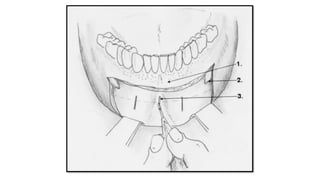
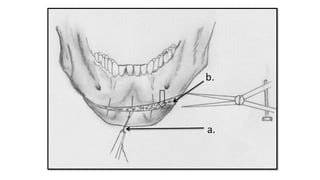
  • #36 Placement of reference marks. (1) The incision is placed in the buccal sulcus leaving at least 5 mm of nonkeratinized mucosa superior to the incision. (2) The mental nerve is identified and protected. (3) Reference marks are placed to assist in accurate repositioning of the genial segment.
  • #37 (a) The horizontal osteotomy is performed using an oscillating saw. (b) Care should be taken to perform the osteotomy at least 5 mm below the root apex of the canine tooth and the mental foramen. (c) Ensure that the osteotomy is carried through the lower border of the mandible.
  • #38 The height of the osteotomy will influence the shape of the chin. (a) A high osteotomy will make the labio-mental fold more obtuse (c) and shallower. (b) A lower osteotomy will augment the tip of the chin (d) and increase the depth of the labio-mental fold.
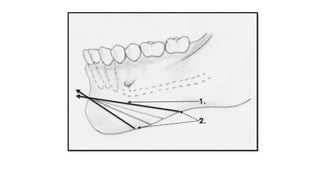
  • #39 The horizontal osteotomy is performed at least 5 mm below the apex of the canine root and the mental foramen. Advancement genioplasty along a high angle will reduce the height of the chin, and the opposite will occur with a setback procedure.
  • #40 Vertical reduction genioplasty. (a) A predetermined segment of bone is removed from the genial segment. (b) The genial segment is repositioned superiorly and fixated.
  • #41 Vertical augmentation genioplasty for incresing the height . (a) The genial segment is repositioned inferiorly and the defect grafted. (b) The amount of vertical increase is predetermined and the segment fixated with 2 bone plates (an H- or X-shaped plate)
  • #42 Widening the posterior aspects of the chin. (a) The position of the horizontal osteotomy is marked. (b) Before the horizontal osteotomy is performed, a bone plate is placed over the center of the genial segment. (c) The centerline osteotomy is performed and the genial segment mobilized.
  • #43 Widening the posterior aspects of the chin. (a) The centerline osteotomy is completed and the genial segments widened using the bone plate as a hinge. (b) A small bone graft is placed in the defect.
  • #44 Narrowing the posterior aspects of the chin. (a) Following mobilization of the genial segment, the centerline osteotomy is completed. (b) A small triangular segment of bone is now removed from the posterior aspect of the genial segments and the genial segments are narrowed by using the bone plate as a hinge.
  • #45 Widening the anterior aspect of the chin. (a) The genial segments are moved laterally to a predetermined width and fixated. (b) A bone plate is placed across the midline defect to fixate the segments. (c) A bone graft is placed into the defect and the graft fixated by the bone plate. (d) The anterior aspect of the chin is made squarer.
  • #46 (a) A predetermined amount of bone is removed from the center of the genial segments. (b) Guided by the reference marks, the defect is closed by moving the segments medially.
  • #47 (a) The genial segments are fixated across the midline and to the mandible.
  • #48 Correction of horizontal chin asymmetry. (a) The osteotomy is performed on a horizontal plane and the genial segment moved to the right, in this case. (b) The clinician is guided by the reference marks.
  • #49 Correction of a chin cant. (a) The left side of the genial segment is repositioned inferiorly using the positioning wire. (b) A bone graft placed in the defect.
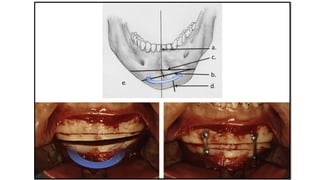
  • #50 The propeller genioplasty. (a) The facial midline is marked on the superior aspect of the chin. (b) The first osteotomy is performed parallel to the lower border of the chin. (c) The second osteotomy is performed parallel to the horizontal. (d) Mark the center of the lower genial segment. (e) The bone segment will be rotated by 180.
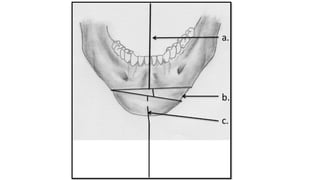
  • #51 The propeller genioplasty. (a) The dental and facial midline. (b) The rotated bone segment. (c) The centerline reference mark of the genial segment.
  • #52 A standard anterior subapical osteotomy is performed after which a portion of the lower border is removed as in a genioplasty & wedged into the space produced between the dentoalveolar segment. This newly formed chin is then reshaped & wound closed in layers.
  • #69 Schematic diagram showing chin and facial midlines (A), horizontal flip around the AP axis (B), the flip interchanges points 1 and 2 (C), niche for pedicle (arrow), and the genial segment fixed in an overriding position buccal to the stable portion of the mandible (D).