CELL -
STRUCTURE &
FUNCTIONS
- ADITYA ARYA
(RIE BHOPAL)
1. DISCOVERY OF THE CELL
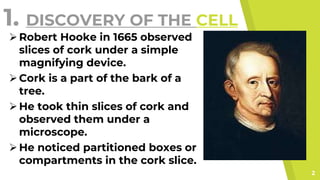
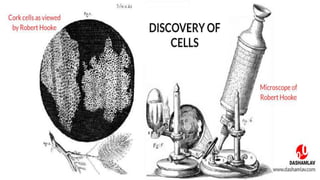
Robert Hooke in 1665 observed
slices of cork under a simple
magnifying device.
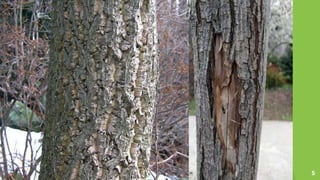
Cork is a part of the bark of a
tree.
He took thin slices of cork and
observed them under a
microscope.
He noticed partitioned boxes or
compartments in the cork slice.
2
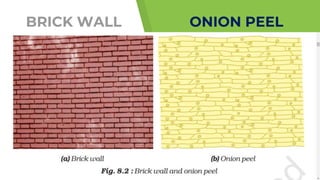
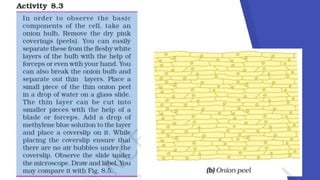
BRICK WALL ONION PEEL
5
HELLO!
6
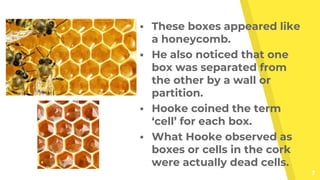
 These boxes appeared like
a honeycomb.
 He also noticed that one
box was separated from
the other by a wall or
partition.
 Hooke coined the term
‘cell’ for each box.
 What Hooke observed as
boxes or cells in the cork
were actually dead cells.
7
8
 Cells of living organisms could be
observed only after the discovery
of improved microscopes.
 Very little was known about the
cell for the next 150 years after
Robert Hooke’s observations.
 Today, we know a lot about cell
structure and its functions
because of improved
microscopes having high
magnification
2. THE CELL
9
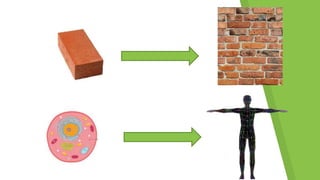
 Cell is a basic structural and
functional unit of living
organisms.
 The buildings, though built of
similar bricks, have different
designs, shapes and sizes.
 Cells in the living organisms are
complex living structures
unlike non-living bricks.
10
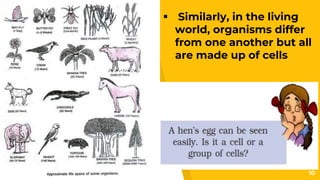
 Similarly, in the living
world, organisms differ
from one another but all
are made up of cells
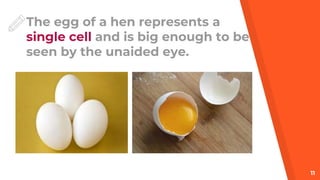
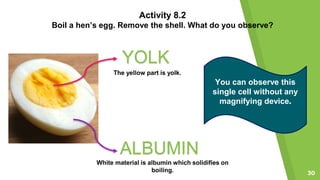
The egg of a hen represents a
single cell and is big enough to be
seen by the unaided eye.
11
3.
Organisms
show Variety in
Cell Number,
Shape and Size
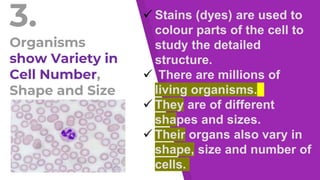
 Stains (dyes) are used to
colour parts of the cell to
study the detailed
structure.
 There are millions of
living organisms.
 They are of different
shapes and sizes.
 Their organs also vary in
shape, size and number of
cells.
“
13
Number of Cells
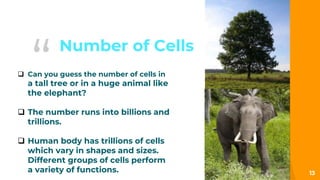
 Can you guess the number of cells in
a tall tree or in a huge animal like
the elephant?
 The number runs into billions and
trillions.
 Human body has trillions of cells
which vary in shapes and sizes.
Different groups of cells perform
a variety of functions.
14
 Organisms made of
more than one cell are
called multicellular
organisms.
MULTICELLULAR
MULTI CELLULAR
MANY CELLS
 The number of cells being less in
smaller organisms does not, in
any way, affect the functioning
of the organisms.
15
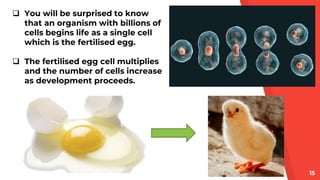
 You will be surprised to know
that an organism with billions of
cells begins life as a single cell
which is the fertilised egg.
 The fertilised egg cell multiplies
and the number of cells increase
as development proceeds.
16
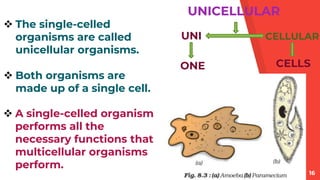
 The single-celled
organisms are called
unicellular organisms.
 Both organisms are
made up of a single cell.
UNICELLULAR
UNI CELLULAR
ONE CELLS
 A single-celled organism
performs all the
necessary functions that
multicellular organisms
perform.
17
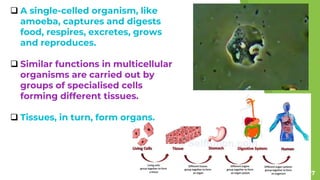
 A single-celled organism, like
amoeba, captures and digests
food, respires, excretes, grows
and reproduces.
 Similar functions in multicellular
organisms are carried out by
groups of specialised cells
forming different tissues.
 Tissues, in turn, form organs.
18
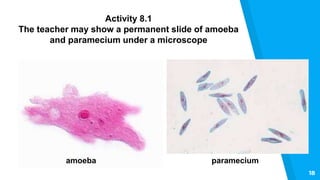
Activity 8.1
The teacher may show a permanent slide of amoeba
and paramecium under a microscope
amoeba paramecium
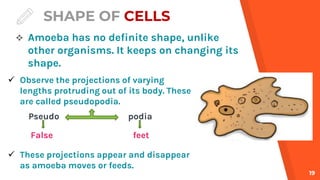
SHAPE OF CELLS
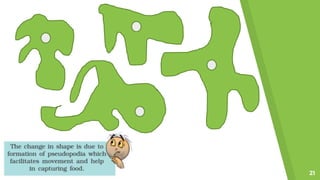
 Amoeba has no definite shape, unlike
other organisms. It keeps on changing its
shape.
19
 Observe the projections of varying
lengths protruding out of its body. These
are called pseudopodia.
 These projections appear and disappear
as amoeba moves or feeds.
Pseudo podia
False feet
20
AMOEBA
21
22
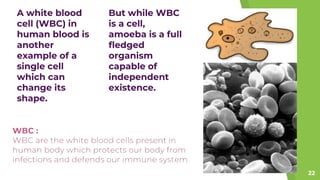
A white blood
cell (WBC) in
human blood is
another
example of a
single cell
which can
change its
shape.
But while WBC
is a cell,
amoeba is a full
fledged
organism
capable of
independent
existence.
23
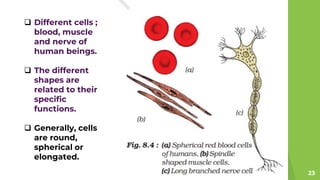
 Different cells ;
blood, muscle
and nerve of
human beings.
 The different
shapes are
related to their
specific
functions.
 Generally, cells
are round,
spherical or
elongated.
24
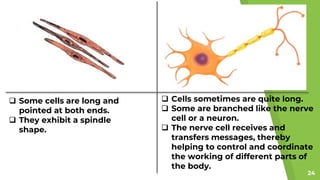
 Some cells are long and
pointed at both ends.
 They exhibit a spindle
shape.
 Cells sometimes are quite long.
 Some are branched like the nerve
cell or a neuron.
 The nerve cell receives and
transfers messages, thereby
helping to control and coordinate
the working of different parts of
the body.
25
Can you
guess, which
part of the
cell gives it
shape?
26
• Components of the cell are
enclosed in a membrane.
• This membrane provides shape to
the cells of plants and animals.
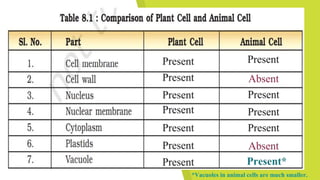
• Cell wall is an additional covering
over the cell membrane in plant
cells.
• It gives shape and rigidity to these
cells.
• Bacterial cell also has a cell wall.
Cell wall
is absent
in animal
cells.
Size of Cells
27
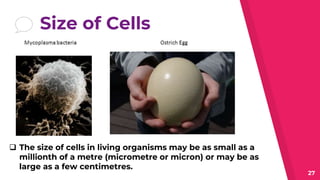
 The size of cells in living organisms may be as small as a
millionth of a metre (micrometre or micron) or may be as
large as a few centimetres.
 Most of the cells are microscopic
in size and are not visible to the
unaided eye.
 They need to be enlarged or
magnified by a microscope.
 The smallest cell is 0.1 to 0.5
micrometre in bacteria.
 The largest cell measuring 170
mm × 130 mm, is the egg of an
ostrich
29
Activity 8.2
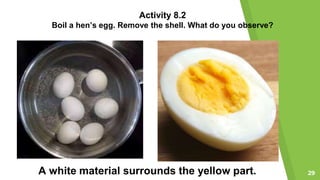
Boil a hen’s egg. Remove the shell. What do you observe?
A white material surrounds the yellow part.
30
Activity 8.2
Boil a hen’s egg. Remove the shell. What do you observe?
White material is albumin which solidifies on
boiling.
ALBUMIN
The yellow part is yolk.
YOLK
You can observe this
single cell without any
magnifying device.
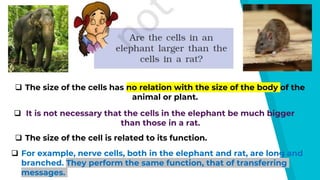
 The size of the cells has no relation with the size of the body of the
animal or plant.
 It is not necessary that the cells in the elephant be much bigger
than those in a rat.
 The size of the cell is related to its function.
 For example, nerve cells, both in the elephant and rat, are long and
branched. They perform the same function, that of transferring
messages.
32
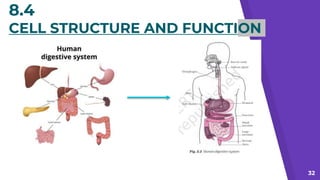
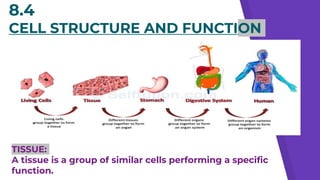
8.4
CELL STRUCTURE AND FUNCTION
33
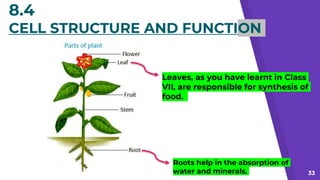
8.4
CELL STRUCTURE AND FUNCTION
Roots help in the absorption of
water and minerals.
Leaves, as you have learnt in Class
VII, are responsible for synthesis of
food.
8.4
CELL STRUCTURE AND FUNCTION
TISSUE:
A tissue is a group of similar cells performing a specific
function.
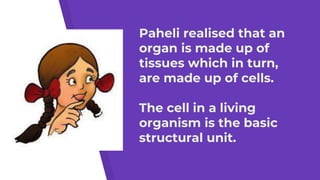
Paheli realised that an
organ is made up of
tissues which in turn,
are made up of cells.
The cell in a living
organism is the basic
structural unit.
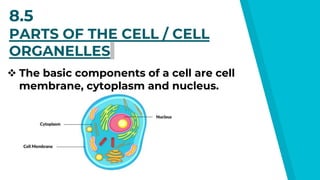
8.5
PARTS OF THE CELL / CELL
ORGANELLES
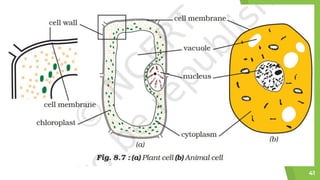
 The basic components of a cell are cell
membrane, cytoplasm and nucleus.
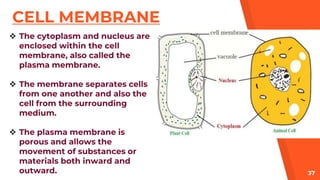
CELL MEMBRANE
37
 The cytoplasm and nucleus are
enclosed within the cell
membrane, also called the
plasma membrane.
 The membrane separates cells
from one another and also the
cell from the surrounding
medium.
 The plasma membrane is
porous and allows the
movement of substances or
materials both inward and
outward.
First
Second
Last
39
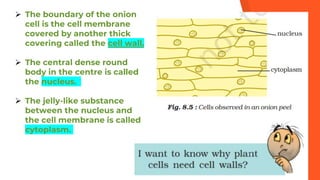
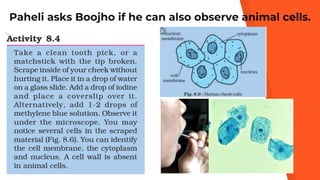
 The boundary of the onion
cell is the cell membrane
covered by another thick
covering called the cell wall.
 The central dense round
body in the centre is called
the nucleus.
 The jelly-like substance
between the nucleus and
the cell membrane is called
cytoplasm.
41
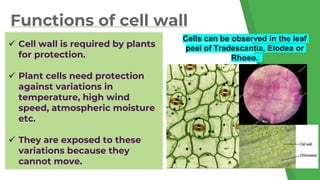
Functions of cell wall
 Cell wall is required by plants
for protection.
 Plant cells need protection
against variations in
temperature, high wind
speed, atmospheric moisture
etc.
 They are exposed to these
variations because they
cannot move.
Cells can be observed in the leaf
peel of Tradescantia, Elodea or
Rhoeo.
CYTOPLASM
 It is the jelly-like substance
present between the cell
membrane and the nucleus.
 Various other components, or
organelles, of cells are
present in the cytoplasm.
 These are mitochondria, golgi
bodies, ribosomes, etc.
NUCLEUS
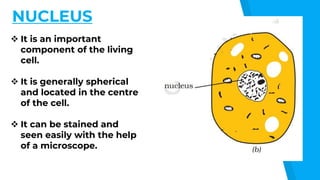
 It is an important
component of the living
cell.
 It is generally spherical
and located in the centre
of the cell.
 It can be stained and
seen easily with the help
of a microscope.
NUCLEUS
 Nucleus is separated from the
cytoplasm by a membrane called
the nuclear membrane.
 This membrane is also porous and
allows the movement of materials
between the cytoplasm and the
inside of the nucleus.
 With a microscope of higher
magnification, we can see a
smaller spherical body in the
nucleus. It is called the nucleolus.
 In addition, nucleus
contains thread-like
structures called
chromosomes.
 These carry genes
and help in
inheritance or
transfer of
characters from the
parents to the
offspring.
 The chromosomes
can be seen only
when the cell
divides.
Chromo
Color
Soma / somes
thread
 Nucleus, in addition to its role
in inheritance, acts as control
centre of the activities of the
cell.
 The entire content of a living
cell is known as protoplasm.
 It includes the cytoplasm and
the nucleus.
 Protoplasm is called the living
substance of the cell.
Protoplasm =
cytoplasm + nucleus
PROKARYOTIC CELL & EUKARYOTIC CELLS
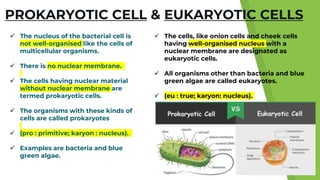
 The nucleus of the bacterial cell is
not well-organised like the cells of
multicellular organisms.
 There is no nuclear membrane.
 The cells having nuclear material
without nuclear membrane are
termed prokaryotic cells.
 The organisms with these kinds of
cells are called prokaryotes
 (pro : primitive; karyon : nucleus).
 Examples are bacteria and blue
green algae.
 The cells, like onion cells and cheek cells
having well-organised nucleus with a
nuclear membrane are designated as
eukaryotic cells.
 All organisms other than bacteria and blue
green algae are called eukaryotes.
 (eu : true; karyon: nucleus).
VACUOLE
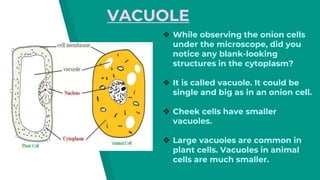
 While observing the onion cells
under the microscope, did you
notice any blank-looking
structures in the cytoplasm?
 It is called vacuole. It could be
single and big as in an onion cell.
 Cheek cells have smaller
vacuoles.
 Large vacuoles are common in
plant cells. Vacuoles in animal
cells are much smaller.
CHLOROPLAST
 They are scattered in the cytoplasm
of the leaf cells.
 These are called plastids.
 They are of different colours.
 Some of them contain green
pigment called chlorophyll.
 Green coloured plastids are called
chloroplasts.
 They provide green colour to the
leaves.
*Vacuoles in animal cells are much smaller.
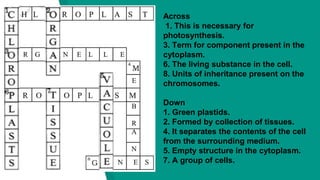
Across
1. This is necessary for
photosynthesis.
3. Term for component present in the
cytoplasm.
6. The living substance in the cell.
8. Units of inheritance present on the
chromosomes.
Down
1. Green plastids.
2. Formed by collection of tissues.
4. It separates the contents of the cell
from the surrounding medium.
5. Empty structure in the cytoplasm.
7. A group of cells.
H L R O P L A S T
R G A N E L L E
R O O P L A S M
E N E S
E
B
R
A
N
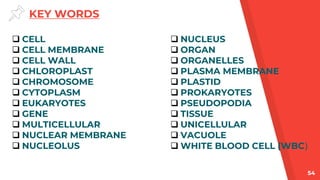
KEY WORDS
54
 CELL
 CELL MEMBRANE
 CELL WALL
 CHLOROPLAST
 CHROMOSOME
 CYTOPLASM
 EUKARYOTES
 GENE
 MULTICELLULAR
 NUCLEAR MEMBRANE
 NUCLEOLUS
 NUCLEUS
 ORGAN
 ORGANELLES
 PLASMA MEMBRANE
 PLASTID
 PROKARYOTES
 PSEUDOPODIA
 TISSUE
 UNICELLULAR
 VACUOLE
 WHITE BLOOD CELL (WBC)
THANK
YOU !