



PROCESS SKILLS
IN SCIENCE
PC:2 Biological Sciences-1
-ADITYA ARYA
B.SC.B.ED (CBZ)
2
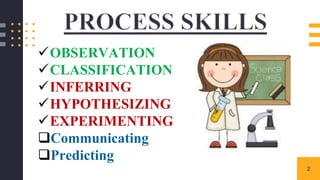
OBSERVATION
CLASSIFICATION
INFERRING
HYPOTHESIZING
EXPERIMENTING
Communicating
Predicting
1. COMMUNICATING :
WHAT IS COMMUNICATING ?
▪ Communicating is
sharing ideas and
information about
what you discovered
in science.
▪ We can share information by
showing a table, chart, or
graph, by writing a report, by
demonstration models, or by
reporting orally.
4
 Scientists usually write a report and publish them in journals,
magazines, or newspapers to share their work to the public. They share
information, data, findings, and opinions that became sources of
knowledge.
“
5
Written or Spoken Words:
These are used in classroom teachings,
lectures, delivered on meetings.
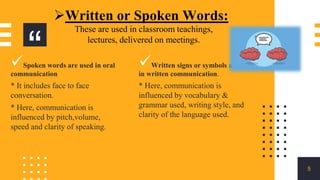
Spoken words are used in oral
communication
* It includes face to face
conversation.
* Here, communication is
influenced by pitch,volume,
speed and clarity of speaking.
Written signs or symbols are used
in written communication.
* Here, communication is
influenced by vocabulary &
grammar used, writing style, and
clarity of the language used.
“
6
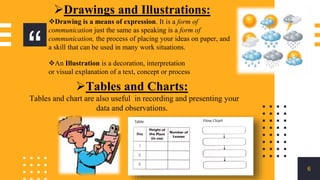
Drawings and Illustrations:
Drawing is a means of expression. It is a form of
communication just the same as speaking is a form of
communication, the process of placing your ideas on paper, and
a skill that can be used in many work situations.
An Illustration is a decoration, interpretation
or visual explanation of a text, concept or process
Tables and Charts:
Tables and chart are also useful in recording and presenting your
data and observations.
“
7
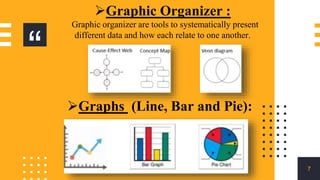
Graphic Organizer :
Graphic organizer are tools to systematically present
different data and how each relate to one another.
Graphs (Line, Bar and Pie):
8
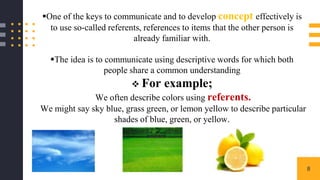
One of the keys to communicate and to develop concept effectively is
to use so-called referents, references to items that the other person is
already familiar with.
The idea is to communicate using descriptive words for which both
people share a common understanding
 For example;
We often describe colors using referents.
We might say sky blue, grass green, or lemon yellow to describe particular
shades of blue, green, or yellow.
Concept
9
Making the abstract concrete
As teachers we deal with abstract concepts all
the time – for example, the structure of the
atom, the particle nature of cells and chemical
reactions. These are all things the students can’t
actually see, so they need to be able to visualise
them if they are going to genuinely understand
them. So how can we make these concepts
more concrete?:
The content to deliver a concept should be selected
keeping in view the:
10
 competence of learners at
various stages,
• Primary,
• Upper Primary,
• Secondary Stage,
• Higher Secondary
depth of the content,
delimitations, etc.
But core areas must
be included.
The contents must
be systematically
organised
11
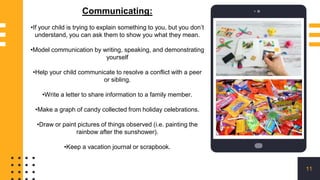
Communicating:
•If your child is trying to explain something to you, but you don’t
understand, you can ask them to show you what they mean.
•Model communication by writing, speaking, and demonstrating
yourself
•Help your child communicate to resolve a conflict with a peer
or sibling.
•Write a letter to share information to a family member.
•Make a graph of candy collected from holiday celebrations.
•Draw or paint pictures of things observed (i.e. painting the
rainbow after the sunshower).
•Keep a vacation journal or scrapbook.
12
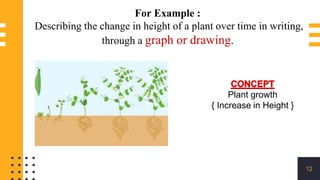
For Example :
Describing the change in height of a plant over time in writing,
through a graph or drawing.
Plant growth
{ Increase in Height }
13
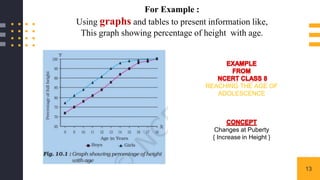
For Example :
Using graphs and tables to present information like,
This graph showing percentage of height with age.
REACHING THE AGE OF
ADOLESCENCE
Changes at Puberty
{ Increase in Height }
14
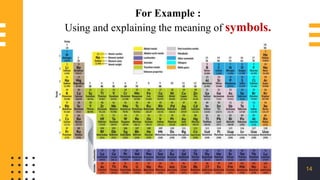
For Example :
Using and explaining the meaning of symbols.
15
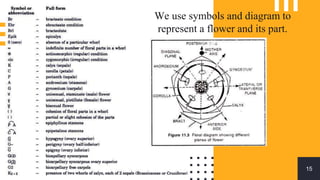
We use symbols and diagram to
represent a flower and its part.
16
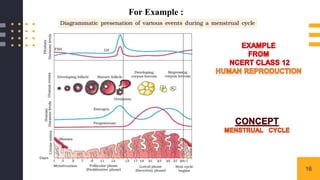
For Example :
2. PREDICTING
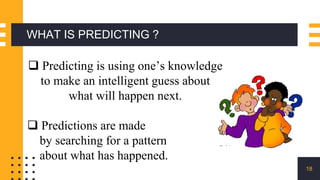
WHAT IS PREDICTING ?
18
 Predicting is using one’s knowledge
to make an intelligent guess about
what will happen next.
 Predictions are made
by searching for a pattern
about what has happened.
19
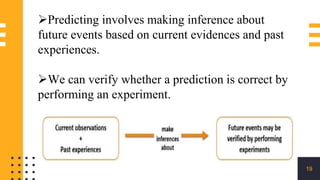
Predicting involves making inference about
future events based on current evidences and past
experiences.
We can verify whether a prediction is correct by
performing an experiment.
20
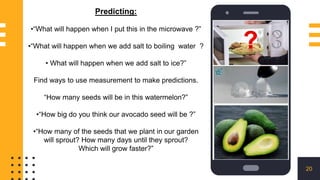
Predicting:
•“What will happen when I put this in the microwave ?”
•“What will happen when we add salt to boiling water ?
• What will happen when we add salt to ice?”
Find ways to use measurement to make predictions.
“How many seeds will be in this watermelon?”
•“How big do you think our avocado seed will be ?”
•“How many of the seeds that we plant in our garden
will sprout? How many days until they sprout?
Which will grow faster?”
21
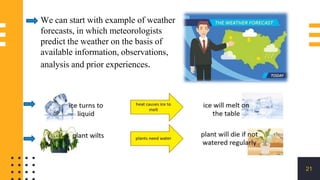
We can start with example of weather
forecasts, in which meteorologists
predict the weather on the basis of
available information, observations,
analysis and prior experiences.
22
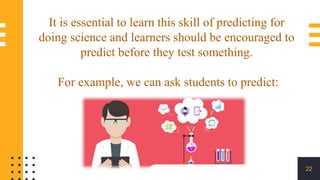
It is essential to learn this skill of predicting for
doing science and learners should be encouraged to
predict before they test something.
For example, we can ask students to predict:
23
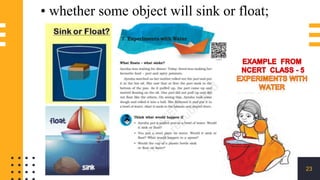
• whether some object will sink or float;
24
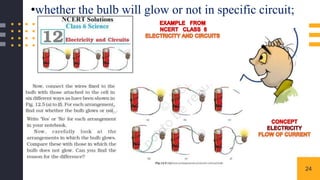
•whether the bulb will glow or not in specific circuit;
25
We should prompt them more and more for making
predictions by using appropriate questioning like:
26
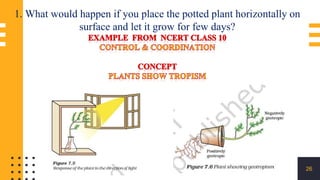
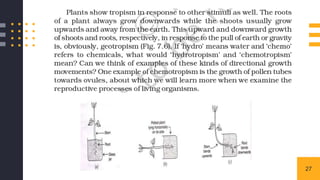
1. What would happen if you place the potted plant horizontally on
surface and let it grow for few days?
27
28
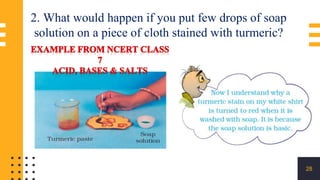
2. What would happen if you put few drops of soap
solution on a piece of cloth stained with turmeric?
29
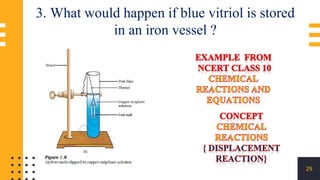
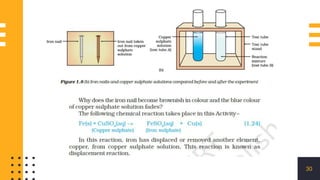
3. What would happen if blue vitriol is stored
in an iron vessel ?
30
31
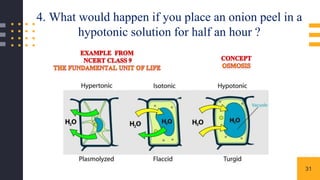
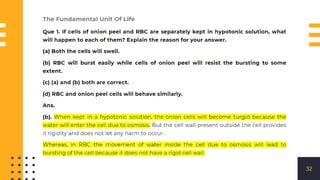
4. What would happen if you place an onion peel in a
hypotonic solution for half an hour ?
32
33
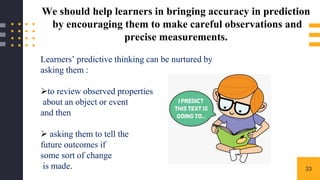
We should help learners in bringing accuracy in prediction
by encouraging them to make careful observations and
precise measurements.
Learners’ predictive thinking can be nurtured by
asking them :
to review observed properties
about an object or event
and then
 asking them to tell the
future outcomes if
some sort of change
is made.
CONCLUSION
35
Development of process skills among learners is all
the more necessary to help them explore and
understand their own environment.
All these aspects of science are important to be
focused while teachings science and we need to be
strategic enough to provide ample opportunities to
our learners for the same.
36
In summary, successfully integrating the science process
skills with classroom lessons. This will make the learning
experiences richer and more meaningful for students.
Students will be learning the skills of science as well as
science content.
To reflect the true nature of science,
ideas must be shared.
Link it to what they already know.
37
The students will be actively engaged with the
science they are learning and thus reach a deeper
understanding of the content.
 Finally active engagement with science will likely
lead students to become more interested and have more
positive attitudes towards science.
38
Thanks!
Any questions?
39

SCIENCE PROCESS SKILLS

  • 1.
    PROCESS SKILLS IN SCIENCE PC:2Biological Sciences-1 -ADITYA ARYA B.SC.B.ED (CBZ)
  • 2.
  • 3.
  • 4.
    WHAT IS COMMUNICATING? ▪ Communicating is sharing ideas and information about what you discovered in science. ▪ We can share information by showing a table, chart, or graph, by writing a report, by demonstration models, or by reporting orally. 4  Scientists usually write a report and publish them in journals, magazines, or newspapers to share their work to the public. They share information, data, findings, and opinions that became sources of knowledge.
  • 5.
    “ 5 Written or SpokenWords: These are used in classroom teachings, lectures, delivered on meetings. Spoken words are used in oral communication * It includes face to face conversation. * Here, communication is influenced by pitch,volume, speed and clarity of speaking. Written signs or symbols are used in written communication. * Here, communication is influenced by vocabulary & grammar used, writing style, and clarity of the language used.
  • 6.
    “ 6 Drawings and Illustrations: Drawingis a means of expression. It is a form of communication just the same as speaking is a form of communication, the process of placing your ideas on paper, and a skill that can be used in many work situations. An Illustration is a decoration, interpretation or visual explanation of a text, concept or process Tables and Charts: Tables and chart are also useful in recording and presenting your data and observations.
  • 7.
    “ 7 Graphic Organizer : Graphicorganizer are tools to systematically present different data and how each relate to one another. Graphs (Line, Bar and Pie):
  • 8.
    8 One of thekeys to communicate and to develop concept effectively is to use so-called referents, references to items that the other person is already familiar with. The idea is to communicate using descriptive words for which both people share a common understanding  For example; We often describe colors using referents. We might say sky blue, grass green, or lemon yellow to describe particular shades of blue, green, or yellow.
  • 9.
    Concept 9 Making the abstractconcrete As teachers we deal with abstract concepts all the time – for example, the structure of the atom, the particle nature of cells and chemical reactions. These are all things the students can’t actually see, so they need to be able to visualise them if they are going to genuinely understand them. So how can we make these concepts more concrete?:
  • 10.
    The content todeliver a concept should be selected keeping in view the: 10  competence of learners at various stages, • Primary, • Upper Primary, • Secondary Stage, • Higher Secondary depth of the content, delimitations, etc. But core areas must be included. The contents must be systematically organised
  • 11.
    11 Communicating: •If your childis trying to explain something to you, but you don’t understand, you can ask them to show you what they mean. •Model communication by writing, speaking, and demonstrating yourself •Help your child communicate to resolve a conflict with a peer or sibling. •Write a letter to share information to a family member. •Make a graph of candy collected from holiday celebrations. •Draw or paint pictures of things observed (i.e. painting the rainbow after the sunshower). •Keep a vacation journal or scrapbook.
  • 12.
    12 For Example : Describingthe change in height of a plant over time in writing, through a graph or drawing. Plant growth { Increase in Height }
  • 13.
    13 For Example : Usinggraphs and tables to present information like, This graph showing percentage of height with age. REACHING THE AGE OF ADOLESCENCE Changes at Puberty { Increase in Height }
  • 14.
    14 For Example : Usingand explaining the meaning of symbols.
  • 15.
    15 We use symbolsand diagram to represent a flower and its part.
  • 16.
  • 17.
  • 18.
    WHAT IS PREDICTING? 18  Predicting is using one’s knowledge to make an intelligent guess about what will happen next.  Predictions are made by searching for a pattern about what has happened.
  • 19.
    19 Predicting involves makinginference about future events based on current evidences and past experiences. We can verify whether a prediction is correct by performing an experiment.
  • 20.
    20 Predicting: •“What will happenwhen I put this in the microwave ?” •“What will happen when we add salt to boiling water ? • What will happen when we add salt to ice?” Find ways to use measurement to make predictions. “How many seeds will be in this watermelon?” •“How big do you think our avocado seed will be ?” •“How many of the seeds that we plant in our garden will sprout? How many days until they sprout? Which will grow faster?”
  • 21.
    21 We can startwith example of weather forecasts, in which meteorologists predict the weather on the basis of available information, observations, analysis and prior experiences.
  • 22.
    22 It is essentialto learn this skill of predicting for doing science and learners should be encouraged to predict before they test something. For example, we can ask students to predict:
  • 23.
    23 • whether someobject will sink or float;
  • 24.
    24 •whether the bulbwill glow or not in specific circuit;
  • 25.
    25 We should promptthem more and more for making predictions by using appropriate questioning like:
  • 26.
    26 1. What wouldhappen if you place the potted plant horizontally on surface and let it grow for few days?
  • 27.
  • 28.
    28 2. What wouldhappen if you put few drops of soap solution on a piece of cloth stained with turmeric?
  • 29.
    29 3. What wouldhappen if blue vitriol is stored in an iron vessel ?
  • 30.
  • 31.
    31 4. What wouldhappen if you place an onion peel in a hypotonic solution for half an hour ?
  • 32.
  • 33.
    33 We should helplearners in bringing accuracy in prediction by encouraging them to make careful observations and precise measurements. Learners’ predictive thinking can be nurtured by asking them : to review observed properties about an object or event and then  asking them to tell the future outcomes if some sort of change is made.
  • 34.
  • 35.
    35 Development of processskills among learners is all the more necessary to help them explore and understand their own environment. All these aspects of science are important to be focused while teachings science and we need to be strategic enough to provide ample opportunities to our learners for the same.
  • 36.
    36 In summary, successfullyintegrating the science process skills with classroom lessons. This will make the learning experiences richer and more meaningful for students. Students will be learning the skills of science as well as science content. To reflect the true nature of science, ideas must be shared. Link it to what they already know.
  • 37.
    37 The students willbe actively engaged with the science they are learning and thus reach a deeper understanding of the content.  Finally active engagement with science will likely lead students to become more interested and have more positive attitudes towards science.
  • 38.
  • 39.