Pollination
Lesson Plan (Class : VII)
Name: Aditya Arya
B.Sc.B.Ed.(CBZ) VI Semester
P.C. – II : Biological Sciences
2
LESSON PLAN
❖ CLASS : VII
❖ SUBJECT : SCIENCE
❖ TOPIC: POLLINATION
❖ DATE: 29 /04/2021
❖ CHAPTER 12 : REPRODUCTION IN PLANTS
❖ PERIOD : 1st
❖ DURATION :45 minutes
”
Pollination, Self-Pollination,
Cross-Polination, Anther, filament,
stamen, pollen, stigma, style (pollen
tube), carpel (pistil), egg, ovule,
ovary.
3
Key Words :
Learning Aspects :
➢ Pollination : The process of transfer and deposition of pollen grains from the
another to the stigmatic surface of the flower is called pollination.
➢ I. Self Pollination It is the process of transfer of pollen grains from the
another to the stigma of either the same flower or another flower borne on
the same plant.
➢ II. Cross Pollination : Cross Pollination involves the transfer of pollen grains
from the flower of one plant to the stigma of the flower of another plant.
➢ On the basis of the agents that bring pollination, the mode of pollination is as
follows :1. Anemophily (Wind) 2. Hydrophily (Water) 3. Entomophily (Insects)
4. Ornithophily (Birds) 5. Chiropterophily (Bats) 6. Myrmecophily (Ants)
Learning Objectives:
On completion of this lesson students will be able to:
✓ Understand the term ‘pollination’.
✓ To know why is it necessary for plants.
✓ Differentiate between types of pollination.
✓ To know various agents of pollination.
✓ Students will simulate pollination to learn about the parts of a flower
and how plants and animals depend on each other.
5
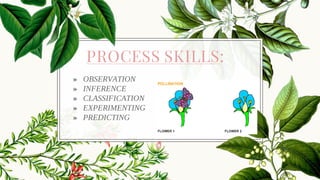
PROCESS SKILLS:
» OBSERVATION
» INFERENCE
» CLASSIFICATION
» EXPERIMENTING
» PREDICTING
Learning Resources :
❖ Images of brightly- colored flowers with bumblebees or butterflies.
❖ Images of hummingbirds and orchids.
❖ Image showing a cross-section of a flower.
❖ NCERT Textbook.
❖ Blackboard / Jam board (based on mode of class).
❖ Chalk /marker, duster, etc.
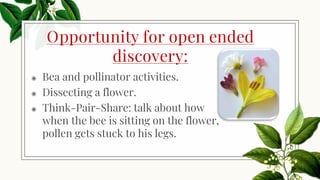
Opportunity for open ended
discovery:
◉ Bea and pollinator activities.
◉ Dissecting a flower.
◉ Think-Pair-Share: talk about how
when the bee is sitting on the flower,
pollen gets stuck to his legs.
9
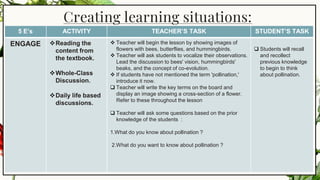
Creating learning situations:
5 E’s ACTIVITY TEACHER’S TASK STUDENT’S TASK
ENGAGE ❖Reading the
content from
the textbook.
❖Whole-Class
Discussion.
❖Daily life based
discussions.
❖ Teacher will begin the lesson by showing images of
flowers with bees, butterflies, and hummingbirds.
❖ Teacher will ask students to vocalize their observations.
Lead the discussion to bees' vision, hummingbirds'
beaks, and the concept of co-evolution.
❖ If students have not mentioned the term 'pollination,'
introduce it now.
❑ Teacher will write the key terms on the board and
display an image showing a cross-section of a flower.
Refer to these throughout the lesson
❑ Teacher will ask some questions based on the prior
knowledge of the students :
1.What do you know about pollination ?
2.What do you want to know about pollination ?
❑ Students will recall
and recollect
previous knowledge
to begin to think
about pollination.
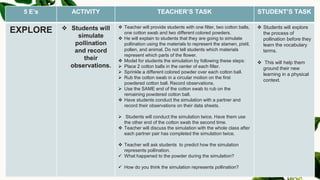
5 E’s ACTIVITY TEACHER’S TASK STUDENT’S TASK
EXPLORE ❖ Students will
simulate
pollination
and record
their
observations.
❖ Teacher will provide students with one filter, two cotton balls,
one cotton swab and two different colored powders.
❖ He will explain to students that they are going to simulate
pollination using the materials to represent the stamen, pistil,
pollen, and animal. Do not tell students which materials
represent which parts of the flower.
❖ Model for students the simulation by following these steps:
➢ Place 2 cotton balls in the center of each filter.
➢ Sprinkle a different colored powder over each cotton ball.
➢ Rub the cotton swab in a circular motion on the first
powdered cotton ball. Record observations.
➢ Use the SAME end of the cotton swab to rub on the
remaining powdered cotton ball.
❖ Have students conduct the simulation with a partner and
record their observations on their data sheets.
➢ Students will conduct the simulation twice. Have them use
the other end of the cotton swab the second time.
❖ Teacher will discuss the simulation with the whole class after
each partner pair has completed the simulation twice.
❖ Teacher will ask students to predict how the simulation
represents pollination.
✓ What happened to the powder during the simulation?
✓ How do you think the simulation represents pollination?
❖ Students will explore
the process of
pollination before they
learn the vocabulary
terms.
❖ This will help them
ground their new
learning in a physical
context.
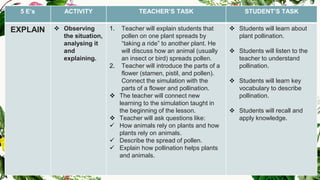
5 E’s ACTIVITY TEACHER’S TASK STUDENT’S TASK
EXPLAIN ❖ Observing
the situation,
analysing it
and
explaining.
1. Teacher will explain students that
pollen on one plant spreads by
“taking a ride” to another plant. He
will discuss how an animal (usually
an insect or bird) spreads pollen.
2. Teacher will introduce the parts of a
flower (stamen, pistil, and pollen).
Connect the simulation with the
parts of a flower and pollination.
❖ The teacher will connect new
learning to the simulation taught in
the beginning of the lesson.
❖ Teacher will ask questions like:
✓ How animals rely on plants and how
plants rely on animals.
✓ Describe the spread of pollen.
✓ Explain how pollination helps plants
and animals.
❖ Students will learn about
plant pollination.
❖ Students will listen to the
teacher to understand
pollination.
❖ Students will learn key
vocabulary to describe
pollination.
❖ Students will recall and
apply knowledge.
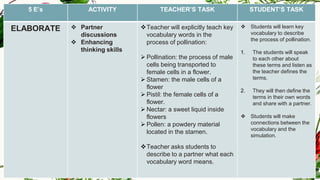
5 E’s ACTIVITY TEACHER’S TASK STUDENT’S TASK
ELABORATE ❖ Partner
discussions
❖ Enhancing
thinking skills
❖Teacher will explicitly teach key
vocabulary words in the
process of pollination:
➢ Pollination: the process of male
cells being transported to
female cells in a flower.
➢ Stamen: the male cells of a
flower
➢ Pistil: the female cells of a
flower.
➢ Nectar: a sweet liquid inside
flowers
➢ Pollen: a powdery material
located in the stamen.
❖Teacher asks students to
describe to a partner what each
vocabulary word means.
❖ Students will learn key
vocabulary to describe
the process of pollination.
1. The students will speak
to each other about
these terms and listen as
the teacher defines the
terms.
2. They will then define the
terms in their own words
and share with a partner.
❖ Students will make
connections between the
vocabulary and the
simulation.
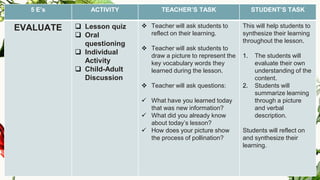
5 E’s ACTIVITY TEACHER’S TASK STUDENT’S TASK
EVALUATE ❑ Lesson quiz
❑ Oral
questioning
❑ Individual
Activity
❑ Child-Adult
Discussion
❖ Teacher will ask students to
reflect on their learning.
❖ Teacher will ask students to
draw a picture to represent the
key vocabulary words they
learned during the lesson.
❖ Teacher will ask questions:
✓ What have you learned today
that was new information?
✓ What did you already know
about today’s lesson?
✓ How does your picture show
the process of pollination?
This will help students to
synthesize their learning
throughout the lesson.
1. The students will
evaluate their own
understanding of the
content.
2. Students will
summarize learning
through a picture
and verbal
description.
Students will reflect on
and synthesize their
learning.
Reflection :-
14
The chapter was started first by checking the
prior knowledge of students about pollination
and related topics. Then familiarizing
students with the topic and explaining its
types, its wide use in nature and about the
factors affecting it. A good response was
observed from the students.
Thanks!
◉ Aditya Arya
B.Sc.B.Ed.(CBZ) VI Semester
15

POLLINATION LESSON PLAN (PC: BIOLOGICAL SCIENCES)

  • 1.
    Pollination Lesson Plan (Class: VII) Name: Aditya Arya B.Sc.B.Ed.(CBZ) VI Semester P.C. – II : Biological Sciences
  • 2.
    2 LESSON PLAN ❖ CLASS: VII ❖ SUBJECT : SCIENCE ❖ TOPIC: POLLINATION ❖ DATE: 29 /04/2021 ❖ CHAPTER 12 : REPRODUCTION IN PLANTS ❖ PERIOD : 1st ❖ DURATION :45 minutes
  • 3.
    ” Pollination, Self-Pollination, Cross-Polination, Anther,filament, stamen, pollen, stigma, style (pollen tube), carpel (pistil), egg, ovule, ovary. 3 Key Words :
  • 4.
    Learning Aspects : ➢Pollination : The process of transfer and deposition of pollen grains from the another to the stigmatic surface of the flower is called pollination. ➢ I. Self Pollination It is the process of transfer of pollen grains from the another to the stigma of either the same flower or another flower borne on the same plant. ➢ II. Cross Pollination : Cross Pollination involves the transfer of pollen grains from the flower of one plant to the stigma of the flower of another plant. ➢ On the basis of the agents that bring pollination, the mode of pollination is as follows :1. Anemophily (Wind) 2. Hydrophily (Water) 3. Entomophily (Insects) 4. Ornithophily (Birds) 5. Chiropterophily (Bats) 6. Myrmecophily (Ants)
  • 5.
    Learning Objectives: On completionof this lesson students will be able to: ✓ Understand the term ‘pollination’. ✓ To know why is it necessary for plants. ✓ Differentiate between types of pollination. ✓ To know various agents of pollination. ✓ Students will simulate pollination to learn about the parts of a flower and how plants and animals depend on each other. 5
  • 6.
    PROCESS SKILLS: » OBSERVATION »INFERENCE » CLASSIFICATION » EXPERIMENTING » PREDICTING
  • 7.
    Learning Resources : ❖Images of brightly- colored flowers with bumblebees or butterflies. ❖ Images of hummingbirds and orchids. ❖ Image showing a cross-section of a flower. ❖ NCERT Textbook. ❖ Blackboard / Jam board (based on mode of class). ❖ Chalk /marker, duster, etc.
  • 8.
    Opportunity for openended discovery: ◉ Bea and pollinator activities. ◉ Dissecting a flower. ◉ Think-Pair-Share: talk about how when the bee is sitting on the flower, pollen gets stuck to his legs.
  • 9.
    9 Creating learning situations: 5E’s ACTIVITY TEACHER’S TASK STUDENT’S TASK ENGAGE ❖Reading the content from the textbook. ❖Whole-Class Discussion. ❖Daily life based discussions. ❖ Teacher will begin the lesson by showing images of flowers with bees, butterflies, and hummingbirds. ❖ Teacher will ask students to vocalize their observations. Lead the discussion to bees' vision, hummingbirds' beaks, and the concept of co-evolution. ❖ If students have not mentioned the term 'pollination,' introduce it now. ❑ Teacher will write the key terms on the board and display an image showing a cross-section of a flower. Refer to these throughout the lesson ❑ Teacher will ask some questions based on the prior knowledge of the students : 1.What do you know about pollination ? 2.What do you want to know about pollination ? ❑ Students will recall and recollect previous knowledge to begin to think about pollination.
  • 10.
    5 E’s ACTIVITYTEACHER’S TASK STUDENT’S TASK EXPLORE ❖ Students will simulate pollination and record their observations. ❖ Teacher will provide students with one filter, two cotton balls, one cotton swab and two different colored powders. ❖ He will explain to students that they are going to simulate pollination using the materials to represent the stamen, pistil, pollen, and animal. Do not tell students which materials represent which parts of the flower. ❖ Model for students the simulation by following these steps: ➢ Place 2 cotton balls in the center of each filter. ➢ Sprinkle a different colored powder over each cotton ball. ➢ Rub the cotton swab in a circular motion on the first powdered cotton ball. Record observations. ➢ Use the SAME end of the cotton swab to rub on the remaining powdered cotton ball. ❖ Have students conduct the simulation with a partner and record their observations on their data sheets. ➢ Students will conduct the simulation twice. Have them use the other end of the cotton swab the second time. ❖ Teacher will discuss the simulation with the whole class after each partner pair has completed the simulation twice. ❖ Teacher will ask students to predict how the simulation represents pollination. ✓ What happened to the powder during the simulation? ✓ How do you think the simulation represents pollination? ❖ Students will explore the process of pollination before they learn the vocabulary terms. ❖ This will help them ground their new learning in a physical context.
  • 11.
    5 E’s ACTIVITYTEACHER’S TASK STUDENT’S TASK EXPLAIN ❖ Observing the situation, analysing it and explaining. 1. Teacher will explain students that pollen on one plant spreads by “taking a ride” to another plant. He will discuss how an animal (usually an insect or bird) spreads pollen. 2. Teacher will introduce the parts of a flower (stamen, pistil, and pollen). Connect the simulation with the parts of a flower and pollination. ❖ The teacher will connect new learning to the simulation taught in the beginning of the lesson. ❖ Teacher will ask questions like: ✓ How animals rely on plants and how plants rely on animals. ✓ Describe the spread of pollen. ✓ Explain how pollination helps plants and animals. ❖ Students will learn about plant pollination. ❖ Students will listen to the teacher to understand pollination. ❖ Students will learn key vocabulary to describe pollination. ❖ Students will recall and apply knowledge.
  • 12.
    5 E’s ACTIVITYTEACHER’S TASK STUDENT’S TASK ELABORATE ❖ Partner discussions ❖ Enhancing thinking skills ❖Teacher will explicitly teach key vocabulary words in the process of pollination: ➢ Pollination: the process of male cells being transported to female cells in a flower. ➢ Stamen: the male cells of a flower ➢ Pistil: the female cells of a flower. ➢ Nectar: a sweet liquid inside flowers ➢ Pollen: a powdery material located in the stamen. ❖Teacher asks students to describe to a partner what each vocabulary word means. ❖ Students will learn key vocabulary to describe the process of pollination. 1. The students will speak to each other about these terms and listen as the teacher defines the terms. 2. They will then define the terms in their own words and share with a partner. ❖ Students will make connections between the vocabulary and the simulation.
  • 13.
    5 E’s ACTIVITYTEACHER’S TASK STUDENT’S TASK EVALUATE ❑ Lesson quiz ❑ Oral questioning ❑ Individual Activity ❑ Child-Adult Discussion ❖ Teacher will ask students to reflect on their learning. ❖ Teacher will ask students to draw a picture to represent the key vocabulary words they learned during the lesson. ❖ Teacher will ask questions: ✓ What have you learned today that was new information? ✓ What did you already know about today’s lesson? ✓ How does your picture show the process of pollination? This will help students to synthesize their learning throughout the lesson. 1. The students will evaluate their own understanding of the content. 2. Students will summarize learning through a picture and verbal description. Students will reflect on and synthesize their learning.
  • 14.
    Reflection :- 14 The chapterwas started first by checking the prior knowledge of students about pollination and related topics. Then familiarizing students with the topic and explaining its types, its wide use in nature and about the factors affecting it. A good response was observed from the students.
  • 15.