The flower morphology
Dr. Prabuddha Gupta
B.Sc Microbiology
Semester: 1
Subject code:
02MB0103
Batch: 2020-2021
Unit: 3
Morphology and
anatomy of plants
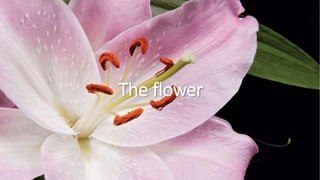
The flower
Parts of flower
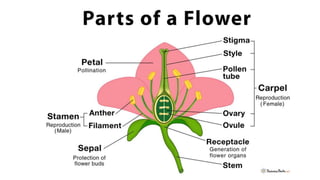
• Peduncle: This is the stalk of the flower.
• Receptacle: It is that part of the flower to which the stalk is attached
to. It is small and found at the centre of the base of the flower.
• Sepals: These are the small, leaf-like parts growing at the base of the
petals. They form the outermost whorl of the flower. Collectively,
sepals are known as the calyx. The main function of the calyx and its
sepals is to protect the flower before it blossoms(in the bud stage).
• Petals: This layer lies just above the sepal layer. They are often bright
in colour as their main function is to attract pollinators such as
insects, butterflies etc to the flower. The petals are collectively known
as the corolla.
Parts of flower
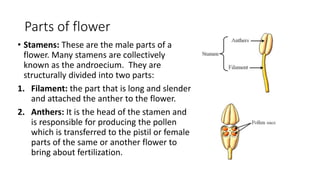
• Stamens: These are the male parts of a
flower. Many stamens are collectively
known as the androecium. They are
structurally divided into two parts:
1. Filament: the part that is long and slender
and attached the anther to the flower.
2. Anthers: It is the head of the stamen and
is responsible for producing the pollen
which is transferred to the pistil or female
parts of the same or another flower to
bring about fertilization.
Parts of flower
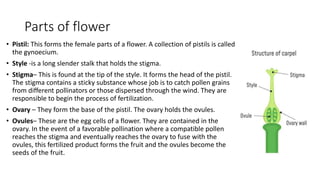
• Pistil: This forms the female parts of a flower. A collection of pistils is called
the gynoecium.
• Style -is a long slender stalk that holds the stigma.
• Stigma– This is found at the tip of the style. It forms the head of the pistil.
The stigma contains a sticky substance whose job is to catch pollen grains
from different pollinators or those dispersed through the wind. They are
responsible to begin the process of fertilization.
• Ovary – They form the base of the pistil. The ovary holds the ovules.
• Ovules– These are the egg cells of a flower. They are contained in the
ovary. In the event of a favorable pollination where a compatible pollen
reaches the stigma and eventually reaches the ovary to fuse with the
ovules, this fertilized product forms the fruit and the ovules become the
seeds of the fruit.
Calyx
• Calyx protects the flower in bud stage.
• Outermost whorl of flower is calyx.
• Unit of calyx is sepal.
• Normally green in colour.
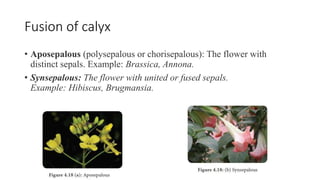
Fusion of calyx
• Aposepalous (polysepalous or chorisepalous): The flower with
distinct sepals. Example: Brassica, Annona.
• Synsepalous: The flower with united or fused sepals.
Example: Hibiscus, Brugmansia.
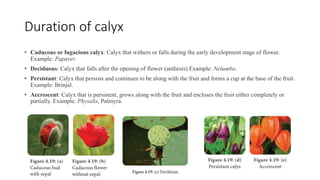
Duration of calyx
• Caducous or fugacious calyx: Calyx that withers or falls during the early development stage of flower.
Example: Papaver.
• Deciduous: Calyx that falls after the opening of flower (anthesis) Example: Nelumbo.
• Persistant: Calyx that persists and continues to be along with the fruit and forms a cup at the base of the fruit.
Example: Brinjal.
• Accrescent: Calyx that is persistent, grows along with the fruit and encloses the fruit either completely or
partially. Example: Physalis, Palmyra.
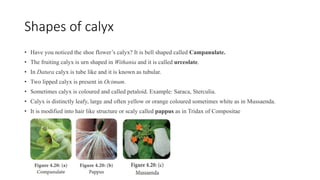
Shapes of calyx
• Have you noticed the shoe flower’s calyx? It is bell shaped called Campanulate.
• The fruiting calyx is urn shaped in Withania and it is called urceolate.
• In Datura calyx is tube like and it is known as tubular.
• Two lipped calyx is present in Ocimum.
• Sometimes calyx is coloured and called petaloid. Example: Saraca, Sterculia.
• Calyx is distinctly leafy, large and often yellow or orange coloured sometimes white as in Mussaenda.
• It is modified into hair like structure or scaly called pappus as in Tridax of Compositae
Corolla
• Corolla is the most attractive part in majority of the flowers and is
usually brightly coloured.
• Corolla helps to display the flower and attracts the pollinators.
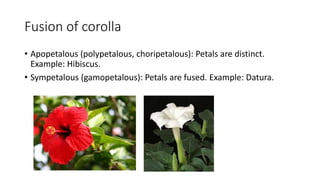
Fusion of corolla
• Apopetalous (polypetalous, choripetalous): Petals are distinct.
Example: Hibiscus.
• Sympetalous (gamopetalous): Petals are fused. Example: Datura.
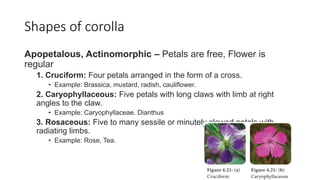
Shapes of corolla
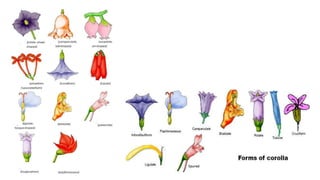
Apopetalous, Actinomorphic – Petals are free, Flower is
regular
1. Cruciform: Four petals arranged in the form of a cross.
• Example: Brassica, mustard, radish, cauliflower.
2. Caryophyllaceous: Five petals with long claws with limb at right
angles to the claw.
• Example: Caryophyllaceae. Dianthus
3. Rosaceous: Five to many sessile or minutely clawed petals with
radiating limbs.
• Example: Rose, Tea.
Shapes of corolla
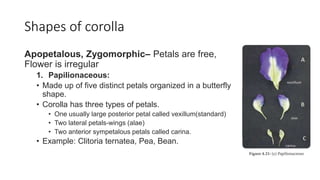
Apopetalous, Zygomorphic– Petals are free,
Flower is irregular
1. Papilionaceous:
• Made up of five distinct petals organized in a butterfly
shape.
• Corolla has three types of petals.
• One usually large posterior petal called vexillum(standard)
• Two lateral petals-wings (alae)
• Two anterior sympetalous petals called carina.
• Example: Clitoria ternatea, Pea, Bean.
Shapes of corolla
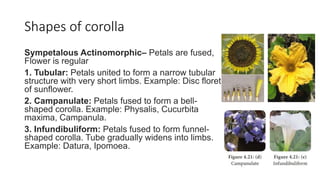
Sympetalous Actinomorphic– Petals are fused,
Flower is regular
1. Tubular: Petals united to form a narrow tubular
structure with very short limbs. Example: Disc floret
of sunflower.
2. Campanulate: Petals fused to form a bell-
shaped corolla. Example: Physalis, Cucurbita
maxima, Campanula.
3. Infundibuliform: Petals fused to form funnel-
shaped corolla. Tube gradually widens into limbs.
Example: Datura, Ipomoea.
Shapes of corolla
Sympetalous Actinomorphic– Petals are fused,
Flower is regular
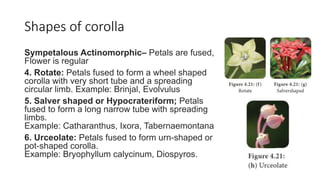
4. Rotate: Petals fused to form a wheel shaped
corolla with very short tube and a spreading
circular limb. Example: Brinjal, Evolvulus
5. Salver shaped or Hypocrateriform; Petals
fused to form a long narrow tube with spreading
limbs.
Example: Catharanthus, Ixora, Tabernaemontana
6. Urceolate: Petals fused to form urn-shaped or
pot-shaped corolla.
Example: Bryophyllum calycinum, Diospyros.
Shapes of corolla
Sympetalous Zygomorphic– Petals are
fused, Flower is irregular
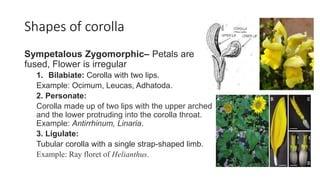
1. Bilabiate: Corolla with two lips.
Example: Ocimum, Leucas, Adhatoda.
2. Personate:
Corolla made up of two lips with the upper arched
and the lower protruding into the corolla throat.
Example: Antirrhinum, Linaria.
3. Ligulate:
Tubular corolla with a single strap-shaped limb.
Example: Ray floret of Helianthus.
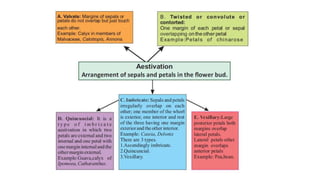
Aestivation
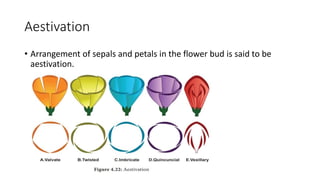
• Arrangement of sepals and petals in the flower bud is said to be
aestivation.
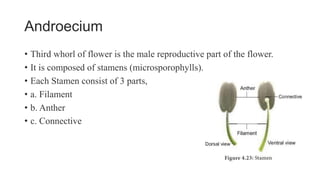
Androecium
• Third whorl of flower is the male reproductive part of the flower.
• It is composed of stamens (microsporophylls).
• Each Stamen consist of 3 parts,
• a. Filament
• b. Anther
• c. Connective
Fusion of stamens:
• 1. Connation: Refers to the fusion of stamens among themselves.
• It is of 3 types.
• a. Adelphy.
• b. Syngenecious.
• c. Synandrous.
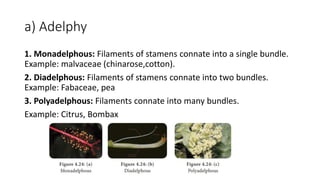
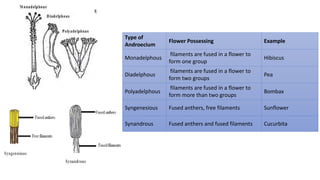
a) Adelphy
1. Monadelphous: Filaments of stamens connate into a single bundle.
Example: malvaceae (chinarose,cotton).
2. Diadelphous: Filaments of stamens connate into two bundles.
Example: Fabaceae, pea
3. Polyadelphous: Filaments connate into many bundles.
Example: Citrus, Bombax
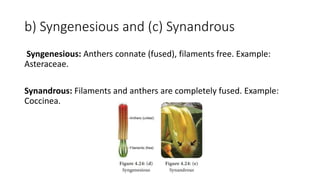
b) Syngenesious and (c) Synandrous
Syngenesious: Anthers connate (fused), filaments free. Example:
Asteraceae.
Synandrous: Filaments and anthers are completely fused. Example:
Coccinea.
Type of
Androecium
Flower Possessing Example
Monadelphous
filaments are fused in a flower to
form one group
Hibiscus
Diadelphous
filaments are fused in a flower to
form two groups
Pea
Polyadelphous
filaments are fused in a flower to
form more than two groups
Bombax
Syngenesious Fused anthers, free filaments Sunflower
Synandrous Fused anthers and fused filaments Cucurbita
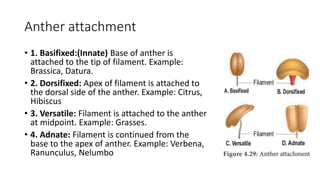
Anther attachment
• 1. Basifixed:(Innate) Base of anther is
attached to the tip of filament. Example:
Brassica, Datura.
• 2. Dorsifixed: Apex of filament is attached to
the dorsal side of the anther. Example: Citrus,
Hibiscus
• 3. Versatile: Filament is attached to the anther
at midpoint. Example: Grasses.
• 4. Adnate: Filament is continued from the
base to the apex of anther. Example: Verbena,
Ranunculus, Nelumbo
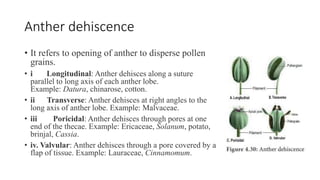
Anther dehiscence
• It refers to opening of anther to disperse pollen
grains.
• i Longitudinal: Anther dehisces along a suture
parallel to long axis of each anther lobe.
Example: Datura, chinarose, cotton.
• ii Transverse: Anther dehisces at right angles to the
long axis of anther lobe. Example: Malvaceae.
• iii Poricidal: Anther dehisces through pores at one
end of the thecae. Example: Ericaceae, Solanum, potato,
brinjal, Cassia.
• iv. Valvular: Anther dehisces through a pore covered by a
flap of tissue. Example: Lauraceae, Cinnamomum.
Gynoecium
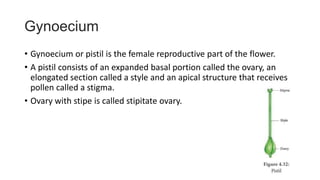
• Gynoecium or pistil is the female reproductive part of the flower.
• A pistil consists of an expanded basal portion called the ovary, an
elongated section called a style and an apical structure that receives
pollen called a stigma.
• Ovary with stipe is called stipitate ovary.
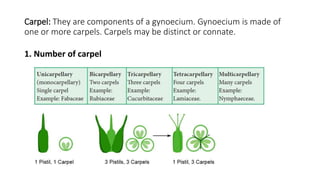
Carpel: They are components of a gynoecium. Gynoecium is made of
one or more carpels. Carpels may be distinct or connate.
1. Number of carpel
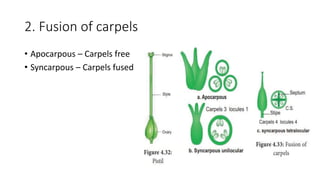
2. Fusion of carpels
• Apocarpous – Carpels free
• Syncarpous – Carpels fused
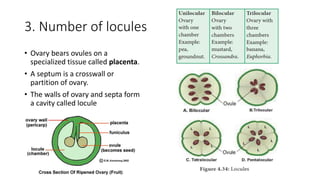
3. Number of locules
• Ovary bears ovules on a
specialized tissue called placenta.
• A septum is a crosswall or
partition of ovary.
• The walls of ovary and septa form
a cavity called locule
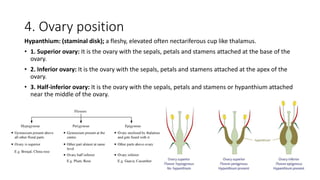
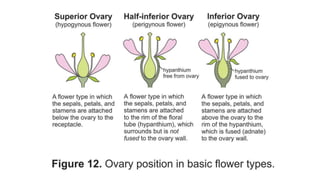
4. Ovary position
Hypanthium: (staminal disk); a fleshy, elevated often nectariferous cup like thalamus.
• 1. Superior ovary: It is the ovary with the sepals, petals and stamens attached at the base of the
ovary.
• 2. Inferior ovary: It is the ovary with the sepals, petals and stamens attached at the apex of the
ovary.
• 3. Half-inferior ovary: It is the ovary with the sepals, petals and stamens or hypanthium attached
near the middle of the ovary.
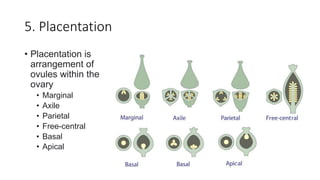
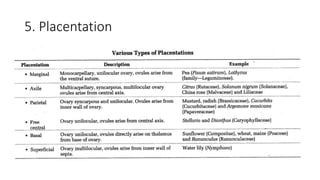
5. Placentation
• Placentation is
arrangement of
ovules within the
ovary
• Marginal
• Axile
• Parietal
• Free-central
• Basal
• Apical
5. Placentation

Theflowerpptx__2021_01_20_14_23_16.pptx

  • 1.
    The flower morphology Dr.Prabuddha Gupta B.Sc Microbiology Semester: 1 Subject code: 02MB0103 Batch: 2020-2021 Unit: 3 Morphology and anatomy of plants
  • 2.
  • 4.
    Parts of flower •Peduncle: This is the stalk of the flower. • Receptacle: It is that part of the flower to which the stalk is attached to. It is small and found at the centre of the base of the flower. • Sepals: These are the small, leaf-like parts growing at the base of the petals. They form the outermost whorl of the flower. Collectively, sepals are known as the calyx. The main function of the calyx and its sepals is to protect the flower before it blossoms(in the bud stage). • Petals: This layer lies just above the sepal layer. They are often bright in colour as their main function is to attract pollinators such as insects, butterflies etc to the flower. The petals are collectively known as the corolla.
  • 5.
    Parts of flower •Stamens: These are the male parts of a flower. Many stamens are collectively known as the androecium. They are structurally divided into two parts: 1. Filament: the part that is long and slender and attached the anther to the flower. 2. Anthers: It is the head of the stamen and is responsible for producing the pollen which is transferred to the pistil or female parts of the same or another flower to bring about fertilization.
  • 6.
    Parts of flower •Pistil: This forms the female parts of a flower. A collection of pistils is called the gynoecium. • Style -is a long slender stalk that holds the stigma. • Stigma– This is found at the tip of the style. It forms the head of the pistil. The stigma contains a sticky substance whose job is to catch pollen grains from different pollinators or those dispersed through the wind. They are responsible to begin the process of fertilization. • Ovary – They form the base of the pistil. The ovary holds the ovules. • Ovules– These are the egg cells of a flower. They are contained in the ovary. In the event of a favorable pollination where a compatible pollen reaches the stigma and eventually reaches the ovary to fuse with the ovules, this fertilized product forms the fruit and the ovules become the seeds of the fruit.
  • 7.
    Calyx • Calyx protectsthe flower in bud stage. • Outermost whorl of flower is calyx. • Unit of calyx is sepal. • Normally green in colour.
  • 8.
    Fusion of calyx •Aposepalous (polysepalous or chorisepalous): The flower with distinct sepals. Example: Brassica, Annona. • Synsepalous: The flower with united or fused sepals. Example: Hibiscus, Brugmansia.
  • 9.
    Duration of calyx •Caducous or fugacious calyx: Calyx that withers or falls during the early development stage of flower. Example: Papaver. • Deciduous: Calyx that falls after the opening of flower (anthesis) Example: Nelumbo. • Persistant: Calyx that persists and continues to be along with the fruit and forms a cup at the base of the fruit. Example: Brinjal. • Accrescent: Calyx that is persistent, grows along with the fruit and encloses the fruit either completely or partially. Example: Physalis, Palmyra.
  • 10.
    Shapes of calyx •Have you noticed the shoe flower’s calyx? It is bell shaped called Campanulate. • The fruiting calyx is urn shaped in Withania and it is called urceolate. • In Datura calyx is tube like and it is known as tubular. • Two lipped calyx is present in Ocimum. • Sometimes calyx is coloured and called petaloid. Example: Saraca, Sterculia. • Calyx is distinctly leafy, large and often yellow or orange coloured sometimes white as in Mussaenda. • It is modified into hair like structure or scaly called pappus as in Tridax of Compositae
  • 11.
    Corolla • Corolla isthe most attractive part in majority of the flowers and is usually brightly coloured. • Corolla helps to display the flower and attracts the pollinators.
  • 12.
    Fusion of corolla •Apopetalous (polypetalous, choripetalous): Petals are distinct. Example: Hibiscus. • Sympetalous (gamopetalous): Petals are fused. Example: Datura.
  • 13.
    Shapes of corolla Apopetalous,Actinomorphic – Petals are free, Flower is regular 1. Cruciform: Four petals arranged in the form of a cross. • Example: Brassica, mustard, radish, cauliflower. 2. Caryophyllaceous: Five petals with long claws with limb at right angles to the claw. • Example: Caryophyllaceae. Dianthus 3. Rosaceous: Five to many sessile or minutely clawed petals with radiating limbs. • Example: Rose, Tea.
  • 14.
    Shapes of corolla Apopetalous,Zygomorphic– Petals are free, Flower is irregular 1. Papilionaceous: • Made up of five distinct petals organized in a butterfly shape. • Corolla has three types of petals. • One usually large posterior petal called vexillum(standard) • Two lateral petals-wings (alae) • Two anterior sympetalous petals called carina. • Example: Clitoria ternatea, Pea, Bean.
  • 15.
    Shapes of corolla SympetalousActinomorphic– Petals are fused, Flower is regular 1. Tubular: Petals united to form a narrow tubular structure with very short limbs. Example: Disc floret of sunflower. 2. Campanulate: Petals fused to form a bell- shaped corolla. Example: Physalis, Cucurbita maxima, Campanula. 3. Infundibuliform: Petals fused to form funnel- shaped corolla. Tube gradually widens into limbs. Example: Datura, Ipomoea.
  • 16.
    Shapes of corolla SympetalousActinomorphic– Petals are fused, Flower is regular 4. Rotate: Petals fused to form a wheel shaped corolla with very short tube and a spreading circular limb. Example: Brinjal, Evolvulus 5. Salver shaped or Hypocrateriform; Petals fused to form a long narrow tube with spreading limbs. Example: Catharanthus, Ixora, Tabernaemontana 6. Urceolate: Petals fused to form urn-shaped or pot-shaped corolla. Example: Bryophyllum calycinum, Diospyros.
  • 17.
    Shapes of corolla SympetalousZygomorphic– Petals are fused, Flower is irregular 1. Bilabiate: Corolla with two lips. Example: Ocimum, Leucas, Adhatoda. 2. Personate: Corolla made up of two lips with the upper arched and the lower protruding into the corolla throat. Example: Antirrhinum, Linaria. 3. Ligulate: Tubular corolla with a single strap-shaped limb. Example: Ray floret of Helianthus.
  • 19.
    Aestivation • Arrangement ofsepals and petals in the flower bud is said to be aestivation.
  • 21.
    Androecium • Third whorlof flower is the male reproductive part of the flower. • It is composed of stamens (microsporophylls). • Each Stamen consist of 3 parts, • a. Filament • b. Anther • c. Connective
  • 22.
    Fusion of stamens: •1. Connation: Refers to the fusion of stamens among themselves. • It is of 3 types. • a. Adelphy. • b. Syngenecious. • c. Synandrous.
  • 23.
    a) Adelphy 1. Monadelphous:Filaments of stamens connate into a single bundle. Example: malvaceae (chinarose,cotton). 2. Diadelphous: Filaments of stamens connate into two bundles. Example: Fabaceae, pea 3. Polyadelphous: Filaments connate into many bundles. Example: Citrus, Bombax
  • 24.
    b) Syngenesious and(c) Synandrous Syngenesious: Anthers connate (fused), filaments free. Example: Asteraceae. Synandrous: Filaments and anthers are completely fused. Example: Coccinea.
  • 25.
    Type of Androecium Flower PossessingExample Monadelphous filaments are fused in a flower to form one group Hibiscus Diadelphous filaments are fused in a flower to form two groups Pea Polyadelphous filaments are fused in a flower to form more than two groups Bombax Syngenesious Fused anthers, free filaments Sunflower Synandrous Fused anthers and fused filaments Cucurbita
  • 26.
    Anther attachment • 1.Basifixed:(Innate) Base of anther is attached to the tip of filament. Example: Brassica, Datura. • 2. Dorsifixed: Apex of filament is attached to the dorsal side of the anther. Example: Citrus, Hibiscus • 3. Versatile: Filament is attached to the anther at midpoint. Example: Grasses. • 4. Adnate: Filament is continued from the base to the apex of anther. Example: Verbena, Ranunculus, Nelumbo
  • 27.
    Anther dehiscence • Itrefers to opening of anther to disperse pollen grains. • i Longitudinal: Anther dehisces along a suture parallel to long axis of each anther lobe. Example: Datura, chinarose, cotton. • ii Transverse: Anther dehisces at right angles to the long axis of anther lobe. Example: Malvaceae. • iii Poricidal: Anther dehisces through pores at one end of the thecae. Example: Ericaceae, Solanum, potato, brinjal, Cassia. • iv. Valvular: Anther dehisces through a pore covered by a flap of tissue. Example: Lauraceae, Cinnamomum.
  • 28.
    Gynoecium • Gynoecium orpistil is the female reproductive part of the flower. • A pistil consists of an expanded basal portion called the ovary, an elongated section called a style and an apical structure that receives pollen called a stigma. • Ovary with stipe is called stipitate ovary.
  • 29.
    Carpel: They arecomponents of a gynoecium. Gynoecium is made of one or more carpels. Carpels may be distinct or connate. 1. Number of carpel
  • 30.
    2. Fusion ofcarpels • Apocarpous – Carpels free • Syncarpous – Carpels fused
  • 31.
    3. Number oflocules • Ovary bears ovules on a specialized tissue called placenta. • A septum is a crosswall or partition of ovary. • The walls of ovary and septa form a cavity called locule
  • 32.
    4. Ovary position Hypanthium:(staminal disk); a fleshy, elevated often nectariferous cup like thalamus. • 1. Superior ovary: It is the ovary with the sepals, petals and stamens attached at the base of the ovary. • 2. Inferior ovary: It is the ovary with the sepals, petals and stamens attached at the apex of the ovary. • 3. Half-inferior ovary: It is the ovary with the sepals, petals and stamens or hypanthium attached near the middle of the ovary.
  • 34.
    5. Placentation • Placentationis arrangement of ovules within the ovary • Marginal • Axile • Parietal • Free-central • Basal • Apical
  • 35.