A logical fallacy is an error , a
defect in reasoning.
 A false statement that weakens an argument
by distorting an issue, drawing false
conclusion, misusing evidence, or misusing
language.
 Logical fallacies take you away from the
strength of the argument.
 They can be intentional (to trick and fool
people) or unintentional ( so watch out!).
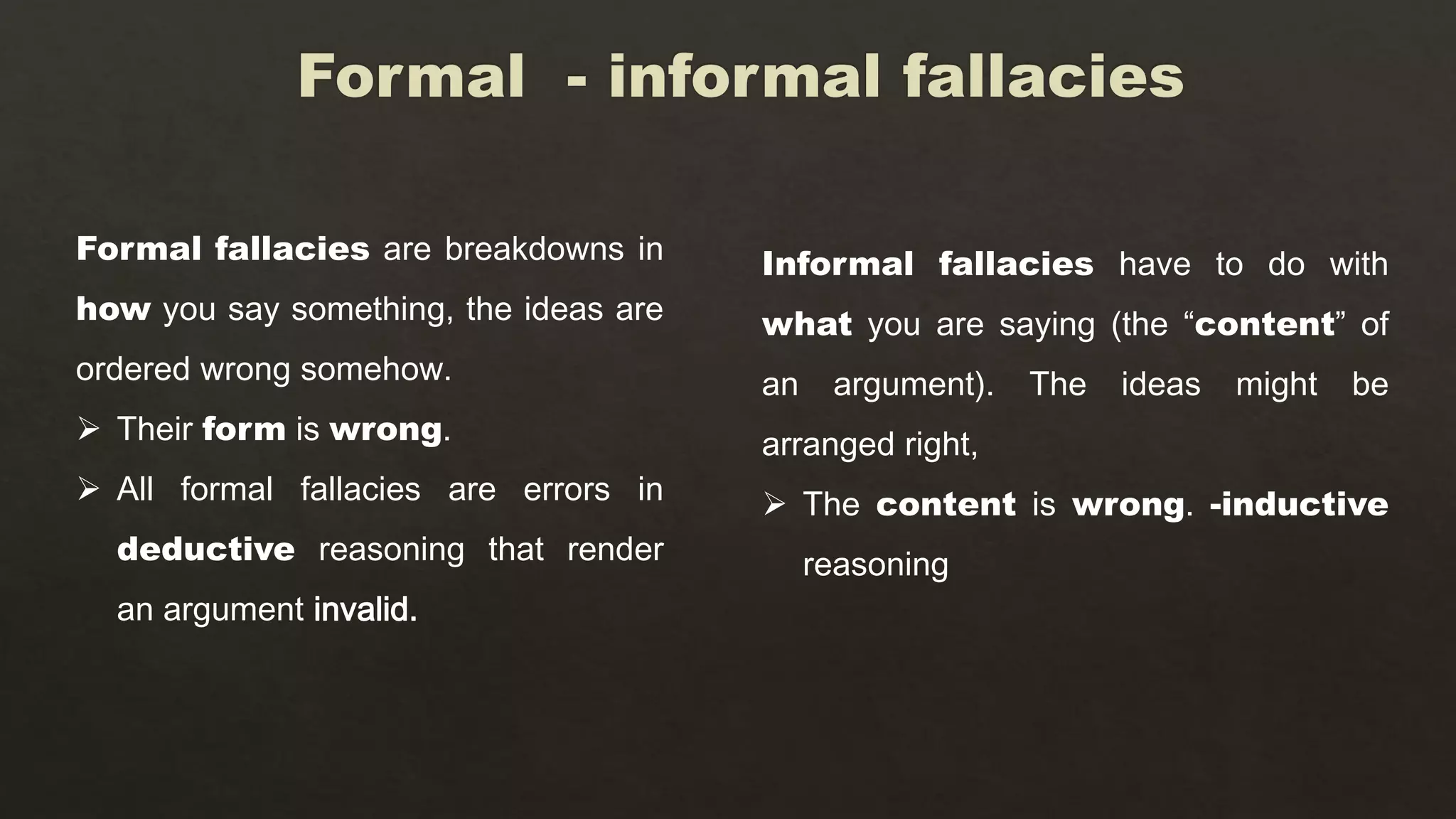
Informal fallacies have to do with
what you are saying (the “content” of
an argument). The ideas might be
arranged right,
 The content is wrong. -inductive
reasoning
Formal fallacies are breakdowns in
how you say something, the ideas are
ordered wrong somehow.
 Their form is wrong.
 All formal fallacies are errors in
deductive reasoning that render
an argument invalid.
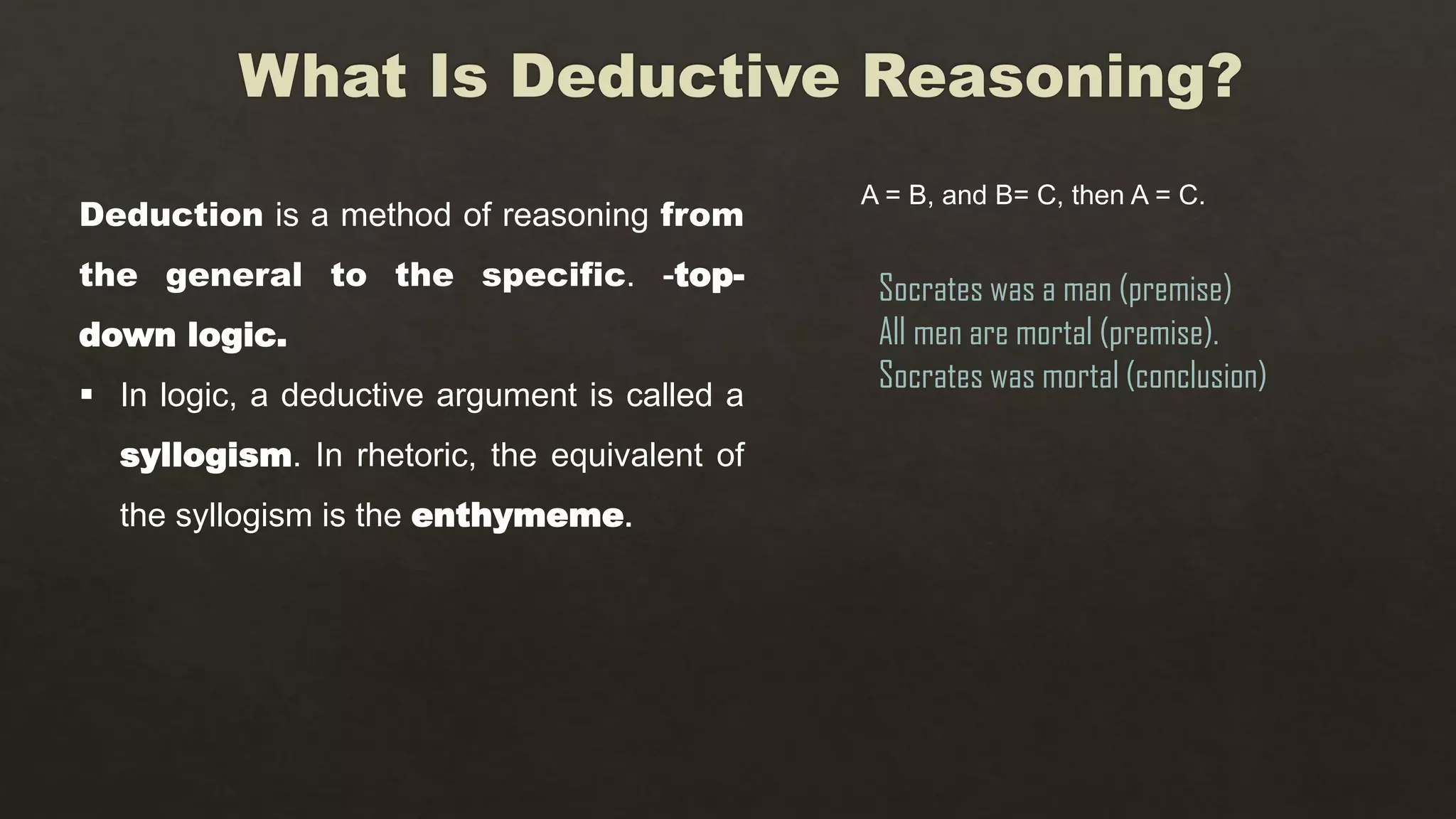
Deduction is a method of reasoning from
the general to the specific. -top-
down logic.
 In logic, a deductive argument is called a
syllogism. In rhetoric, the equivalent of
the syllogism is the enthymeme.
A = B, and B= C, then A = C.
Socrates was a man (premise)
All men are mortal (premise).
Socrates was mortal (conclusion)
Induction is a method of reasoning that
moves from specific instances to a
general conclusion. (bottom-up
logic)
P-Socrates was Greek (premise).
P- Most Greeks eat fish (premise).
C- Socrates ate fish (conclusion).
 Ad Hominem
 Straw Man
 Appeal to Ignorance
 False Dilemma
 Slippery Slope
 Circular Argument
 Hasty Generalization
 Red Herring
 Tu Quoque
 Causal Fallacy
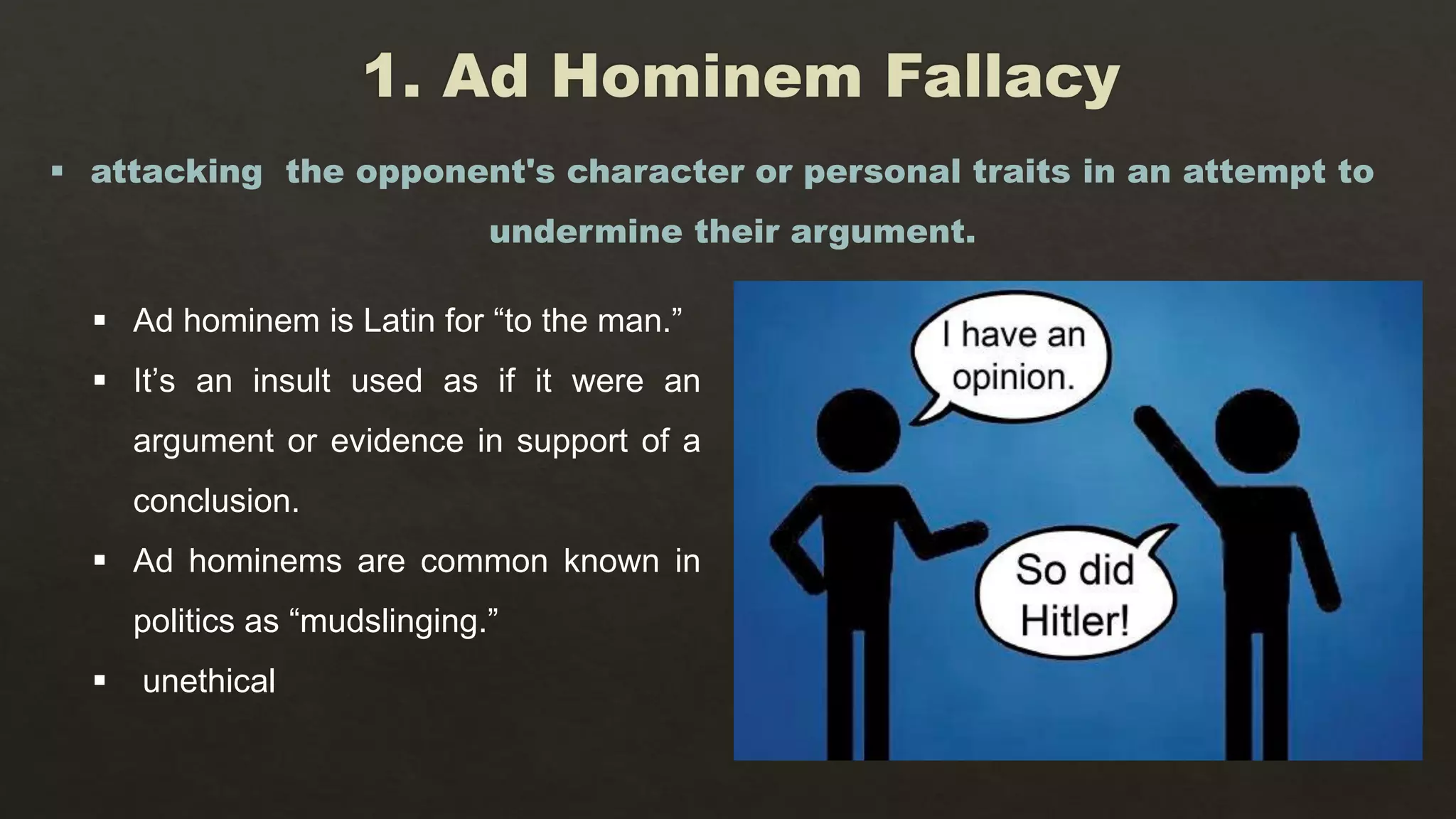
 Ad hominem is Latin for “to the man.”
 It’s an insult used as if it were an
argument or evidence in support of a
conclusion.
 Ad hominems are common known in
politics as “mudslinging.”
 unethical
 attacking the opponent's character or personal traits in an attempt to
undermine their argument.
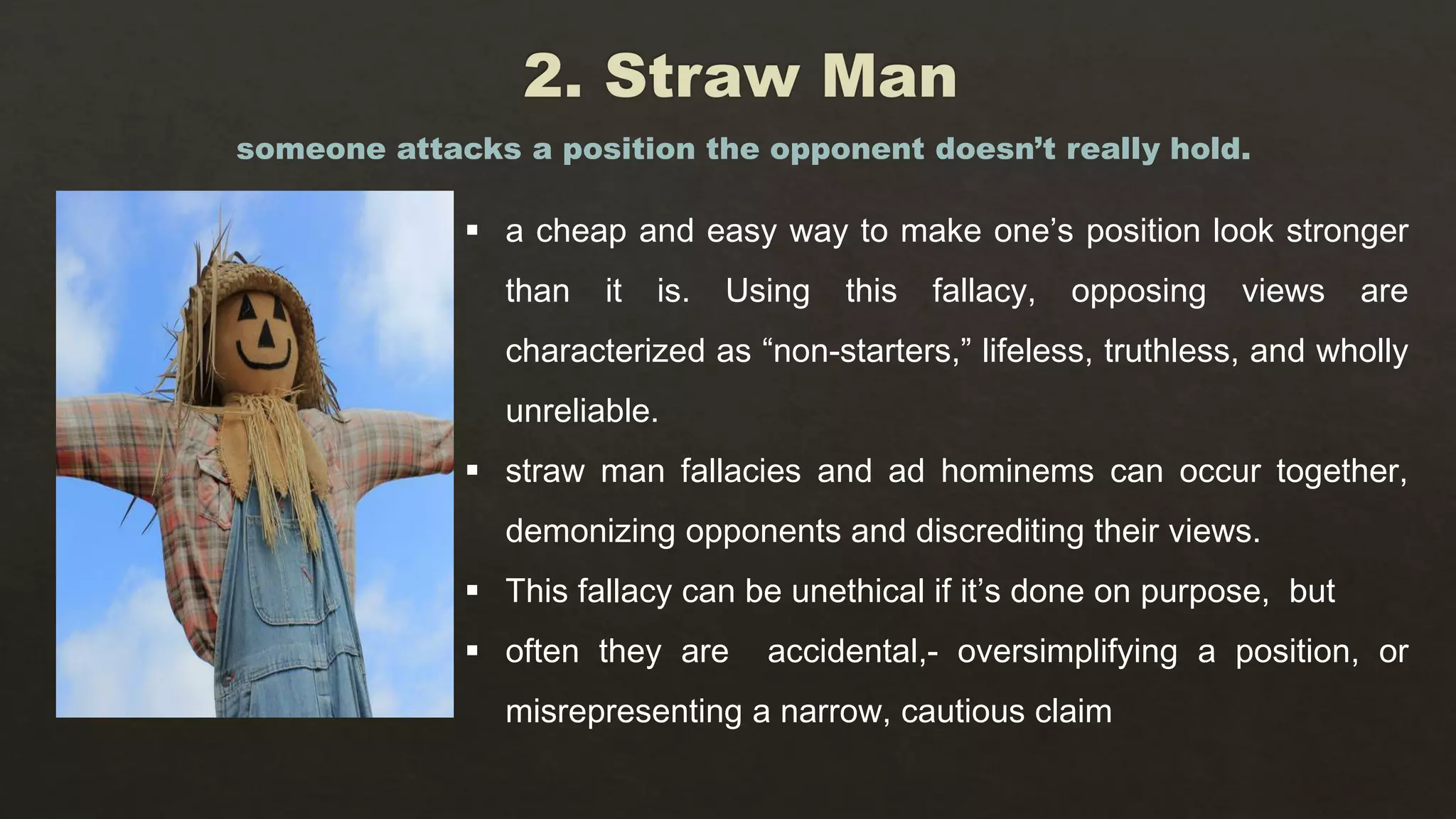
 a cheap and easy way to make one’s position look stronger
than it is. Using this fallacy, opposing views are
characterized as “non-starters,” lifeless, truthless, and wholly
unreliable.
 straw man fallacies and ad hominems can occur together,
demonizing opponents and discrediting their views.
 This fallacy can be unethical if it’s done on purpose, but
 often they are accidental,- oversimplifying a position, or
misrepresenting a narrow, cautious claim
someone attacks a position the opponent doesn’t really hold.
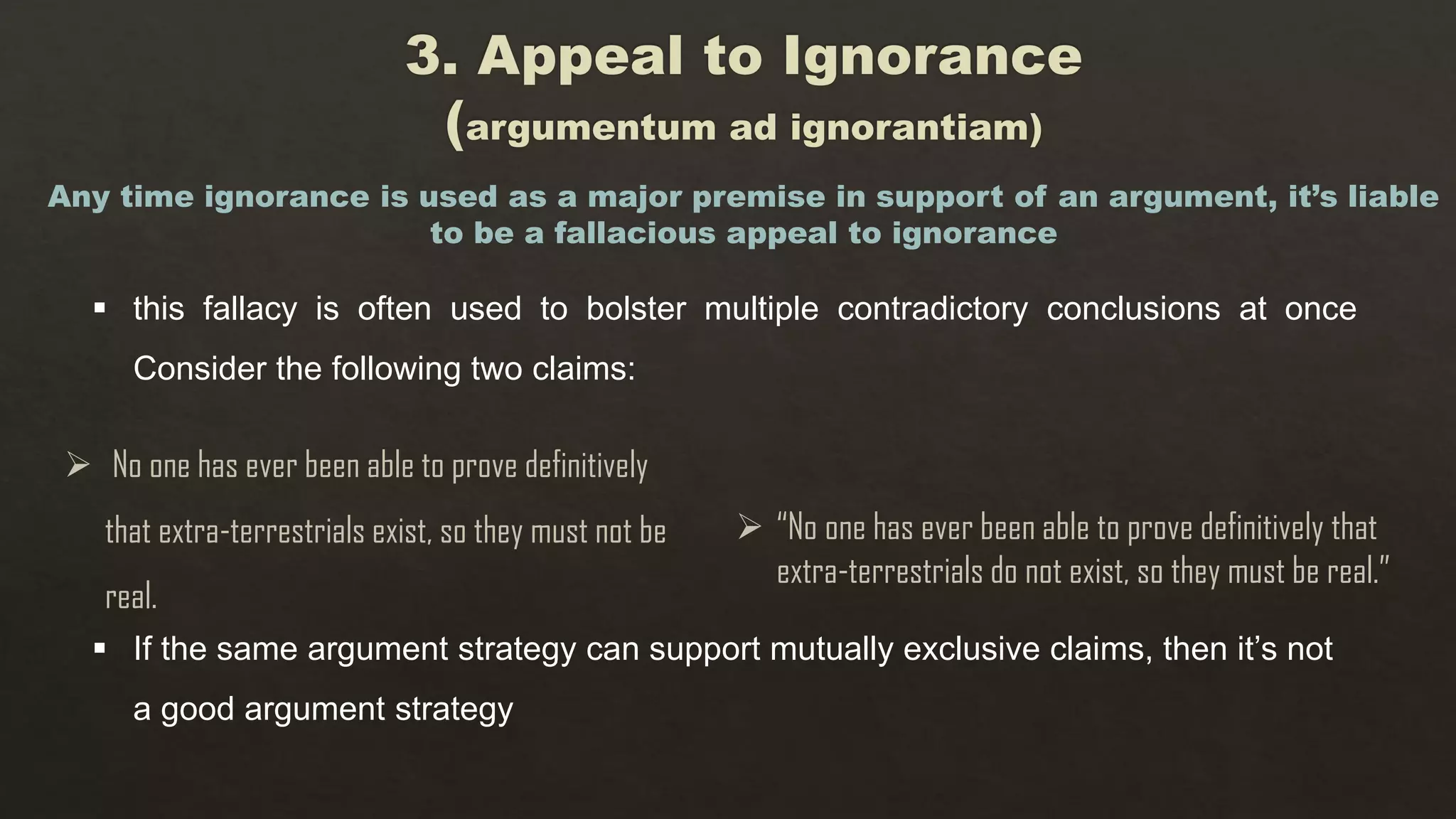
 this fallacy is often used to bolster multiple contradictory conclusions at once
Consider the following two claims:
Any time ignorance is used as a major premise in support of an argument, it’s liable
to be a fallacious appeal to ignorance
 No one has ever been able to prove definitively
that extra-terrestrials exist, so they must not be
real.
 “No one has ever been able to prove definitively that
extra-terrestrials do not exist, so they must be real.”
 If the same argument strategy can support mutually exclusive claims, then it’s not
a good argument strategy
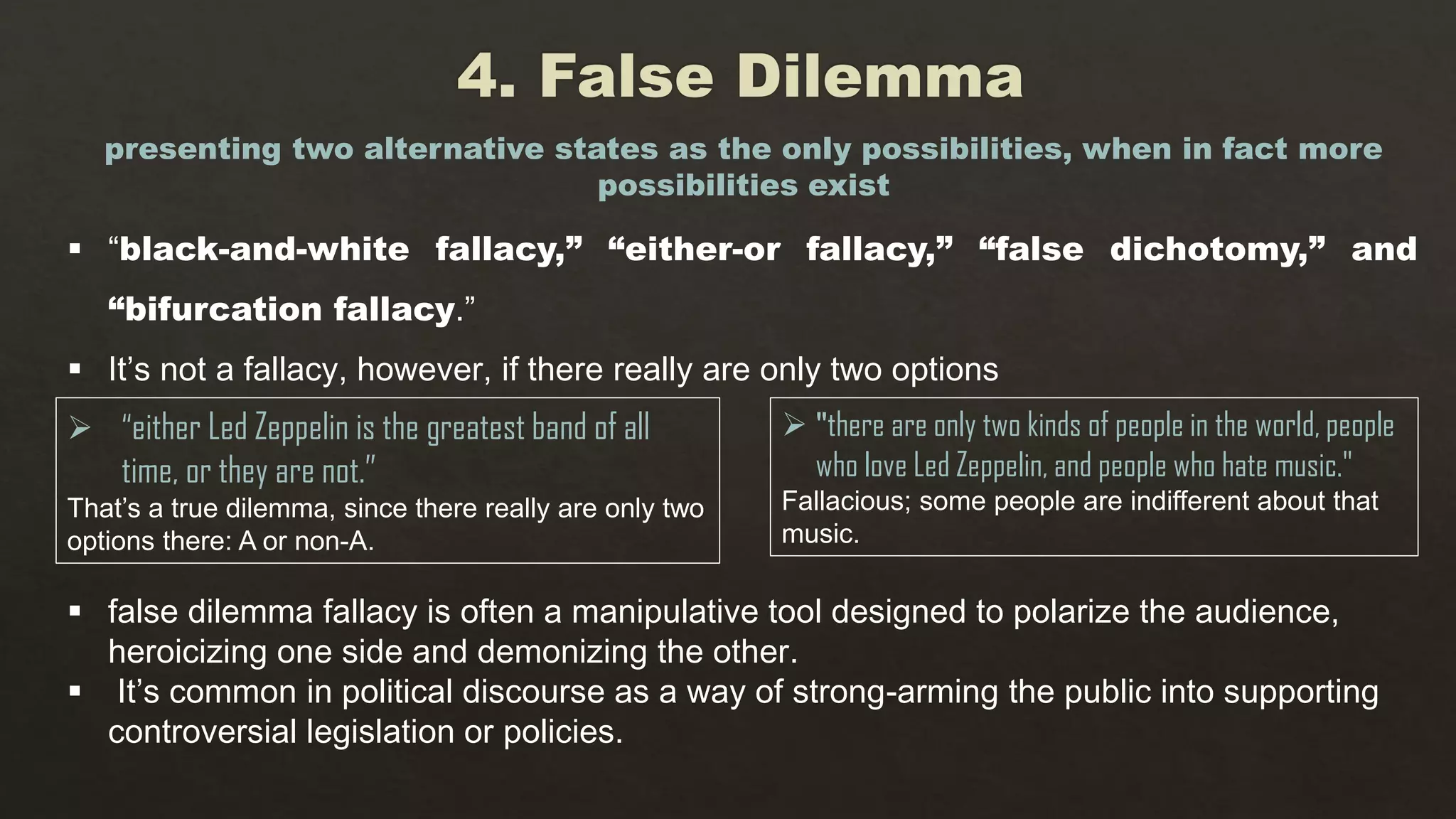
 “black-and-white fallacy,” “either-or fallacy,” “false dichotomy,” and
“bifurcation fallacy.”
 It’s not a fallacy, however, if there really are only two options
presenting two alternative states as the only possibilities, when in fact more
possibilities exist
 “either Led Zeppelin is the greatest band of all
time, or they are not.”
That’s a true dilemma, since there really are only two
options there: A or non-A.
 "there are only two kinds of people in the world, people
who love Led Zeppelin, and people who hate music."
Fallacious; some people are indifferent about that
music.
 false dilemma fallacy is often a manipulative tool designed to polarize the audience,
heroicizing one side and demonizing the other.
 It’s common in political discourse as a way of strong-arming the public into supporting
controversial legislation or policies.
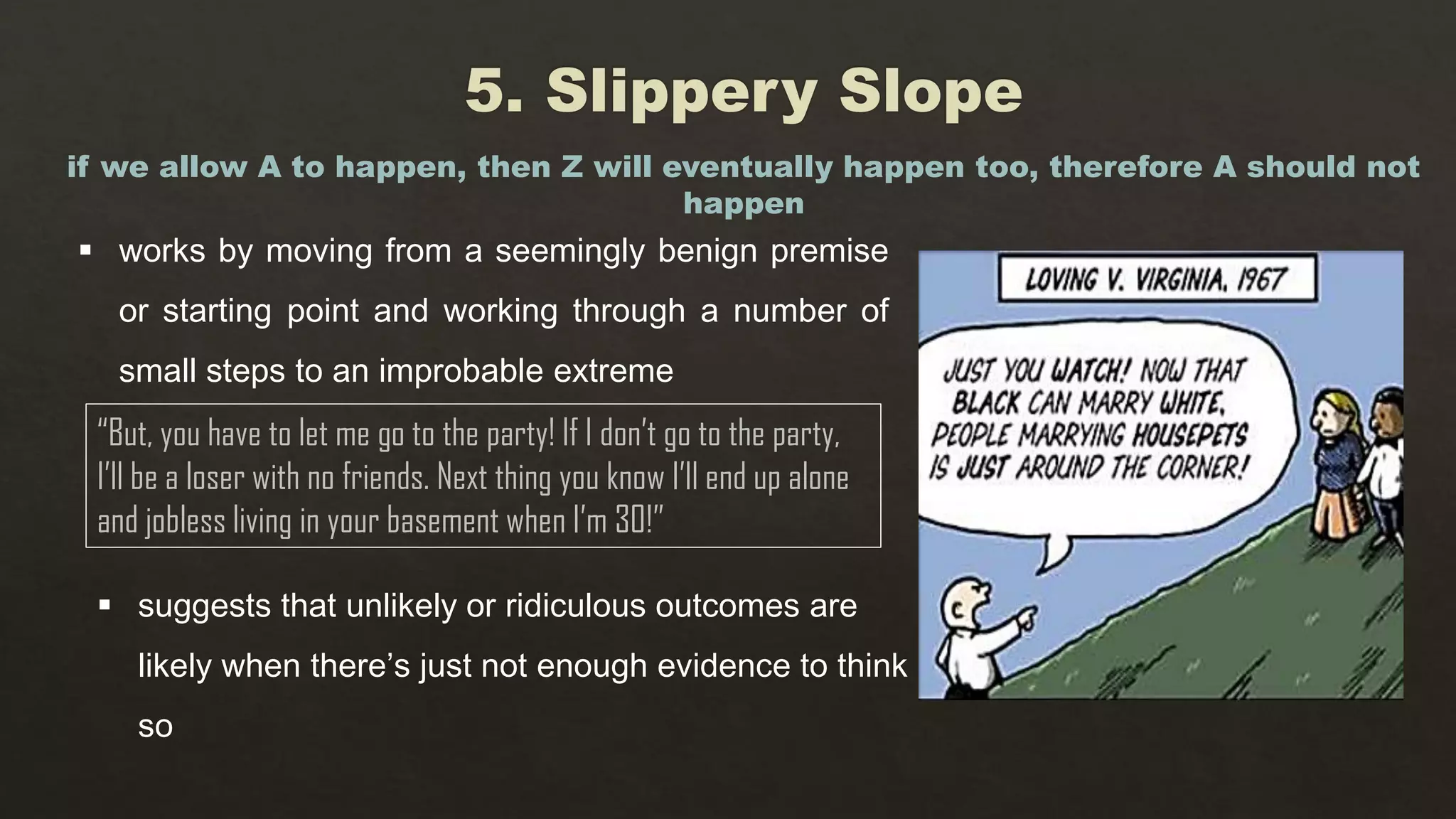
 works by moving from a seemingly benign premise
or starting point and working through a number of
small steps to an improbable extreme
if we allow A to happen, then Z will eventually happen too, therefore A should not
happen
“But, you have to let me go to the party! If I don’t go to the party,
I’ll be a loser with no friends. Next thing you know I’ll end up alone
and jobless living in your basement when I’m 30!”
 suggests that unlikely or ridiculous outcomes are
likely when there’s just not enough evidence to think
so
 Petitio principii meaning “Assuming the initial [thing]“
(commonly mistranslated as "begging the question“
 When a person’s argument is just repeating what they
already assumed beforehand, it’s not arriving at any new
conclusion recognize a circular argument when the
conclusion also appears as one of the premises in the
argument.
 circular arguments start where they finish, and finish
where they started
a circular argument in which the conclusion was included in the premise
“I need a car so I can work. I need a job so I can get a car
I
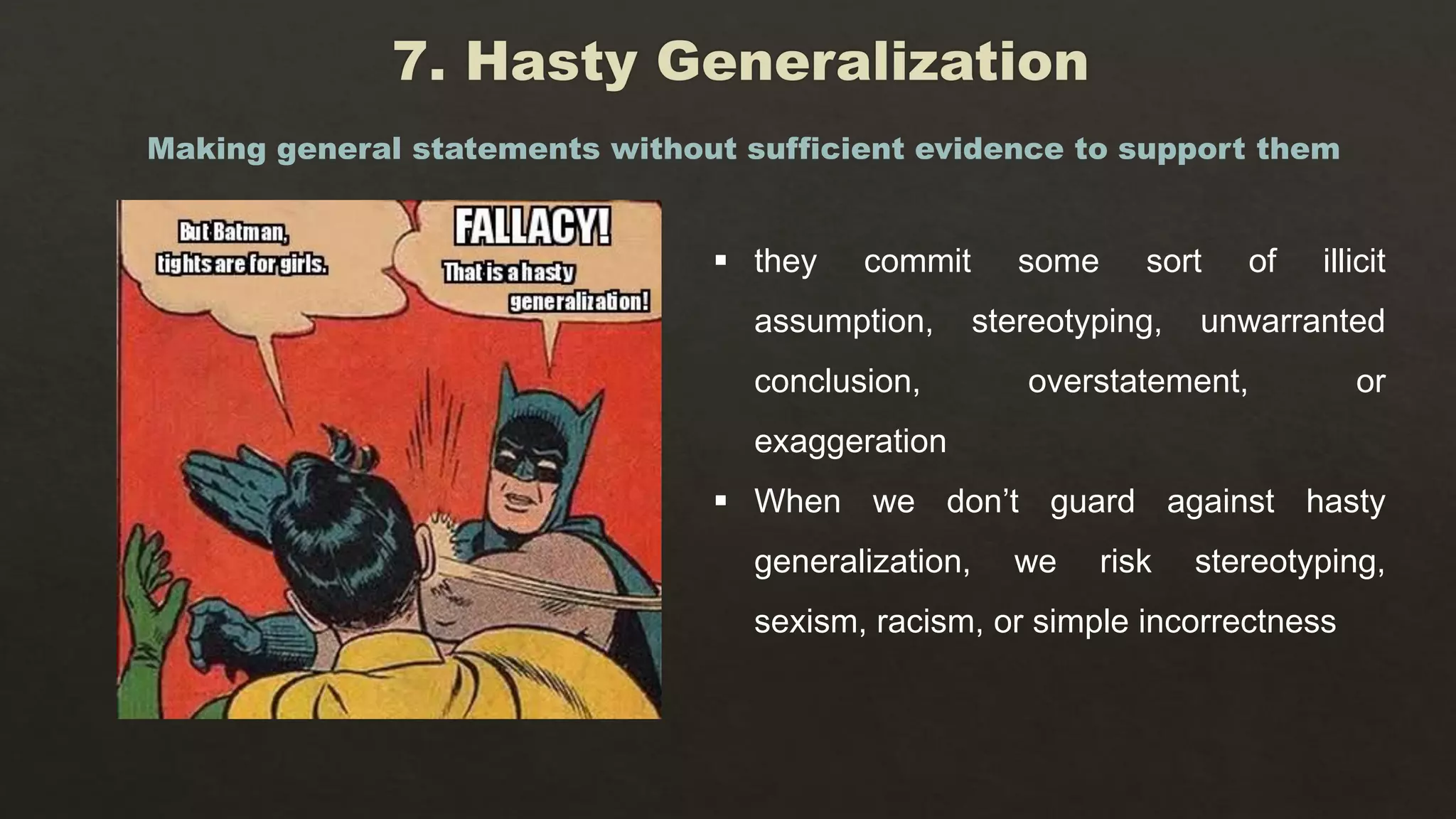
 they commit some sort of illicit
assumption, stereotyping, unwarranted
conclusion, overstatement, or
exaggeration
 When we don’t guard against hasty
generalization, we risk stereotyping,
sexism, racism, or simple incorrectness
Making general statements without sufficient evidence to support them
 This tactic is common when someone
doesn’t like the current topic and wants
to detour into something else instead,
something easier or safer to address.
 Red herrings are typically related to the
issue in question but aren’t quite
relevant enough to be helpful.
 Instead of clarifying and focusing they
confuse and distract.
a distraction from the argument typically with some sentiment that seems to be
relevant but isn’t really on-topic.
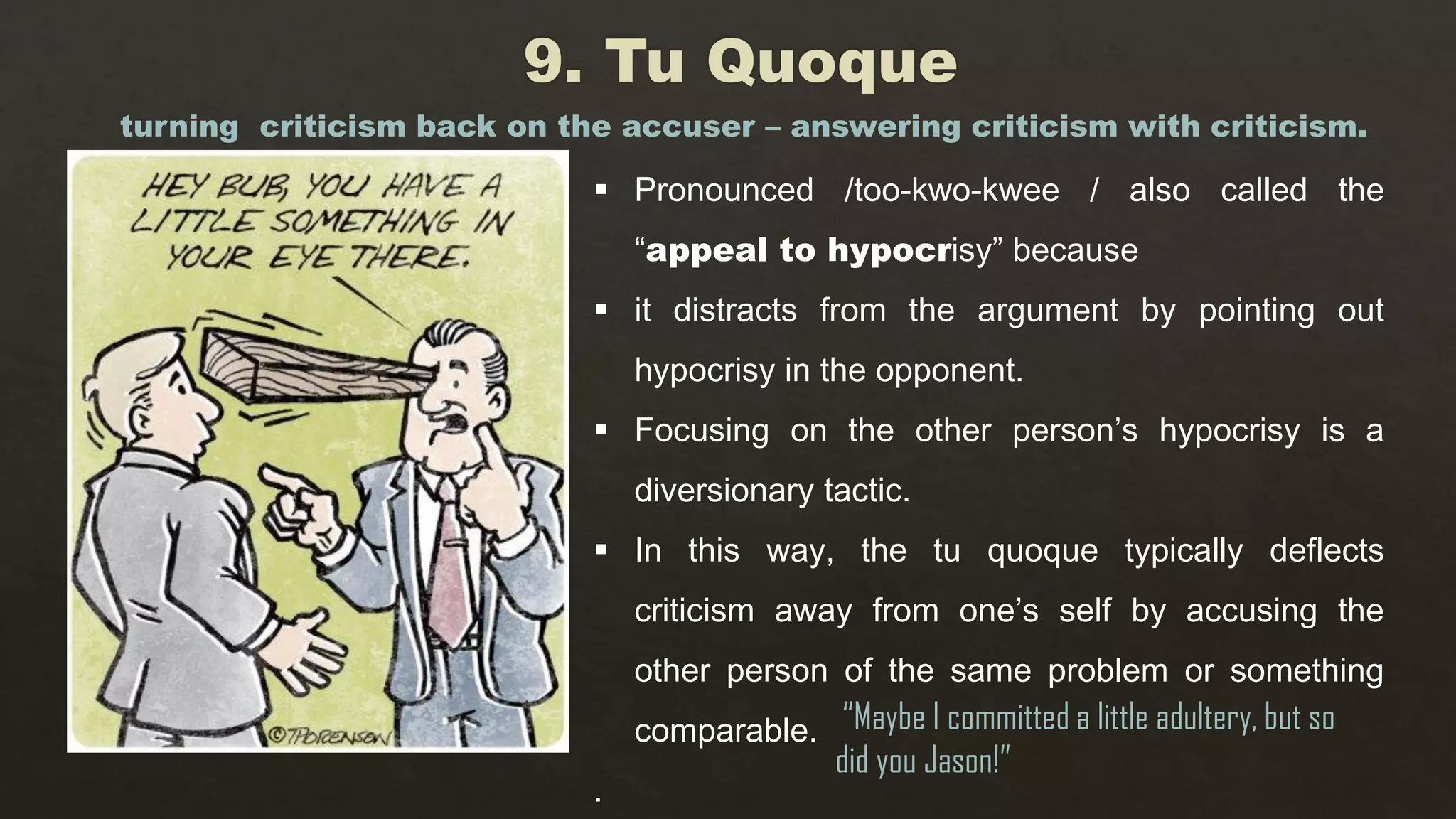
 Pronounced /too-kwo-kwee / also called the
“appeal to hypocrisy” because
 it distracts from the argument by pointing out
hypocrisy in the opponent.
 Focusing on the other person’s hypocrisy is a
diversionary tactic.
 In this way, the tu quoque typically deflects
criticism away from one’s self by accusing the
other person of the same problem or something
comparable.
.
turning criticism back on the accuser – answering criticism with criticism.
“Maybe I committed a little adultery, but so
did you Jason!”
 a parent category for several different fallacies about unproven causes
 One causal fallacy is the False Cause or “non causa pro causa” ("not the-cause for
a cause") fallacy, which is when you conclude about a cause without enough
evidence to do so
 False Cause Fallacy.
“Since your parents named you ‘Harvest,’ they must be farmers.”
It’s possible that the parents are farmers, but that name alone is not enough evidence to draw that
conclusion. That name doesn’t tell us much of anything about the parents. –
any logical breakdown when identifying a cause
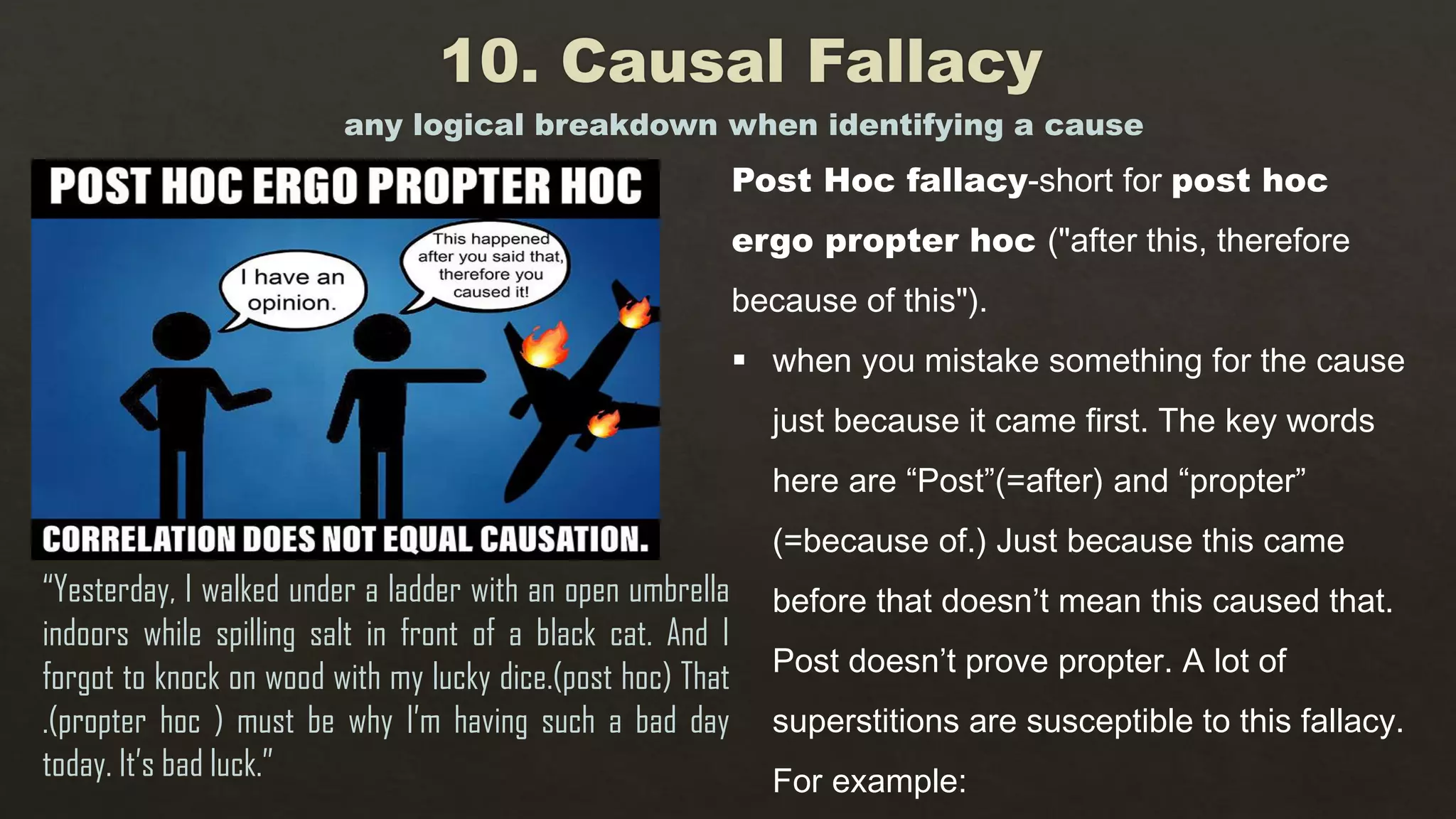
“Yesterday, I walked under a ladder with an open umbrella
indoors while spilling salt in front of a black cat. And I
forgot to knock on wood with my lucky dice.(post hoc) That
.(propter hoc ) must be why I’m having such a bad day
today. It’s bad luck.”
Post Hoc fallacy-short for post hoc
ergo propter hoc ("after this, therefore
because of this").
 when you mistake something for the cause
just because it came first. The key words
here are “Post”(=after) and “propter”
(=because of.) Just because this came
before that doesn’t mean this caused that.
Post doesn’t prove propter. A lot of
superstitions are susceptible to this fallacy.
For example:
 cum hoc ergo propter hoc (Lat., “with this therefore because of
this")
 fallacy happens when you mistakenly interpret two things found together as being
causally related
 Correlation doesn’t prove causation
any logical breakdown when identifying a cause
“Every time Joe goes swimming he is wearing his Speedos.
Something about wearing that Speedo must make him want
to go swimming.”
 Appeal to Authority (argumentum ad verecundiam) (“argument from respect”)
when we misuse an authority.- We can cite only authorities Or we can cite irrelevant
authorities, poor authorities, or false authorities
“I buy Fruit of the Loom™ underwear because Michael Jordan says it’s the best.”
 Even the authorities can be wrong sometimes
 burden of proof -lies not with the person making the claim, but with someone else
to disprove.
 Equivocation (ambiguity) a double meaning or ambiguity of language to mislead
or misrepresent the truth--a tone of deception or just a simple misunderstanding e.g
"lying" //"creative license, "fired from my job" //"early retirement."
appeal to emotion (argumentum ad misericordiam) attempted to
manipulate an emotional response in place of a valid or compelling argument.
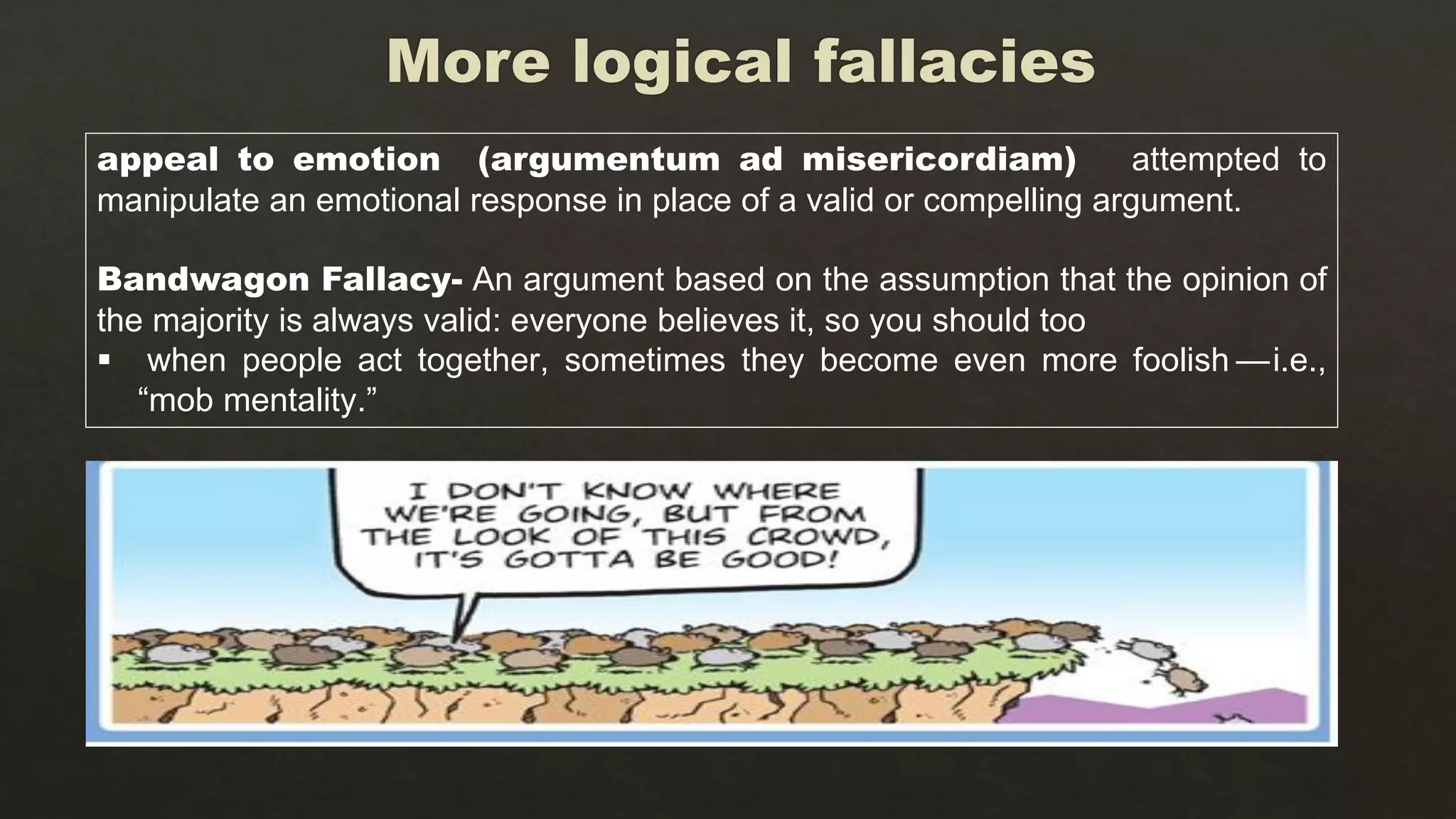
Bandwagon Fallacy- An argument based on the assumption that the opinion of
the majority is always valid: everyone believes it, so you should too
 when people act together, sometimes they become even more foolish — i.e.,
“mob mentality.”
Critical thinking Logical Fallacies  t

Critical thinking Logical Fallacies t

  • 2.
    A logical fallacyis an error , a defect in reasoning.  A false statement that weakens an argument by distorting an issue, drawing false conclusion, misusing evidence, or misusing language.  Logical fallacies take you away from the strength of the argument.  They can be intentional (to trick and fool people) or unintentional ( so watch out!).
  • 3.
    Informal fallacies haveto do with what you are saying (the “content” of an argument). The ideas might be arranged right,  The content is wrong. -inductive reasoning Formal fallacies are breakdowns in how you say something, the ideas are ordered wrong somehow.  Their form is wrong.  All formal fallacies are errors in deductive reasoning that render an argument invalid.
  • 4.
    Deduction is amethod of reasoning from the general to the specific. -top- down logic.  In logic, a deductive argument is called a syllogism. In rhetoric, the equivalent of the syllogism is the enthymeme. A = B, and B= C, then A = C. Socrates was a man (premise) All men are mortal (premise). Socrates was mortal (conclusion)
  • 5.
    Induction is amethod of reasoning that moves from specific instances to a general conclusion. (bottom-up logic) P-Socrates was Greek (premise). P- Most Greeks eat fish (premise). C- Socrates ate fish (conclusion).
  • 6.
     Ad Hominem Straw Man  Appeal to Ignorance  False Dilemma  Slippery Slope  Circular Argument  Hasty Generalization  Red Herring  Tu Quoque  Causal Fallacy
  • 7.
     Ad hominemis Latin for “to the man.”  It’s an insult used as if it were an argument or evidence in support of a conclusion.  Ad hominems are common known in politics as “mudslinging.”  unethical  attacking the opponent's character or personal traits in an attempt to undermine their argument.
  • 8.
     a cheapand easy way to make one’s position look stronger than it is. Using this fallacy, opposing views are characterized as “non-starters,” lifeless, truthless, and wholly unreliable.  straw man fallacies and ad hominems can occur together, demonizing opponents and discrediting their views.  This fallacy can be unethical if it’s done on purpose, but  often they are accidental,- oversimplifying a position, or misrepresenting a narrow, cautious claim someone attacks a position the opponent doesn’t really hold.
  • 9.
     this fallacyis often used to bolster multiple contradictory conclusions at once Consider the following two claims: Any time ignorance is used as a major premise in support of an argument, it’s liable to be a fallacious appeal to ignorance  No one has ever been able to prove definitively that extra-terrestrials exist, so they must not be real.  “No one has ever been able to prove definitively that extra-terrestrials do not exist, so they must be real.”  If the same argument strategy can support mutually exclusive claims, then it’s not a good argument strategy
  • 10.
     “black-and-white fallacy,”“either-or fallacy,” “false dichotomy,” and “bifurcation fallacy.”  It’s not a fallacy, however, if there really are only two options presenting two alternative states as the only possibilities, when in fact more possibilities exist  “either Led Zeppelin is the greatest band of all time, or they are not.” That’s a true dilemma, since there really are only two options there: A or non-A.  "there are only two kinds of people in the world, people who love Led Zeppelin, and people who hate music." Fallacious; some people are indifferent about that music.  false dilemma fallacy is often a manipulative tool designed to polarize the audience, heroicizing one side and demonizing the other.  It’s common in political discourse as a way of strong-arming the public into supporting controversial legislation or policies.
  • 11.
     works bymoving from a seemingly benign premise or starting point and working through a number of small steps to an improbable extreme if we allow A to happen, then Z will eventually happen too, therefore A should not happen “But, you have to let me go to the party! If I don’t go to the party, I’ll be a loser with no friends. Next thing you know I’ll end up alone and jobless living in your basement when I’m 30!”  suggests that unlikely or ridiculous outcomes are likely when there’s just not enough evidence to think so
  • 12.
     Petitio principiimeaning “Assuming the initial [thing]“ (commonly mistranslated as "begging the question“  When a person’s argument is just repeating what they already assumed beforehand, it’s not arriving at any new conclusion recognize a circular argument when the conclusion also appears as one of the premises in the argument.  circular arguments start where they finish, and finish where they started a circular argument in which the conclusion was included in the premise “I need a car so I can work. I need a job so I can get a car I
  • 13.
     they commitsome sort of illicit assumption, stereotyping, unwarranted conclusion, overstatement, or exaggeration  When we don’t guard against hasty generalization, we risk stereotyping, sexism, racism, or simple incorrectness Making general statements without sufficient evidence to support them
  • 14.
     This tacticis common when someone doesn’t like the current topic and wants to detour into something else instead, something easier or safer to address.  Red herrings are typically related to the issue in question but aren’t quite relevant enough to be helpful.  Instead of clarifying and focusing they confuse and distract. a distraction from the argument typically with some sentiment that seems to be relevant but isn’t really on-topic.
  • 15.
     Pronounced /too-kwo-kwee/ also called the “appeal to hypocrisy” because  it distracts from the argument by pointing out hypocrisy in the opponent.  Focusing on the other person’s hypocrisy is a diversionary tactic.  In this way, the tu quoque typically deflects criticism away from one’s self by accusing the other person of the same problem or something comparable. . turning criticism back on the accuser – answering criticism with criticism. “Maybe I committed a little adultery, but so did you Jason!”
  • 16.
     a parentcategory for several different fallacies about unproven causes  One causal fallacy is the False Cause or “non causa pro causa” ("not the-cause for a cause") fallacy, which is when you conclude about a cause without enough evidence to do so  False Cause Fallacy. “Since your parents named you ‘Harvest,’ they must be farmers.” It’s possible that the parents are farmers, but that name alone is not enough evidence to draw that conclusion. That name doesn’t tell us much of anything about the parents. – any logical breakdown when identifying a cause
  • 17.
    any logical breakdownwhen identifying a cause “Yesterday, I walked under a ladder with an open umbrella indoors while spilling salt in front of a black cat. And I forgot to knock on wood with my lucky dice.(post hoc) That .(propter hoc ) must be why I’m having such a bad day today. It’s bad luck.” Post Hoc fallacy-short for post hoc ergo propter hoc ("after this, therefore because of this").  when you mistake something for the cause just because it came first. The key words here are “Post”(=after) and “propter” (=because of.) Just because this came before that doesn’t mean this caused that. Post doesn’t prove propter. A lot of superstitions are susceptible to this fallacy. For example:
  • 18.
     cum hocergo propter hoc (Lat., “with this therefore because of this")  fallacy happens when you mistakenly interpret two things found together as being causally related  Correlation doesn’t prove causation any logical breakdown when identifying a cause “Every time Joe goes swimming he is wearing his Speedos. Something about wearing that Speedo must make him want to go swimming.”
  • 19.
     Appeal toAuthority (argumentum ad verecundiam) (“argument from respect”) when we misuse an authority.- We can cite only authorities Or we can cite irrelevant authorities, poor authorities, or false authorities “I buy Fruit of the Loom™ underwear because Michael Jordan says it’s the best.”  Even the authorities can be wrong sometimes  burden of proof -lies not with the person making the claim, but with someone else to disprove.  Equivocation (ambiguity) a double meaning or ambiguity of language to mislead or misrepresent the truth--a tone of deception or just a simple misunderstanding e.g "lying" //"creative license, "fired from my job" //"early retirement."
  • 20.
    appeal to emotion(argumentum ad misericordiam) attempted to manipulate an emotional response in place of a valid or compelling argument. Bandwagon Fallacy- An argument based on the assumption that the opinion of the majority is always valid: everyone believes it, so you should too  when people act together, sometimes they become even more foolish — i.e., “mob mentality.”