
The Fallacies File
• Fallacy: an error in logic
– An error in reasoning or in making an argument
– Different than just an error of fact
Ad Hominem
• 1. Ad hominem fallacy (against the person):
– category of fallacies in which a claim or argument
is rejected on the basis of some irrelevant fact
about the author of or the person presenting the
claim or argument.
– Typically, two steps.
• 1. an attack against the character of person making the
claim, her circumstances, or her actions is made (or the
character, circumstances, or actions of the person
reporting the claim).
• Second, this attack is taken to be evidence against the
claim or argument the person in question is making (or
presenting). This type of "argument" has the following
form:
Ad hominem cont.
1. Person A makes claim X.
2. Person B makes an attack on person A.
3. Therefore A's claim is false.
– Why is an Ad Hominem a fallacy?
– Because the character, circumstances, or
actions of a person do not (in most cases)
have a bearing on the truth or falsity of the
claim being made (or the quality of the
argument being made).
Ad Hominem cont.
• Example of Ad Hominem
Bill: "I believe that abortion is morally wrong."
Dave: "Of course you would say that, you're a
priest."
Bill: "What about the arguments I gave to
support my position?"
Dave: "Those don't count. Like I said, you're a
priest, so you have to say that abortion is
wrong. Further, you are just a yes man to the
Pope, so I can't believe what you say."
The False Dichotomy
• AKA: the Either-Or, False Dilemma
• A dichotomy: a premise that only two
alternatives are possible. This is false when
other alternatives are in fact possible, which
usually is the case. The notion that a binary
choice exists usually is implied rather than
being stated explicitly.
False Dichotomy Cont.
• A FD: uses pattern of "reasoning":
1. Either claim X is true or claim Y is true (when X and Y could
both be false).
2. Claim Y is false.
3. Therefore claim X is true.
• Fallacious because if both claims could be false, then it cannot
be inferred that one is true because the other is false. That this
is the case is made clear by the following example:
1. Either 1+1=4 or 1+1=12.
2. It is not the case that 1+1=4.
3. Therefore 1+1=12.
Examples of FD
Senator Jill: "We'll have to cut education funding this year."
Senator Bill: "Why?"
Senator Jill: "Well, either we cut the social programs or we live
with a huge deficit and we can't live with the deficit."
Bill: "Jill and I both support having prayer in public schools."
Jill: "Hey, I never said that!"
Bill: "You're not an atheist are you Jill?"
"Look, you are going to have to make up your mind. Either you
decide that you can afford this stereo, or you decide you are
going to do without music for a while."
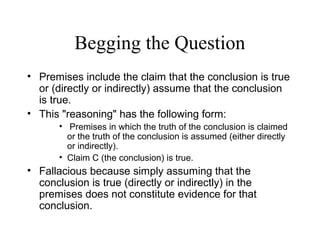
Begging the Question
• Premises include the claim that the conclusion is true
or (directly or indirectly) assume that the conclusion
is true.
• This "reasoning" has the following form:
• Premises in which the truth of the conclusion is claimed
or the truth of the conclusion is assumed (either directly
or indirectly).
• Claim C (the conclusion) is true.
• Fallacious because simply assuming that the
conclusion is true (directly or indirectly) in the
premises does not constitute evidence for that
conclusion.
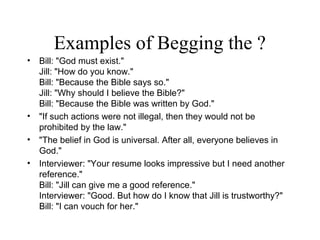
Examples of Begging the ?
• Bill: "God must exist."
Jill: "How do you know."
Bill: "Because the Bible says so."
Jill: "Why should I believe the Bible?"
Bill: "Because the Bible was written by God."
• "If such actions were not illegal, then they would not be
prohibited by the law."
• "The belief in God is universal. After all, everyone believes in
God."
• Interviewer: "Your resume looks impressive but I need another
reference."
Bill: "Jill can give me a good reference."
Interviewer: "Good. But how do I know that Jill is trustworthy?"
Bill: "I can vouch for her."
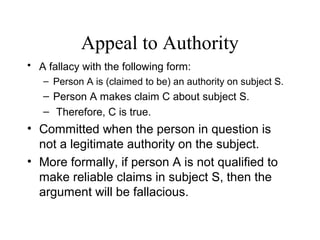
Appeal to Authority
• A fallacy with the following form:
– Person A is (claimed to be) an authority on subject S.
– Person A makes claim C about subject S.
– Therefore, C is true.
• Committed when the person in question is
not a legitimate authority on the subject.
• More formally, if person A is not qualified to
make reliable claims in subject S, then the
argument will be fallacious.
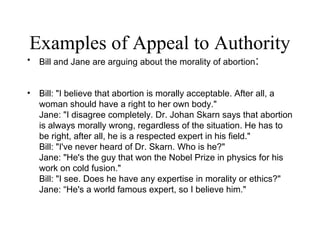
Examples of Appeal to Authority
• Bill and Jane are arguing about the morality of abortion:
• Bill: "I believe that abortion is morally acceptable. After all, a
woman should have a right to her own body."
Jane: "I disagree completely. Dr. Johan Skarn says that abortion
is always morally wrong, regardless of the situation. He has to
be right, after all, he is a respected expert in his field."
Bill: "I've never heard of Dr. Skarn. Who is he?"
Jane: "He's the guy that won the Nobel Prize in physics for his
work on cold fusion."
Bill: "I see. Does he have any expertise in morality or ethics?"
Jane: “He's a world famous expert, so I believe him."
Slippery Slope
• Fallacy in which a person asserts that some event
must inevitably follow from another without any
argument for the inevitability of the event in
question.
– In most cases, there are a series of steps or
gradations between one event and the one in
question and no reason is given as to why the
intervening steps or gradations will simply be
bypassed.
– This "argument" has the following form:
1.Event X has occurred (or will or might occur).
2.Therefore event Y will inevitably happen.
Fallacious b/c there is no reason to believe that one event must
inevitably follow from another without an argument for such a
claim. Especially clear in cases in which there is a significant
number of steps or gradations between one event and
another.
Example of Slippery Slope
• "If today you can take a thing like evolution and make it a crime to
teach it in the public school, tomorrow you can make it a crime to
teach it in the private schools, and the next year you can make it a
crime to teach it to the hustings or in the church. At the next session
you may ban books and the newspapers. Soon you may set Catholic
against Protestant and Protestant against Protestant, and try to foist
your own religion upon the minds of men. If you can do one you can
do the other. Ignorance and fanaticism is ever busy and needs feeding.
Always it is feeding and gloating for more. Today it is the public
school teachers, tomorrow the private. The next day the preachers and
the lectures, the magazines, the books, the newspapers. After while,
your honor, it is the setting of man against man and creed against
creed until with flying banners and beating drums we are marching
backward to the glorious ages of the sixteenth century when bigots
lighted fagots to burn the men who dared to bring any intelligence
and enlightenment and culture to the human mind." Source: Clarence
Darrow, The Scopes Trial, Day 2
Giving good reasons & arguments
Reason = statement that tells why a
proposition is justified
= statements that answer why you
should believe or do something
Good reasons:
1. Can be supported with facts
2. Are relevant to the proposition
3. Will have an impact on YOUR audience
Finding evidence to support
reasons
• Factual statements
• Expert opinions
• Good evidence
– Source
– Recent
– Relevant
Organizing Reasons
• Persuasion Principle
– You are more likely to persuade an audience
when you organize your reasons in a way that
will be most persuasive to that audience
Statement of Logical Reasons
• You present the best-supported reasons you
can find in this order:
– 1. Second strongest
– 2. Other reasons
– 3. Strongest
• i.e.
Problem-Solution
• Clarifies nature of the problem and showing why a
given proposal is the best one
– 1. Statement of problem
– 2. Statement of solution
– 3. Statement of consequences (what will happen if
solution is adopted and what positive consequences it
will have)
This works well for an audience that is:
unaware of a problem, has no opinion, has mild opinion
Comparative Advantages
• Allows you to place the emphasis on the
superiority of the proposed course of action
– Instead of the proposition being the solution to
a grave problem, it presents the proposition as
one that should be adopted because it has
advantages over the present condition
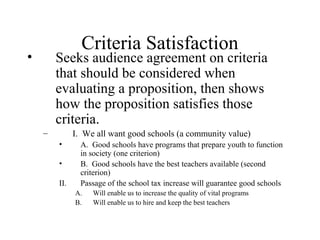
Criteria Satisfaction
• Seeks audience agreement on criteria
that should be considered when
evaluating a proposition, then shows
how the proposition satisfies those
criteria.
– I. We all want good schools (a community value)
• A. Good schools have programs that prepare youth to function
in society (one criterion)
• B. Good schools have the best teachers available (second
criterion)
II. Passage of the school tax increase will guarantee good schools
A. Will enable us to increase the quality of vital programs
B. Will enable us to hire and keep the best teachers
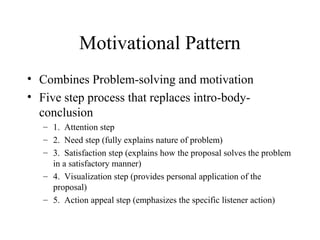
Motivational Pattern
• Combines Problem-solving and motivation
• Five step process that replaces intro-body-
conclusion
– 1. Attention step
– 2. Need step (fully explains nature of problem)
– 3. Satisfaction step (explains how the proposal solves the problem
in a satisfactory manner)
– 4. Visualization step (provides personal application of the
proposal)
– 5. Action appeal step (emphasizes the specific listener action)
Ari Pregen on Logical Fallacies

Ari Pregen on Logical Fallacies

  • 1.
    The Fallacies File •Fallacy: an error in logic – An error in reasoning or in making an argument – Different than just an error of fact
  • 2.
    Ad Hominem • 1.Ad hominem fallacy (against the person): – category of fallacies in which a claim or argument is rejected on the basis of some irrelevant fact about the author of or the person presenting the claim or argument. – Typically, two steps. • 1. an attack against the character of person making the claim, her circumstances, or her actions is made (or the character, circumstances, or actions of the person reporting the claim). • Second, this attack is taken to be evidence against the claim or argument the person in question is making (or presenting). This type of "argument" has the following form:
  • 3.
    Ad hominem cont. 1.Person A makes claim X. 2. Person B makes an attack on person A. 3. Therefore A's claim is false. – Why is an Ad Hominem a fallacy? – Because the character, circumstances, or actions of a person do not (in most cases) have a bearing on the truth or falsity of the claim being made (or the quality of the argument being made).
  • 4.
    Ad Hominem cont. •Example of Ad Hominem Bill: "I believe that abortion is morally wrong." Dave: "Of course you would say that, you're a priest." Bill: "What about the arguments I gave to support my position?" Dave: "Those don't count. Like I said, you're a priest, so you have to say that abortion is wrong. Further, you are just a yes man to the Pope, so I can't believe what you say."
  • 5.
    The False Dichotomy •AKA: the Either-Or, False Dilemma • A dichotomy: a premise that only two alternatives are possible. This is false when other alternatives are in fact possible, which usually is the case. The notion that a binary choice exists usually is implied rather than being stated explicitly.
  • 6.
    False Dichotomy Cont. •A FD: uses pattern of "reasoning": 1. Either claim X is true or claim Y is true (when X and Y could both be false). 2. Claim Y is false. 3. Therefore claim X is true. • Fallacious because if both claims could be false, then it cannot be inferred that one is true because the other is false. That this is the case is made clear by the following example: 1. Either 1+1=4 or 1+1=12. 2. It is not the case that 1+1=4. 3. Therefore 1+1=12.
  • 7.
    Examples of FD SenatorJill: "We'll have to cut education funding this year." Senator Bill: "Why?" Senator Jill: "Well, either we cut the social programs or we live with a huge deficit and we can't live with the deficit." Bill: "Jill and I both support having prayer in public schools." Jill: "Hey, I never said that!" Bill: "You're not an atheist are you Jill?" "Look, you are going to have to make up your mind. Either you decide that you can afford this stereo, or you decide you are going to do without music for a while."
  • 8.
    Begging the Question •Premises include the claim that the conclusion is true or (directly or indirectly) assume that the conclusion is true. • This "reasoning" has the following form: • Premises in which the truth of the conclusion is claimed or the truth of the conclusion is assumed (either directly or indirectly). • Claim C (the conclusion) is true. • Fallacious because simply assuming that the conclusion is true (directly or indirectly) in the premises does not constitute evidence for that conclusion.
  • 9.
    Examples of Beggingthe ? • Bill: "God must exist." Jill: "How do you know." Bill: "Because the Bible says so." Jill: "Why should I believe the Bible?" Bill: "Because the Bible was written by God." • "If such actions were not illegal, then they would not be prohibited by the law." • "The belief in God is universal. After all, everyone believes in God." • Interviewer: "Your resume looks impressive but I need another reference." Bill: "Jill can give me a good reference." Interviewer: "Good. But how do I know that Jill is trustworthy?" Bill: "I can vouch for her."
  • 10.
    Appeal to Authority •A fallacy with the following form: – Person A is (claimed to be) an authority on subject S. – Person A makes claim C about subject S. – Therefore, C is true. • Committed when the person in question is not a legitimate authority on the subject. • More formally, if person A is not qualified to make reliable claims in subject S, then the argument will be fallacious.
  • 11.
    Examples of Appealto Authority • Bill and Jane are arguing about the morality of abortion: • Bill: "I believe that abortion is morally acceptable. After all, a woman should have a right to her own body." Jane: "I disagree completely. Dr. Johan Skarn says that abortion is always morally wrong, regardless of the situation. He has to be right, after all, he is a respected expert in his field." Bill: "I've never heard of Dr. Skarn. Who is he?" Jane: "He's the guy that won the Nobel Prize in physics for his work on cold fusion." Bill: "I see. Does he have any expertise in morality or ethics?" Jane: “He's a world famous expert, so I believe him."
  • 12.
    Slippery Slope • Fallacyin which a person asserts that some event must inevitably follow from another without any argument for the inevitability of the event in question. – In most cases, there are a series of steps or gradations between one event and the one in question and no reason is given as to why the intervening steps or gradations will simply be bypassed. – This "argument" has the following form: 1.Event X has occurred (or will or might occur). 2.Therefore event Y will inevitably happen. Fallacious b/c there is no reason to believe that one event must inevitably follow from another without an argument for such a claim. Especially clear in cases in which there is a significant number of steps or gradations between one event and another.
  • 13.
    Example of SlipperySlope • "If today you can take a thing like evolution and make it a crime to teach it in the public school, tomorrow you can make it a crime to teach it in the private schools, and the next year you can make it a crime to teach it to the hustings or in the church. At the next session you may ban books and the newspapers. Soon you may set Catholic against Protestant and Protestant against Protestant, and try to foist your own religion upon the minds of men. If you can do one you can do the other. Ignorance and fanaticism is ever busy and needs feeding. Always it is feeding and gloating for more. Today it is the public school teachers, tomorrow the private. The next day the preachers and the lectures, the magazines, the books, the newspapers. After while, your honor, it is the setting of man against man and creed against creed until with flying banners and beating drums we are marching backward to the glorious ages of the sixteenth century when bigots lighted fagots to burn the men who dared to bring any intelligence and enlightenment and culture to the human mind." Source: Clarence Darrow, The Scopes Trial, Day 2
  • 14.
    Giving good reasons& arguments Reason = statement that tells why a proposition is justified = statements that answer why you should believe or do something Good reasons: 1. Can be supported with facts 2. Are relevant to the proposition 3. Will have an impact on YOUR audience
  • 15.
    Finding evidence tosupport reasons • Factual statements • Expert opinions • Good evidence – Source – Recent – Relevant
  • 16.
    Organizing Reasons • PersuasionPrinciple – You are more likely to persuade an audience when you organize your reasons in a way that will be most persuasive to that audience
  • 17.
    Statement of LogicalReasons • You present the best-supported reasons you can find in this order: – 1. Second strongest – 2. Other reasons – 3. Strongest • i.e.
  • 18.
    Problem-Solution • Clarifies natureof the problem and showing why a given proposal is the best one – 1. Statement of problem – 2. Statement of solution – 3. Statement of consequences (what will happen if solution is adopted and what positive consequences it will have) This works well for an audience that is: unaware of a problem, has no opinion, has mild opinion
  • 19.
    Comparative Advantages • Allowsyou to place the emphasis on the superiority of the proposed course of action – Instead of the proposition being the solution to a grave problem, it presents the proposition as one that should be adopted because it has advantages over the present condition
  • 20.
    Criteria Satisfaction • Seeksaudience agreement on criteria that should be considered when evaluating a proposition, then shows how the proposition satisfies those criteria. – I. We all want good schools (a community value) • A. Good schools have programs that prepare youth to function in society (one criterion) • B. Good schools have the best teachers available (second criterion) II. Passage of the school tax increase will guarantee good schools A. Will enable us to increase the quality of vital programs B. Will enable us to hire and keep the best teachers
  • 21.
    Motivational Pattern • CombinesProblem-solving and motivation • Five step process that replaces intro-body- conclusion – 1. Attention step – 2. Need step (fully explains nature of problem) – 3. Satisfaction step (explains how the proposal solves the problem in a satisfactory manner) – 4. Visualization step (provides personal application of the proposal) – 5. Action appeal step (emphasizes the specific listener action)