Fallacies of Relevance
All Fallacies of Relevance share the
common problem of appealing to features
that are irrelevant for the evaluation of a
line of reasoning or evidence—they appeal
to factors that do not speak to the truth of
a position or the quality of evidence for it.
Personal Attack (Ad Hominem)
 Literally: “against the man”
 Replaces evaluation of ideas or evidence
with a personal attack
 Ad Hominem is not fallacious if it is
relevant to evaluating a line of reasoning
 Ad Hominem Circumstantial: group-based
version of the ad Hominem
 Abusive Form
 To Quoque
Tu Quo (or Tu Quoque)
 Literally: “You too”
 Charge of hypocrisy
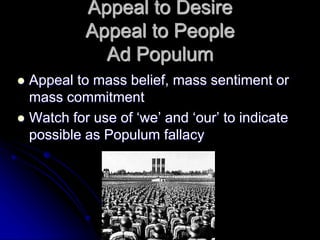
Appeal to Desire
Appeal to People
Ad Populum
 Appeal to mass belief, mass sentiment or
mass commitment
 Watch for use of ‘we’ and ‘our’ to indicate
possible as Populum fallacy
Appeal to Force
“Ad Baculum”
“to the stick”
 Appeal to force or other coercion
Ad Misericordiam (Appeal to Pity)
 Appeal to our emotions, especially sympathy or pity, to
convince without argument.
 Not all emotional appeals are fallacious– no fallacy if this
is used to help us to recognize data or adopt another’s
standpoint.
Ad Ignorantiam (Appeal to
Ignorance)
 Involves a claim being declared true or
false because its denial can’t be proven
 There may be some cases where a lack of
evidence IS evidence
Ad Verecundiam (Improper Appeal
to Authority)
 Appeal to someone as an authority in
areas where they lack relevant expertise
Appeals to Authority Continued
 Appeals to authorities that have a
recognizable bias
Appeals to Authority Continued
 Appeals to law or religious principles as
finalizing matters of truth
Fallacies of Presumption
All fallacies of presumption share the
common failing of appealing to
unwarranted assumptions that, when
revealed, undermine the strength of the
reasoning offered
Hasty Generalization
 Hasty Generalizations occur when an
inference is made from a small or atypical
sample
Availability Heuristic (or Bias)
 We tend to overestimate how likely an
event is to occur based on how easy it is
to recall to memory
 Events that are startling, emotionally
evocative or otherwise salient will be
recalled easier
Confirmation Bias
 Our tendency to search out confirming
evidence and ignore possible
disconfirming evidence
 Includes our tendency to treat
disconfirming evidence more critically than
confirming evidence
Fallacy of Misleading Vividness
 Overlooking strong evidence due to a
salient counterexample
Fallacy of Accident
 Reverse of the Hasty Generalization
 Involves applying a general rule to a
recognizably atypical or exceptional case
Begging the Question (Circularity)
 Circular reasoning assumes what it is out
to prove; the evidence already assumes
the truth of the conclusion
 Circular arguments may be deductively
valid (and sound!), but are still fallacious
Indirect Circularity
 Appealing to evidence that only those who
agree with your conclusion would accept
as evidence; “preaching to the choir”
 Involves appeal to controversial evidence
that is not recognized as such
 Unlike directly circular arguments, these
can be salvaged
Complex Question
 A question loaded to generate a specific
answer
 Typically a form of question-begging: and
answer is assumed
 Framing Effect: the way the question is
“framed” affects what answers are given
Straw Man
 Deliberate misrepresentation of an
opposing viewpoint; distorts or caricatures
for ease of refutation
 Look for attributions of extreme views: this
is a red flag for a Straw Man
 Look for attributions of absurd views: this
is a red flag for a Straw Man
 Different from a Reductio argument
Bifurcation (aka False Dichotomy;
False Dilemma)
 Artificial limitation of options; typically to 2
 Often linked to other fallacies
 Brainstorming as a way to overcome
bifurcation
 Value Dichotomies: WE value x, while
THEY don’t
 Commonality and Compromise as ways to
overcome value dichotomies
Slippery Slope
 Predictive story without supporting evidence, or
where the only evidence is “common sense”
 Connections in the story are assumed, not
demonstrated
 Can be progressive (if we just do X, all these
great things will happen!) or gloom-and-doom (of
we do X, the sky will fall!)
 Related to Golden Age Fallacy (things were so
much better in the past) and Utopian Fallacy
(things are so much better than they once were)
Slippery Slope continued
 Predictive stories are never more certain
than their first step
 This is because with each additional step
in the story that isn’t CERTAIN, the
likelihood that the whole story is true
DECREASES
 The irony: the features that make a
slippery slope a good story undermine the
likelihood of the story’s truth

Ct fallacies

  • 1.
    Fallacies of Relevance AllFallacies of Relevance share the common problem of appealing to features that are irrelevant for the evaluation of a line of reasoning or evidence—they appeal to factors that do not speak to the truth of a position or the quality of evidence for it.
  • 2.
    Personal Attack (AdHominem)  Literally: “against the man”  Replaces evaluation of ideas or evidence with a personal attack  Ad Hominem is not fallacious if it is relevant to evaluating a line of reasoning  Ad Hominem Circumstantial: group-based version of the ad Hominem  Abusive Form  To Quoque
  • 3.
    Tu Quo (orTu Quoque)  Literally: “You too”  Charge of hypocrisy
  • 4.
    Appeal to Desire Appealto People Ad Populum  Appeal to mass belief, mass sentiment or mass commitment  Watch for use of ‘we’ and ‘our’ to indicate possible as Populum fallacy
  • 5.
    Appeal to Force “AdBaculum” “to the stick”  Appeal to force or other coercion
  • 6.
    Ad Misericordiam (Appealto Pity)  Appeal to our emotions, especially sympathy or pity, to convince without argument.  Not all emotional appeals are fallacious– no fallacy if this is used to help us to recognize data or adopt another’s standpoint.
  • 7.
    Ad Ignorantiam (Appealto Ignorance)  Involves a claim being declared true or false because its denial can’t be proven  There may be some cases where a lack of evidence IS evidence
  • 8.
    Ad Verecundiam (ImproperAppeal to Authority)  Appeal to someone as an authority in areas where they lack relevant expertise
  • 9.
    Appeals to AuthorityContinued  Appeals to authorities that have a recognizable bias
  • 10.
    Appeals to AuthorityContinued  Appeals to law or religious principles as finalizing matters of truth
  • 11.
    Fallacies of Presumption Allfallacies of presumption share the common failing of appealing to unwarranted assumptions that, when revealed, undermine the strength of the reasoning offered
  • 12.
    Hasty Generalization  HastyGeneralizations occur when an inference is made from a small or atypical sample
  • 13.
    Availability Heuristic (orBias)  We tend to overestimate how likely an event is to occur based on how easy it is to recall to memory  Events that are startling, emotionally evocative or otherwise salient will be recalled easier
  • 14.
    Confirmation Bias  Ourtendency to search out confirming evidence and ignore possible disconfirming evidence  Includes our tendency to treat disconfirming evidence more critically than confirming evidence
  • 15.
    Fallacy of MisleadingVividness  Overlooking strong evidence due to a salient counterexample
  • 16.
    Fallacy of Accident Reverse of the Hasty Generalization  Involves applying a general rule to a recognizably atypical or exceptional case
  • 17.
    Begging the Question(Circularity)  Circular reasoning assumes what it is out to prove; the evidence already assumes the truth of the conclusion  Circular arguments may be deductively valid (and sound!), but are still fallacious
  • 18.
    Indirect Circularity  Appealingto evidence that only those who agree with your conclusion would accept as evidence; “preaching to the choir”  Involves appeal to controversial evidence that is not recognized as such  Unlike directly circular arguments, these can be salvaged
  • 19.
    Complex Question  Aquestion loaded to generate a specific answer  Typically a form of question-begging: and answer is assumed  Framing Effect: the way the question is “framed” affects what answers are given
  • 20.
    Straw Man  Deliberatemisrepresentation of an opposing viewpoint; distorts or caricatures for ease of refutation  Look for attributions of extreme views: this is a red flag for a Straw Man  Look for attributions of absurd views: this is a red flag for a Straw Man  Different from a Reductio argument
  • 21.
    Bifurcation (aka FalseDichotomy; False Dilemma)  Artificial limitation of options; typically to 2  Often linked to other fallacies  Brainstorming as a way to overcome bifurcation  Value Dichotomies: WE value x, while THEY don’t  Commonality and Compromise as ways to overcome value dichotomies
  • 22.
    Slippery Slope  Predictivestory without supporting evidence, or where the only evidence is “common sense”  Connections in the story are assumed, not demonstrated  Can be progressive (if we just do X, all these great things will happen!) or gloom-and-doom (of we do X, the sky will fall!)  Related to Golden Age Fallacy (things were so much better in the past) and Utopian Fallacy (things are so much better than they once were)
  • 23.
    Slippery Slope continued Predictive stories are never more certain than their first step  This is because with each additional step in the story that isn’t CERTAIN, the likelihood that the whole story is true DECREASES  The irony: the features that make a slippery slope a good story undermine the likelihood of the story’s truth