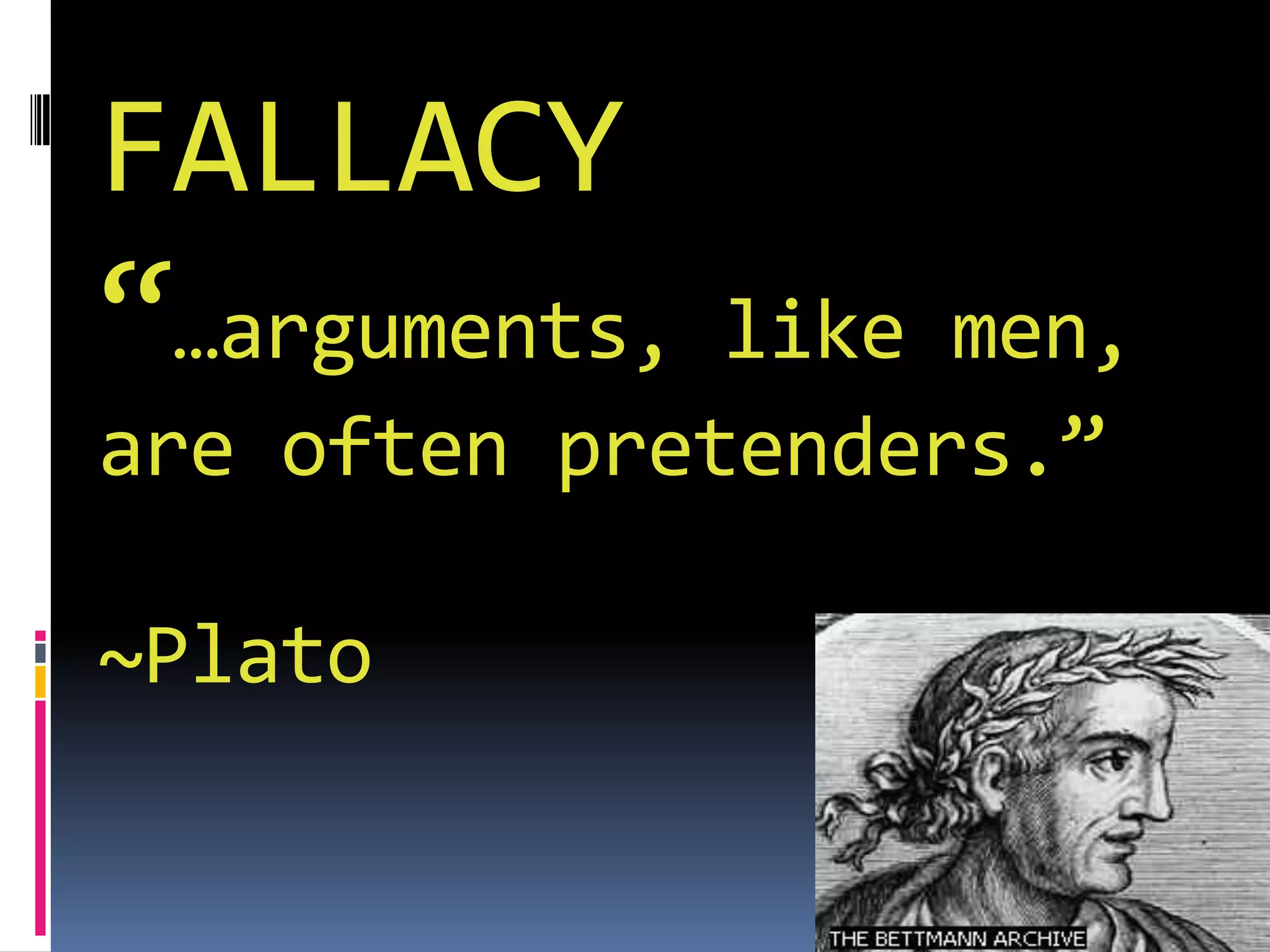
FALLACY
“…arguments,  like men,
are often pretenders.”

~Plato
In forming an argument
 you may appeal to:

1.   Ethos = appeal to ethics or morality
2.   Pathos = appeal to pity or the emotions
3.   Logos = appeal to reason
Logic is where fallacies occur
 Fallacies are common errors in reasoning that
  will undermine the logic of your argument.
 Fallacies can be either illegitimate arguments
  or irrelevant points, and are often identified
  because they lack evidence that supports their
  claim.
 Avoid these common fallacies in your own
  arguments and watch for them in the
  arguments of others.
Appeal to Pity
(Argumentum ad Misericordiam)

 A fallacy committed when pity is appealed to
  for the sake of getting a conclusion accepted.

   But Mr. Gonzalez, I have failed 2326 four times in a row.
    Don’t you think I deserve to pass it this time around? How
    many times do I have to fail it before I pass it?

   Officer, I know I was speeding, but I just paid for a speeding
    ticket just last month. Can you give me a break?
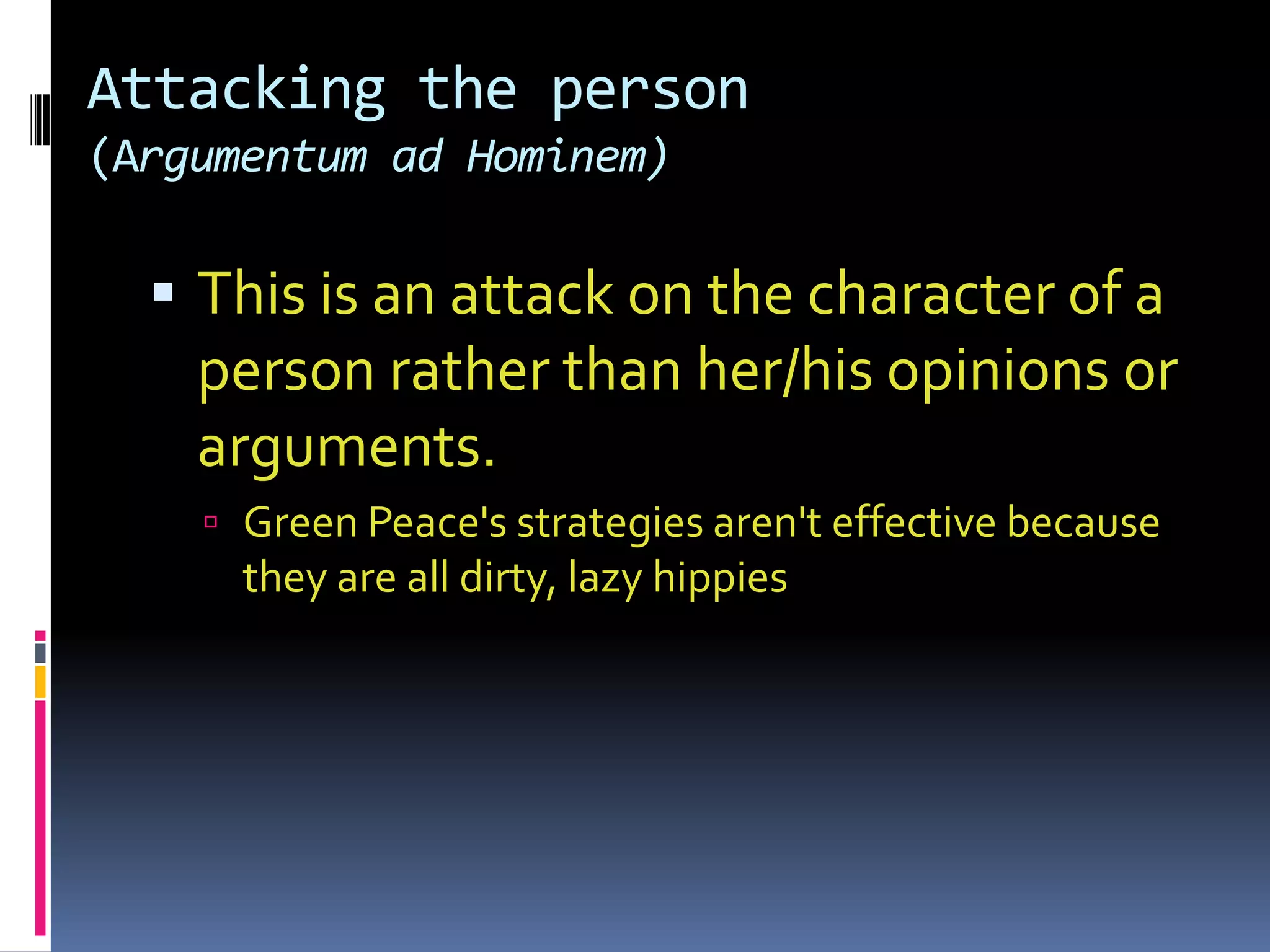
Attacking the person
(Argumentum ad Hominem)

   This is an attack on the character of a
    person rather than her/his opinions or
    arguments.
     Green Peace's strategies aren't effective because
      they are all dirty, lazy hippies
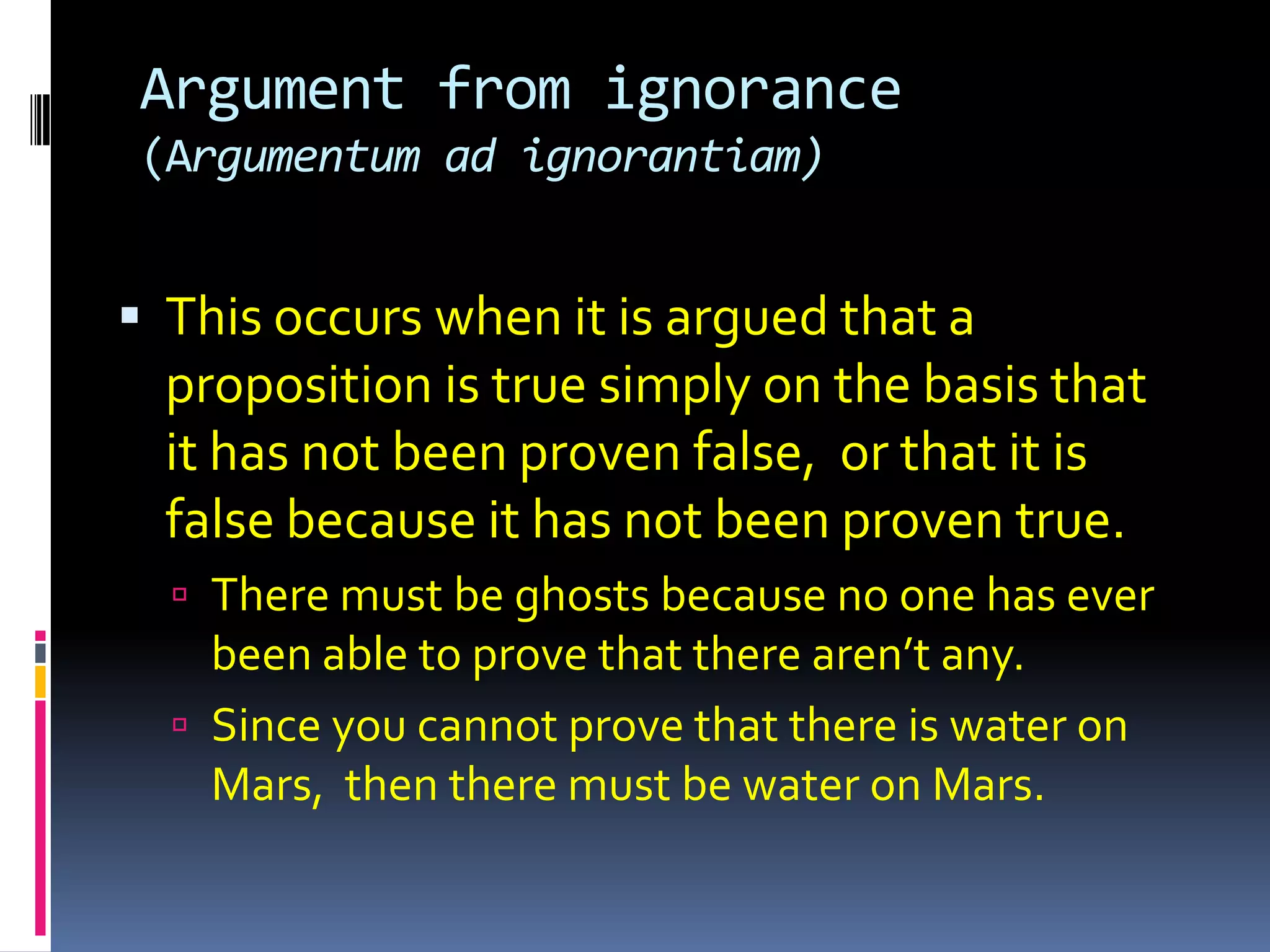
Argument from ignorance
(Argumentum ad ignorantiam)


 This occurs when it is argued that a
  proposition is true simply on the basis that
  it has not been proven false, or that it is
  false because it has not been proven true.
   There must be ghosts because no one has ever
    been able to prove that there aren’t any.
   Since you cannot prove that there is water on
    Mars, then there must be water on Mars.
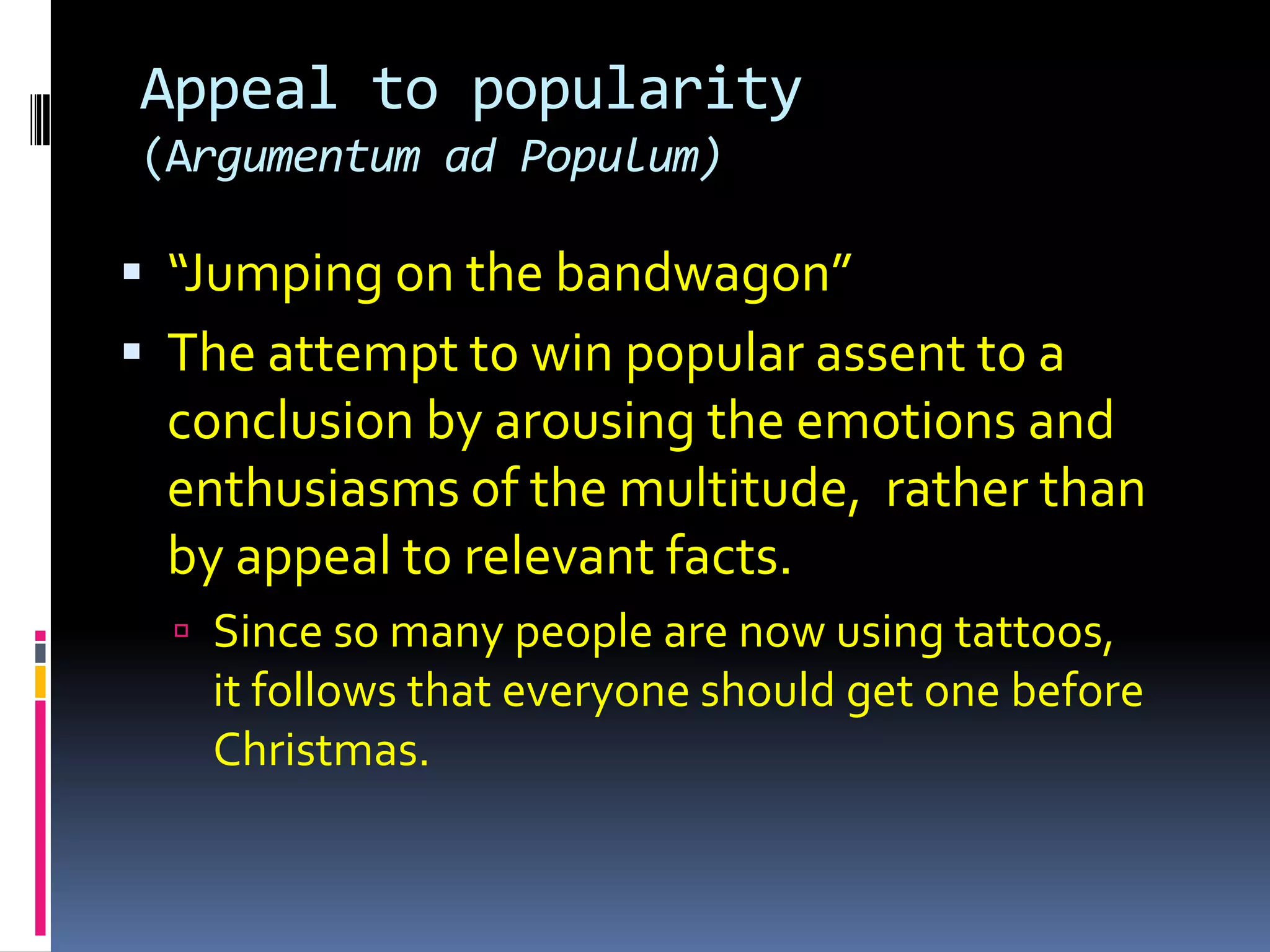
Appeal to popularity
(Argumentum ad Populum)

 “Jumping on the bandwagon”
 The attempt to win popular assent to a
  conclusion by arousing the emotions and
  enthusiasms of the multitude, rather than
  by appeal to relevant facts.
   Since so many people are now using tattoos,
   it follows that everyone should get one before
   Christmas.
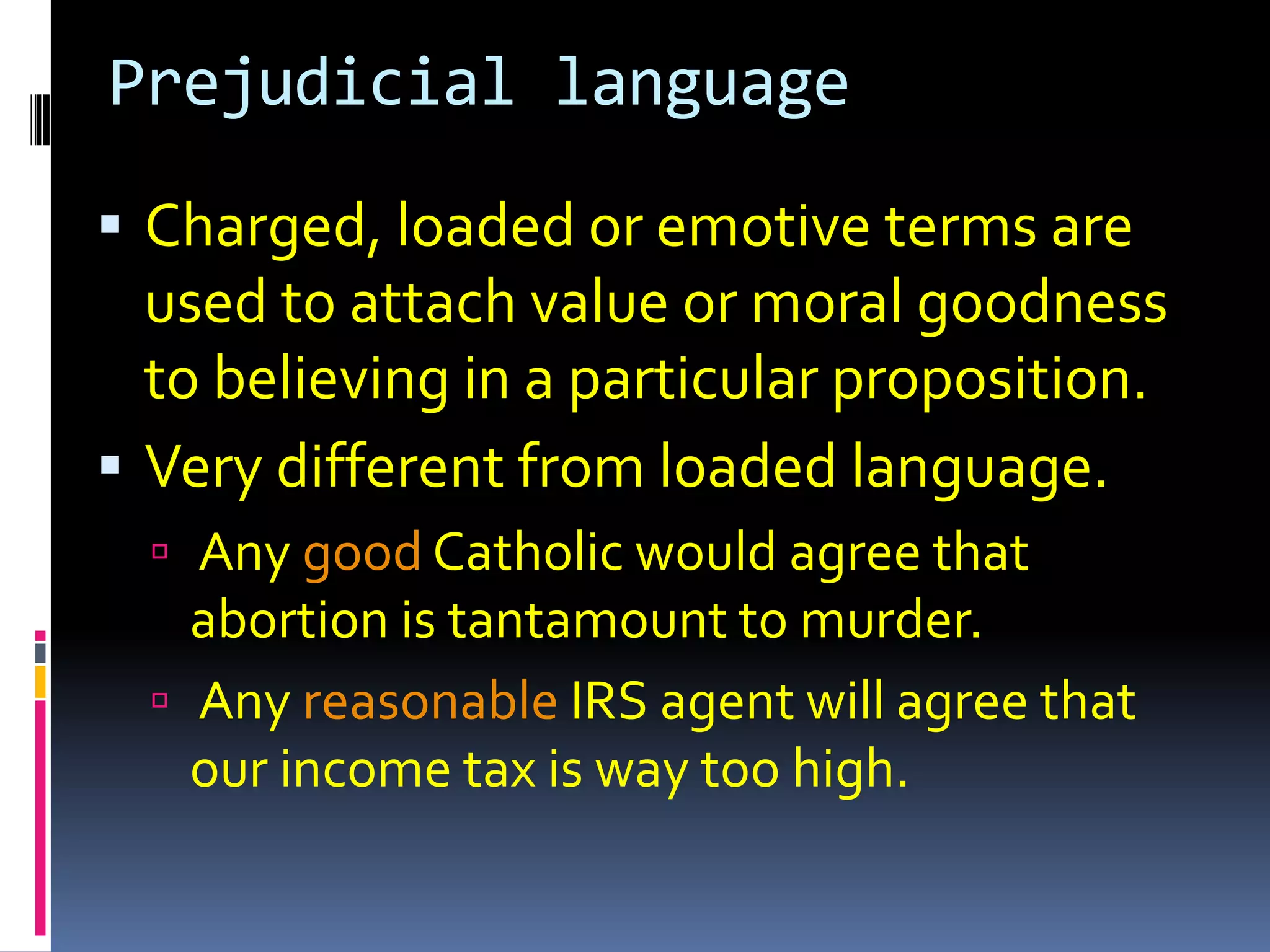
Prejudicial language

 Charged, loaded or emotive terms are
  used to attach value or moral goodness
  to believing in a particular proposition.
 Very different from loaded language.
   Any good Catholic would agree that
    abortion is tantamount to murder.
   Any reasonable IRS agent will agree that
    our income tax is way too high.
Slippery slope
 On the basis of a sequence of several
 unacceptable premises, an
 illegitimate conclusion is drawn.
   You should never gamble. Once you
   start gambling you will find it hard to
   stop. Soon you are spending all your
   money on gambling, and eventually you
   will turn to a life of crime.
False dilemma
 (either/or)
 A limited number of options (usually two)
  is given while in reality there are more
  options.
 Putting issues or opinions into “black and
  white” terms
   America: Love it or leave it.
   Every person is either wholly good or wholly
   evil.
Begging the question &
Circular Reasoning
 The conclusion that the writer should
 prove is validated within the claim.
   He is an unjust man. Thus, it may be asserted
    that he is an unfair man.
   George Bush is a good communicator
    because he speaks effectively.
Appeal to authority

 An authority is appealed to for testimony in
  matters outside the province of that authority’s
  special field.
   An appeal to the opinion of a great physicist like
    Einstein to settle a political or economic argument
    would be fallacious. He may be an authority in science,
    but not government.
   President Bush has stated that walking is the best
    exercise for your heart.
Anonymous authority
 The authority appealed to is not specified.
 The authority is anonymous or unknown
 and thus unreliable.
   Government experts have reported that anthrax has
   been found in 95% of federal government buildings.
Straw Man

 This move oversimplifies an opponent's
  viewpoint and then attacks that hollow
  argument.
   People who don't support the proposed state
    minimum wage increase hate the poor.
Citations

 “Logical Fallacies”. Purdue Online Writing Lab. 2011.
  http://owl.english.purdue.edu/owl/resource/659/03/
 “Fallacy”. South Texas College. 2011.
  http://www.southtexascollege.edu/dev-
  english/PowerPoint/gonzalez/1302/Fallacies.ppt

Honors iii argumentative fallacies

  • 1.
    FALLACY “…arguments, likemen, are often pretenders.” ~Plato
  • 2.
    In forming anargument you may appeal to: 1. Ethos = appeal to ethics or morality 2. Pathos = appeal to pity or the emotions 3. Logos = appeal to reason
  • 3.
    Logic is wherefallacies occur  Fallacies are common errors in reasoning that will undermine the logic of your argument.  Fallacies can be either illegitimate arguments or irrelevant points, and are often identified because they lack evidence that supports their claim.  Avoid these common fallacies in your own arguments and watch for them in the arguments of others.
  • 4.
    Appeal to Pity (Argumentumad Misericordiam)  A fallacy committed when pity is appealed to for the sake of getting a conclusion accepted.  But Mr. Gonzalez, I have failed 2326 four times in a row. Don’t you think I deserve to pass it this time around? How many times do I have to fail it before I pass it?  Officer, I know I was speeding, but I just paid for a speeding ticket just last month. Can you give me a break?
  • 5.
    Attacking the person (Argumentumad Hominem)  This is an attack on the character of a person rather than her/his opinions or arguments.  Green Peace's strategies aren't effective because they are all dirty, lazy hippies
  • 6.
    Argument from ignorance (Argumentumad ignorantiam)  This occurs when it is argued that a proposition is true simply on the basis that it has not been proven false, or that it is false because it has not been proven true.  There must be ghosts because no one has ever been able to prove that there aren’t any.  Since you cannot prove that there is water on Mars, then there must be water on Mars.
  • 7.
    Appeal to popularity (Argumentumad Populum)  “Jumping on the bandwagon”  The attempt to win popular assent to a conclusion by arousing the emotions and enthusiasms of the multitude, rather than by appeal to relevant facts.  Since so many people are now using tattoos, it follows that everyone should get one before Christmas.
  • 8.
    Prejudicial language  Charged,loaded or emotive terms are used to attach value or moral goodness to believing in a particular proposition.  Very different from loaded language.  Any good Catholic would agree that abortion is tantamount to murder.  Any reasonable IRS agent will agree that our income tax is way too high.
  • 9.
    Slippery slope  Onthe basis of a sequence of several unacceptable premises, an illegitimate conclusion is drawn.  You should never gamble. Once you start gambling you will find it hard to stop. Soon you are spending all your money on gambling, and eventually you will turn to a life of crime.
  • 10.
    False dilemma (either/or) A limited number of options (usually two) is given while in reality there are more options.  Putting issues or opinions into “black and white” terms  America: Love it or leave it.  Every person is either wholly good or wholly evil.
  • 11.
    Begging the question& Circular Reasoning  The conclusion that the writer should prove is validated within the claim.  He is an unjust man. Thus, it may be asserted that he is an unfair man.  George Bush is a good communicator because he speaks effectively.
  • 12.
    Appeal to authority An authority is appealed to for testimony in matters outside the province of that authority’s special field.  An appeal to the opinion of a great physicist like Einstein to settle a political or economic argument would be fallacious. He may be an authority in science, but not government.  President Bush has stated that walking is the best exercise for your heart.
  • 13.
    Anonymous authority  Theauthority appealed to is not specified. The authority is anonymous or unknown and thus unreliable.  Government experts have reported that anthrax has been found in 95% of federal government buildings.
  • 14.
    Straw Man  Thismove oversimplifies an opponent's viewpoint and then attacks that hollow argument.  People who don't support the proposed state minimum wage increase hate the poor.
  • 15.
    Citations  “Logical Fallacies”.Purdue Online Writing Lab. 2011. http://owl.english.purdue.edu/owl/resource/659/03/  “Fallacy”. South Texas College. 2011. http://www.southtexascollege.edu/dev- english/PowerPoint/gonzalez/1302/Fallacies.ppt