Fallacies
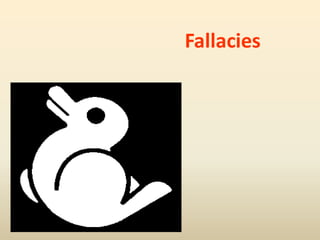
Man or Woman?
Source: http://www.coolopticalillusions.com/manwoman.htm
How many legs does this elephant have?
Source: http://www.coolopticalillusions.com/elephantlegs.htm
Which officer is the tallest?
Source: http://www.coolopticalillusions.com/optical_illusions_images_2/giant_man.htm
Is this wave moving?
Source: http://www.grand-illusions.com/opticalillusions/oblong_wave/
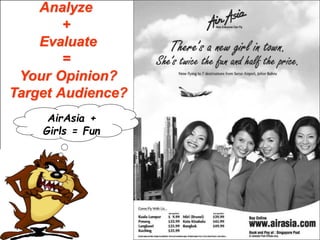
AirAsia +
Girls = Fun
Analyze
+
Evaluate
=
Your Opinion?
Target Audience?
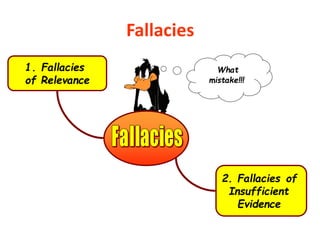
Fallacies
1. Fallacies
of Relevance
2. Fallacies of
Insufficient
Evidence
What
mistake!!!
4.0 What is a Fallacy?
• A (logical) fallacy is an argument that containsa mistake
in reasoning.
• Fallacies can be divided into two general types:
– Fallaciesof Relevance
Arguments in which the premises are logically
irrelevant to the conclusion.
– Fallaciesof Insufficient Evidence
Arguments in which the premises, though logically
relevant to the conclusion, fail to provide sufficient
evidence for the conclusion.
“There is nothing so stupid as an educated man,
if you get him off the thing he was educated in”
- Will Rogers
4.1 Fallacies of Relevance
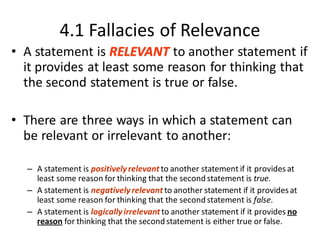
• A statement is RELEVANT to another statement if
it provides at least some reason for thinking that
the second statement is true or false.
• There are three ways in which a statement can
be relevant or irrelevant to another:
– A statement is positivelyrelevant to another statement if it providesat
least some reason for thinking that the second statement is true.
– A statement is negativelyrelevant to another statement if it providesat
least some reason for thinking that the second statement is false.
– A statement is logicallyirrelevant to another statement if it provides no
reason for thinking that the second statement is either true or false.
4.1 Fallacies of Relevance
Personal Attack
( Ad Hominem)
Appeal to Emotion
(Ad Populum)
Attacking the Motive Bandwagon
Argument
Look Who’s Talking Straw Man
Begging the Question Red Herring
Scare Tactics Equivocation
Two Wrongs Make a Right
4.1.1 Personal Attack (Ad Hominem)
Example:
Professor Doogie has argued for more emphasis on
music in our F2F classes to facilitate creativity.
But Doogie is a selfish bigheaded fool. I
absolutely refuse to listen to him.
Personal Attack
When an arguer rejects a person’s argument or claim
by attacking the person’s character rather than
examining the worth of the argument or claim itself.
1. X is a bad person.
2. Therefore X's argument must be bad.
Pattern
4.1.2 Attacking the Motive
Example:
Donald Trump has argued that we need to build a new campus. But Trump is the
owner of Trump’s Construction Company. He’ll make a fortuneif his company
is picked to build the new campus. Obviously,Trump’s argument is a lot of self-
serving nonsense.
Attacking the Motive
When an arguer criticizes a person’s motivation for
offering a particular argument or claim, rather than
examining the worth of the argument or claim itself.
1. X has biased or has questionable motives.
2. Therefore, X’s arguments or claim should be rejected.
Pattern
4.1.3 Look Who’s Talking
Example:
Doctor: You should quite smoking.
Patient: Look who’s talking! I’ll quit when you do, Dr. Smokestack!
Look Who’s Talking (tu quoque)
When an arguer rejects another person’s argument
or claim because that person is a hypocrite.
1. X fails to follow his or her own advice.
2. Therefore, X’s claim or argument should be rejected.
Pattern
4.1.4 Two Wrongs Make a Right
Examples:
1. “I don’t feel guilty about cheating on Zaid’s online quiz. Half the class
cheats on his quiz.”
2. “Why pick on me, officer? Everyone else is using drugs.”
Two Wrongs Make a Right
When an arguer attempts to justify a wrongful act
by claiming that some other act is just as bad or worse.
1. Others are committing worse or equally bad acts.
2. Therefore my wrongful act is justified.Pattern
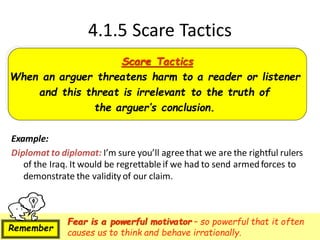
4.1.5 Scare Tactics
Example:
Diplomat to diplomat: I’m sure you’ll agreethat we are the rightful rulers
of the Iraq. It would be regrettableif we had to send armed forces to
demonstrate the validity of our claim.
Scare Tactics
When an arguer threatens harm to a reader or listener
and this threat is irrelevant to the truth of
the arguer’s conclusion.
Fear is a powerful motivator – so powerful that it often
causes us to think and behave irrationally.
Remember
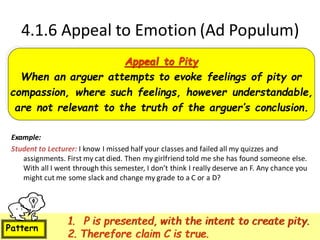
4.1.6 Appeal to Emotion (Ad Populum)
Example:
Student to Lecturer: I know I missed half your classes and failed all my quizzes and
assignments. First my cat died. Then my girlfriend told me she has found someone else.
With all I went through this semester, I don’t think I really deserve an F. Any chance you
might cut me some slack and change my grade to a C or a D?
Appeal to Pity
When an arguer attempts to evoke feelings of pity or
compassion, where such feelings, however understandable,
are not relevant to the truth of the arguer’s conclusion.
1. P is presented, with the intent to create pity.
2. Therefore claim C is true.
Pattern
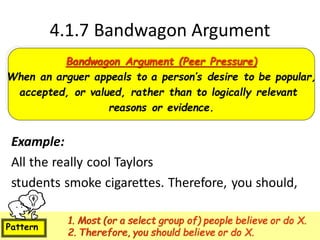
4.1.7 Bandwagon Argument
Example:
All the really cool Taylors
students smoke cigarettes. Therefore, you should,
too.
Bandwagon Argument (Peer Pressure)
When an arguer appeals to a person’s desire to be popular,
accepted, or valued, rather than to logically relevant
reasons or evidence.
1. Most (or a select group of) people believe or do X.
2. Therefore, you should believe or do X.
Pattern
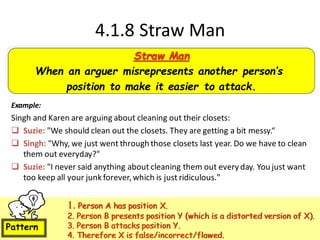
4.1.8 Straw Man
Example:
Singh and Karen are arguing about cleaning out their closets:
 Suzie: "We should clean out the closets. They are getting a bit messy.“
 Singh: "Why, we just went through those closets last year. Do we have to clean
them out everyday?"
 Suzie: "I never said anything about cleaning them out every day. You just want
too keep all your junk forever,which is just ridiculous."
Straw Man
When an arguer misrepresents another person’s
position to make it easier to attack.
1. Person A has position X.
2. Person B presents position Y (which is a distorted version of X).
3. Person B attacks position Y.
4. Therefore X is false/incorrect/flawed.
Pattern
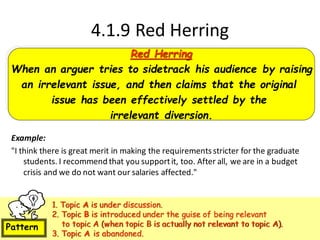
4.1.9 Red Herring
Example:
"I think there is great merit in making the requirementsstricter for the graduate
students. I recommend that you supportit, too. After all, we are in a budget
crisis and we do not want our salaries affected."
Red Herring
When an arguer tries to sidetrack his audience by raising
an irrelevant issue, and then claims that the original
issue has been effectively settled by the
irrelevant diversion.
1. Topic A is under discussion.
2. Topic B is introduced under the guise of being relevant
to topic A (when topic B is actually not relevant to topic A).
3. Topic A is abandoned.
Pattern
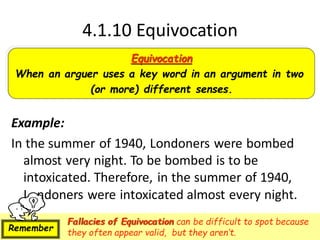
4.1.10 Equivocation
Example:
In the summer of 1940, Londoners were bombed
almost very night. To be bombed is to be
intoxicated. Therefore, in the summer of 1940,
Londoners were intoxicated almost every night.
Equivocation
When an arguer uses a key word in an argument in two
(or more) different senses.
Fallacies of Equivocation can be difficult to spot because
they often appear valid, but they aren’t.
Remember
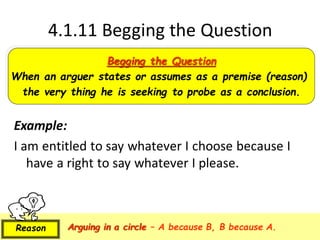
4.1.11 Begging the Question
Example:
I am entitled to say whatever I choose because I
have a right to say whatever I please.
Begging the Question
When an arguer states or assumes as a premise (reason)
the very thing he is seeking to probe as a conclusion.
Arguing in a circle – A because B, B because A.Reason
4.1 Mini Quiz – Question 1
I'm trying hard to understand this guy who identifies himself as a security
supervisor and criticizes the police officersin this area. I can only come up
with two solutions. One, he is either a member of the criminal element,
or two, he is a frustrated security guard who can never make it as a police
officer and figures he can take cheap shots at cops through the
newspaper (adapted from a newspaper call-in column).
Which fallacy?
A) Loaded Question
B) Personal Attack
C) Bandwagon Argument
D) Scare Tactics
4.1 Mini Quiz – Question 2
The Red Cross is worried about the treatment
of the suspected terrorists held by the U.S. at
GuantanamoBay, Cuba. What do they want the
U.S. to do with them, put them on the beaches
of Florida for a vacation or take them skiing in
the Rockies? Come on, let's worry about the
Americans. (adapted from a newspaper call-in
column)
Which fallacy?
A) Bandwagon Argument
B) Personal Attack
C) Straw Man
D) Scare Tactics
“The foolish and the dead alone
never change their opinion.”
- James Russell Lowell
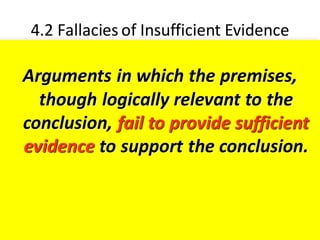
4.2 Fallacies of Insufficient Evidence
Arguments in which the premises,
though logically relevant to the
conclusion, fail to provide sufficient
evidence to support the conclusion.
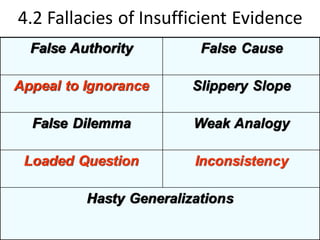
4.2 Fallacies of Insufficient Evidence
False Authority False Cause
Appeal to Ignorance Slippery Slope
False Dilemma Weak Analogy
Loaded Question Inconsistency
Hasty Generalizations
4.2.1 False Authority
Example:
My dentist told me that aliens built the lost city of
Atlantis. So, it’s reasonable to believethat aliens did
build the lost city of Atlantis.
False Authority
Citing a witness or authority that is untrustworthy.
Authority Assessment
1. Is the source an authority on the subject at issue?
2. Is the source biased?
3. Is the accuracy of the source observations questionable?
4. Is the source known to be generally unreliable?
5. Has the source been cited correctly?
6. Does the source’s claim conflict with expert opinion?
7. Can the source’s claim be settled by an appeal to expert opinion?
8. Is the claim highly improbable on its face?
Tips
4.2.2 Appeal to Ignorance
Example:
Yoda must exist. No one has proved that he doesn’t
exist.
Appeal to Ignorance
Claiming that something is true because no one has
proven it false or vice versa.
“Not proven, therefore false”
If such reasoning were allowed, we could prove almost
any conclusion.
Remember
Agree
I do!
4.2.3 False Dilemma
Example:
The choice in this MPP election is clear: Either we elect
Zaki as our next president, or we watch our MPP
unity slide into anarchy and frustration. Clearly, we
don’t want that to happen. Therefore, we should
elect Zaki as our next president.
False Dilemma
Posing a false either/or choice.
Fallacy of false dilemma can involve more than
two (2) alternatives. It can also be expressed as a
conditional (if-then) statement.
Remember
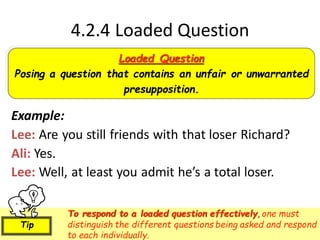
4.2.4 Loaded Question
Example:
Lee: Are you still friends with that loser Richard?
Ali: Yes.
Lee: Well, at least you admit he’s a total loser.
Loaded Question
Posing a question that contains an unfair or unwarranted
presupposition.
To respond to a loaded question effectively, one must
distinguish the different questions being asked and respond
to each individually.
Tip
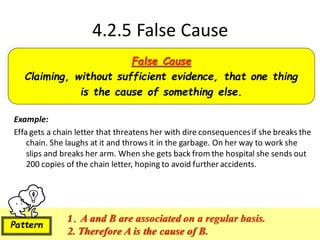
4.2.5 False Cause
Example:
Effa gets a chain letter that threatens her with dire consequencesif she breaks the
chain. She laughs at it and throws it in the garbage. On her way to work she
slips and breaks her arm. When she gets back from the hospital she sends out
200 copies of the chain letter, hoping to avoid further accidents.
False Cause
Claiming, without sufficient evidence, that one thing
is the cause of something else.
1. A and B are associated on a regular basis.
2. Therefore A is the cause of B.
Pattern
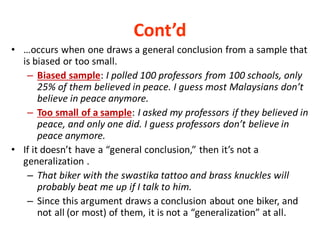
4.2.6 Hasty Generalization
Example:
Malays are lazy. I have two friends who are Malays,
and both of them never prepare for class, or do
their homework.
Hasty Generalization
Drawing a general conclusion from a sample that
is biased or too small.
1. A biased sample is one that is not representative of the target population.
2. The target population is the group of people or things that the
generalization is about.
3. Hasty generalizations can often lead to false stereotypes.
Pattern
Cont’d
• …occurs when one draws a general conclusion from a sample that
is biased or too small.
– Biased sample: I polled 100 professors from 100 schools, only
25% of them believed in peace. I guess most Malaysians don’t
believe in peace anymore.
– Too small of a sample: I asked my professors if they believed in
peace, and only one did. I guess professors don’t believe in
peace anymore.
• If it doesn’t have a “general conclusion,” then it’s not a
generalization .
– That biker with the swastika tattoo and brass knuckles will
probably beat me up if I talk to him.
– Since this argument draws a conclusion about one biker, and
not all (or most) of them, it is not a “generalization” at all.
4.2.7 Slippery Slope
Examples:
• “The Malaysian militarily shouldn't get involved in other countries. Once the
governmentsends in a few troops, it will then send in thousands to die."
Slippery Slope
Claiming, without sufficient evidence, that a seemingly
harmless action, if taken, will lead to a disastrous
outcome.
1. The arguer claims that if a certain seemingly harmless action, A,
is permitted, A will lead to B, B will lead to C, and so on to D.
2. The arguer holds that D is a terrible thing and therefore should
not be permitted.
3. In fact, there is no good reason to believe that A will actually
lead to D.
Pattern
4.2.8 Weak Analogy
Example:
Nobody would buy a car without first taking it for a
test drive. Why then shouldn’t two mature UiTM
students live together before they decide
whether or not to get married?
Weak Analogy
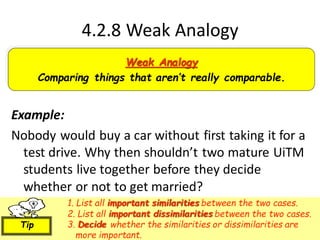
Comparing things that aren’t really comparable.
1. List all important similarities between the two cases.
2. List all important dissimilarities between the two cases.
3. Decide whether the similarities or dissimilarities are
more important.
Tip
Cont’d
• …occurs when an arguer compares two (or more) things that
aren’t really comparable in the relevant respect.
– e.g., Lettuce is leafy and green and good on burgers. Poison Ivy
leafy and green. It would be good on burgers too.
• Common forms:
– A has characteristics w, x, y and z. B has characteristics w, x and
y. Therefore, B probably has characteristic z too.
– A is x and y. B is x and y. C is x. So C is y.
• Many exceptions:
– Alice lives in a mansion and she is rich. Bruce lives in a mansion.
Bruce is probably rich too.
• The form is easy to spot, but—quite often—to know whether it is
fallacy or not, you just have to know whether the shared
characteristics are relevant to the concluded one.
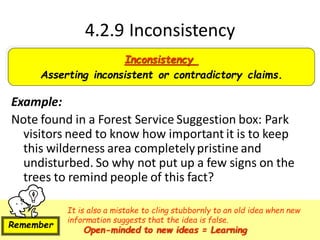
4.2.9 Inconsistency
Example:
Note found in a Forest Service Suggestion box: Park
visitors need to know how important it is to keep
this wilderness area completelypristine and
undisturbed. So why not put up a few signs on the
trees to remind people of this fact?
Inconsistency
Asserting inconsistent or contradictory claims.
It is also a mistake to cling stubbornly to an old idea when new
information suggests that the idea is false.
Open-minded to new ideas = Learning
Remember
4.2 Mini Quiz – Question 1
What's to say against [cigars]? They killed George
Burns at 100. If he hadn't smoked them, he'd
have died at 75. (Bert Sugar, quoted in New York
Times, September 20, 2002)
Which fallacy?
A) False Cause
B) Hasty Generalization
C) Slippery Slope
D) Weak Analogy
4.2 Mini Quiz – Question 2
According to North Korea's officialstate-runnews agency, "a war
between North Korea and the United States will end with the delightful
victory of North Korea, a newly emerging militarypower, in 100 hours. .
. . The U. S. [will] be enveloped in flames. . . and the arrogant empire of
the devil will breathe its last". Given that this predictioncomes from the
official North Korean news agency, it is probably true.
(Passage quoted in Nicholas D. Kristof, "Empire of the Devil," New York Times,
April 4, 2003)
Which fallacy?
A) False Authority
B) Appeal to Ignorance
C) False Alternatives
D) Loaded Question
4.2 Mini Quiz – Question 3
Jurors in tobaccolawsuitsshould award judgments so large that they
put tobaccocompanies out of business. Respecting the right of tobacco
companies to stay in business is akin to saying there are "two sides" to
slavery...
(Anti-tobaccolawyer,quoted in George F. Will, "Court Ruling Expresses
Anti-Smoking Hypocrisy," Wilkes-Barre Times Leader, May 25, 2003)
Which fallacy?
A) Loaded Question
B) Hasty Generalization
C) Slippery Slope
D) Weak Analogy
Group Activity
• Break into groups of 4 - 6, and construct five (5)
fallacious arguments.
• Each group can choose any of the 20 fallacies
discussed, but must construct at least two fallacious
argumentsof each category:Fallacies of Relevance &
Fallacies of InsufficientEvidence).
• The constructedfallacious arguments must discuss
the topics specified in the templateprovided
(Business, Education, Information Technology,
Environment, and Tourism).
20 min Construct 5 fallacious arguments.
5 min Document constructed arguments into the template provided.
15 min Group presentation & discussion.
The Group leader must submit their findings in hard-copy or soft-copy format to the
lecturer before or during the next class.
Summary – 20 Common Fallacies
Fallacy
An argument that contains a mistake in reasoning.
Fallacies of Relevance
Arguments in which the premises are
logically irrelevant to the conclusion.
Fallacies of Insufficient Evidence
Arguments in which the premises, though
logically relevant to the conclusion, fail to
provide sufficient evidence for the conclusion.
 Personal Attack (Ad Hominem)
 Attacking the Motive
 Look Who’s Talking
 Two Wrongs Make a Right
 Scare Tactics
 Appeal to Emotion
 Bandwagon Argument
 Straw Man
 Red Herring
 Equivocation
 Begging the Question
 False Authority
 Appeal to Ignorance
 False Dilemma
 Loaded Question
 False Cause
 Hasty Generalization
 Slippery Slope
 Weak Analogy
 Inconsistency
References
Book
• Chapter 5 (Logical Fallacies -1) & 6 (Logical
Fallacies -2): G Bassham, W Irwin, H Nardone, J M
Wallace, Critical Thinking: A Student's Introduction,
McGraw-HillInternational Edition, 2007
Online Resources
• Fallacies (The Nizkor Project):
http://www.nizkor.org/features/fallacies/
• Cool Optical Illusions:
http://www.coolopticalillusions.com/

Fallacies

  • 1.
  • 2.
    Man or Woman? Source:http://www.coolopticalillusions.com/manwoman.htm
  • 3.
    How many legsdoes this elephant have? Source: http://www.coolopticalillusions.com/elephantlegs.htm
  • 4.
    Which officer isthe tallest? Source: http://www.coolopticalillusions.com/optical_illusions_images_2/giant_man.htm
  • 5.
    Is this wavemoving? Source: http://www.grand-illusions.com/opticalillusions/oblong_wave/
  • 6.
    AirAsia + Girls =Fun Analyze + Evaluate = Your Opinion? Target Audience?
  • 7.
    Fallacies 1. Fallacies of Relevance 2.Fallacies of Insufficient Evidence What mistake!!!
  • 8.
    4.0 What isa Fallacy? • A (logical) fallacy is an argument that containsa mistake in reasoning. • Fallacies can be divided into two general types: – Fallaciesof Relevance Arguments in which the premises are logically irrelevant to the conclusion. – Fallaciesof Insufficient Evidence Arguments in which the premises, though logically relevant to the conclusion, fail to provide sufficient evidence for the conclusion.
  • 9.
    “There is nothingso stupid as an educated man, if you get him off the thing he was educated in” - Will Rogers
  • 10.
    4.1 Fallacies ofRelevance • A statement is RELEVANT to another statement if it provides at least some reason for thinking that the second statement is true or false. • There are three ways in which a statement can be relevant or irrelevant to another: – A statement is positivelyrelevant to another statement if it providesat least some reason for thinking that the second statement is true. – A statement is negativelyrelevant to another statement if it providesat least some reason for thinking that the second statement is false. – A statement is logicallyirrelevant to another statement if it provides no reason for thinking that the second statement is either true or false.
  • 11.
    4.1 Fallacies ofRelevance Personal Attack ( Ad Hominem) Appeal to Emotion (Ad Populum) Attacking the Motive Bandwagon Argument Look Who’s Talking Straw Man Begging the Question Red Herring Scare Tactics Equivocation Two Wrongs Make a Right
  • 12.
    4.1.1 Personal Attack(Ad Hominem) Example: Professor Doogie has argued for more emphasis on music in our F2F classes to facilitate creativity. But Doogie is a selfish bigheaded fool. I absolutely refuse to listen to him. Personal Attack When an arguer rejects a person’s argument or claim by attacking the person’s character rather than examining the worth of the argument or claim itself. 1. X is a bad person. 2. Therefore X's argument must be bad. Pattern
  • 13.
    4.1.2 Attacking theMotive Example: Donald Trump has argued that we need to build a new campus. But Trump is the owner of Trump’s Construction Company. He’ll make a fortuneif his company is picked to build the new campus. Obviously,Trump’s argument is a lot of self- serving nonsense. Attacking the Motive When an arguer criticizes a person’s motivation for offering a particular argument or claim, rather than examining the worth of the argument or claim itself. 1. X has biased or has questionable motives. 2. Therefore, X’s arguments or claim should be rejected. Pattern
  • 14.
    4.1.3 Look Who’sTalking Example: Doctor: You should quite smoking. Patient: Look who’s talking! I’ll quit when you do, Dr. Smokestack! Look Who’s Talking (tu quoque) When an arguer rejects another person’s argument or claim because that person is a hypocrite. 1. X fails to follow his or her own advice. 2. Therefore, X’s claim or argument should be rejected. Pattern
  • 15.
    4.1.4 Two WrongsMake a Right Examples: 1. “I don’t feel guilty about cheating on Zaid’s online quiz. Half the class cheats on his quiz.” 2. “Why pick on me, officer? Everyone else is using drugs.” Two Wrongs Make a Right When an arguer attempts to justify a wrongful act by claiming that some other act is just as bad or worse. 1. Others are committing worse or equally bad acts. 2. Therefore my wrongful act is justified.Pattern
  • 16.
    4.1.5 Scare Tactics Example: Diplomatto diplomat: I’m sure you’ll agreethat we are the rightful rulers of the Iraq. It would be regrettableif we had to send armed forces to demonstrate the validity of our claim. Scare Tactics When an arguer threatens harm to a reader or listener and this threat is irrelevant to the truth of the arguer’s conclusion. Fear is a powerful motivator – so powerful that it often causes us to think and behave irrationally. Remember
  • 17.
    4.1.6 Appeal toEmotion (Ad Populum) Example: Student to Lecturer: I know I missed half your classes and failed all my quizzes and assignments. First my cat died. Then my girlfriend told me she has found someone else. With all I went through this semester, I don’t think I really deserve an F. Any chance you might cut me some slack and change my grade to a C or a D? Appeal to Pity When an arguer attempts to evoke feelings of pity or compassion, where such feelings, however understandable, are not relevant to the truth of the arguer’s conclusion. 1. P is presented, with the intent to create pity. 2. Therefore claim C is true. Pattern
  • 18.
    4.1.7 Bandwagon Argument Example: Allthe really cool Taylors students smoke cigarettes. Therefore, you should, too. Bandwagon Argument (Peer Pressure) When an arguer appeals to a person’s desire to be popular, accepted, or valued, rather than to logically relevant reasons or evidence. 1. Most (or a select group of) people believe or do X. 2. Therefore, you should believe or do X. Pattern
  • 19.
    4.1.8 Straw Man Example: Singhand Karen are arguing about cleaning out their closets:  Suzie: "We should clean out the closets. They are getting a bit messy.“  Singh: "Why, we just went through those closets last year. Do we have to clean them out everyday?"  Suzie: "I never said anything about cleaning them out every day. You just want too keep all your junk forever,which is just ridiculous." Straw Man When an arguer misrepresents another person’s position to make it easier to attack. 1. Person A has position X. 2. Person B presents position Y (which is a distorted version of X). 3. Person B attacks position Y. 4. Therefore X is false/incorrect/flawed. Pattern
  • 20.
    4.1.9 Red Herring Example: "Ithink there is great merit in making the requirementsstricter for the graduate students. I recommend that you supportit, too. After all, we are in a budget crisis and we do not want our salaries affected." Red Herring When an arguer tries to sidetrack his audience by raising an irrelevant issue, and then claims that the original issue has been effectively settled by the irrelevant diversion. 1. Topic A is under discussion. 2. Topic B is introduced under the guise of being relevant to topic A (when topic B is actually not relevant to topic A). 3. Topic A is abandoned. Pattern
  • 21.
    4.1.10 Equivocation Example: In thesummer of 1940, Londoners were bombed almost very night. To be bombed is to be intoxicated. Therefore, in the summer of 1940, Londoners were intoxicated almost every night. Equivocation When an arguer uses a key word in an argument in two (or more) different senses. Fallacies of Equivocation can be difficult to spot because they often appear valid, but they aren’t. Remember
  • 22.
    4.1.11 Begging theQuestion Example: I am entitled to say whatever I choose because I have a right to say whatever I please. Begging the Question When an arguer states or assumes as a premise (reason) the very thing he is seeking to probe as a conclusion. Arguing in a circle – A because B, B because A.Reason
  • 23.
    4.1 Mini Quiz– Question 1 I'm trying hard to understand this guy who identifies himself as a security supervisor and criticizes the police officersin this area. I can only come up with two solutions. One, he is either a member of the criminal element, or two, he is a frustrated security guard who can never make it as a police officer and figures he can take cheap shots at cops through the newspaper (adapted from a newspaper call-in column). Which fallacy? A) Loaded Question B) Personal Attack C) Bandwagon Argument D) Scare Tactics
  • 24.
    4.1 Mini Quiz– Question 2 The Red Cross is worried about the treatment of the suspected terrorists held by the U.S. at GuantanamoBay, Cuba. What do they want the U.S. to do with them, put them on the beaches of Florida for a vacation or take them skiing in the Rockies? Come on, let's worry about the Americans. (adapted from a newspaper call-in column) Which fallacy? A) Bandwagon Argument B) Personal Attack C) Straw Man D) Scare Tactics
  • 25.
    “The foolish andthe dead alone never change their opinion.” - James Russell Lowell
  • 26.
    4.2 Fallacies ofInsufficient Evidence Arguments in which the premises, though logically relevant to the conclusion, fail to provide sufficient evidence to support the conclusion.
  • 27.
    4.2 Fallacies ofInsufficient Evidence False Authority False Cause Appeal to Ignorance Slippery Slope False Dilemma Weak Analogy Loaded Question Inconsistency Hasty Generalizations
  • 28.
    4.2.1 False Authority Example: Mydentist told me that aliens built the lost city of Atlantis. So, it’s reasonable to believethat aliens did build the lost city of Atlantis. False Authority Citing a witness or authority that is untrustworthy. Authority Assessment 1. Is the source an authority on the subject at issue? 2. Is the source biased? 3. Is the accuracy of the source observations questionable? 4. Is the source known to be generally unreliable? 5. Has the source been cited correctly? 6. Does the source’s claim conflict with expert opinion? 7. Can the source’s claim be settled by an appeal to expert opinion? 8. Is the claim highly improbable on its face? Tips
  • 29.
    4.2.2 Appeal toIgnorance Example: Yoda must exist. No one has proved that he doesn’t exist. Appeal to Ignorance Claiming that something is true because no one has proven it false or vice versa. “Not proven, therefore false” If such reasoning were allowed, we could prove almost any conclusion. Remember Agree I do!
  • 30.
    4.2.3 False Dilemma Example: Thechoice in this MPP election is clear: Either we elect Zaki as our next president, or we watch our MPP unity slide into anarchy and frustration. Clearly, we don’t want that to happen. Therefore, we should elect Zaki as our next president. False Dilemma Posing a false either/or choice. Fallacy of false dilemma can involve more than two (2) alternatives. It can also be expressed as a conditional (if-then) statement. Remember
  • 31.
    4.2.4 Loaded Question Example: Lee:Are you still friends with that loser Richard? Ali: Yes. Lee: Well, at least you admit he’s a total loser. Loaded Question Posing a question that contains an unfair or unwarranted presupposition. To respond to a loaded question effectively, one must distinguish the different questions being asked and respond to each individually. Tip
  • 32.
    4.2.5 False Cause Example: Effagets a chain letter that threatens her with dire consequencesif she breaks the chain. She laughs at it and throws it in the garbage. On her way to work she slips and breaks her arm. When she gets back from the hospital she sends out 200 copies of the chain letter, hoping to avoid further accidents. False Cause Claiming, without sufficient evidence, that one thing is the cause of something else. 1. A and B are associated on a regular basis. 2. Therefore A is the cause of B. Pattern
  • 33.
    4.2.6 Hasty Generalization Example: Malaysare lazy. I have two friends who are Malays, and both of them never prepare for class, or do their homework. Hasty Generalization Drawing a general conclusion from a sample that is biased or too small. 1. A biased sample is one that is not representative of the target population. 2. The target population is the group of people or things that the generalization is about. 3. Hasty generalizations can often lead to false stereotypes. Pattern
  • 34.
    Cont’d • …occurs whenone draws a general conclusion from a sample that is biased or too small. – Biased sample: I polled 100 professors from 100 schools, only 25% of them believed in peace. I guess most Malaysians don’t believe in peace anymore. – Too small of a sample: I asked my professors if they believed in peace, and only one did. I guess professors don’t believe in peace anymore. • If it doesn’t have a “general conclusion,” then it’s not a generalization . – That biker with the swastika tattoo and brass knuckles will probably beat me up if I talk to him. – Since this argument draws a conclusion about one biker, and not all (or most) of them, it is not a “generalization” at all.
  • 35.
    4.2.7 Slippery Slope Examples: •“The Malaysian militarily shouldn't get involved in other countries. Once the governmentsends in a few troops, it will then send in thousands to die." Slippery Slope Claiming, without sufficient evidence, that a seemingly harmless action, if taken, will lead to a disastrous outcome. 1. The arguer claims that if a certain seemingly harmless action, A, is permitted, A will lead to B, B will lead to C, and so on to D. 2. The arguer holds that D is a terrible thing and therefore should not be permitted. 3. In fact, there is no good reason to believe that A will actually lead to D. Pattern
  • 36.
    4.2.8 Weak Analogy Example: Nobodywould buy a car without first taking it for a test drive. Why then shouldn’t two mature UiTM students live together before they decide whether or not to get married? Weak Analogy Comparing things that aren’t really comparable. 1. List all important similarities between the two cases. 2. List all important dissimilarities between the two cases. 3. Decide whether the similarities or dissimilarities are more important. Tip
  • 37.
    Cont’d • …occurs whenan arguer compares two (or more) things that aren’t really comparable in the relevant respect. – e.g., Lettuce is leafy and green and good on burgers. Poison Ivy leafy and green. It would be good on burgers too. • Common forms: – A has characteristics w, x, y and z. B has characteristics w, x and y. Therefore, B probably has characteristic z too. – A is x and y. B is x and y. C is x. So C is y. • Many exceptions: – Alice lives in a mansion and she is rich. Bruce lives in a mansion. Bruce is probably rich too. • The form is easy to spot, but—quite often—to know whether it is fallacy or not, you just have to know whether the shared characteristics are relevant to the concluded one.
  • 38.
    4.2.9 Inconsistency Example: Note foundin a Forest Service Suggestion box: Park visitors need to know how important it is to keep this wilderness area completelypristine and undisturbed. So why not put up a few signs on the trees to remind people of this fact? Inconsistency Asserting inconsistent or contradictory claims. It is also a mistake to cling stubbornly to an old idea when new information suggests that the idea is false. Open-minded to new ideas = Learning Remember
  • 39.
    4.2 Mini Quiz– Question 1 What's to say against [cigars]? They killed George Burns at 100. If he hadn't smoked them, he'd have died at 75. (Bert Sugar, quoted in New York Times, September 20, 2002) Which fallacy? A) False Cause B) Hasty Generalization C) Slippery Slope D) Weak Analogy
  • 40.
    4.2 Mini Quiz– Question 2 According to North Korea's officialstate-runnews agency, "a war between North Korea and the United States will end with the delightful victory of North Korea, a newly emerging militarypower, in 100 hours. . . . The U. S. [will] be enveloped in flames. . . and the arrogant empire of the devil will breathe its last". Given that this predictioncomes from the official North Korean news agency, it is probably true. (Passage quoted in Nicholas D. Kristof, "Empire of the Devil," New York Times, April 4, 2003) Which fallacy? A) False Authority B) Appeal to Ignorance C) False Alternatives D) Loaded Question
  • 41.
    4.2 Mini Quiz– Question 3 Jurors in tobaccolawsuitsshould award judgments so large that they put tobaccocompanies out of business. Respecting the right of tobacco companies to stay in business is akin to saying there are "two sides" to slavery... (Anti-tobaccolawyer,quoted in George F. Will, "Court Ruling Expresses Anti-Smoking Hypocrisy," Wilkes-Barre Times Leader, May 25, 2003) Which fallacy? A) Loaded Question B) Hasty Generalization C) Slippery Slope D) Weak Analogy
  • 42.
    Group Activity • Breakinto groups of 4 - 6, and construct five (5) fallacious arguments. • Each group can choose any of the 20 fallacies discussed, but must construct at least two fallacious argumentsof each category:Fallacies of Relevance & Fallacies of InsufficientEvidence). • The constructedfallacious arguments must discuss the topics specified in the templateprovided (Business, Education, Information Technology, Environment, and Tourism). 20 min Construct 5 fallacious arguments. 5 min Document constructed arguments into the template provided. 15 min Group presentation & discussion. The Group leader must submit their findings in hard-copy or soft-copy format to the lecturer before or during the next class.
  • 43.
    Summary – 20Common Fallacies Fallacy An argument that contains a mistake in reasoning. Fallacies of Relevance Arguments in which the premises are logically irrelevant to the conclusion. Fallacies of Insufficient Evidence Arguments in which the premises, though logically relevant to the conclusion, fail to provide sufficient evidence for the conclusion.  Personal Attack (Ad Hominem)  Attacking the Motive  Look Who’s Talking  Two Wrongs Make a Right  Scare Tactics  Appeal to Emotion  Bandwagon Argument  Straw Man  Red Herring  Equivocation  Begging the Question  False Authority  Appeal to Ignorance  False Dilemma  Loaded Question  False Cause  Hasty Generalization  Slippery Slope  Weak Analogy  Inconsistency
  • 44.
    References Book • Chapter 5(Logical Fallacies -1) & 6 (Logical Fallacies -2): G Bassham, W Irwin, H Nardone, J M Wallace, Critical Thinking: A Student's Introduction, McGraw-HillInternational Edition, 2007 Online Resources • Fallacies (The Nizkor Project): http://www.nizkor.org/features/fallacies/ • Cool Optical Illusions: http://www.coolopticalillusions.com/