Lareb hussain langah
Roll no# 42
BBA-II
Section A
3rd semester
Business administration dept.
Shah Abdul Latif university Khairpur
9/29/2015 1
In the name of Allah whose most merciful and beneficent
WHAT IS FALLACY?
• Fallacies are defects that weaken arguments.
• First, fallacious arguments are very, very common and can be quite persuasive,
at least to the causal reader or listener. You can find dozens of examples of
fallacious reasoning in newspapers, advertisements, and other sources.
• Second, it is sometimes hard to evaluate whether an argument is fallacious.
• An argument might be very weak, somewhat weak, somewhat strong, or very
strong. An argument that has several stages or parts might have some strong
sections and some weak ones.
9/29/2015 2
OVERGENERALIZATION
• Overgeneralization is a conclusion about all or many instances
of a phenomenon that has been reached on the basis of just
one or just a few instances of that phenomenon. It is an
example of jumping to conclusions
• For example, we may generalize about all people, or all
members of a group, based on what we know about just one or
just a few people
9/29/2015 3
FALSE CAUSE
• Definition: Assuming that because B comes after A,
A caused B.
– Of course, sometimes one event really does
cause another one that comes later--for example,
if I register for a class, and my name later
appears on the roll, it's true that the first event
caused the one that came later. But sometimes
two events that seem related in time aren't really
related as cause and event. That is, correlation
isn't the same thing as causation.
9/29/2015 4
CONTINUE…
• Examples: "President Jones raised taxes, and then
the rate of violent crime went up. Jones is
responsible for the rise in crime.“
– The increase in taxes might or might not be one
factor in the rising crime rates, but the argument
hasn't shown us that one caused the other.
9/29/2015 5
WEAK ANALOGY
• Definition: Many arguments rely on an analogy
between two or more objects, ideas, or
situations. If the two things that are being
compared aren't really alike in the relevant
respects, the analogy is a weak one, and the
argument that relies on it commits the fallacy
weak analogy.
• Example: "Guns are like hammers--they're
both tools with metal parts that could be used
to kill someone. And yet it would be ridiculous
to restrict the purchase of hammers--so
restrictions on purchasing guns are equally
ridiculous."
9/29/2015 6
CONTINUE…
• While guns and hammers do share certain features,
these features (having metal parts, being tools, and
being potentially useful for violence) are not the
ones at stake in deciding whether to restrict guns.
Rather, we restrict guns because they can easily be
used to kill large numbers of people at a distance.
This is a feature hammers do not share--it'd be hard
to kill a crowd with a hammer. Thus, the analogy is
weak, and so is the argument based on it.
9/29/2015 7
CIRCULAR REASONING
• Circular reasoning is a logical fallacy
in which the reasoner begins with
what they are trying to end with. The
components of a circular argument
are often logically valid because if
the premises are true, the conclusion
must be true
9/29/2015 8
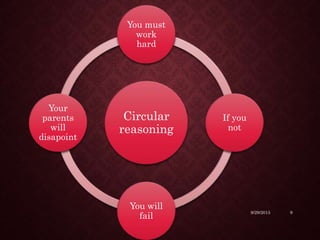
Circular
reasoning
You must
work
hard
If you
not
You will
fail
Your
parents
will
disapoint
9/29/2015 9
FALSE DILEMMA
• A false dilemma asserts that a complex situation can
have only two possible outcomes and that one of the
options is necessary or preferable.
Either go to college or forget about making money.
• The arguer claims that there are only two options and
one is unacceptable so we must accept the other.
However in actuality there are other alternatives.
• Either we ban negative ads or we let them run amok
on our television stations.
• “Either the Saudis control the US government, or they
don’t” –
9/29/2015 10
APPEAL TO AUTHORITY
• Definition: Often we add strength to our
arguments by referring to respected
sources or authorities and explaining
their positions on the issues we're
discussing.
• Example; faiza beauty cream is the best
for the sanam Baloch. It is the best for
all girls.
9/29/2015 11
APPEAL TO PITY
• Definition: The appeal to pity takes place
when an arguer tries to get people to accept a
conclusion by making them feel sorry for
someone.
• Example: "I know the exam is graded based on
performance, but you should give me an A. My
cat has been sick, my car broke down, and I've
had a cold, so it was really hard for me to
study!" 9/29/2015 12
BEGGING THE QUESTION
9/29/2015 13
• Definition: A complicated fallacy, an
argument that begs the question asks
the reader to simply accept the
conclusion without providing real
evidence.
• Example; “Ali can be the descent person
that's why he does not punish.”
• 1st statement is questionable but 1st
give a support to 2nd statement.
APPEAL TO IGNORANCE
• Definition: In the appeal to ignorance, the
arguer basically says, "Look, there's no
conclusive evidence on the issue at hand.
Therefore, you should accept my conclusion on
this issue."
• Example; "People have been trying for years to
prove that God does not exist. But no one has
yet been able to prove it. Therefore, God exists."
9/29/2015 14
AD HOMINEM/PERSONAL ATTACK
• Ad Hominem/Personal Attack:
• Making a personal attack on the
individual instead of arguing for
themselves.
9/29/2015 15
NON SEQUITUR/IT DOES NOT FOLLOW
• Non sequitur/It does not follow:
• A statement that does not follow logically or is
not clearly related to anything previously said.
• Example;
• “Tens of thousands of Americans have seen
lights in the night sky which they could not
identify. The existence of life on other planets is
fast becoming certainty!"
9/29/2015 16
9/29/2015 17

Fallacy and types

  • 1.
    Lareb hussain langah Rollno# 42 BBA-II Section A 3rd semester Business administration dept. Shah Abdul Latif university Khairpur 9/29/2015 1 In the name of Allah whose most merciful and beneficent
  • 2.
    WHAT IS FALLACY? •Fallacies are defects that weaken arguments. • First, fallacious arguments are very, very common and can be quite persuasive, at least to the causal reader or listener. You can find dozens of examples of fallacious reasoning in newspapers, advertisements, and other sources. • Second, it is sometimes hard to evaluate whether an argument is fallacious. • An argument might be very weak, somewhat weak, somewhat strong, or very strong. An argument that has several stages or parts might have some strong sections and some weak ones. 9/29/2015 2
  • 3.
    OVERGENERALIZATION • Overgeneralization isa conclusion about all or many instances of a phenomenon that has been reached on the basis of just one or just a few instances of that phenomenon. It is an example of jumping to conclusions • For example, we may generalize about all people, or all members of a group, based on what we know about just one or just a few people 9/29/2015 3
  • 4.
    FALSE CAUSE • Definition:Assuming that because B comes after A, A caused B. – Of course, sometimes one event really does cause another one that comes later--for example, if I register for a class, and my name later appears on the roll, it's true that the first event caused the one that came later. But sometimes two events that seem related in time aren't really related as cause and event. That is, correlation isn't the same thing as causation. 9/29/2015 4
  • 5.
    CONTINUE… • Examples: "PresidentJones raised taxes, and then the rate of violent crime went up. Jones is responsible for the rise in crime.“ – The increase in taxes might or might not be one factor in the rising crime rates, but the argument hasn't shown us that one caused the other. 9/29/2015 5
  • 6.
    WEAK ANALOGY • Definition:Many arguments rely on an analogy between two or more objects, ideas, or situations. If the two things that are being compared aren't really alike in the relevant respects, the analogy is a weak one, and the argument that relies on it commits the fallacy weak analogy. • Example: "Guns are like hammers--they're both tools with metal parts that could be used to kill someone. And yet it would be ridiculous to restrict the purchase of hammers--so restrictions on purchasing guns are equally ridiculous." 9/29/2015 6
  • 7.
    CONTINUE… • While gunsand hammers do share certain features, these features (having metal parts, being tools, and being potentially useful for violence) are not the ones at stake in deciding whether to restrict guns. Rather, we restrict guns because they can easily be used to kill large numbers of people at a distance. This is a feature hammers do not share--it'd be hard to kill a crowd with a hammer. Thus, the analogy is weak, and so is the argument based on it. 9/29/2015 7
  • 8.
    CIRCULAR REASONING • Circularreasoning is a logical fallacy in which the reasoner begins with what they are trying to end with. The components of a circular argument are often logically valid because if the premises are true, the conclusion must be true 9/29/2015 8
  • 9.
    Circular reasoning You must work hard If you not Youwill fail Your parents will disapoint 9/29/2015 9
  • 10.
    FALSE DILEMMA • Afalse dilemma asserts that a complex situation can have only two possible outcomes and that one of the options is necessary or preferable. Either go to college or forget about making money. • The arguer claims that there are only two options and one is unacceptable so we must accept the other. However in actuality there are other alternatives. • Either we ban negative ads or we let them run amok on our television stations. • “Either the Saudis control the US government, or they don’t” – 9/29/2015 10
  • 11.
    APPEAL TO AUTHORITY •Definition: Often we add strength to our arguments by referring to respected sources or authorities and explaining their positions on the issues we're discussing. • Example; faiza beauty cream is the best for the sanam Baloch. It is the best for all girls. 9/29/2015 11
  • 12.
    APPEAL TO PITY •Definition: The appeal to pity takes place when an arguer tries to get people to accept a conclusion by making them feel sorry for someone. • Example: "I know the exam is graded based on performance, but you should give me an A. My cat has been sick, my car broke down, and I've had a cold, so it was really hard for me to study!" 9/29/2015 12
  • 13.
    BEGGING THE QUESTION 9/29/201513 • Definition: A complicated fallacy, an argument that begs the question asks the reader to simply accept the conclusion without providing real evidence. • Example; “Ali can be the descent person that's why he does not punish.” • 1st statement is questionable but 1st give a support to 2nd statement.
  • 14.
    APPEAL TO IGNORANCE •Definition: In the appeal to ignorance, the arguer basically says, "Look, there's no conclusive evidence on the issue at hand. Therefore, you should accept my conclusion on this issue." • Example; "People have been trying for years to prove that God does not exist. But no one has yet been able to prove it. Therefore, God exists." 9/29/2015 14
  • 15.
    AD HOMINEM/PERSONAL ATTACK •Ad Hominem/Personal Attack: • Making a personal attack on the individual instead of arguing for themselves. 9/29/2015 15
  • 16.
    NON SEQUITUR/IT DOESNOT FOLLOW • Non sequitur/It does not follow: • A statement that does not follow logically or is not clearly related to anything previously said. • Example; • “Tens of thousands of Americans have seen lights in the night sky which they could not identify. The existence of life on other planets is fast becoming certainty!" 9/29/2015 16
  • 17.