Asia Government
Distribution of Power
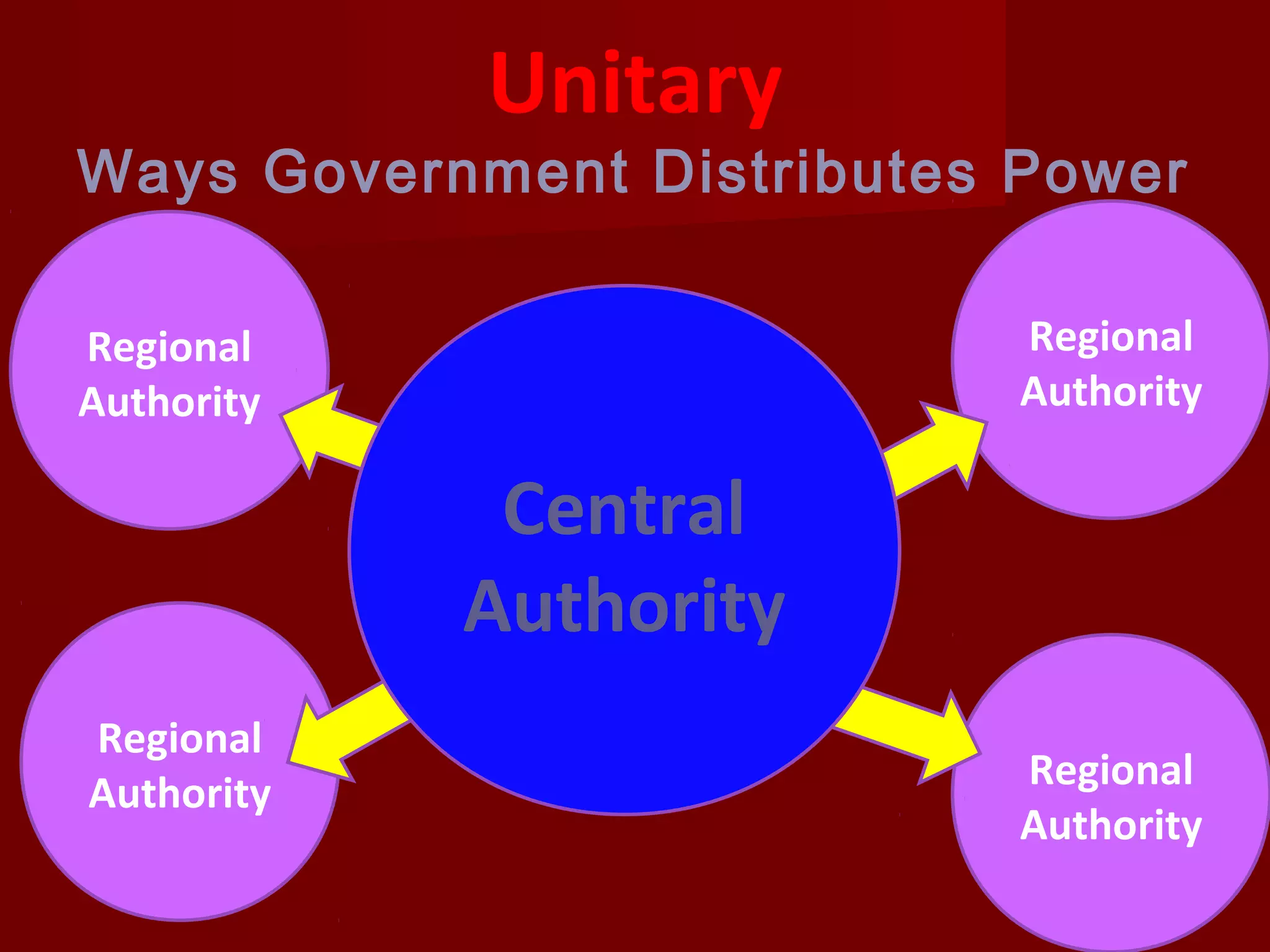
Unitary
a form of government in which
 power is held by one central
 authority
Unitary
Ways Government Distributes Power

Regional                    Regional
Authority                   Authority

             Central
            Authority
Regional
                            Regional
Authority
                            Authority
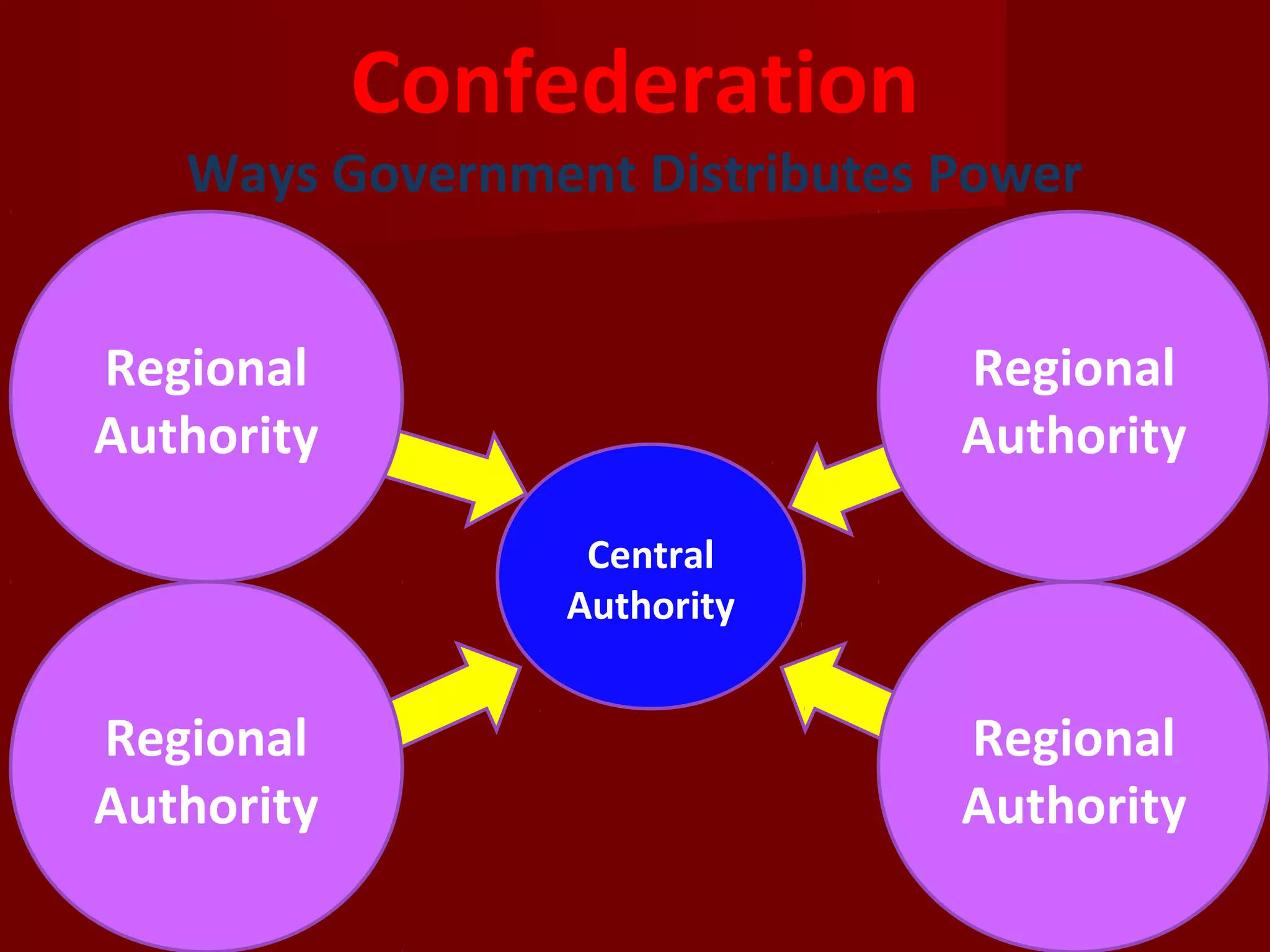
Confederation
voluntary associations of
 independent states that, to secure
 some common purpose, agree to
 certain limitations on their power
Confederation
   Ways Government Distributes Power


Regional                       Regional
Authority                      Authority

                 Central
                Authority


Regional                       Regional
Authority                      Authority
Federal
a form of government in which power is
  divided between one central and several
  regional authorities
Federation / Federal
     Ways Government Distributes Power

Regional                           Regional
Authority                          Authority

                   Central
                  Authority


Regional                           Regional
Authority                          Authority
Citizen Participation
Autocratic

government in which one person possesses
  unlimited power and the citizen has little if
  any role in the government.
Oligarchic

government by the few, sometimes a
  government in which a small group
  exercises control especially for corrupt
  and selfish purposes. The citizen has a
  very limited role.
Democratic

a government in which the supreme power
  is vested in the people and exercised by
  them directly or indirectly through a
  system of representation usually involving
  periodically held free elections.
How Governments Determine
   Citizen Participation
    High Participation                                                                                        High Participation
                     Citizen Participation


                                                                                                                                      Citizen Participation
                                             Government Power
  Government Power


                                                                                                                   Government Power
                                                                                      General Citizens’
                                                                   Select Citizens’


                                                                                      Participation
                                                                   Participation


Low or No Participation                      Low or No Participation                                      Low or No Participation


Autocratic                                                      Oligarchic                                   Democracy
Democratic Governments
Parliamentary

a system of government having the real
  executive power vested in a cabinet
  composed of members of the legislature
  who are individually and collectively
  responsible to the legislature. May have a
  Prime Minister elected by the legislature.
Presidential

a system of government in which the
  president is constitutionally independent of
  the legislature
In Japan, the prefectures (Japan’s word for
  states or provinces) do not have any
  independent authority. Instead, they carry
  out the laws and policies of the national
  government. This is an example of what
  system of government?
A. Unitary
B. Confederation
C. Federal
D. parliamentary
In Japan, the prefectures (Japan’s word for
  states or provinces) do not have any
  independent authority. Instead, they carry
  out the laws and policies of the national
  government. This is an example of what
  system of government?
A. Unitary*
B. Confederation
C. Federal
D. parliamentary
How does a democratic government
 differ from an oligarchic government?

A. Role of the citizen
B. Law making process
C. Judicial system
D. Role of individual states
How does a democratic government
 differ from an oligarchic government?

A. Role of the citizen*
B. Law making process
C. Judicial system
D. Role of individual states
In a parliamentary government, unlike the
  presidential system, the head of
  government belongs to which branch?

A. Judicial
B. National
C. Executive
D. Legislative
In a parliamentary government, unlike the
  presidential system, the head of
  government belongs to which branch?

A. Judicial
B. National
C. Executive
D. Legislative*
Asia Government
Federal Republic of India

   Although India is a republic, individual states are
    more tightly controlled by the central government
    than states in the United States. India has a
    President and a Prime Minister. The President is
    the head of state while the Prime Minister is the
    head of government. The President is elected by
    an electoral college to 5-year term. The Vice-
    President is elected by both houses of
    Parliament. The Prime Minister is generally the
    head of the party that enjoys a majority in the
    legislative branch. All citizens 18 and over may
    vote for their legislators.
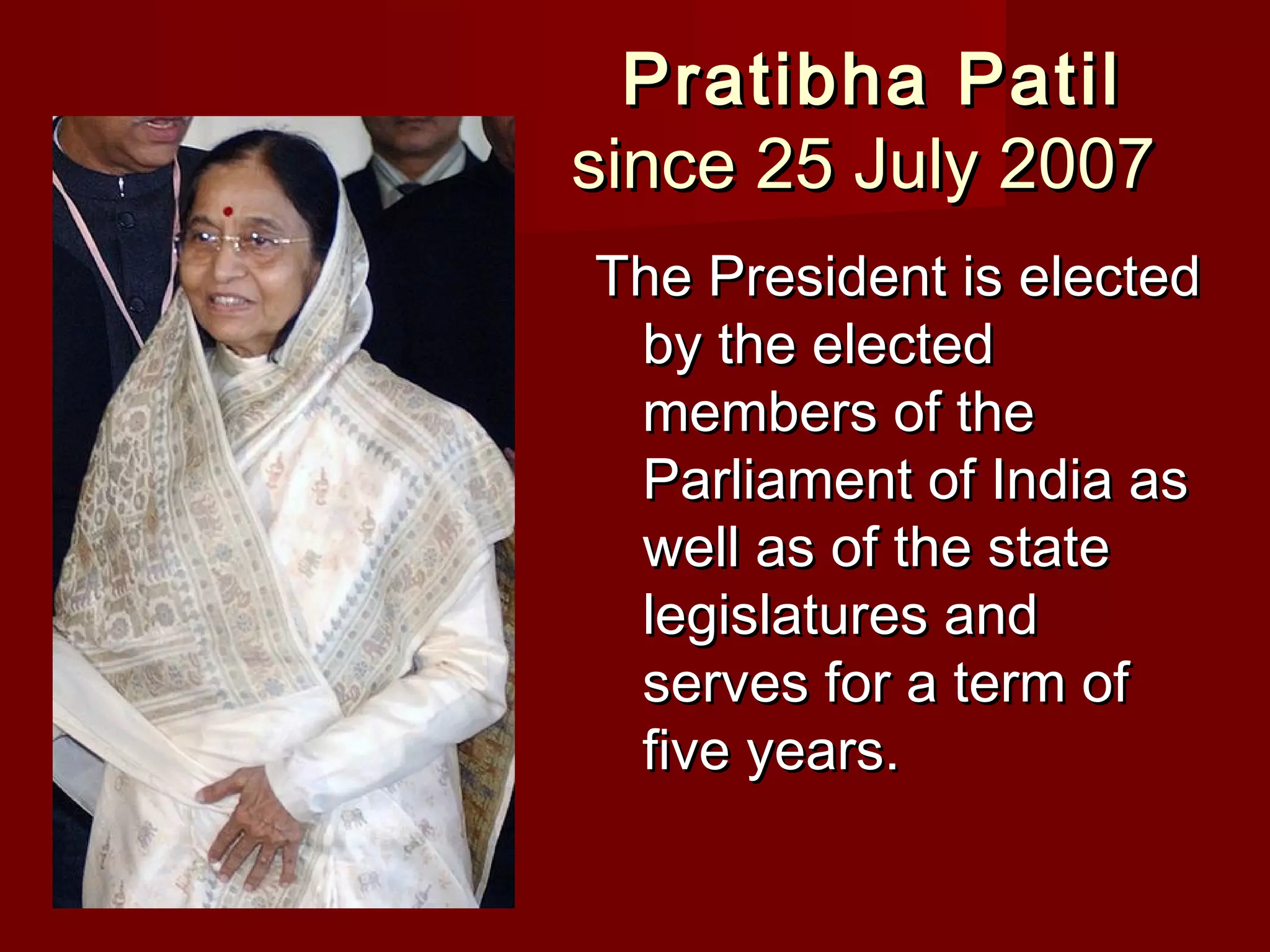
Pratibha Patil
since 25 July 2007
The President is elected
 by the elected
 members of the
 Parliament of India as
 well as of the state
 legislatures and
 serves for a term of
 five years.
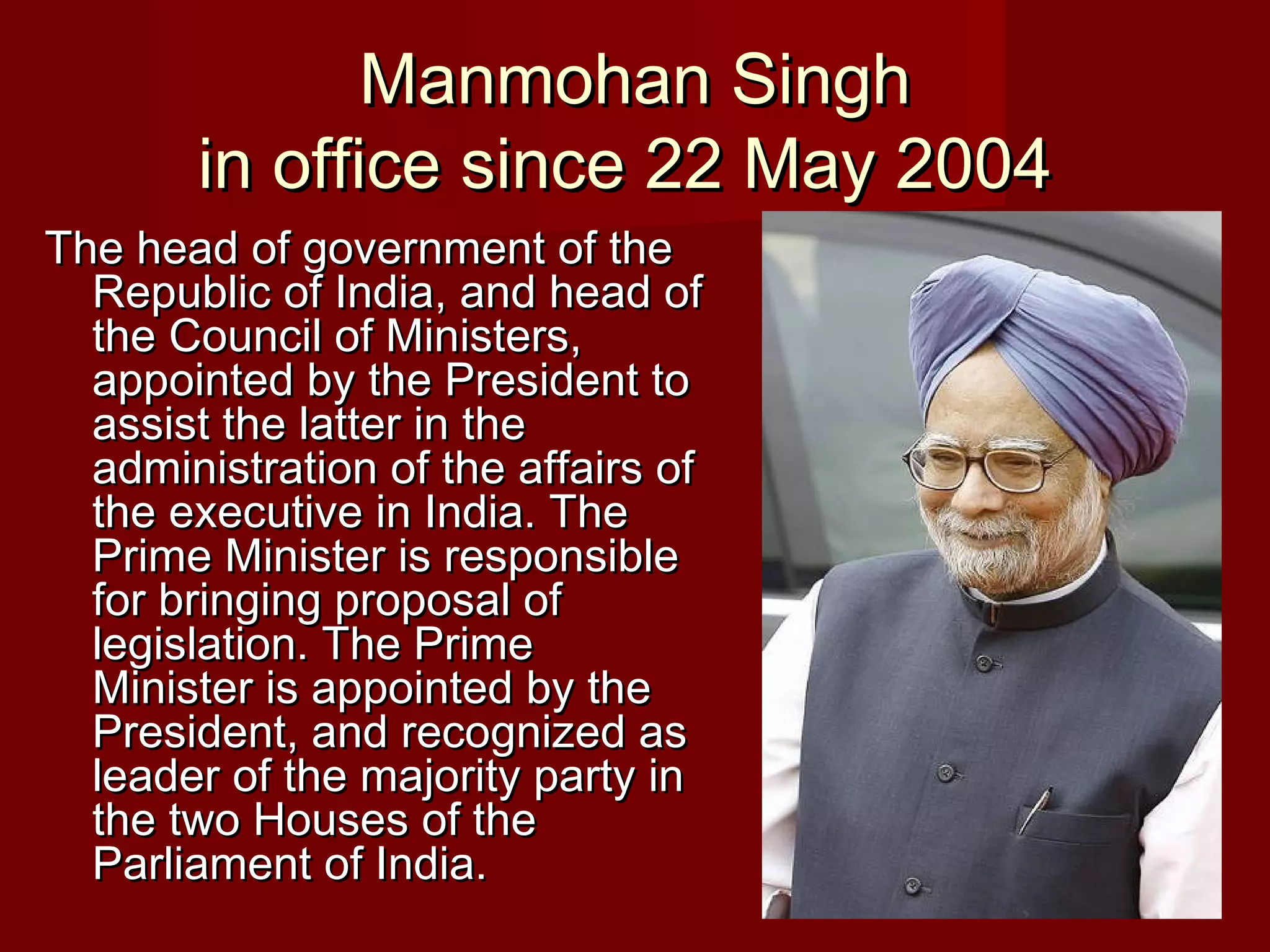
Manmohan Singh
       in office since 22 May 2004
The head of government of the
  Republic of India, and head of
  the Council of Ministers,
  appointed by the President to
  assist the latter in the
  administration of the affairs of
  the executive in India. The
  Prime Minister is responsible
  for bringing proposal of
  legislation. The Prime
  Minister is appointed by the
  President, and recognized as
  leader of the majority party in
  the two Houses of the
  Parliament of India.
The People’s Republic of
                   China
 Although China is called a republic, true power
  lies with the ruling Communist Party. China has
  a President and a Premier. The President is the
  head of state while the Premier is the head of
  government. The President and Vice-President
  are elected by the National People’s Congress.
  The Prime Minister is the head of the ruling
  party, the Chinese Communist Party. While
  there are elections for the National People’s
  Congress, there is truly only one political party,
  the Chinese Communist Party. The State
  Council, which functions as a cabinet, is
  appointed by the National People’s Congress.
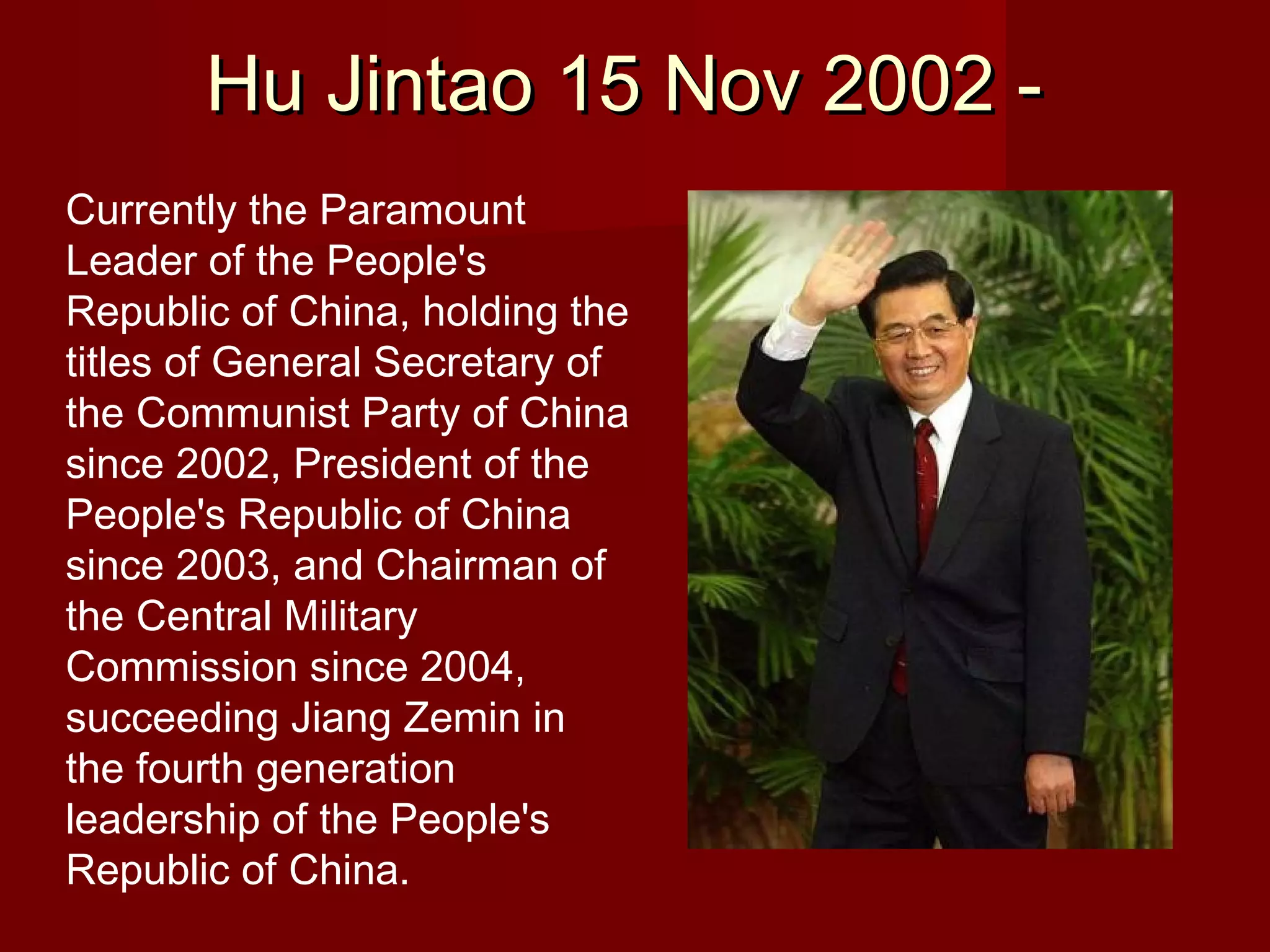
Hu Jintao 15 Nov 2002 -
Currently the Paramount
Leader of the People's
Republic of China, holding the
titles of General Secretary of
the Communist Party of China
since 2002, President of the
People's Republic of China
since 2003, and Chairman of
the Central Military
Commission since 2004,
succeeding Jiang Zemin in
the fourth generation
leadership of the People's
Republic of China.
•   Increased population means more
    resources are needed to meet the needs
    of the growing population. Due to fears of
    overpopulation in China, the government
    has introduced a One Child Policy
    encouraging families to have only one
    child. If families have more than one child
    there are financial penalties.
The Constitutional Monarchy
         of Japan
 The Emperor of Japan (head of state) is
 merely a “symbol of the state.” True
 executive power resides with the Prime
 Minister (head of government), and the
 Cabinet of Ministers, who are part of the
 legislative branch of government. There
 are universal voting rights for all adult
 citizens.
Emperor Akihito   The symbol of the state
                    and of the unity of the
                    Japanese people. He is
                    the head of the
                    Japanese Imperial
                    Family. He is also the
                    highest authority of the
                    Shinto religion. Under
                    Japan's present
                    constitution, the Emperor
                    is the "symbol of the
                    state and the unity of the
                    people," and is a
                    ceremonial figurehead in
                    a constitutional
                    monarchy
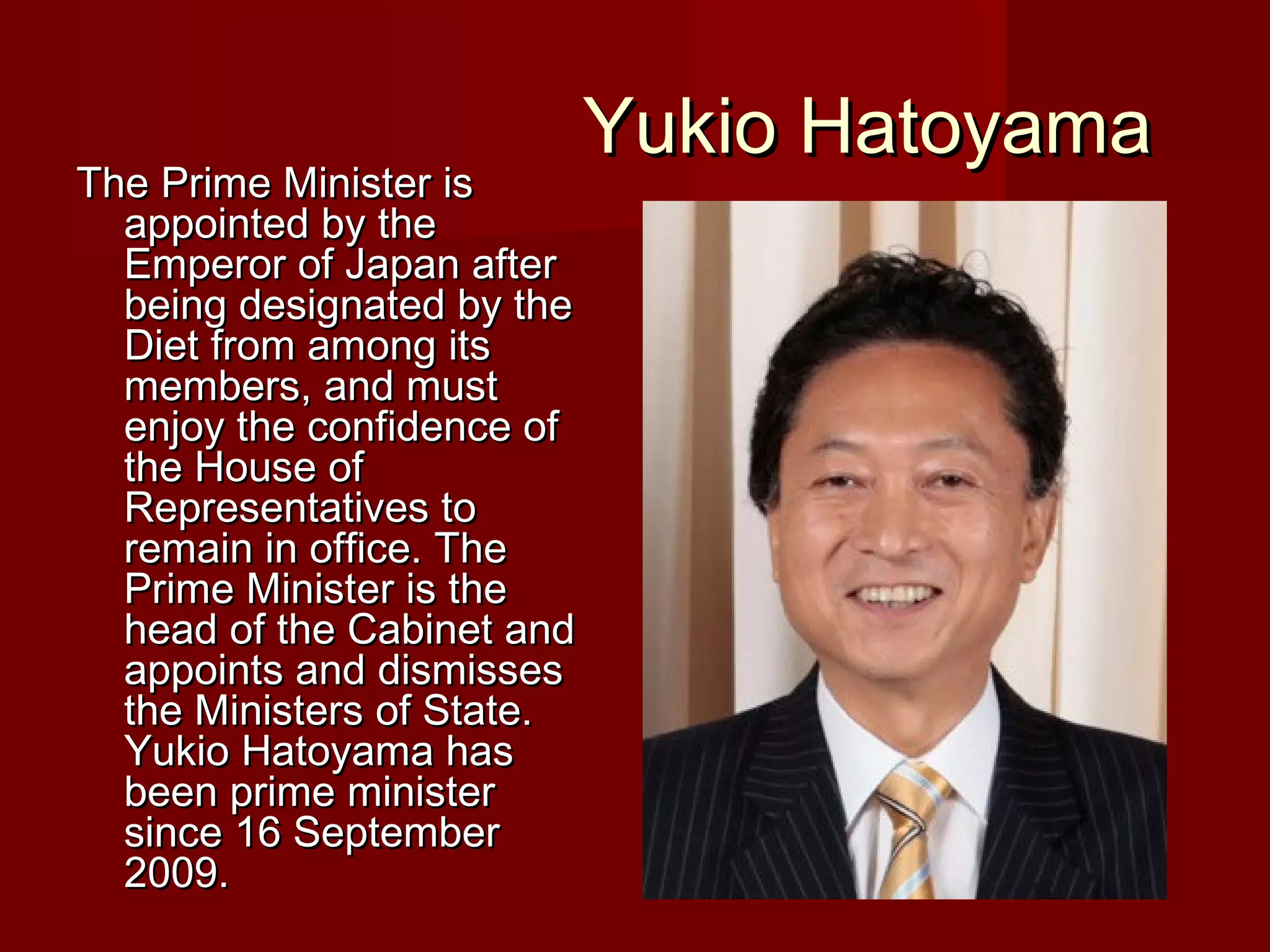
Yukio Hatoyama
The Prime Minister is
  appointed by the
  Emperor of Japan after
  being designated by the
  Diet from among its
  members, and must
  enjoy the confidence of
  the House of
  Representatives to
  remain in office. The
  Prime Minister is the
  head of the Cabinet and
  appoints and dismisses
  the Ministers of State.
  Yukio Hatoyama has
  been prime minister
  since 16 September
  2009.
COUNT    TYPE OF GOV’T   How do they become leaders    Form of Leadership   Personal
   RY                           in this country?                            Freedoms?
India   Federal          President –              President – head of 18 and
                         Electoral College        state               older
                                                                      vote
        Parliamentar     Prime Minister – Head of Prime Minister –
        y                Majority legislative     head of gov’t
        Democracy        branch

China   Republic         President – chosen by        President – head of None
        (fake)           National People’s            state
                         Congress                 Premier (Prime
        Unitary
                         Premier (Prime Minister) Minister) – head of
        Oligarchic
                         – Head of the Ruling     government
      Lead by
                         Party (Communist Party)
      Communist
      Party
Japan Unitary            Emperor – Inherited          Emperor – head of     18 and
      Parliamentar       Prime Minister – chosen      state                 older
      y Democracy        by the Diet and emperor Prime Minister –           vote
        Constitutional   gives blessing          head of
        Monarchy                                 government
 Chief of state  includes the name and title
 of the titular leader of the country who
 represents the state at official and
 ceremonial functions, but who may not be
 involved with the day-to-day activities of
 the government.
 Head of government    includes the name
 and title of the top administrative leader
 who is designated to manage the day-to-
 day activities of the government.
 For example, in Japan, the emperor is the
 chief of state, and the prime minister is the
 head of government. {In the US, the
 president is both the chief of state and the
 head of government.}
The emperor holds a ceremonial role as head of state

The prime minister is the head of government

The government’s true power lies with the Prime Minister and
the Cabinet


 Based on the information above, which term identifies
    Japan’s government?
 A. federal republic
 B. communist state
 C. constitutional monarchy
 D. autocratic confederation
The emperor holds a ceremonial role as head of state

The prime minister is the head of government

The government’s true power lies with the Prime Minister and
the Cabinet


 Based on the information above, which term identifies
    Japan’s government?
 A. federal republic
 B. communist state
 C. constitutional monarchy *
 D. autocratic confederation
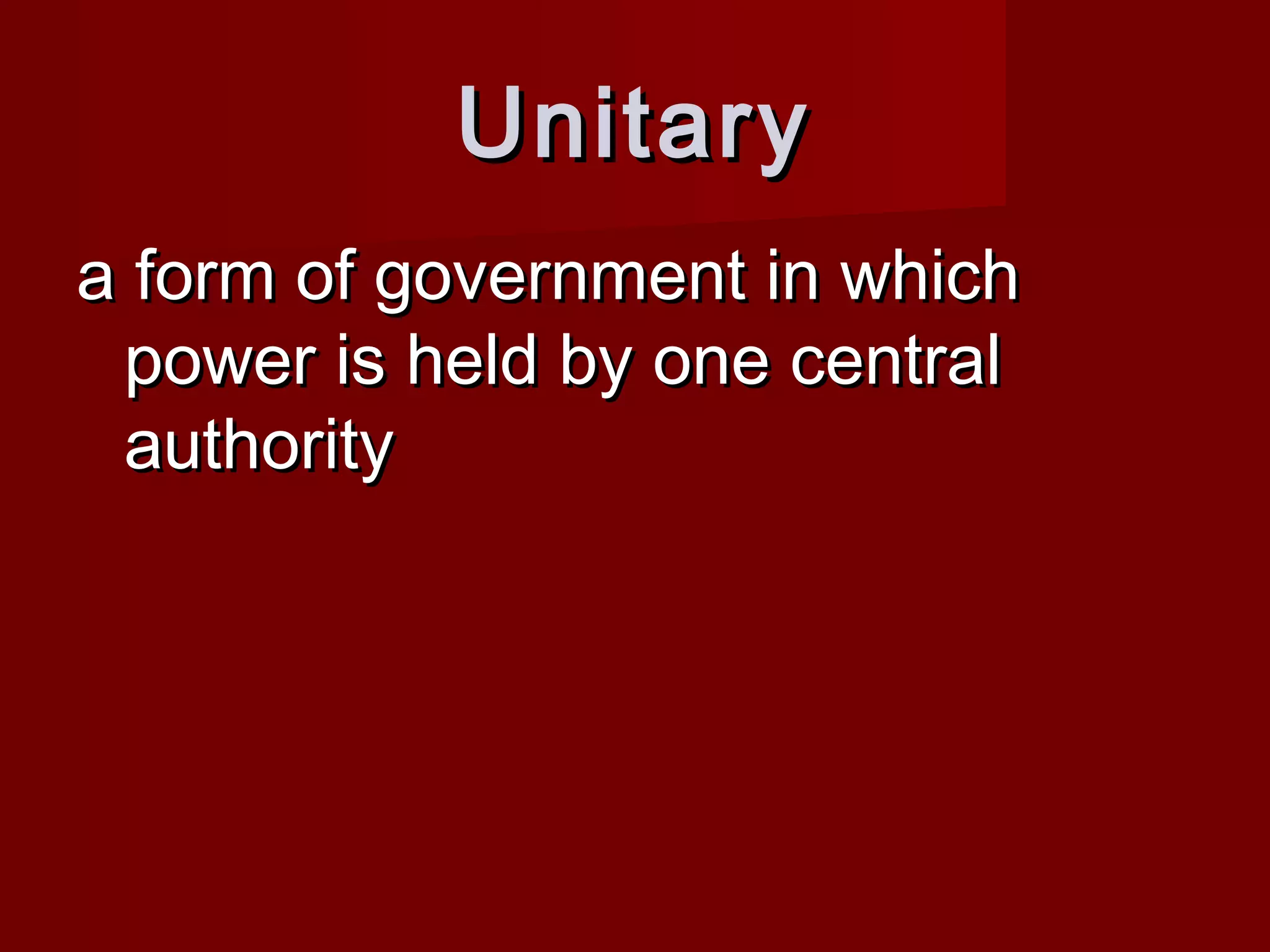
a national government as well as 28 state
 governments

 the leader of each state legislature's majority is
 appointed governor by the president

 citizens of each state elect state legislatures
Based on the information above, which term identifies
   India's government?
A. federal republic
B. communist state
C. constitutional monarchy
D. autocratic confederation
a national government as well as 28 state
 governments

 the leader of each state legislature's majority is
 appointed governor by the president

 citizens of each state elect state legislatures
Based on the information above, which term identifies
   India's government?
A. federal republic *
B. communist state
C. constitutional monarchy
D. autocratic confederation
Governments of asia

  • 1.
  • 2.
  • 3.
    Unitary a form ofgovernment in which power is held by one central authority
  • 4.
    Unitary Ways Government DistributesPower Regional Regional Authority Authority Central Authority Regional Regional Authority Authority
  • 5.
    Confederation voluntary associations of independent states that, to secure some common purpose, agree to certain limitations on their power
  • 6.
    Confederation Ways Government Distributes Power Regional Regional Authority Authority Central Authority Regional Regional Authority Authority
  • 7.
    Federal a form ofgovernment in which power is divided between one central and several regional authorities
  • 8.
    Federation / Federal Ways Government Distributes Power Regional Regional Authority Authority Central Authority Regional Regional Authority Authority
  • 9.
  • 10.
    Autocratic government in whichone person possesses unlimited power and the citizen has little if any role in the government.
  • 11.
    Oligarchic government by thefew, sometimes a government in which a small group exercises control especially for corrupt and selfish purposes. The citizen has a very limited role.
  • 12.
    Democratic a government inwhich the supreme power is vested in the people and exercised by them directly or indirectly through a system of representation usually involving periodically held free elections.
  • 13.
    How Governments Determine Citizen Participation High Participation High Participation Citizen Participation Citizen Participation Government Power Government Power Government Power General Citizens’ Select Citizens’ Participation Participation Low or No Participation Low or No Participation Low or No Participation Autocratic Oligarchic Democracy
  • 14.
  • 15.
    Parliamentary a system ofgovernment having the real executive power vested in a cabinet composed of members of the legislature who are individually and collectively responsible to the legislature. May have a Prime Minister elected by the legislature.
  • 16.
    Presidential a system ofgovernment in which the president is constitutionally independent of the legislature
  • 17.
    In Japan, theprefectures (Japan’s word for states or provinces) do not have any independent authority. Instead, they carry out the laws and policies of the national government. This is an example of what system of government? A. Unitary B. Confederation C. Federal D. parliamentary
  • 18.
    In Japan, theprefectures (Japan’s word for states or provinces) do not have any independent authority. Instead, they carry out the laws and policies of the national government. This is an example of what system of government? A. Unitary* B. Confederation C. Federal D. parliamentary
  • 19.
    How does ademocratic government differ from an oligarchic government? A. Role of the citizen B. Law making process C. Judicial system D. Role of individual states
  • 20.
    How does ademocratic government differ from an oligarchic government? A. Role of the citizen* B. Law making process C. Judicial system D. Role of individual states
  • 21.
    In a parliamentarygovernment, unlike the presidential system, the head of government belongs to which branch? A. Judicial B. National C. Executive D. Legislative
  • 22.
    In a parliamentarygovernment, unlike the presidential system, the head of government belongs to which branch? A. Judicial B. National C. Executive D. Legislative*
  • 23.
  • 24.
    Federal Republic ofIndia  Although India is a republic, individual states are more tightly controlled by the central government than states in the United States. India has a President and a Prime Minister. The President is the head of state while the Prime Minister is the head of government. The President is elected by an electoral college to 5-year term. The Vice- President is elected by both houses of Parliament. The Prime Minister is generally the head of the party that enjoys a majority in the legislative branch. All citizens 18 and over may vote for their legislators.
  • 25.
    Pratibha Patil since 25 July2007 The President is elected by the elected members of the Parliament of India as well as of the state legislatures and serves for a term of five years.
  • 26.
    Manmohan Singh in office since 22 May 2004 The head of government of the Republic of India, and head of the Council of Ministers, appointed by the President to assist the latter in the administration of the affairs of the executive in India. The Prime Minister is responsible for bringing proposal of legislation. The Prime Minister is appointed by the President, and recognized as leader of the majority party in the two Houses of the Parliament of India.
  • 27.
    The People’s Republicof China  Although China is called a republic, true power lies with the ruling Communist Party. China has a President and a Premier. The President is the head of state while the Premier is the head of government. The President and Vice-President are elected by the National People’s Congress. The Prime Minister is the head of the ruling party, the Chinese Communist Party. While there are elections for the National People’s Congress, there is truly only one political party, the Chinese Communist Party. The State Council, which functions as a cabinet, is appointed by the National People’s Congress.
  • 28.
    Hu Jintao 15Nov 2002 - Currently the Paramount Leader of the People's Republic of China, holding the titles of General Secretary of the Communist Party of China since 2002, President of the People's Republic of China since 2003, and Chairman of the Central Military Commission since 2004, succeeding Jiang Zemin in the fourth generation leadership of the People's Republic of China.
  • 29.
    Increased population means more resources are needed to meet the needs of the growing population. Due to fears of overpopulation in China, the government has introduced a One Child Policy encouraging families to have only one child. If families have more than one child there are financial penalties.
  • 30.
    The Constitutional Monarchy of Japan  The Emperor of Japan (head of state) is merely a “symbol of the state.” True executive power resides with the Prime Minister (head of government), and the Cabinet of Ministers, who are part of the legislative branch of government. There are universal voting rights for all adult citizens.
  • 31.
    Emperor Akihito The symbol of the state and of the unity of the Japanese people. He is the head of the Japanese Imperial Family. He is also the highest authority of the Shinto religion. Under Japan's present constitution, the Emperor is the "symbol of the state and the unity of the people," and is a ceremonial figurehead in a constitutional monarchy
  • 32.
    Yukio Hatoyama The PrimeMinister is appointed by the Emperor of Japan after being designated by the Diet from among its members, and must enjoy the confidence of the House of Representatives to remain in office. The Prime Minister is the head of the Cabinet and appoints and dismisses the Ministers of State. Yukio Hatoyama has been prime minister since 16 September 2009.
  • 33.
    COUNT TYPE OF GOV’T How do they become leaders Form of Leadership Personal RY in this country? Freedoms? India Federal President – President – head of 18 and Electoral College state older vote Parliamentar Prime Minister – Head of Prime Minister – y Majority legislative head of gov’t Democracy branch China Republic President – chosen by President – head of None (fake) National People’s state Congress Premier (Prime Unitary Premier (Prime Minister) Minister) – head of Oligarchic – Head of the Ruling government Lead by Party (Communist Party) Communist Party Japan Unitary Emperor – Inherited Emperor – head of 18 and Parliamentar Prime Minister – chosen state older y Democracy by the Diet and emperor Prime Minister – vote Constitutional gives blessing head of Monarchy government
  • 34.
     Chief ofstate includes the name and title of the titular leader of the country who represents the state at official and ceremonial functions, but who may not be involved with the day-to-day activities of the government.  Head of government includes the name and title of the top administrative leader who is designated to manage the day-to- day activities of the government.
  • 35.
     For example,in Japan, the emperor is the chief of state, and the prime minister is the head of government. {In the US, the president is both the chief of state and the head of government.}
  • 36.
    The emperor holdsa ceremonial role as head of state The prime minister is the head of government The government’s true power lies with the Prime Minister and the Cabinet Based on the information above, which term identifies Japan’s government? A. federal republic B. communist state C. constitutional monarchy D. autocratic confederation
  • 37.
    The emperor holdsa ceremonial role as head of state The prime minister is the head of government The government’s true power lies with the Prime Minister and the Cabinet Based on the information above, which term identifies Japan’s government? A. federal republic B. communist state C. constitutional monarchy * D. autocratic confederation
  • 38.
    a national governmentas well as 28 state governments the leader of each state legislature's majority is appointed governor by the president citizens of each state elect state legislatures Based on the information above, which term identifies India's government? A. federal republic B. communist state C. constitutional monarchy D. autocratic confederation
  • 39.
    a national governmentas well as 28 state governments the leader of each state legislature's majority is appointed governor by the president citizens of each state elect state legislatures Based on the information above, which term identifies India's government? A. federal republic * B. communist state C. constitutional monarchy D. autocratic confederation