Lesson
Outline
01 What Isa Fallacy?
02 Classification of Fallacies
03 Fallacies of Relevance
04 Fallacies of Defective Induction
05 Fallacies of Presumption
06 Fallacies of Ambiguity
3.
1.WHAT IS AFALLACY ?
A logical fallacy is an error of
reasoning that will weaken your
argument and, in the most cases
undermine it completely
4.
TYPES OF FALLACIES
FORMALFALLACIES:
INFORMAL FALLACIES:
Errors in the logical structure or form of an
argument.
Errors related to the content, language, or context
of the argument rather than its logical form.
5.
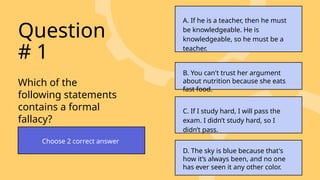
Which of the
followingstatements
contains a formal
fallacy?
Question
# 1
Choose 2 correct answer
A. If he is a teacher, then he must
be knowledgeable. He is
knowledgeable, so he must be a
teacher.
B. You can't trust her argument
about nutrition because she eats
fast food.
C. If I study hard, I will pass the
exam. I didn’t study hard, so I
didn’t pass.
D. The sky is blue because that's
how it’s always been, and no one
has ever seen it any other color.
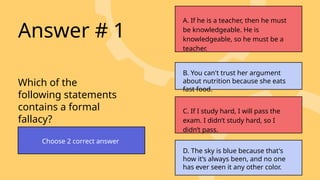
6.
Which of the
followingstatements
contains a formal
fallacy?
Answer # 1
Choose 2 correct answer
A. If he is a teacher, then he must
be knowledgeable. He is
knowledgeable, so he must be a
teacher.
B. You can't trust her argument
about nutrition because she eats
fast food.
C. If I study hard, I will pass the
exam. I didn’t study hard, so I
didn’t pass.
D. The sky is blue because that's
how it’s always been, and no one
has ever seen it any other color.
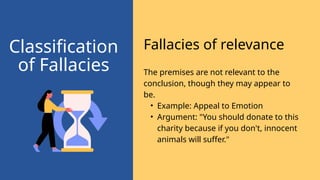
The premises arenot relevant to the
conclusion, though they may appear to
be.
• Example: Appeal to Emotion
• Argument: "You should donate to this
charity because if you don't, innocent
animals will suffer."
Fallacies of relevance
Classification
of Fallacies
9.
Fallacies of relevance:The premises are
not relevant to the conclusion, though
they may appear to be.
• Example: Appeal to Emotion
• Argument: "You should donate to this
charity because if you don't, innocent
animals will suffer."
• Issue: The argument appeals to
emotions rather than providing logical
reasons for donating.
Fallacies of relevance
Classification
of Fallacies
10.
The premises arerelevant but too weak
to support the conclusion.
• Example: Hasty Generalization
• Argument: "I met two people from
Italy, and they were both rude.
Therefore, all Italians must be rude."
Fallacies of defective
induction.
Classificatio
n of
Fallacies
11.
The premises arerelevant but too weak
to support the conclusion.
• Example: Hasty Generalization
• Argument: "I met two people from
Italy, and they were both rude.
Therefore, all Italians must be rude."
• Issue: A conclusion is drawn from an
insufficient sample size.
Fallacies of defective
induction.
Classificatio
n of
Fallacies
Fallacies of presumption.
Classificatio
nof
Fallacies The premises assume too much, relying
on unwarranted assumptions.
• Example: Begging the Question
• Argument: "Reading is beneficial
because it's good for you."
15.
Fallacies of presumption.
Classificatio
nof
Fallacies
The premises assume too much, relying
on unwarranted assumptions.
• Example: Begging the Question
• Argument: "Reading is beneficial
because it's good for you."
• Issue: The argument assumes what it
is trying to prove without providing
evidence.
16.
These involve themisleading use of
words or phrases with multiple
meanings.
• Example: Equivocation
• Argument: "A feather is light. What is
light cannot be dark. Therefore, a
feather cannot be dark."
Fallacies of ambiguity.
Classificatio
n of
Fallacies
17.
These involve themisleading use of
words or phrases with multiple
meanings.
• Example: Equivocation
• Argument: "A feather is light. What is
light cannot be dark. Therefore, a
feather cannot be dark."
• Issue: The word "light" is used with
two different meanings, creating
confusion.
Fallacies of ambiguity.
Classificatio
n of
Fallacies
• Definition: Occurwhen the premises
do not logically relate to or support
the conclusion.
• Characteristics: Missing Connection:
No real link exists between premises
and conclusion. Reliance on Emotion:
Often use emotive Language instead
of objective reasoning.
• Key Point: These fallacies attempt to
persuade by appealing to feelings or
irrelevant information, rather than
providing logical evidence for the
argument.
What Is
FallaCies of
relevance?
20.
R1 - TheAppeal to the Populace
(Argumentum ad Populum)
2. Seven fallacies
of relevance
It is one of the most common of all fallacies.
It is defined as the attempt to win popular
assent to a conclusion by arousing the feelings
of the multitude.
21.
Appeals to Emotion:Appeal to Pity
(ad Misericordiam)
R2
Misericordia means “merciful heart” (literally)
=> The fallacy means the argument relies on generosity, altruism,
or mercy, rather than on reason.
LOGICAL FORM
Person 1 is accused of X, but person 1 is pathetic.
Therefore, person 1 is innocent.
EXAMPLE
A person is accused of stealing. In court, he claimed innocence.
Instead of giving evidence to prove his innocence, he told about
his difficult family situation, poverty, good character, etc. to hope
that the trial panel would sympathize and conclude that he is
innocent.
22.
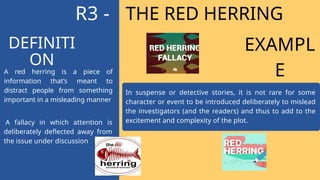
THE RED HERRING
Afallacy in which attention is
deliberately deflected away from
the issue under discussion
In suspense or detective stories, it is not rare for some
character or event to be introduced deliberately to mislead
the investigators (and the readers) and thus to add to the
excitement and complexity of the plot.
A red herring is a piece of
information that’s meant to
distract people from something
important in a misleading manner
DEFINITI
ON
R3 -
EXAMPL
E
23.
A straw manargument, sometimes called a straw
person argument or spelled strawman argument, is the
logical fallacy of distorting an opposing position into an
extreme version of itself and then arguing against that
extreme version.
The straw man
R4
It is an effort to shift the conflict from its original complexity into
a different conflict, between parties other than those originally
in dispute. So common is this variety of distraction that the
pattern of argument that relies on it has long carried its name:
the straw man argument.
24.
An opponent's positionis
depicted as being more extreme
or unreasonable than is justified
by what was actually asserted.
Example A – Women have control over their
bodies, they can do anything with it,
including abortion.
B – Do you support abortion?
25.
ARGUMENT AGAINST THE
PERSON(ARGUMENTUM AD
HOMINEM)
R5
-
Definition
⚬One of the most dangerous and common fallacy.
⚬Inflicting unfairness on an opponent, hurtful, serious
personal damage without any opportunity for the
fallacy to be exposed or its author chastised.
Classified into 2 main types:
Abuse and Circumstance
26.
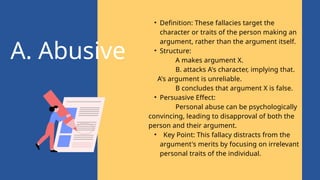
A. Abusive
• Definition:These fallacies target the
character or traits of the person making an
argument, rather than the argument itself.
• Structure:
A makes argument X.
B. attacks A's character, implying that.
A's argument is unreliable.
B concludes that argument X is false.
• Persuasive Effect:
Personal abuse can be psychologically
convincing, leading to disapproval of both the
person and their argument.
• Key Point: This fallacy distracts from the
argument's merits by focusing on irrelevant
personal traits of the individual.
27.
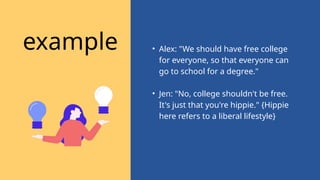
• Alex: "Weshould have free college
for everyone, so that everyone can
go to school for a degree."
• Jen: "No, college shouldn't be free.
It's just that you're hippie." {Hippie
here refers to a liberal lifestyle}
example
28.
• TU QUOQUE( YOU'R ANOTHER)
• This type of fallacy tends to negate the interlocutor's argument by arguing that their behavior is incompatible
with the conclusion of the argument and silences the opponent.
• Example: A smoking mother advised her child not to do it because it was not good for her health.The child replied,
"Then why do you smoke too? If you can smoke, you can smoke too." Here, the child thinks that because his
mother smokes, what he says about smoking is bad for his health is wrong. However, the mother's argument
cannot be equated wrong just because there is a contradiction between her assertion and her way of staying.
• This form of fallacy is often used as a distraction tactic and is a special case of the personal attack fallacy.
Circumstances
B
29.
R6. THE APPEALTO FORCE
(ARGUMENTUM AD BACULUM)
A rhetorical fallacy that relies on
force or intimidation to get
someone to accept a conclusion or
take a particular action
30.
• The mostdifficult to describe the fallacies of
relevance with precision
• A fallacy in which the premises support a different
conclusion from the one that is proposed.
• Logical Form:
• Person 1 gives a proposed conclusion.
• Person 2 gives a claim other than that which was
originally at issue.
• => person 2 misses the point
Missing the point (Ignoratio
elenchi)
R7.
=> Example: The prisoner pleaded guilty and he said he had
made a mistake. But the judge allowed him to change his plea
to not guilty. The case was tried. He became innocent The jury
acquitted
D1. THE ARGUMENTFROM IGNORANCE
(ARGUMENTUM
1.ad Ignorantiam)
• Definition: Asserting something is true because it hasn't
been proven false, or false because it hasn't been proven
true.
• Example: "No one has proven aliens don’t exist, so they
must be real."
• Explanation: Lack of evidence is used incorrectly as proof.
33.
2. Appeal toInappropriate Authority
(Argumentum ad Verecundiam)
Definition: Citing an authority
outside their expertise to validate a
conclusion.
Example: "A famous actor says this
brand of medicine is the best, so it
must be effective."
Explanation: Authority is not relevant to
the topic.
34.
# 3 FalseCause (Non Causa
Pro Causa)
• Definition: Incorrectly identifying a
cause-and-effect relationship.
• Example: "Since we started recycling,
the weather has improved, so recycling
must be the cause."
Explanation: Correlation is mistaken for
causation.
35.
• Definition: Makinga broad conclusion
based on a small sample.
• Example: "I met two rude people from
that city, so everyone there must be
rude."
• Explanation: Insufficient data leads to
an overgeneralization.
4. Hasty
Generalization
These fallacies occurwhen an
argument makes unjustified
or unsupported assumptions.
These fallacies occur when an
argument makes unjustified
or unsupported assumptions.
in theory
39.
An argument assumeswhat it is
supposed to prove.
Begging the Question
(Circular Reasoning)
• Example: "I’m always truthful because I
never lie."
• Explanation: The argument simply restates
the claim rather than providing proof,
resulting in circular reasoning.
40.
False Dilemma
(False
Dichotomy)
Presenting onlytwo options when more
might exist.
• Example: "You either support this policy, or
you're against progress."
• Explanation: This fallacy oversimplifies the
situation by excluding other possibilities.
These occur whenunclear or
ambiguous language distorts
an argument.
in theory
43.
Using a wordwith multiple meanings in different
parts of the argument, leading to confusion.
Equivocation
• Example: "A feather is light. What is light cannot
be dark. Therefore, a feather cannot be dark."
• Explanation: The word "light" is used in two
different senses—weight and brightness—
creating a misleading conclusion.
44.
Amphiboly
Ambiguity arises frompoor sentence
structure, leading to misinterpretation.
• Example: "The burglar threatened the man
with the knife."
• Explanation: It's unclear whether the burglar
or the man has the knife, leading to
confusion.