Fallacy and its Types
UMAIR WAHEED
20-EE-30
SOBAN TARIQ
20-EE-31
HAMMAD ABBASI
20-EE-24
FALLACY
Argument meant to prove a point good reasons for accepting
a claim sometimes succeed and sometimes not.
When arguments fails to prove point then the problem will be
that the premises are false, the reasoning is faulty.
Flawed arguments are known as fallacies and said to be
fallacious.
TYPES OF FALLACIES
There are two broad categories of fallacies:
1) Irrelavent premises
2) Unacceptable premises
Irrelavent Premises
 Irrelavent Premises have no bearing on the truth of the conclusion. An
argument may seem to offer reasons for accepting the conclusion, but the
"reasons" has nothing to do with the conclusion.
Examples:
 You can dismiss that alternative energy conservation plan. It's the brainchild
of a liberal think tank in Washington.
 We should reject that proposal for solving the current welfare mess. It comes
straight from the Republican party.
 Only man is rational. No woman is a man. Therefore, no woman is rational.
Irrelavent Premises
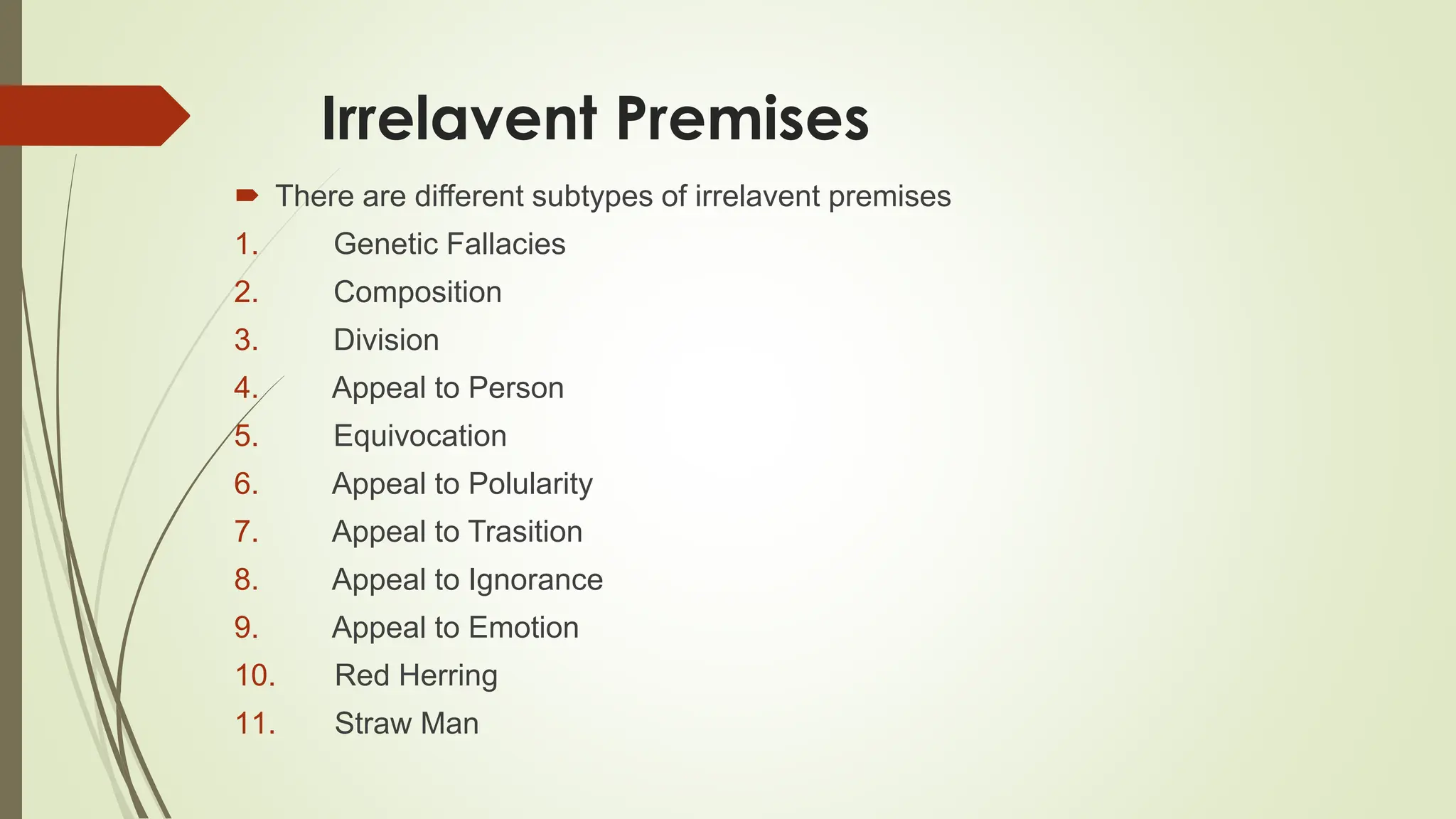
 There are different subtypes of irrelavent premises
1. Genetic Fallacies
2. Composition
3. Division
4. Appeal to Person
5. Equivocation
6. Appeal to Polularity
7. Appeal to Trasition
8. Appeal to Ignorance
9. Appeal to Emotion
10. Red Herring
11. Straw Man
1. Genetic Fallacies
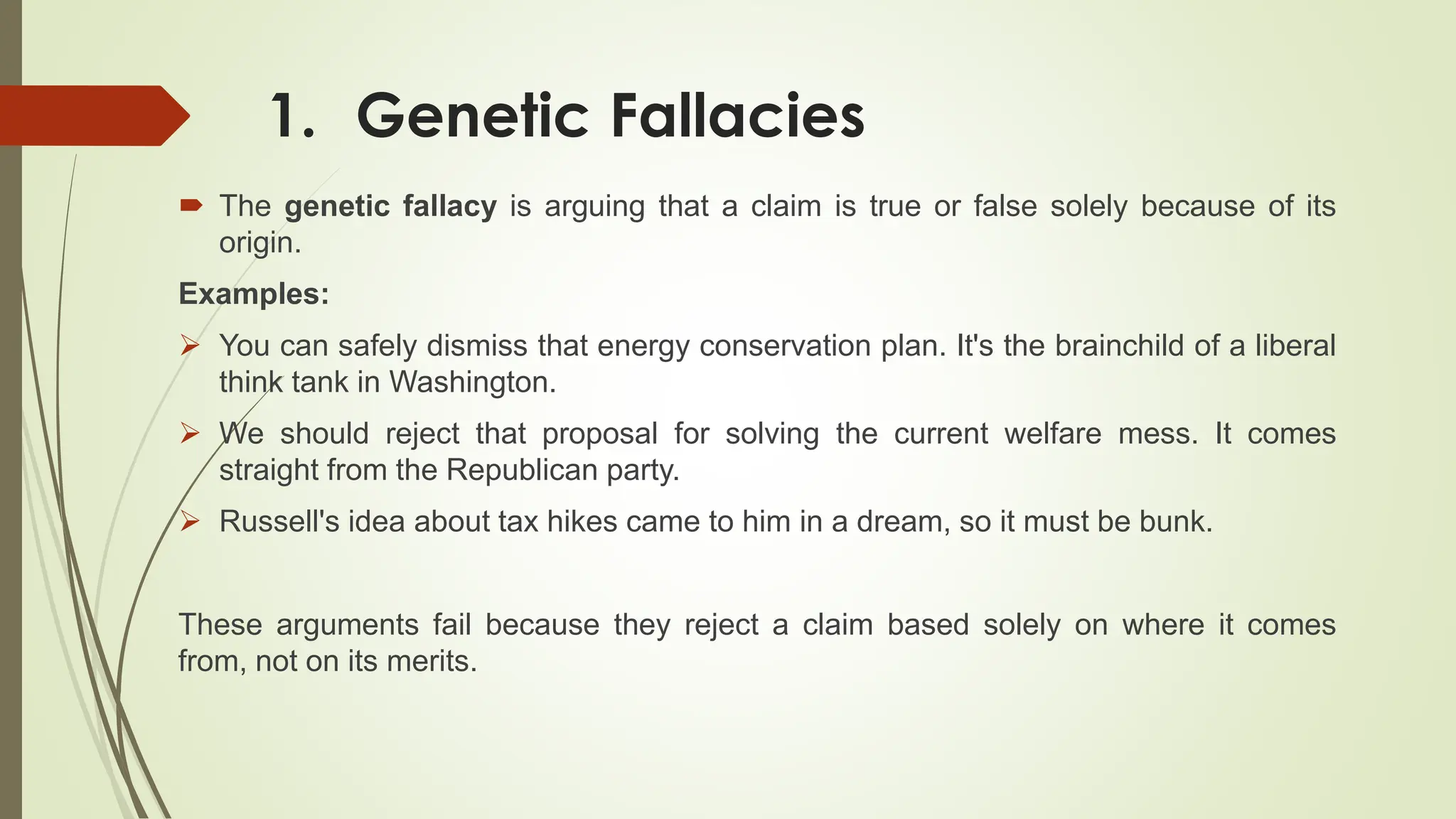
 The genetic fallacy is arguing that a claim is true or false solely because of its
origin.
Examples:
 You can safely dismiss that energy conservation plan. It's the brainchild of a liberal
think tank in Washington.
 We should reject that proposal for solving the current welfare mess. It comes
straight from the Republican party.
 Russell's idea about tax hikes came to him in a dream, so it must be bunk.
These arguments fail because they reject a claim based solely on where it comes
from, not on its merits.
2. Composition
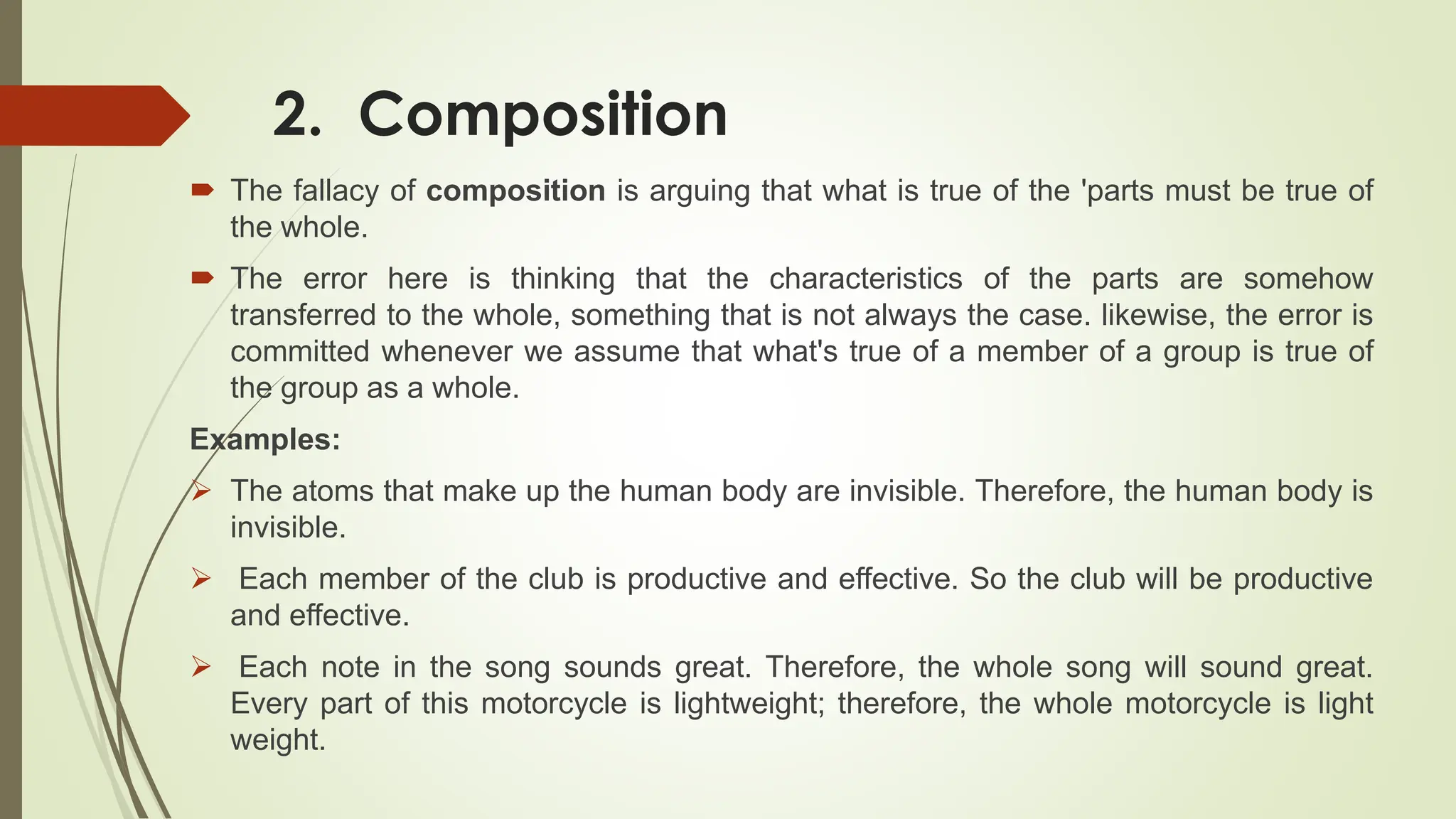
 The fallacy of composition is arguing that what is true of the 'parts must be true of
the whole.
 The error here is thinking that the characteristics of the parts are somehow
transferred to the whole, something that is not always the case. likewise, the error is
committed whenever we assume that what's true of a member of a group is true of
the group as a whole.
Examples:
 The atoms that make up the human body are invisible. Therefore, the human body is
invisible.
 Each member of the club is productive and effective. So the club will be productive
and effective.
 Each note in the song sounds great. Therefore, the whole song will sound great.
Every part of this motorcycle is lightweight; therefore, the whole motorcycle is light
weight.
3. Division
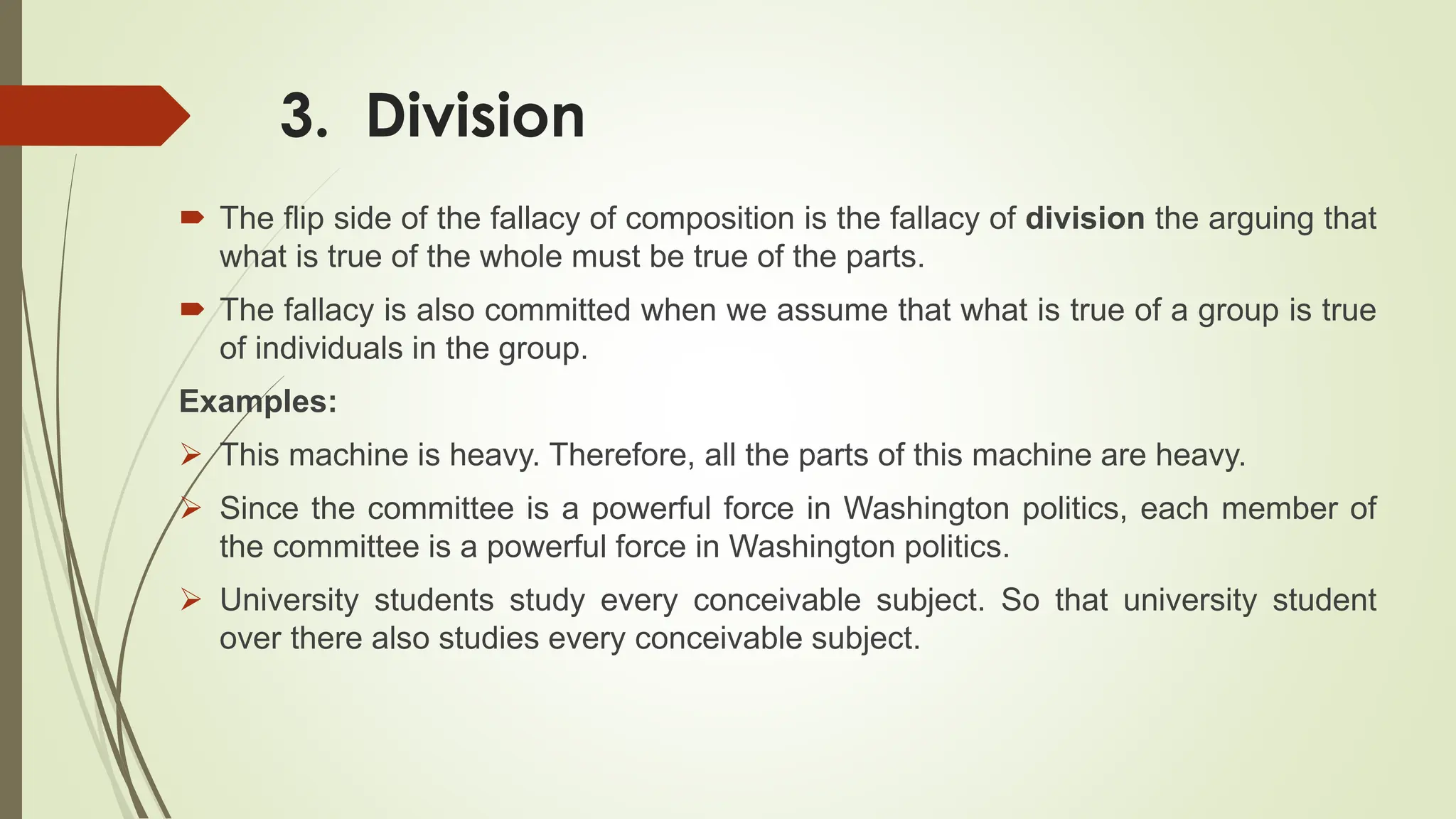
 The flip side of the fallacy of composition is the fallacy of division the arguing that
what is true of the whole must be true of the parts.
 The fallacy is also committed when we assume that what is true of a group is true
of individuals in the group.
Examples:
 This machine is heavy. Therefore, all the parts of this machine are heavy.
 Since the committee is a powerful force in Washington politics, each member of
the committee is a powerful force in Washington politics.
 University students study every conceivable subject. So that university student
over there also studies every conceivable subject.
4. Appeal to the person
 The fallacy of appeal to the person l (or ad hominem, meaning "to the man") is
rejecting a claim by criticizing the person who makes it rather than the claim itself.
Examples:
 Jones has argued for a ban on government-sanctioned prayer in schools and at
school-sponsored events. But he's a rabid atheist without morals of any kind.
Anything he has to say on the issue is bound to be a perversion of the truth.
 We should reject Chen's argument for life on other planets. He dabbles in the
paranormal.
 You can't believe anything Morris says about welfare reform. He's a bleeding heart
liberal.
5. Equivocation
 The fallacy of equivocation is the use of a word in two different senses in an
argument.
Examples:
 The end of everything is its perfection. The end of life is death. Therefore, death is
the perfection of life.
 Only man is rational. No woman is a man. Therefore, no woman is rational.
In the first argument, end is used in two different senses. In the first premise it means
purpose, but in the second it means termination. Because of this flip-flop in meanings,
the conclusion doesn't follow from the premises-but it looks as if it should.
In the second argument, man is the equivocal term. In the first premise it means
humankind, but in the second, male. So the conclusion doesn't follow, making it appear
that a sound argument has banished women's rationality.
6. Appeal to Polularity
 The fallacy of the appeal to popularity (or to the masses) is arguing that a claim
must be true merely because a substantial number of people believe it. The basic
pattern of this fallacy is "Everyone (or almost everyone, most people, many
people) believes X, so X must be true.“
Examples:
 Most people approve of the government's new security measures, even though
innocent people's privacy is sometimes violated. So I guess the measures must be
okay.
 Of course the war is justified. Everyone believes that it's justified. The vast
majority of Americans believe that there's a supreme being, so how could you
doubt it?
7. Appeal to Trasition
 The appeal to tradition is arguing that a claim must be true just
because it's part of a tradition.
Examples:
 No one in this family has ever been divorced; therefore, you need to
work out your marital problems. We don't get divorced!
 The cheerleaders should be allowed to wear their uniforms to school
on Fridays because that's the way we have always done it. It is a
tradition at this school.
8. Appeal to Ignorance
 The appeal to ignorance is arguing that a lack of evidence proves
something. In one type of this fallacy, the problem arises by thinking that a
claim must be true because it hasn't been shown to be false.
Examples:
 No one has shown that ghosts aren't real, so they must be real.
 I thought I had every reason to think I was doing fine leading the group; no
one complained.
 No one on the council objected to the idea that he proposed, so everyone
must think it’s a great idea.
9. Appeal to Emotion
 The fallacy of the appeal to emotion is the use of emotions as premises in an
argument. That is, it consists of trying to persuade someone of a conclusion
solely by arousing his or her feelings rather than presenting relevant reasons.
They appeal to almost nothing but strong emotions.
Examples:
 “They’re saying that what I did was a crime, but I’m not guilty, because if I am
then I’ll have to spend many horrible years in jail”.
 You should hire me for this network analyst position. I'm the best person for the
job. If I don't get a job soon my wife will leave me, and I won't have enough
money to pay for my mother's heart operation. Come on, give me a break.
10. Red Herring
 The deliberate raising of an irrelevant issue during an argument this type of
argument called Red Herring.
 This fallacy consists in diverting attention from the real issue by focusing
instead on an issue having only a surface relevance to the first.
Examples:
 Son: "Wow, Dad, it's really hard to make a living on my salary." Father:
"Consider yourself lucky, son. Why, when I was your age, I only made $40 a
week.“
 Reporter: "Mr. President, your opponent, Imran khan is considerably younger
than you. Do you think that with the threat of nuclear war, age should be an
issue in this campaign?" President Reagan: "Not at all. I am not going to
exploit my opponent's youth and inexperience."
11. Straw man
 The fallacy of the straw man the distorting, weakening, or
oversimplifying of someone's position so it can be more easily attacked
or refuted.
Examples:
 Teaching assistant: the homework assignment was much harder
than we thought, so I think we should give a few extra points to
students who completed it. Professor: that’s a terrible idea. If we
give everyone a perfect score for no reason, students won’t bother
working hard in the future.
Unacceptable Premises
 Unacceptable premises are relevant to the conclusion but are
nonetheless dubious - some way. An argument may have premises that
pertain to the conclusion, but they do not adequately support it.
 Premises can be unacceptable because they are as dubious as the claim
they're intended to support, because the evidence they offer is too weak to
adequately support the conclusion, or because they're otherwise so
defective that they provide no support at all
 So in good arguments, premises must be both relevant and acceptable. In
fallacious arguments, at least one of these requirements is not met.
EXAMPLES
 Look, either you support the war or you are a traitor to your country. You
don't support the war. So you're a traitor.
 We absolutely must not lose the war in Vietnam. If South Vietnam falls to the
communists, then Thailand will fall to them. If Thailand falls to them, then
South Korea will fall to them. And before you know it, all of Southeast Asia
will be under communist control.
 The rights of the criminal are just as important as the rights of the victim.
Everyone's rights are equal.
 Snow is white. That bird is white. Because these things are alike, that bird is
also cold like snow.
Unacceptable Premises
 There are different subtypes of unacceptable premises
1. Begging the Question
2. False Dilemma
3. Slippery Slope
4. Hasty Generalization
5. Faulty Analogy
1. Begging the Question
 The fallacy of begging the question (or arguing in a circle) is the
attempt to establish the conclusion of an argument by using that
conclusion as a premise.
Examples:
 The Bible says that God exists. The Bible is true because God wrote it.
Therefore, God exists.
 Killing people is wrong, so the death penalty is wrong.
 The rights of the criminal are just as important as the rights of the
victim. Everyone's rights are equal.
2. False Dilemma
 The fallacy of false dilemma is asserting that there are only two alternatives
to consider when there are actually more than two.
Examples:
 Look, either you support the war or you are a traitor to your country. You
don't support the war. So you're a traitor.
 Either those lights you saw in the night sky were alien spacecraft (UFOs), or
you were hallucinating. You obviously weren't hallucinating. So they had to
be UFOs.
 Drink water every day and be healthy, or continue to drink sodas and be
unhealthy. Those are the only options.
 The animal shelter is a place that values animal rights and never euthanizes
animals, or the animal shelter is a place that kills innocent animals.
3. Slippery Slope
 The fallacy of slippery slope is arguing, without good reasons, that taking a
particular step will inevitably lead to a further, undesirable step (or steps). The
idea behind the metaphor, of course, is that if you take the first step on a
slippery slope, you will have to take others because, well, the slope is slippery.
Examples:
 We absolutely must not lose the war in Vietnam. If South Vietnam falls to the
communists, then Thailand will fall to them. If Thailand falls to them, then South
Korea will fall to them. And before you know it, all of Southeast Asia will be
under communist control.
 If assault rifles are banned in this country, then handguns will be next. Then
sporting rifles will be banned. And ultimately all guns will be banned, and our
fundamental freedom to own guns will be canceled out altogether. So if assault
rifles are banned, we might as well strike the Second Amendment from the
Constitution because it will be worthless.
4. Hasty Generalization
 The connection between the availability error and the fallacy known as hasty
generalization.
 The guilty of hasty generalization when we draw a conclusion about a whole group
based on an inadequate sample of the group. This mistake is a genuine fallacy of
unacceptable premises because the premises stating the sample size are relevant
to the conclusion, but they provide inadequate evidence.
Examples:
 You should buy a Dell computer. They're great. I bought one last year, and it has
given me nothing but flawless performance.
 The only male professor I've had this year was a chauvinist pig. All the male
professors at this school must be chauvinist pigs.
 The French are snobby and rude. Remember those two high-and-mighty guys with
really bad manners? They're French. I rest my case.
5. Faulty Analogy
 An analogy is a comparison of two Or more things alike in specific respects.
An argument by analogy reasons this way: Because two or more things are
similar in several respects, they must be similar in some further respect.
Examples:
 Dogs are warm-blooded, nurse their young, and give birth to puppies.
Humans are warm-blooded and nurse their young. Therefore, humans give
birth to puppies too.
 Snow is white. That bird is white. Because these things are alike, that bird is
also cold like snow.

"Understanding Common Fallacies: Ad Hominem, Straw Man, Appeal to Authority, and More – How to Identify and Avoid Logical Errors in Arguments

  • 1.
    Fallacy and itsTypes UMAIR WAHEED 20-EE-30 SOBAN TARIQ 20-EE-31 HAMMAD ABBASI 20-EE-24
  • 2.
    FALLACY Argument meant toprove a point good reasons for accepting a claim sometimes succeed and sometimes not. When arguments fails to prove point then the problem will be that the premises are false, the reasoning is faulty. Flawed arguments are known as fallacies and said to be fallacious.
  • 3.
    TYPES OF FALLACIES Thereare two broad categories of fallacies: 1) Irrelavent premises 2) Unacceptable premises
  • 4.
    Irrelavent Premises  IrrelaventPremises have no bearing on the truth of the conclusion. An argument may seem to offer reasons for accepting the conclusion, but the "reasons" has nothing to do with the conclusion. Examples:  You can dismiss that alternative energy conservation plan. It's the brainchild of a liberal think tank in Washington.  We should reject that proposal for solving the current welfare mess. It comes straight from the Republican party.  Only man is rational. No woman is a man. Therefore, no woman is rational.
  • 5.
    Irrelavent Premises  Thereare different subtypes of irrelavent premises 1. Genetic Fallacies 2. Composition 3. Division 4. Appeal to Person 5. Equivocation 6. Appeal to Polularity 7. Appeal to Trasition 8. Appeal to Ignorance 9. Appeal to Emotion 10. Red Herring 11. Straw Man
  • 6.
    1. Genetic Fallacies The genetic fallacy is arguing that a claim is true or false solely because of its origin. Examples:  You can safely dismiss that energy conservation plan. It's the brainchild of a liberal think tank in Washington.  We should reject that proposal for solving the current welfare mess. It comes straight from the Republican party.  Russell's idea about tax hikes came to him in a dream, so it must be bunk. These arguments fail because they reject a claim based solely on where it comes from, not on its merits.
  • 7.
    2. Composition  Thefallacy of composition is arguing that what is true of the 'parts must be true of the whole.  The error here is thinking that the characteristics of the parts are somehow transferred to the whole, something that is not always the case. likewise, the error is committed whenever we assume that what's true of a member of a group is true of the group as a whole. Examples:  The atoms that make up the human body are invisible. Therefore, the human body is invisible.  Each member of the club is productive and effective. So the club will be productive and effective.  Each note in the song sounds great. Therefore, the whole song will sound great. Every part of this motorcycle is lightweight; therefore, the whole motorcycle is light weight.
  • 8.
    3. Division  Theflip side of the fallacy of composition is the fallacy of division the arguing that what is true of the whole must be true of the parts.  The fallacy is also committed when we assume that what is true of a group is true of individuals in the group. Examples:  This machine is heavy. Therefore, all the parts of this machine are heavy.  Since the committee is a powerful force in Washington politics, each member of the committee is a powerful force in Washington politics.  University students study every conceivable subject. So that university student over there also studies every conceivable subject.
  • 9.
    4. Appeal tothe person  The fallacy of appeal to the person l (or ad hominem, meaning "to the man") is rejecting a claim by criticizing the person who makes it rather than the claim itself. Examples:  Jones has argued for a ban on government-sanctioned prayer in schools and at school-sponsored events. But he's a rabid atheist without morals of any kind. Anything he has to say on the issue is bound to be a perversion of the truth.  We should reject Chen's argument for life on other planets. He dabbles in the paranormal.  You can't believe anything Morris says about welfare reform. He's a bleeding heart liberal.
  • 10.
    5. Equivocation  Thefallacy of equivocation is the use of a word in two different senses in an argument. Examples:  The end of everything is its perfection. The end of life is death. Therefore, death is the perfection of life.  Only man is rational. No woman is a man. Therefore, no woman is rational. In the first argument, end is used in two different senses. In the first premise it means purpose, but in the second it means termination. Because of this flip-flop in meanings, the conclusion doesn't follow from the premises-but it looks as if it should. In the second argument, man is the equivocal term. In the first premise it means humankind, but in the second, male. So the conclusion doesn't follow, making it appear that a sound argument has banished women's rationality.
  • 11.
    6. Appeal toPolularity  The fallacy of the appeal to popularity (or to the masses) is arguing that a claim must be true merely because a substantial number of people believe it. The basic pattern of this fallacy is "Everyone (or almost everyone, most people, many people) believes X, so X must be true.“ Examples:  Most people approve of the government's new security measures, even though innocent people's privacy is sometimes violated. So I guess the measures must be okay.  Of course the war is justified. Everyone believes that it's justified. The vast majority of Americans believe that there's a supreme being, so how could you doubt it?
  • 12.
    7. Appeal toTrasition  The appeal to tradition is arguing that a claim must be true just because it's part of a tradition. Examples:  No one in this family has ever been divorced; therefore, you need to work out your marital problems. We don't get divorced!  The cheerleaders should be allowed to wear their uniforms to school on Fridays because that's the way we have always done it. It is a tradition at this school.
  • 13.
    8. Appeal toIgnorance  The appeal to ignorance is arguing that a lack of evidence proves something. In one type of this fallacy, the problem arises by thinking that a claim must be true because it hasn't been shown to be false. Examples:  No one has shown that ghosts aren't real, so they must be real.  I thought I had every reason to think I was doing fine leading the group; no one complained.  No one on the council objected to the idea that he proposed, so everyone must think it’s a great idea.
  • 14.
    9. Appeal toEmotion  The fallacy of the appeal to emotion is the use of emotions as premises in an argument. That is, it consists of trying to persuade someone of a conclusion solely by arousing his or her feelings rather than presenting relevant reasons. They appeal to almost nothing but strong emotions. Examples:  “They’re saying that what I did was a crime, but I’m not guilty, because if I am then I’ll have to spend many horrible years in jail”.  You should hire me for this network analyst position. I'm the best person for the job. If I don't get a job soon my wife will leave me, and I won't have enough money to pay for my mother's heart operation. Come on, give me a break.
  • 15.
    10. Red Herring The deliberate raising of an irrelevant issue during an argument this type of argument called Red Herring.  This fallacy consists in diverting attention from the real issue by focusing instead on an issue having only a surface relevance to the first. Examples:  Son: "Wow, Dad, it's really hard to make a living on my salary." Father: "Consider yourself lucky, son. Why, when I was your age, I only made $40 a week.“  Reporter: "Mr. President, your opponent, Imran khan is considerably younger than you. Do you think that with the threat of nuclear war, age should be an issue in this campaign?" President Reagan: "Not at all. I am not going to exploit my opponent's youth and inexperience."
  • 16.
    11. Straw man The fallacy of the straw man the distorting, weakening, or oversimplifying of someone's position so it can be more easily attacked or refuted. Examples:  Teaching assistant: the homework assignment was much harder than we thought, so I think we should give a few extra points to students who completed it. Professor: that’s a terrible idea. If we give everyone a perfect score for no reason, students won’t bother working hard in the future.
  • 17.
    Unacceptable Premises  Unacceptablepremises are relevant to the conclusion but are nonetheless dubious - some way. An argument may have premises that pertain to the conclusion, but they do not adequately support it.  Premises can be unacceptable because they are as dubious as the claim they're intended to support, because the evidence they offer is too weak to adequately support the conclusion, or because they're otherwise so defective that they provide no support at all  So in good arguments, premises must be both relevant and acceptable. In fallacious arguments, at least one of these requirements is not met.
  • 18.
    EXAMPLES  Look, eitheryou support the war or you are a traitor to your country. You don't support the war. So you're a traitor.  We absolutely must not lose the war in Vietnam. If South Vietnam falls to the communists, then Thailand will fall to them. If Thailand falls to them, then South Korea will fall to them. And before you know it, all of Southeast Asia will be under communist control.  The rights of the criminal are just as important as the rights of the victim. Everyone's rights are equal.  Snow is white. That bird is white. Because these things are alike, that bird is also cold like snow.
  • 19.
    Unacceptable Premises  Thereare different subtypes of unacceptable premises 1. Begging the Question 2. False Dilemma 3. Slippery Slope 4. Hasty Generalization 5. Faulty Analogy
  • 20.
    1. Begging theQuestion  The fallacy of begging the question (or arguing in a circle) is the attempt to establish the conclusion of an argument by using that conclusion as a premise. Examples:  The Bible says that God exists. The Bible is true because God wrote it. Therefore, God exists.  Killing people is wrong, so the death penalty is wrong.  The rights of the criminal are just as important as the rights of the victim. Everyone's rights are equal.
  • 21.
    2. False Dilemma The fallacy of false dilemma is asserting that there are only two alternatives to consider when there are actually more than two. Examples:  Look, either you support the war or you are a traitor to your country. You don't support the war. So you're a traitor.  Either those lights you saw in the night sky were alien spacecraft (UFOs), or you were hallucinating. You obviously weren't hallucinating. So they had to be UFOs.  Drink water every day and be healthy, or continue to drink sodas and be unhealthy. Those are the only options.  The animal shelter is a place that values animal rights and never euthanizes animals, or the animal shelter is a place that kills innocent animals.
  • 22.
    3. Slippery Slope The fallacy of slippery slope is arguing, without good reasons, that taking a particular step will inevitably lead to a further, undesirable step (or steps). The idea behind the metaphor, of course, is that if you take the first step on a slippery slope, you will have to take others because, well, the slope is slippery. Examples:  We absolutely must not lose the war in Vietnam. If South Vietnam falls to the communists, then Thailand will fall to them. If Thailand falls to them, then South Korea will fall to them. And before you know it, all of Southeast Asia will be under communist control.  If assault rifles are banned in this country, then handguns will be next. Then sporting rifles will be banned. And ultimately all guns will be banned, and our fundamental freedom to own guns will be canceled out altogether. So if assault rifles are banned, we might as well strike the Second Amendment from the Constitution because it will be worthless.
  • 23.
    4. Hasty Generalization The connection between the availability error and the fallacy known as hasty generalization.  The guilty of hasty generalization when we draw a conclusion about a whole group based on an inadequate sample of the group. This mistake is a genuine fallacy of unacceptable premises because the premises stating the sample size are relevant to the conclusion, but they provide inadequate evidence. Examples:  You should buy a Dell computer. They're great. I bought one last year, and it has given me nothing but flawless performance.  The only male professor I've had this year was a chauvinist pig. All the male professors at this school must be chauvinist pigs.  The French are snobby and rude. Remember those two high-and-mighty guys with really bad manners? They're French. I rest my case.
  • 24.
    5. Faulty Analogy An analogy is a comparison of two Or more things alike in specific respects. An argument by analogy reasons this way: Because two or more things are similar in several respects, they must be similar in some further respect. Examples:  Dogs are warm-blooded, nurse their young, and give birth to puppies. Humans are warm-blooded and nurse their young. Therefore, humans give birth to puppies too.  Snow is white. That bird is white. Because these things are alike, that bird is also cold like snow.