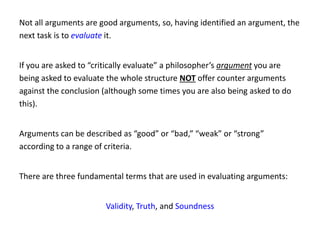
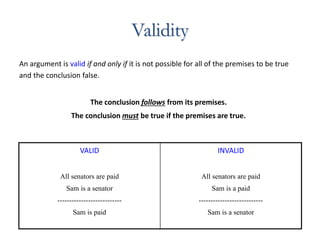
An argument is a logical structure with premises that lead to a conclusion. Arguments can be evaluated based on validity, truth, and soundness. Validity means the conclusion follows logically from the premises. An argument is sound if it is valid and all premises are true. Inductive and deductive reasoning differ in strengths and weaknesses. Inductive relies on experience while deductive accepts fixed definitions, but may lead to apparently necessary but false conclusions. Fallacies and counterarguments should be considered when critically evaluating arguments.