TYPES of
ARGUMENT
BY
AWAIS ALI
BL-0244
ARGUMENT
 An argument is a group of
statements including one or
more premises and one
conclusion.
ARGUMENT
 Example:
 1. All the youngsters listen to the pop
music. (Premise)
 2. Ali is a Youngster. (Premise)
 So Ali listens pop music. (conclusion)
ARGUMENT
 Example:
 You need to make argument
in front of parents to get
permission for a trip or to take
extra pocket money.
TYPES OF ARGUMENT
 Two types of Argument:
 1. Deductive Argument.
 2. Inductive Argument.
Deductive Argument
 Deductive argument is the type of
argument in which the conclusion
necessarily taken from the
premises.
Deductive Argument
 Example:
 1.All bats are mammels,
 2.All mammels are warm-blooded,
 So, all bats are warm-blooded.
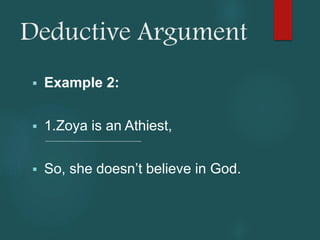
Deductive Argument
 Example 2:
 1.Zoya is an Athiest,
 So, she doesn’t believe in God.
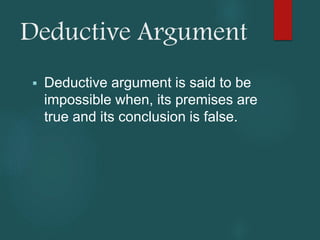
Deductive Argument
 Deductive argument is said to be
impossible when, its premises are
true and its conclusion is false.
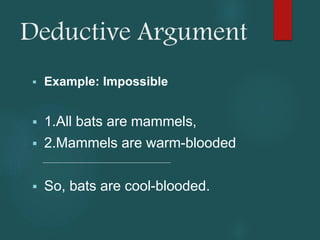
Deductive Argument
 Example: Impossible
 1.All bats are mammels,
 2.Mammels are warm-blooded
 So, bats are cool-blooded.
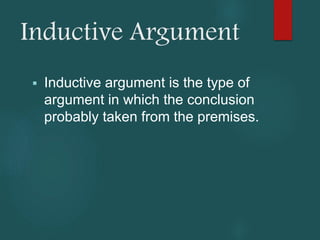
Inductive Argument
 Inductive argument is the type of
argument in which the conclusion
probably taken from the premises.
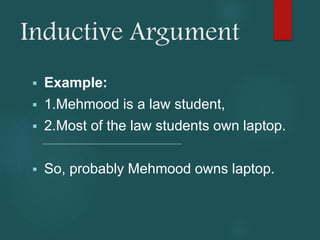
Inductive Argument
 Example:
 1.Mehmood is a law student,
 2.Most of the law students own laptop.
 So, probably Mehmood owns laptop.
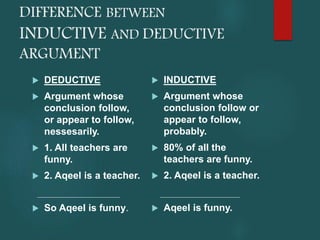
DIFFERENCE BETWEEN
INDUCTIVE AND DEDUCTIVE
ARGUMENT
 DEDUCTIVE
 Argument whose
conclusion follow,
or appear to follow,
nessesarily.
 1. All teachers are
funny.
 2. Aqeel is a teacher.
 So Aqeel is funny.
 INDUCTIVE
 Argument whose
conclusion follow or
appear to follow,
probably.
 80% of all the
teachers are funny.
 2. Aqeel is a teacher.
 Aqeel is funny.

Types of Argument presentation