
agenda 9.24.15
what is formal analysis and why do we need it?
to assist us in understanding complex phenomena like works
of art
LINE and COLOR
Long history of talking about these two properties
Disegno versus colore (in Italy)
Dessin vs. couleur (in France)
Are considered the two most
basic elements of two-
dimensional art
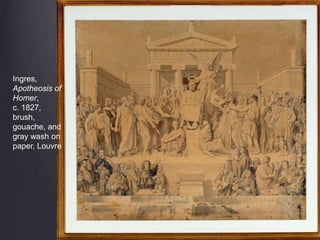
LINE • Line/design can mean
several things:
• (It’s clearer if we use a
more direct translation:
design)
• Design could mean:
• A drawing
• A plan to make
something
Ingres,
Apotheosis of
Homer,
c. 1827,
brush,
gouache, and
gray wash on
paper, Louvre
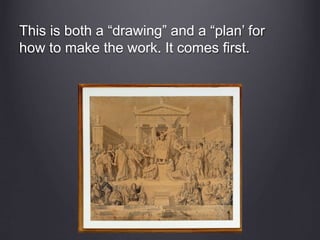
This is both a “drawing” and a “plan’ for
how to make the work. It comes first.
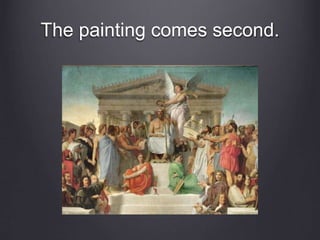
The painting comes second.
So color was thought to be
secondary.
Except that some artists defied this rule.
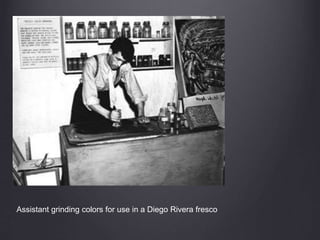
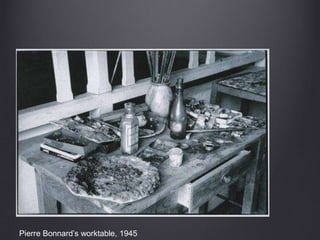
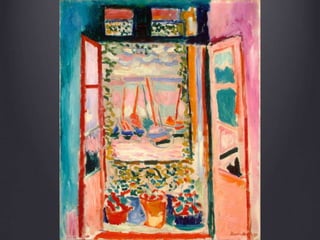
They said, actually paint is what paintings are made of, and
paint is pigment (a color) suspended in a medium (some
sort of binder).
Assistant grinding colors for use in a Diego Rivera fresco
Pierre Bonnard’s worktable, 1945
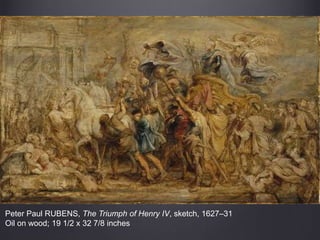
Peter Paul RUBENS, The Triumph of Henry IV, sketch, 1627–31
Oil on wood; 19 1/2 x 32 7/8 inches
LINE
The literal lines that the artist uses to create shape, suggest
depth, etc. These lines can have a variety of characteristics,
for example; line can be fine and delicate, or bold and
chunky, it can be fluid or halting, precise or sketchy.
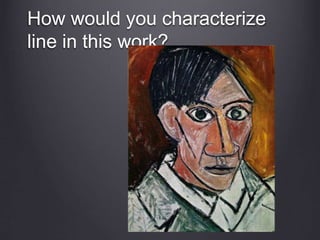
How would you characterize
line in this work?
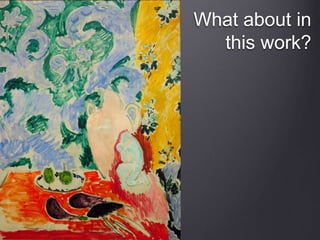
What about in
this work?
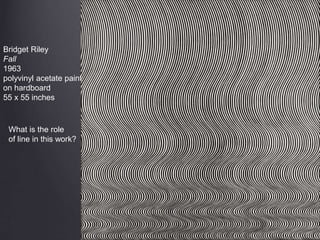
Bridget Riley
Fall
1963
polyvinyl acetate paint
on hardboard
55 x 55 inches
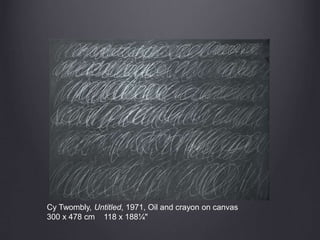
What is the role
of line in this work?
Cy Twombly, Untitled, 1971, Oil and crayon on canvas
300 x 478 cm 118 x 188¼"
COLOR
1. Ask yourself, how important is color in this work?
2. In some works, color is quite significant; in others, far less
so.
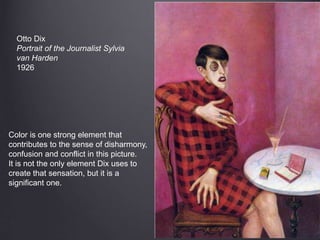
Otto Dix
Portrait of the Journalist Sylvia
van Harden
1926
Color is one strong element that
contributes to the sense of disharmony,
confusion and conflict in this picture.
It is not the only element Dix uses to
create that sensation, but it is a
significant one.
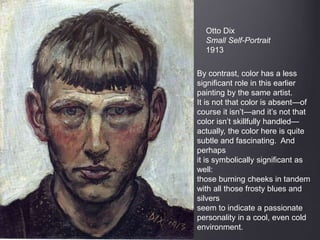
Otto Dix
Small Self-Portrait
1913
By contrast, color has a less
significant role in this earlier
painting by the same artist.
It is not that color is absent—of
course it isn’t—and it’s not that
color isn’t skillfully handled—
actually, the color here is quite
subtle and fascinating. And
perhaps
it is symbolically significant as
well:
those burning cheeks in tandem
with all those frosty blues and
silvers
seem to indicate a passionate
personality in a cool, even cold
environment.
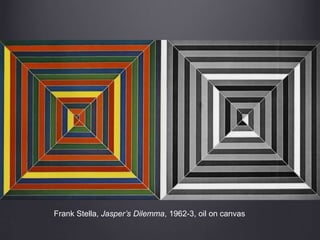
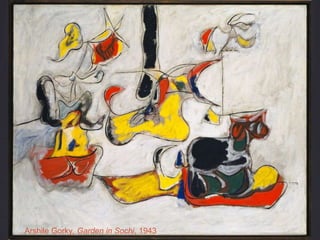
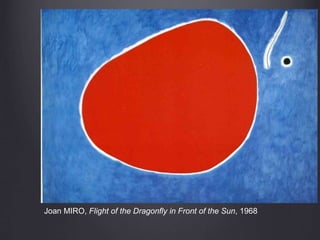
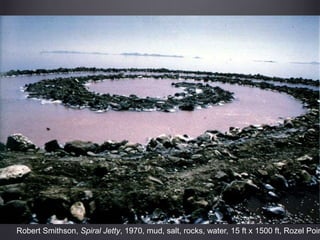
SHAPE
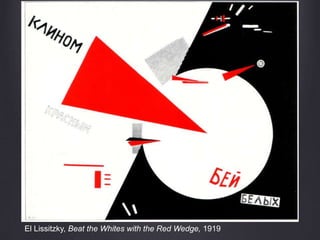
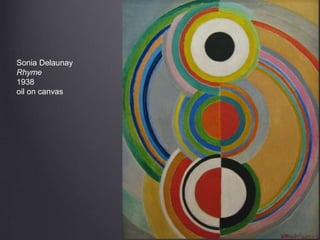
• Can be geometric (e.g., cube,
cylinder, cone, pyramid, circle,
square, triangle)
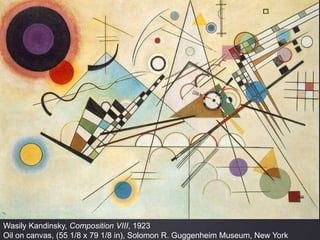
• Or biomorphic (sometimes also
called organic); wiggly, blob-like
shapes with irregular outlines.
El Lissitzky, Beat the Whites with the Red Wedge, 1919
Wasily Kandinsky, Composition VIII, 1923
Oil on canvas, (55 1/8 x 79 1/8 in), Solomon R. Guggenheim Museum, New York
Sonia Delaunay
Rhyme
1938
oil on canvas
Frank Stella, Jasper’s Dilemma, 1962-3, oil on canvas
Arshile Gorky, Garden in Sochi, 1943
Joan MIRO, Flight of the Dragonfly in Front of the Sun, 1968
Robert Smithson, Spiral Jetty, 1970, mud, salt, rocks, water, 15 ft x 1500 ft, Rozel Poin
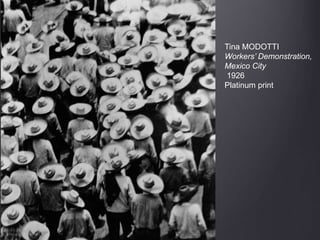
Tina MODOTTI
Workers’ Demonstration,
Mexico City
1926
Platinum print
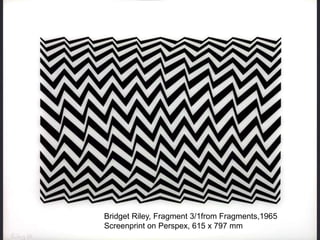
pattern
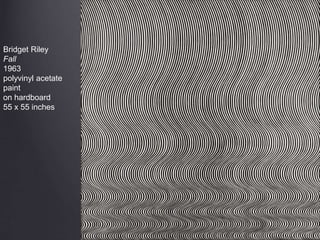
Bridget Riley
Fall
1963
polyvinyl acetate
paint
on hardboard
55 x 55 inches
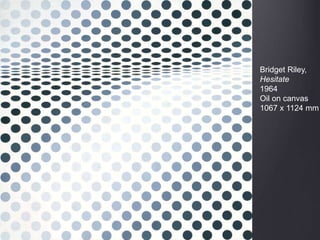
Bridget Riley,
Hesitate
1964
Oil on canvas
1067 x 1124 mm
Bridget Riley, Fragment 3/1from Fragments,1965
Screenprint on Perspex, 615 x 797 mm
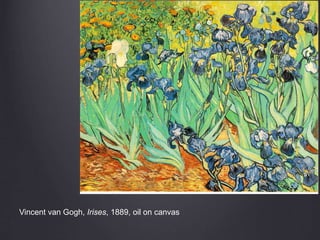
Vincent van Gogh, Irises, 1889, oil on canvas
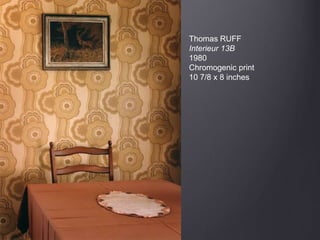
Thomas RUFF
Interieur 13B
1980
Chromogenic print
10 7/8 x 8 inches
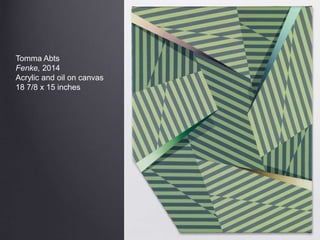
Tomma Abts
Fenke, 2014
Acrylic and oil on canvas
18 7/8 x 15 inches
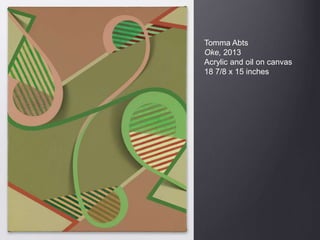
Tomma Abts
Oke, 2013
Acrylic and oil on canvas
18 7/8 x 15 inches
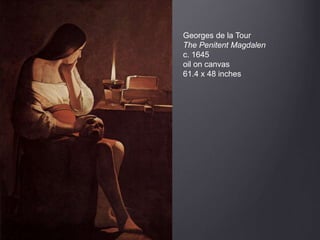
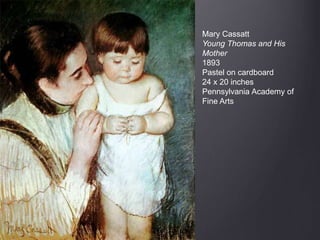
light
how does light appear in the picture?
where are the highlights (brightest spots) in the picture)
from what direction is the light cast?
does the light create a point of emphasis?
Georges de la Tour
The Penitent Magdalen
c. 1645
oil on canvas
61.4 x 48 inches
Weegee (Arthur Fellig), Two Offenders in the Paddywagon
Mary Cassatt
Young Thomas and His
Mother
1893
Pastel on cardboard
24 x 20 inches
Pennsylvania Academy of
Fine Arts
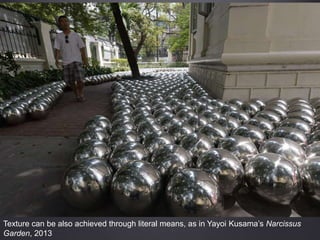
texture/materials
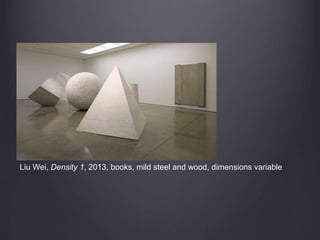
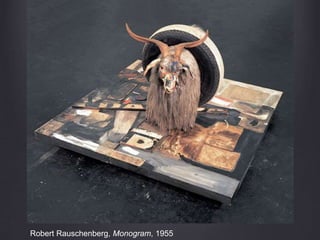
• in contemporary art especially, artists often use materials
for expressive purposes; almost anything and everything
can be used as an art material
• texture can be a result of the specific qualities of the
chosen material
• texture can also be the result of specific handling of the
material; for example, scribbling or scratching
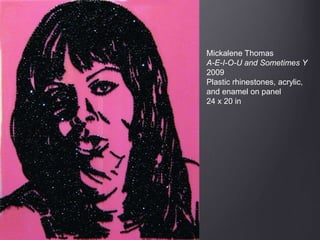
Mickalene Thomas
A-E-I-O-U and Sometimes Y
2009
Plastic rhinestones, acrylic,
and enamel on panel
24 x 20 in
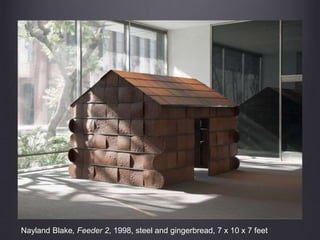
Nayland Blake, Feeder 2, 1998, steel and gingerbread, 7 x 10 x 7 feet
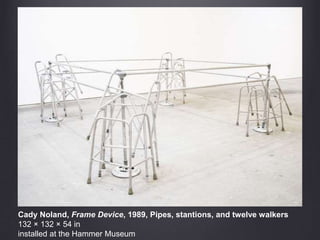
Cady Noland, Frame Device, 1989, Pipes, stantions, and twelve walkers
132 × 132 × 54 in
installed at the Hammer Museum
Liu Wei, Density 1, 2013, books, mild steel and wood, dimensions variable
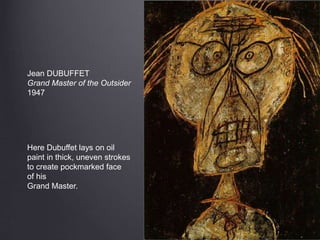
Jean DUBUFFET
Grand Master of the Outsider
1947
Here Dubuffet lays on oil
paint in thick, uneven strokes
to create pockmarked face
of his
Grand Master.
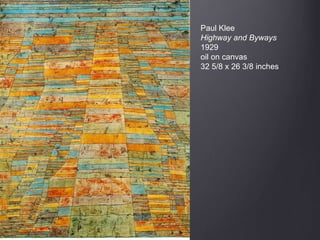
Paul Klee
Highway and Byways
1929
oil on canvas
32 5/8 x 26 3/8 inches
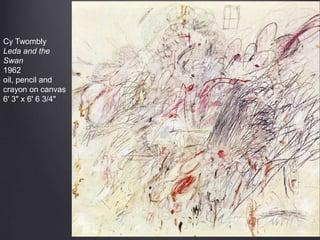
Cy Twombly
Leda and the
Swan
1962
oil, pencil and
crayon on canvas
6' 3" x 6' 6 3/4"
Texture can be also achieved through literal means, as in Yayoi Kusama’s Narcissus
Garden, 2013
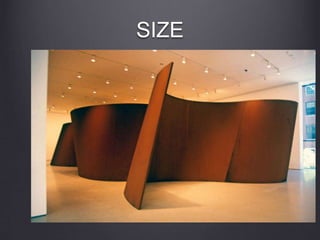
SIZE
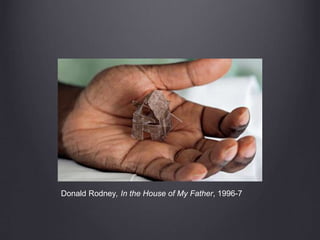
Donald Rodney, In the House of My Father, 1996-7
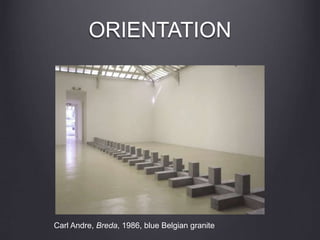
ORIENTATION
Carl Andre, Breda, 1986, blue Belgian granite
Robert Rauschenberg, Monogram, 1955
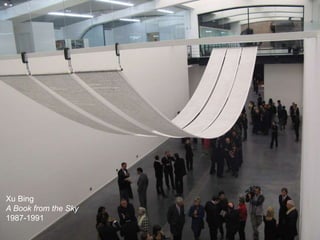
Xu Bing
A Book from the Sky
1987-1991
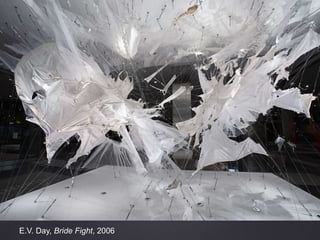
E.V. Day, Bride Fight, 2006
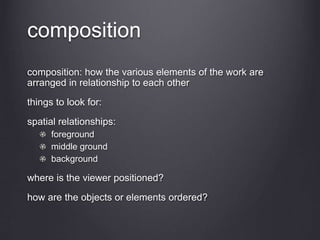
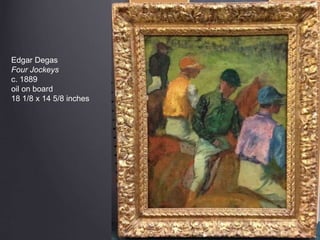
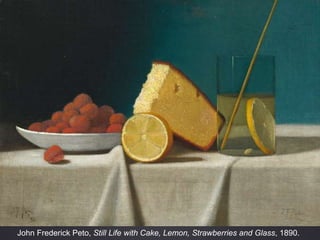
composition
composition: how the various elements of the work are
arranged in relationship to each other
things to look for:
spatial relationships:
foreground
middle ground
background
where is the viewer positioned?
how are the objects or elements ordered?
Edgar Degas
Four Jockeys
c. 1889
oil on board
18 1/8 x 14 5/8 inches
John Frederick Peto, Still Life with Cake, Lemon, Strawberries and Glass, 1890.
guidelines
• medium/materials (what is it made of?)
• subject matter/genre (keep very brief for now)
• composition
• line
• color
• shape
• texture
• size
• orientation
REMEMBER, not all of these categories will be applicable to every work of art.
Choose the categories that are most relevant to the work you are considering.
in matters of style…
…nuance is key. You are training your eyes to detect subtle
differences, rather than blatant ones.
The more fine-grained the differences you can observe, the
better you will have understood the artist’s style.
“God is in the details.”

Fall15Module5.2

Editor's Notes

  • #6 Jean August Dominique Ingres
  • #33 Bridget Riley, Hesitate, 1964 Oil paint on canvas Dimensions Support: 1067 x 1124 mm
  • #55 Robert Rauschenberg, Monogram, 1955