PrinciplesElementsAndArtOfBy Natalie BurrVAEDU 326
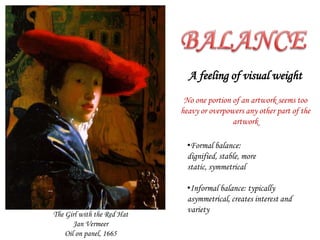
BALANCEA feeling of visual weightNo one portion of an artwork seems too heavy or overpowers any other part of the artworkFormal balance: dignified, stable, more static, symmetrical
Informal balance: typically asymmetrical, creates interest and varietyThe Girl with the Red Hat Jan Vermeer Oil on panel, 1665
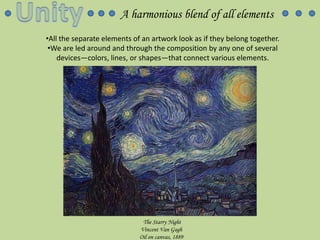
UnityA harmonious blend of all elementsAll the separate elements of an artwork look as if they belong together.
We are led around and through the composition by any one of several devices—colors, lines, or shapes—that connect various elements.   The Starry NightVincent Van GoghOil on canvas, 1889
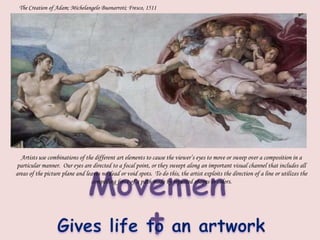
The Creation of Adam; Michelangelo Buonarroti; Fresco, 1511Artists use combinations of the different art elements to cause the viewer’s eyes to move or sweep over a composition in a particular manner.  Our eyes are directed to a focal point, or they sweept along an important visual channel that includes all areas of the picture plane and leaves no dead or void spots.  To do this, the artist exploits the direction of a line or utilizes the compelling force of a path made by repeated shapes or colors.MovementGives life to an artwork
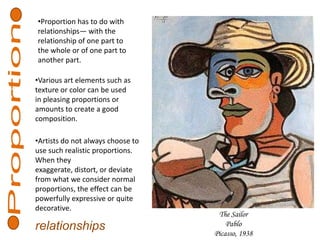
Proportion has to do with relationships— with the relationship of one part to the whole or of one part to another part.
Various art elements such as texture or color can be used in pleasing proportions or amounts to create a good composition.ProportionArtists do not always choose to use such realistic proportions.  When they exaggerate, distort, or deviate from what we consider normal proportions, the effect can be powerfully expressive or quite decorative.The SailorPablo Picasso, 1938relationships
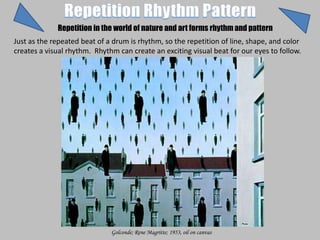
Repetition Rhythm PatternRepetition in the world of nature and art forms rhythm and patternJust as the repeated beat of a drum is rhythm, so the repetition of line, shape, and color creates a visual rhythm.  Rhythm can create an exciting visual beat for our eyes to follow.Golconde; Rene Magritte; 1953, oil on canvas
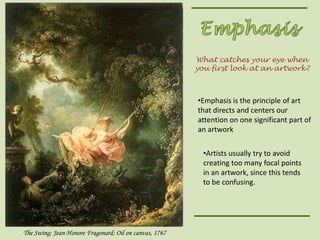
EmphasisWhat catches your eye when you first look at an artwork?Emphasis is the principle of art that directs and centers our attention on one significant part of an artwork
Artists usually try to avoid  creating too many focal points in an artwork, since this tends to be confusing.The Swing; Jean-Honore Fragonard; Oil on canvas, 1767
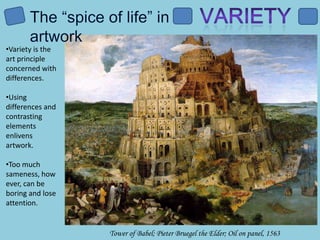
VarietyThe “spice of life” in artworkVariety is the art principle concerned with differences.
Using differences and contrasting elements enlivens artwork.
Too much sameness, however, can be boring and lose attention.Tower of Babel; Pieter Bruegel the Elder; Oil on panel, 1563

Principles and Elements of Art Slideshow

  • 1.
  • 2.
    BALANCEA feeling ofvisual weightNo one portion of an artwork seems too heavy or overpowers any other part of the artworkFormal balance: dignified, stable, more static, symmetrical
  • 3.
    Informal balance: typicallyasymmetrical, creates interest and varietyThe Girl with the Red Hat Jan Vermeer Oil on panel, 1665
  • 4.
    UnityA harmonious blendof all elementsAll the separate elements of an artwork look as if they belong together.
  • 5.
    We are ledaround and through the composition by any one of several devices—colors, lines, or shapes—that connect various elements. The Starry NightVincent Van GoghOil on canvas, 1889
  • 6.
    The Creation ofAdam; Michelangelo Buonarroti; Fresco, 1511Artists use combinations of the different art elements to cause the viewer’s eyes to move or sweep over a composition in a particular manner. Our eyes are directed to a focal point, or they sweept along an important visual channel that includes all areas of the picture plane and leaves no dead or void spots. To do this, the artist exploits the direction of a line or utilizes the compelling force of a path made by repeated shapes or colors.MovementGives life to an artwork
  • 7.
    Proportion has todo with relationships— with the relationship of one part to the whole or of one part to another part.
  • 8.
    Various art elementssuch as texture or color can be used in pleasing proportions or amounts to create a good composition.ProportionArtists do not always choose to use such realistic proportions. When they exaggerate, distort, or deviate from what we consider normal proportions, the effect can be powerfully expressive or quite decorative.The SailorPablo Picasso, 1938relationships
  • 9.
    Repetition Rhythm PatternRepetitionin the world of nature and art forms rhythm and patternJust as the repeated beat of a drum is rhythm, so the repetition of line, shape, and color creates a visual rhythm. Rhythm can create an exciting visual beat for our eyes to follow.Golconde; Rene Magritte; 1953, oil on canvas
  • 10.
    EmphasisWhat catches youreye when you first look at an artwork?Emphasis is the principle of art that directs and centers our attention on one significant part of an artwork
  • 11.
    Artists usually tryto avoid creating too many focal points in an artwork, since this tends to be confusing.The Swing; Jean-Honore Fragonard; Oil on canvas, 1767
  • 12.
    VarietyThe “spice oflife” in artworkVariety is the art principle concerned with differences.
  • 13.
    Using differences andcontrasting elements enlivens artwork.
  • 14.
    Too much sameness,however, can be boring and lose attention.Tower of Babel; Pieter Bruegel the Elder; Oil on panel, 1563