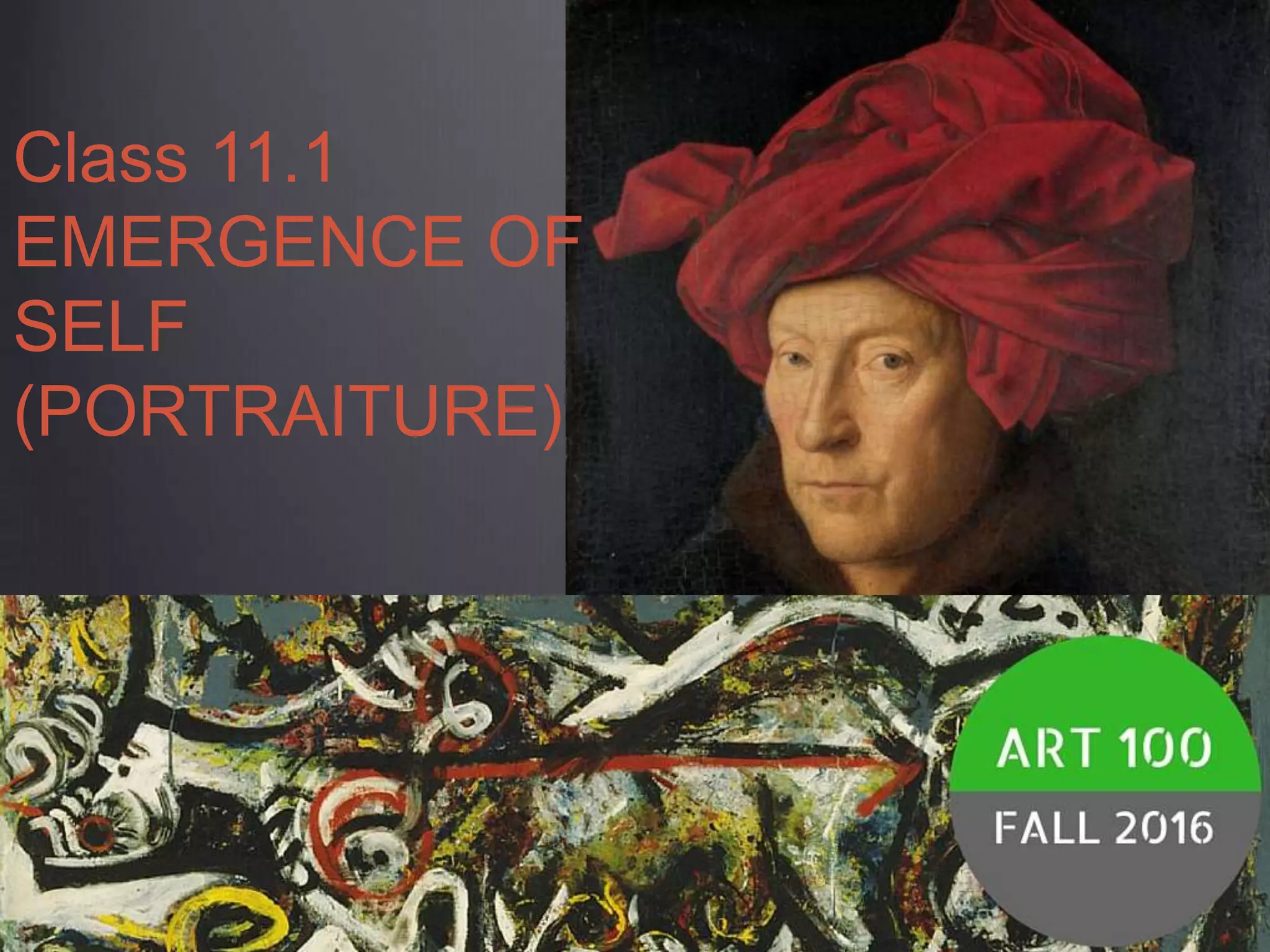
Class 11.1
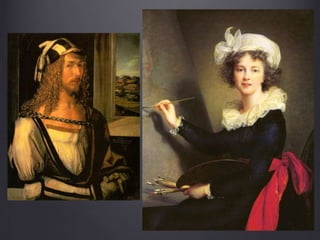
EMERGENCE OF
SELF
(PORTRAITURE)
AGENDA 11.1.16
assign paper
some key characteristics of Renaissance art
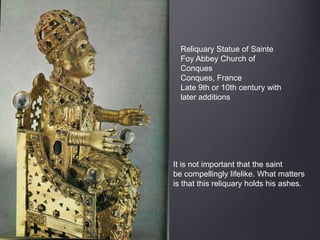
Reliquary Statue of Sainte
Foy Abbey Church of
Conques
Conques, France
Late 9th or 10th century with
later additions
It is not important that the saint
be compellingly lifelike. What matters
is that this reliquary holds his ashes.
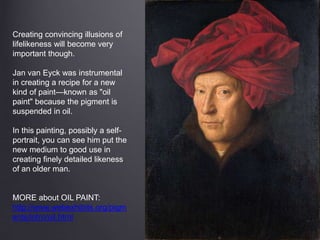
Creating convincing illusions of
lifelikeness will become very
important though.
Jan van Eyck was instrumental
in creating a recipe for a new
kind of paint—known as "oil
paint" because the pigment is
suspended in oil.
In this painting, possibly a self-
portrait, you can see him put the
new medium to good use in
creating finely detailed likeness
of an older man.
MORE about OIL PAINT:
http://www.webexhibits.org/pigm
ents/intro/oil.html
a new style emerges:
representational painting
• Oil paint is a new innovation. It can be applied in very thin
layers, allowing for finely detailed textures that
differentiate skin, hair, fabrics, etc.
• The rules of perspective are codified. Perspective is a way
of dividing and structuring a two-dimensional surface to
produce an illusion of three-dimensional space.
• The direct study of the human body allows for more lifelike
representations of its proportions, skeleton, and
musculature. Some artists even get involved in the (still-
illegal) practice of dissecting the human body to
understand its anatomy.
Taken together, these new
techniques allow artists to
create works that create the
illusion of actual bodies in
space more compellingly
than ever before...
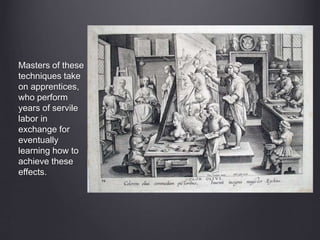
Masters of these
techniques take
on apprentices,
who perform
years of servile
labor in
exchange for
eventually
learning how to
achieve these
effects.
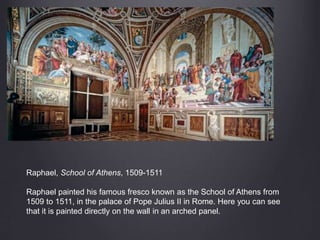
Raphael, School of Athens, 1509-1511
Raphael painted his famous fresco known as the School of Athens from
1509 to 1511, in the palace of Pope Julius II in Rome. Here you can see
that it is painted directly on the wall in an arched panel.
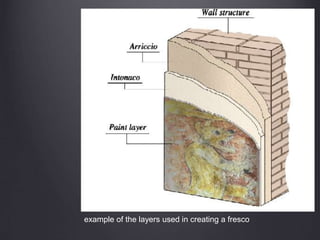
example of the layers used in creating a fresco
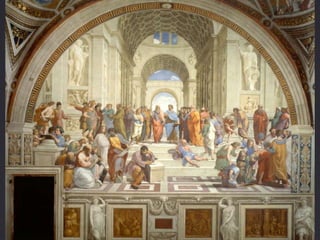
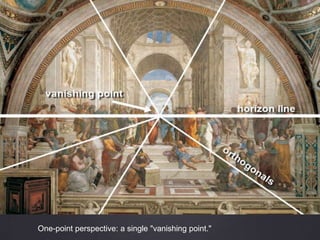
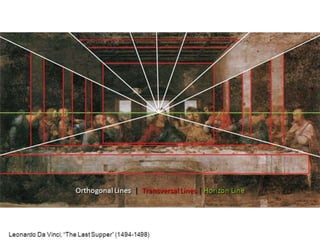
One-point perspective: a single "vanishing point."
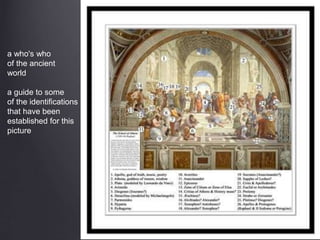
a who's who
of the ancient
world
a guide to some
of the identifications
that have been
established for this
picture
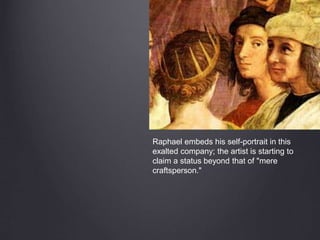
Raphael embeds his self-portrait in this
exalted company; the artist is starting to
claim a status beyond that of "mere
craftsperson."
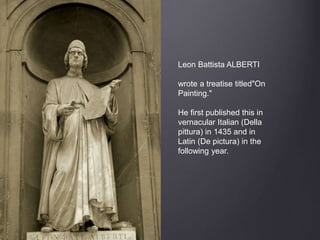
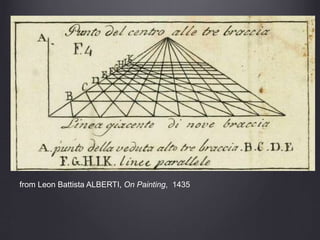
Leon Battista ALBERTI
wrote a treatise titled"On
Painting."
He first published this in
vernacular Italian (Della
pittura) in 1435 and in
Latin (De pictura) in the
following year.
from Leon Battista ALBERTI, On Painting, 1435
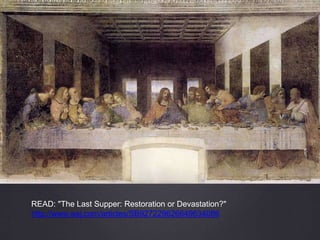
READ: "The Last Supper: Restoration or Devastation?"
http://www.wsj.com/articles/SB927229626649634086
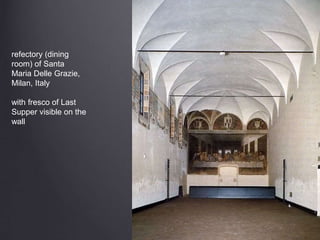
refectory (dining
room) of Santa
Maria Delle Grazie,
Milan, Italy
with fresco of Last
Supper visible on the
wall
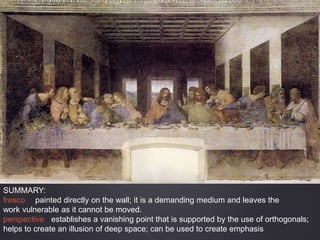
SUMMARY:
fresco painted directly on the wall; it is a demanding medium and leaves the
work vulnerable as it cannot be moved.
perspective establishes a vanishing point that is supported by the use of orthogonals;
helps to create an illusion of deep space; can be used to create emphasis

ART100_Fall2016_Class11.1

  • 1.
  • 2.
    AGENDA 11.1.16 assign paper somekey characteristics of Renaissance art
  • 3.
    Reliquary Statue ofSainte Foy Abbey Church of Conques Conques, France Late 9th or 10th century with later additions It is not important that the saint be compellingly lifelike. What matters is that this reliquary holds his ashes.
  • 4.
    Creating convincing illusionsof lifelikeness will become very important though. Jan van Eyck was instrumental in creating a recipe for a new kind of paint—known as "oil paint" because the pigment is suspended in oil. In this painting, possibly a self- portrait, you can see him put the new medium to good use in creating finely detailed likeness of an older man. MORE about OIL PAINT: http://www.webexhibits.org/pigm ents/intro/oil.html
  • 6.
    a new styleemerges: representational painting • Oil paint is a new innovation. It can be applied in very thin layers, allowing for finely detailed textures that differentiate skin, hair, fabrics, etc. • The rules of perspective are codified. Perspective is a way of dividing and structuring a two-dimensional surface to produce an illusion of three-dimensional space. • The direct study of the human body allows for more lifelike representations of its proportions, skeleton, and musculature. Some artists even get involved in the (still- illegal) practice of dissecting the human body to understand its anatomy.
  • 7.
    Taken together, thesenew techniques allow artists to create works that create the illusion of actual bodies in space more compellingly than ever before...
  • 8.
    Masters of these techniquestake on apprentices, who perform years of servile labor in exchange for eventually learning how to achieve these effects.
  • 9.
    Raphael, School ofAthens, 1509-1511 Raphael painted his famous fresco known as the School of Athens from 1509 to 1511, in the palace of Pope Julius II in Rome. Here you can see that it is painted directly on the wall in an arched panel.
  • 10.
    example of thelayers used in creating a fresco
  • 13.
    One-point perspective: asingle "vanishing point."
  • 14.
    a who's who ofthe ancient world a guide to some of the identifications that have been established for this picture
  • 15.
    Raphael embeds hisself-portrait in this exalted company; the artist is starting to claim a status beyond that of "mere craftsperson."
  • 16.
    Leon Battista ALBERTI wrotea treatise titled"On Painting." He first published this in vernacular Italian (Della pittura) in 1435 and in Latin (De pictura) in the following year.
  • 17.
    from Leon BattistaALBERTI, On Painting, 1435
  • 18.
    READ: "The LastSupper: Restoration or Devastation?" http://www.wsj.com/articles/SB927229626649634086
  • 19.
    refectory (dining room) ofSanta Maria Delle Grazie, Milan, Italy with fresco of Last Supper visible on the wall
  • 21.
    SUMMARY: fresco painted directlyon the wall; it is a demanding medium and leaves the work vulnerable as it cannot be moved. perspective establishes a vanishing point that is supported by the use of orthogonals; helps to create an illusion of deep space; can be used to create emphasis