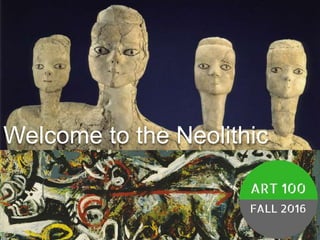
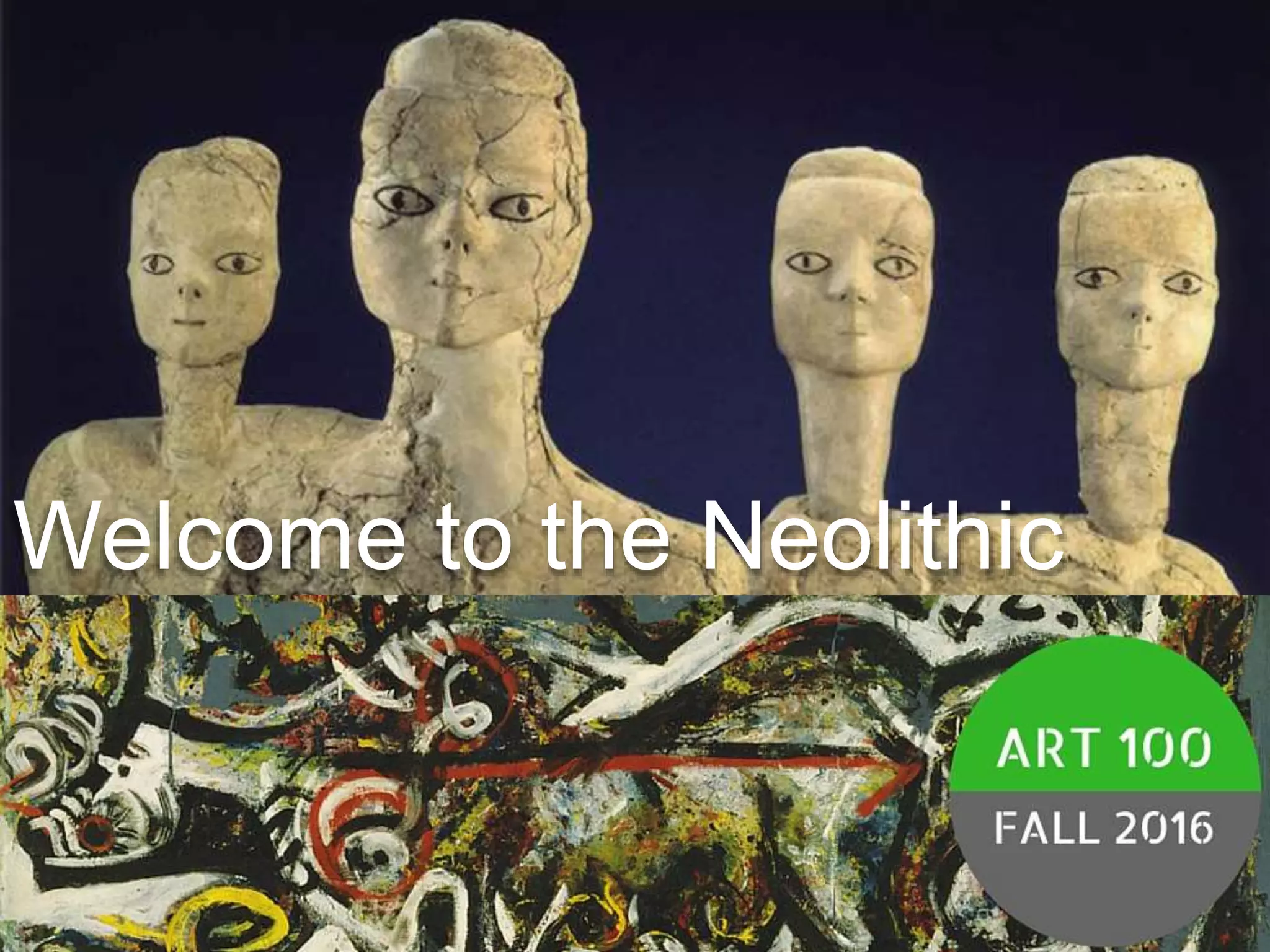




Welcome to the Neolithic
Paleolithic art
• jewelry, body decoration
• manuports (small portable carved objects)
• cave paintings
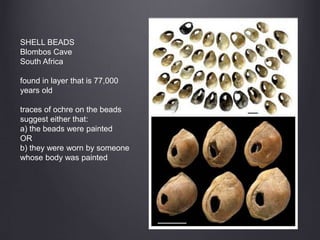
SHELL BEADS
Blombos Cave
South Africa
found in layer that is 77,000
years old
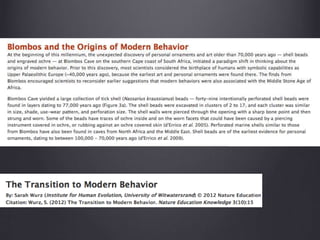
traces of ochre on the beads
suggest either that:
a) the beads were painted
OR
b) they were worn by someone
whose body was painted
http://www.hikarucho.com/
ritual/ceremony?
or, visualization?
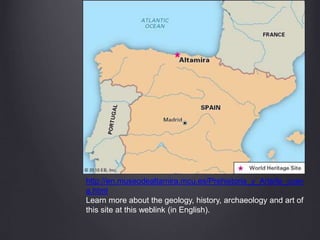
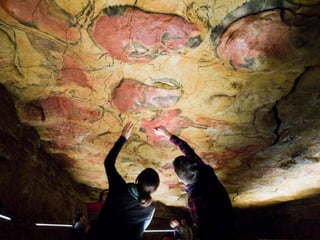
Cave of Altamira, Cantabria, Spain
Cave of Altamira
Santillana del Mar
Cantabria, Spain
oldest layers are 35,000
years ago
http://en.museodealtamira.mcu.es/Prehistoria_y_Arte/la_cuev
a.html
Learn more about the geology, history, archaeology and art of
this site at this weblink (in English).
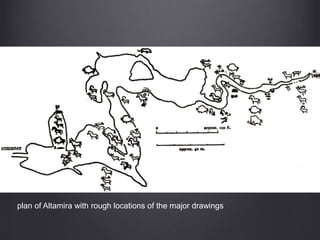
plan of Altamira with rough locations of the major drawings
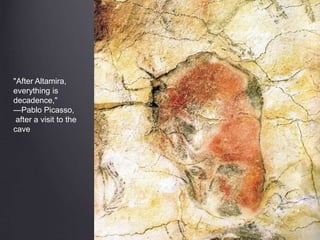
"After Altamira,
everything is
decadence,"
—Pablo Picasso,
after a visit to the
cave
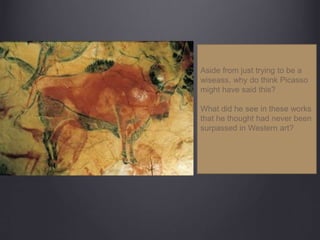
Aside from just trying to be a
wiseass, why do think Picasso
might have said this?
What did he see in these works
that he thought had never been
surpassed in Western art?
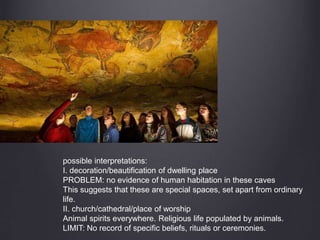
possible interpretations:
I. decoration/beautification of dwelling place
PROBLEM: no evidence of human habitation in these caves
This suggests that these are special spaces, set apart from ordinary
life.
II. church/cathedral/place of worship
Animal spirits everywhere. Religious life populated by animals.
LIMIT: No record of specific beliefs, rituals or ceremonies.
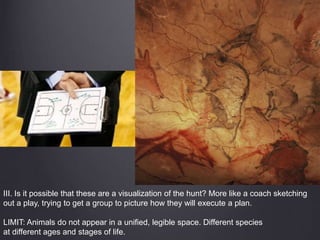
III. Is it possible that these are a visualization of the hunt? More like a coach sketching
out a play, trying to get a group to picture how they will execute a plan.
LIMIT: Animals do not appear in a unified, legible space. Different species
at different ages and stages of life.
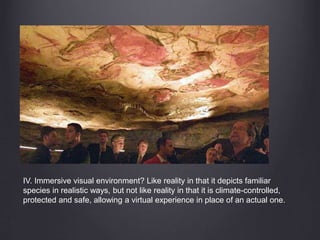
IV. Immersive visual environment? Like reality in that it depicts familiar
species in realistic ways, but not like reality in that it is climate-controlled,
protected and safe, allowing a virtual experience in place of an actual one.
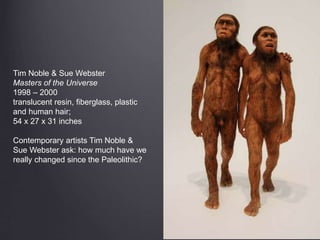
Tim Noble & Sue Webster
Masters of the Universe
1998 – 2000
translucent resin, fiberglass, plastic
and human hair;
54 x 27 x 31 inches
Contemporary artists Tim Noble &
Sue Webster ask: how much have we
really changed since the Paleolithic?
“When humans first gave up the dangerous and uncertain life of
the hunter and gatherer for the more predictable and stable life
of the farmer and herder, the change in human society was so
significant that historians justly have dubbed it the Neolithic
Revolution.”
—Stephen S. Kleiner, Art: A Global History (2012)
“Neolithic Revolution” –
the textbook view
“Besides malnutrition, starvation, and epidemic
diseases, farming helped bring another curse
upon humanity: deep class divisions. Hunter-
gatherers have little or no stored food, and no
concentrated food sources, like an orchard or a
herd of cows: they live off the wild plants and
animals they obtain each day. Therefore, there
can be no kings, no class of social parasites who
grow fat on food seized from others. Only in a
farming population could a healthy, non-
producing élite set itself above the disease-
ridden masses.”
—Jared Diamond, “The Worst
Mistake in the History of the Human Race”
“Neolithic Revolution” –
alternative view
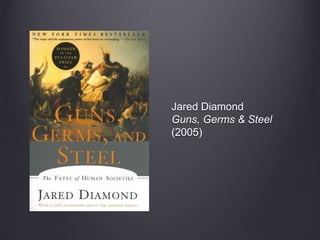
Jared Diamond
Guns, Germs & Steel
(2005)
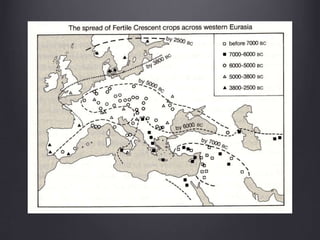
The transition to food production
in the Fertile Crescent begins
around 8500 BC, not 18,500 or
28,500 BC.
Why not earlier?
• Before that time, hunting-gathering was more
rewarding than food production because:
• Wild mammals were still abundant (gazelles)
• Wild cereals were not yet abundant
• People had not yet developed technology
necessary for harvesting and storing grains
(sickles with flint blades for harvest; baskets for
carrying grain, mortars and pestles to remove the
husks; technique of roasting grains so they could
be stored without sprouting; plastered underground
storage pits)
• Population density was low enough that people
didn’t have to worry about extracting the maximum
number of calories per acre.
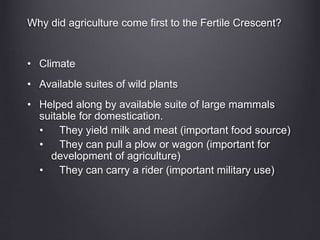
Why did agriculture come first to the Fertile Crescent?
• Climate
• Available suites of wild plants
• Helped along by available suite of large mammals
suitable for domestication.
• They yield milk and meat (important food source)
• They can pull a plow or wagon (important for
development of agriculture)
• They can carry a rider (important military use)
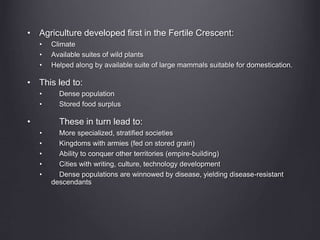
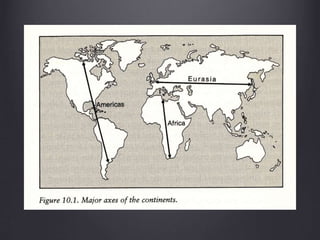
• Agriculture developed first in the Fertile Crescent:
• Climate
• Available suites of wild plants
• Helped along by available suite of large mammals suitable for domestication.
• This led to:
• Dense population
• Stored food surplus
• These in turn lead to:
• More specialized, stratified societies
• Kingdoms with armies (fed on stored grain)
• Ability to conquer other territories (empire-building)
• Cities with writing, culture, technology development
• Dense populations are winnowed by disease, yielding disease-resistant
descendants
Diamond’s purpose is actually to
understand why Europe dominated
the world from the 16th-19th centuries
But for right now, let’s think about his argument as it applies in the initial
context he discusses, Mesopotamian agricultural dominance (and
consequently, military, political and religious dominance).
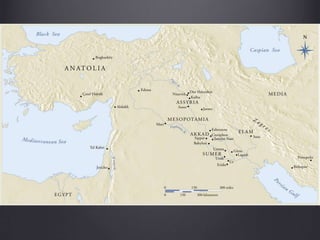
This is the later, Greek name for this area between the Tigris
and Euphrates Rivers, which feed into the Persian Gulf.
It means “land between two rivers.” An alluvial floodplain, this
area was perfect for agriculture (when not actually
flooded!). Myths about floods abound in the
Mesopotamian religions.
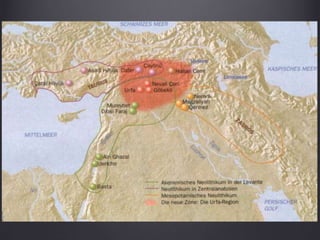
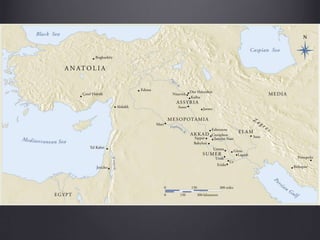
what is Mesopotamia?
Looking at the map, you can see that numerous towns and cities
grew up in this rich agricultural area that yielded plenty of crops to
sustain larger populations.
As Jared Diamond would predict, more intensive agriculture
went hand in hand with population growth. Agricultural
surplus was the basis for the first taxes, which went to the
temple to provide offerings to the gods, and to the king to
provide military protection.
A stratified society becomes possible.
Most are farmers; a small elite serves as priests, nobles, and
kings.
Welcome to the Neolithic...
• Beginning of AGRICULTURE:
• Oldest communities near the Tigris & Euphrates rivers in
Mesopotamia. [part of modern day Syria/Iraq]
• Neolithic innovations: systematic agriculture, weaving, metalworking,
pottery, and counting & recording with tokens.
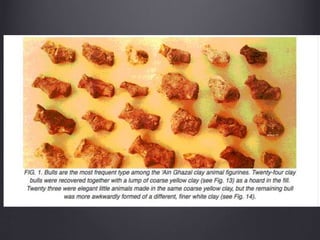
• Ain Ghazal
• Catal Huyuk
• Gobekli Tepe
• Jericho
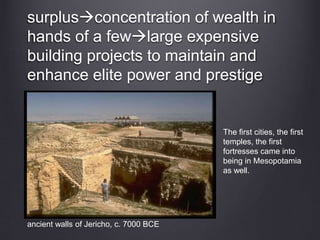
surplusconcentration of wealth in
hands of a fewlarge expensive
building projects to maintain and
enhance elite power and prestige
The first cities, the first
temples, the first
fortresses came into
being in Mesopotamia
as well.
ancient walls of Jericho, c. 7000 BCE
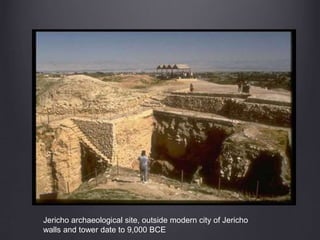
Jericho archaeological site, outside modern city of Jericho
walls and tower date to 9,000 BCE
34
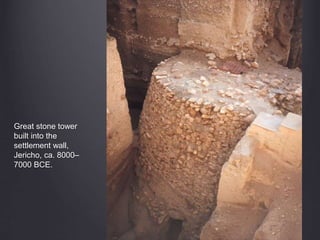
Great stone tower
built into the
settlement wall,
Jericho, ca. 8000–
7000 BCE.
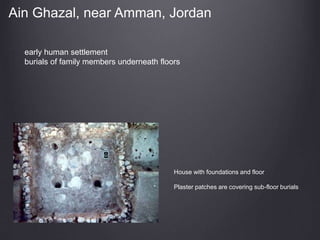
House with foundations and floor
Plaster patches are covering sub-floor burials
Ain Ghazal, near Amman, Jordan
early human settlement
burials of family members underneath floors
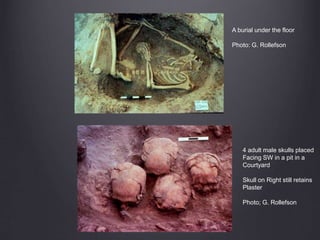
A burial under the floor
Photo: G. Rollefson
4 adult male skulls placed
Facing SW in a pit in a
Courtyard
Skull on Right still retains
Plaster
Photo; G. Rollefson
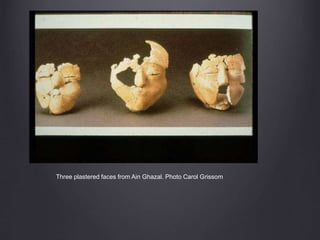
Three plastered faces from Ain Ghazal. Photo Carol Grissom
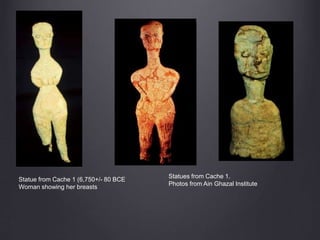
Statue from Cache 1 (6,750+/- 80 BCE
Woman showing her breasts
Statues from Cache 1.
Photos from Ain Ghazal Institute
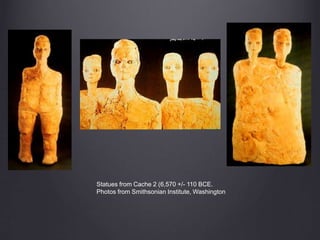
Statues from Cache 2 (6,570 +/- 110 BCE.
Photos from Smithsonian Institute, Washington
41
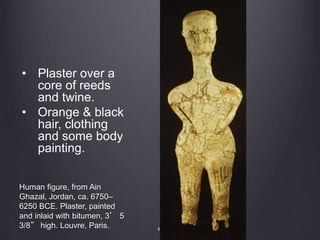
Human figure, from Ain
Ghazal, Jordan, ca. 6750–
6250 BCE. Plaster, painted
and inlaid with bitumen, 3’ 5
3/8” high. Louvre, Paris.
• Plaster over a
core of reeds
and twine.
• Orange & black
hair, clothing
and some body
painting.
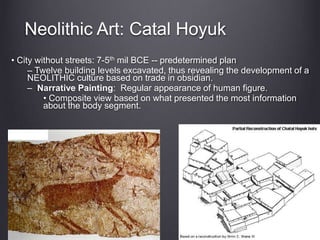
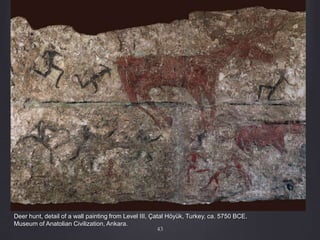
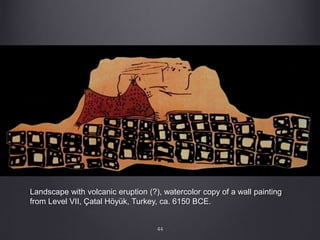
Neolithic Art: Catal Hoyuk
• City without streets: 7-5th mil BCE -- predetermined plan
– Twelve building levels excavated, thus revealing the development of a
NEOLITHIC culture based on trade in obsidian.
– Narrative Painting: Regular appearance of human figure.
• Composite view based on what presented the most information
about the body segment.
43
Deer hunt, detail of a wall painting from Level III, Çatal Höyük, Turkey, ca. 5750 BCE.
Museum of Anatolian Civilization, Ankara.
Landscape with volcanic eruption (?), watercolor copy of a wall painting
from Level VII, Çatal Höyük, Turkey, ca. 6150 BCE.
44
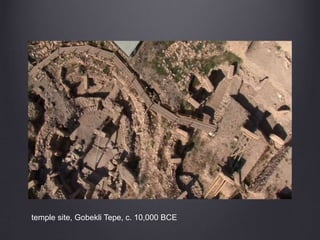
temple site, Gobekli Tepe, c. 10,000 BCE
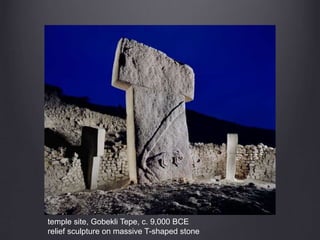
temple site, Gobekli Tepe, c. 9,000 BCE
relief sculpture on massive T-shaped stone
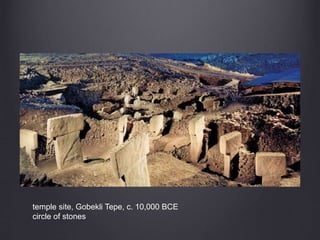
temple site, Gobekli Tepe, c. 10,000 BCE
circle of stones
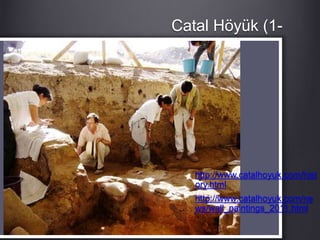
Catal Höyük (1-
16), c. 7400
BCE
http://www.catalhoyuk.com/hist
ory.html
http://www.catalhoyuk.com/ne
ws/wall_paintings_2011.html
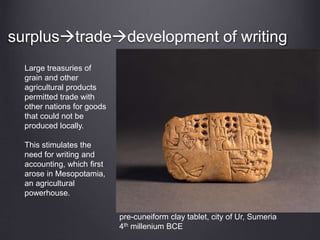
surplustradedevelopment of writing
Large treasuries of
grain and other
agricultural products
permitted trade with
other nations for goods
that could not be
produced locally.
This stimulates the
need for writing and
accounting, which first
arose in Mesopotamia,
an agricultural
powerhouse.
pre-cuneiform clay tablet, city of Ur, Sumeria
4th millenium BCE
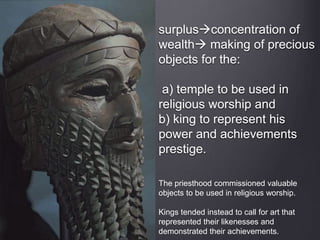
The priesthood commissioned valuable
objects to be used in religious worship.
Kings tended instead to call for art that
represented their likenesses and
demonstrated their achievements.
surplusconcentration of
wealth making of precious
objects for the:
a) temple to be used in
religious worship and
b) king to represent his
power and achievements
prestige.
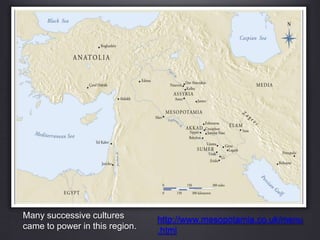
Many successive cultures
came to power in this region.
http://www.mesopotamia.co.uk/menu
.html
Among them were…
Sumerians
Elamites
Akkadians
Babylonians
Assyrians
neo-Sumerians
and neo-Babylonians!
Although there was a lot of complexity in terms of changing
centers of power, changing rulers, and changing religious
beliefs, these societies also had a great deal in common.
To keep things simple, we are going to look primarily at
artifacts from the first culture to come into ascendance in
the region, the Sumerians.
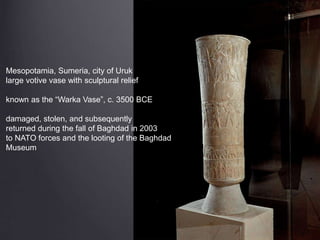
Mesopotamia, Sumeria, city of Uruk
large votive vase with sculptural relief
known as the “Warka Vase”, c. 3500 BCE
damaged, stolen, and subsequently
returned during the fall of Baghdad in 2003
to NATO forces and the looting of the Baghdad
Museum
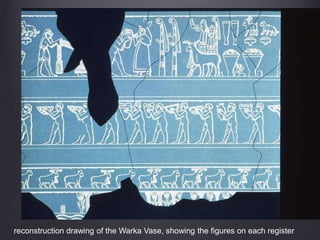
reconstruction drawing of the Warka Vase, showing the figures on each register
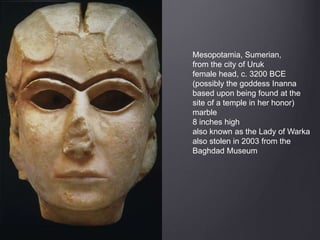
Mesopotamia, Sumerian,
from the city of Uruk
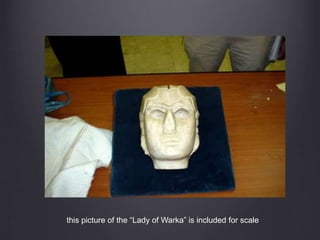
female head, c. 3200 BCE
(possibly the goddess Inanna
based upon being found at the
site of a temple in her honor)
marble
8 inches high
also known as the Lady of Warka
also stolen in 2003 from the
Baghdad Museum
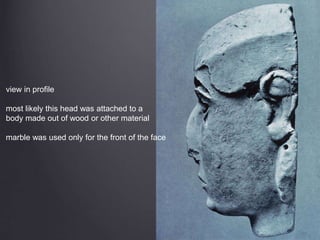
view in profile
most likely this head was attached to a
body made out of wood or other material
marble was used only for the front of the face
this picture of the “Lady of Warka” is included for scale
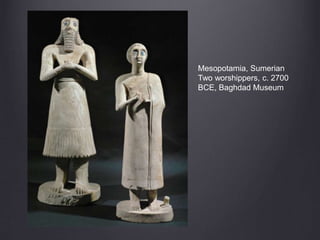
Mesopotamia, Sumerian
Two worshippers, c. 2700
BCE, Baghdad Museum
Votive Figures, c. 2700 B.C.E. limestone;
Square Temple in Eshnunna (Tell Asmar, Iraq).
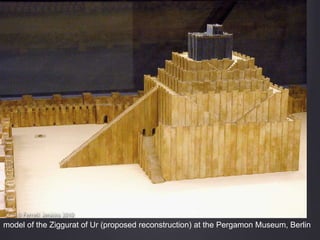
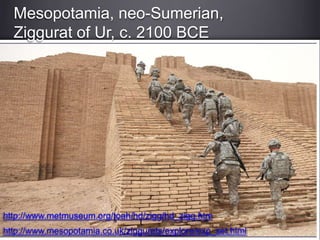
model of the Ziggurat of Ur (proposed reconstruction) at the Pergamon Museum, Berlin
Mesopotamia, neo-Sumerian,
Ziggurat of Ur, c. 2100 BCE
http://www.metmuseum.org/toah/hd/zigg/hd_zigg.htm
http://www.mesopotamia.co.uk/ziggurats/explore/exp_set.html
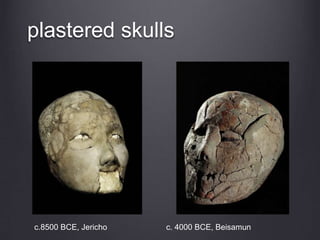
plastered skulls
c.8500 BCE, Jericho c. 4000 BCE, Beisamun
Prehistoric (before
the invention of
writing)
Europe: France,
Spain
[Central Europe]
[China]
[India]
[Japan]
[Korea]
[Africa]
Paleolithic
Multiple hominin
species
Simple stone tools
Hunting-gathering
Neolithic
Homo sapiens
Transition to
agriculture
Settlements, food
storage, stratification
by wealth and
profession, religion

Uvc100 fall2016 class8.2

  • 1.
    Welcome to theNeolithic
  • 2.
    Paleolithic art • jewelry,body decoration • manuports (small portable carved objects) • cave paintings
  • 3.
    SHELL BEADS Blombos Cave SouthAfrica found in layer that is 77,000 years old traces of ochre on the beads suggest either that: a) the beads were painted OR b) they were worn by someone whose body was painted
  • 5.
  • 6.
  • 7.
    Cave of Altamira Santillanadel Mar Cantabria, Spain oldest layers are 35,000 years ago
  • 8.
    http://en.museodealtamira.mcu.es/Prehistoria_y_Arte/la_cuev a.html Learn more aboutthe geology, history, archaeology and art of this site at this weblink (in English).
  • 9.
    plan of Altamirawith rough locations of the major drawings
  • 10.
    "After Altamira, everything is decadence," —PabloPicasso, after a visit to the cave
  • 11.
    Aside from justtrying to be a wiseass, why do think Picasso might have said this? What did he see in these works that he thought had never been surpassed in Western art?
  • 13.
    possible interpretations: I. decoration/beautificationof dwelling place PROBLEM: no evidence of human habitation in these caves This suggests that these are special spaces, set apart from ordinary life. II. church/cathedral/place of worship Animal spirits everywhere. Religious life populated by animals. LIMIT: No record of specific beliefs, rituals or ceremonies.
  • 14.
    III. Is itpossible that these are a visualization of the hunt? More like a coach sketching out a play, trying to get a group to picture how they will execute a plan. LIMIT: Animals do not appear in a unified, legible space. Different species at different ages and stages of life.
  • 15.
    IV. Immersive visualenvironment? Like reality in that it depicts familiar species in realistic ways, but not like reality in that it is climate-controlled, protected and safe, allowing a virtual experience in place of an actual one.
  • 16.
    Tim Noble &Sue Webster Masters of the Universe 1998 – 2000 translucent resin, fiberglass, plastic and human hair; 54 x 27 x 31 inches Contemporary artists Tim Noble & Sue Webster ask: how much have we really changed since the Paleolithic?
  • 17.
    “When humans firstgave up the dangerous and uncertain life of the hunter and gatherer for the more predictable and stable life of the farmer and herder, the change in human society was so significant that historians justly have dubbed it the Neolithic Revolution.” —Stephen S. Kleiner, Art: A Global History (2012) “Neolithic Revolution” – the textbook view
  • 18.
    “Besides malnutrition, starvation,and epidemic diseases, farming helped bring another curse upon humanity: deep class divisions. Hunter- gatherers have little or no stored food, and no concentrated food sources, like an orchard or a herd of cows: they live off the wild plants and animals they obtain each day. Therefore, there can be no kings, no class of social parasites who grow fat on food seized from others. Only in a farming population could a healthy, non- producing élite set itself above the disease- ridden masses.” —Jared Diamond, “The Worst Mistake in the History of the Human Race” “Neolithic Revolution” – alternative view
  • 19.
  • 20.
    The transition tofood production in the Fertile Crescent begins around 8500 BC, not 18,500 or 28,500 BC. Why not earlier?
  • 21.
    • Before thattime, hunting-gathering was more rewarding than food production because: • Wild mammals were still abundant (gazelles) • Wild cereals were not yet abundant • People had not yet developed technology necessary for harvesting and storing grains (sickles with flint blades for harvest; baskets for carrying grain, mortars and pestles to remove the husks; technique of roasting grains so they could be stored without sprouting; plastered underground storage pits) • Population density was low enough that people didn’t have to worry about extracting the maximum number of calories per acre.
  • 22.
    Why did agriculturecome first to the Fertile Crescent? • Climate • Available suites of wild plants • Helped along by available suite of large mammals suitable for domestication. • They yield milk and meat (important food source) • They can pull a plow or wagon (important for development of agriculture) • They can carry a rider (important military use)
  • 23.
    • Agriculture developedfirst in the Fertile Crescent: • Climate • Available suites of wild plants • Helped along by available suite of large mammals suitable for domestication. • This led to: • Dense population • Stored food surplus • These in turn lead to: • More specialized, stratified societies • Kingdoms with armies (fed on stored grain) • Ability to conquer other territories (empire-building) • Cities with writing, culture, technology development • Dense populations are winnowed by disease, yielding disease-resistant descendants
  • 26.
    Diamond’s purpose isactually to understand why Europe dominated the world from the 16th-19th centuries But for right now, let’s think about his argument as it applies in the initial context he discusses, Mesopotamian agricultural dominance (and consequently, military, political and religious dominance).
  • 27.
    This is thelater, Greek name for this area between the Tigris and Euphrates Rivers, which feed into the Persian Gulf. It means “land between two rivers.” An alluvial floodplain, this area was perfect for agriculture (when not actually flooded!). Myths about floods abound in the Mesopotamian religions. what is Mesopotamia?
  • 28.
    Looking at themap, you can see that numerous towns and cities grew up in this rich agricultural area that yielded plenty of crops to sustain larger populations.
  • 29.
    As Jared Diamondwould predict, more intensive agriculture went hand in hand with population growth. Agricultural surplus was the basis for the first taxes, which went to the temple to provide offerings to the gods, and to the king to provide military protection. A stratified society becomes possible. Most are farmers; a small elite serves as priests, nobles, and kings.
  • 30.
    Welcome to theNeolithic... • Beginning of AGRICULTURE: • Oldest communities near the Tigris & Euphrates rivers in Mesopotamia. [part of modern day Syria/Iraq] • Neolithic innovations: systematic agriculture, weaving, metalworking, pottery, and counting & recording with tokens. • Ain Ghazal • Catal Huyuk • Gobekli Tepe • Jericho
  • 32.
    surplusconcentration of wealthin hands of a fewlarge expensive building projects to maintain and enhance elite power and prestige The first cities, the first temples, the first fortresses came into being in Mesopotamia as well. ancient walls of Jericho, c. 7000 BCE
  • 33.
    Jericho archaeological site,outside modern city of Jericho walls and tower date to 9,000 BCE
  • 34.
    34 Great stone tower builtinto the settlement wall, Jericho, ca. 8000– 7000 BCE.
  • 36.
    House with foundationsand floor Plaster patches are covering sub-floor burials Ain Ghazal, near Amman, Jordan early human settlement burials of family members underneath floors
  • 37.
    A burial underthe floor Photo: G. Rollefson 4 adult male skulls placed Facing SW in a pit in a Courtyard Skull on Right still retains Plaster Photo; G. Rollefson
  • 38.
    Three plastered facesfrom Ain Ghazal. Photo Carol Grissom
  • 39.
    Statue from Cache1 (6,750+/- 80 BCE Woman showing her breasts Statues from Cache 1. Photos from Ain Ghazal Institute
  • 40.
    Statues from Cache2 (6,570 +/- 110 BCE. Photos from Smithsonian Institute, Washington
  • 41.
    41 Human figure, fromAin Ghazal, Jordan, ca. 6750– 6250 BCE. Plaster, painted and inlaid with bitumen, 3’ 5 3/8” high. Louvre, Paris. • Plaster over a core of reeds and twine. • Orange & black hair, clothing and some body painting.
  • 42.
    Neolithic Art: CatalHoyuk • City without streets: 7-5th mil BCE -- predetermined plan – Twelve building levels excavated, thus revealing the development of a NEOLITHIC culture based on trade in obsidian. – Narrative Painting: Regular appearance of human figure. • Composite view based on what presented the most information about the body segment.
  • 43.
    43 Deer hunt, detailof a wall painting from Level III, Çatal Höyük, Turkey, ca. 5750 BCE. Museum of Anatolian Civilization, Ankara.
  • 44.
    Landscape with volcaniceruption (?), watercolor copy of a wall painting from Level VII, Çatal Höyük, Turkey, ca. 6150 BCE. 44
  • 46.
    temple site, GobekliTepe, c. 10,000 BCE
  • 47.
    temple site, GobekliTepe, c. 9,000 BCE relief sculpture on massive T-shaped stone
  • 48.
    temple site, GobekliTepe, c. 10,000 BCE circle of stones
  • 49.
    Catal Höyük (1- 16),c. 7400 BCE http://www.catalhoyuk.com/hist ory.html http://www.catalhoyuk.com/ne ws/wall_paintings_2011.html
  • 50.
    surplustradedevelopment of writing Largetreasuries of grain and other agricultural products permitted trade with other nations for goods that could not be produced locally. This stimulates the need for writing and accounting, which first arose in Mesopotamia, an agricultural powerhouse. pre-cuneiform clay tablet, city of Ur, Sumeria 4th millenium BCE
  • 51.
    The priesthood commissionedvaluable objects to be used in religious worship. Kings tended instead to call for art that represented their likenesses and demonstrated their achievements. surplusconcentration of wealth making of precious objects for the: a) temple to be used in religious worship and b) king to represent his power and achievements prestige.
  • 52.
    Many successive cultures cameto power in this region. http://www.mesopotamia.co.uk/menu .html
  • 53.
  • 54.
    Although there wasa lot of complexity in terms of changing centers of power, changing rulers, and changing religious beliefs, these societies also had a great deal in common. To keep things simple, we are going to look primarily at artifacts from the first culture to come into ascendance in the region, the Sumerians.
  • 56.
    Mesopotamia, Sumeria, cityof Uruk large votive vase with sculptural relief known as the “Warka Vase”, c. 3500 BCE damaged, stolen, and subsequently returned during the fall of Baghdad in 2003 to NATO forces and the looting of the Baghdad Museum
  • 57.
    reconstruction drawing ofthe Warka Vase, showing the figures on each register
  • 58.
    Mesopotamia, Sumerian, from thecity of Uruk female head, c. 3200 BCE (possibly the goddess Inanna based upon being found at the site of a temple in her honor) marble 8 inches high also known as the Lady of Warka also stolen in 2003 from the Baghdad Museum
  • 59.
    view in profile mostlikely this head was attached to a body made out of wood or other material marble was used only for the front of the face
  • 60.
    this picture ofthe “Lady of Warka” is included for scale
  • 61.
    Mesopotamia, Sumerian Two worshippers,c. 2700 BCE, Baghdad Museum
  • 62.
    Votive Figures, c.2700 B.C.E. limestone; Square Temple in Eshnunna (Tell Asmar, Iraq).
  • 63.
    model of theZiggurat of Ur (proposed reconstruction) at the Pergamon Museum, Berlin
  • 64.
    Mesopotamia, neo-Sumerian, Ziggurat ofUr, c. 2100 BCE http://www.metmuseum.org/toah/hd/zigg/hd_zigg.htm http://www.mesopotamia.co.uk/ziggurats/explore/exp_set.html
  • 65.
    plastered skulls c.8500 BCE,Jericho c. 4000 BCE, Beisamun
  • 66.
    Prehistoric (before the inventionof writing) Europe: France, Spain [Central Europe] [China] [India] [Japan] [Korea] [Africa] Paleolithic Multiple hominin species Simple stone tools Hunting-gathering Neolithic Homo sapiens Transition to agriculture Settlements, food storage, stratification by wealth and profession, religion