CLASS 5
UNDERSTANDING FORM
“It’s personal.”
Finding out more is a great
thing to do.
But NO amount of information
will answer all your questions.
There are as many flavors of art
as there are people who make
it.
New flavors are being created
all the time.
You get to pick your favorites.
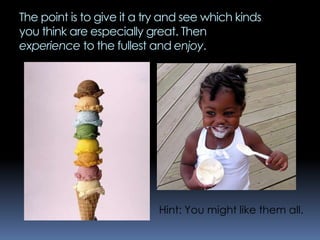
The point is to give it a try and see which kinds
you think are especially great. Then
experience to the fullest and enjoy.
Hint: You might like them all.
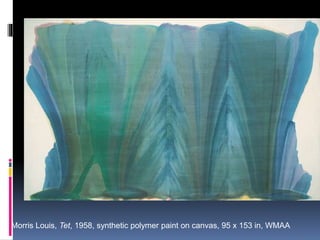
Morris Louis, Tet, 1958, synthetic polymer paint on canvas, 95 x 153 in, WMAA
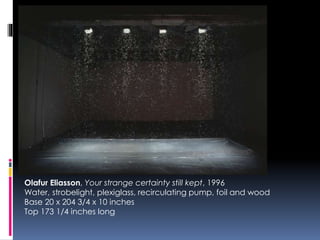
Olafur Eliasson, Your strange certainty still kept, 1996
Water, strobelight, plexiglass, recirculating pump, foil and wood
Base 20 x 204 3/4 x 10 inches
Top 173 1/4 inches long
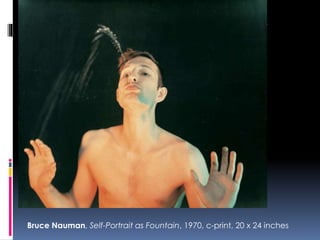
Bruce Nauman, Self-Portrait as Fountain, 1970, c-print, 20 x 24 inches
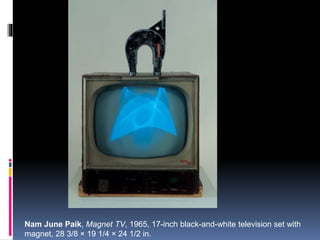
Nam June Paik, Magnet TV, 1965, 17-inch black-and-white television set with
magnet, 28 3/8 × 19 1/4 × 24 1/2 in.
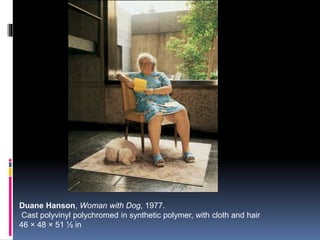
Duane Hanson, Woman with Dog, 1977.
Cast polyvinyl polychromed in synthetic polymer, with cloth and hair
46 × 48 × 51 ½ in
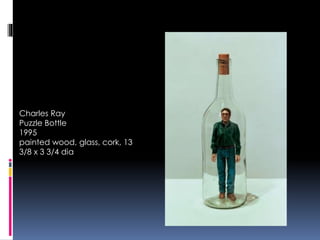
Charles Ray
Puzzle Bottle
1995
painted wood, glass, cork, 13
3/8 x 3 3/4 dia
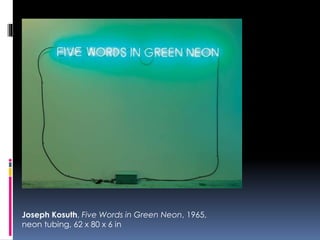
Joseph Kosuth, Five Words in Green Neon, 1965,
neon tubing, 62 x 80 x 6 in
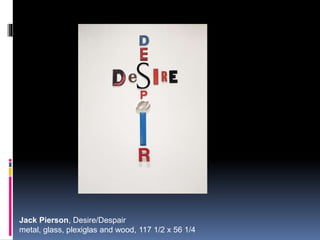
Jack Pierson, Desire/Despair
metal, glass, plexiglas and wood, 117 1/2 x 56 1/4
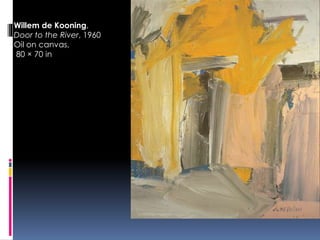
Willem de Kooning,
Door to the River, 1960
Oil on canvas,
80 × 70 in
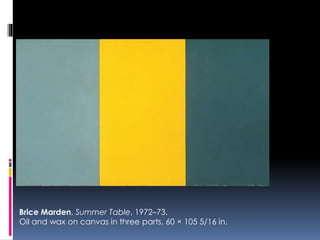
Brice Marden, Summer Table, 1972–73.
Oil and wax on canvas in three parts, 60 × 105 5/16 in.
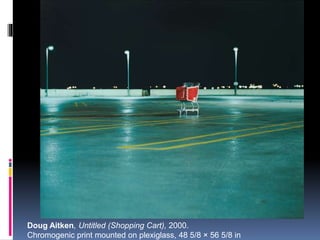
Doug Aitken, Untitled (Shopping Cart), 2000.
Chromogenic print mounted on plexiglass, 48 5/8 × 56 5/8 in
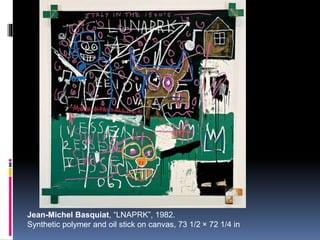
Jean-Michel Basquiat, “LNAPRK”, 1982.
Synthetic polymer and oil stick on canvas, 73 1/2 × 72 1/4 in
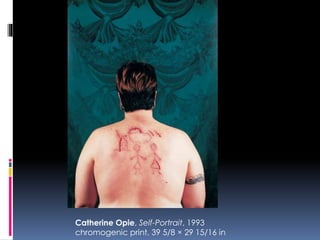
Catherine Opie, Self-Portrait, 1993
chromogenic print, 39 5/8 × 29 15/16 in
You’re allowed to—
supposed to!—respond
personally to artwork.
The artist wants you to have an experience—an
emotional, physical, spiritual, intellectual, moral
(some combination of these or all of them)
experience of the work.
If you like a work of art, you’ll
often want to find out more
about it.
That’s great, find out more, it will enrich your experience of
the work, no doubt about it. But there is no “final correct
answer” to the meaning of a given work. There are more and
less satisfying interpretations, more and less sensitive readings,
but no single reading is ultimately correct.
Like your parents probably told you,
“How do you know you don’t like it if
you won’t even try it?
This class gives you a chance to try out different kinds of art.
There’s no obligation to like the things that I, or your classmates, like.
Pick your own likes and dislikes.
However, you can learn from—even come to appreciate—works you
don’t particularly care for.
SO, HOW DO WE EXPERIENCE
ART TO THE FULLEST?
 One way we try to experience art
more fully is by understanding how it
creates the effects it has on us.
experiencing art
experiencing art
 Experience, with your eyes, mind,
feelings, memories, body. What does
this piece do to me?
 Examples: Does it make me happy?
Uncomfortable? Sad? Upset? Does it turn
my stomach? Does it make me shiver?
Worry? Sweat?
experiencing the effects
 1. Experience comes first. What do you
SEE and how does it make you FEEL in
your bones.
 At this point, it doesn’t matter who made
it, when, or why. The point is to try to
figure out, as completely as possible, the
effect the work is having on you.
 So let’s sum this up as “experiencing the
effects” of the work. This process can
take a while. It is not necessarily simple. In
fact, one definition of art could be work
that takes the viewer some time and
trouble to experience.
accounting for the effects
Now that you have a handle on what
you’ve experienced, you want to know
how the piece made you feel that way. Cf.
driving a car to learning how it actually
works.
This is where formal analysis can be helpful.
How did this piece make me feel (x, y, and
z) way? How is it structured to achieve
those specific effects?
This is where purely personal, idiosyncratic
responses can be weeded out if you are
writing to share with an audience.
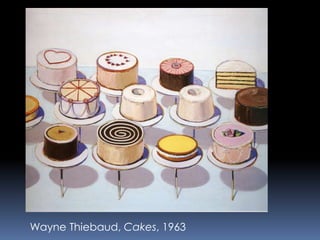
Wayne Thiebaud, Cakes, 1963
Effects 1
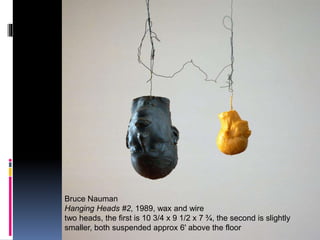
Bruce Nauman
Hanging Heads #2, 1989, wax and wire
two heads, the first is 10 3/4 x 9 1/2 x 7 ¾, the second is slightly
smaller, both suspended approx 6' above the floor
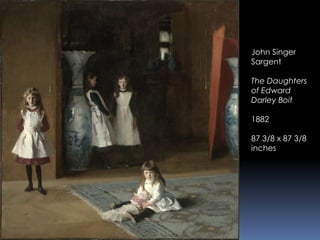
John Singer
Sargent
The Daughters
of Edward
Darley Boit
1882
87 3/8 x 87 3/8
inches
formal analysis
What will
happen in this
movie?
How do you
know?
http://prezi.com/
sazemrmsx16b/
what-is-a-
genre/
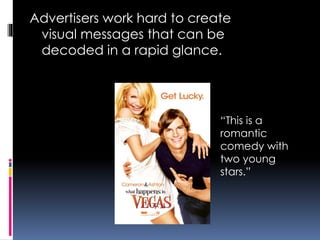
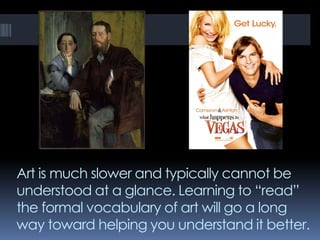
Advertisers work hard to create
visual messages that can be
decoded in a rapid glance.
“This is a
romantic
comedy with
two young
stars.”
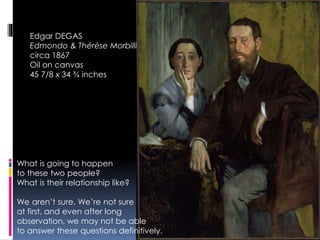
Edgar DEGAS
Edmondo & Thérèse Morbilli
circa 1867
Oil on canvas
45 7/8 x 34 ¾ inches
What is going to happen
to these two people?
What is their relationship like?
We aren’t sure. We’re not sure
at first, and even after long
observation, we may not be able
to answer these questions definitively.
Art is much slower and typically cannot be
understood at a glance. Learning to “read”
the formal vocabulary of art will go a long
way toward helping you understand it better.
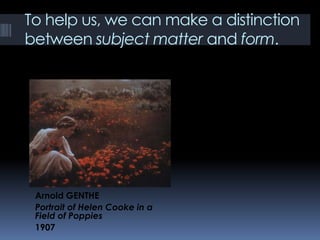
To help us, we can make a distinction
between subject matter and form.
Arnold GENTHE
Portrait of Helen Cooke in a
Field of Poppies
1907
Paula Modersohn-Becker
Old Woman with Poppies
1906
Paula Modersohn-Becker
Old Woman with Poppies
1906
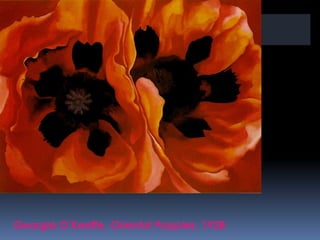
Georgia O’Keeffe, Oriental Poppies, 1928
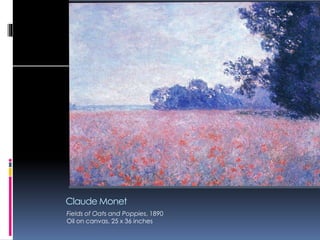
Claude Monet
Fields of Oats and Poppies, 1890
Oil on canvas, 25 x 36 inches
Stuart Franklin (Magnum photo)
Peter Melchett’s
organic farm in
Ringstead, with
poppies and
cornflowers growing
alongside organic
wheat
2008
What is Formal Analysis?
 Breaking a work down into
component parts for purposes
of systematic observation and
understanding.
 When the parts are put back
together, you do so with a
richer understanding of each
part and how they fit together.
TO BEGIN a formal analysis
IDENTIFY the materials and medium.
What is the work physically made of: oil
on canvas, charcoal on paper? Be sure
you know.
MATERIALS
 EXAMPLE: art made of paper will have
a different resonance than art made
of steel
 Materials can have a strong expressive
content.
 Even similar materials can be handled
quite differently, resulting in different
nuances of meaning.
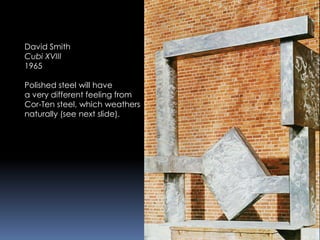
David Smith
Cubi XVIII
1965
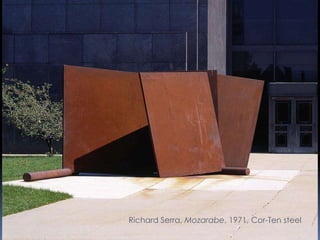
Polished steel will have
a very different feeling from
Cor-Ten steel, which weathers
naturally (see next slide).
Richard Serra, Mozarabe, 1971, Cor-Ten steel
What is the MEDIUM of the
work?
1. What is the medium of the work? Is it 2-
dimensional?
drawing—charcoal on paper
painting—pigment on a prepared
surface
print—lithograph, silkscreen, etching
photograph
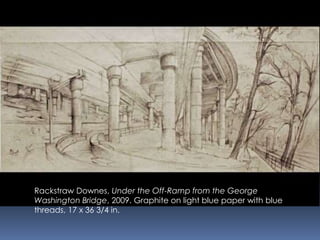
Rackstraw Downes, Under the Off-Ramp from the George
Washington Bridge, 2009. Graphite on light blue paper with blue
threads, 17 x 36 3/4 in.
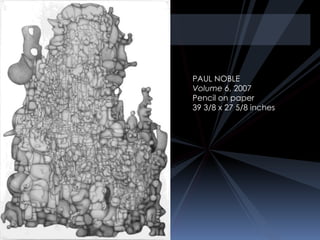
PAUL NOBLE
Volume 6, 2007
Pencil on paper
39 3/8 x 27 5/8 inches
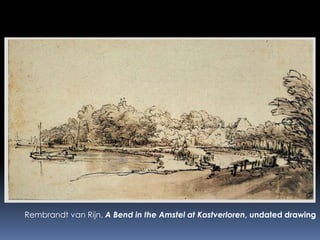
Rembrandt van Rijn, A Bend in the Amstel at Kostverloren, undated drawing
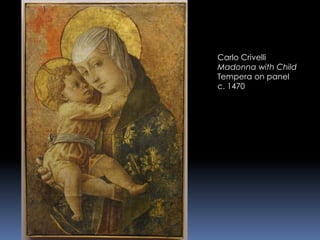
Carlo Crivelli
Madonna with Child
Tempera on panel
c. 1470
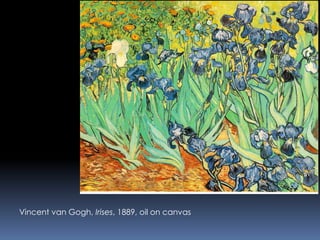
Vincent van Gogh, Irises, 1889, oil on canvas
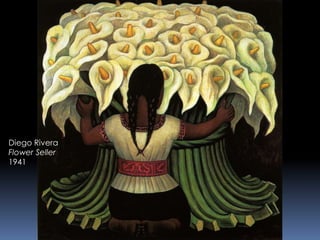
Diego Rivera
Flower Seller
1941
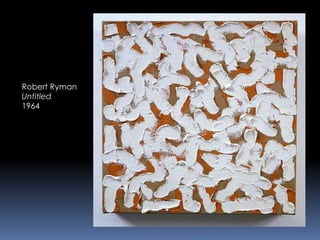
Robert Ryman
Untitled
1964
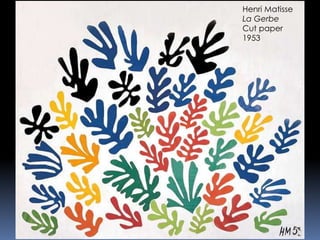
Henri Matisse
La Gerbe
Cut paper
1953
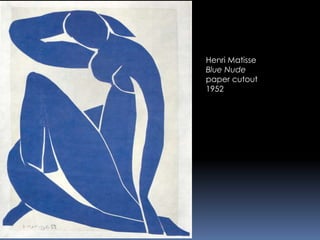
Henri Matisse
Blue Nude
paper cutout
1952
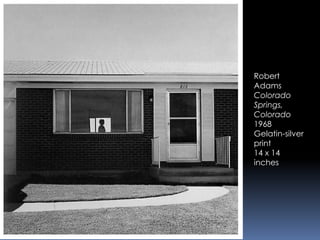
Robert
Adams
Colorado
Springs,
Colorado
1968
Gelatin-silver
print
14 x 14
inches
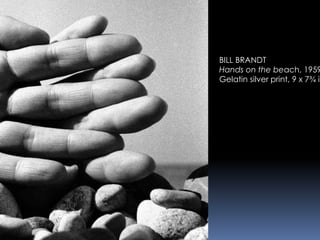
BILL BRANDT
Hands on the beach, 1959
Gelatin silver print, 9 x 7¾ in
What is the MEDIUM of the
work?
Is it three-dimensional=existing in space?
 Sculpture
 Relief (bas-relief or low-relief)
 Sculpture in the round
 Installation
 Architecture and landscape architecture
 (4th Dimension—time)
 Film
 Video
Brief Nod to Subject Matter
DESCRIBE the subject.
What subject is depicted? (Major features
only, at this point it does not need to be
too detailed.)
Include the genre if applicable and if you
know it.
history painting
portraiture
landscape
still life
are some examples of artistic genres.
COMPOSITION
composition: how the various elements
of the work are arranged in relationship
to each other
things to look for:
spatial relationships:
 foreground
 middle ground
 background
where is the viewer positioned?
how are the objects or elements
ordered?
LINE
The literal lines that the artist uses to
create shape, suggest depth, etc. These
lines can have a variety of
characteristics, for example; line can be
fine and delicate, or bold and chunky, it
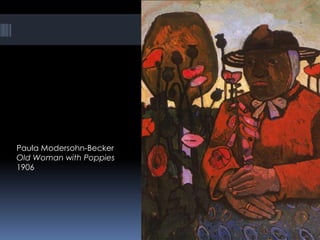
can be fluid or halting, precise or
sketchy.
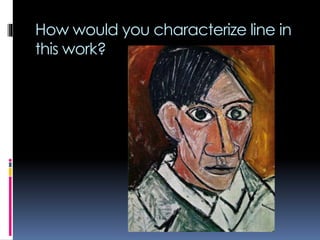
How would you characterize line in
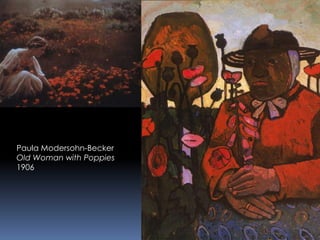
this work?
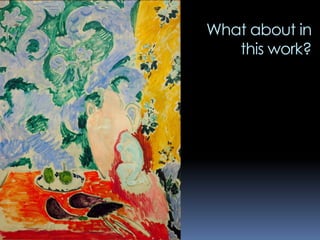
What about in
this work?
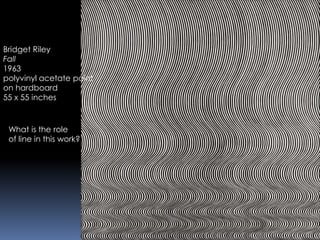
Bridget Riley
Fall
1963
polyvinyl acetate paint
on hardboard
55 x 55 inches
What is the role
of line in this work?
COLOR
1. Ask yourself, how important is color in
this work?
2. In some works, color is quite significant;
in others, far less so.
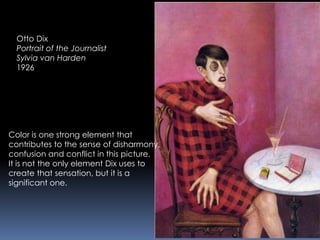
Otto Dix
Portrait of the Journalist
Sylvia van Harden
1926
Color is one strong element that
contributes to the sense of disharmony,
confusion and conflict in this picture.
It is not the only element Dix uses to
create that sensation, but it is a
significant one.
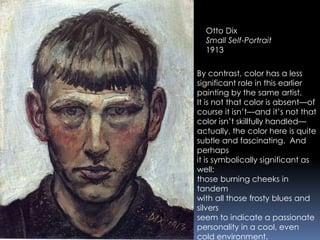
Otto Dix
Small Self-Portrait
1913
By contrast, color has a less
significant role in this earlier
painting by the same artist.
It is not that color is absent—of
course it isn’t—and it’s not that
color isn’t skillfully handled—
actually, the color here is quite
subtle and fascinating. And
perhaps
it is symbolically significant as
well:
those burning cheeks in
tandem
with all those frosty blues and
silvers
seem to indicate a passionate
personality in a cool, even
cold environment.
Quick Historical Interlude: LINE and
COLOR
 Long history of talking about these two
properties
 Disegno versus colore (in Italy)
 Dessin vs. couleur (in France)
Are considered the two most basic elements of
two-dimensional art
LINE
 Line/design can mean
several things:
 (It’s clearer if we use a
more direct translation:
design)
 Design could mean:
 A drawing
 A plan to make
something
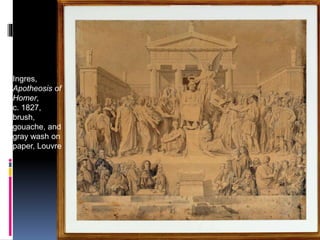
Ingres,
Apotheosis of
Homer,
c. 1827,
brush,
gouache, and
gray wash on
paper, Louvre
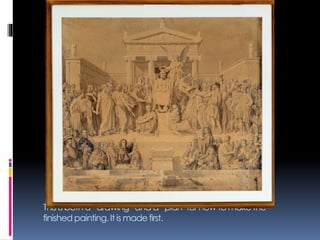
This is both a “drawing” and a “plan’ for how to make the
finished painting. It is made first.
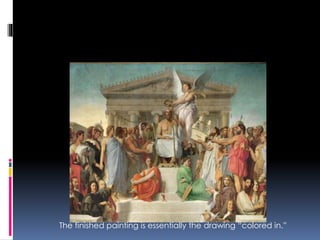
The finished painting is essentially the drawing “colored in.”
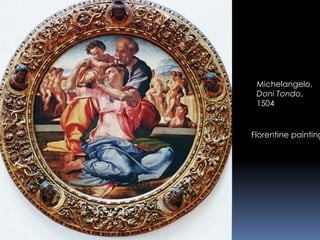
Color was thought to be secondary;
line primary.
But artists hate rules. As soon as you give
them one they will try to break it.

This academic rule “design has priority; it is
the first thing, and the most important
thing” was closely associated with the
city of Florence.
So the artists of Venice tried to disprove it.
Michelangelo,
Doni Tondo,
1504
Florentine painting
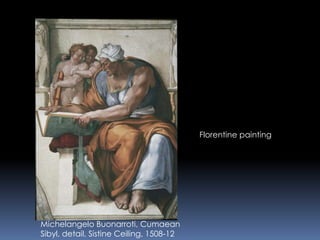
Michelangelo Buonarroti, Cumaean
Sibyl, detail, Sistine Ceiling, 1508-12
Florentine painting
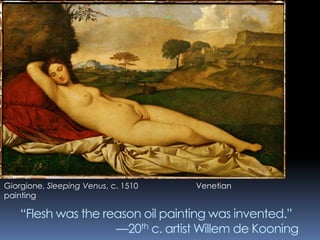
“Flesh was the reason oil painting was invented.”
—20th c. artist Willem de Kooning
Giorgione, Sleeping Venus, c. 1510 Venetian
painting
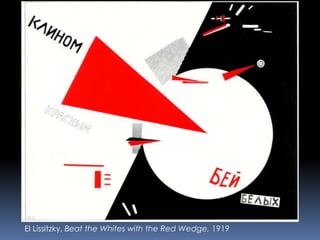
SHAPE
 Can be geometric (e.g.,
cube, cylinder, cone,
pyramid, circle, square,
triangle)
 Or “biomorphic”
(sometimes called
organic); wiggly, blob-like
shapes with irregular
outlines.
El Lissitzky, Beat the Whites with the Red Wedge, 1919
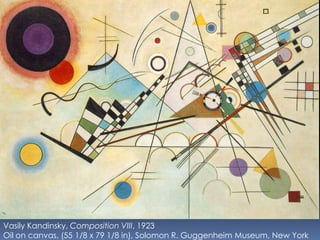
Vasily Kandinsky, Composition VIII, 1923
Oil on canvas, (55 1/8 x 79 1/8 in), Solomon R. Guggenheim Museum, New York
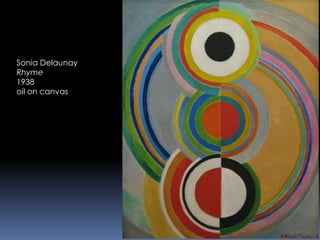
Sonia Delaunay
Rhyme
1938
oil on canvas
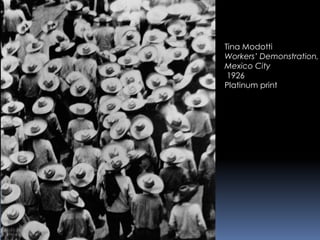
Tina Modotti
Workers’ Demonstration,
Mexico City
1926
Platinum print
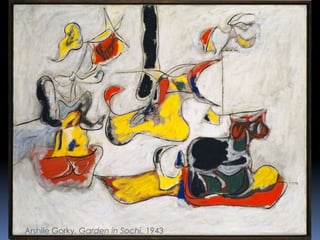
Arshile Gorky, Garden in Sochi, 1943
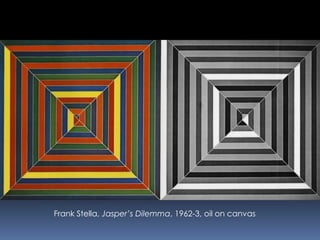
Frank Stella, Jasper’s Dilemma, 1962-3, oil on canvas
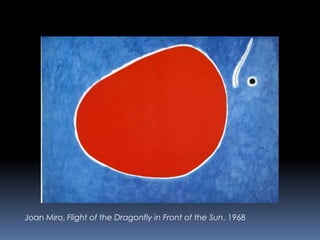
Joan Miro, Flight of the Dragonfly in Front of the Sun, 1968
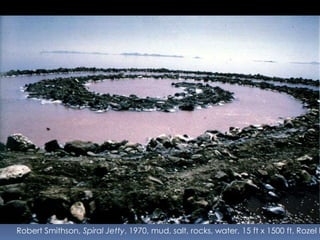
Robert Smithson, Spiral Jetty, 1970, mud, salt, rocks, water, 15 ft x 1500 ft, Rozel P
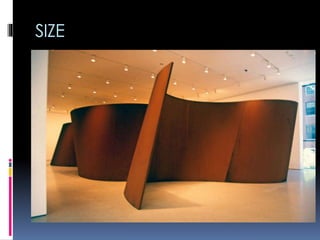
SIZE
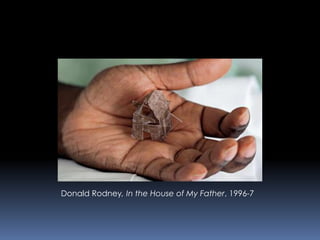
Donald Rodney, In the House of My Father, 1996-7
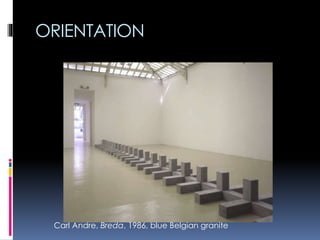
ORIENTATION
Carl Andre, Breda, 1986, blue Belgian granite
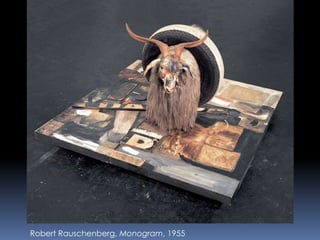
Robert Rauschenberg, Monogram, 1955
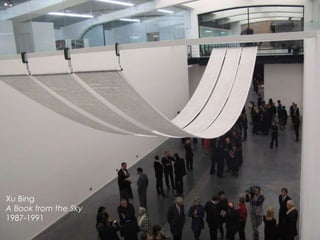
Xu Bing
A Book from the Sky
1987-1991
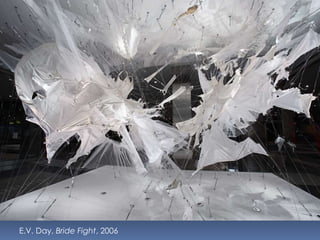
E.V. Day, Bride Fight, 2006
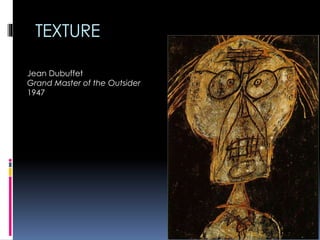
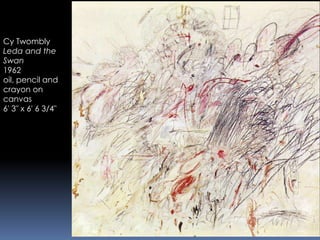
TEXTURE
Jean Dubuffet
Grand Master of the Outsider
1947
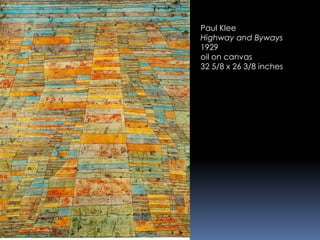
Paul Klee
Highway and Byways
1929
oil on canvas
32 5/8 x 26 3/8 inches
Cy Twombly
Leda and the
Swan
1962
oil, pencil and
crayon on
canvas
6' 3" x 6' 6 3/4"
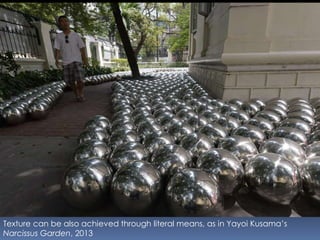
Texture can be also achieved through literal means, as in Yayoi Kusama’s
Narcissus Garden, 2013
Try this at home!
 Following are some examples you can use to review.
 Here are the guidelines:
 medium/materials (what is it made of?)
 subject matter/genre (keep very brief for now)
 composition
 line
 color
 shape
 texture
 size
 orientation
REMEMBER, not all of these categories will be applicable
to every work of art. Choose the categories that are
most relevant to the work you are considering.
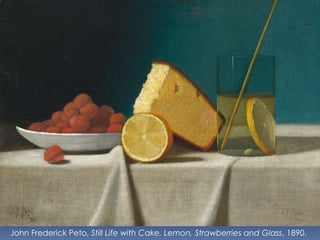
John Frederick Peto, Still Life with Cake, Lemon, Strawberries and Glass, 1890.
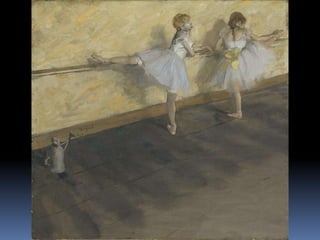
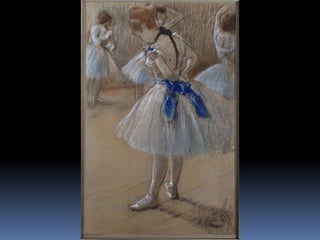
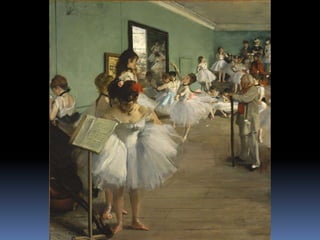
Some artists have characteristic subject
matter, which you can use to help
identify them, along with their style.
IN MATTERS OF STYLE…
…nuance is key. You are training your
eyes to detect subtle differences,
rather than blatant ones.
The more fine-grained the differences
you can observe, the better you will
have understood the artist’s style.
“God is in the details.”

SUMMER15UVC5

  • 1.
  • 2.
  • 3.
    Finding out moreis a great thing to do. But NO amount of information will answer all your questions.
  • 4.
    There are asmany flavors of art as there are people who make it. New flavors are being created all the time. You get to pick your favorites.
  • 5.
    The point isto give it a try and see which kinds you think are especially great. Then experience to the fullest and enjoy. Hint: You might like them all.
  • 6.
    Morris Louis, Tet,1958, synthetic polymer paint on canvas, 95 x 153 in, WMAA
  • 7.
    Olafur Eliasson, Yourstrange certainty still kept, 1996 Water, strobelight, plexiglass, recirculating pump, foil and wood Base 20 x 204 3/4 x 10 inches Top 173 1/4 inches long
  • 8.
    Bruce Nauman, Self-Portraitas Fountain, 1970, c-print, 20 x 24 inches
  • 9.
    Nam June Paik,Magnet TV, 1965, 17-inch black-and-white television set with magnet, 28 3/8 × 19 1/4 × 24 1/2 in.
  • 10.
    Duane Hanson, Womanwith Dog, 1977. Cast polyvinyl polychromed in synthetic polymer, with cloth and hair 46 × 48 × 51 ½ in
  • 11.
    Charles Ray Puzzle Bottle 1995 paintedwood, glass, cork, 13 3/8 x 3 3/4 dia
  • 12.
    Joseph Kosuth, FiveWords in Green Neon, 1965, neon tubing, 62 x 80 x 6 in
  • 13.
    Jack Pierson, Desire/Despair metal,glass, plexiglas and wood, 117 1/2 x 56 1/4
  • 14.
    Willem de Kooning, Doorto the River, 1960 Oil on canvas, 80 × 70 in
  • 15.
    Brice Marden, SummerTable, 1972–73. Oil and wax on canvas in three parts, 60 × 105 5/16 in.
  • 16.
    Doug Aitken, Untitled(Shopping Cart), 2000. Chromogenic print mounted on plexiglass, 48 5/8 × 56 5/8 in
  • 17.
    Jean-Michel Basquiat, “LNAPRK”,1982. Synthetic polymer and oil stick on canvas, 73 1/2 × 72 1/4 in
  • 18.
    Catherine Opie, Self-Portrait,1993 chromogenic print, 39 5/8 × 29 15/16 in
  • 19.
    You’re allowed to— supposedto!—respond personally to artwork. The artist wants you to have an experience—an emotional, physical, spiritual, intellectual, moral (some combination of these or all of them) experience of the work.
  • 20.
    If you likea work of art, you’ll often want to find out more about it. That’s great, find out more, it will enrich your experience of the work, no doubt about it. But there is no “final correct answer” to the meaning of a given work. There are more and less satisfying interpretations, more and less sensitive readings, but no single reading is ultimately correct.
  • 21.
    Like your parentsprobably told you, “How do you know you don’t like it if you won’t even try it? This class gives you a chance to try out different kinds of art. There’s no obligation to like the things that I, or your classmates, like. Pick your own likes and dislikes. However, you can learn from—even come to appreciate—works you don’t particularly care for.
  • 22.
    SO, HOW DOWE EXPERIENCE ART TO THE FULLEST?
  • 23.
     One waywe try to experience art more fully is by understanding how it creates the effects it has on us. experiencing art
  • 24.
    experiencing art  Experience,with your eyes, mind, feelings, memories, body. What does this piece do to me?  Examples: Does it make me happy? Uncomfortable? Sad? Upset? Does it turn my stomach? Does it make me shiver? Worry? Sweat?
  • 25.
    experiencing the effects 1. Experience comes first. What do you SEE and how does it make you FEEL in your bones.  At this point, it doesn’t matter who made it, when, or why. The point is to try to figure out, as completely as possible, the effect the work is having on you.  So let’s sum this up as “experiencing the effects” of the work. This process can take a while. It is not necessarily simple. In fact, one definition of art could be work that takes the viewer some time and trouble to experience.
  • 26.
    accounting for theeffects Now that you have a handle on what you’ve experienced, you want to know how the piece made you feel that way. Cf. driving a car to learning how it actually works. This is where formal analysis can be helpful. How did this piece make me feel (x, y, and z) way? How is it structured to achieve those specific effects? This is where purely personal, idiosyncratic responses can be weeded out if you are writing to share with an audience.
  • 27.
  • 28.
    Effects 1 Bruce Nauman HangingHeads #2, 1989, wax and wire two heads, the first is 10 3/4 x 9 1/2 x 7 ¾, the second is slightly smaller, both suspended approx 6' above the floor
  • 29.
    John Singer Sargent The Daughters ofEdward Darley Boit 1882 87 3/8 x 87 3/8 inches
  • 30.
  • 31.
    What will happen inthis movie? How do you know? http://prezi.com/ sazemrmsx16b/ what-is-a- genre/
  • 32.
    Advertisers work hardto create visual messages that can be decoded in a rapid glance. “This is a romantic comedy with two young stars.”
  • 33.
    Edgar DEGAS Edmondo &Thérèse Morbilli circa 1867 Oil on canvas 45 7/8 x 34 ¾ inches What is going to happen to these two people? What is their relationship like? We aren’t sure. We’re not sure at first, and even after long observation, we may not be able to answer these questions definitively.
  • 34.
    Art is muchslower and typically cannot be understood at a glance. Learning to “read” the formal vocabulary of art will go a long way toward helping you understand it better.
  • 35.
    To help us,we can make a distinction between subject matter and form. Arnold GENTHE Portrait of Helen Cooke in a Field of Poppies 1907
  • 36.
  • 37.
  • 38.
  • 39.
    Claude Monet Fields ofOats and Poppies, 1890 Oil on canvas, 25 x 36 inches
  • 40.
    Stuart Franklin (Magnumphoto) Peter Melchett’s organic farm in Ringstead, with poppies and cornflowers growing alongside organic wheat 2008
  • 42.
    What is FormalAnalysis?  Breaking a work down into component parts for purposes of systematic observation and understanding.  When the parts are put back together, you do so with a richer understanding of each part and how they fit together.
  • 43.
    TO BEGIN aformal analysis IDENTIFY the materials and medium. What is the work physically made of: oil on canvas, charcoal on paper? Be sure you know.
  • 44.
    MATERIALS  EXAMPLE: artmade of paper will have a different resonance than art made of steel  Materials can have a strong expressive content.  Even similar materials can be handled quite differently, resulting in different nuances of meaning.
  • 45.
    David Smith Cubi XVIII 1965 Polishedsteel will have a very different feeling from Cor-Ten steel, which weathers naturally (see next slide).
  • 46.
    Richard Serra, Mozarabe,1971, Cor-Ten steel
  • 47.
    What is theMEDIUM of the work? 1. What is the medium of the work? Is it 2- dimensional? drawing—charcoal on paper painting—pigment on a prepared surface print—lithograph, silkscreen, etching photograph
  • 48.
    Rackstraw Downes, Underthe Off-Ramp from the George Washington Bridge, 2009. Graphite on light blue paper with blue threads, 17 x 36 3/4 in.
  • 49.
    PAUL NOBLE Volume 6,2007 Pencil on paper 39 3/8 x 27 5/8 inches
  • 50.
    Rembrandt van Rijn,A Bend in the Amstel at Kostverloren, undated drawing
  • 51.
    Carlo Crivelli Madonna withChild Tempera on panel c. 1470
  • 52.
    Vincent van Gogh,Irises, 1889, oil on canvas
  • 53.
  • 54.
  • 55.
  • 56.
  • 57.
  • 58.
    BILL BRANDT Hands onthe beach, 1959 Gelatin silver print, 9 x 7¾ in
  • 59.
    What is theMEDIUM of the work? Is it three-dimensional=existing in space?  Sculpture  Relief (bas-relief or low-relief)  Sculpture in the round  Installation  Architecture and landscape architecture  (4th Dimension—time)  Film  Video
  • 60.
    Brief Nod toSubject Matter DESCRIBE the subject. What subject is depicted? (Major features only, at this point it does not need to be too detailed.) Include the genre if applicable and if you know it. history painting portraiture landscape still life are some examples of artistic genres.
  • 61.
    COMPOSITION composition: how thevarious elements of the work are arranged in relationship to each other things to look for: spatial relationships:  foreground  middle ground  background where is the viewer positioned? how are the objects or elements ordered?
  • 62.
    LINE The literal linesthat the artist uses to create shape, suggest depth, etc. These lines can have a variety of characteristics, for example; line can be fine and delicate, or bold and chunky, it can be fluid or halting, precise or sketchy.
  • 63.
    How would youcharacterize line in this work?
  • 64.
  • 65.
    Bridget Riley Fall 1963 polyvinyl acetatepaint on hardboard 55 x 55 inches What is the role of line in this work?
  • 66.
    COLOR 1. Ask yourself,how important is color in this work? 2. In some works, color is quite significant; in others, far less so.
  • 67.
    Otto Dix Portrait ofthe Journalist Sylvia van Harden 1926 Color is one strong element that contributes to the sense of disharmony, confusion and conflict in this picture. It is not the only element Dix uses to create that sensation, but it is a significant one.
  • 68.
    Otto Dix Small Self-Portrait 1913 Bycontrast, color has a less significant role in this earlier painting by the same artist. It is not that color is absent—of course it isn’t—and it’s not that color isn’t skillfully handled— actually, the color here is quite subtle and fascinating. And perhaps it is symbolically significant as well: those burning cheeks in tandem with all those frosty blues and silvers seem to indicate a passionate personality in a cool, even cold environment.
  • 69.
    Quick Historical Interlude:LINE and COLOR  Long history of talking about these two properties  Disegno versus colore (in Italy)  Dessin vs. couleur (in France) Are considered the two most basic elements of two-dimensional art
  • 70.
    LINE  Line/design canmean several things:  (It’s clearer if we use a more direct translation: design)  Design could mean:  A drawing  A plan to make something
  • 71.
  • 72.
    This is botha “drawing” and a “plan’ for how to make the finished painting. It is made first.
  • 73.
    The finished paintingis essentially the drawing “colored in.”
  • 74.
    Color was thoughtto be secondary; line primary. But artists hate rules. As soon as you give them one they will try to break it. This academic rule “design has priority; it is the first thing, and the most important thing” was closely associated with the city of Florence. So the artists of Venice tried to disprove it.
  • 75.
  • 76.
    Michelangelo Buonarroti, Cumaean Sibyl,detail, Sistine Ceiling, 1508-12 Florentine painting
  • 77.
    “Flesh was thereason oil painting was invented.” —20th c. artist Willem de Kooning Giorgione, Sleeping Venus, c. 1510 Venetian painting
  • 78.
    SHAPE  Can begeometric (e.g., cube, cylinder, cone, pyramid, circle, square, triangle)  Or “biomorphic” (sometimes called organic); wiggly, blob-like shapes with irregular outlines.
  • 79.
    El Lissitzky, Beatthe Whites with the Red Wedge, 1919
  • 80.
    Vasily Kandinsky, CompositionVIII, 1923 Oil on canvas, (55 1/8 x 79 1/8 in), Solomon R. Guggenheim Museum, New York
  • 81.
  • 82.
  • 83.
    Arshile Gorky, Gardenin Sochi, 1943
  • 84.
    Frank Stella, Jasper’sDilemma, 1962-3, oil on canvas
  • 85.
    Joan Miro, Flightof the Dragonfly in Front of the Sun, 1968
  • 86.
    Robert Smithson, SpiralJetty, 1970, mud, salt, rocks, water, 15 ft x 1500 ft, Rozel P
  • 87.
  • 88.
    Donald Rodney, Inthe House of My Father, 1996-7
  • 89.
    ORIENTATION Carl Andre, Breda,1986, blue Belgian granite
  • 90.
  • 91.
    Xu Bing A Bookfrom the Sky 1987-1991
  • 92.
    E.V. Day, BrideFight, 2006
  • 93.
  • 94.
    Paul Klee Highway andByways 1929 oil on canvas 32 5/8 x 26 3/8 inches
  • 95.
    Cy Twombly Leda andthe Swan 1962 oil, pencil and crayon on canvas 6' 3" x 6' 6 3/4"
  • 96.
    Texture can bealso achieved through literal means, as in Yayoi Kusama’s Narcissus Garden, 2013
  • 97.
    Try this athome!  Following are some examples you can use to review.  Here are the guidelines:  medium/materials (what is it made of?)  subject matter/genre (keep very brief for now)  composition  line  color  shape  texture  size  orientation REMEMBER, not all of these categories will be applicable to every work of art. Choose the categories that are most relevant to the work you are considering.
  • 98.
    John Frederick Peto,Still Life with Cake, Lemon, Strawberries and Glass, 1890.
  • 99.
    Some artists havecharacteristic subject matter, which you can use to help identify them, along with their style.
  • 113.
    IN MATTERS OFSTYLE… …nuance is key. You are training your eyes to detect subtle differences, rather than blatant ones. The more fine-grained the differences you can observe, the better you will have understood the artist’s style. “God is in the details.”

Editor's Notes

  • #3 Find some things you like, and enjoy them.
  • #5 Seriously. There’s art made out of chocolate, art made out of steel, art made out of cardboard boxes, ribbons, toy airplanes; if you can imagine it, an artist has probably used it in their work.
  • #20 Find some things you like, and enjoy them.
  • #22 Seriously. There’s art made out of chocolate, art made out of steel, art made out of cardboard boxes, ribbons, toy airplanes; if you can imagine it, an artist has probably used it in their work.
  • #32 Genre is a structure of expectations that guides the viewer through the work.
  • #34 In contrast, artists do not usually assume that they reach their viewers in a competitive situation where there is only a moment to grab and hold visual attention. Typically the expectation is that artists can present more ambiguous visual information, and part of the fun is in discussing and debating how we put that information together.
  • #35 1000s of example of movie posters May or may not have seen 1000s of examples of Familiarity Also, medium is different and less familiar Also, requirement of immediate intelligibility isn’t present
  • #43 Set of techniques Developed mostly in the writing
  • #72 Jean August Dominique Ingres
  • #91 Robert Rauschenberg, Monogram, 1955
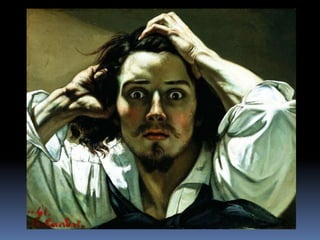
  • #111 The Desperate Man Date 1844-1845 Medium oil on canvas Dimensions 45 × 55 cm (17.7 × 21.7 in)
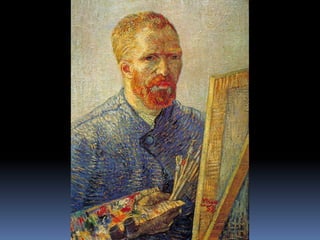
  • #112 Van Gogh, Self-Portrait at the Easel,