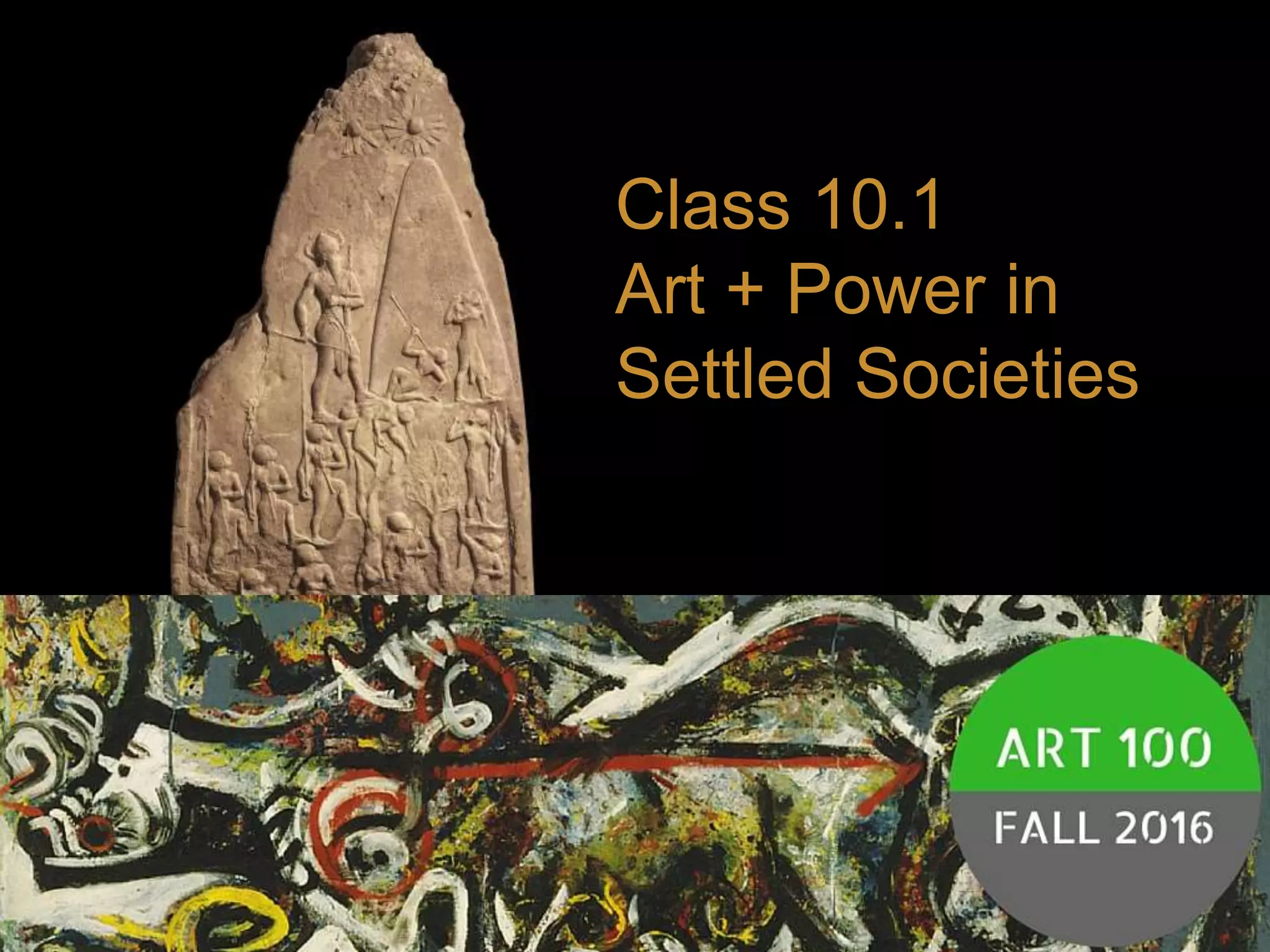
Class 10.1
Art + Power in
Settled Societies
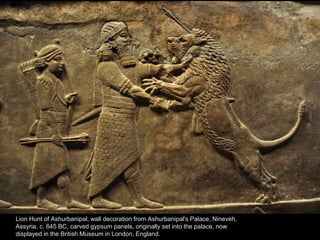
Lion Hunt of Ashurbanipal, wall decoration from Ashurbanipal's Palace, Nineveh,
Assyria, c. 645 BC, carved gypsum panels, originally set into the palace, now
displayed in the British Museum in London, England.
going over homework: relief sculpture
Part I. Write a description of the work depicted in this photograph. Here are some guidelines to help
you:
•
• A. Identify the artist, title (italicized, or underlined) and date by working these into a sentence that
contains other information.
• B. Identify the major visual features of the work and describes them as richly, thoroughly, and
concretely as possible.
• C. Include some sense of your response to the piece, worked into your description.
• D. A good description does all of these things in a few short lines that are dense with information.
• Part II. Analyze the composition: How are the objects or elements ordered from right to left? What
is in the center? What do you think is emphasized?
•
• Part III. Now that you've learned some general characteristics of neolithic societies, how do you
think this particular work of art relates to the new forms of social organization that emerged
alongside the ability to store surplus grain harvest?
•
• Connect this specific work of art to the more general social characteristics we have studied:
• what does the piece say about the changing relationship between the human and animal world?
• what is the role of violence in establishing the king’s authority, according to this picture?
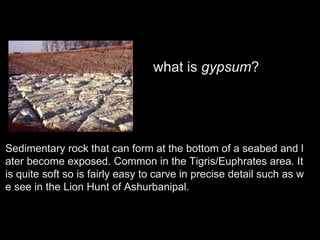
Sedimentary rock that can form at the bottom of a seabed and l
ater become exposed. Common in the Tigris/Euphrates area. It
is quite soft so is fairly easy to carve in precise detail such as w
e see in the Lion Hunt of Ashurbanipal.
what is gypsum?
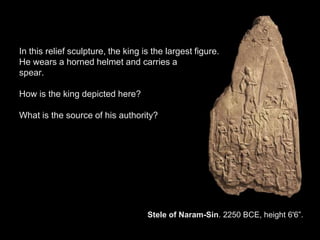
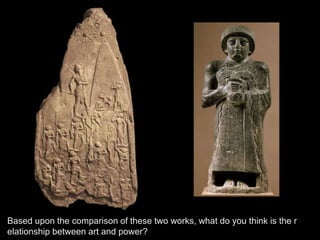
Stele of Naram-Sin. 2250 BCE, height 6'6”.
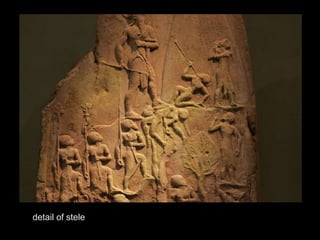
In this relief sculpture, the king is the largest figure.
He wears a horned helmet and carries a
spear.
How is the king depicted here?
What is the source of his authority?
detail of stele
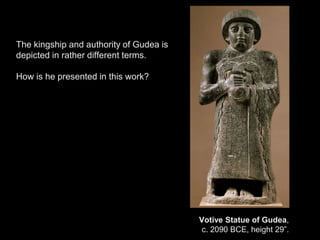
Votive Statue of Gudea,
c. 2090 BCE, height 29”.
The kingship and authority of Gudea is
depicted in rather different terms.
How is he presented in this work?
Based upon the comparison of these two works, what do you think is the r
elationship between art and power?
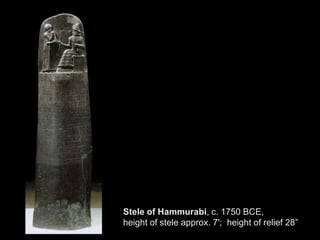
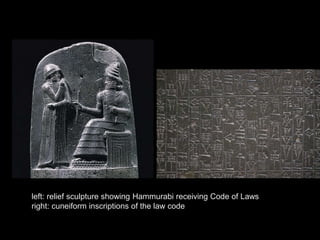
Stele of Hammurabi, c. 1750 BCE,
height of stele approx. 7'; height of relief 28”
left: relief sculpture showing Hammurabi receiving Code of Laws
right: cuneiform inscriptions of the law code
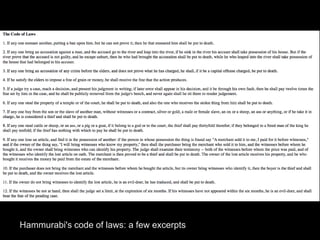
Hammurabi's code of laws: a few excerpts
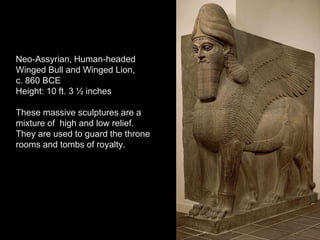
Neo-Assyrian, Human-headed
Winged Bull and Winged Lion,
c. 860 BCE
Height: 10 ft. 3 ½ inches
These massive sculptures are a
mixture of high and low relief.
They are used to guard the throne
rooms and tombs of royalty.
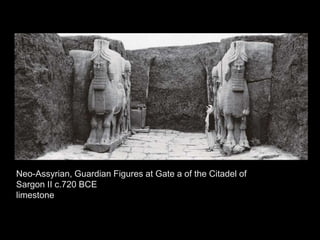
Neo-Assyrian, Guardian Figures at Gate a of the Citadel of
Sargon II c.720 BCE
limestone
"Man is the measure of all things.”
—Protagoras, Greek philosopher
how does sculpture change when we move to
ancient Greece?
The perfect individual form,
defined by ideal scale and
proportions, became the Greek
ideal.
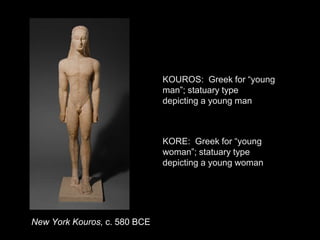
New York Kouros, c. 580 BCE
KOUROS: Greek for “young
man”; statuary type
depicting a young man
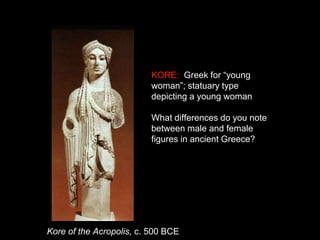
KORE: Greek for “young
woman”; statuary type
depicting a young woman
Kore of the Acropolis, c. 500 BCE
KORE: Greek for “young
woman”; statuary type
depicting a young woman
What differences do you note
between male and female
figures in ancient Greece?
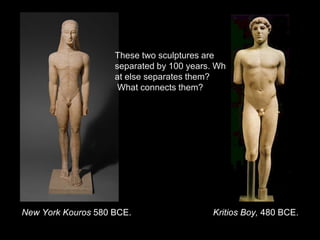
Kritios Boy, 480 BCE.New York Kouros 580 BCE.
These two sculptures are
separated by 100 years. Wh
at else separates them?
What connects them?
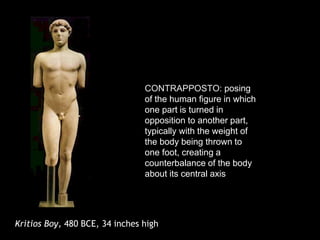
Kritios Boy, 480 BCE, 34 inches high
CONTRAPPOSTO: posing
of the human figure in which
one part is turned in
opposition to another part,
typically with the weight of
the body being thrown to
one foot, creating a
counterbalance of the body
about its central axis
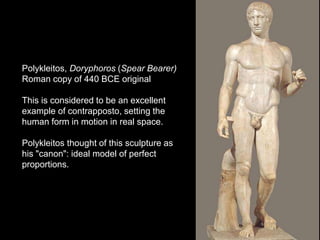
Polykleitos, Doryphoros (Spear Bearer)
Roman copy of 440 BCE original
This is considered to be an excellent
example of contrapposto, setting the
human form in motion in real space.
Polykleitos thought of this sculpture as
his "canon": ideal model of perfect
proportions.

ART100_Fall2016_Class10.1

  • 1.
    Class 10.1 Art +Power in Settled Societies
  • 2.
    Lion Hunt ofAshurbanipal, wall decoration from Ashurbanipal's Palace, Nineveh, Assyria, c. 645 BC, carved gypsum panels, originally set into the palace, now displayed in the British Museum in London, England.
  • 3.
    going over homework:relief sculpture Part I. Write a description of the work depicted in this photograph. Here are some guidelines to help you: • • A. Identify the artist, title (italicized, or underlined) and date by working these into a sentence that contains other information. • B. Identify the major visual features of the work and describes them as richly, thoroughly, and concretely as possible. • C. Include some sense of your response to the piece, worked into your description. • D. A good description does all of these things in a few short lines that are dense with information. • Part II. Analyze the composition: How are the objects or elements ordered from right to left? What is in the center? What do you think is emphasized? • • Part III. Now that you've learned some general characteristics of neolithic societies, how do you think this particular work of art relates to the new forms of social organization that emerged alongside the ability to store surplus grain harvest? • • Connect this specific work of art to the more general social characteristics we have studied: • what does the piece say about the changing relationship between the human and animal world? • what is the role of violence in establishing the king’s authority, according to this picture?
  • 4.
    Sedimentary rock thatcan form at the bottom of a seabed and l ater become exposed. Common in the Tigris/Euphrates area. It is quite soft so is fairly easy to carve in precise detail such as w e see in the Lion Hunt of Ashurbanipal. what is gypsum?
  • 5.
    Stele of Naram-Sin.2250 BCE, height 6'6”. In this relief sculpture, the king is the largest figure. He wears a horned helmet and carries a spear. How is the king depicted here? What is the source of his authority?
  • 6.
  • 7.
    Votive Statue ofGudea, c. 2090 BCE, height 29”. The kingship and authority of Gudea is depicted in rather different terms. How is he presented in this work?
  • 8.
    Based upon thecomparison of these two works, what do you think is the r elationship between art and power?
  • 9.
    Stele of Hammurabi,c. 1750 BCE, height of stele approx. 7'; height of relief 28”
  • 10.
    left: relief sculptureshowing Hammurabi receiving Code of Laws right: cuneiform inscriptions of the law code
  • 11.
    Hammurabi's code oflaws: a few excerpts
  • 12.
    Neo-Assyrian, Human-headed Winged Bulland Winged Lion, c. 860 BCE Height: 10 ft. 3 ½ inches These massive sculptures are a mixture of high and low relief. They are used to guard the throne rooms and tombs of royalty.
  • 13.
    Neo-Assyrian, Guardian Figuresat Gate a of the Citadel of Sargon II c.720 BCE limestone
  • 14.
    "Man is themeasure of all things.” —Protagoras, Greek philosopher how does sculpture change when we move to ancient Greece? The perfect individual form, defined by ideal scale and proportions, became the Greek ideal.
  • 15.
    New York Kouros,c. 580 BCE KOUROS: Greek for “young man”; statuary type depicting a young man KORE: Greek for “young woman”; statuary type depicting a young woman
  • 16.
    Kore of theAcropolis, c. 500 BCE KORE: Greek for “young woman”; statuary type depicting a young woman What differences do you note between male and female figures in ancient Greece?
  • 17.
    Kritios Boy, 480BCE.New York Kouros 580 BCE. These two sculptures are separated by 100 years. Wh at else separates them? What connects them?
  • 18.
    Kritios Boy, 480BCE, 34 inches high CONTRAPPOSTO: posing of the human figure in which one part is turned in opposition to another part, typically with the weight of the body being thrown to one foot, creating a counterbalance of the body about its central axis
  • 19.
    Polykleitos, Doryphoros (SpearBearer) Roman copy of 440 BCE original This is considered to be an excellent example of contrapposto, setting the human form in motion in real space. Polykleitos thought of this sculpture as his "canon": ideal model of perfect proportions.