Class 4.1
Art in the
Twentieth
Century
ART 100
Spring ‘16
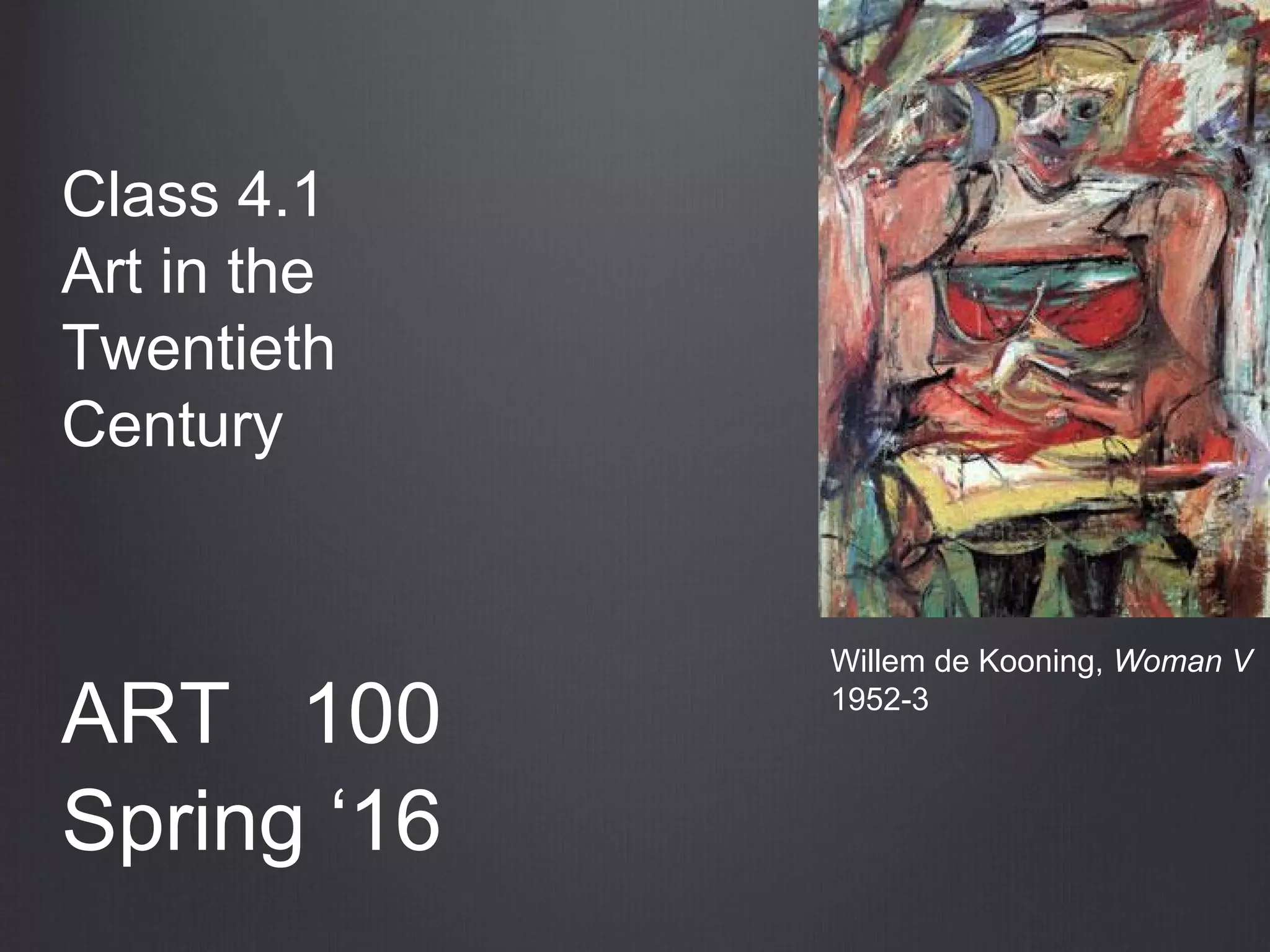
Willem de Kooning, Woman V
1952-3
as we discussed previously,
the notion of an autonomous realm devoted purely to the
appreciation of beauty is peculiar to the modern West
(European and places colonized by Europe)
autonomous=standing on its own, independent of other
considerations, such as function.
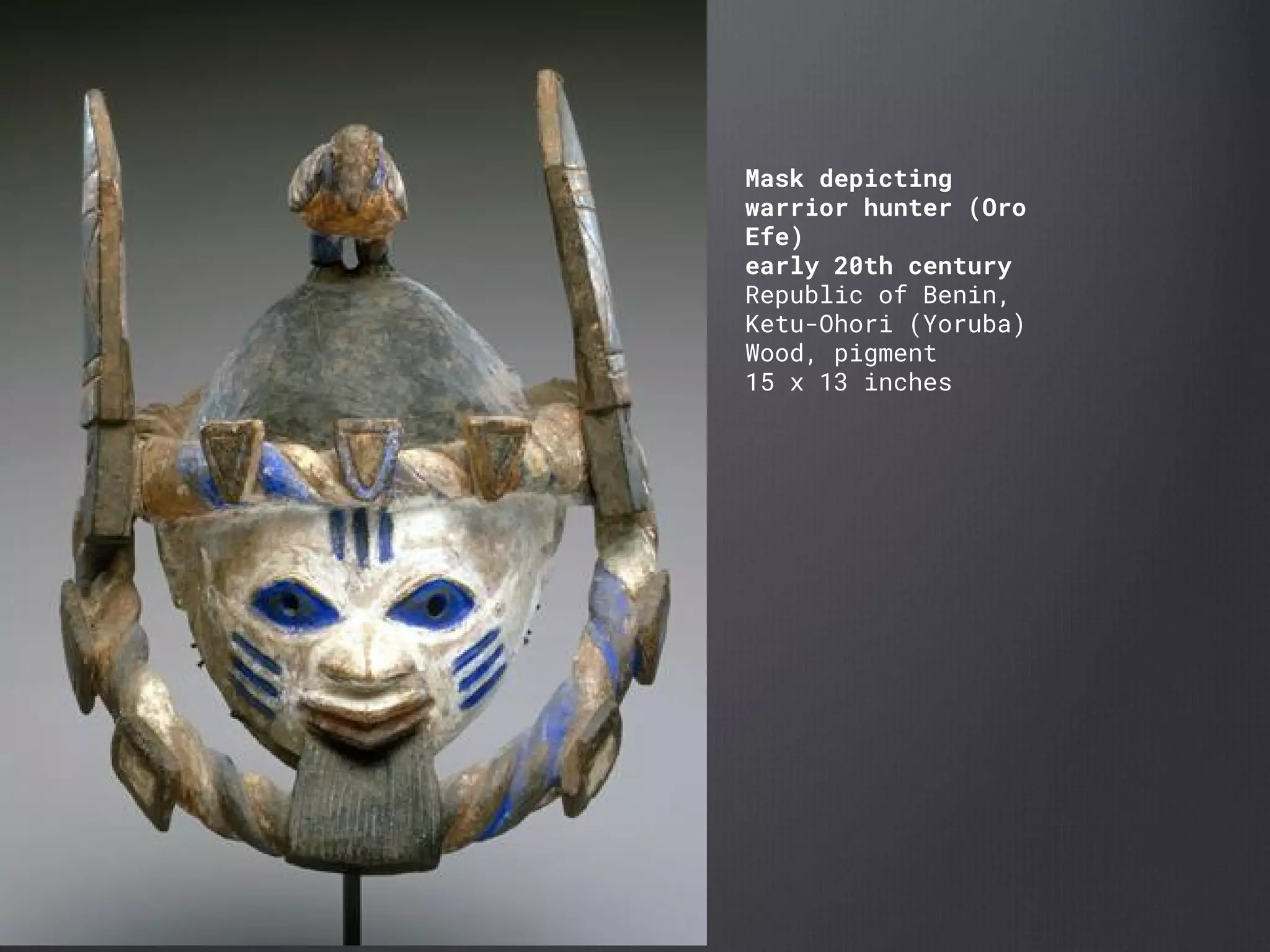
Mask depicting
warrior hunter (Oro
Efe)
early 20th century
Republic of Benin,
Ketu-Ohori (Yoruba)
Wood, pigment
15 x 13 inches
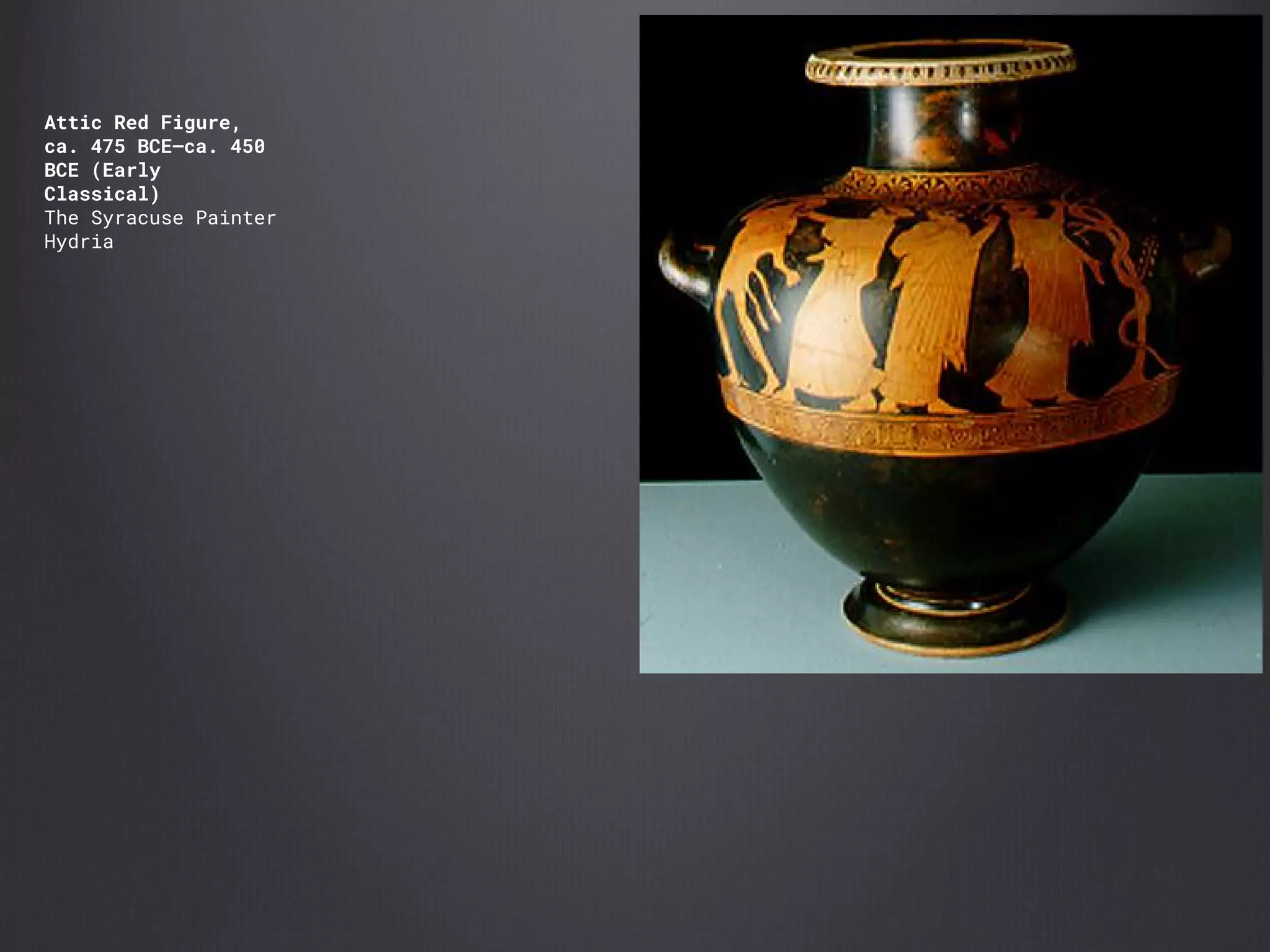
Attic Red Figure,
ca. 475 BCE–ca. 450
BCE (Early
Classical)
The Syracuse Painter
Hydria
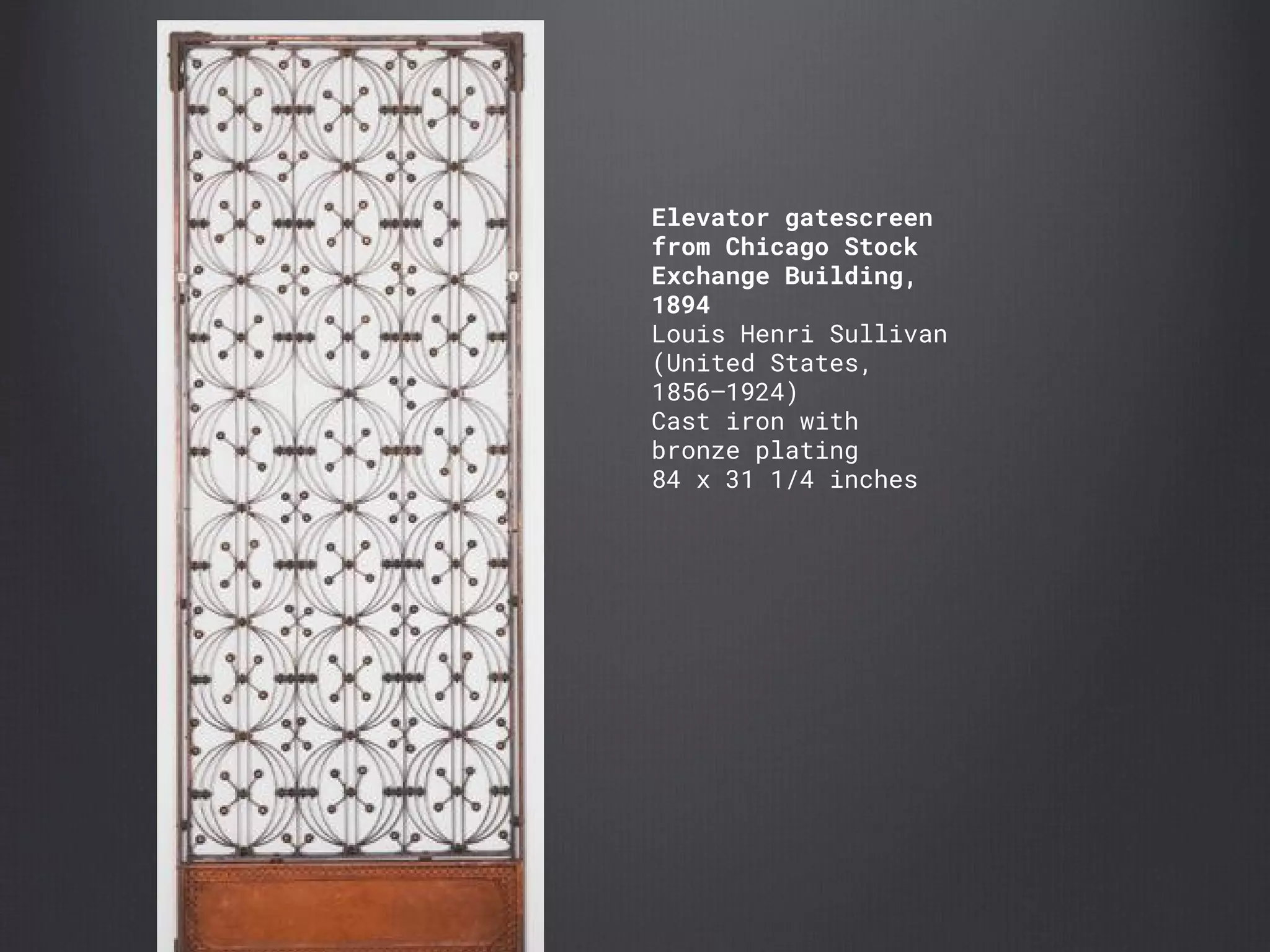
Elevator gatescreen
from Chicago Stock
Exchange Building,
1894
Louis Henri Sullivan
(United States,
1856–1924)
Cast iron with
bronze plating
84 x 31 1/4 inches
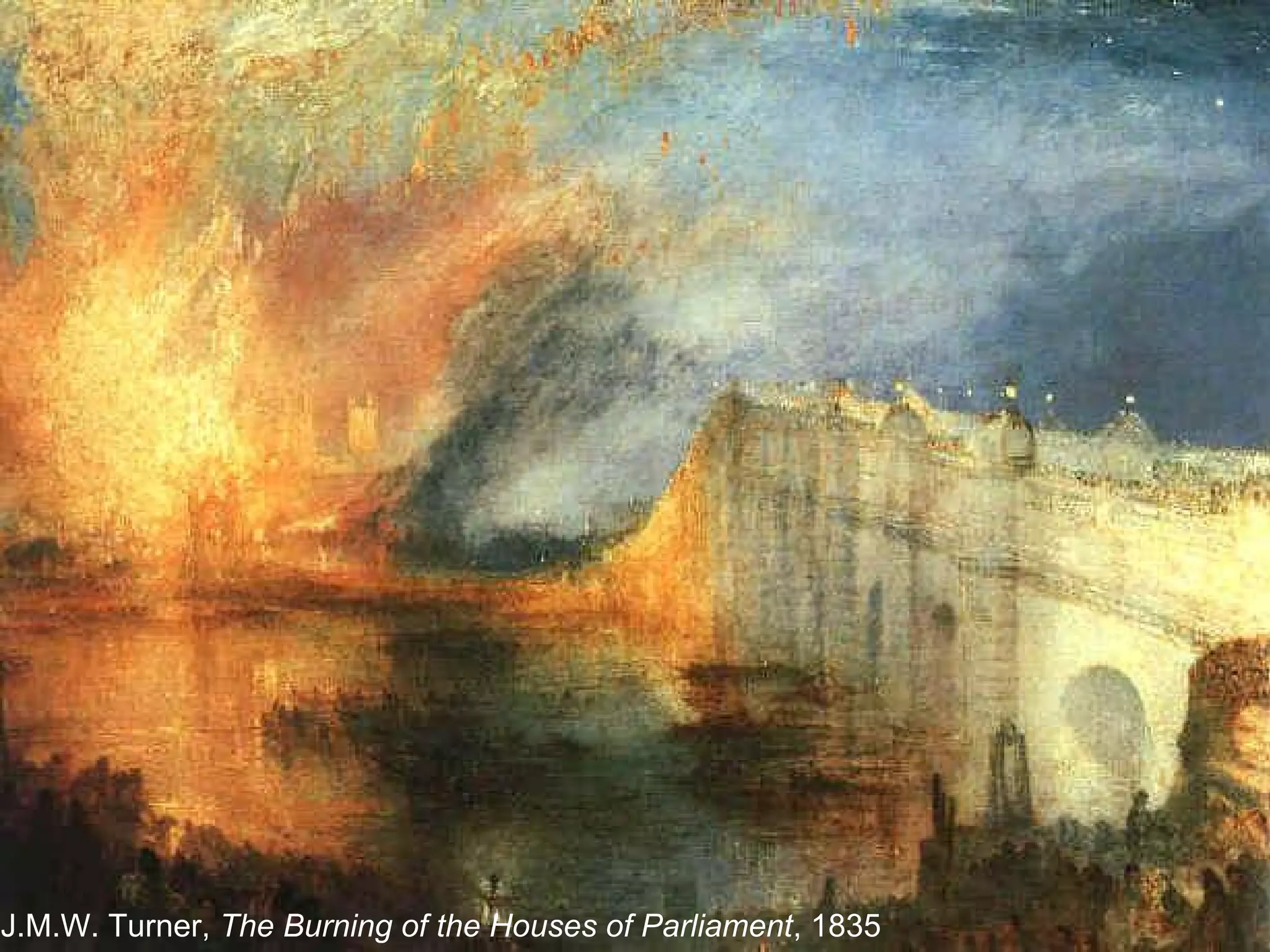
J.M.W. Turner, The Burning of the Houses of Parliament, 1835
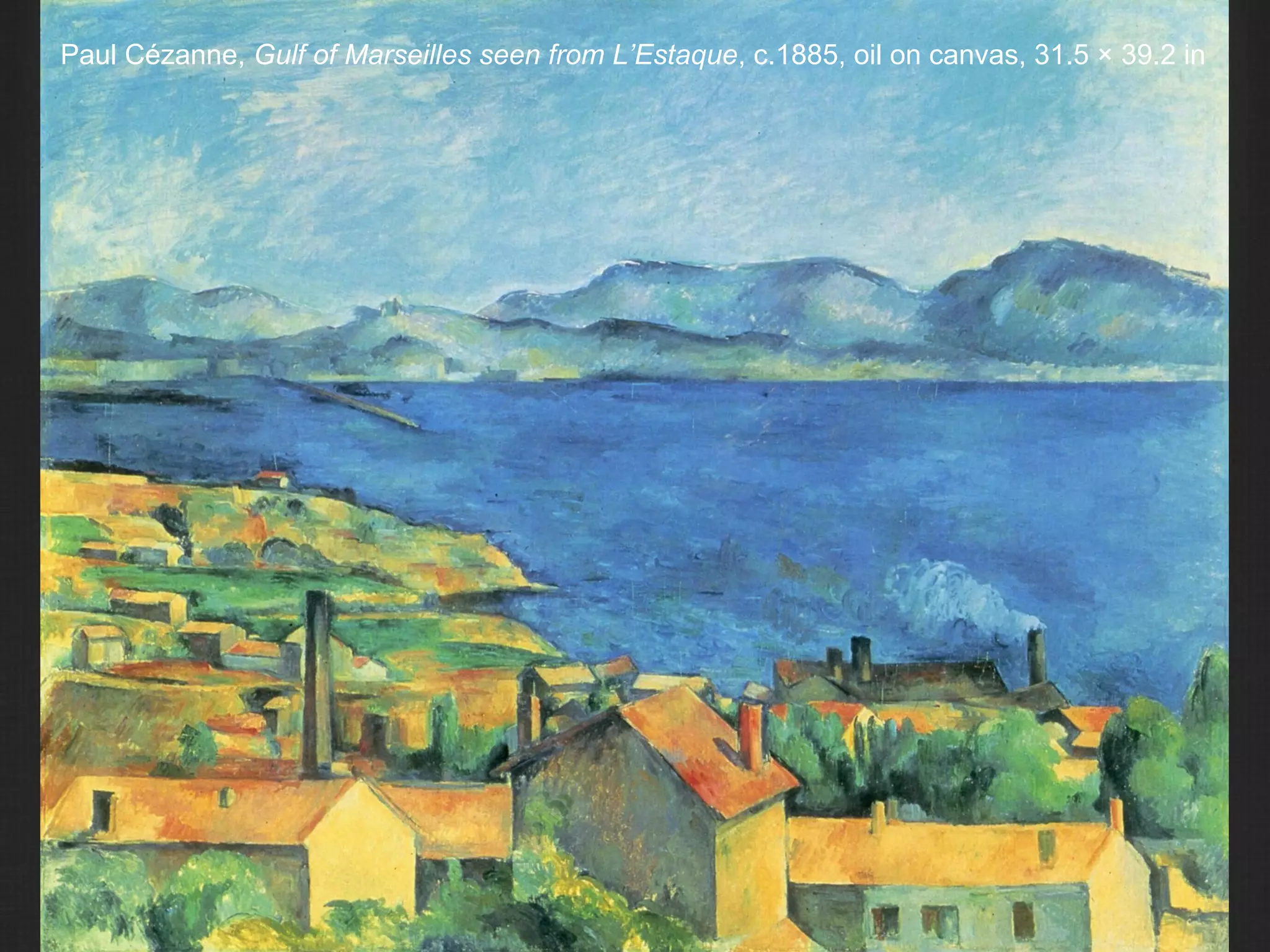
Paul Cézanne, Gulf of Marseilles seen from L’Estaque, c.1885, oil on canvas, 31.5 × 39.2 in
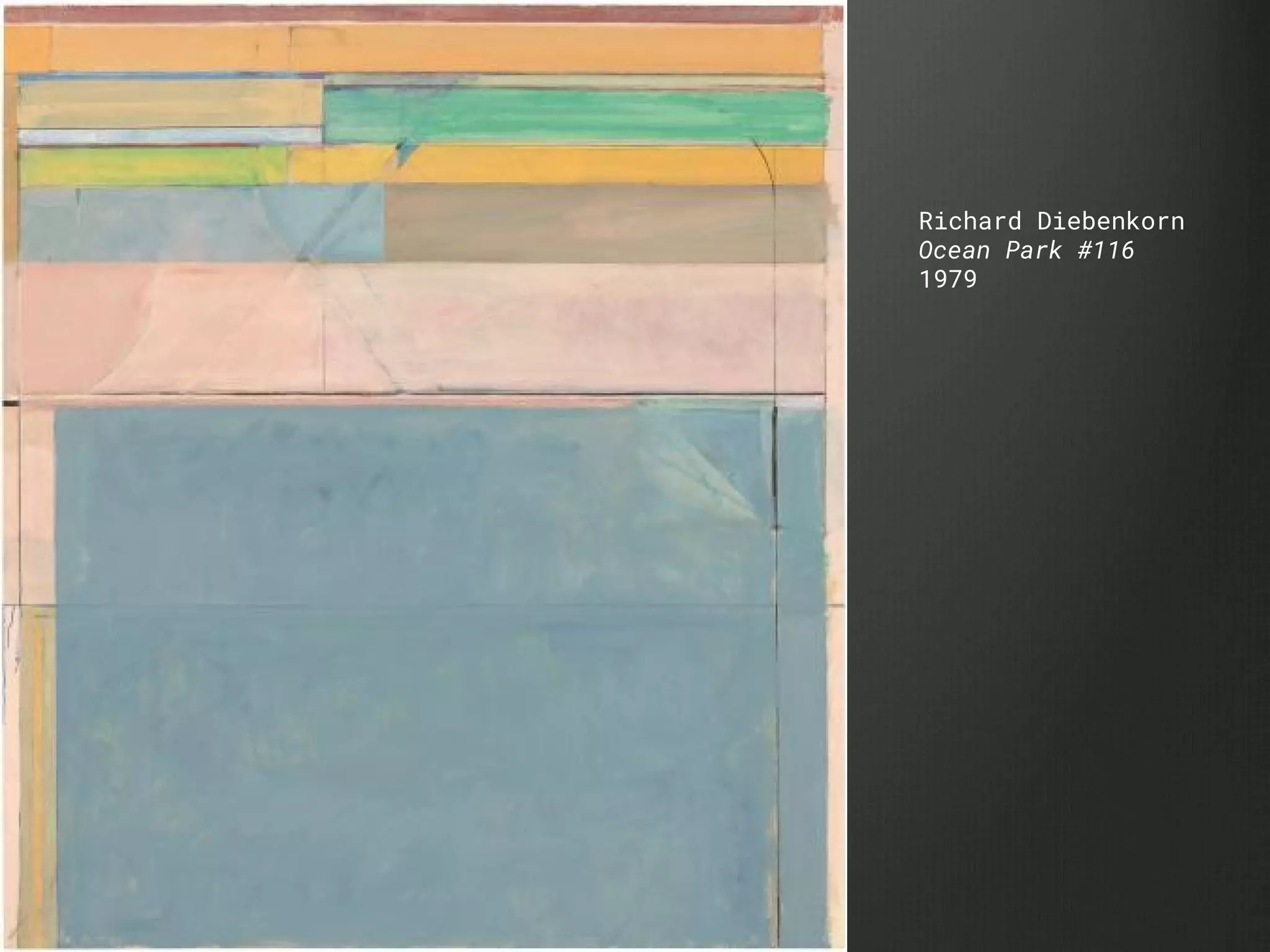
Richard Diebenkorn
Ocean Park #116
1979
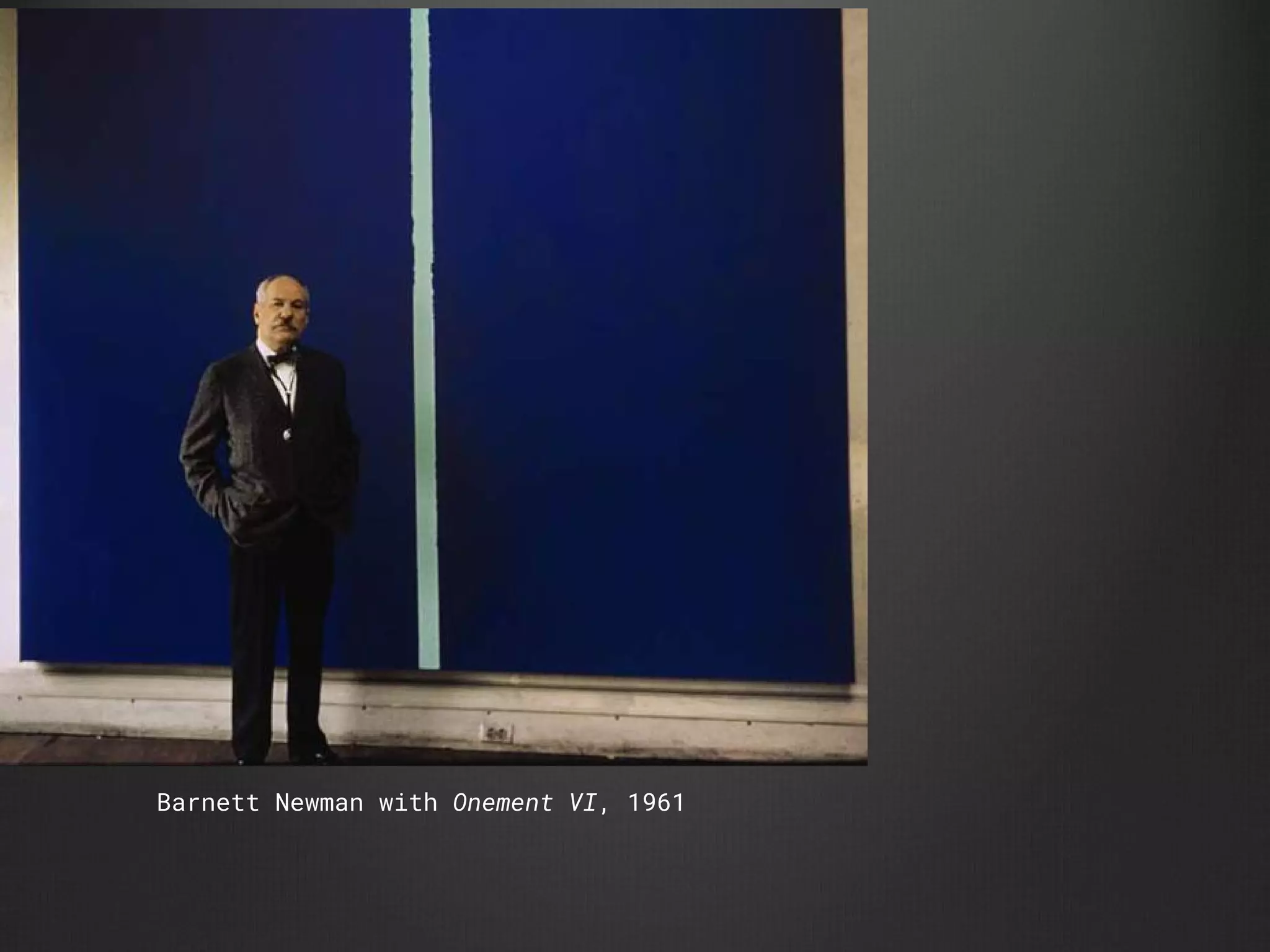
Barnett Newman with Onement VI, 1961
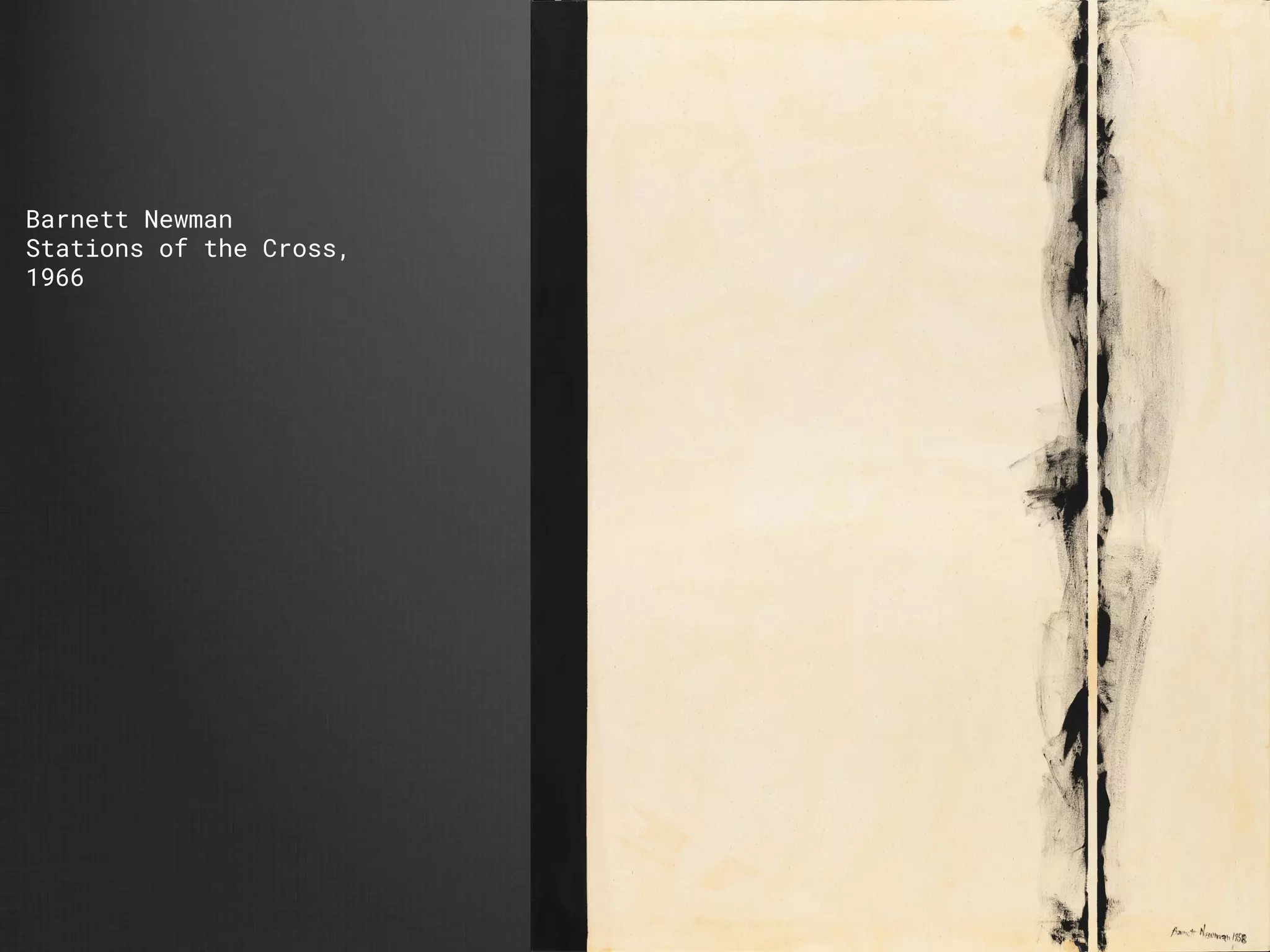
Barnett Newman
Stations of the Cross,
1966
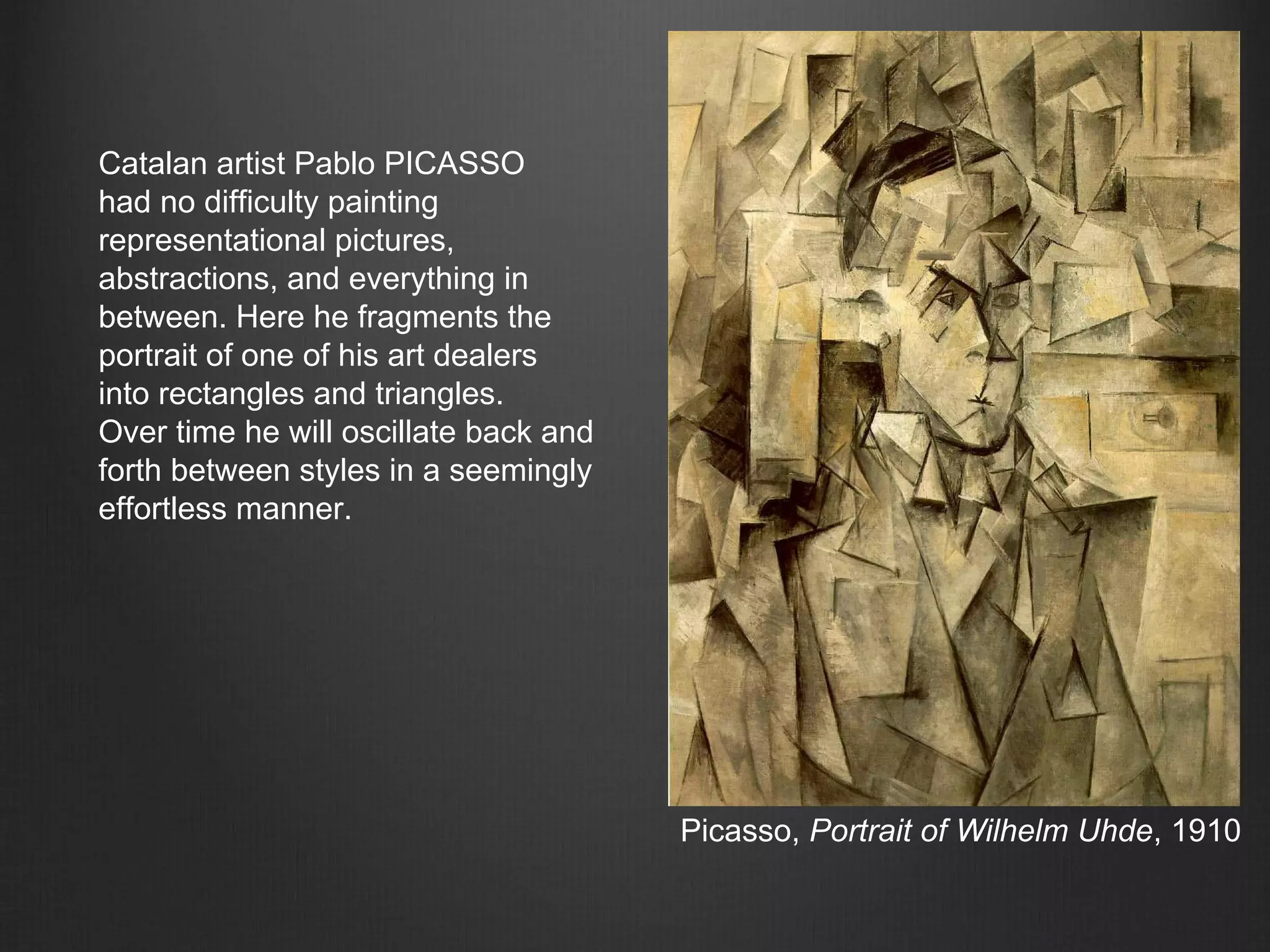
Picasso, Portrait of Wilhelm Uhde, 1910
Catalan artist Pablo PICASSO
had no difficulty painting
representational pictures,
abstractions, and everything in
between. Here he fragments the
portrait of one of his art dealers
into rectangles and triangles.
Over time he will oscillate back and
forth between styles in a seemingly
effortless manner.
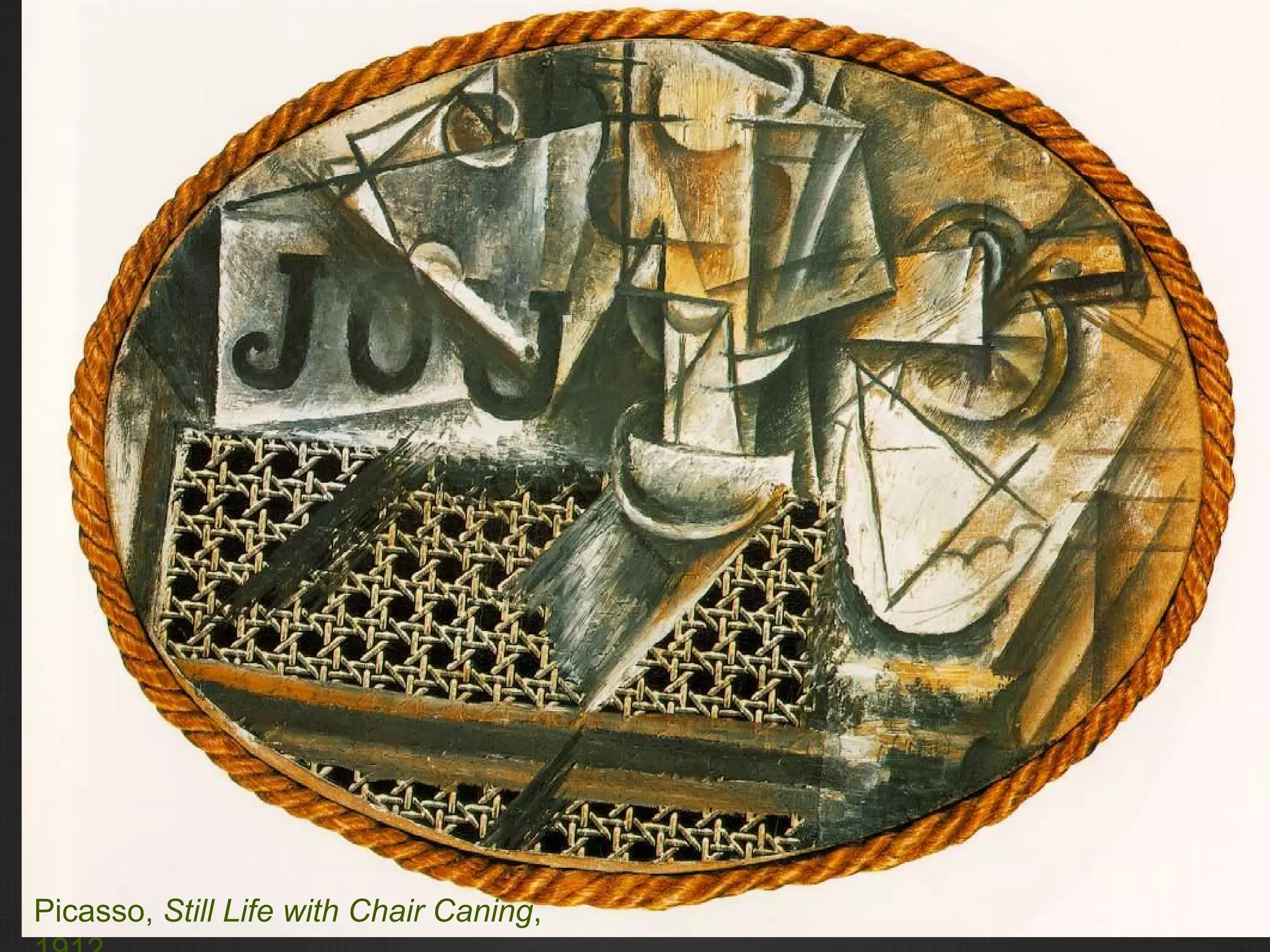
Picasso, Still Life with Chair Caning,
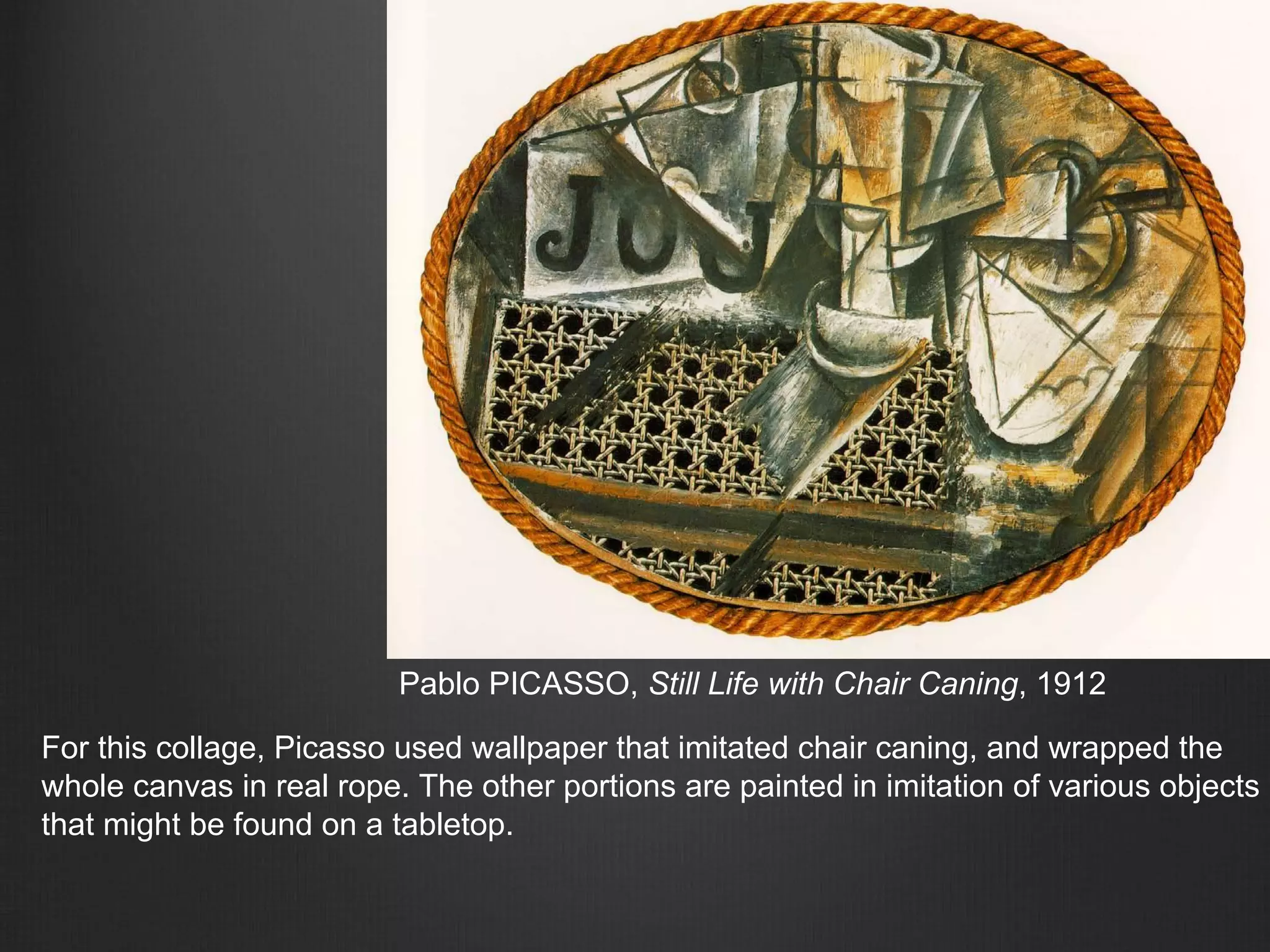
Pablo PICASSO, Still Life with Chair Caning, 1912
For this collage, Picasso used wallpaper that imitated chair caning, and wrapped the
whole canvas in real rope. The other portions are painted in imitation of various objects
that might be found on a tabletop.
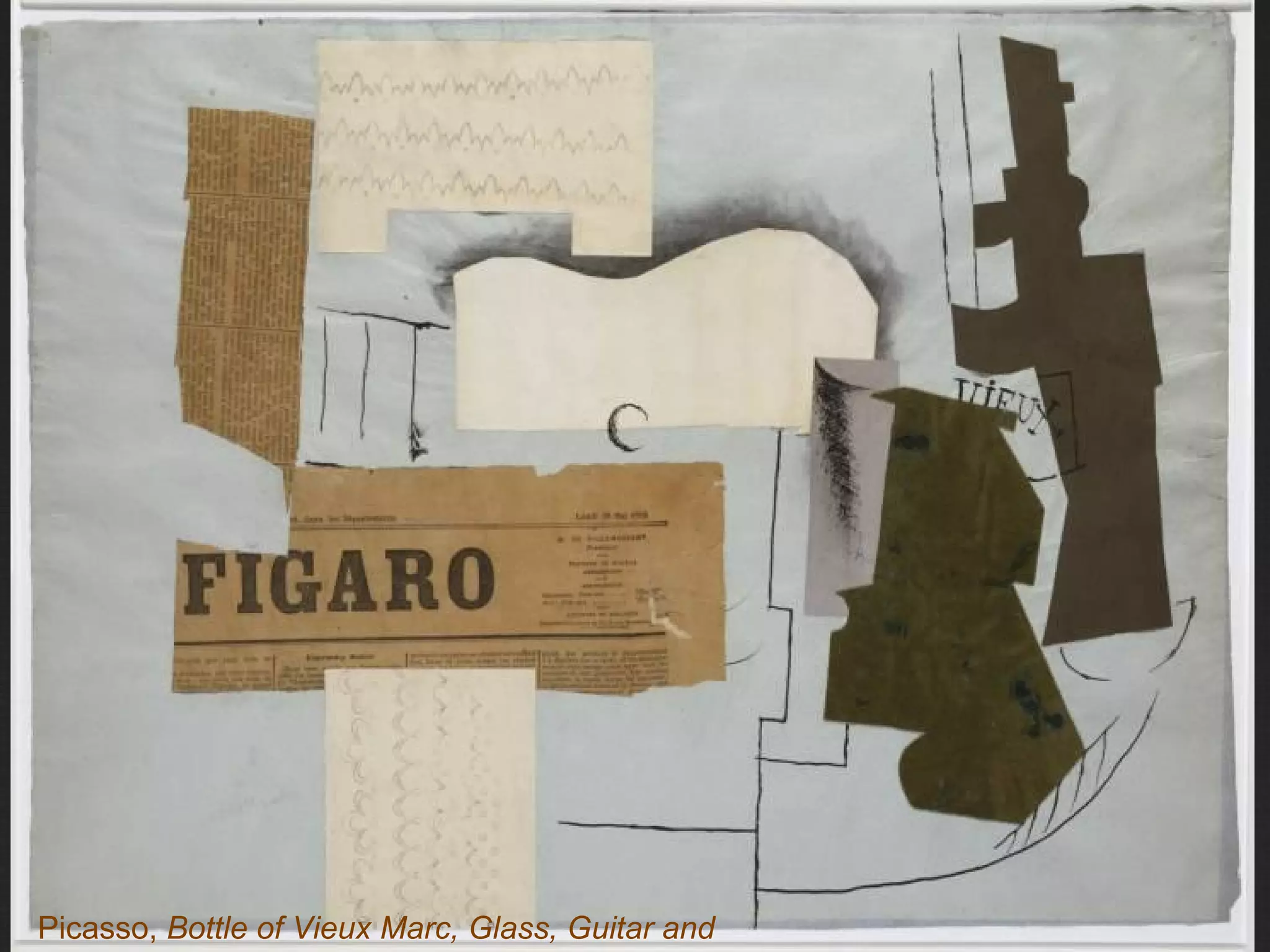
Picasso, Bottle of Vieux Marc, Glass, Guitar and
Newspaper, 1913,Picasso, Bottle of Vieux Marc, Glass, Guitar and
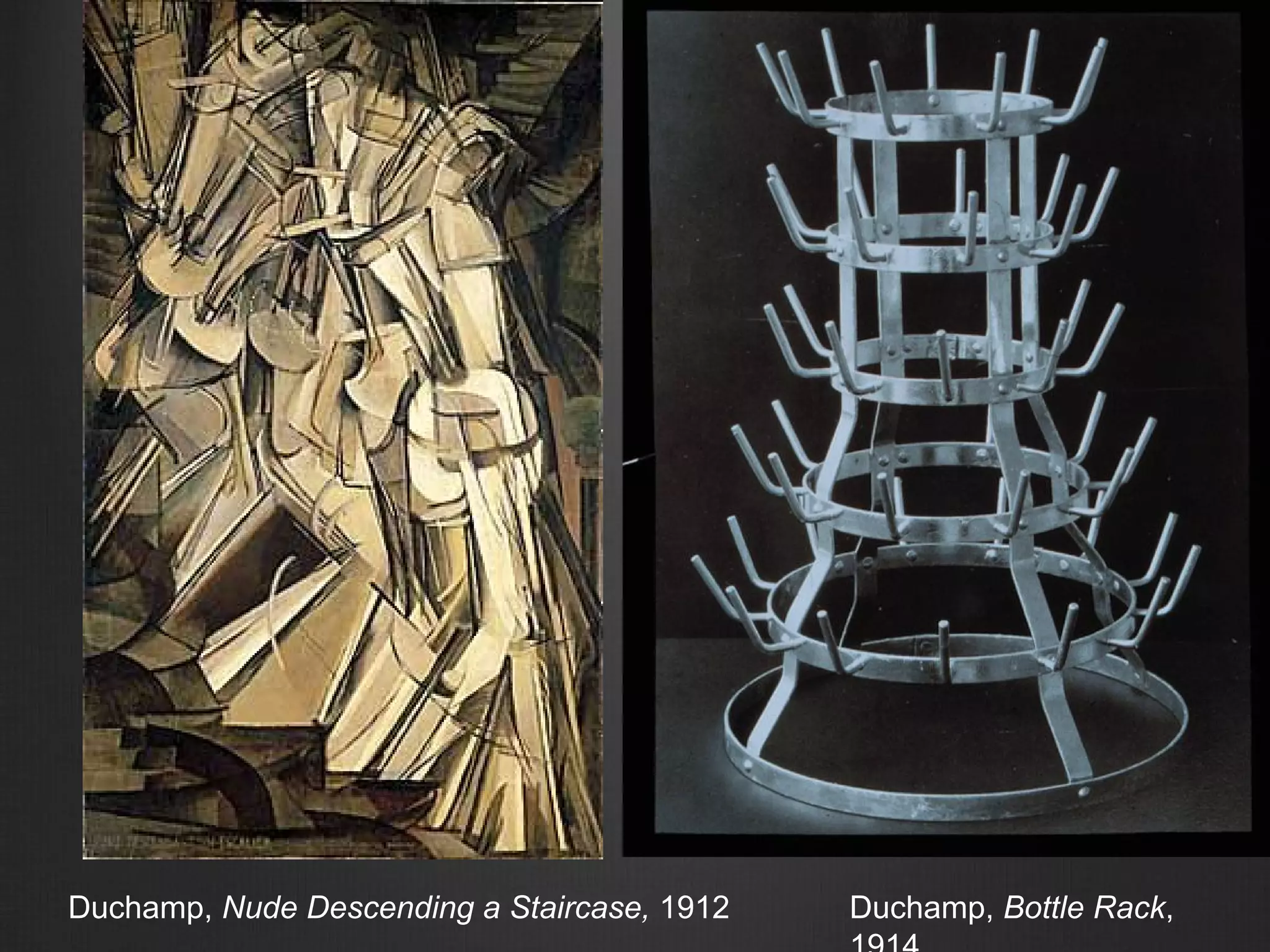
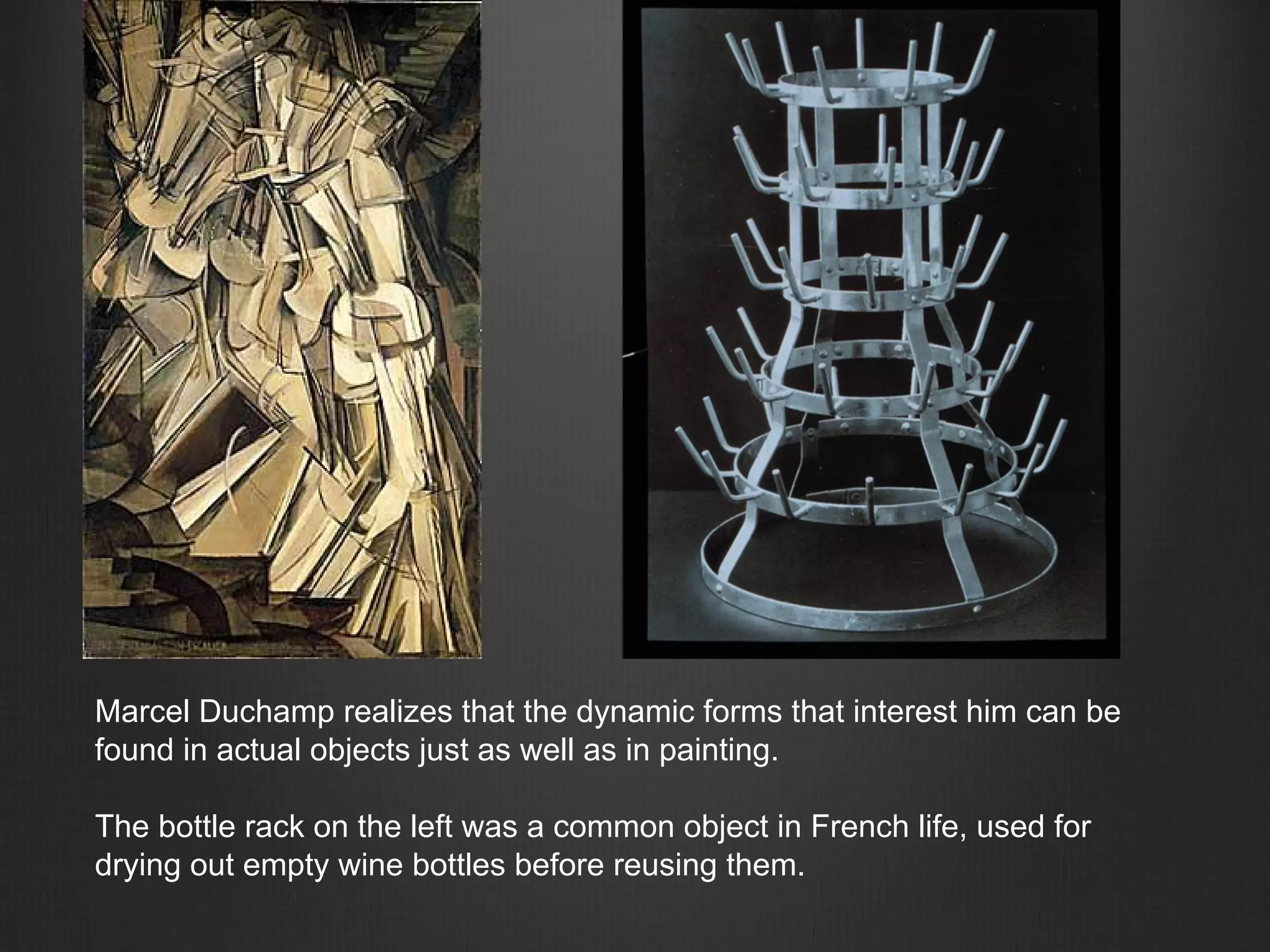
Duchamp, Nude Descending a Staircase, 1912 Duchamp, Bottle Rack,
Marcel Duchamp realizes that the dynamic forms that interest him can be
found in actual objects just as well as in painting.
The bottle rack on the left was a common object in French life, used for
drying out empty wine bottles before reusing them.
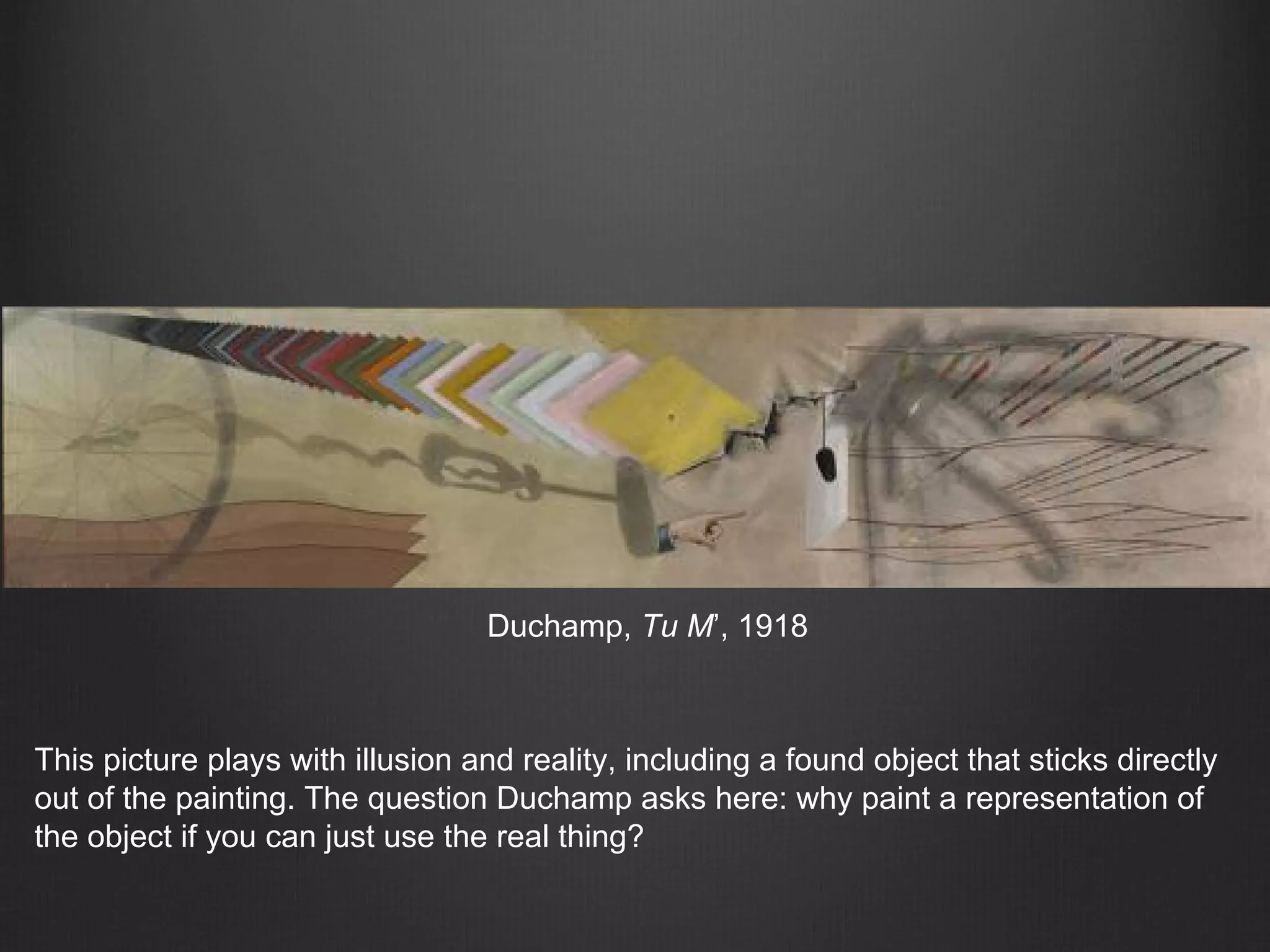
Duchamp, Tu M’, 1918
This picture plays with illusion and reality, including a found object that sticks directly
out of the painting. The question Duchamp asks here: why paint a representation of
the object if you can just use the real thing?
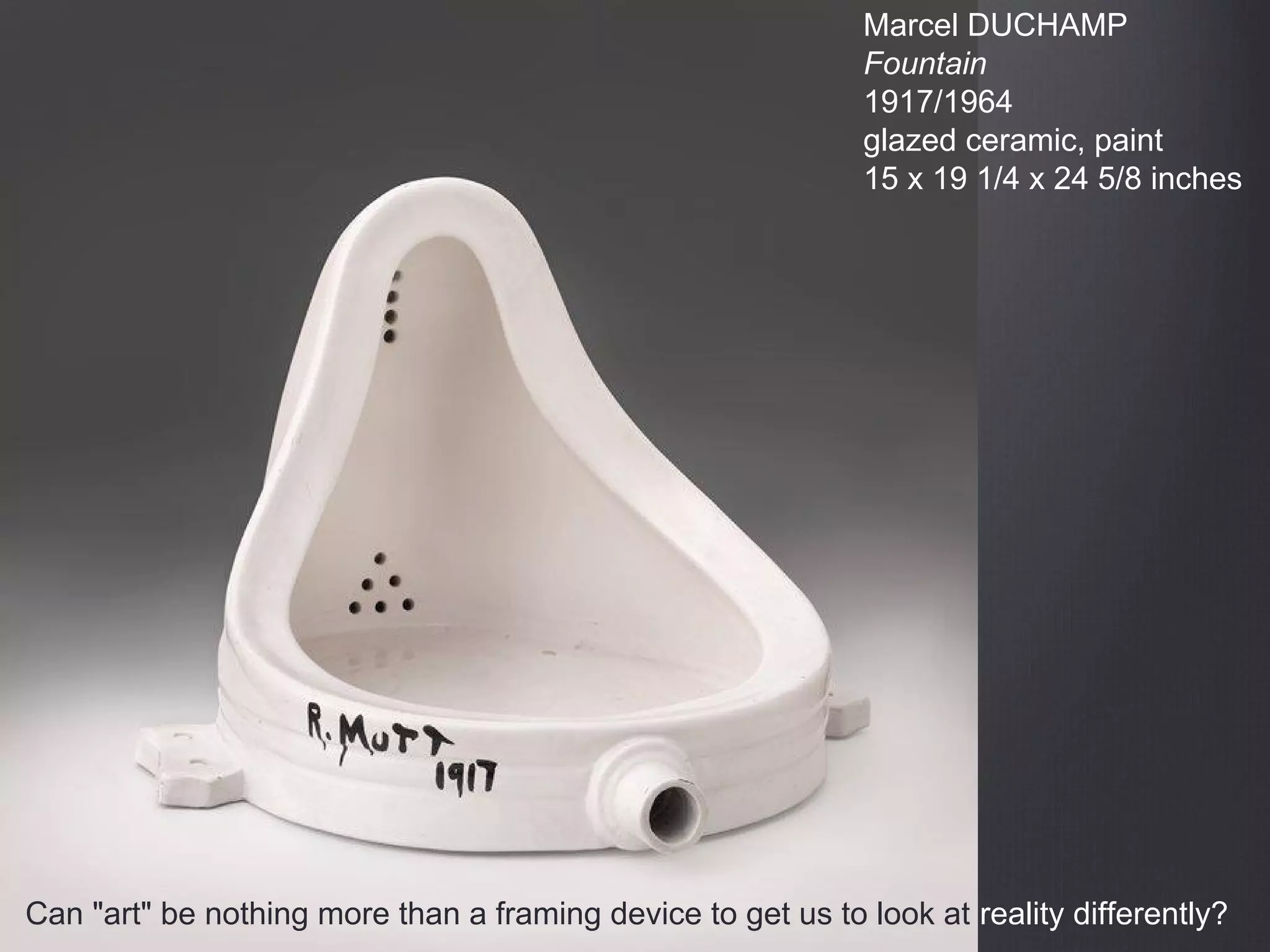
Marcel DUCHAMP
Fountain
1917/1964
glazed ceramic, paint
15 x 19 1/4 x 24 5/8 inches
Can "art" be nothing more than a framing device to get us to look at reality differently?
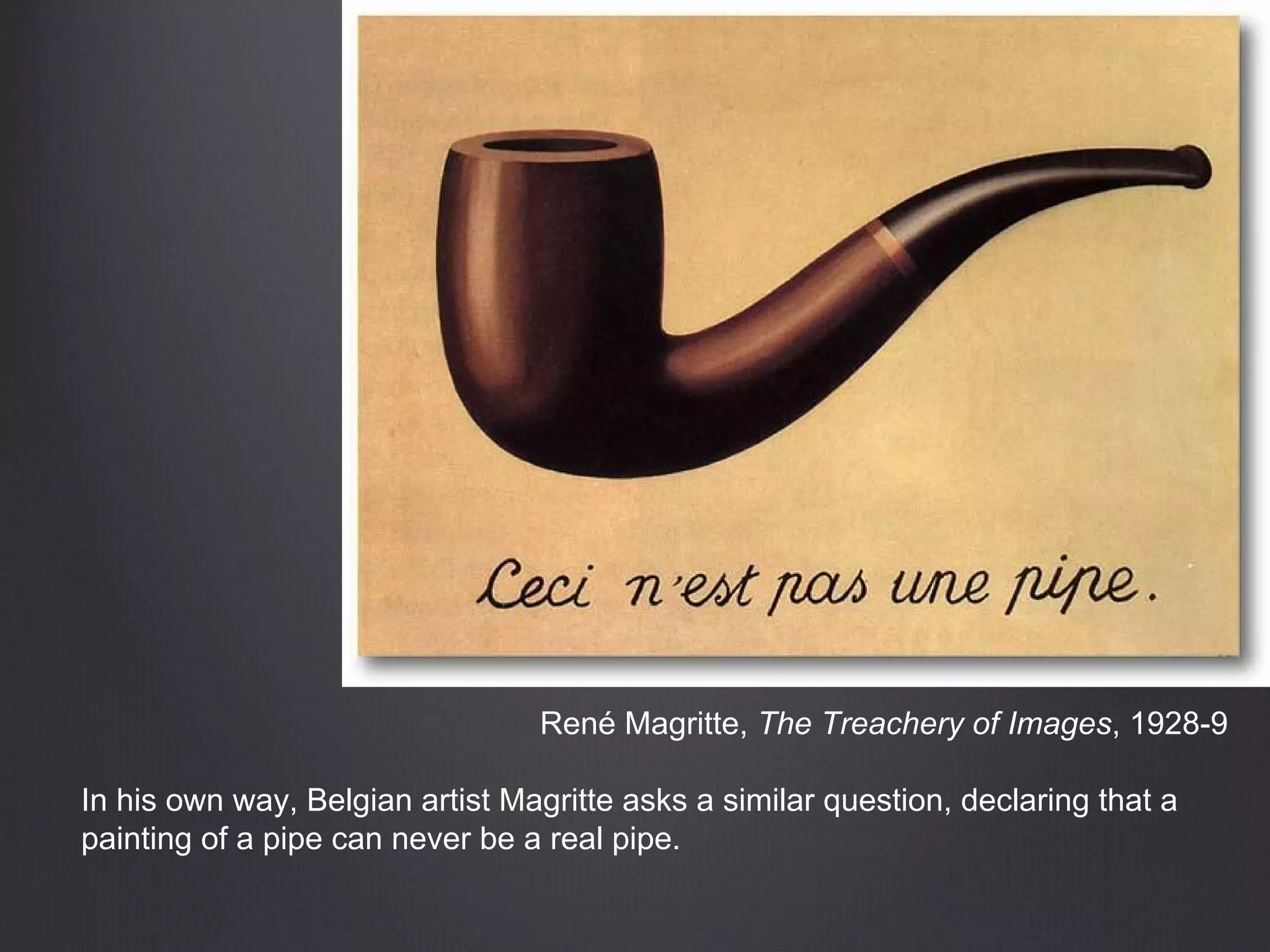
René Magritte, The Treachery of Images, 1928-9
In his own way, Belgian artist Magritte asks a similar question, declaring that a
painting of a pipe can never be a real pipe.
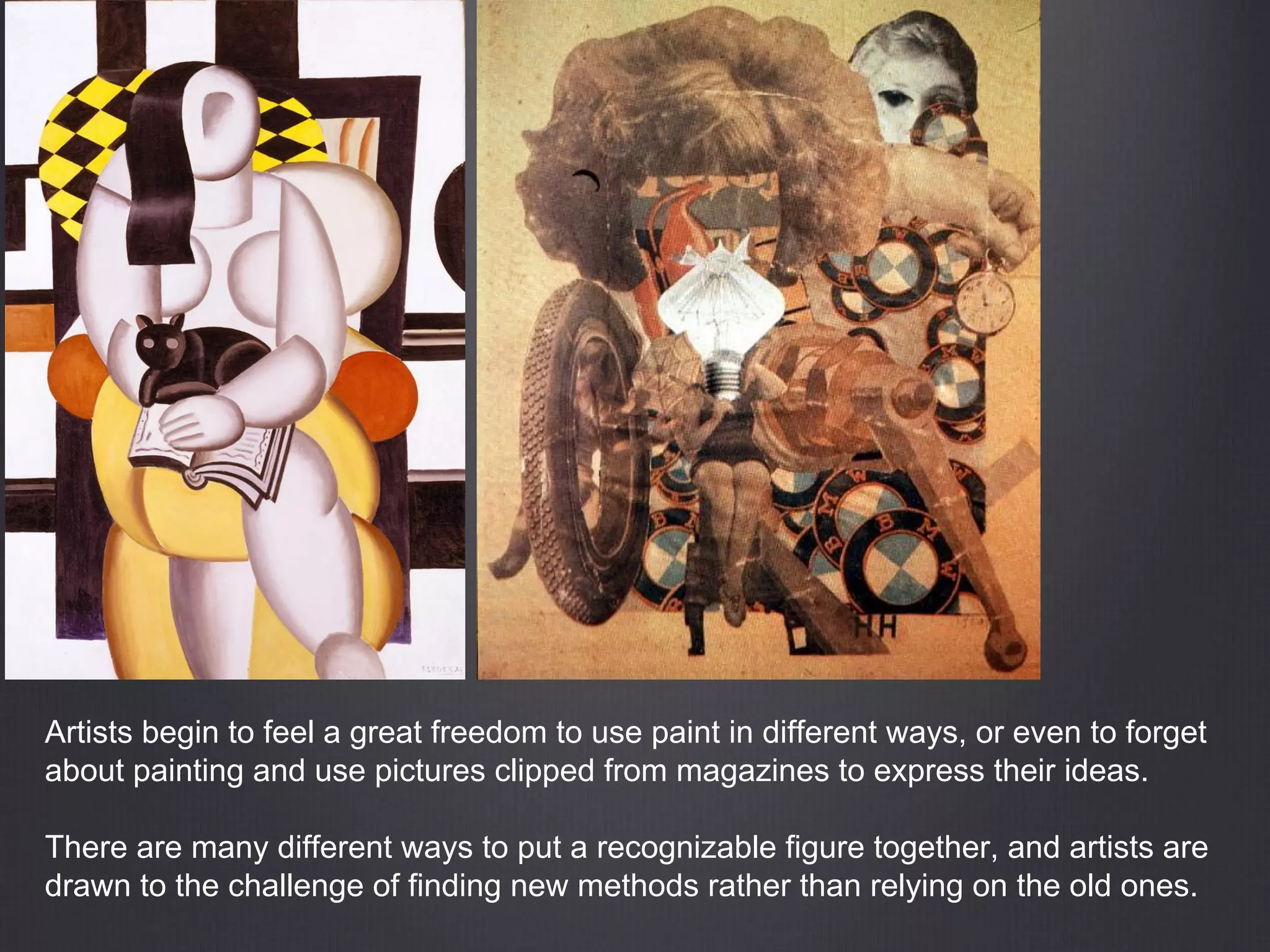
Artists begin to feel a great freedom to use paint in different ways, or even to forget
about painting and use pictures clipped from magazines to express their ideas.
There are many different ways to put a recognizable figure together, and artists are
drawn to the challenge of finding new methods rather than relying on the old ones.
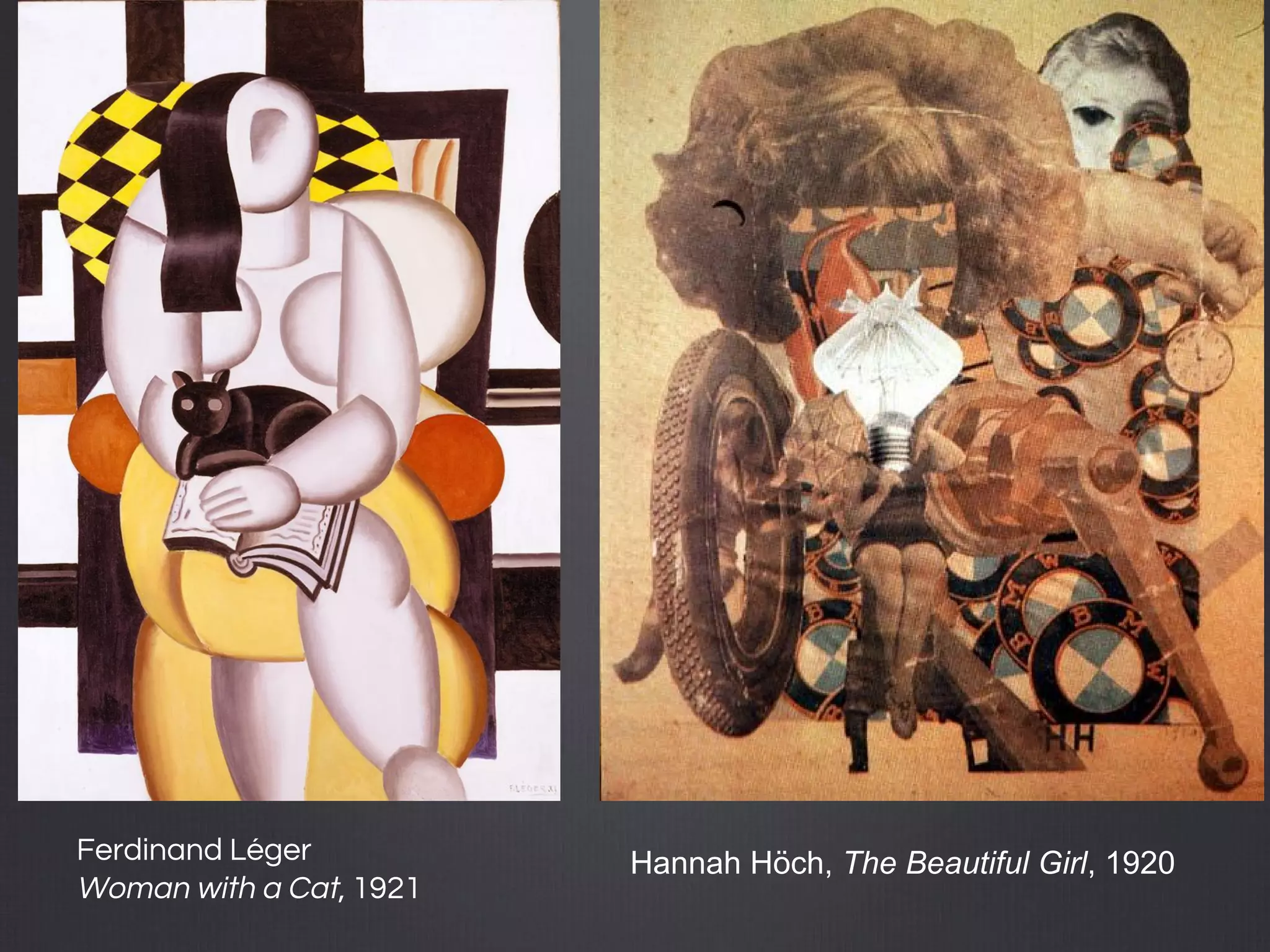
Ferdinand Léger
Woman with a Cat, 1921
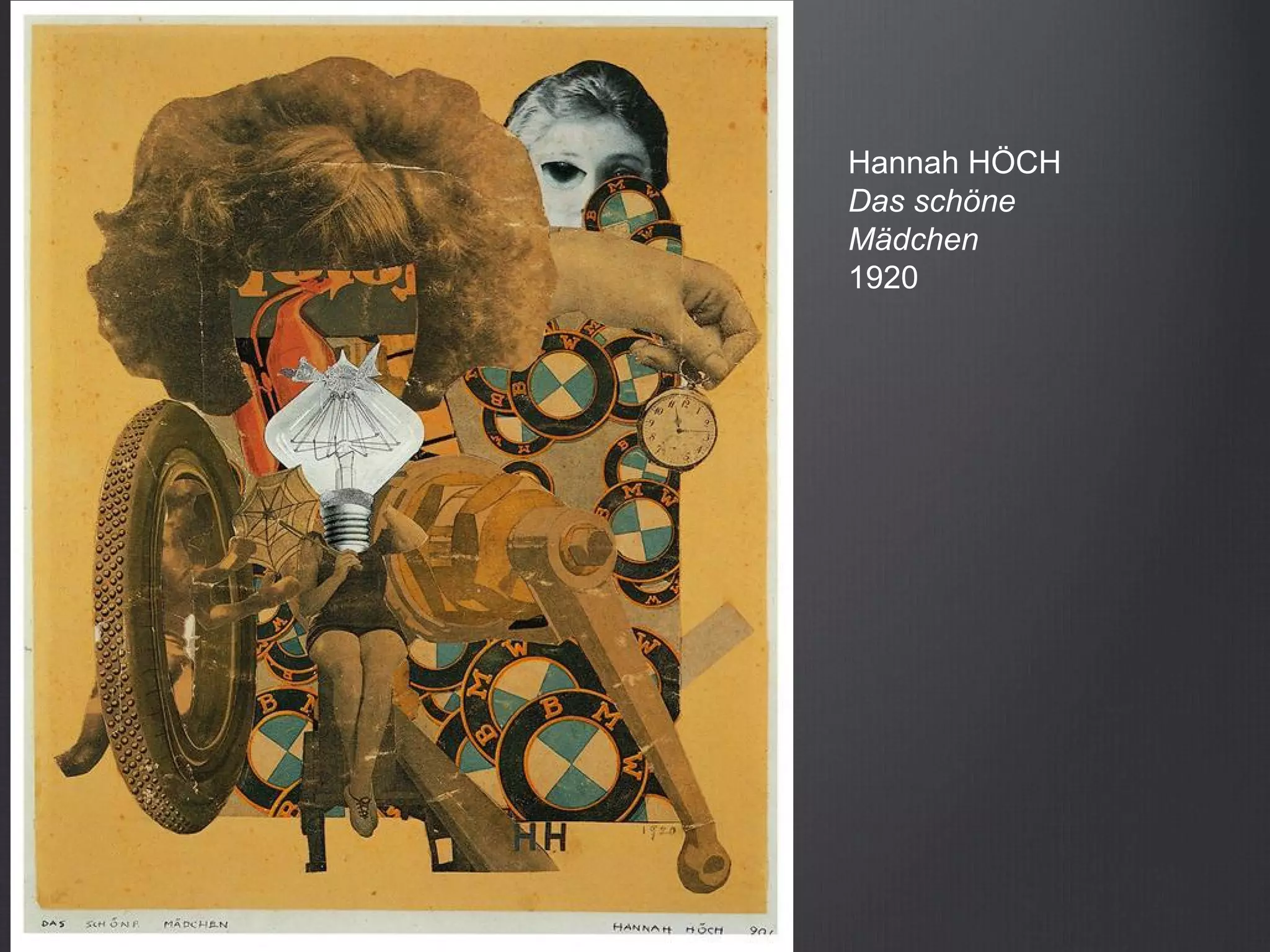
Hannah Höch, The Beautiful Girl, 1920
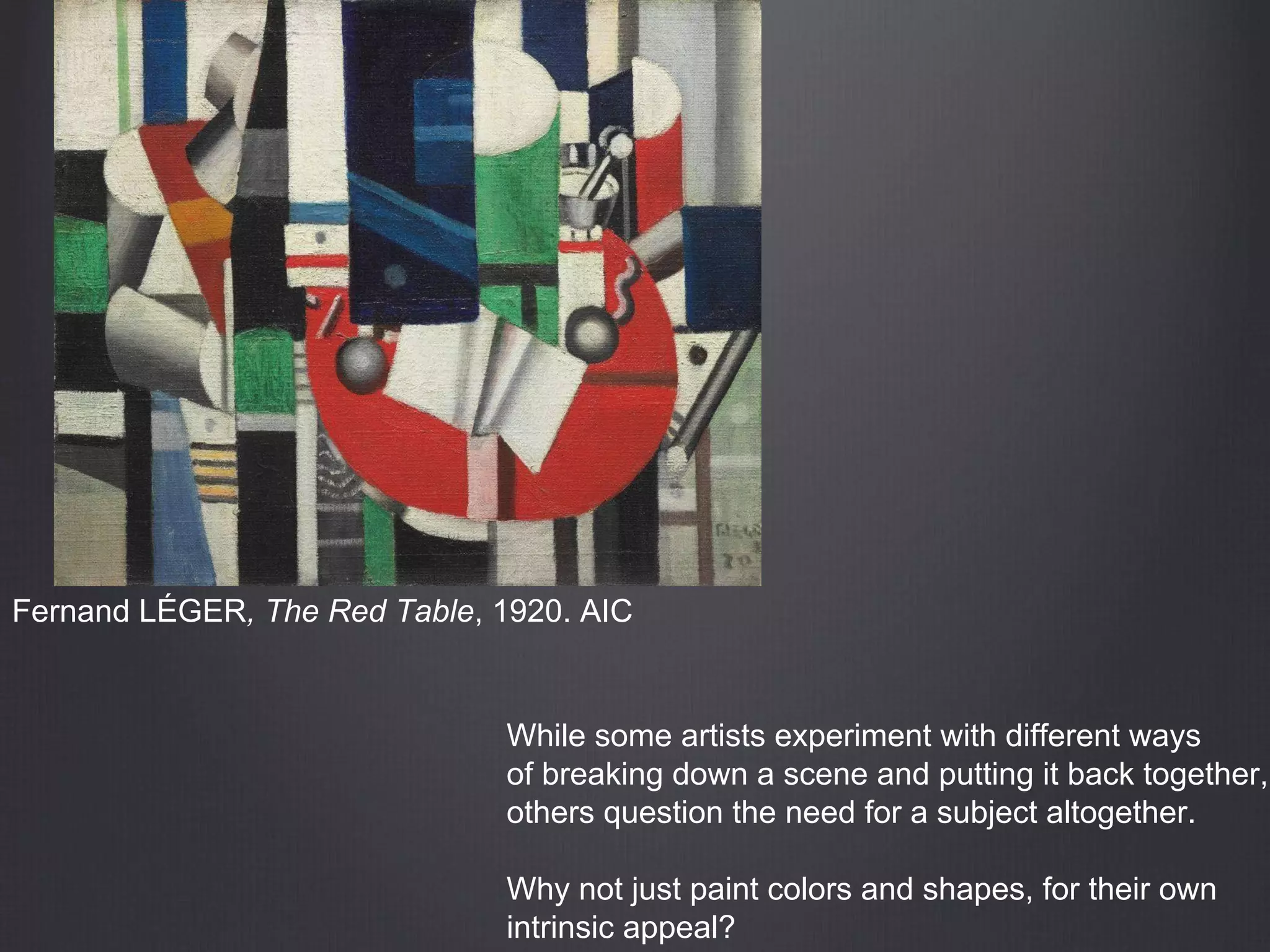
Fernand LÉGER, The Red Table, 1920. AIC
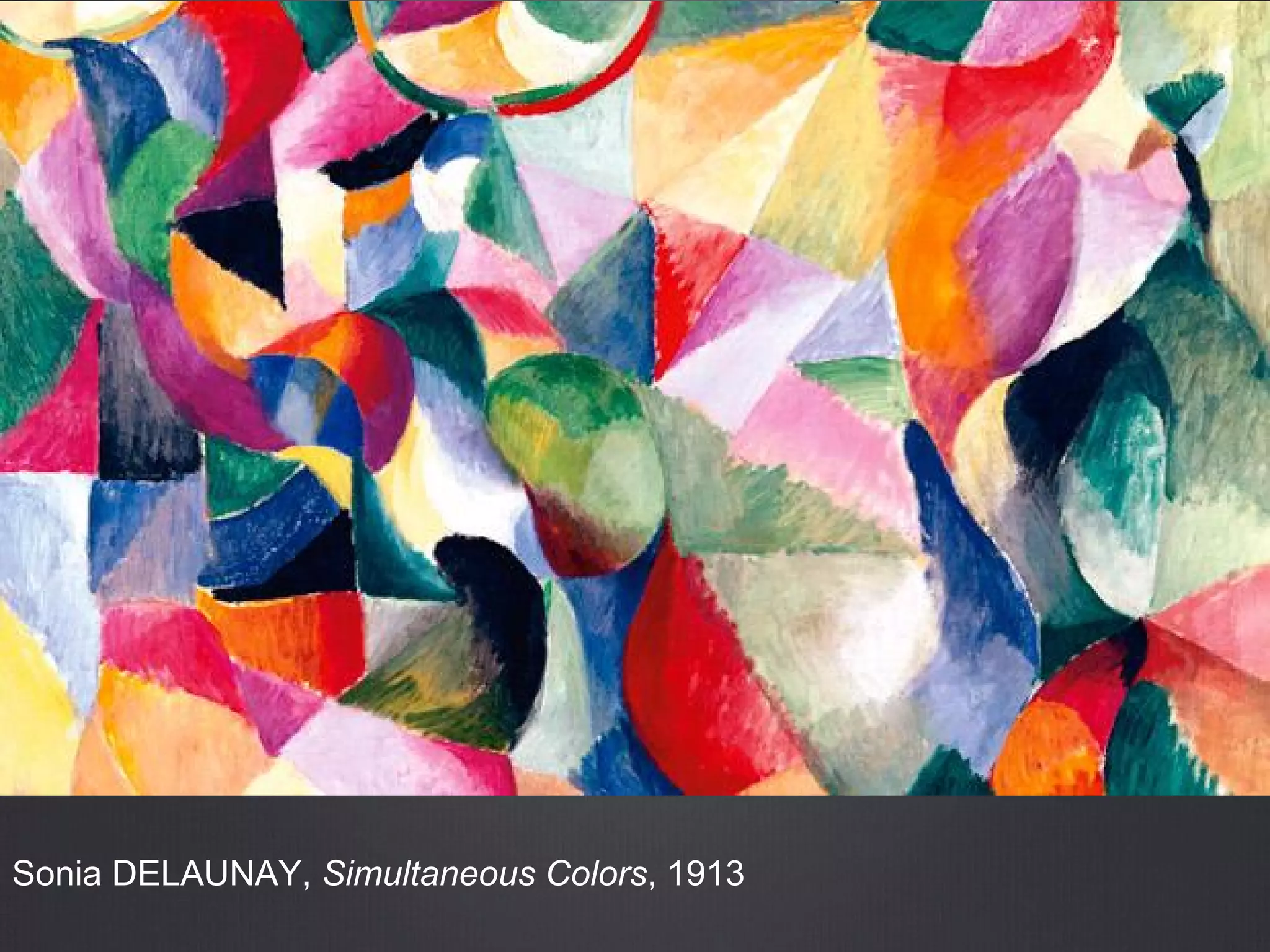
While some artists experiment with different ways
of breaking down a scene and putting it back together,
others question the need for a subject altogether.
Why not just paint colors and shapes, for their own
intrinsic appeal?
Sonia DELAUNAY, Simultaneous Colors, 1913
“There is no such thing as
‘abstract,’ or ‘concrete’… There is a
good picture and a bad picture.
There is the picture that moves you
and the picture that leaves you
cold… A picture has a value in
itself, like a musical score, like a
poem.”
—Fernand Léger
Here French artist Léger tries to explain that it doesn’t really matter whether a
picture has a subject matter.
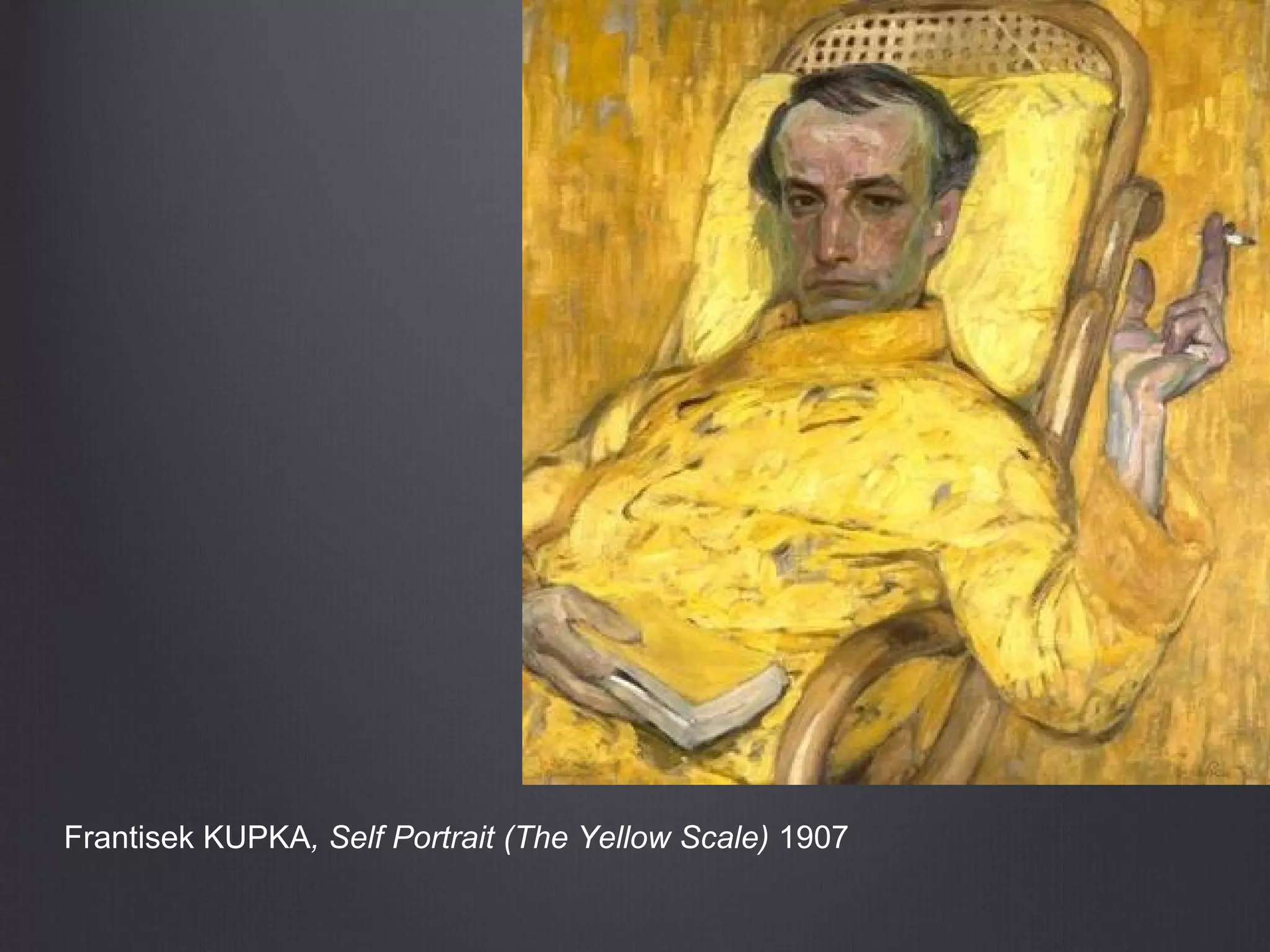
Frantisek KUPKA, Self Portrait (The Yellow Scale) 1907
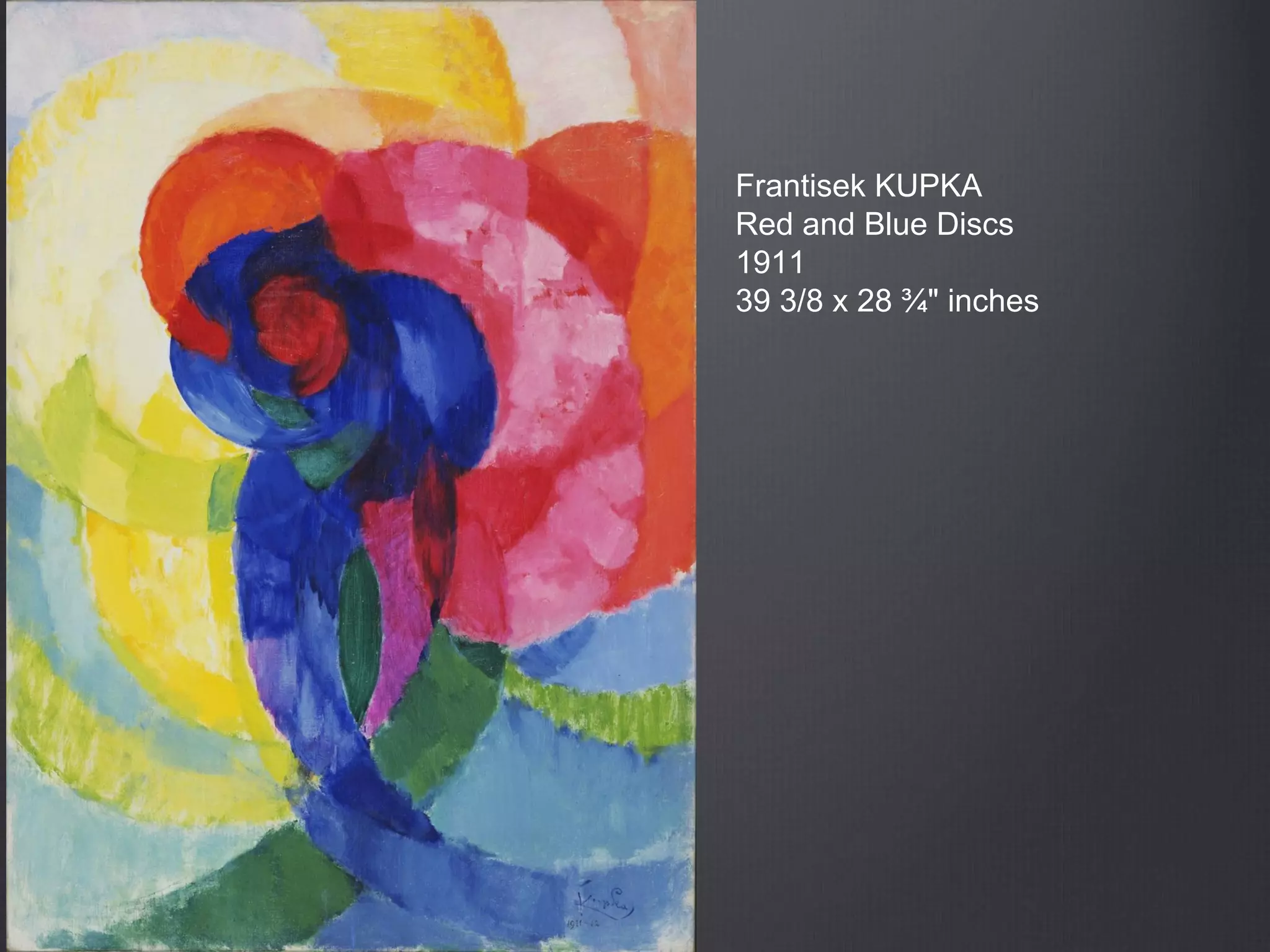
Frantisek KUPKA
Red and Blue Discs
1911
39 3/8 x 28 ¾" inches
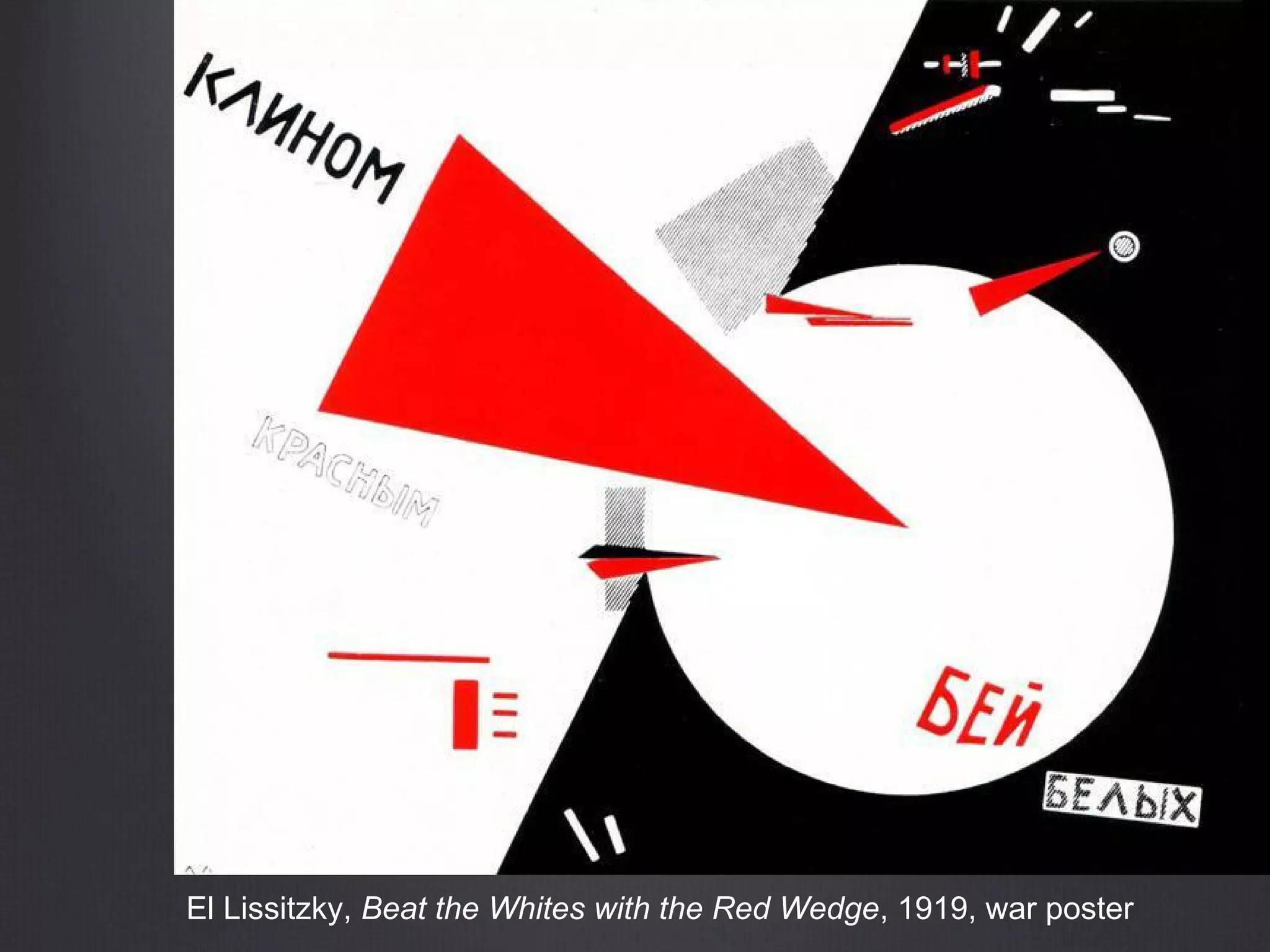
El Lissitzky, Beat the Whites with the Red Wedge, 1919, war poster
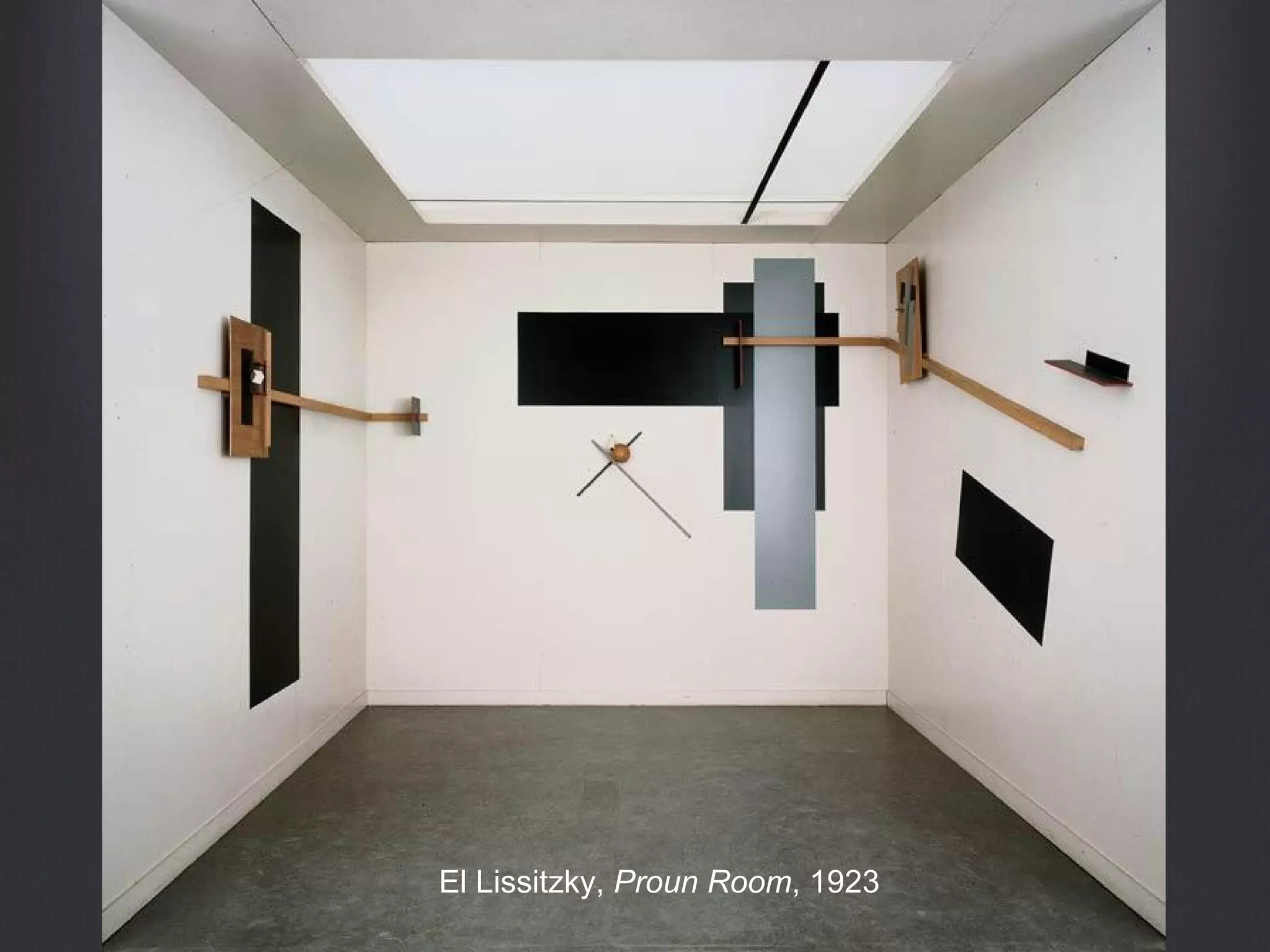
El Lissitzky, Proun Room, 1923
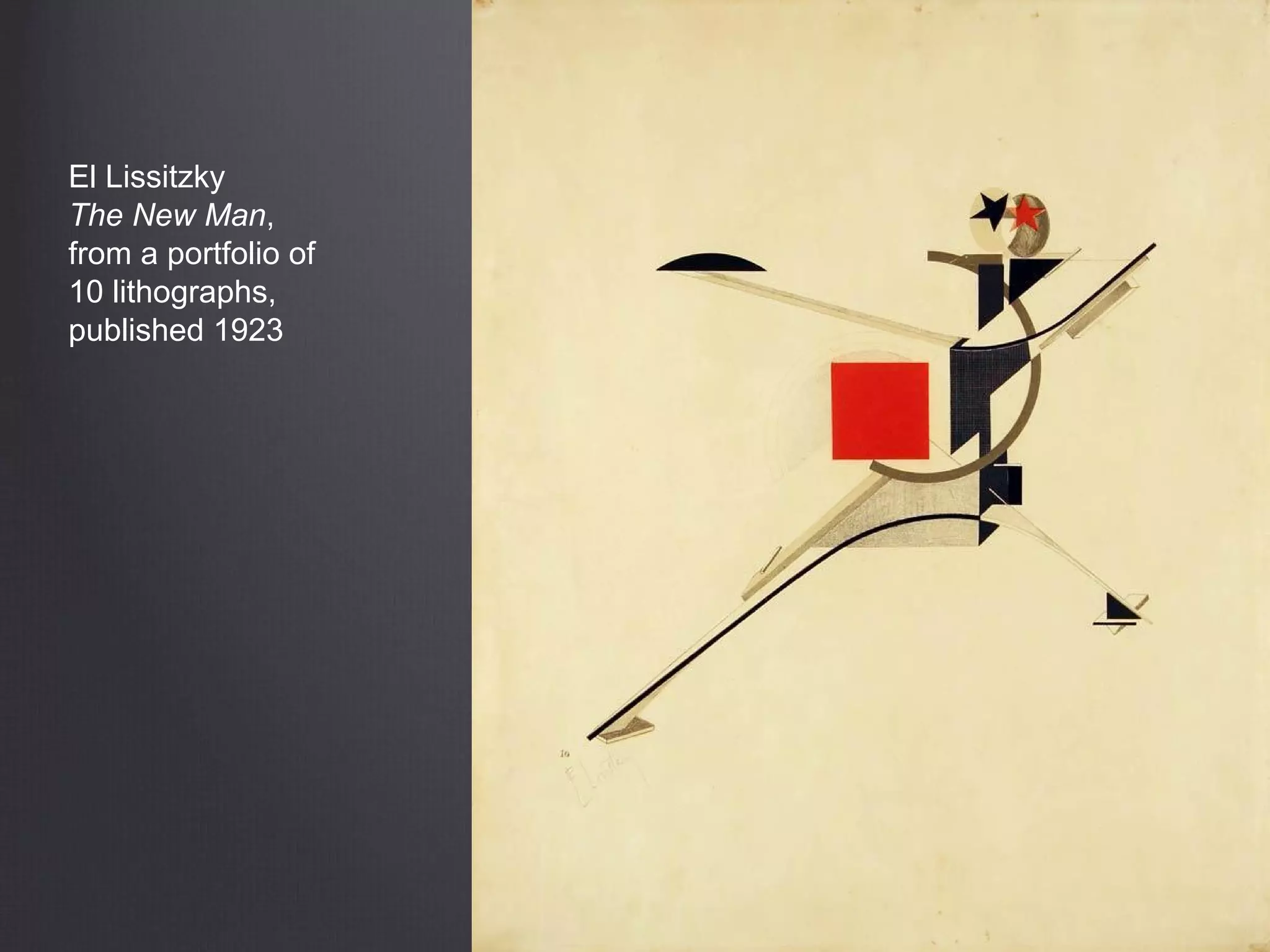
El Lissitzky
The New Man,
from a portfolio of
10 lithographs,
published 1923
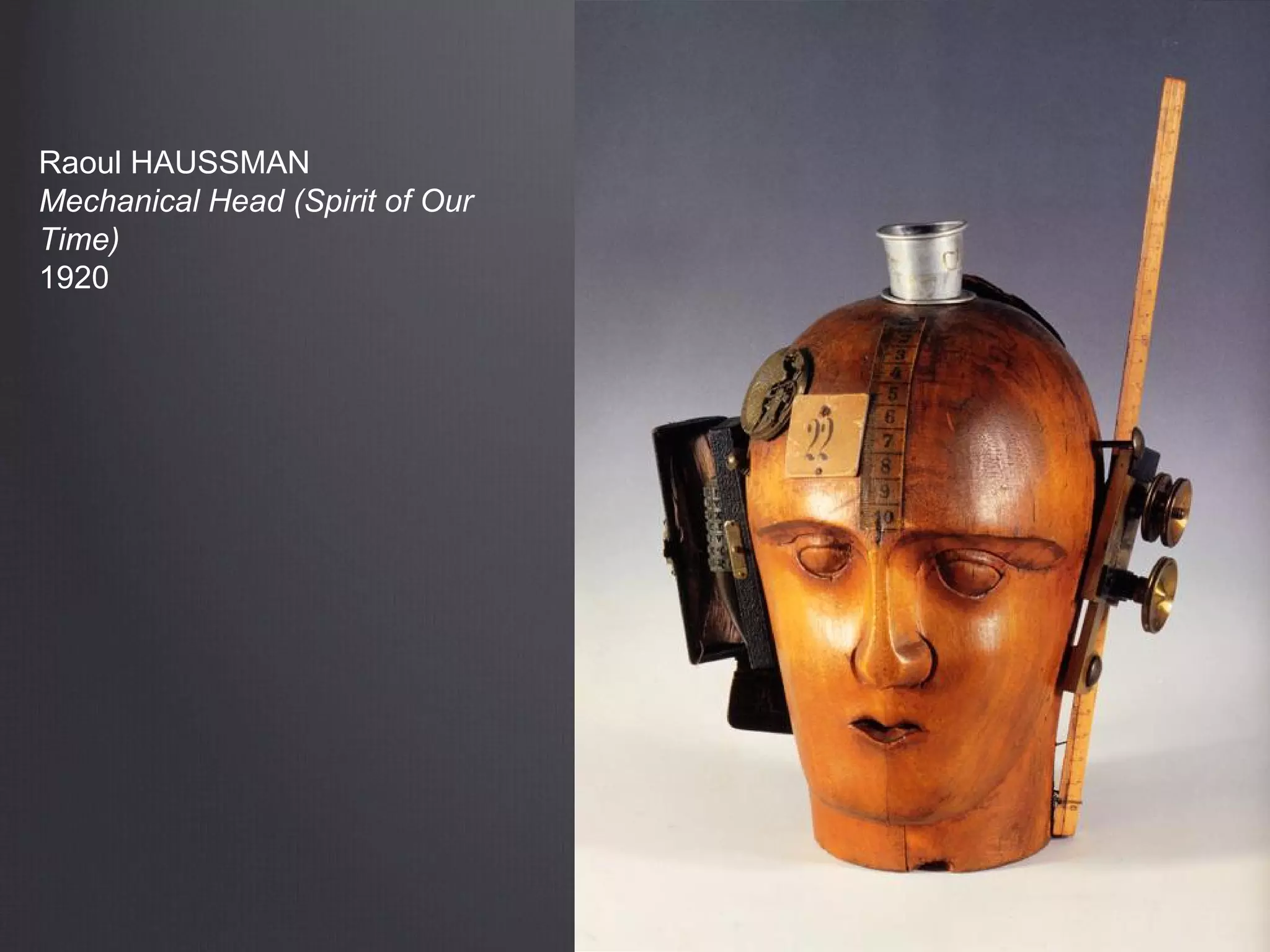
Raoul HAUSSMAN
Mechanical Head (Spirit of Our
Time)
1920
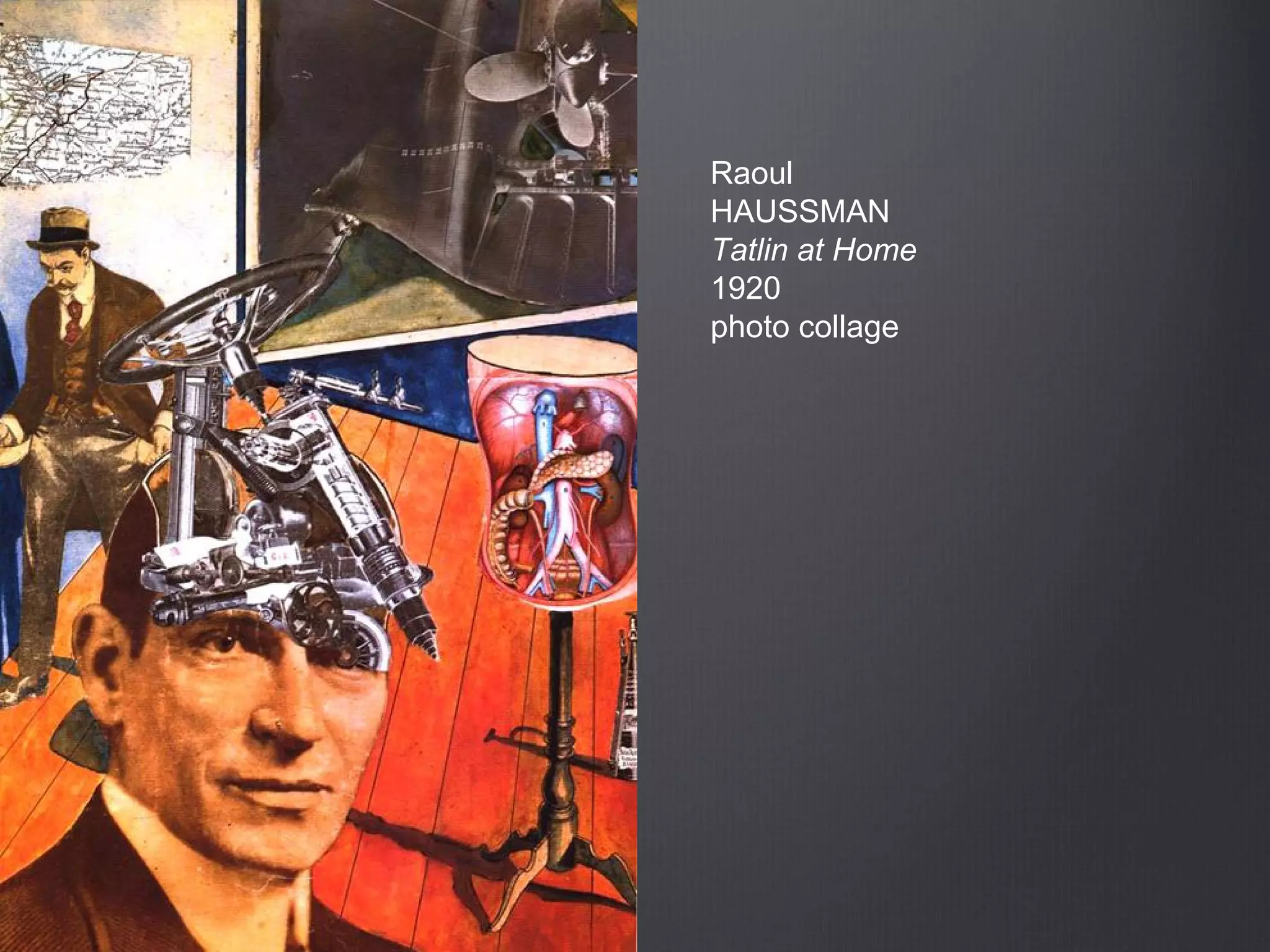
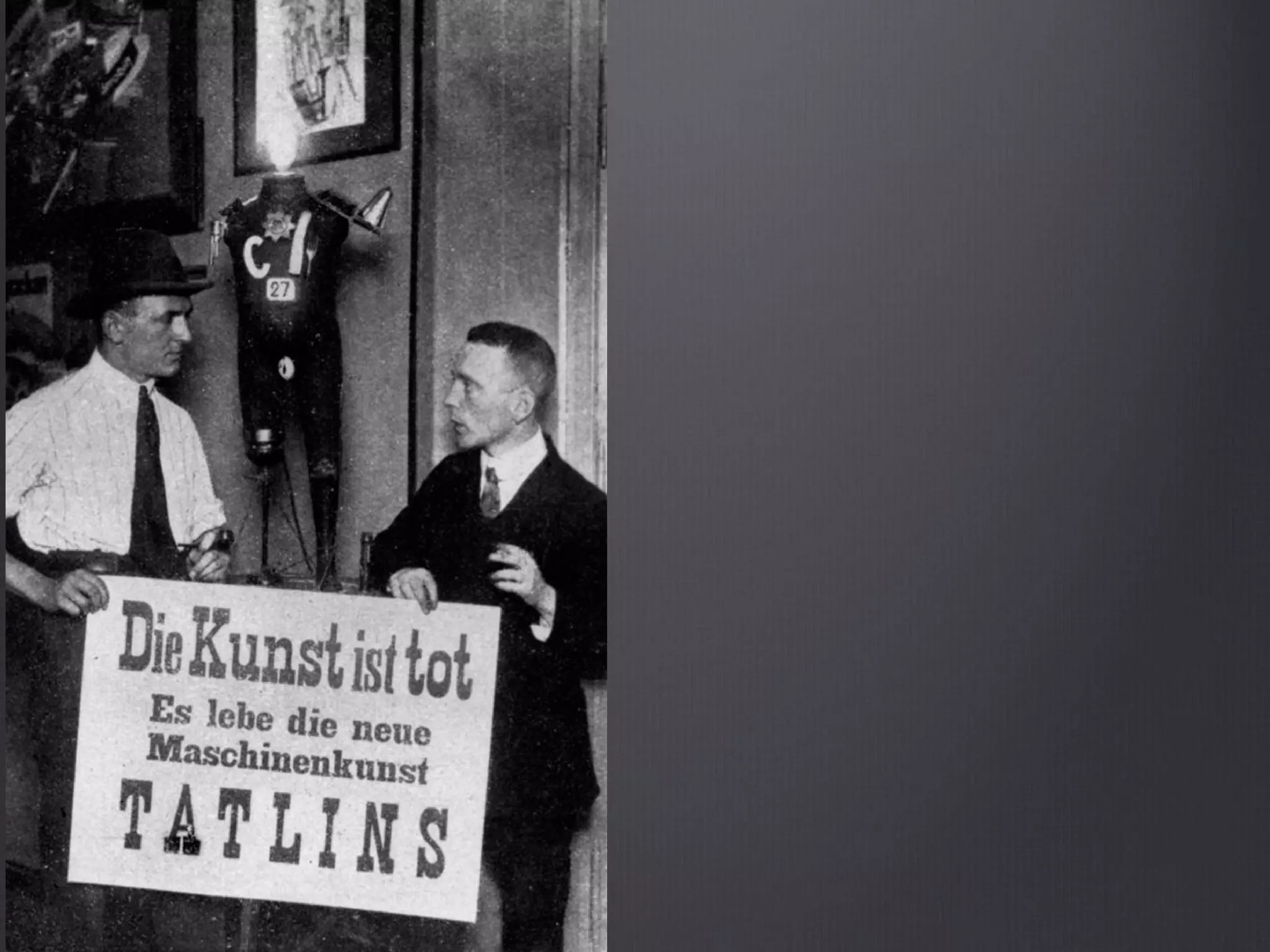
Raoul
HAUSSMAN
Tatlin at Home
1920
photo collage
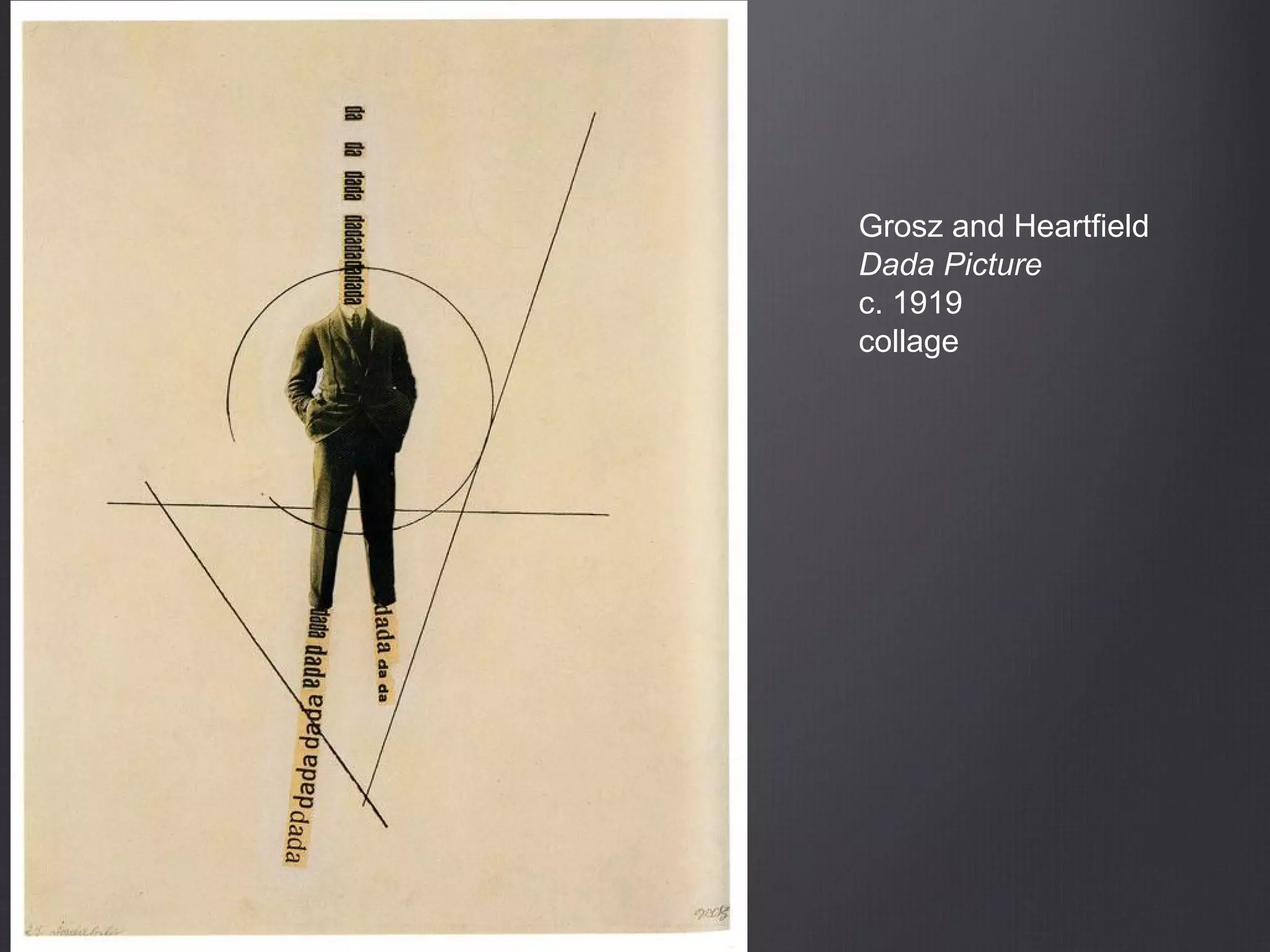
Grosz and Heartfield
Dada Picture
c. 1919
collage
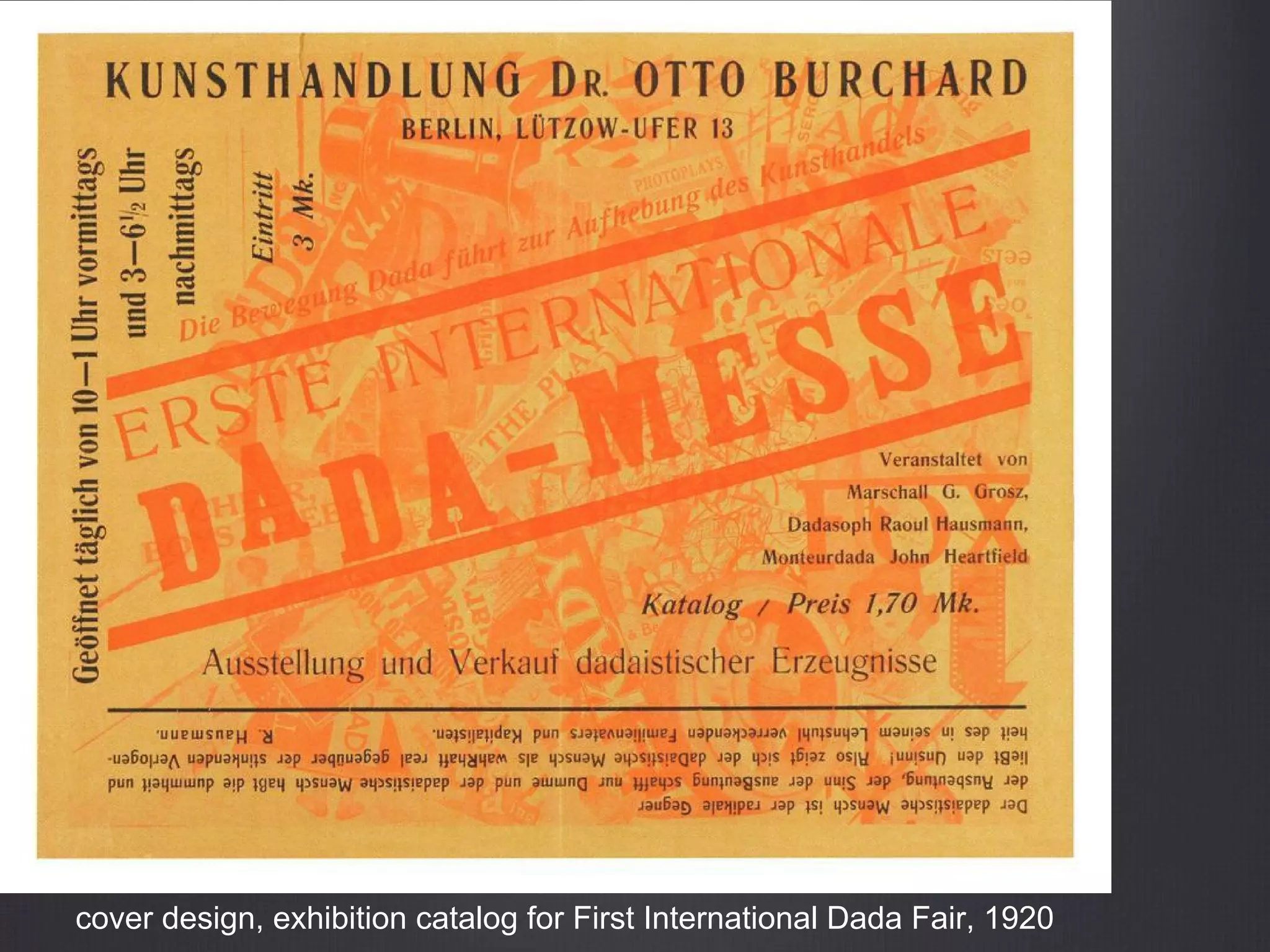
cover design, exhibition catalog for First International Dada Fair, 1920
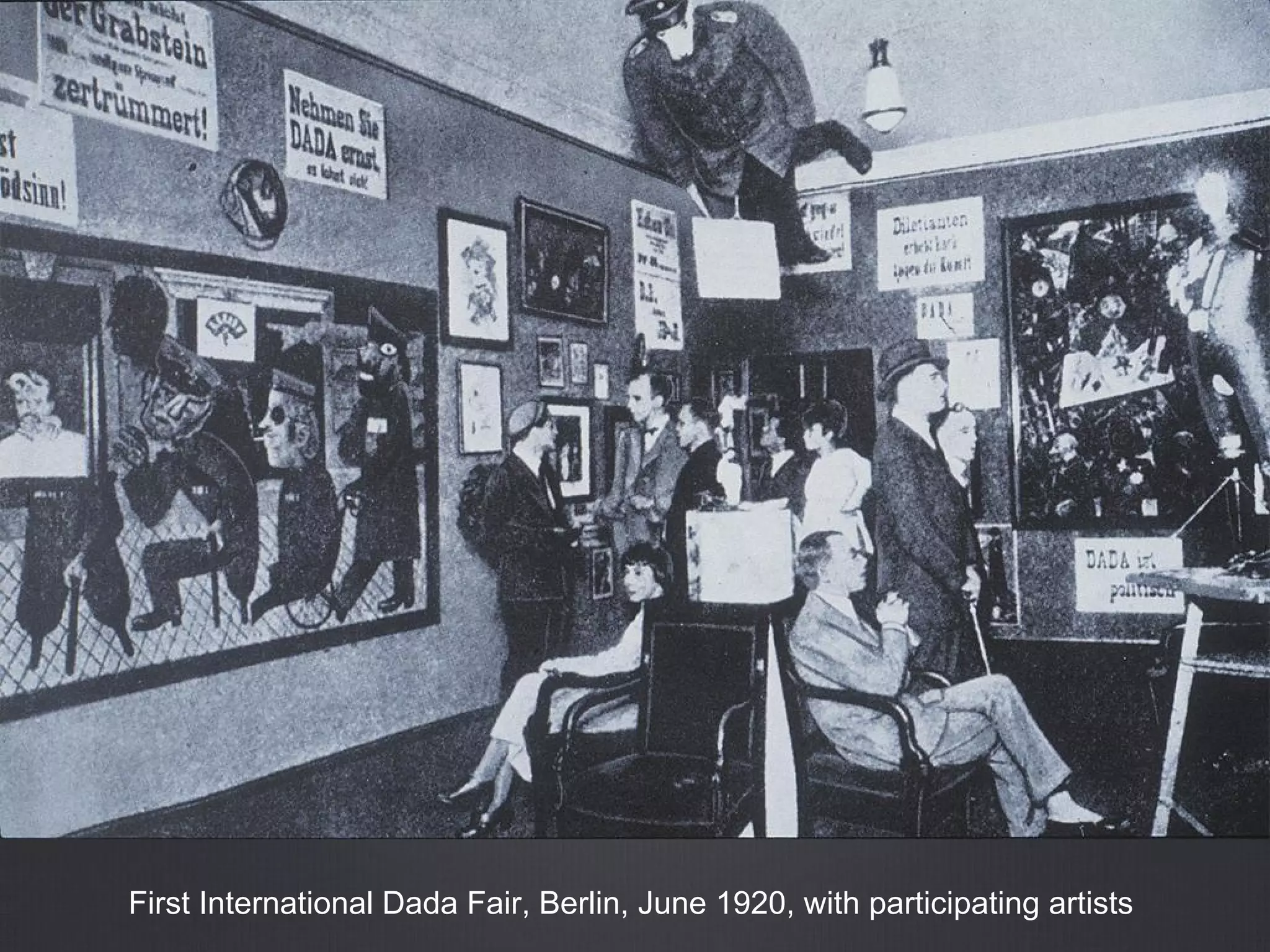
First International Dada Fair, Berlin, June 1920, with participating artists
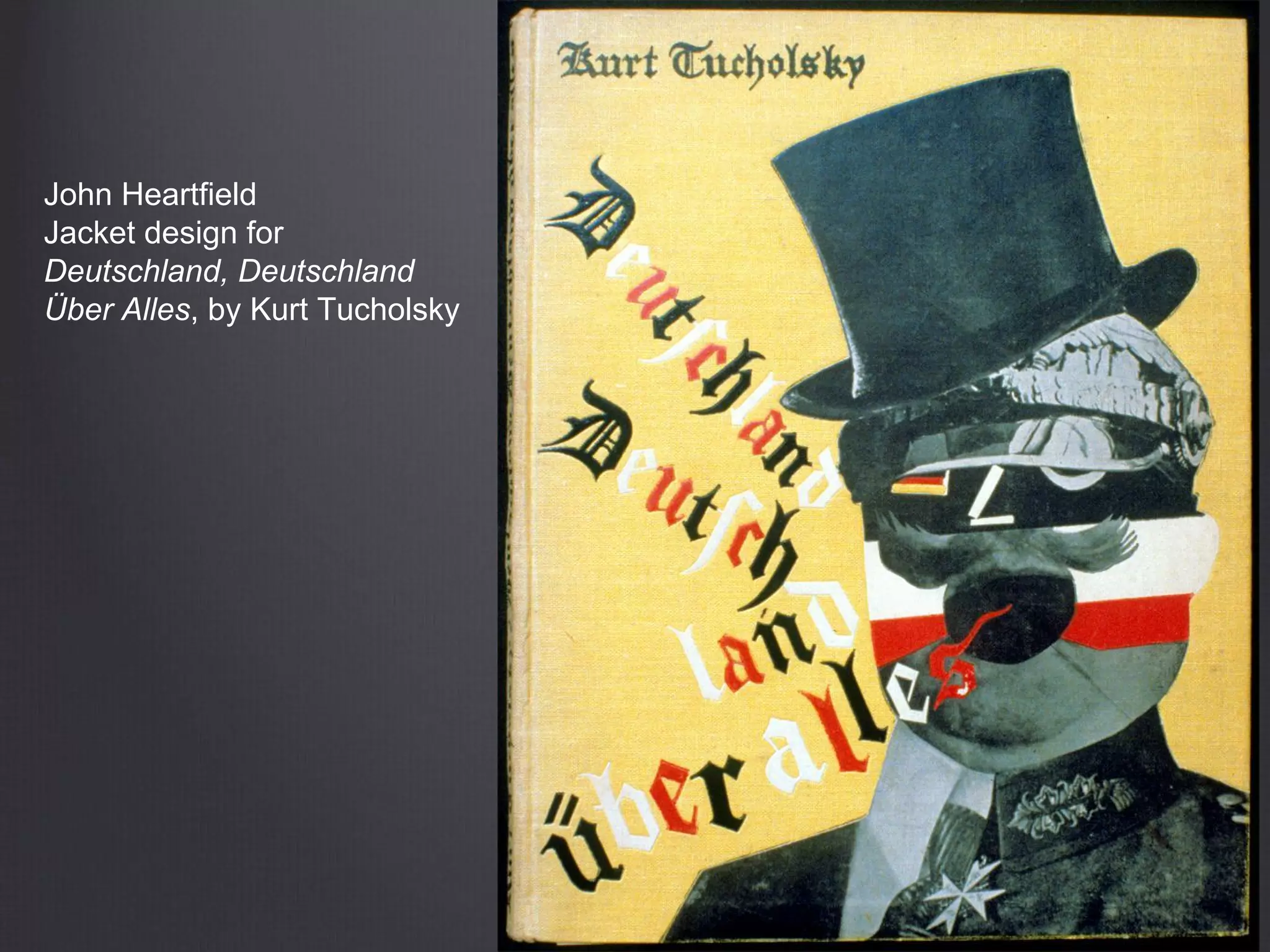
John Heartfield
Jacket design for
Deutschland, Deutschland
Über Alles, by Kurt Tucholsky
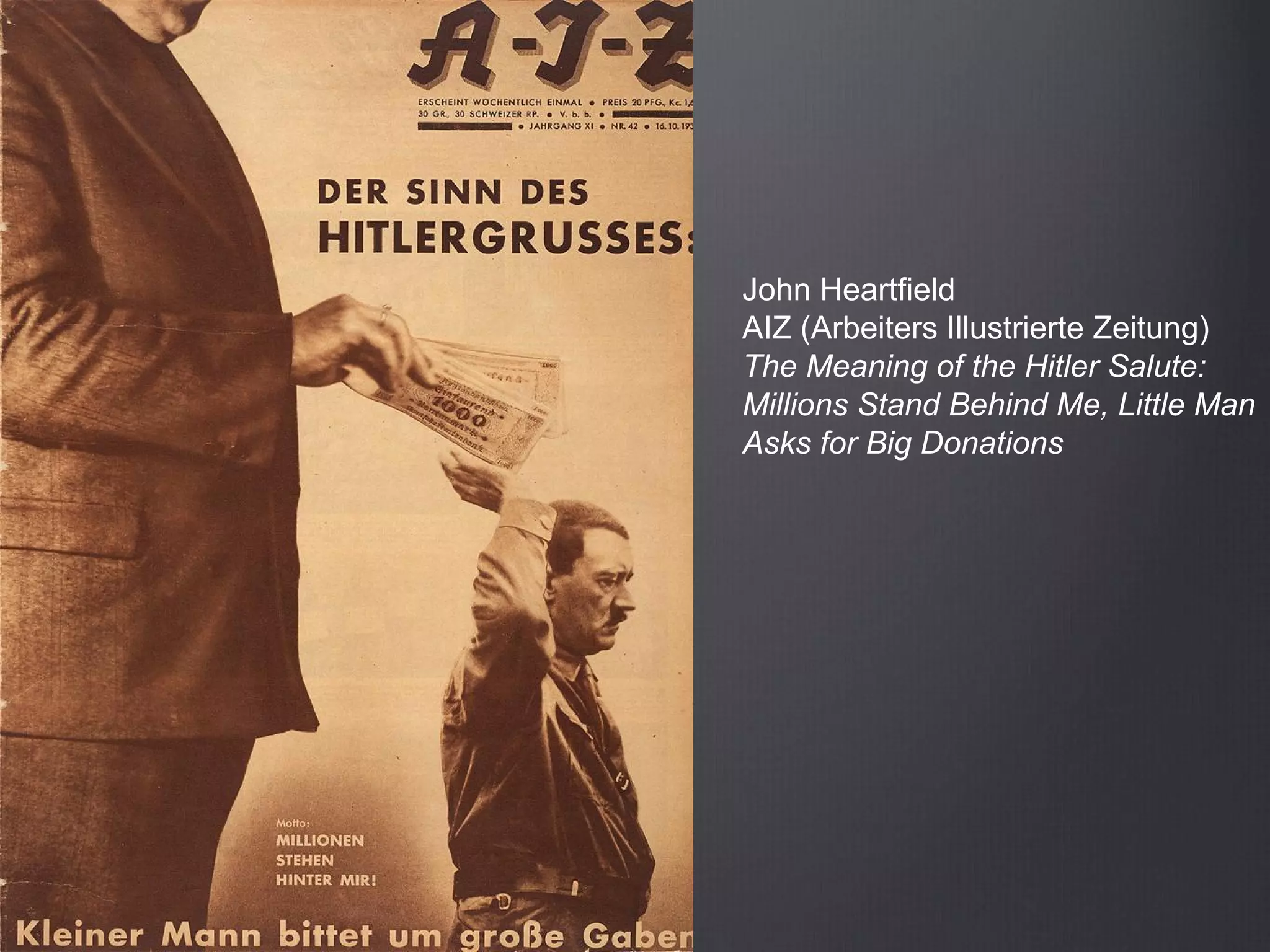
John Heartfield
AIZ (Arbeiters Illustrierte Zeitung)
The Meaning of the Hitler Salute:
Millions Stand Behind Me, Little Man
Asks for Big Donations
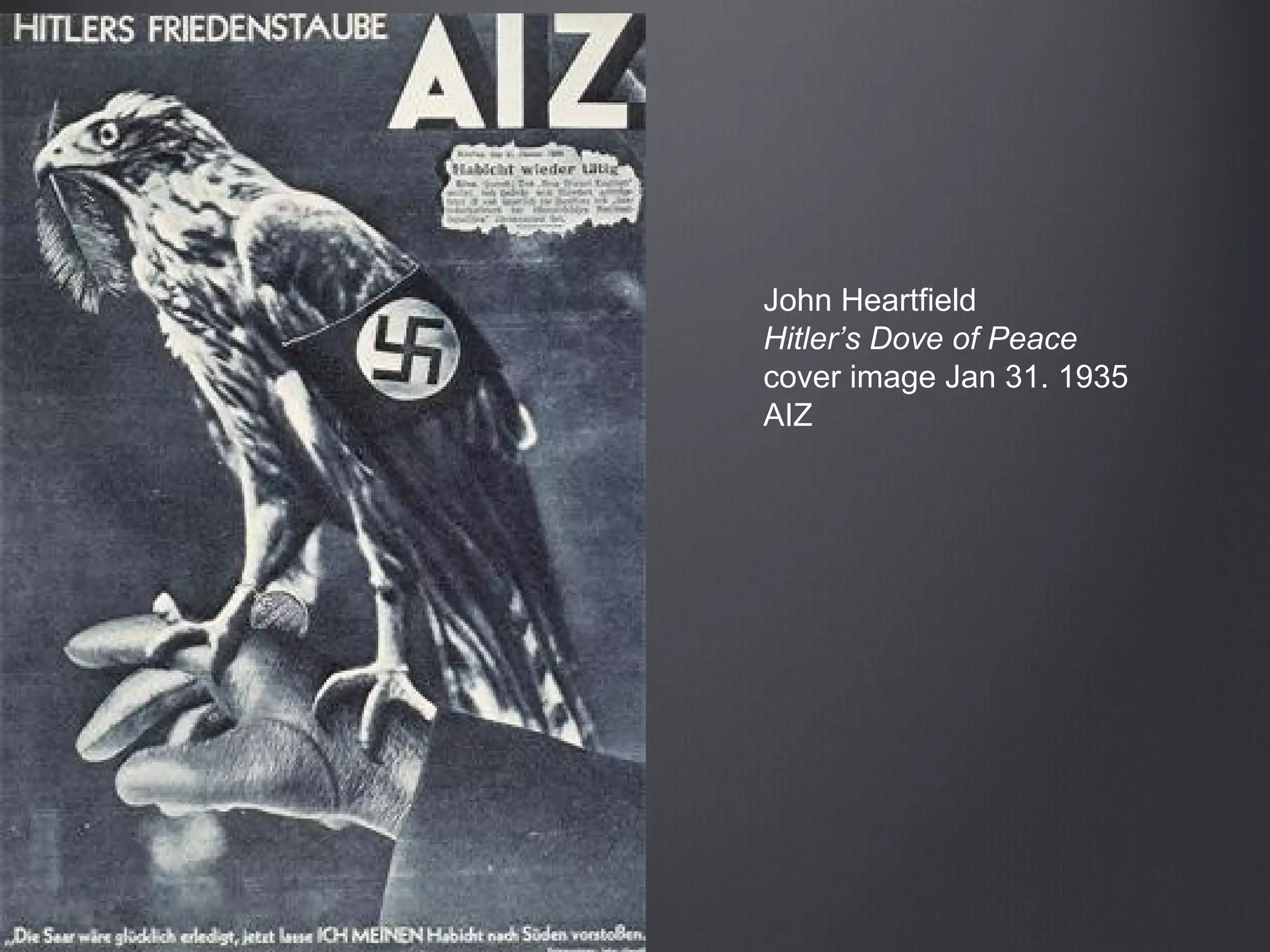
John Heartfield
Hitler’s Dove of Peace
cover image Jan 31. 1935
AIZ
Hannah HÖCH
Das schöne
Mädchen
1920
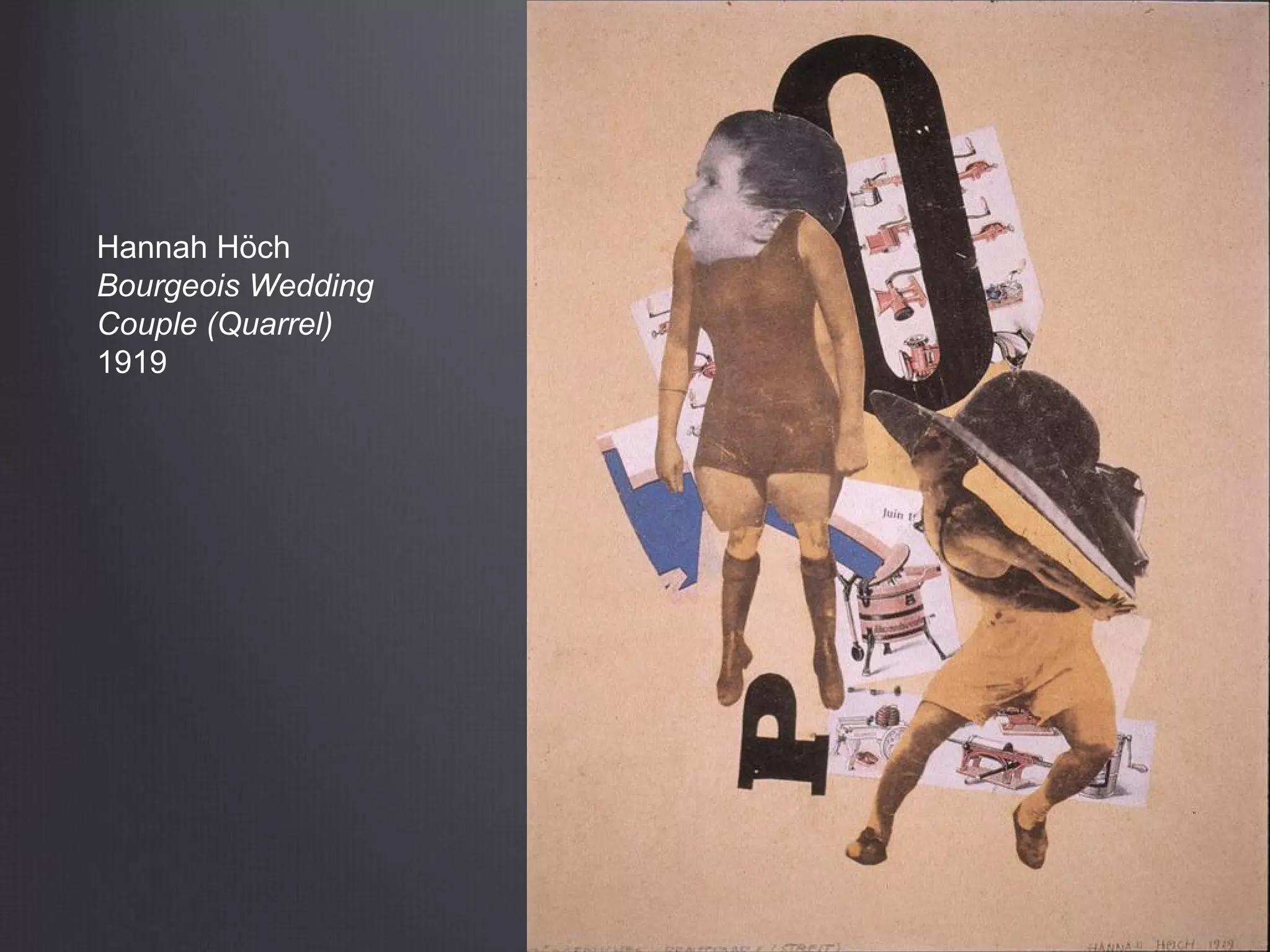
Hannah Höch
Bourgeois Wedding
Couple (Quarrel)
1919
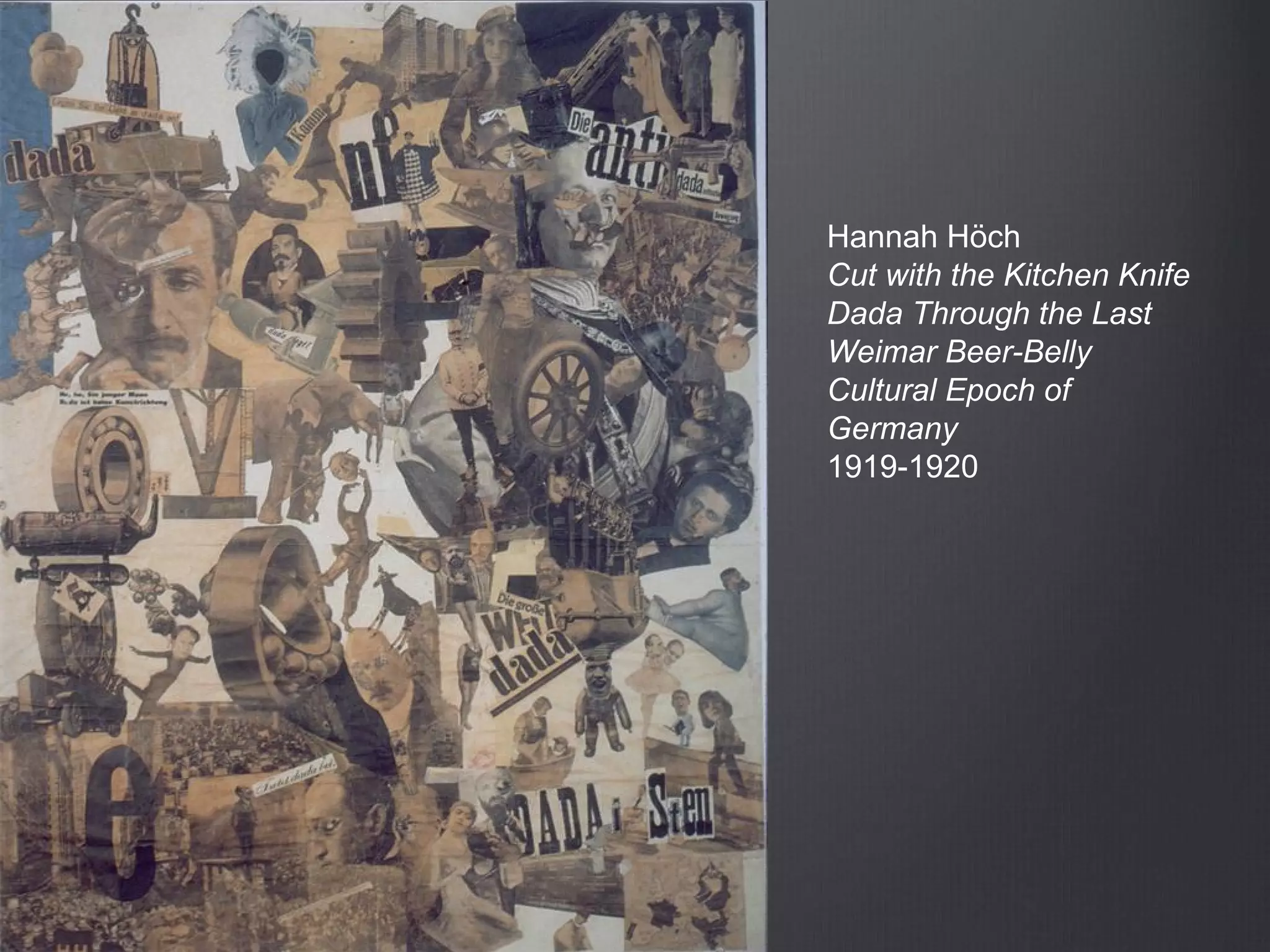
Hannah Höch
Cut with the Kitchen Knife
Dada Through the Last
Weimar Beer-Belly
Cultural Epoch of
Germany
1919-1920
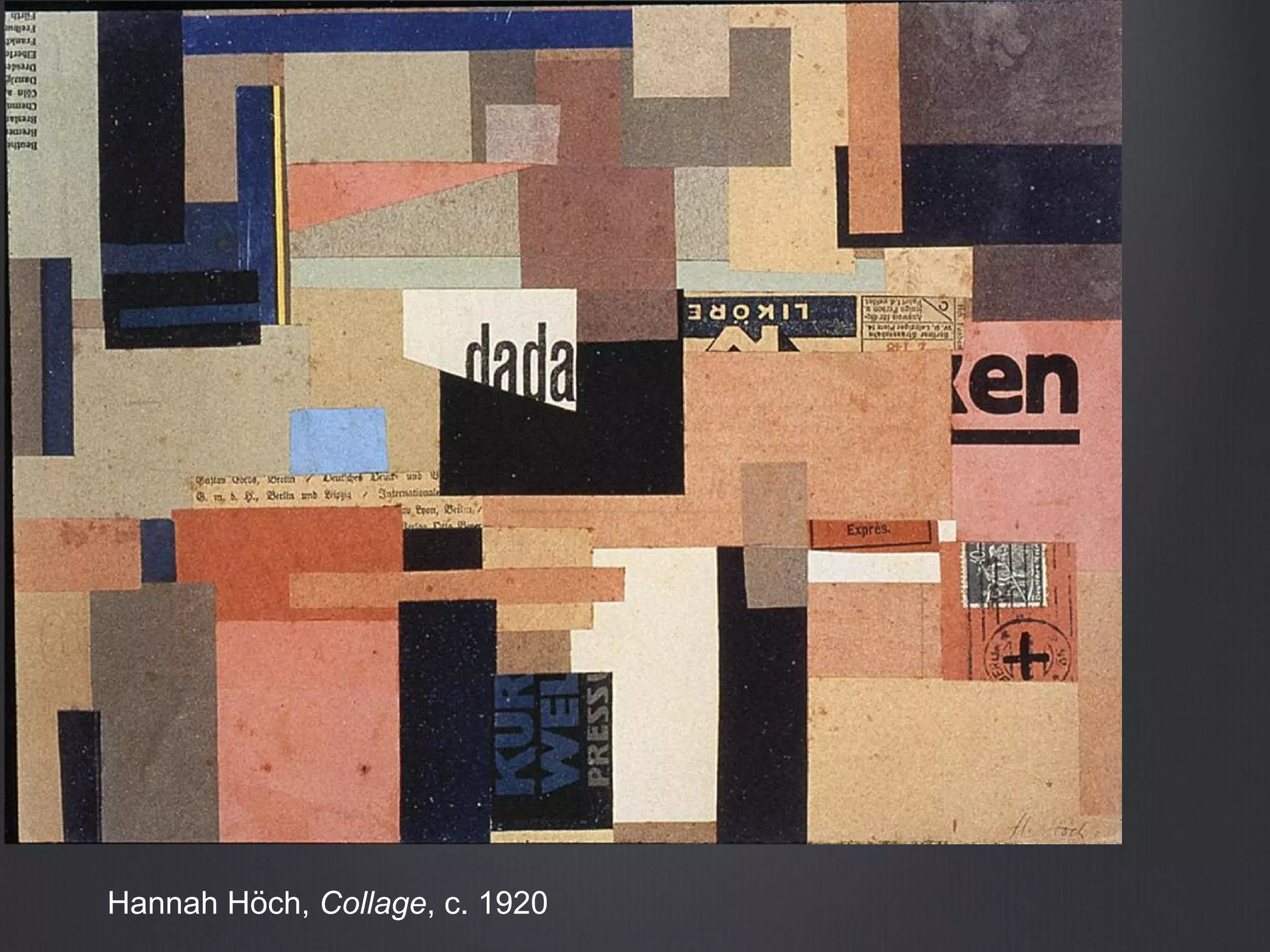
Hannah Höch, Collage, c. 1920
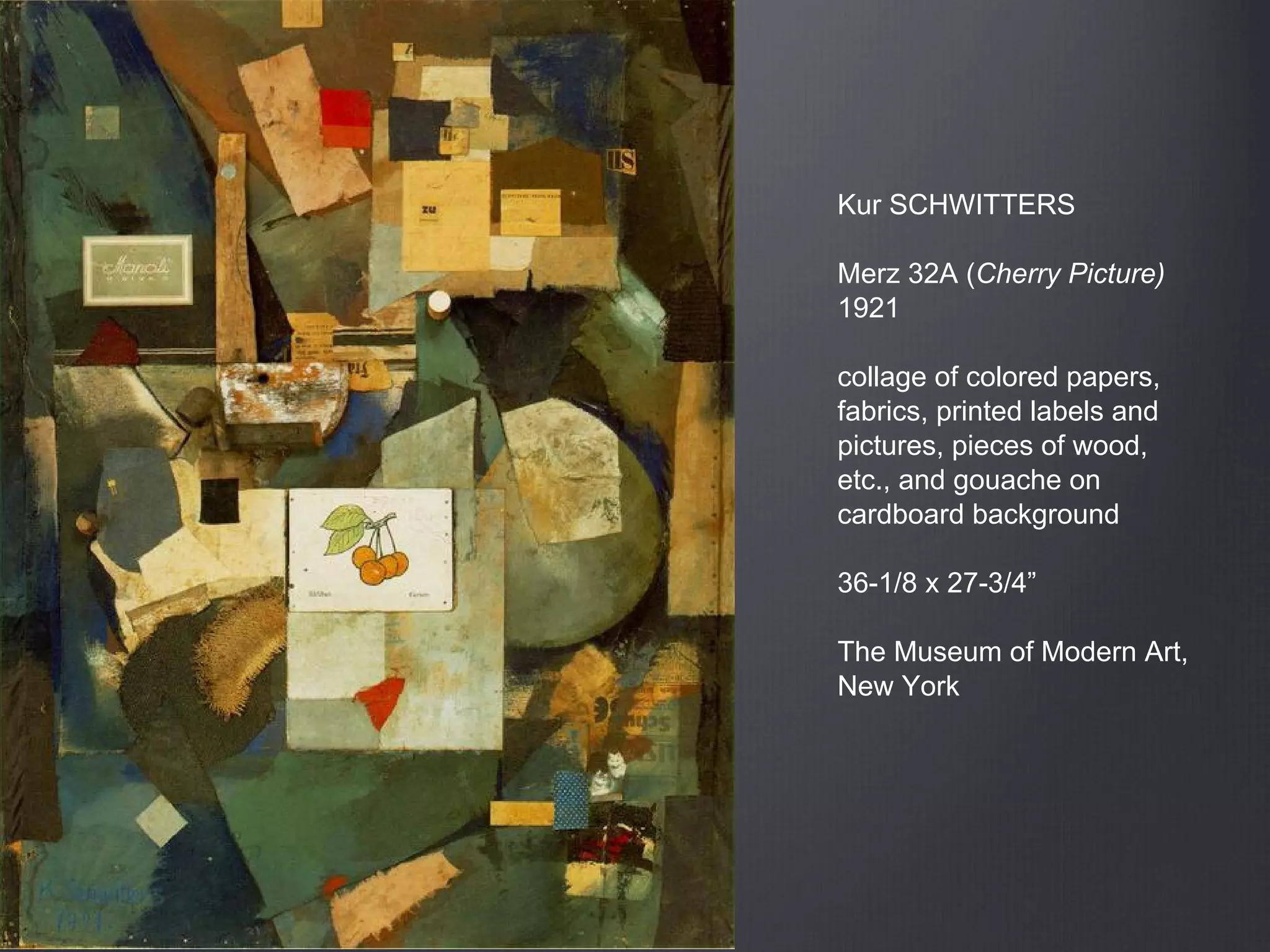
Kur SCHWITTERS
Merz 32A (Cherry Picture)
1921
collage of colored papers,
fabrics, printed labels and
pictures, pieces of wood,
etc., and gouache on
cardboard background
36-1/8 x 27-3/4”
The Museum of Modern Art,
New York
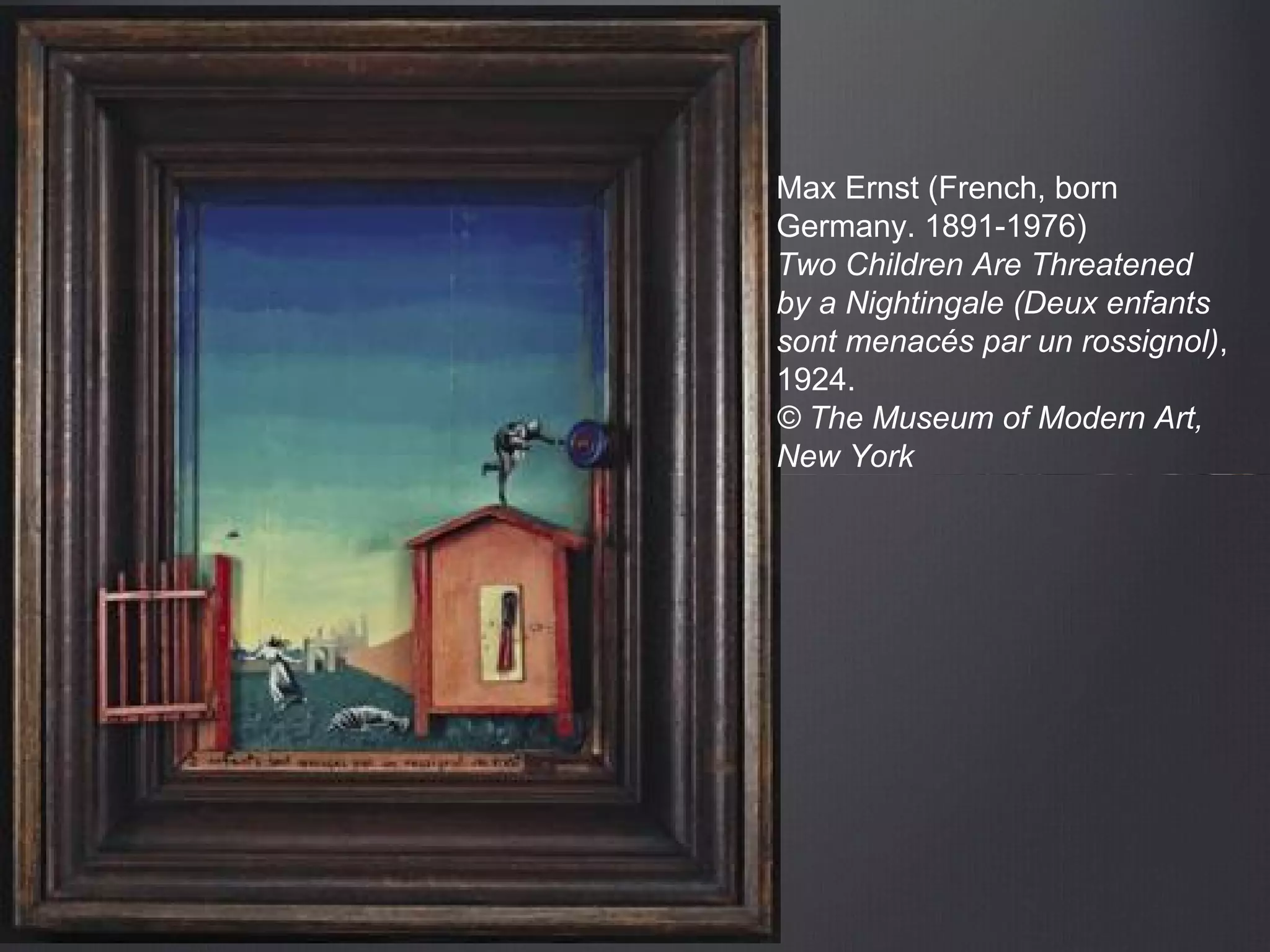
Max Ernst (French, born
Germany. 1891-1976)
Two Children Are Threatened
by a Nightingale (Deux enfants
sont menacés par un rossignol),
1924.
© The Museum of Modern Art,
New York
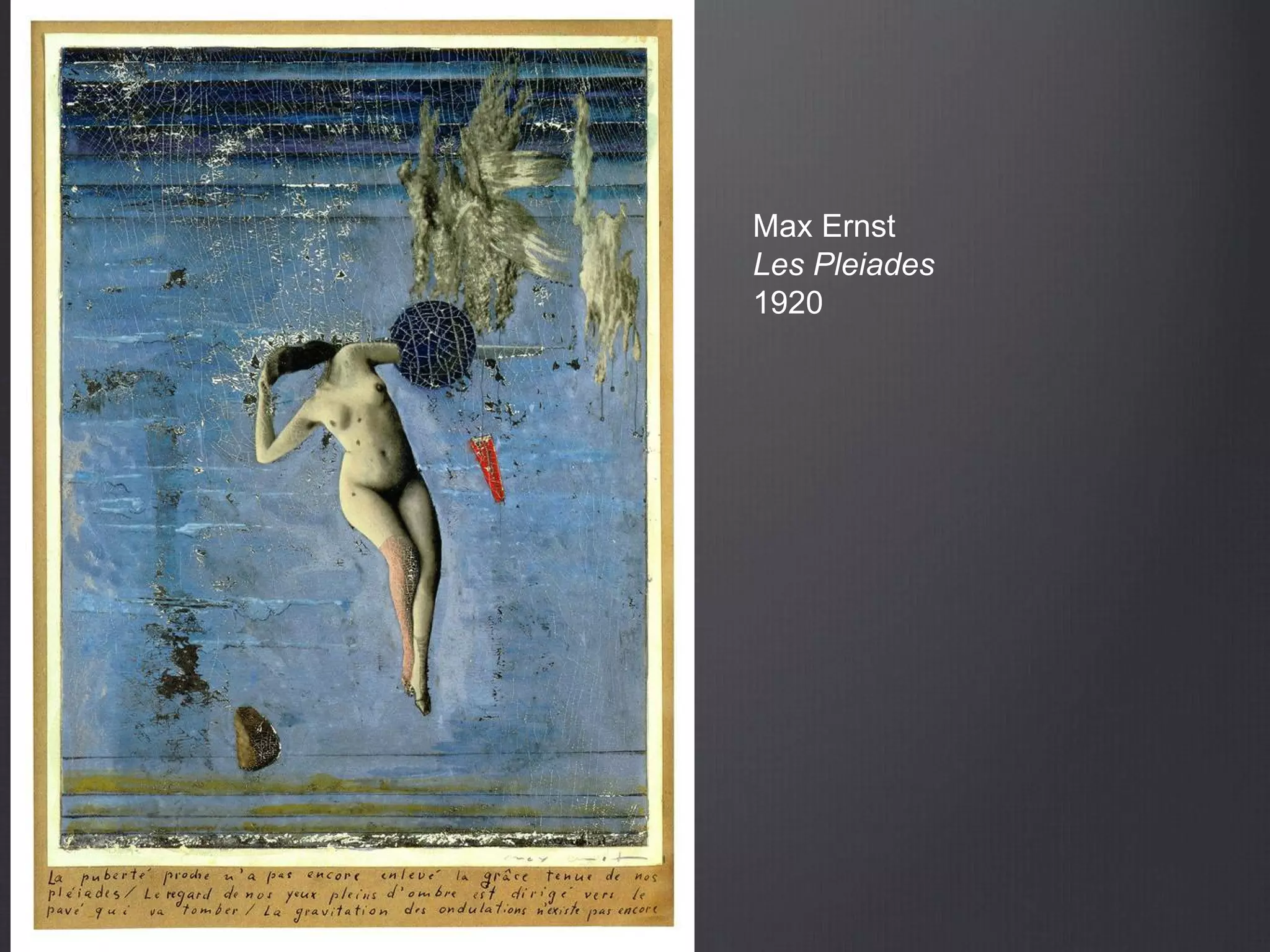
Max Ernst
Les Pleiades
1920
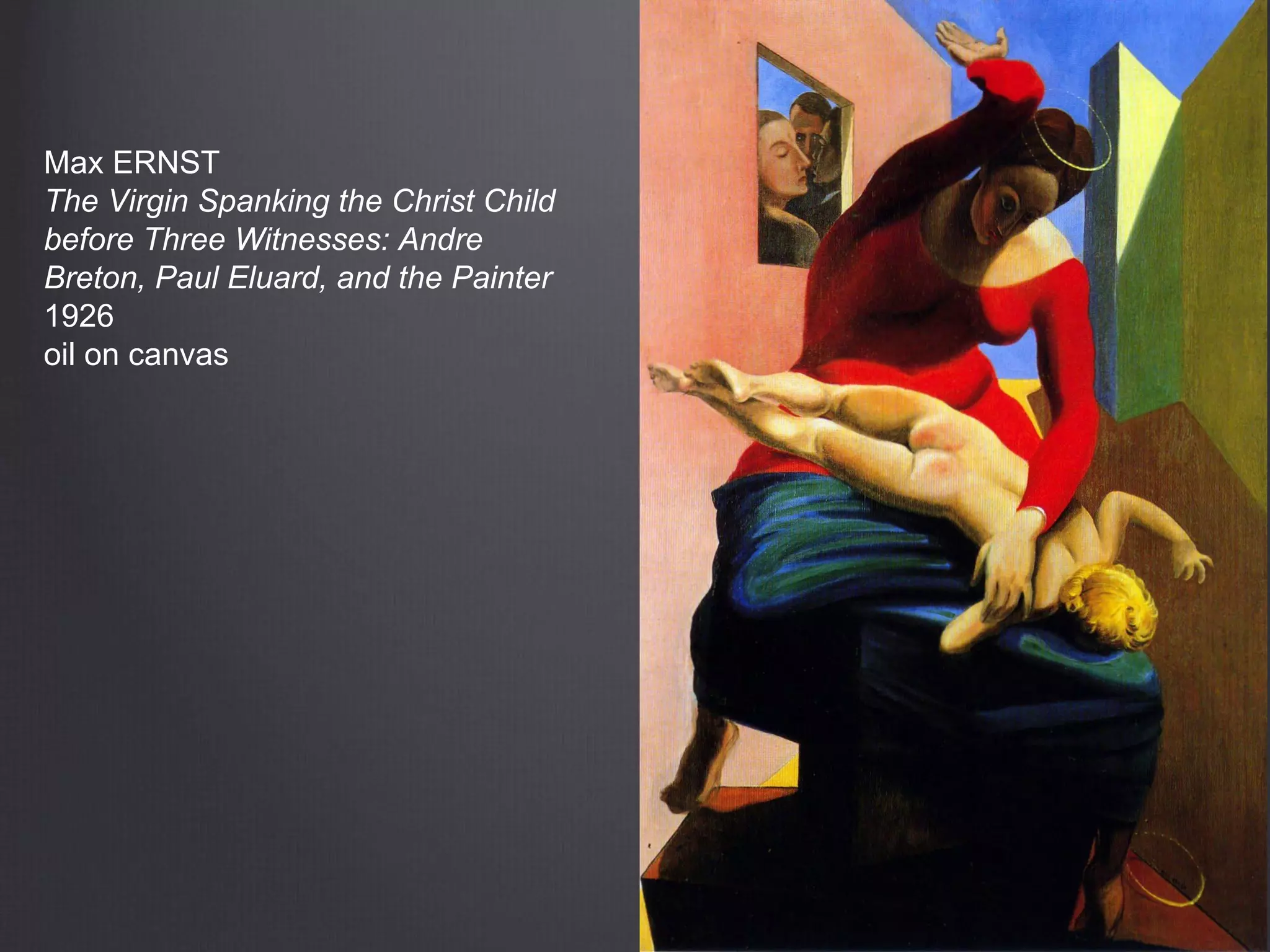
Max ERNST
The Virgin Spanking the Christ Child
before Three Witnesses: Andre
Breton, Paul Eluard, and the Painter
1926
oil on canvas
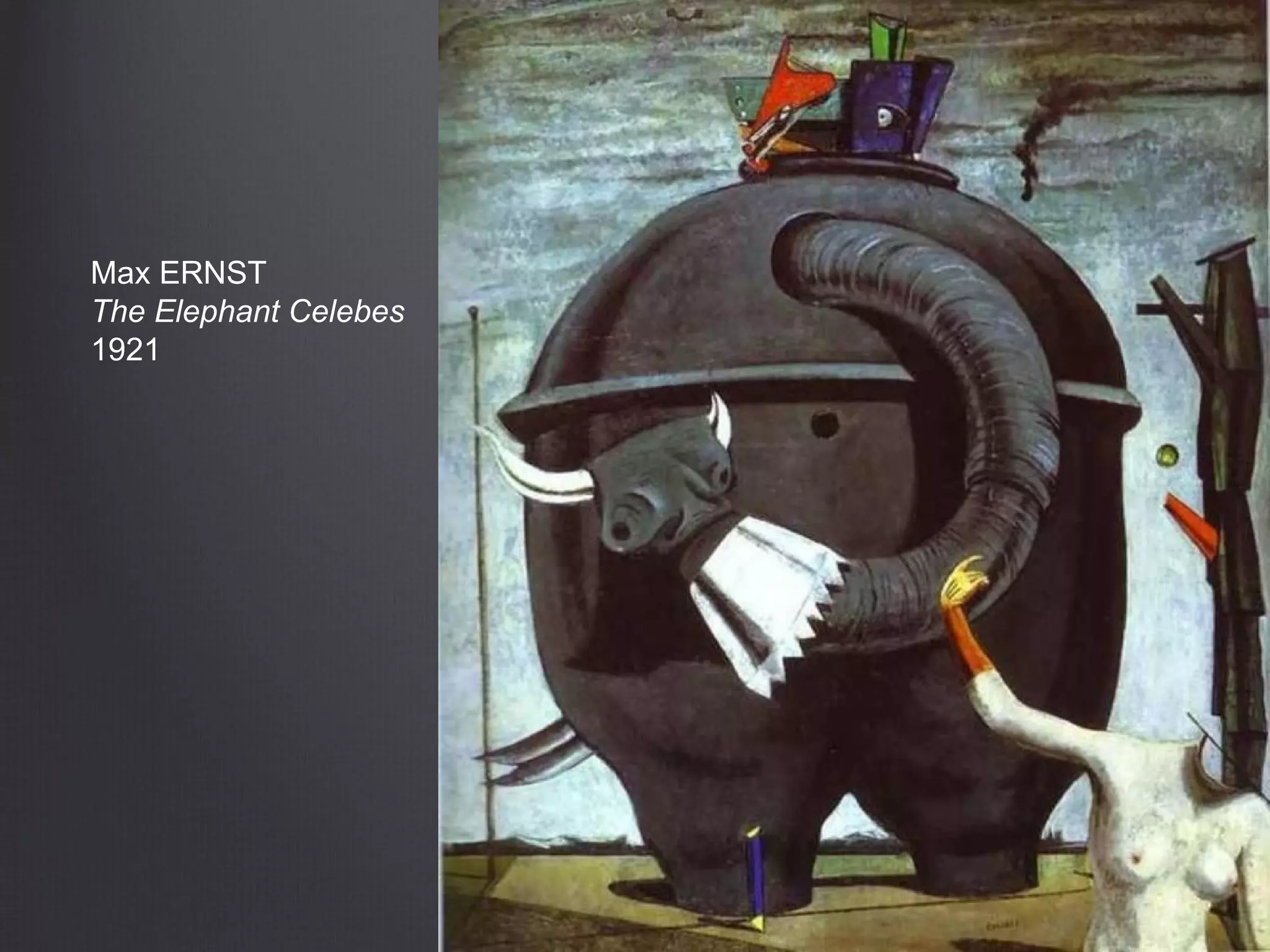
Max ERNST
The Elephant Celebes
1921
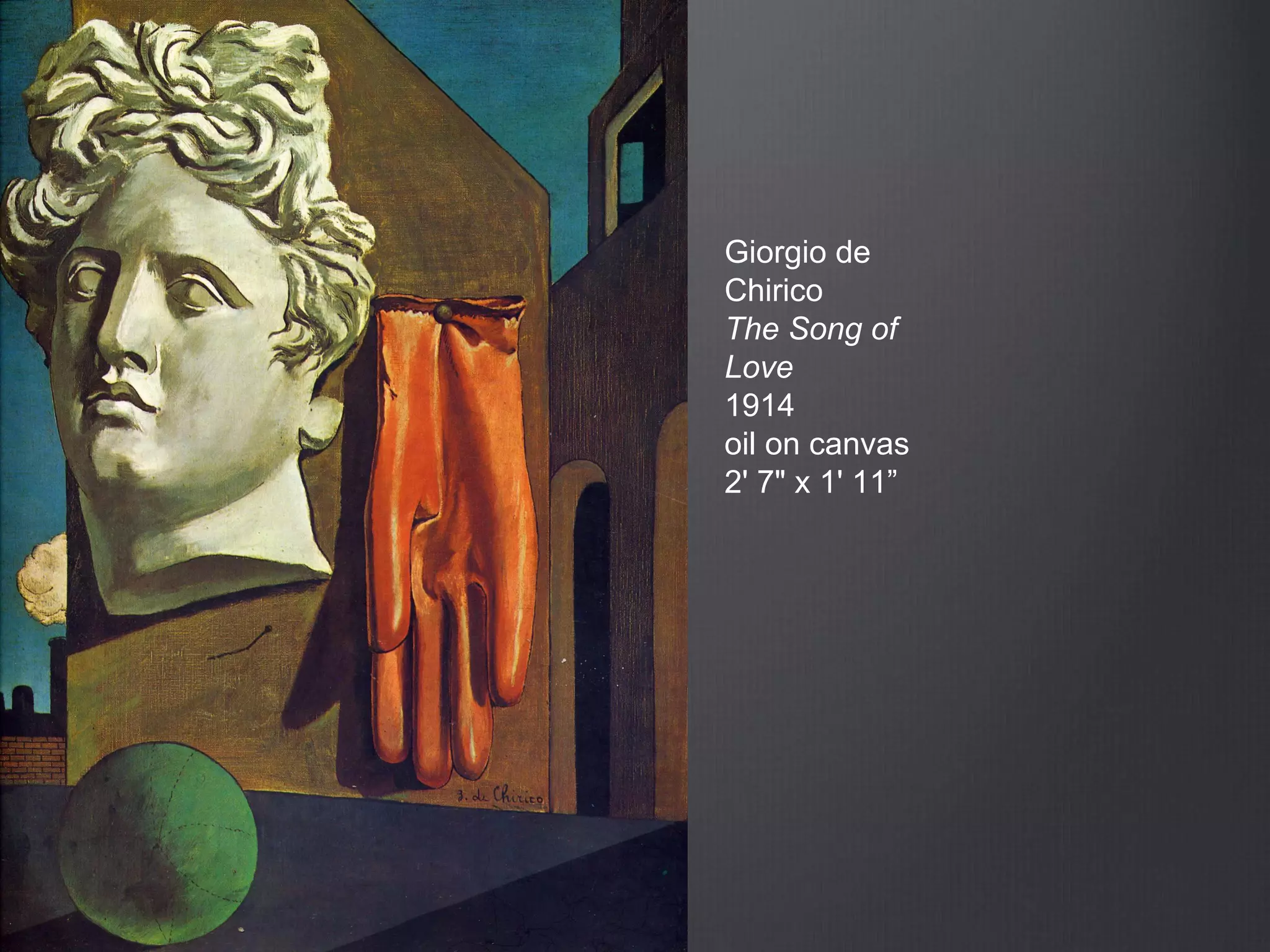
Giorgio de
Chirico
The Song of
Love
1914
oil on canvas
2' 7" x 1' 11”
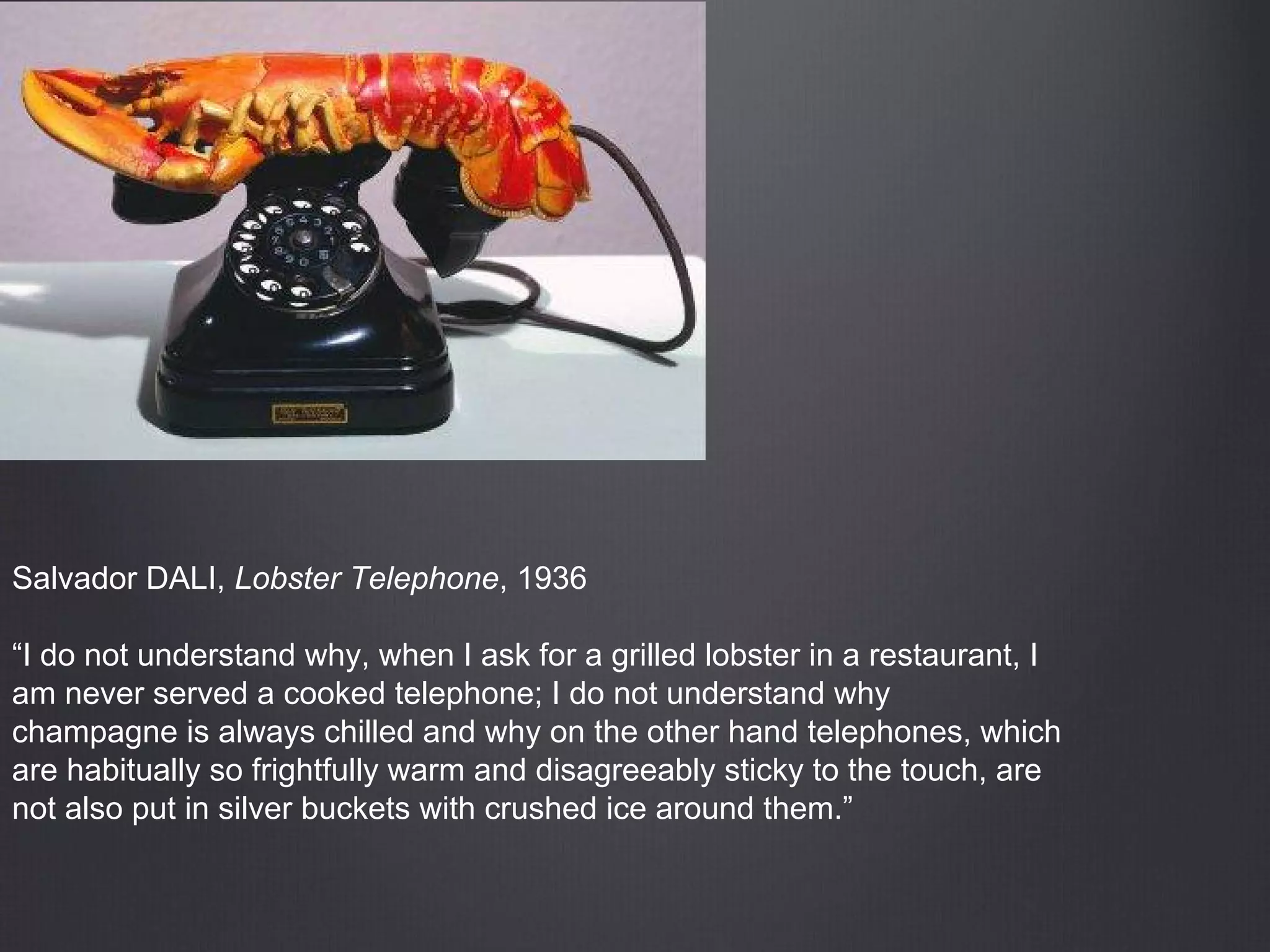
Salvador DALI, Lobster Telephone, 1936
“I do not understand why, when I ask for a grilled lobster in a restaurant, I
am never served a cooked telephone; I do not understand why
champagne is always chilled and why on the other hand telephones, which
are habitually so frightfully warm and disagreeably sticky to the touch, are
not also put in silver buckets with crushed ice around them.”
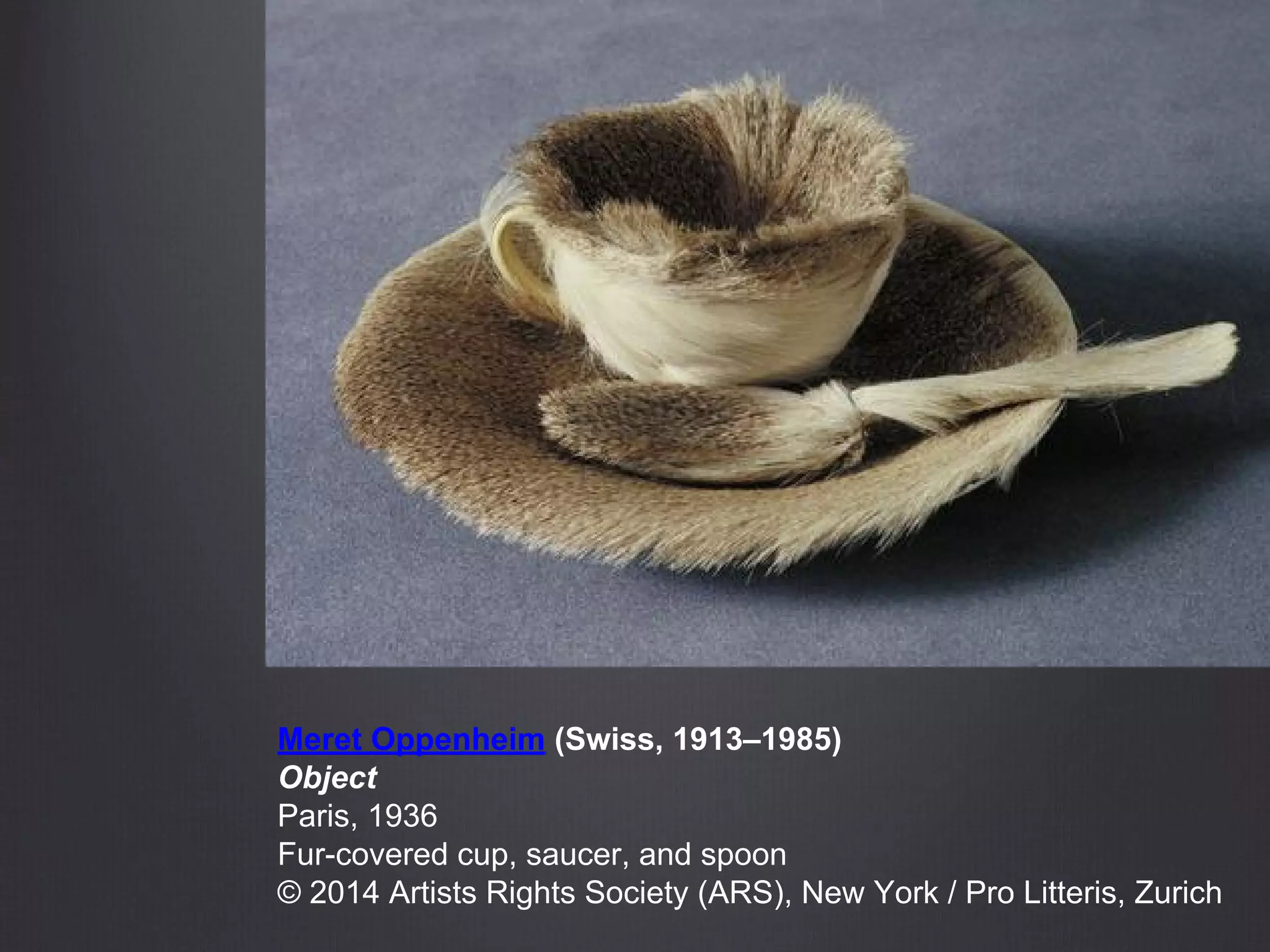
Meret Oppenheim (Swiss, 1913–1985)
Object
Paris, 1936
Fur-covered cup, saucer, and spoon
© 2014 Artists Rights Society (ARS), New York / Pro Litteris, Zurich
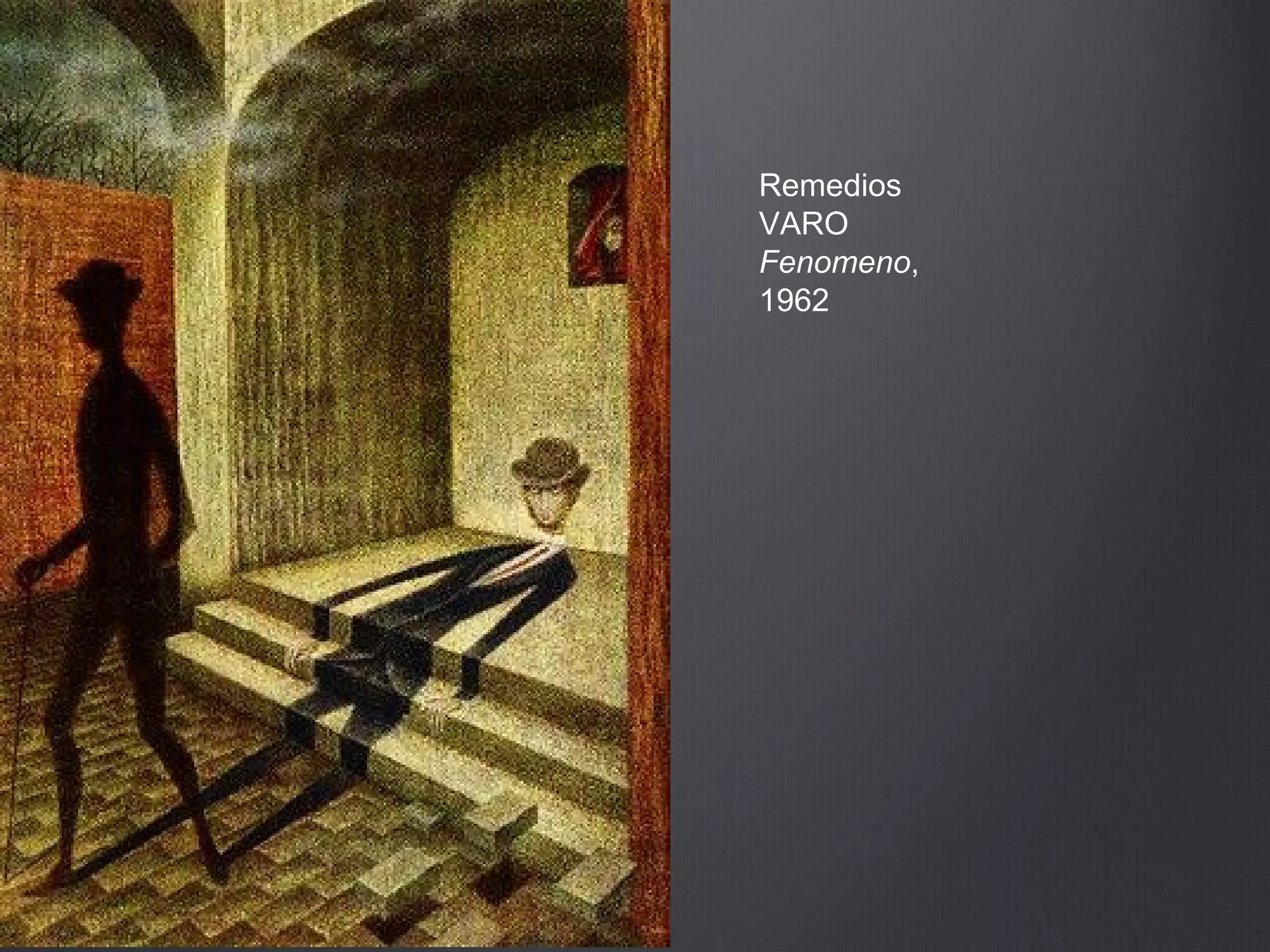
Remedios
VARO
Fenomeno,
1962
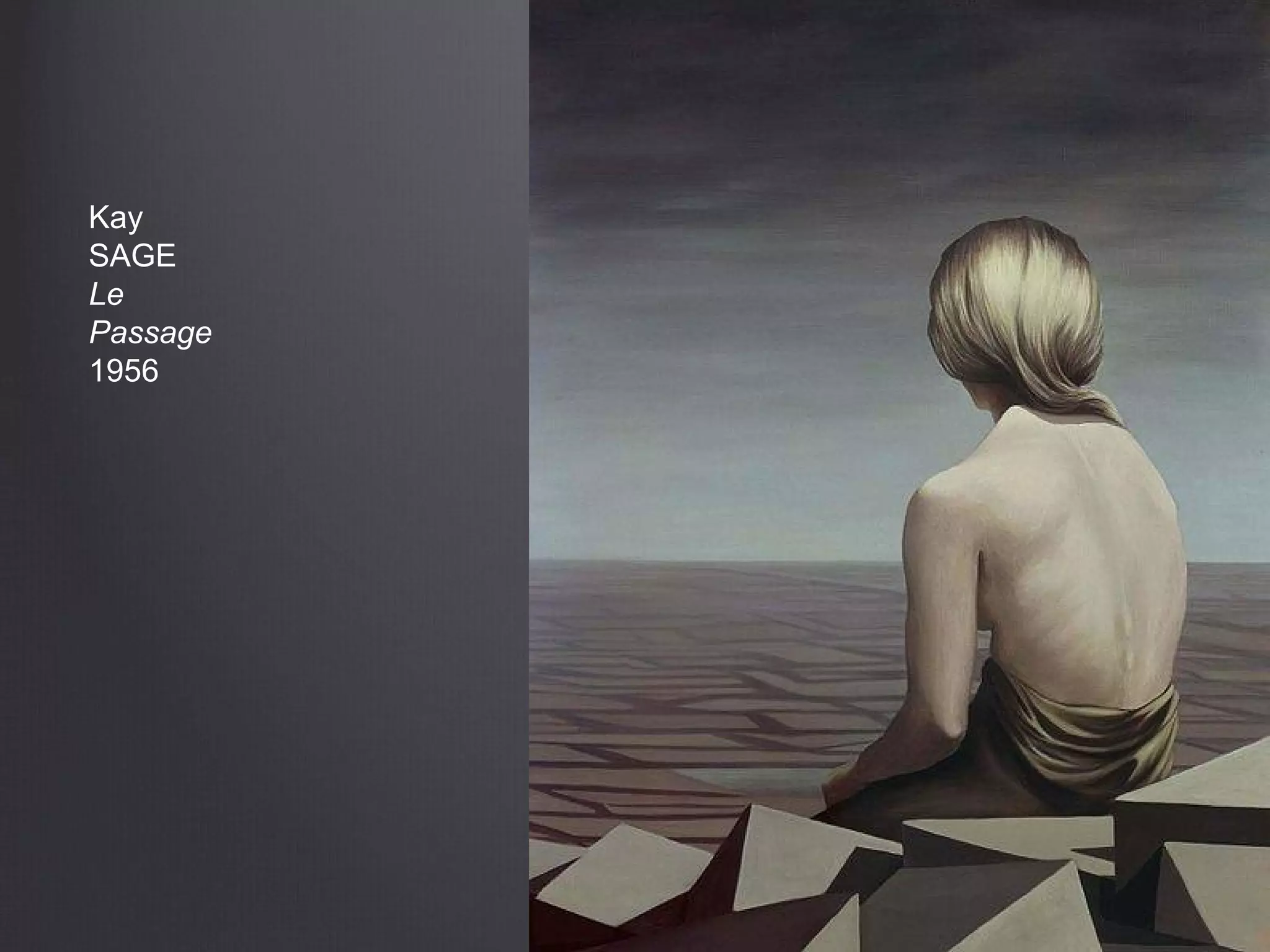
Kay
SAGE
Le
Passage
1956
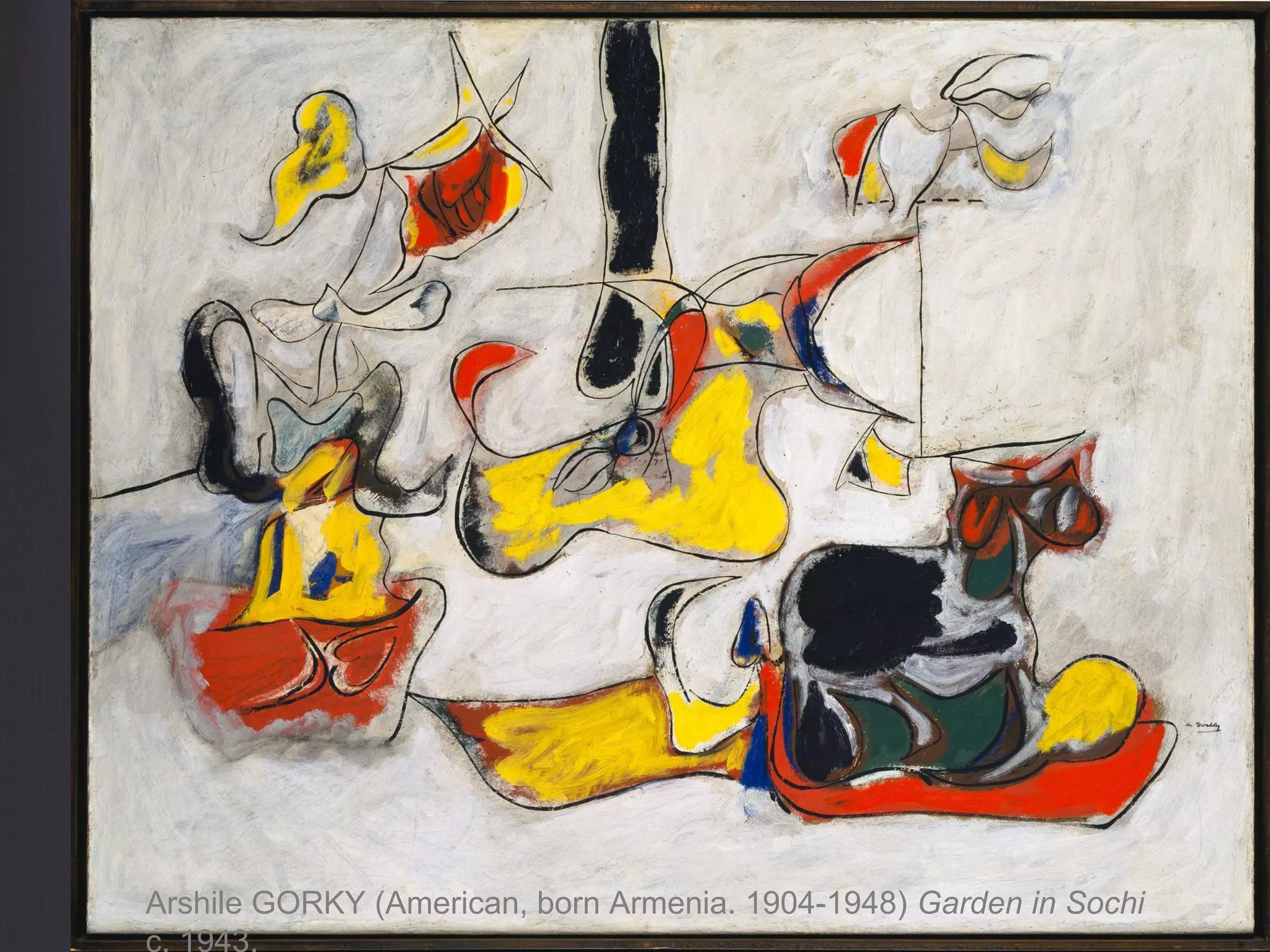
Arshile GORKY (American, born Armenia. 1904-1948) Garden in Sochi
c. 1943.
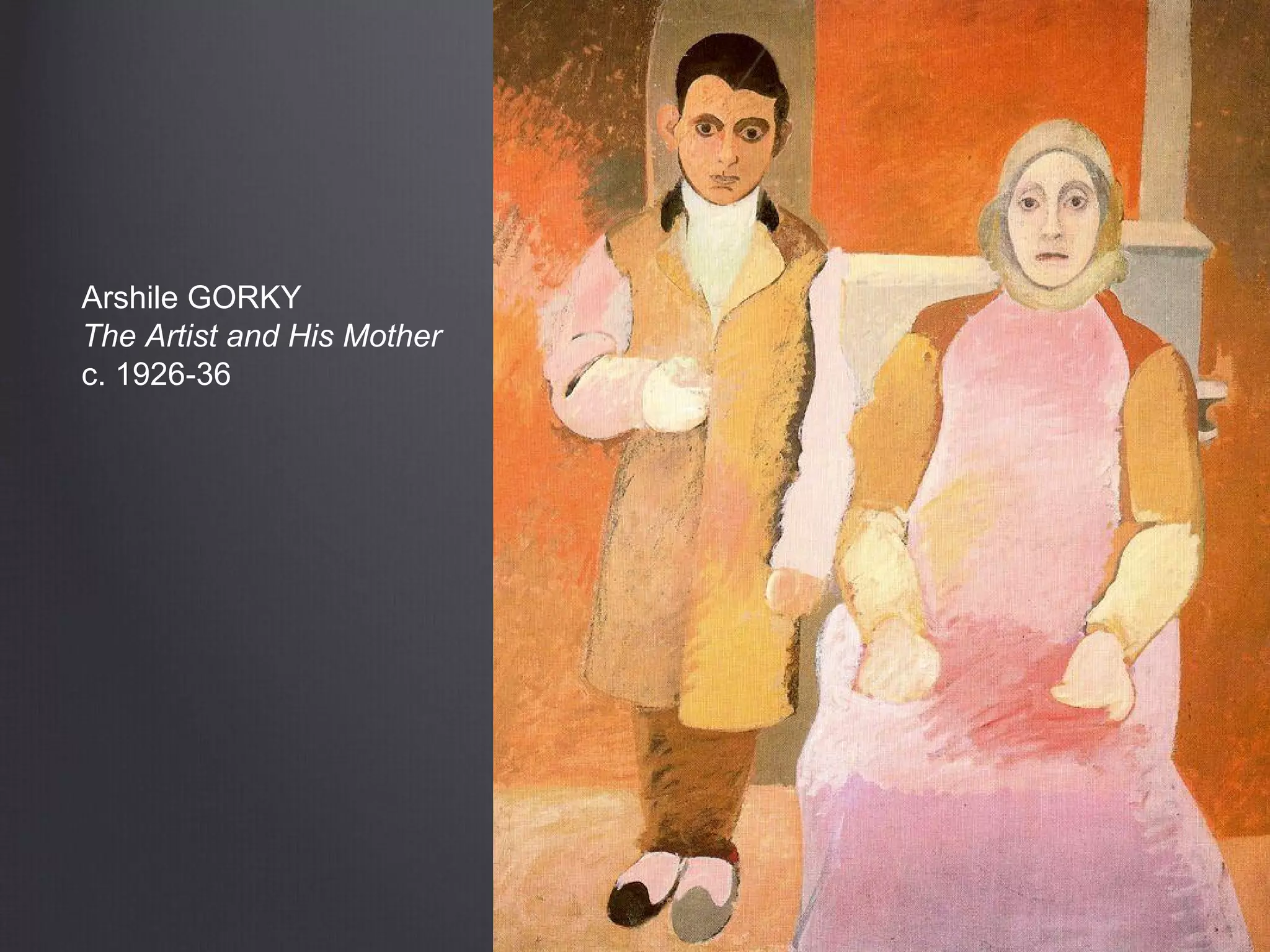
Arshile GORKY
The Artist and His Mother
c. 1926-36
I don’t like that word, “finish.” When
something is finished, that means it’s
dead, doesn’t it? I believe in
everlastingness. I never finish a
painting—I just stop working on it for a
while.
Arshile Gorky, 1948
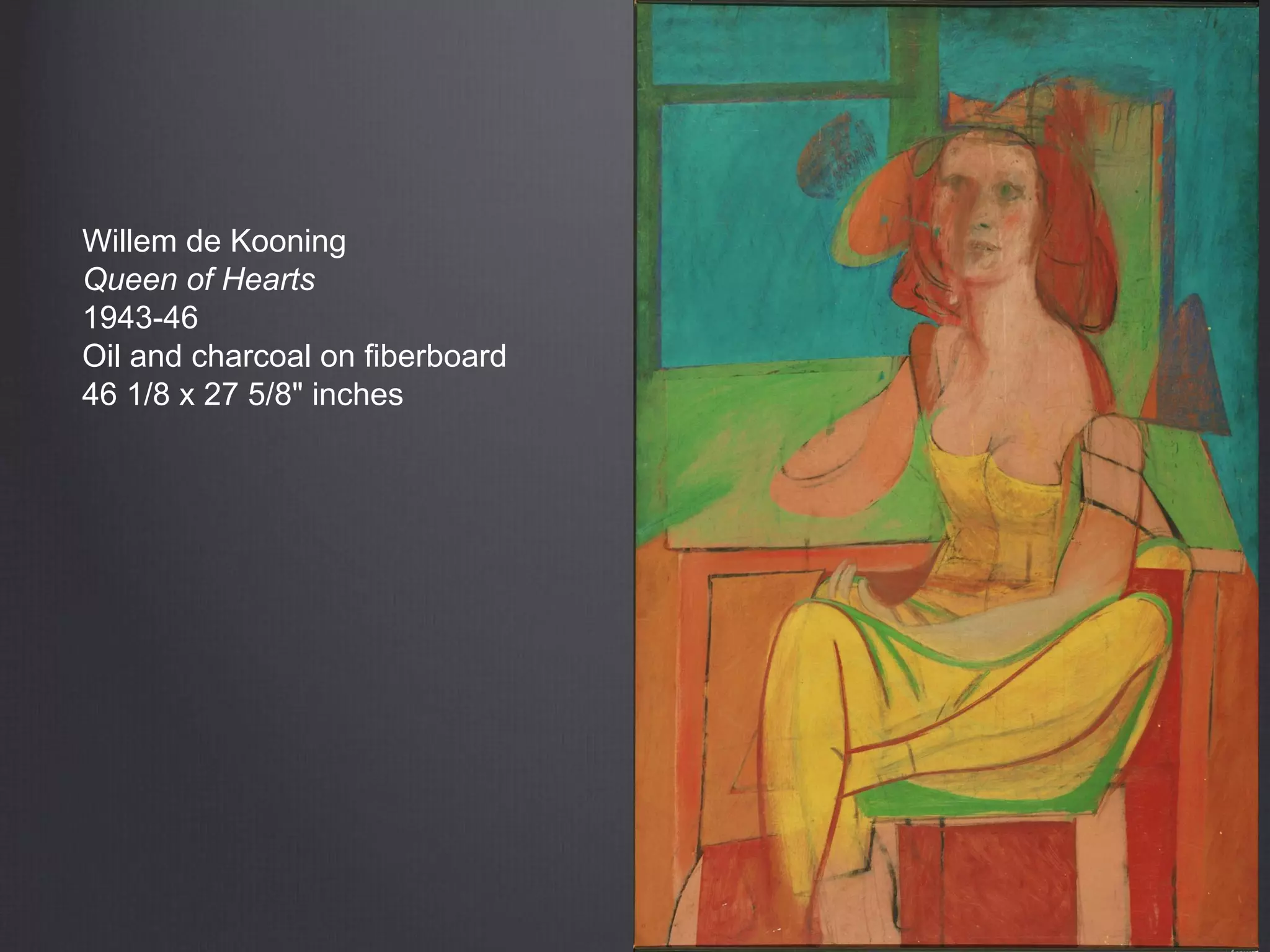
Willem de Kooning
Queen of Hearts
1943-46
Oil and charcoal on fiberboard
46 1/8 x 27 5/8" inches
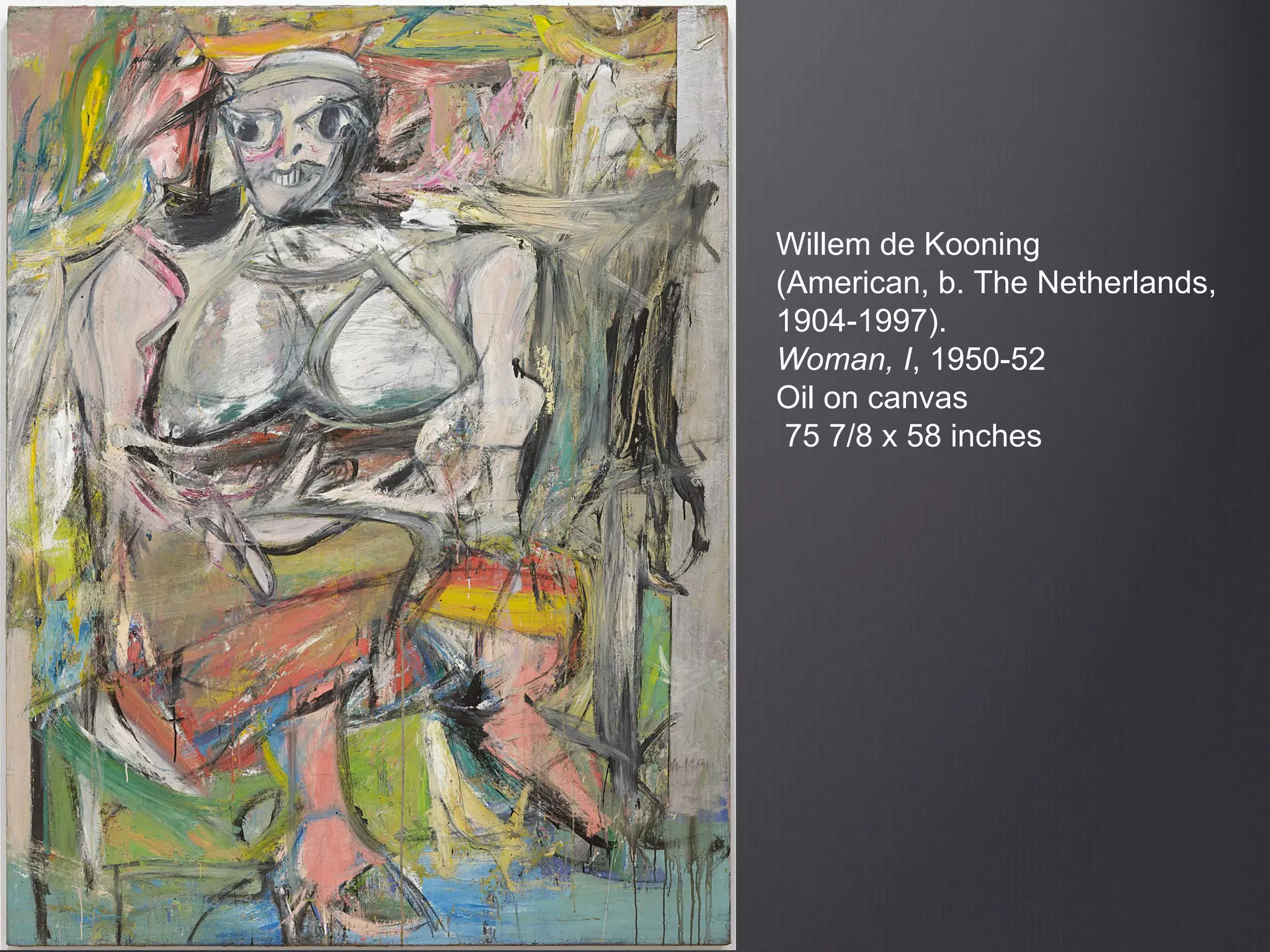
Willem de Kooning
(American, b. The Netherlands,
1904-1997).
Woman, I, 1950-52
Oil on canvas
75 7/8 x 58 inches
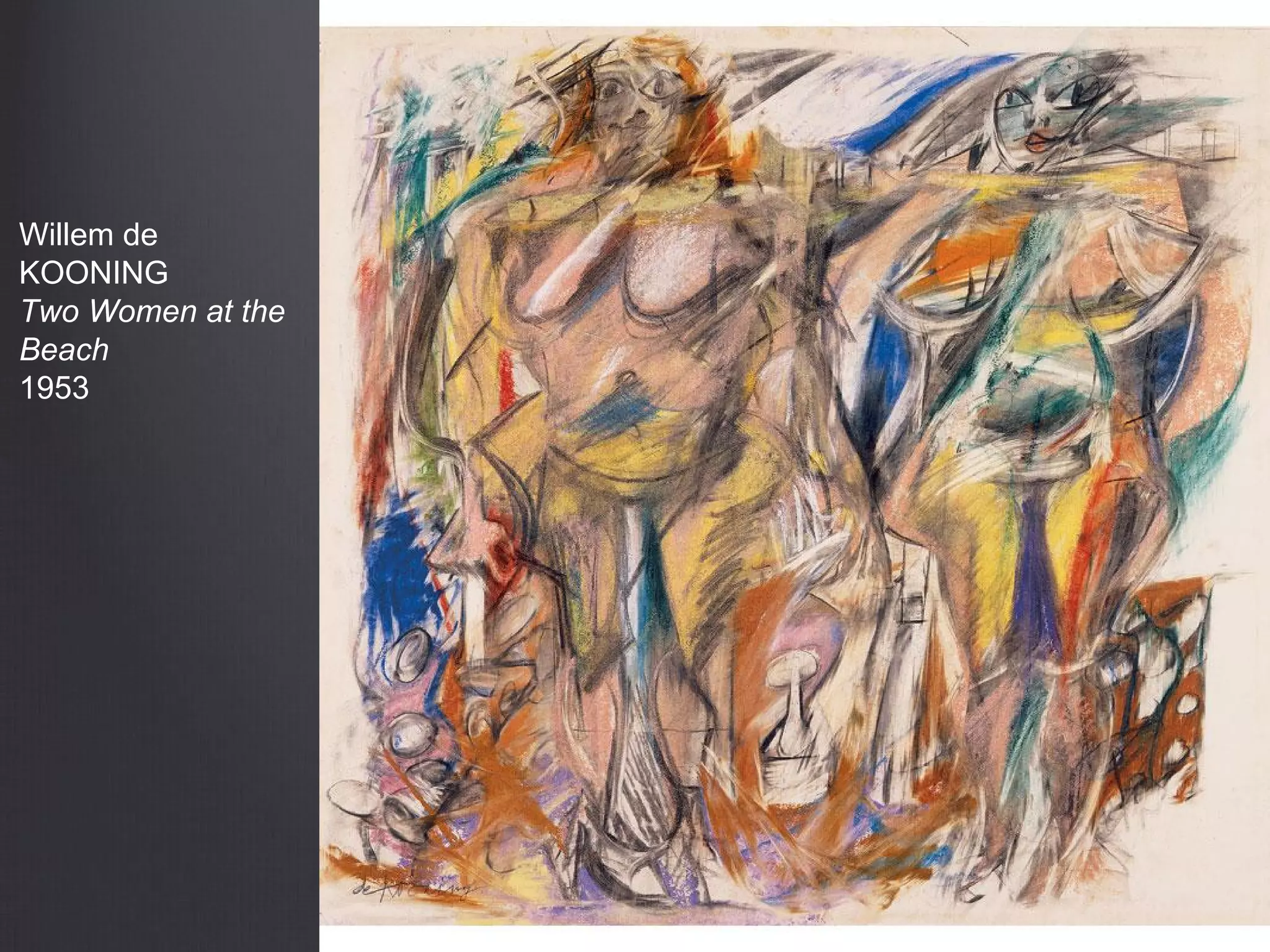
Willem de
KOONING
Two Women at the
Beach
1953
“…if you pick up some paint with your brush and
make somebody's nose with it, this is rather ridiculous
when you think of it, theoretically or philosophically.
It's really absurd to make an image, like a human
image, with paint, today, when you think about it, since
we have this problem of doing it or not doing it. But
then all of a sudden it was even more absurd not to do
it. So I fear I have to follow my desires.”
—Willem de Kooning,
in a 1962 radio interview
Like Léger before him, de Kooning points
out that it doesn’t really matter if a painting
has a subject or not.
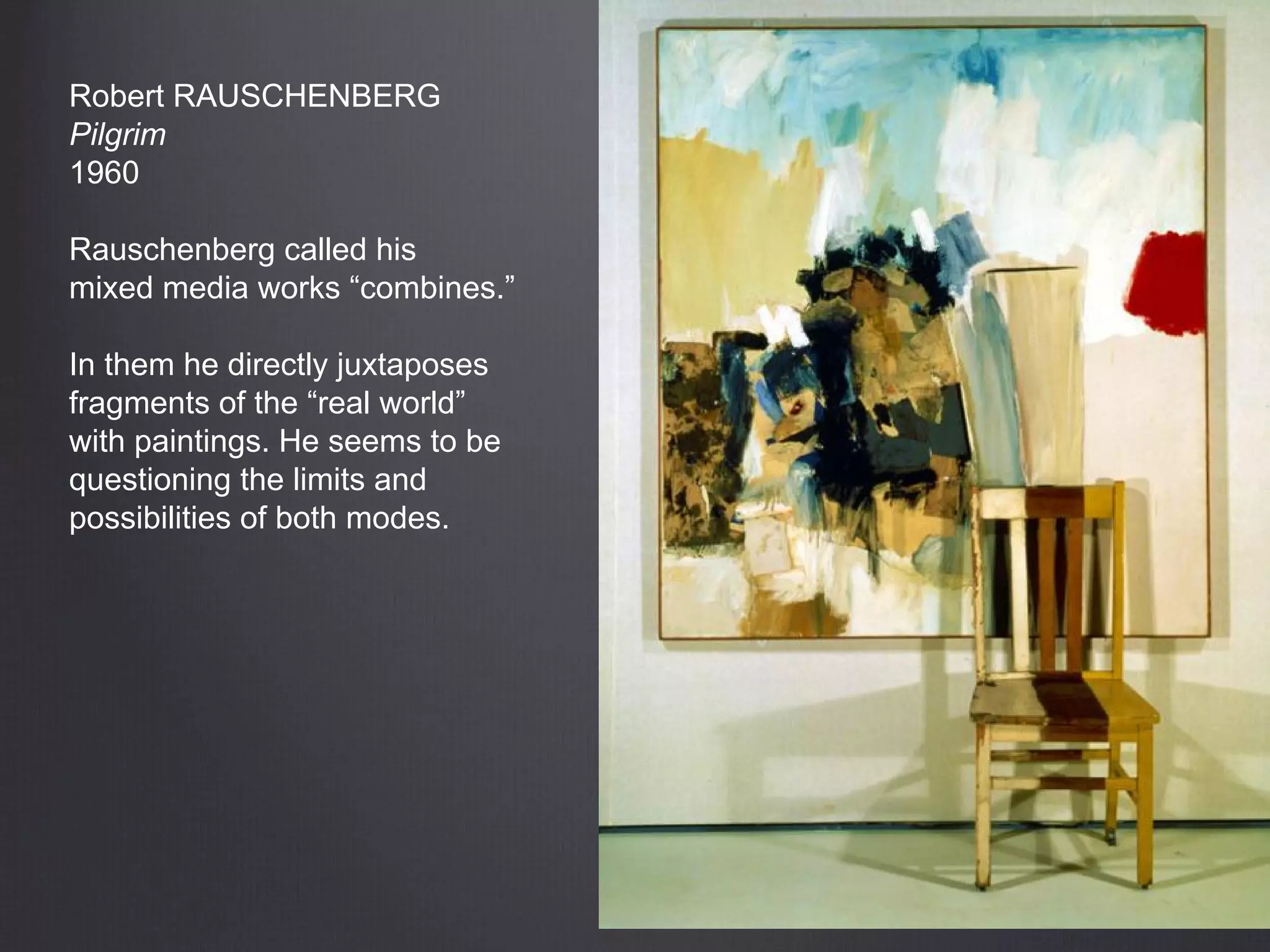
Robert RAUSCHENBERG
Pilgrim
1960
Rauschenberg called his
mixed media works “combines.”
In them he directly juxtaposes
fragments of the “real world”
with paintings. He seems to be
questioning the limits and
possibilities of both modes.
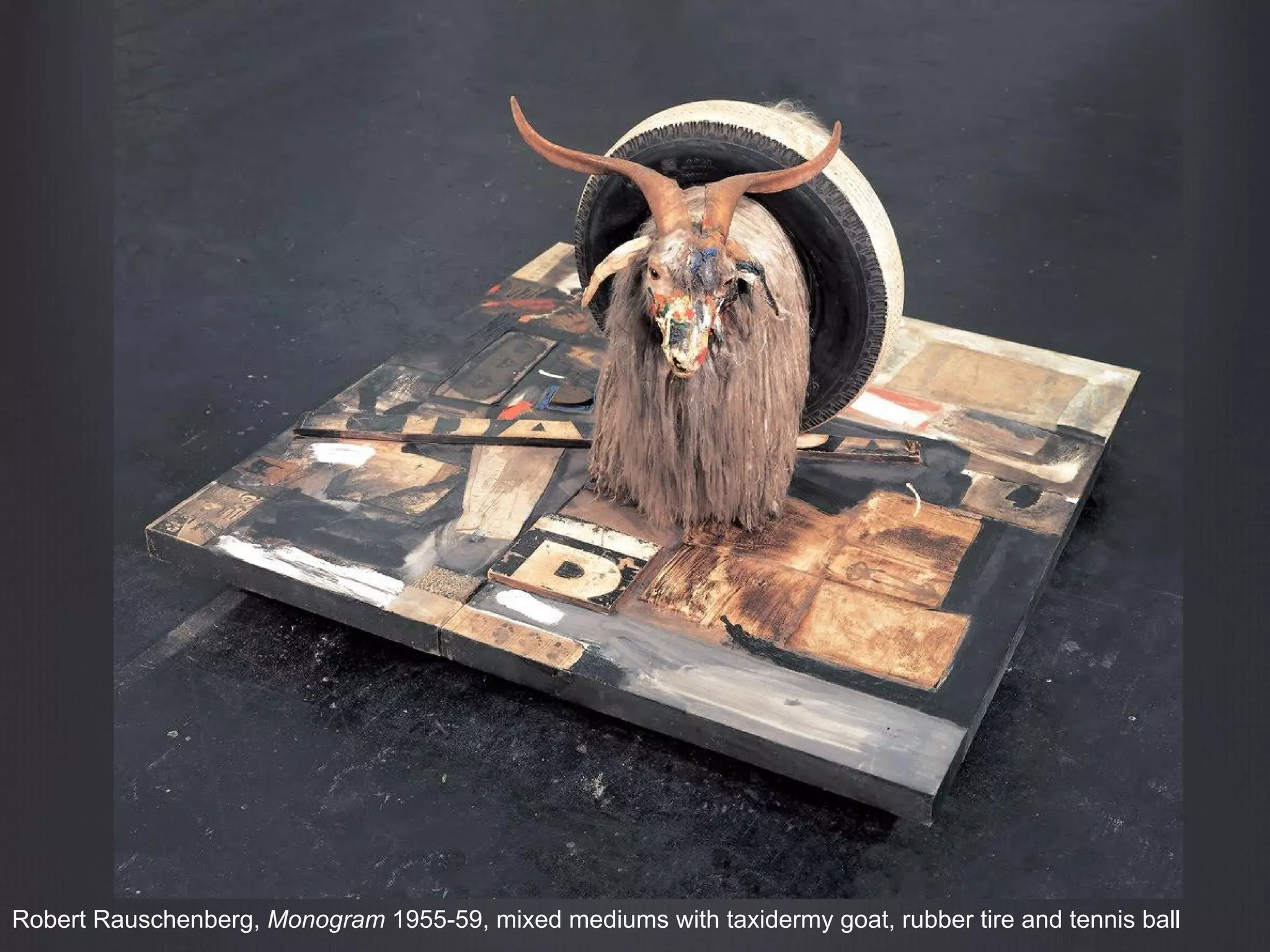
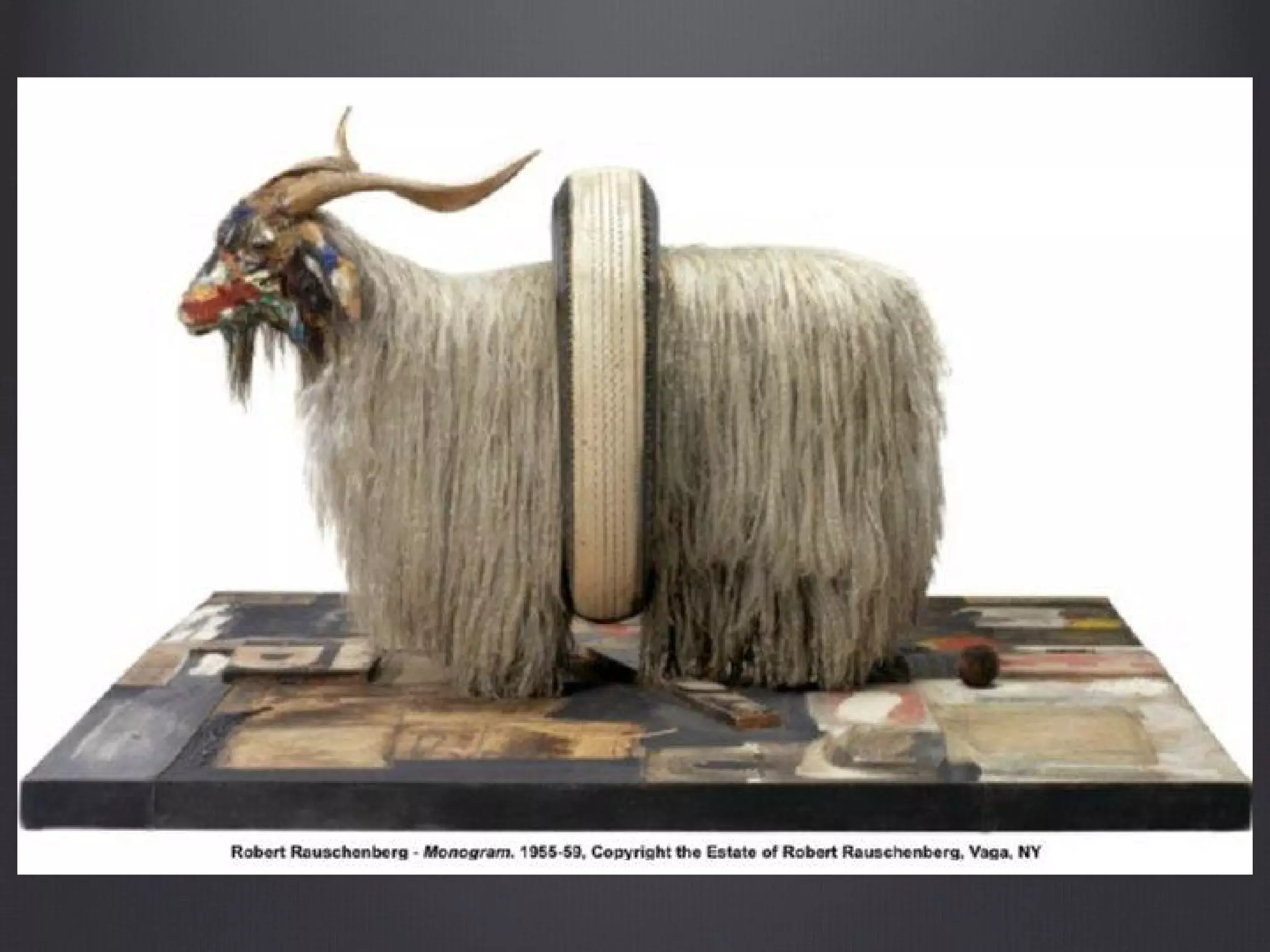
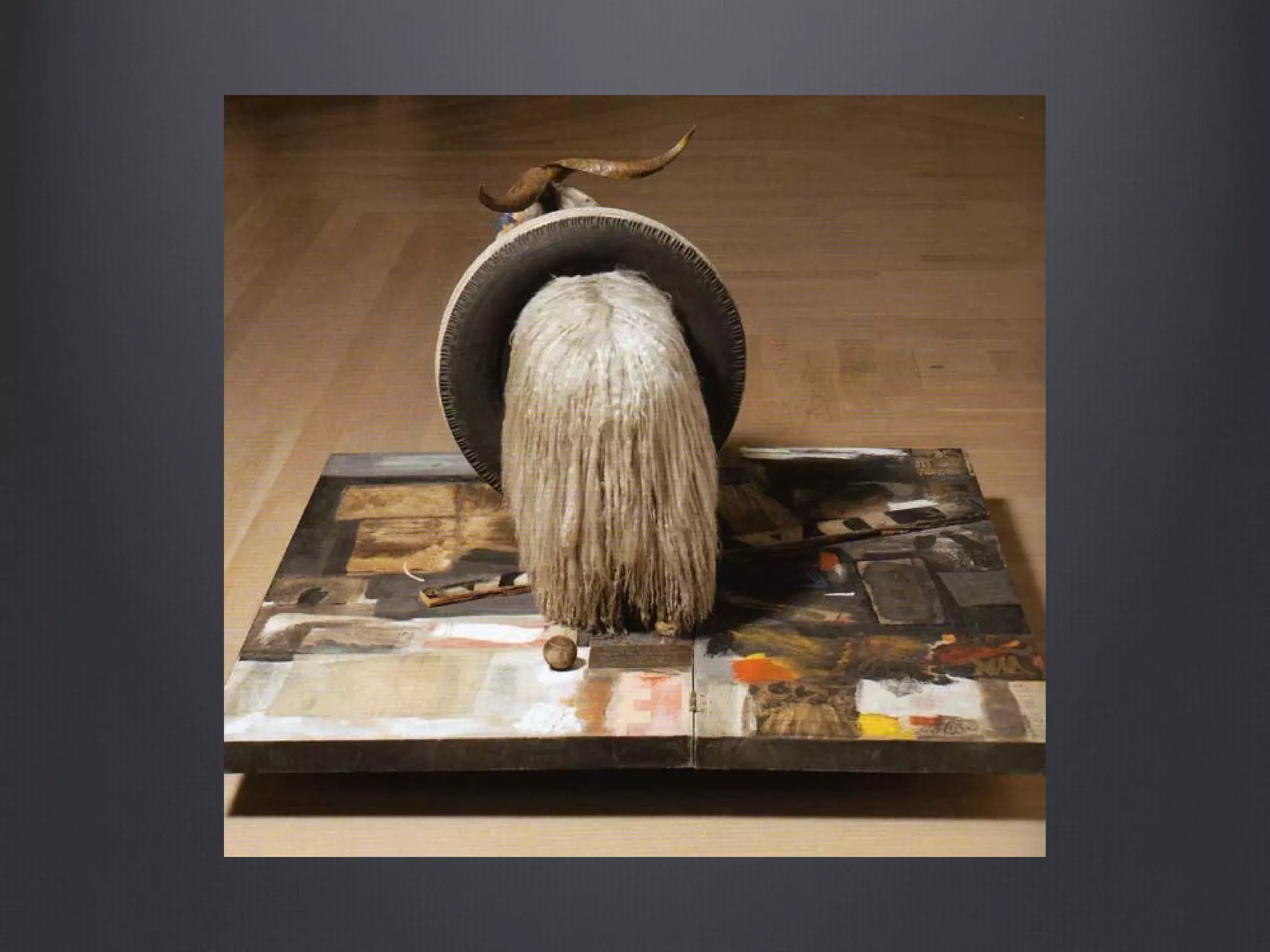
Robert Rauschenberg, Monogram 1955-59, mixed mediums with taxidermy goat, rubber tire and tennis ball
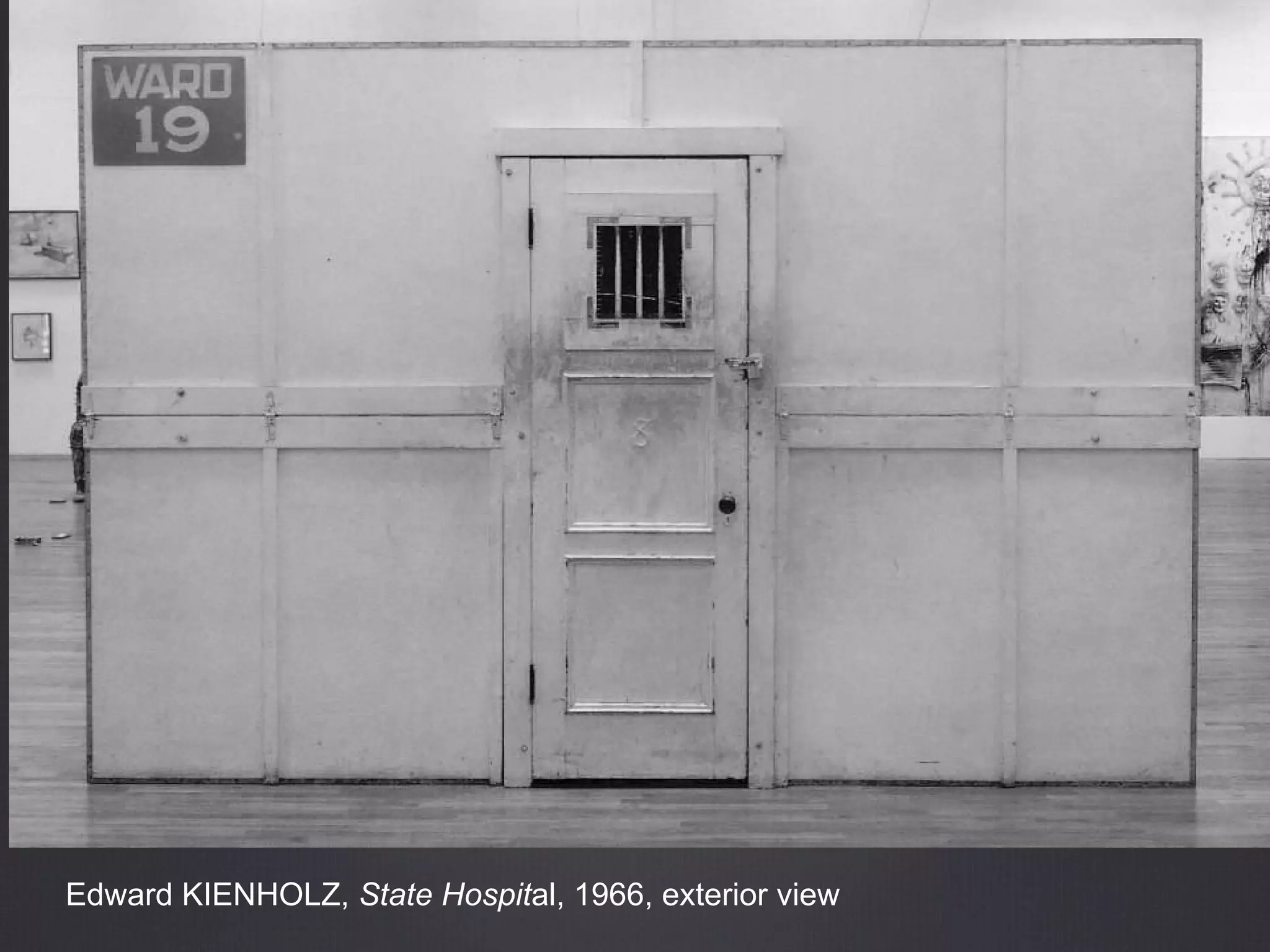
Edward KIENHOLZ, State Hospital, 1966, exterior view
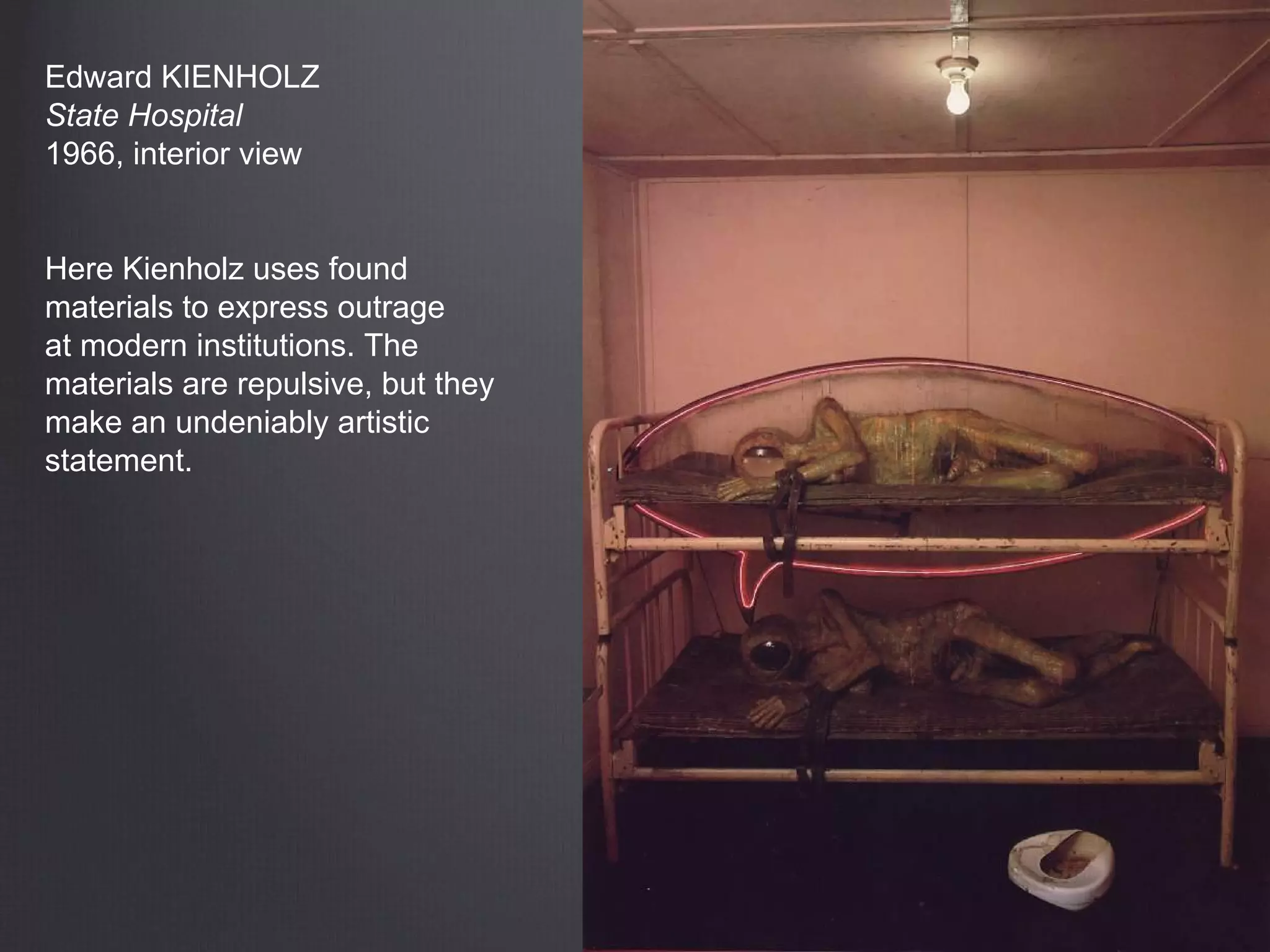
Edward KIENHOLZ
State Hospital
1966, interior view
Here Kienholz uses found
materials to express outrage
at modern institutions. The
materials are repulsive, but they
make an undeniably artistic
statement.
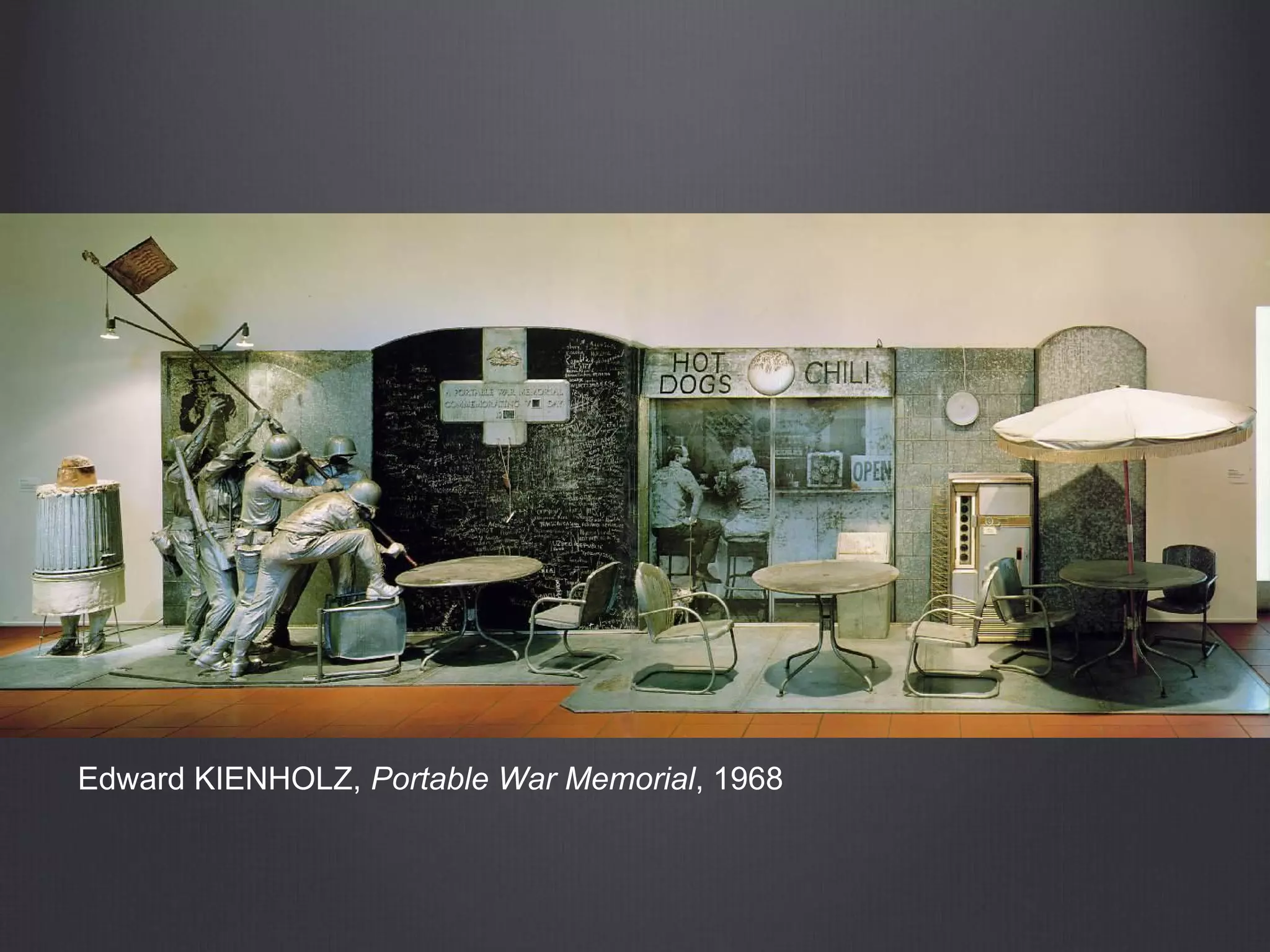
Edward KIENHOLZ, Portable War Memorial, 1968
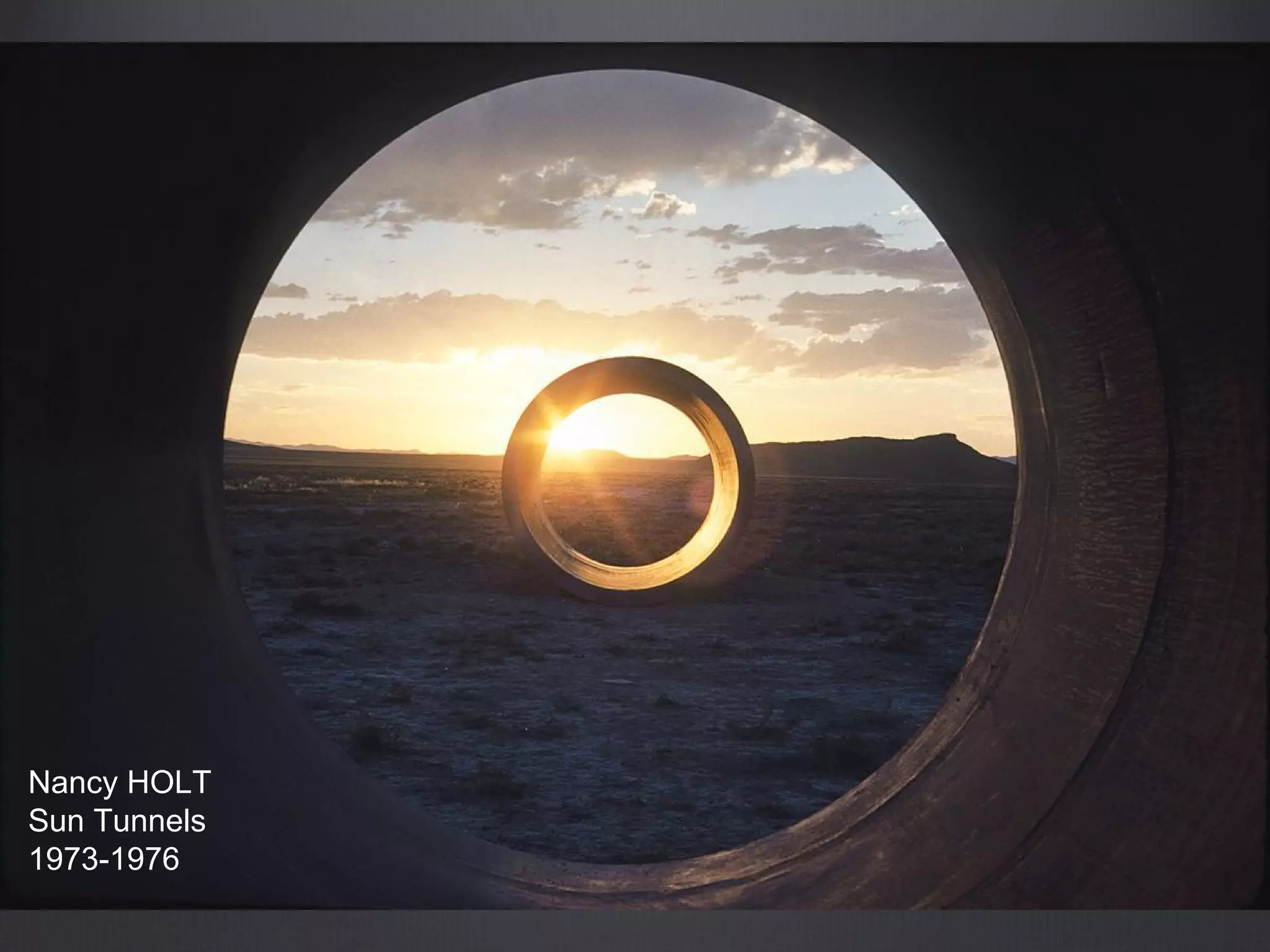
Nancy HOLT
Sun Tunnels
1973-1976
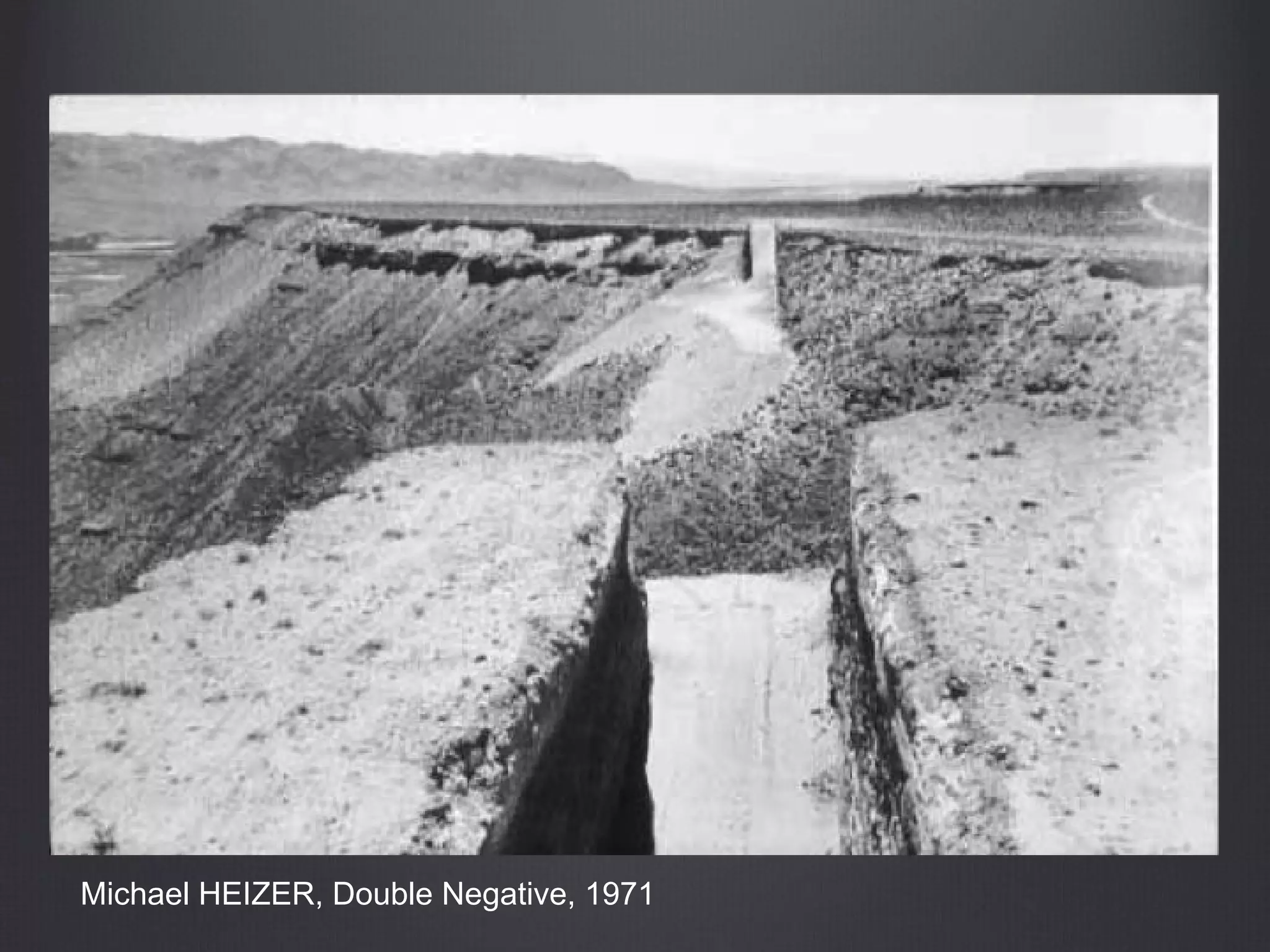
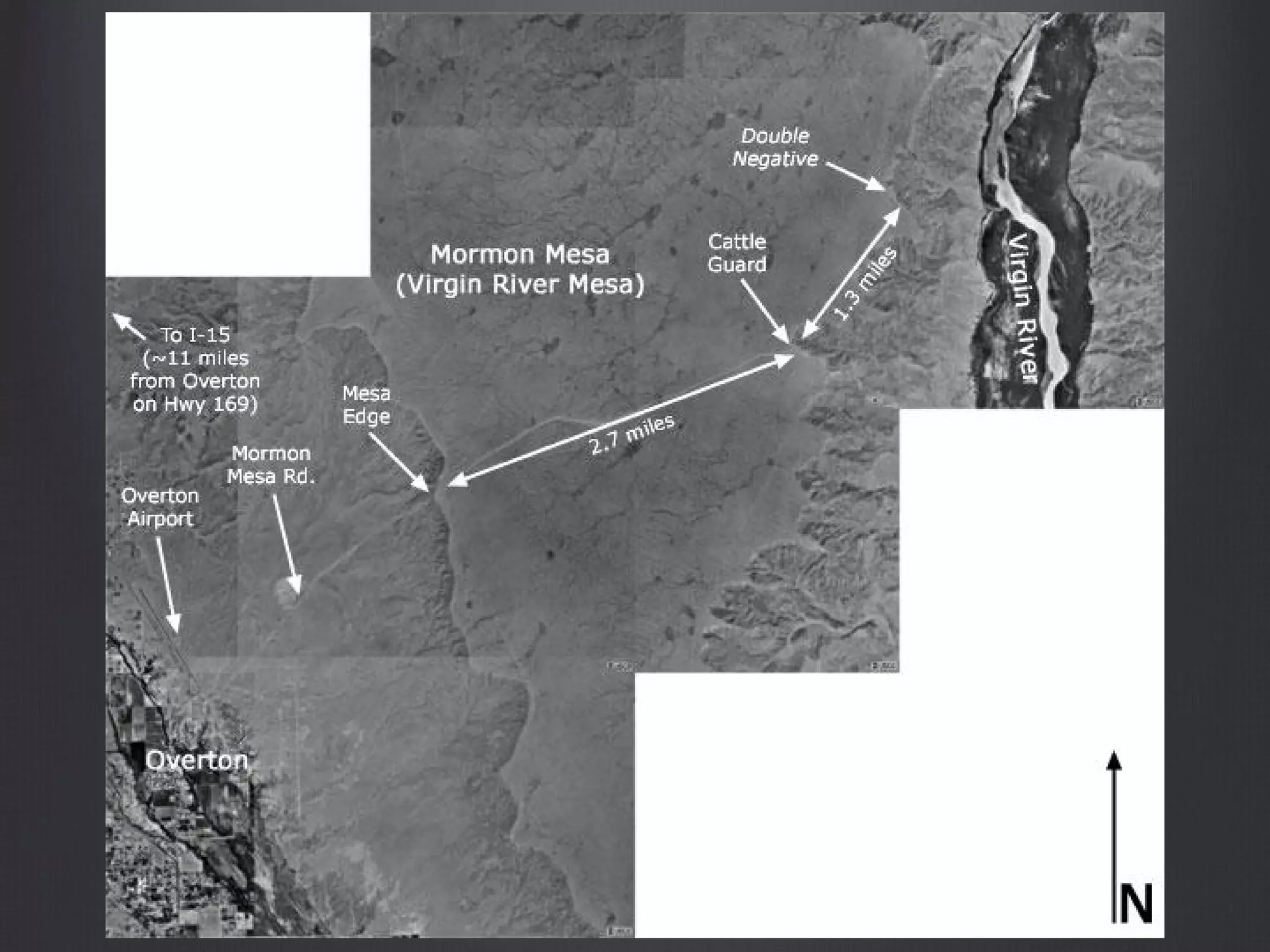
Michael HEIZER, Double Negative, 1971
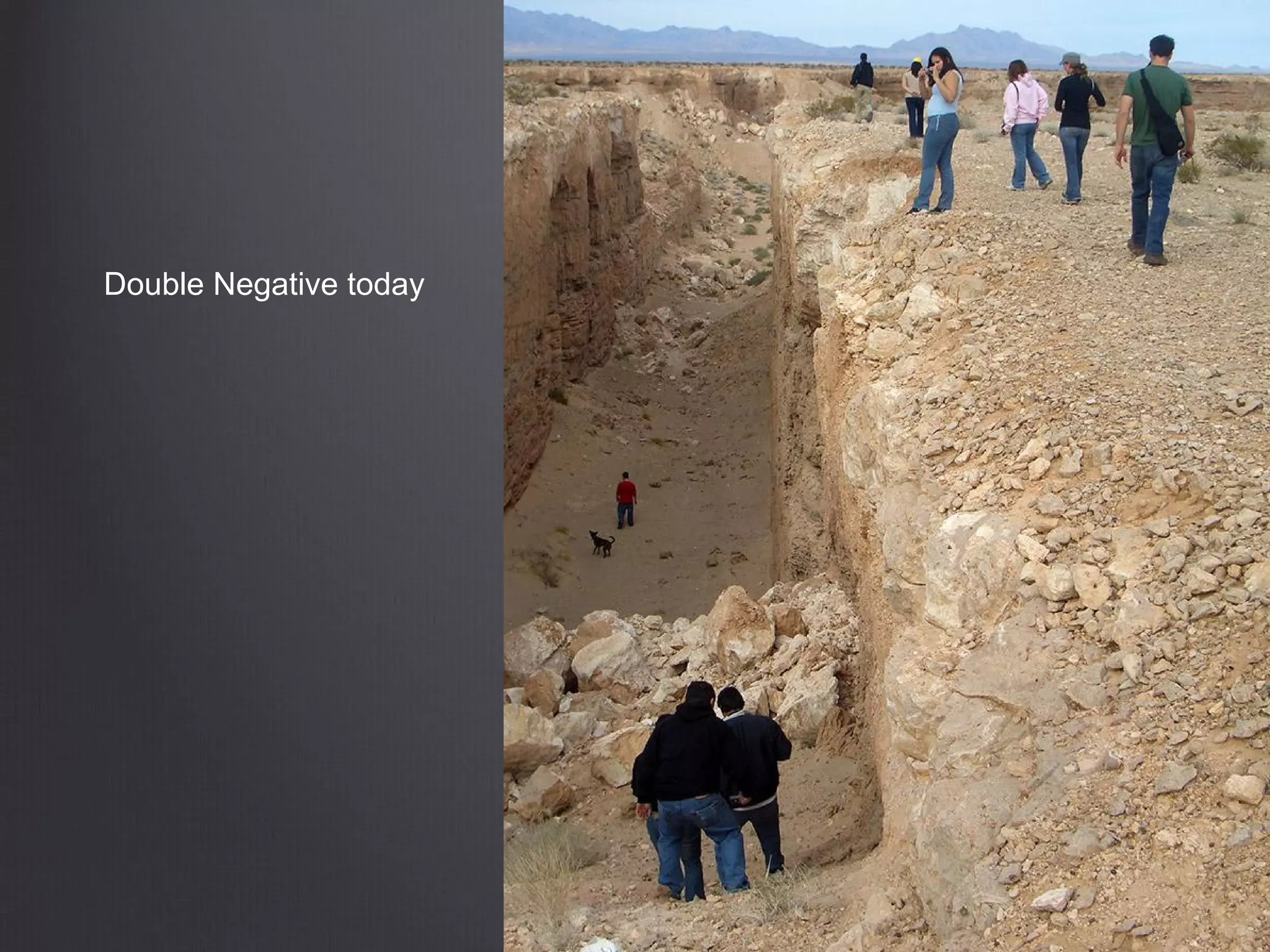
Double Negative today
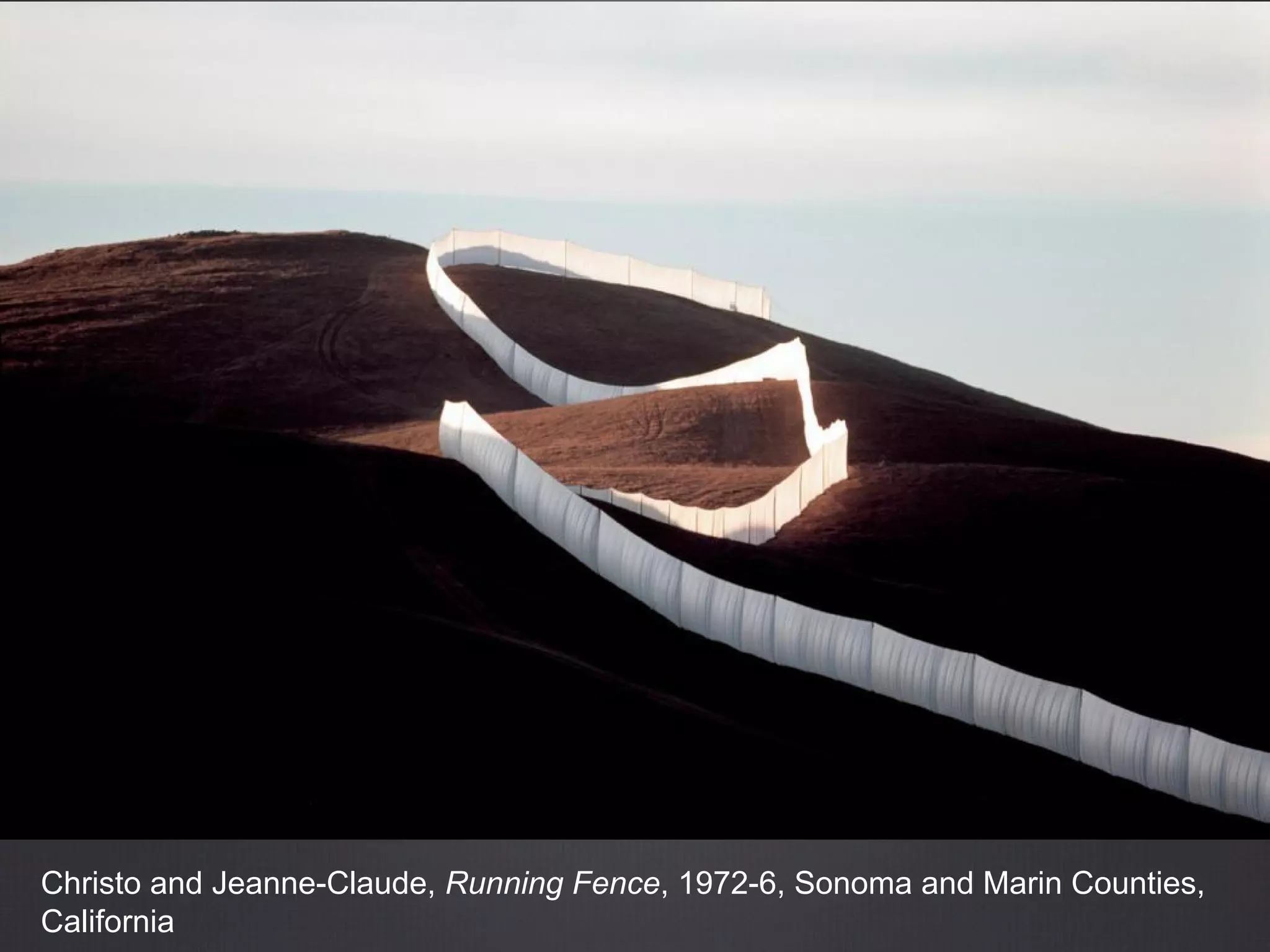
Christo and Jeanne-Claude, Running Fence, 1972-6, Sonoma and Marin Counties,
California
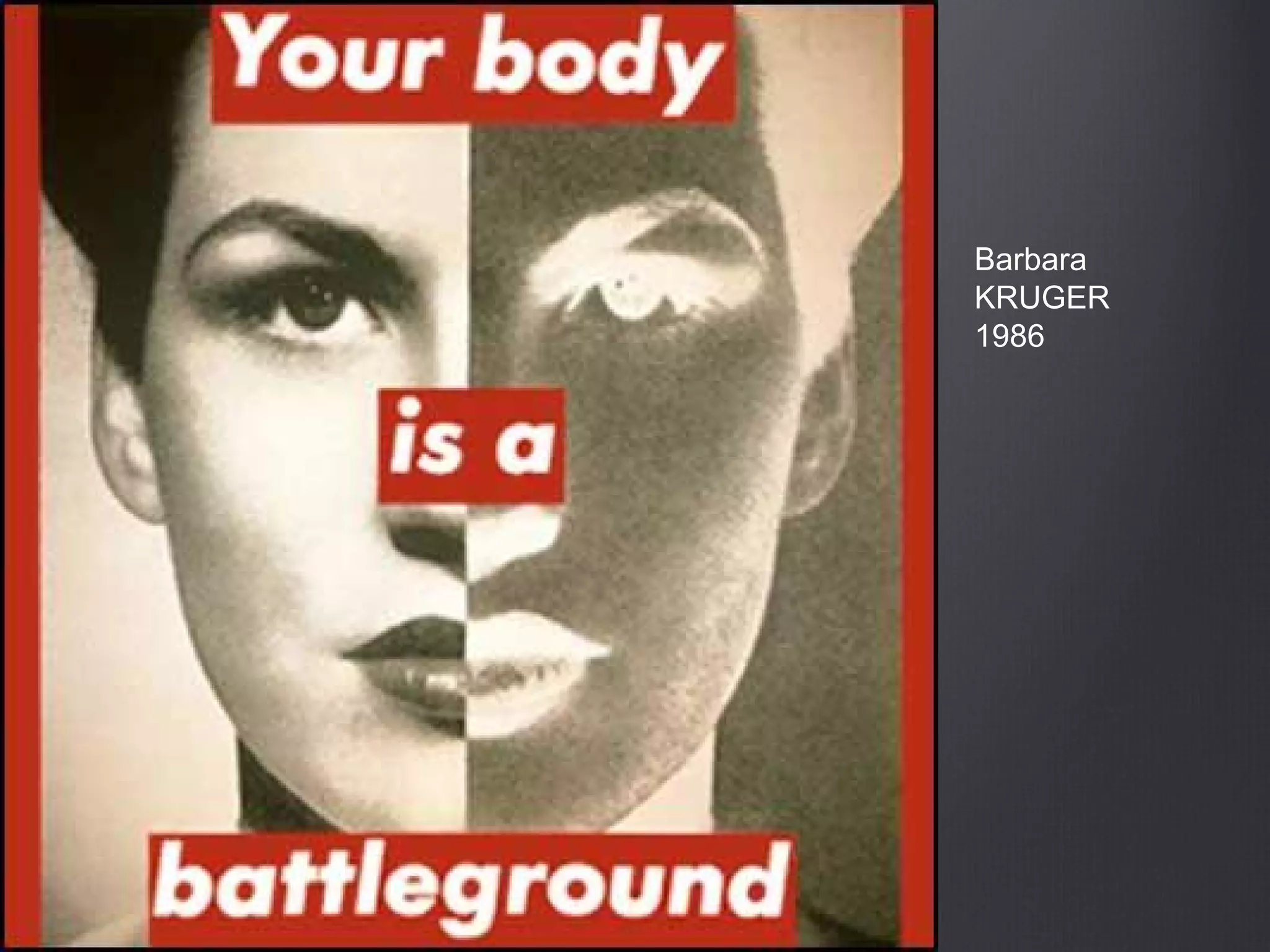
Barbara
KRUGER
1986
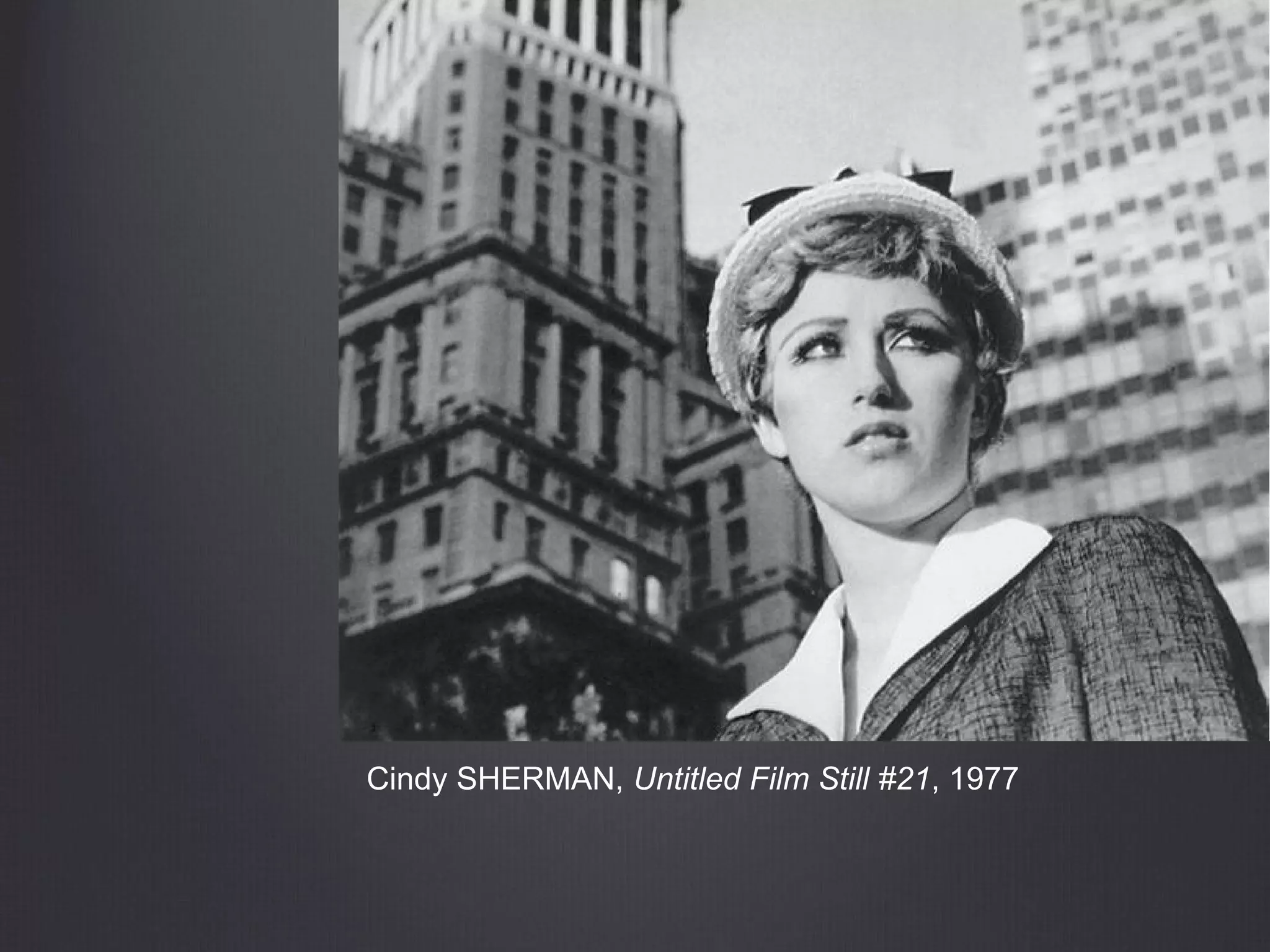
Cindy SHERMAN, Untitled Film Still #21, 1977
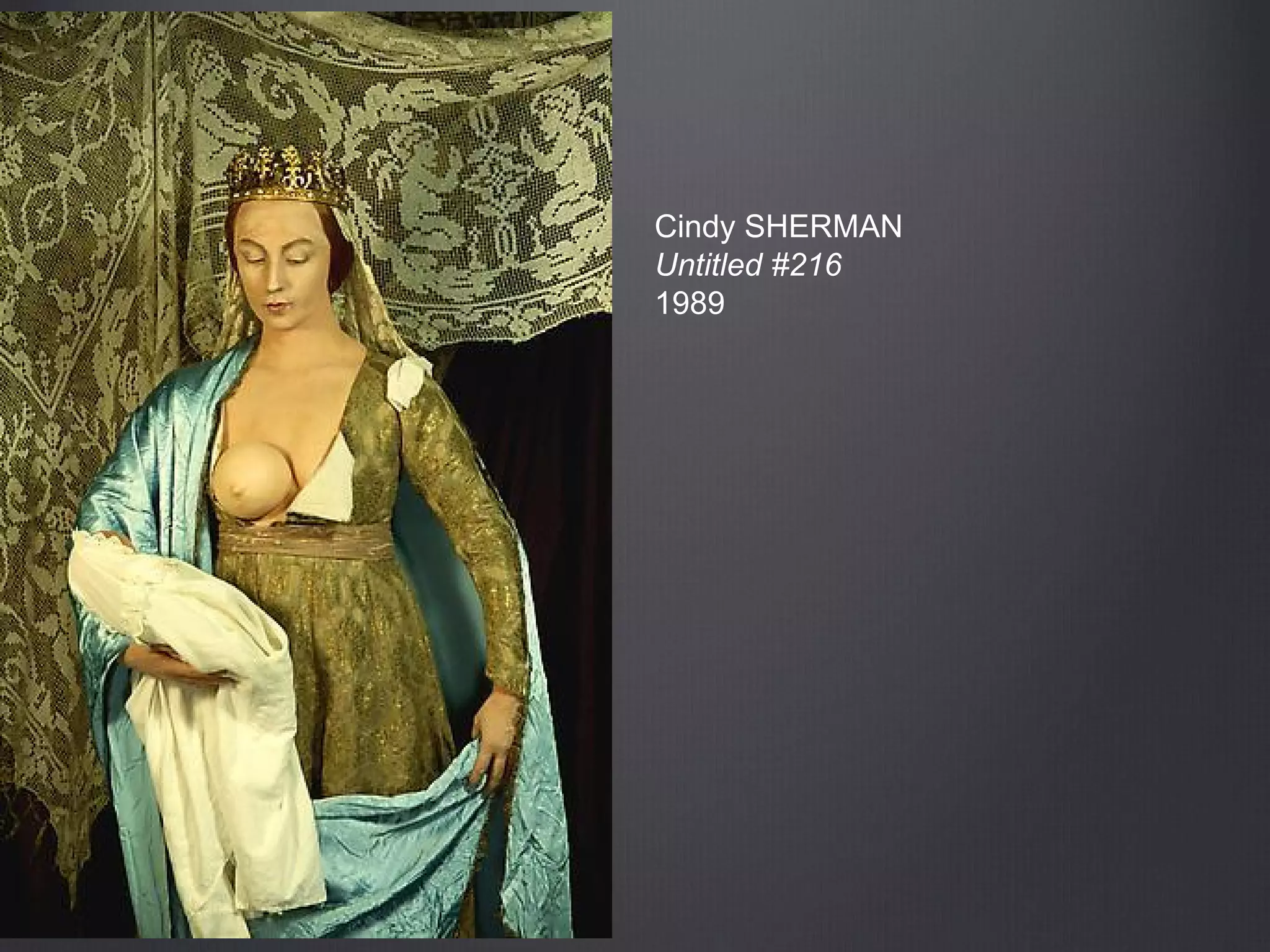
Cindy SHERMAN
Untitled #216
1989
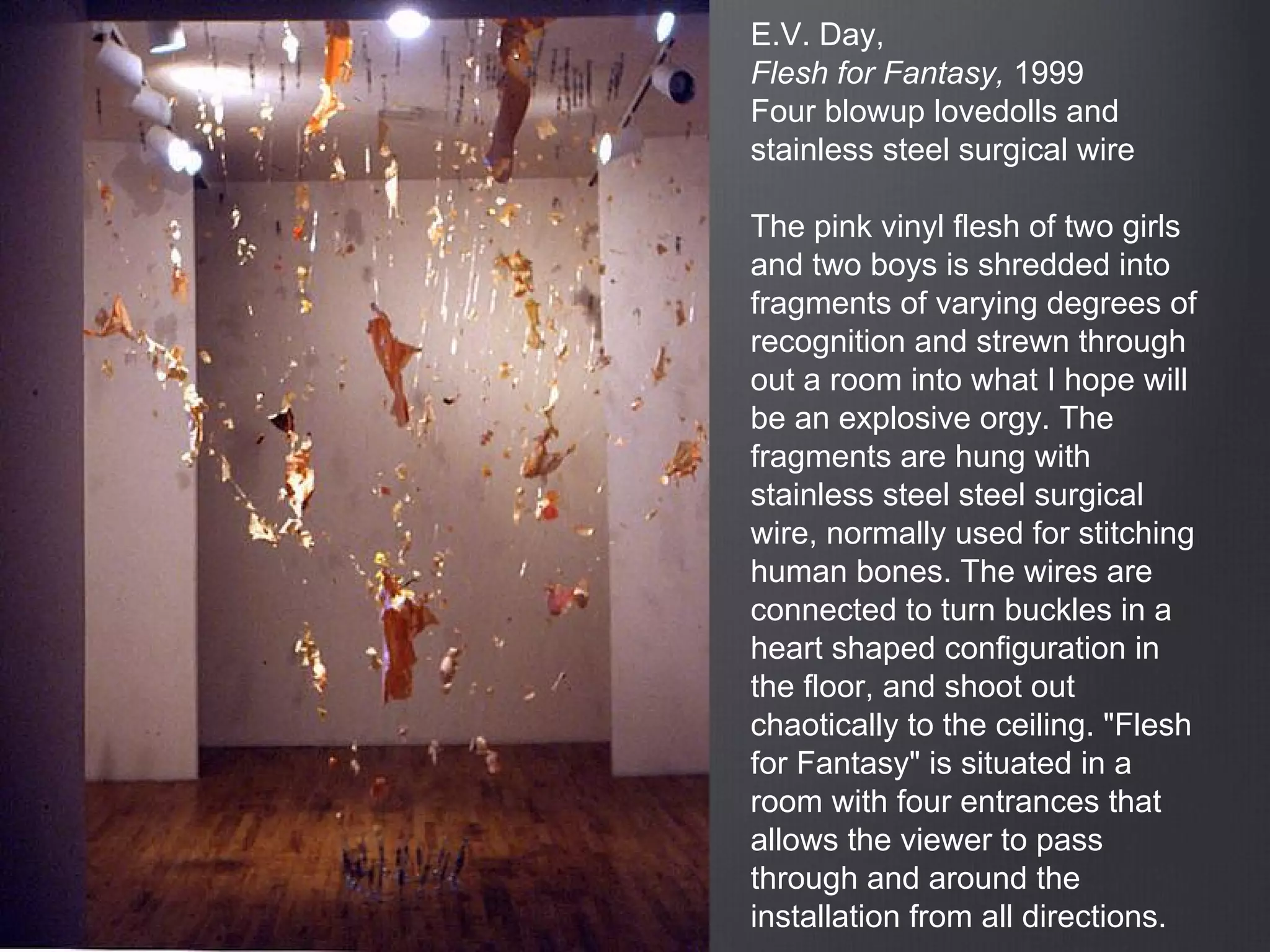
E.V. Day,
Flesh for Fantasy, 1999
Four blowup lovedolls and
stainless steel surgical wire
The pink vinyl flesh of two girls
and two boys is shredded into
fragments of varying degrees of
recognition and strewn through
out a room into what I hope will
be an explosive orgy. The
fragments are hung with
stainless steel steel surgical
wire, normally used for stitching
human bones. The wires are
connected to turn buckles in a
heart shaped configuration in
the floor, and shoot out
chaotically to the ceiling. "Flesh
for Fantasy" is situated in a
room with four entrances that
allows the viewer to pass
through and around the
installation from all directions.
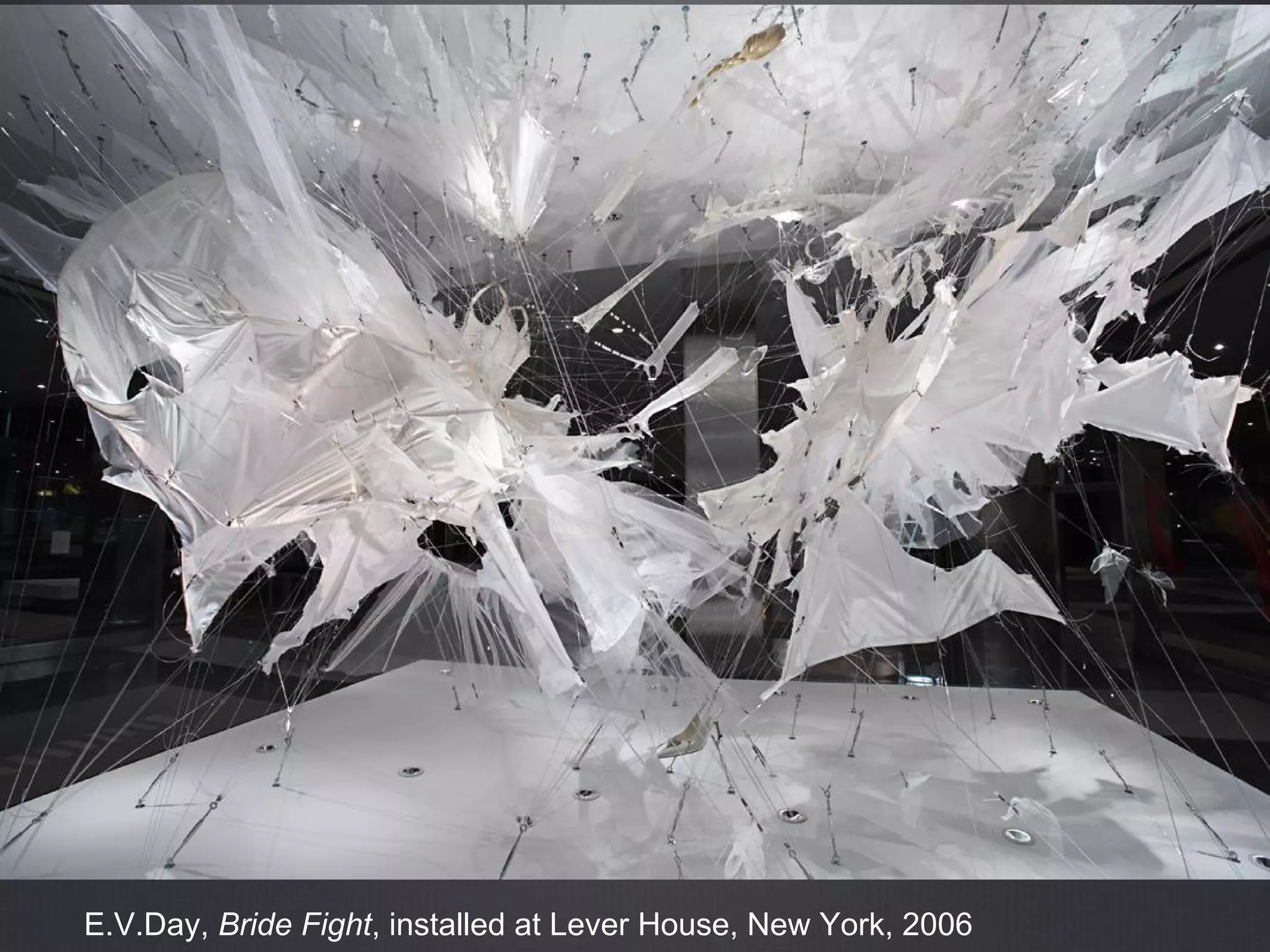
E.V.Day, Bride Fight, installed at Lever House, New York, 2006
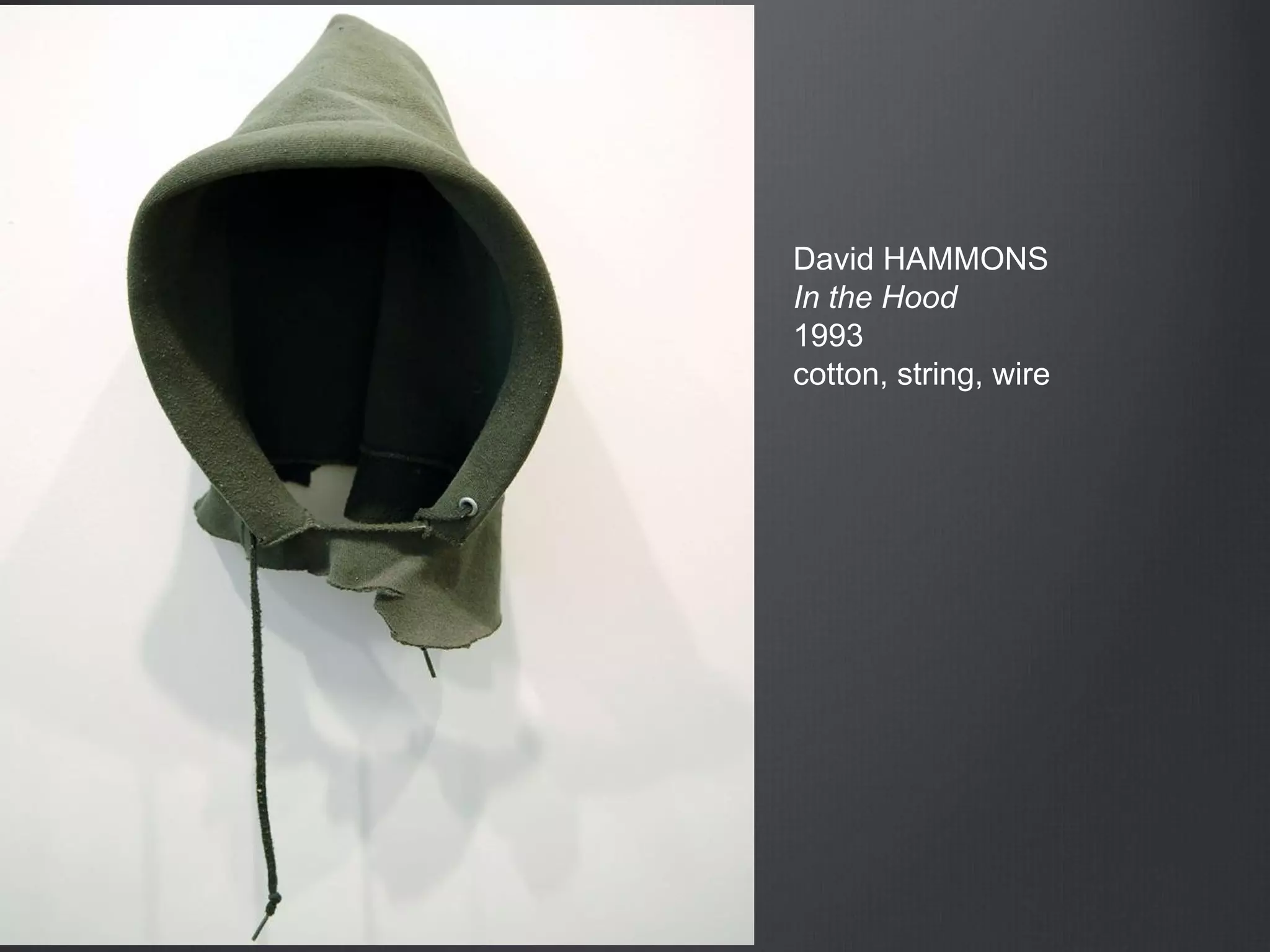
David HAMMONS
In the Hood
1993
cotton, string, wire
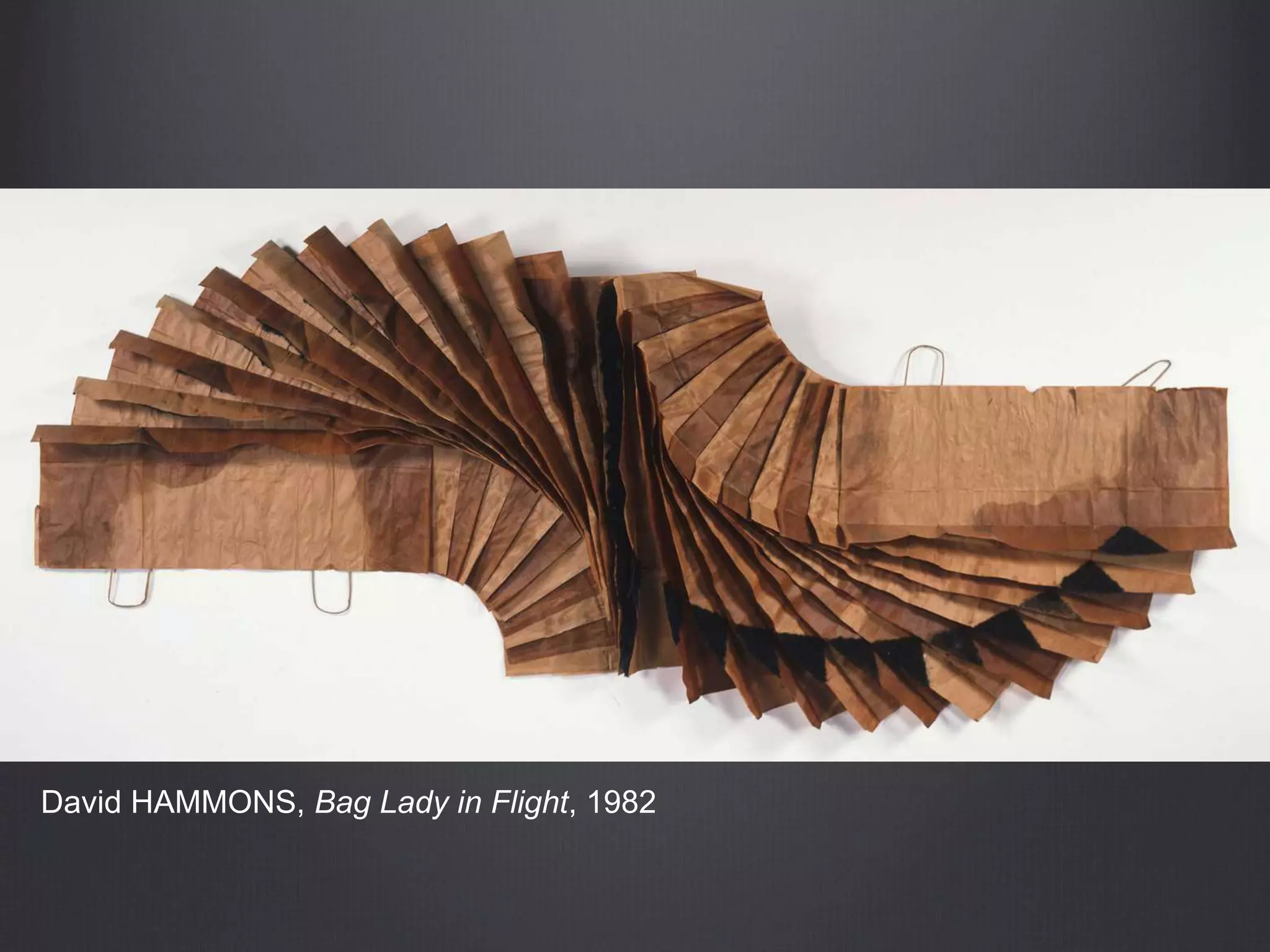
David HAMMONS, Bag Lady in Flight, 1982
Key points
• Imbrication of art and commerce
• constant cross-pollination between elite and popular
culture
• moving past realist modes of representation (post-
photographic)
• development of self-reflective capacity
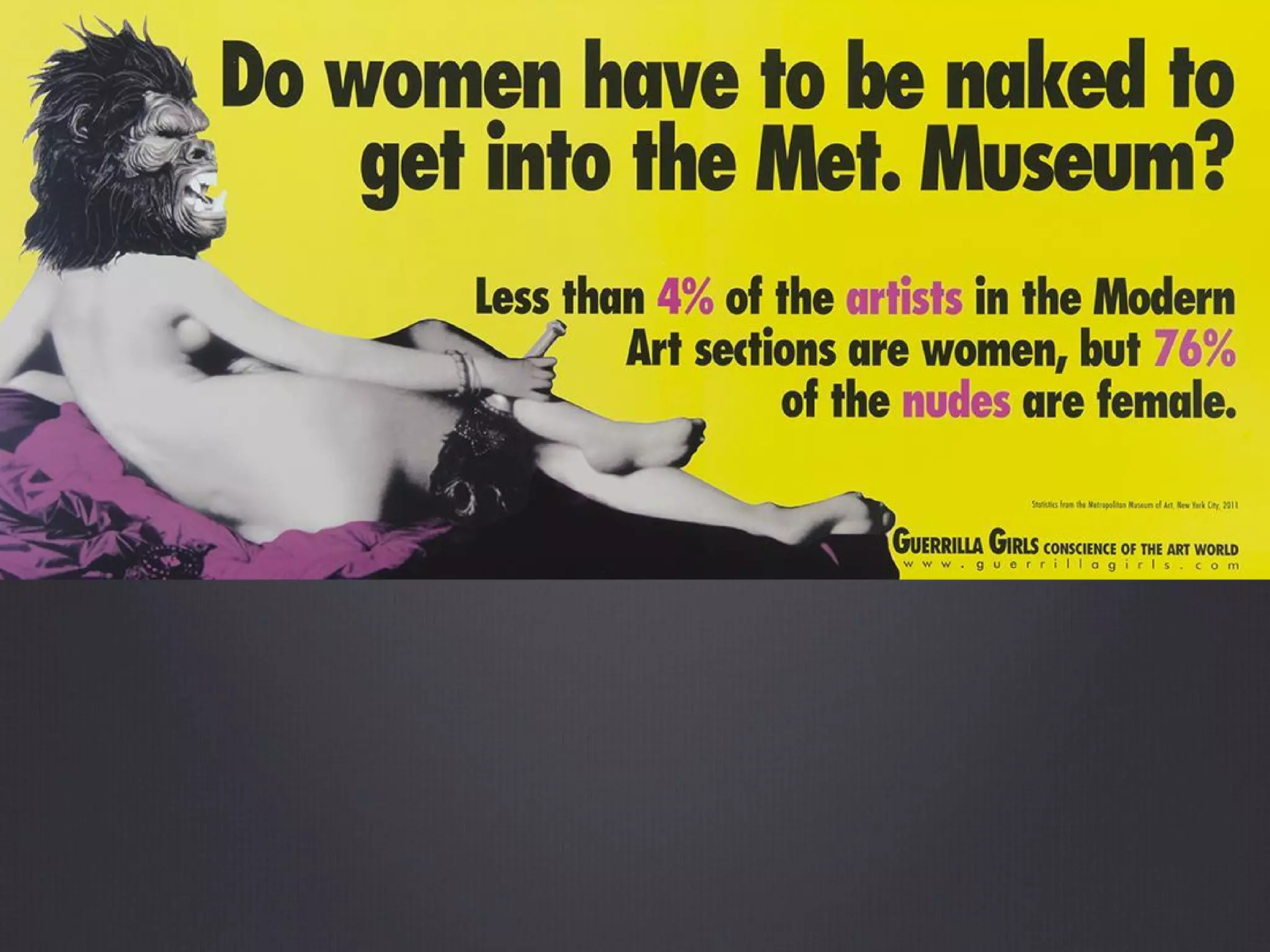
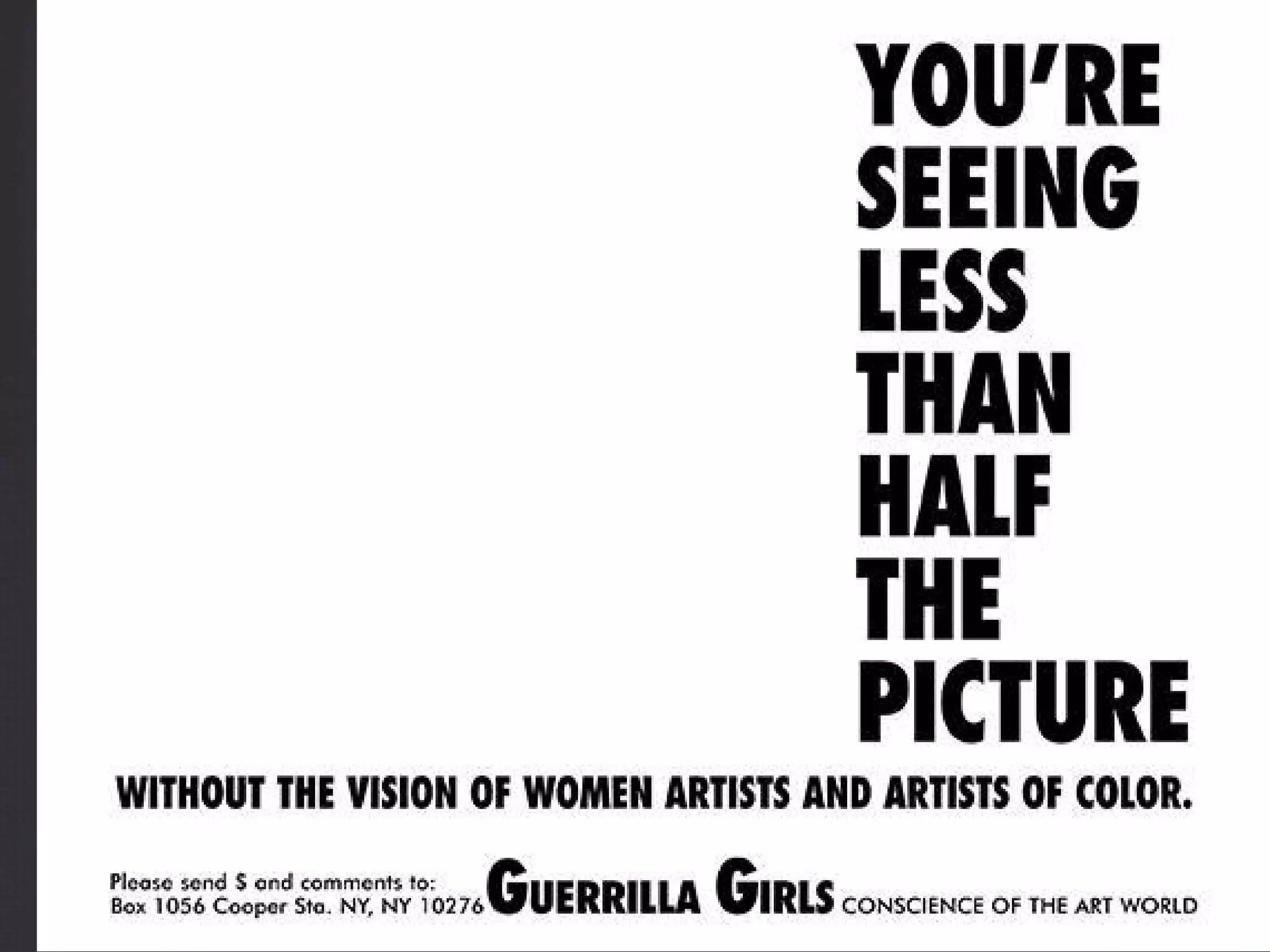
• critical perspectives on the treatment of women and non-
whites in previous art
• awareness of the power of representation to shape belief

ART100SP16_Module4.1

  • 1.
    Class 4.1 Art inthe Twentieth Century ART 100 Spring ‘16 Willem de Kooning, Woman V 1952-3
  • 2.
    as we discussedpreviously, the notion of an autonomous realm devoted purely to the appreciation of beauty is peculiar to the modern West (European and places colonized by Europe) autonomous=standing on its own, independent of other considerations, such as function.
  • 4.
    Mask depicting warrior hunter(Oro Efe) early 20th century Republic of Benin, Ketu-Ohori (Yoruba) Wood, pigment 15 x 13 inches
  • 5.
    Attic Red Figure, ca.475 BCE–ca. 450 BCE (Early Classical) The Syracuse Painter Hydria
  • 6.
    Elevator gatescreen from ChicagoStock Exchange Building, 1894 Louis Henri Sullivan (United States, 1856–1924) Cast iron with bronze plating 84 x 31 1/4 inches
  • 7.
    J.M.W. Turner, TheBurning of the Houses of Parliament, 1835
  • 8.
    Paul Cézanne, Gulfof Marseilles seen from L’Estaque, c.1885, oil on canvas, 31.5 × 39.2 in
  • 9.
  • 10.
    Barnett Newman withOnement VI, 1961
  • 11.
  • 13.
    Picasso, Portrait ofWilhelm Uhde, 1910 Catalan artist Pablo PICASSO had no difficulty painting representational pictures, abstractions, and everything in between. Here he fragments the portrait of one of his art dealers into rectangles and triangles. Over time he will oscillate back and forth between styles in a seemingly effortless manner.
  • 14.
    Picasso, Still Lifewith Chair Caning,
  • 15.
    Pablo PICASSO, StillLife with Chair Caning, 1912 For this collage, Picasso used wallpaper that imitated chair caning, and wrapped the whole canvas in real rope. The other portions are painted in imitation of various objects that might be found on a tabletop.
  • 16.
    Picasso, Bottle ofVieux Marc, Glass, Guitar and Newspaper, 1913,Picasso, Bottle of Vieux Marc, Glass, Guitar and
  • 17.
    Duchamp, Nude Descendinga Staircase, 1912 Duchamp, Bottle Rack,
  • 18.
    Marcel Duchamp realizesthat the dynamic forms that interest him can be found in actual objects just as well as in painting. The bottle rack on the left was a common object in French life, used for drying out empty wine bottles before reusing them.
  • 19.
    Duchamp, Tu M’,1918 This picture plays with illusion and reality, including a found object that sticks directly out of the painting. The question Duchamp asks here: why paint a representation of the object if you can just use the real thing?
  • 20.
    Marcel DUCHAMP Fountain 1917/1964 glazed ceramic,paint 15 x 19 1/4 x 24 5/8 inches Can "art" be nothing more than a framing device to get us to look at reality differently?
  • 21.
    René Magritte, TheTreachery of Images, 1928-9 In his own way, Belgian artist Magritte asks a similar question, declaring that a painting of a pipe can never be a real pipe.
  • 22.
    Artists begin tofeel a great freedom to use paint in different ways, or even to forget about painting and use pictures clipped from magazines to express their ideas. There are many different ways to put a recognizable figure together, and artists are drawn to the challenge of finding new methods rather than relying on the old ones.
  • 23.
    Ferdinand Léger Woman witha Cat, 1921 Hannah Höch, The Beautiful Girl, 1920
  • 24.
    Fernand LÉGER, TheRed Table, 1920. AIC While some artists experiment with different ways of breaking down a scene and putting it back together, others question the need for a subject altogether. Why not just paint colors and shapes, for their own intrinsic appeal?
  • 25.
  • 26.
    “There is nosuch thing as ‘abstract,’ or ‘concrete’… There is a good picture and a bad picture. There is the picture that moves you and the picture that leaves you cold… A picture has a value in itself, like a musical score, like a poem.” —Fernand Léger Here French artist Léger tries to explain that it doesn’t really matter whether a picture has a subject matter.
  • 27.
    Frantisek KUPKA, SelfPortrait (The Yellow Scale) 1907
  • 28.
    Frantisek KUPKA Red andBlue Discs 1911 39 3/8 x 28 ¾" inches
  • 29.
    El Lissitzky, Beatthe Whites with the Red Wedge, 1919, war poster
  • 30.
  • 31.
    El Lissitzky The NewMan, from a portfolio of 10 lithographs, published 1923
  • 32.
    Raoul HAUSSMAN Mechanical Head(Spirit of Our Time) 1920
  • 33.
  • 34.
    Grosz and Heartfield DadaPicture c. 1919 collage
  • 35.
    cover design, exhibitioncatalog for First International Dada Fair, 1920
  • 36.
    First International DadaFair, Berlin, June 1920, with participating artists
  • 38.
    John Heartfield Jacket designfor Deutschland, Deutschland Über Alles, by Kurt Tucholsky
  • 39.
    John Heartfield AIZ (ArbeitersIllustrierte Zeitung) The Meaning of the Hitler Salute: Millions Stand Behind Me, Little Man Asks for Big Donations
  • 40.
    John Heartfield Hitler’s Doveof Peace cover image Jan 31. 1935 AIZ
  • 41.
  • 42.
  • 43.
    Hannah Höch Cut withthe Kitchen Knife Dada Through the Last Weimar Beer-Belly Cultural Epoch of Germany 1919-1920
  • 44.
  • 45.
    Kur SCHWITTERS Merz 32A(Cherry Picture) 1921 collage of colored papers, fabrics, printed labels and pictures, pieces of wood, etc., and gouache on cardboard background 36-1/8 x 27-3/4” The Museum of Modern Art, New York
  • 46.
    Max Ernst (French,born Germany. 1891-1976) Two Children Are Threatened by a Nightingale (Deux enfants sont menacés par un rossignol), 1924. © The Museum of Modern Art, New York
  • 47.
  • 48.
    Max ERNST The VirginSpanking the Christ Child before Three Witnesses: Andre Breton, Paul Eluard, and the Painter 1926 oil on canvas
  • 49.
  • 50.
    Giorgio de Chirico The Songof Love 1914 oil on canvas 2' 7" x 1' 11”
  • 51.
    Salvador DALI, LobsterTelephone, 1936 “I do not understand why, when I ask for a grilled lobster in a restaurant, I am never served a cooked telephone; I do not understand why champagne is always chilled and why on the other hand telephones, which are habitually so frightfully warm and disagreeably sticky to the touch, are not also put in silver buckets with crushed ice around them.”
  • 52.
    Meret Oppenheim (Swiss,1913–1985) Object Paris, 1936 Fur-covered cup, saucer, and spoon © 2014 Artists Rights Society (ARS), New York / Pro Litteris, Zurich
  • 53.
  • 54.
  • 55.
    Arshile GORKY (American,born Armenia. 1904-1948) Garden in Sochi c. 1943.
  • 56.
    Arshile GORKY The Artistand His Mother c. 1926-36
  • 57.
    I don’t likethat word, “finish.” When something is finished, that means it’s dead, doesn’t it? I believe in everlastingness. I never finish a painting—I just stop working on it for a while. Arshile Gorky, 1948
  • 58.
    Willem de Kooning Queenof Hearts 1943-46 Oil and charcoal on fiberboard 46 1/8 x 27 5/8" inches
  • 59.
    Willem de Kooning (American,b. The Netherlands, 1904-1997). Woman, I, 1950-52 Oil on canvas 75 7/8 x 58 inches
  • 60.
    Willem de KOONING Two Womenat the Beach 1953
  • 61.
    “…if you pickup some paint with your brush and make somebody's nose with it, this is rather ridiculous when you think of it, theoretically or philosophically. It's really absurd to make an image, like a human image, with paint, today, when you think about it, since we have this problem of doing it or not doing it. But then all of a sudden it was even more absurd not to do it. So I fear I have to follow my desires.” —Willem de Kooning, in a 1962 radio interview Like Léger before him, de Kooning points out that it doesn’t really matter if a painting has a subject or not.
  • 62.
    Robert RAUSCHENBERG Pilgrim 1960 Rauschenberg calledhis mixed media works “combines.” In them he directly juxtaposes fragments of the “real world” with paintings. He seems to be questioning the limits and possibilities of both modes.
  • 63.
    Robert Rauschenberg, Monogram1955-59, mixed mediums with taxidermy goat, rubber tire and tennis ball
  • 66.
    Edward KIENHOLZ, StateHospital, 1966, exterior view
  • 67.
    Edward KIENHOLZ State Hospital 1966,interior view Here Kienholz uses found materials to express outrage at modern institutions. The materials are repulsive, but they make an undeniably artistic statement.
  • 68.
    Edward KIENHOLZ, PortableWar Memorial, 1968
  • 69.
  • 70.
    Michael HEIZER, DoubleNegative, 1971
  • 72.
  • 73.
    Christo and Jeanne-Claude,Running Fence, 1972-6, Sonoma and Marin Counties, California
  • 76.
  • 77.
    Cindy SHERMAN, UntitledFilm Still #21, 1977
  • 78.
  • 79.
    E.V. Day, Flesh forFantasy, 1999 Four blowup lovedolls and stainless steel surgical wire The pink vinyl flesh of two girls and two boys is shredded into fragments of varying degrees of recognition and strewn through out a room into what I hope will be an explosive orgy. The fragments are hung with stainless steel steel surgical wire, normally used for stitching human bones. The wires are connected to turn buckles in a heart shaped configuration in the floor, and shoot out chaotically to the ceiling. "Flesh for Fantasy" is situated in a room with four entrances that allows the viewer to pass through and around the installation from all directions.
  • 80.
    E.V.Day, Bride Fight,installed at Lever House, New York, 2006
  • 81.
    David HAMMONS In theHood 1993 cotton, string, wire
  • 82.
    David HAMMONS, BagLady in Flight, 1982
  • 87.
    Key points • Imbricationof art and commerce • constant cross-pollination between elite and popular culture • moving past realist modes of representation (post- photographic) • development of self-reflective capacity • critical perspectives on the treatment of women and non- whites in previous art • awareness of the power of representation to shape belief