Arts Elements and Visual Principles
Arts Elements Are the visual, tactile, spatial (and sometimes the sonic) sensory qualities used when creating or talking about 2D, 3D and time based artworks.  Arts elements are traditionally associated with particular arts disciplines and art forms. In visual arts, these elements include…
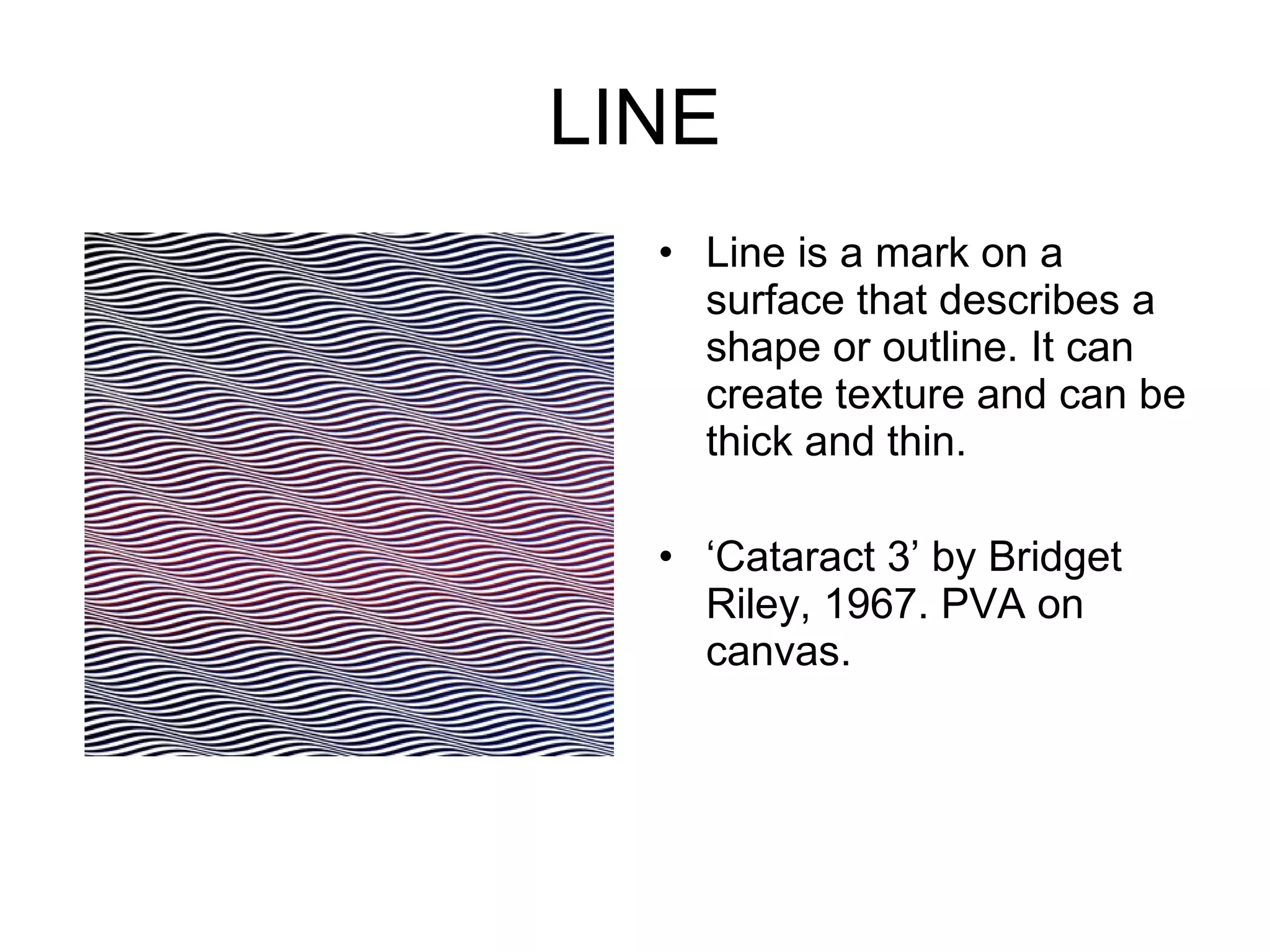
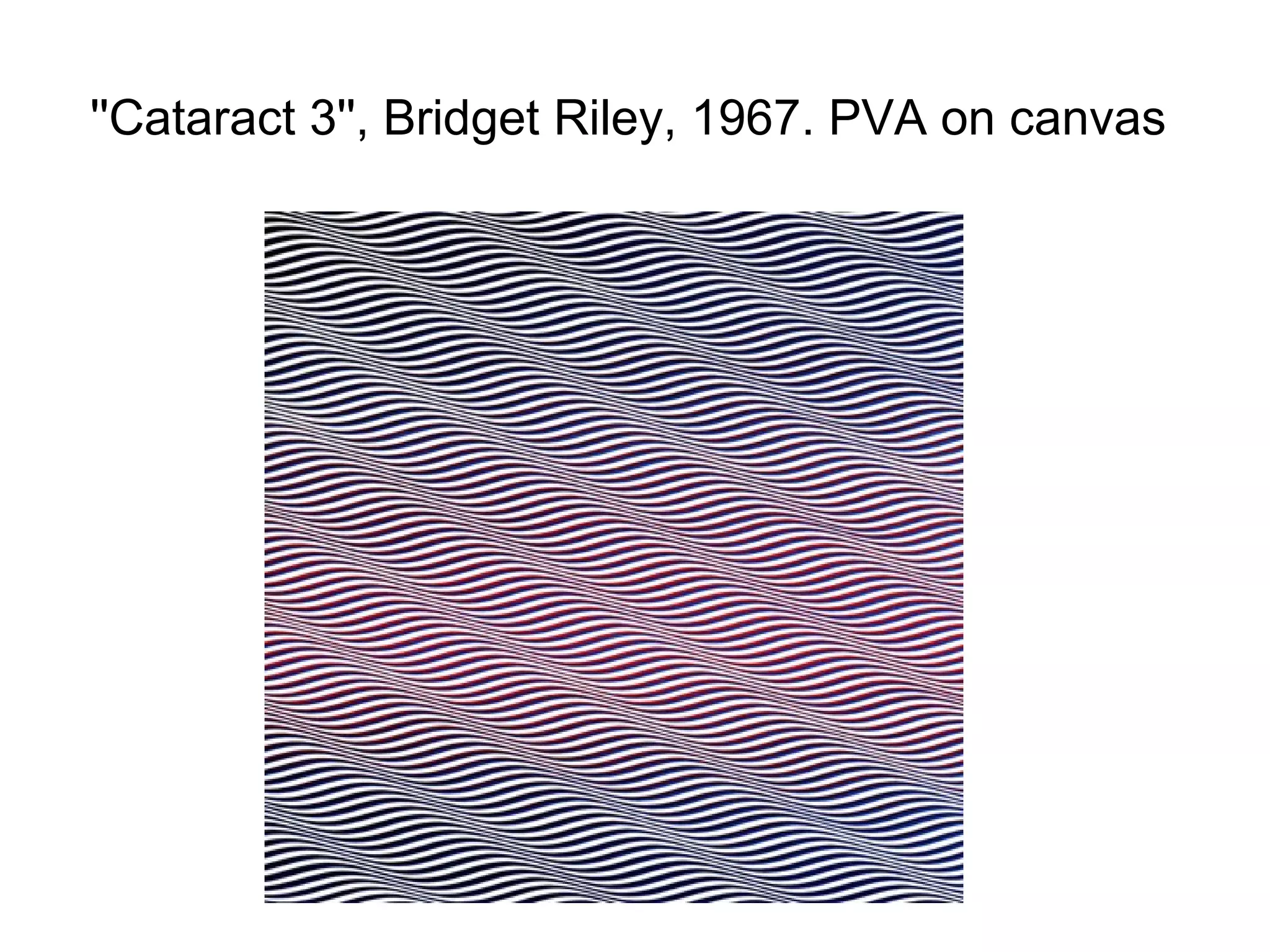
LINE Line is a mark on a surface that describes a shape or outline. It can create texture and can be thick and thin.  ‘ Cataract 3’ by Bridget Riley, 1967. PVA on canvas.
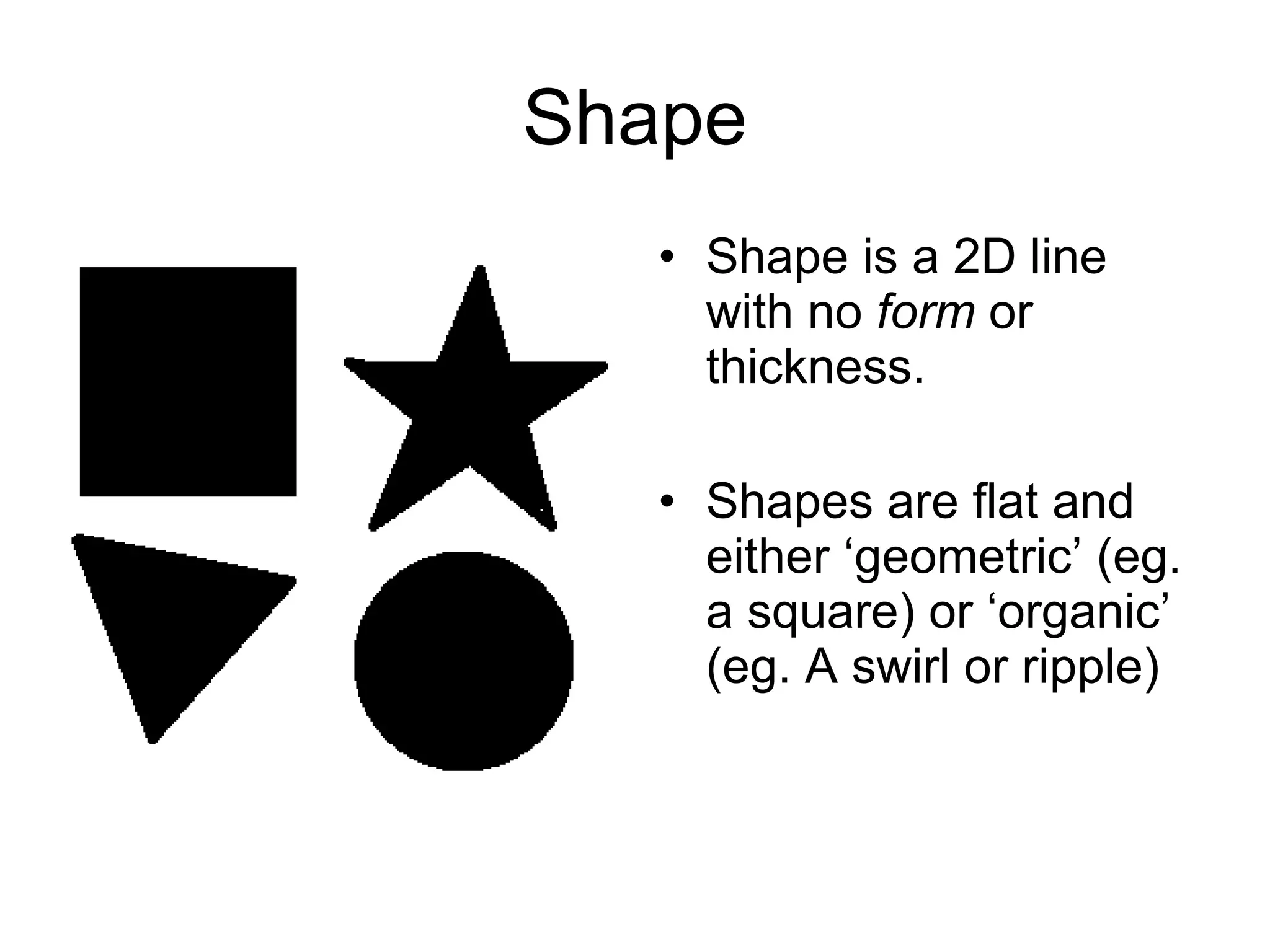
Shape Shape is a 2D line with no  form  or thickness.  Shapes are flat and either ‘geometric’ (eg. a square) or ‘organic’ (eg. A swirl or ripple)
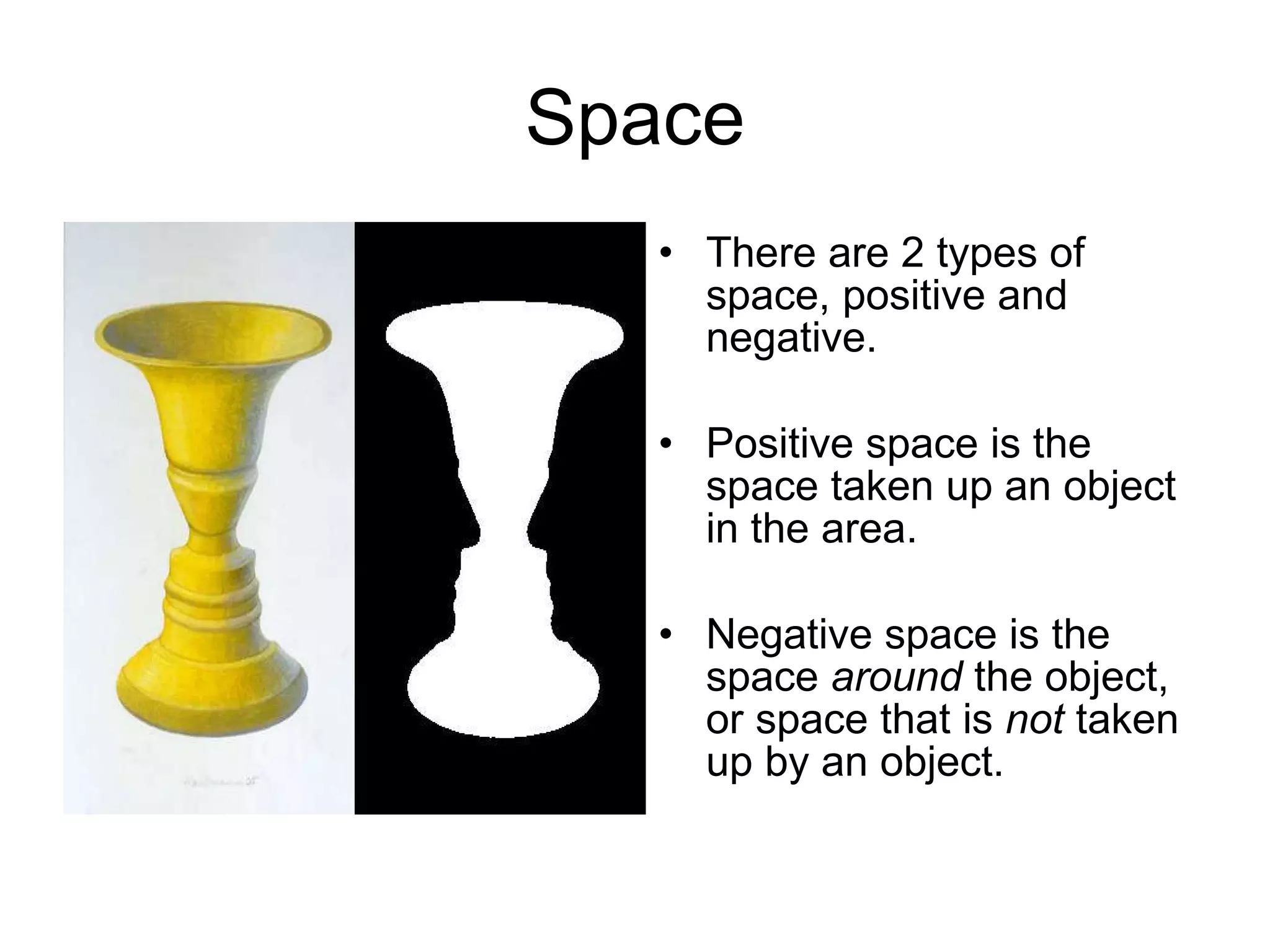
Space . There are 2 types of space, positive and negative.  Positive space is the space taken up an object in the area.  Negative space is the space  around  the object, or space that is  not  taken up by an object.
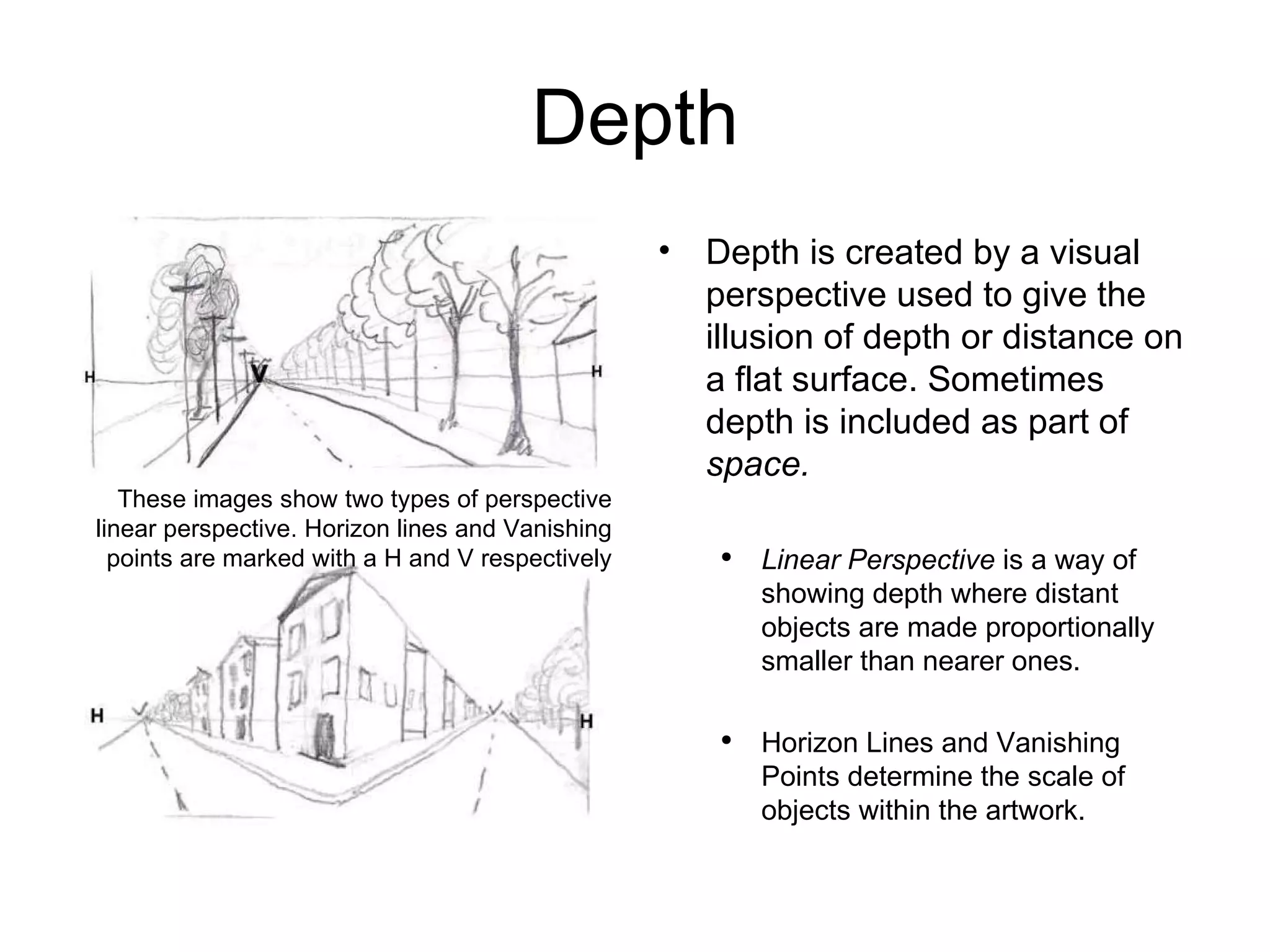
Depth Depth is created by a visual perspective used to give the illusion of depth or distance on a flat surface. Sometimes depth is included as part of  space. Linear Perspective  is a way of showing depth where distant objects are made proportionally smaller than nearer ones.  Horizon Lines and Vanishing Points determine the scale of objects within the artwork. These images show two types of perspective linear perspective. Horizon lines and Vanishing points are marked with a H and V respectively
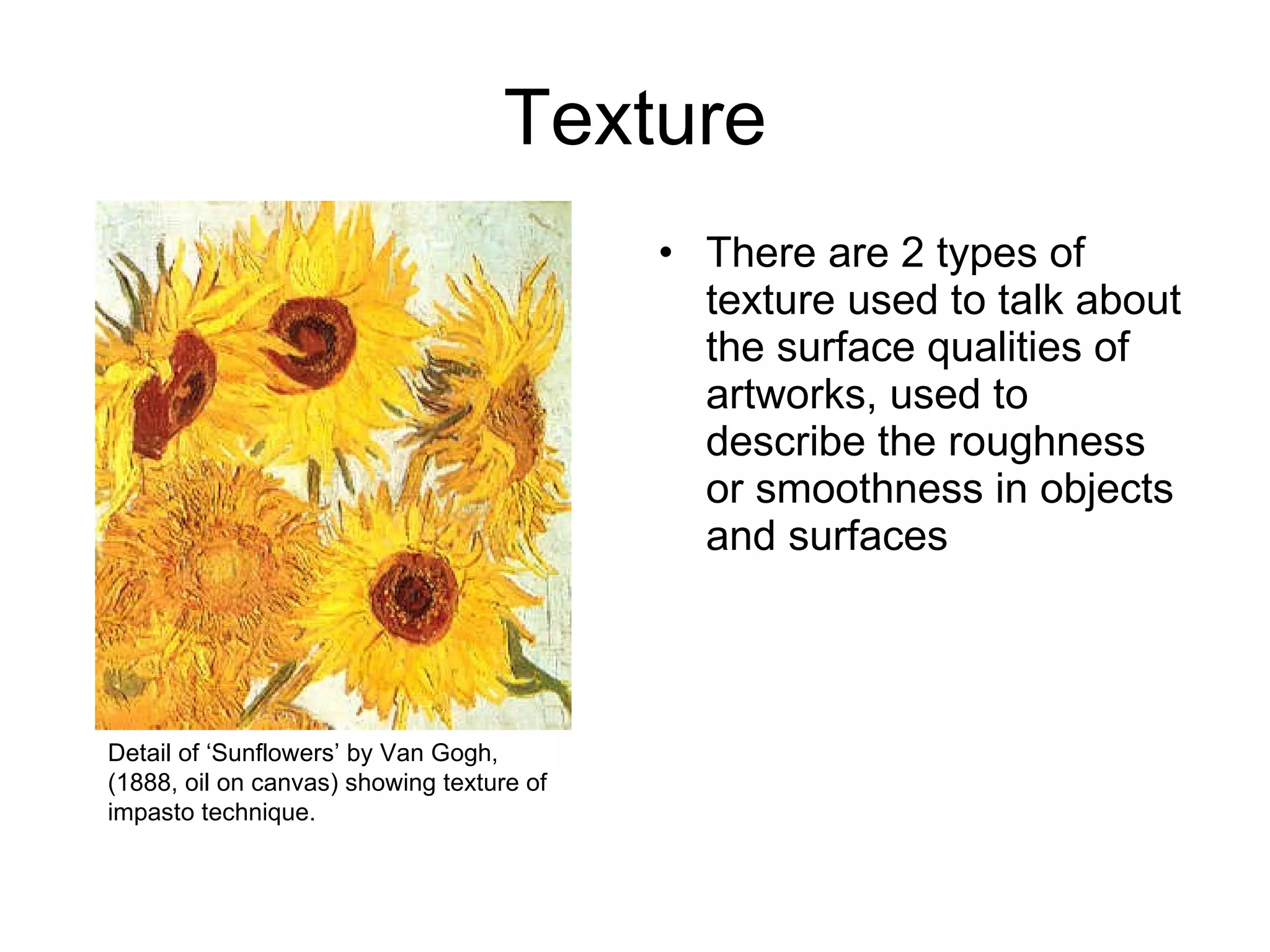
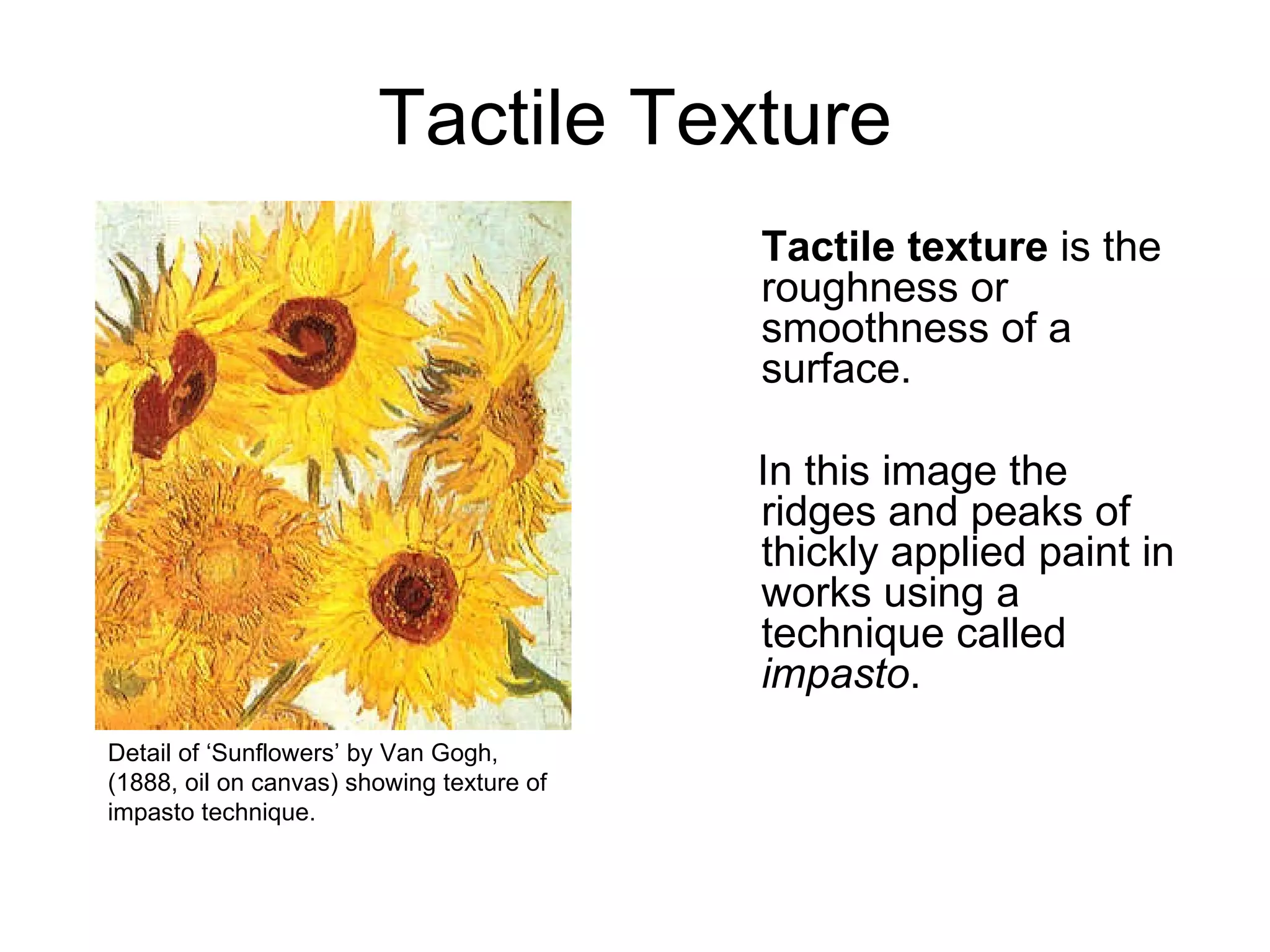
Texture There are 2 types of texture used to talk about the surface qualities of artworks, used to describe the roughness or smoothness in objects and surfaces Detail of ‘Sunflowers’ by Van Gogh, (1888, oil on canvas) showing texture of impasto technique.
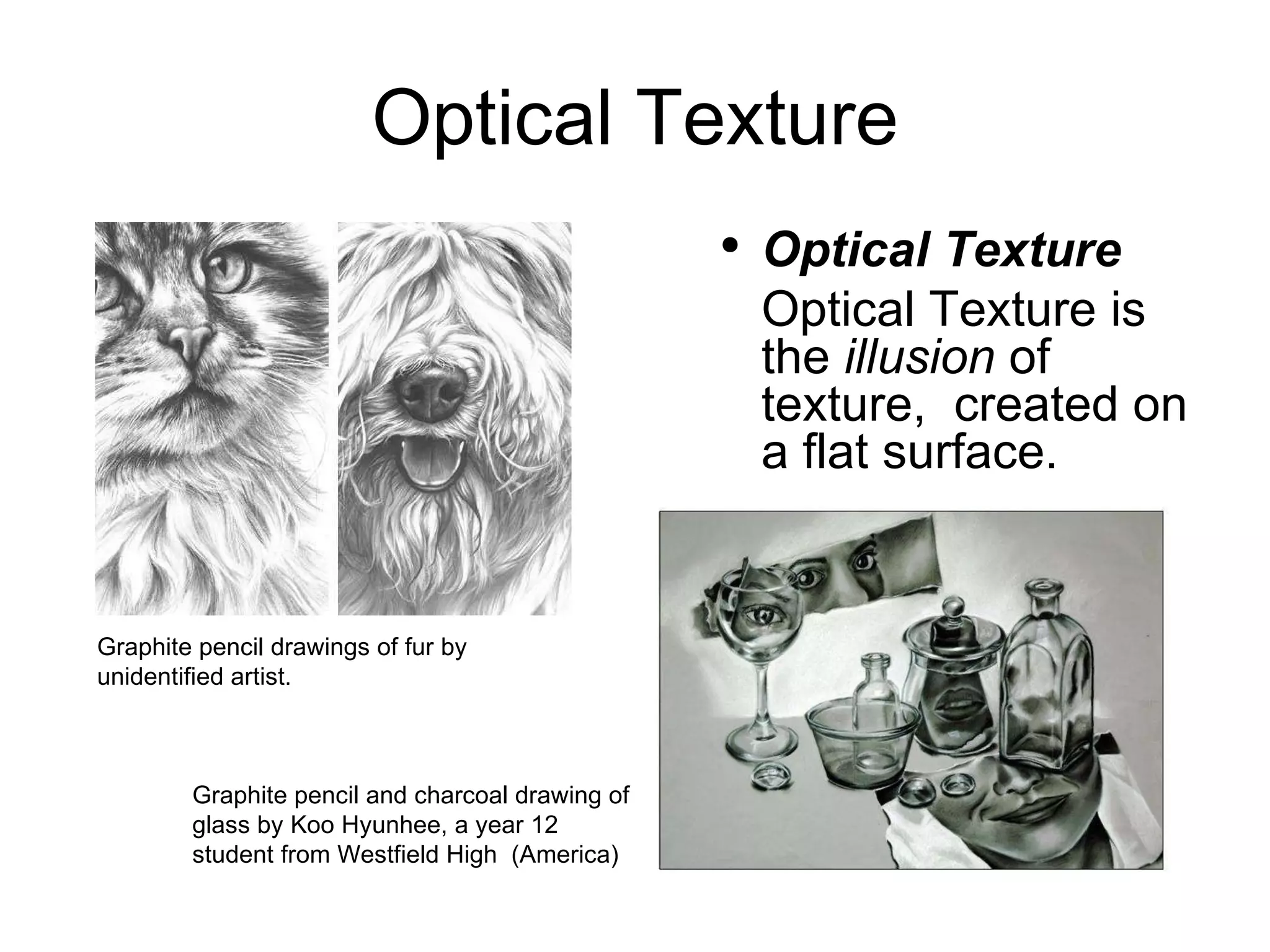
Optical Texture Optical Texture Optical Texture is the  illusion  of texture,  created on a flat surface.  Graphite pencil drawings of fur by unidentified artist. Graphite pencil and charcoal drawing of glass by Koo Hyunhee, a year 12 student from Westfield High  (America)
Tactile Texture Tactile texture  is the roughness or smoothness of a surface. In this image the ridges and peaks of thickly applied paint in works using a technique called  impasto .  Detail of ‘Sunflowers’ by Van Gogh, (1888, oil on canvas) showing texture of impasto technique.
Colour Refers to specific hues (pure colours without tint or shade, which are created by adding white or black pigments respectively), and has three properties CHROMA INTENSITY VALUE
Chroma Chroma   is about how vivid colours are perceived to be. Essentially, it’s a measure of a colour’s purity compared to grey. Chroma Wheel:
Intensity The brightness or dullness of a colour is referred to as the colour’s  intensity .  A pure colour is high intensity, whereas a colour that has been mixed with it’s complementary colour is called a low intensity colour.
Value Value  (sometimes called ‘tone’)  is concerned with the LIGHTNESS and DARKNESS of a colour and is achieved by adding white or black to a colour to create  tints  (by adding white) and  shades  (by adding black).
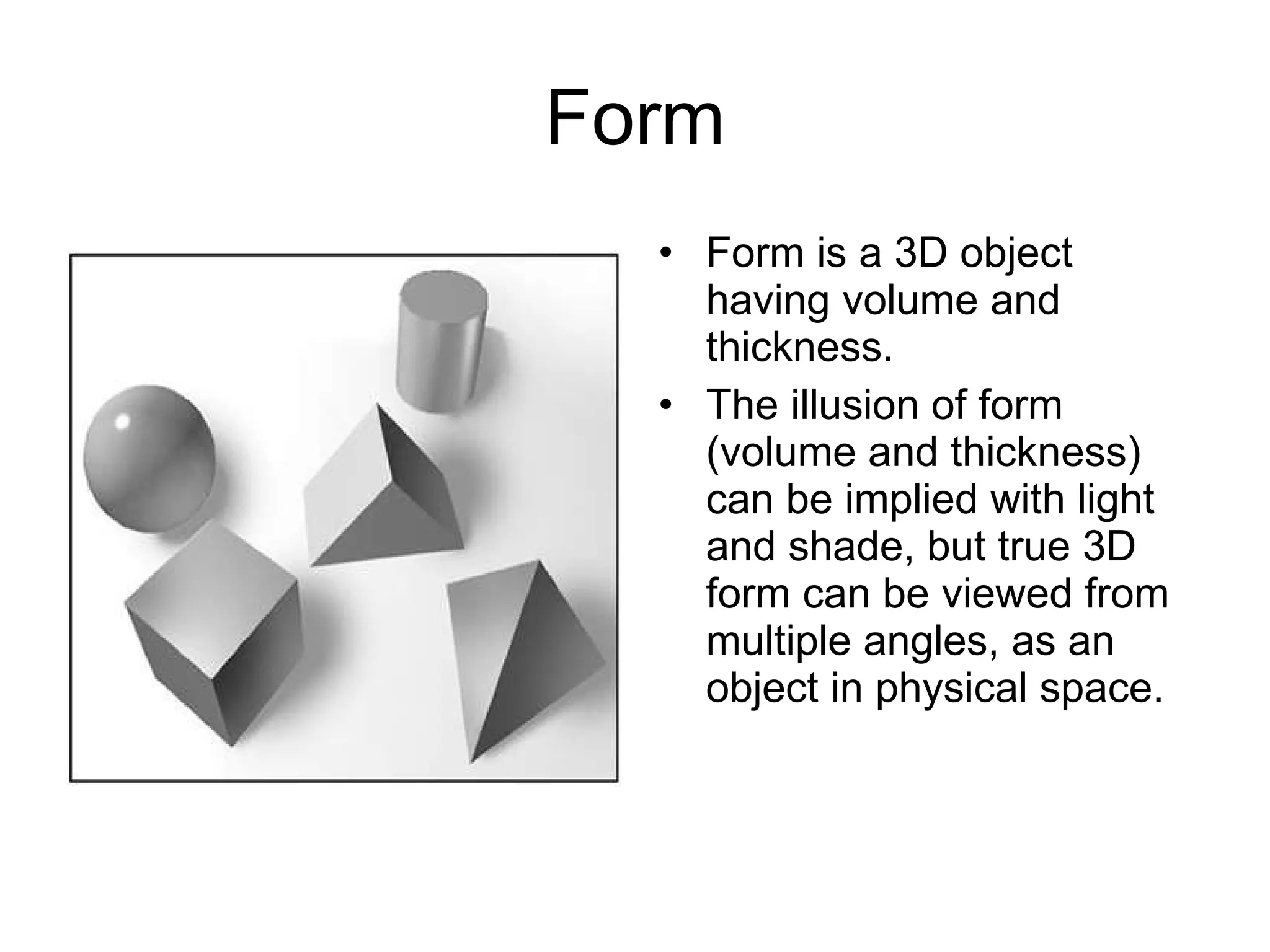
Form Form is a 3D object having volume and thickness.  The illusion of form (volume and thickness) can be implied with light and shade, but true 3D form can be viewed from multiple angles, as an object in physical space.
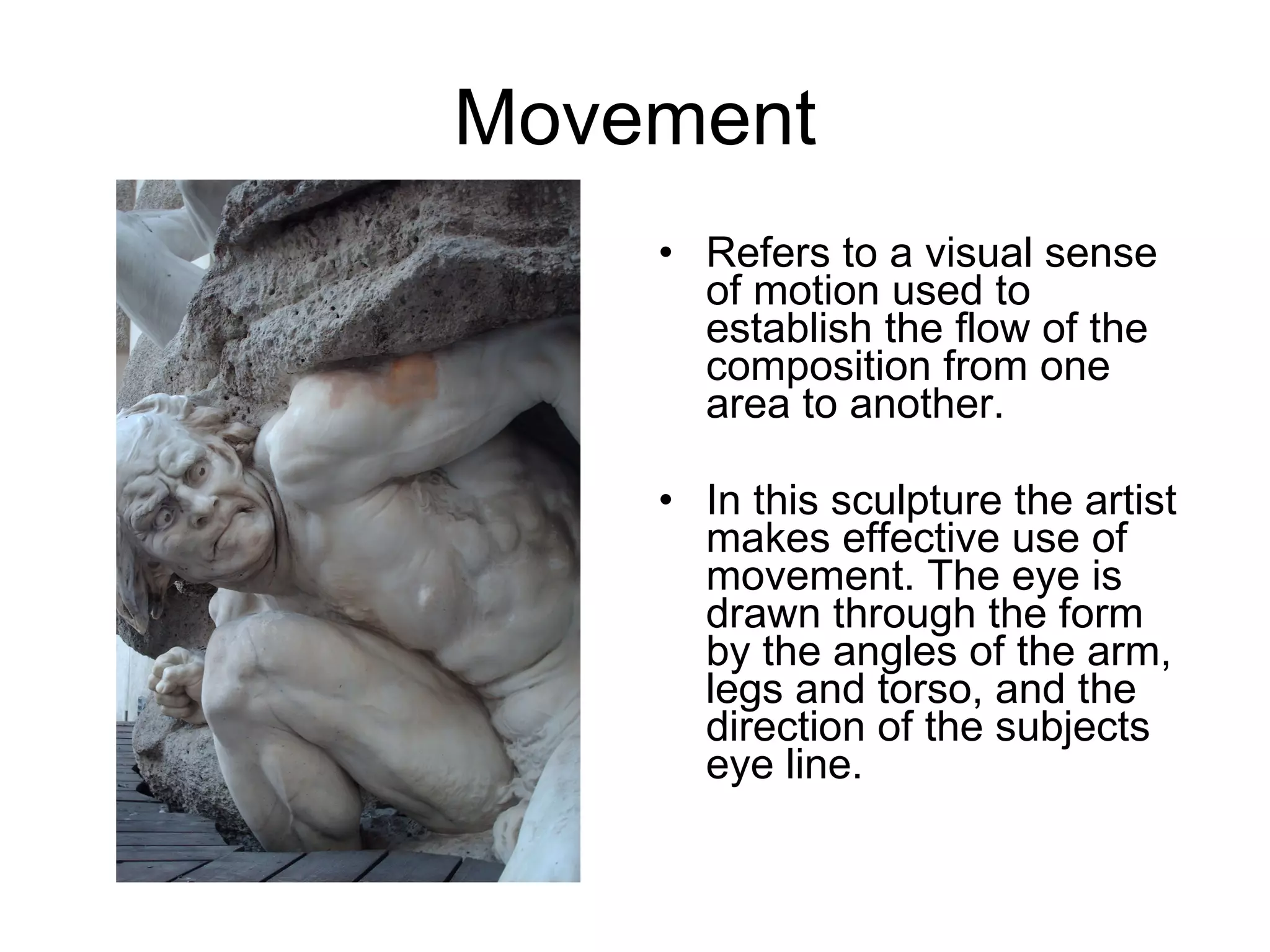
Movement Refers to a visual sense of motion used to establish the flow of the composition from one area to another.  In this sculpture the artist makes effective use of movement. The eye is drawn through the form by the angles of the arm, legs and torso, and the direction of the subjects eye line.
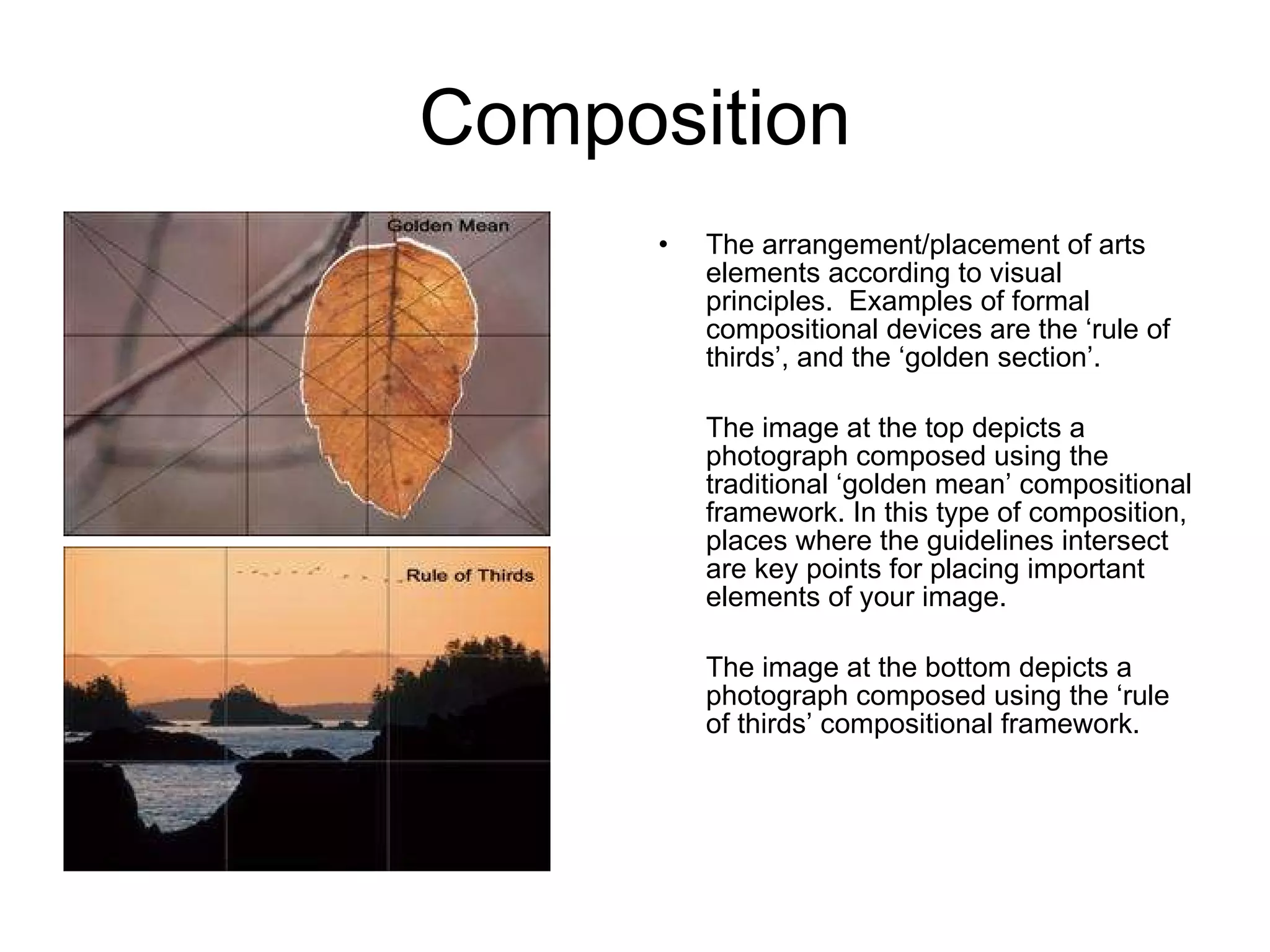
Composition The arrangement/placement of arts elements according to visual principles.  Examples of formal compositional devices are the ‘rule of thirds’, and the ‘golden section’.  The image at the top depicts a photograph composed using the traditional ‘golden mean’ compositional framework. In this type of composition, places where the guidelines intersect are key points for placing important elements of your image. The image at the bottom depicts a photograph composed using the ‘rule of thirds’ compositional framework.
VISUAL PRINCIPLES Are the ways that art elements are used, arranged, or organised to create artworks.  Arts principles are also referred to as ‘compositional’ or ‘structural’ devices or  conventions. They include:
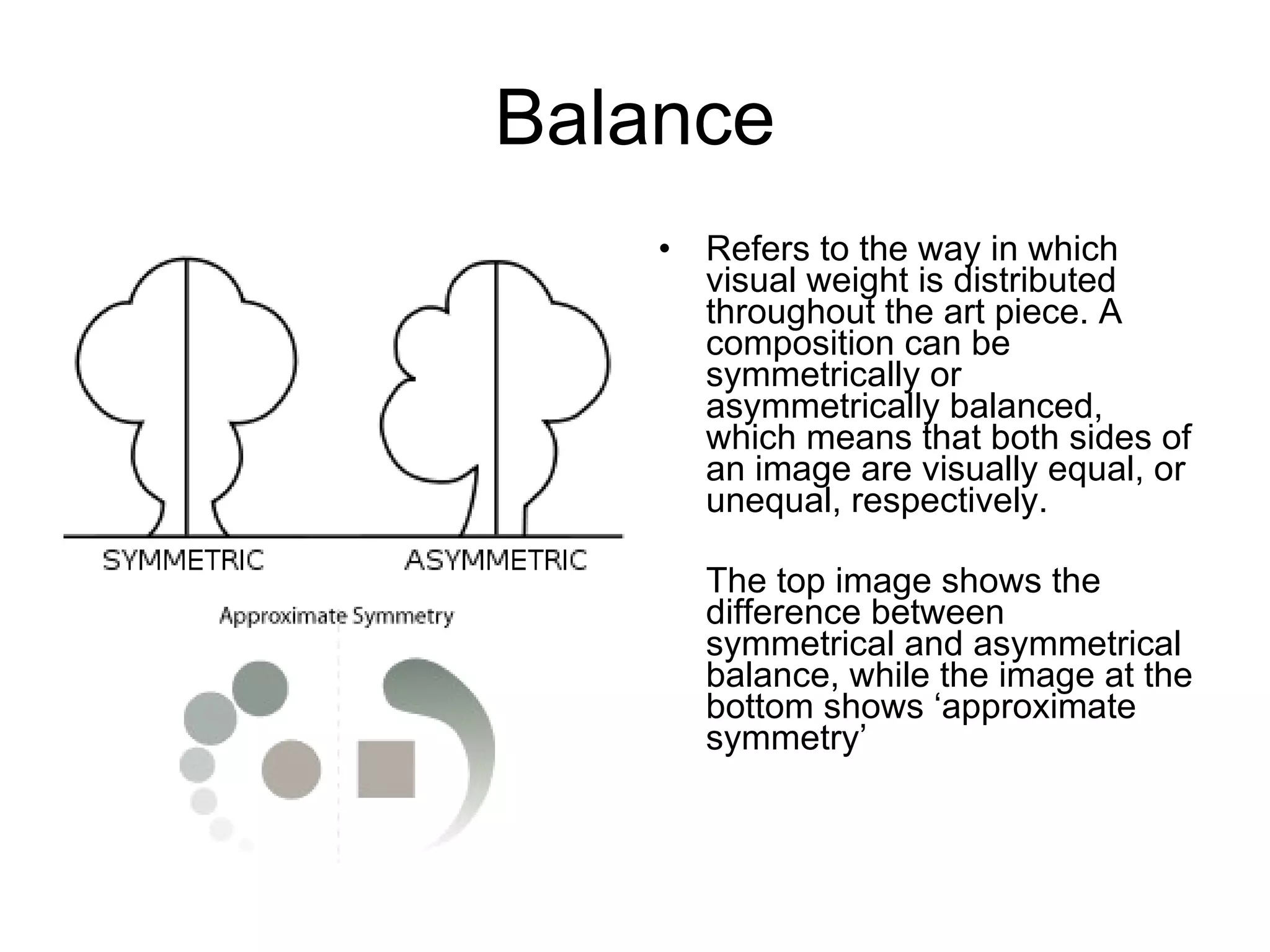
Balance Refers to the way in which visual weight is distributed throughout the art piece. A composition can be symmetrically or asymmetrically balanced, which means that both sides of an image are visually equal, or unequal, respectively.  The top image shows the difference between symmetrical and asymmetrical balance, while the image at the bottom shows ‘approximate symmetry’
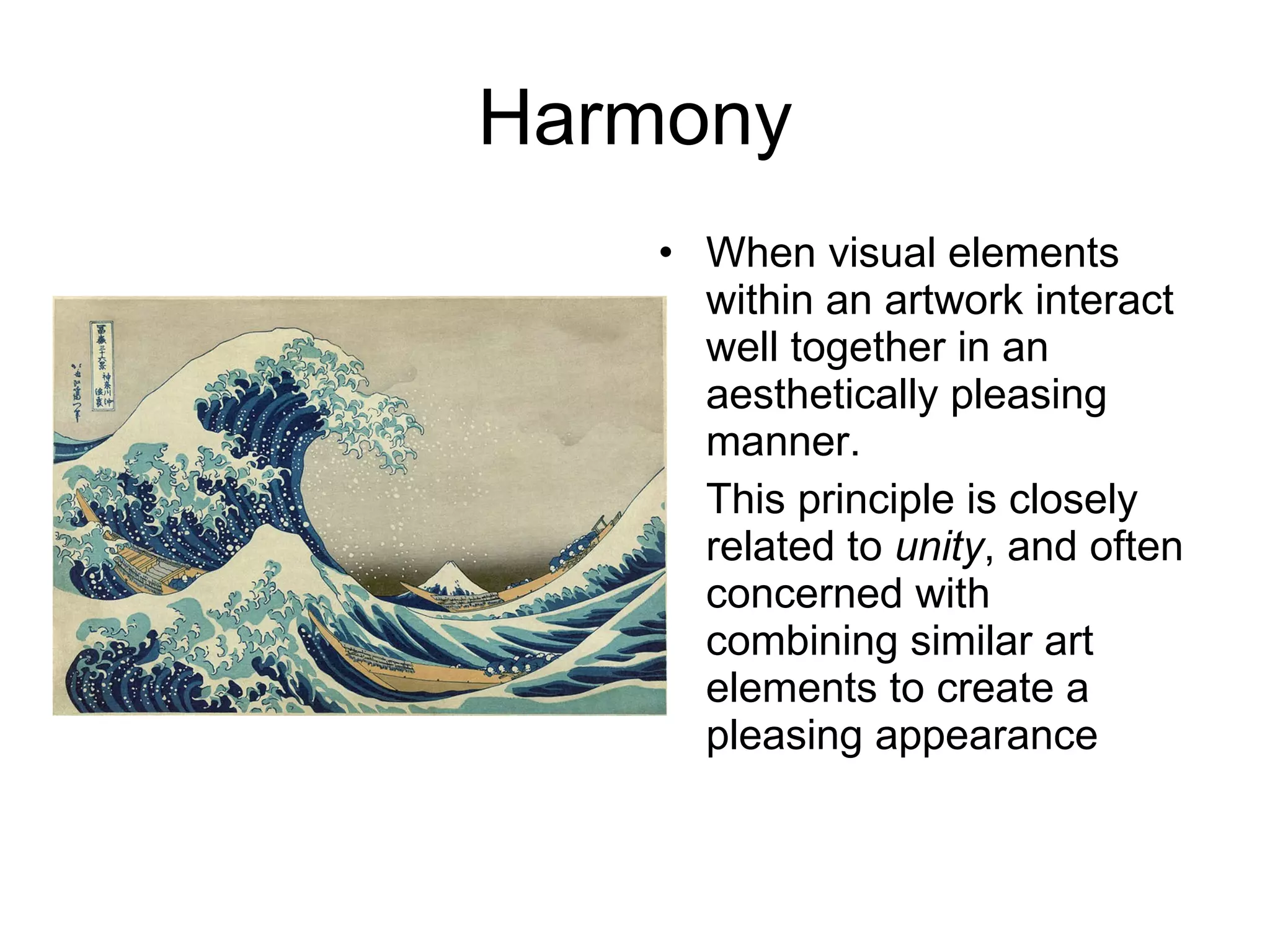
Harmony When visual elements within an artwork interact well together in an aesthetically pleasing manner.  This principle is closely related to  unity , and often concerned with combining similar art elements to create a pleasing appearance
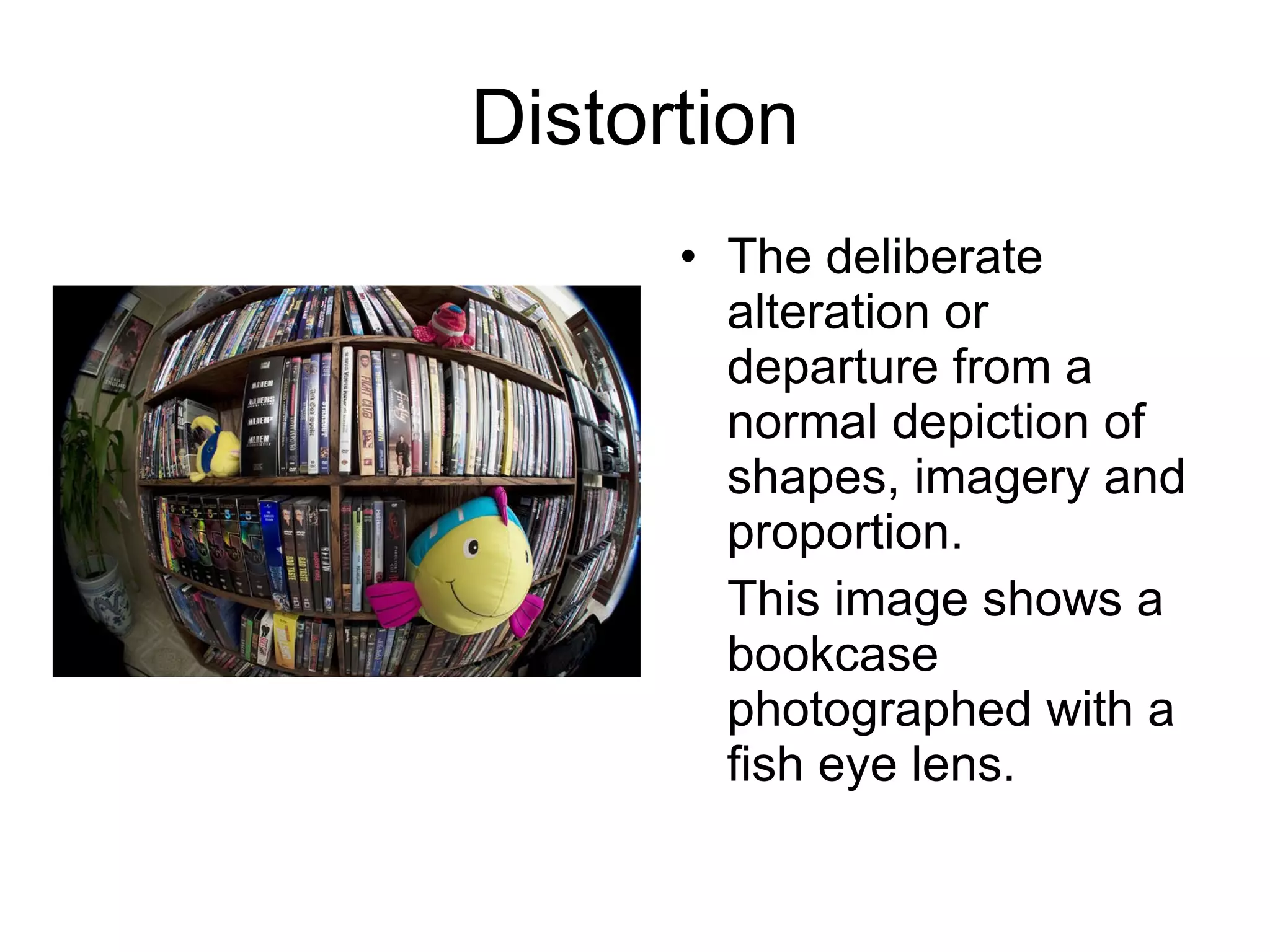
Distortion The deliberate alteration or departure from a normal depiction of shapes, imagery and proportion. This image shows a bookcase photographed with a fish eye lens.
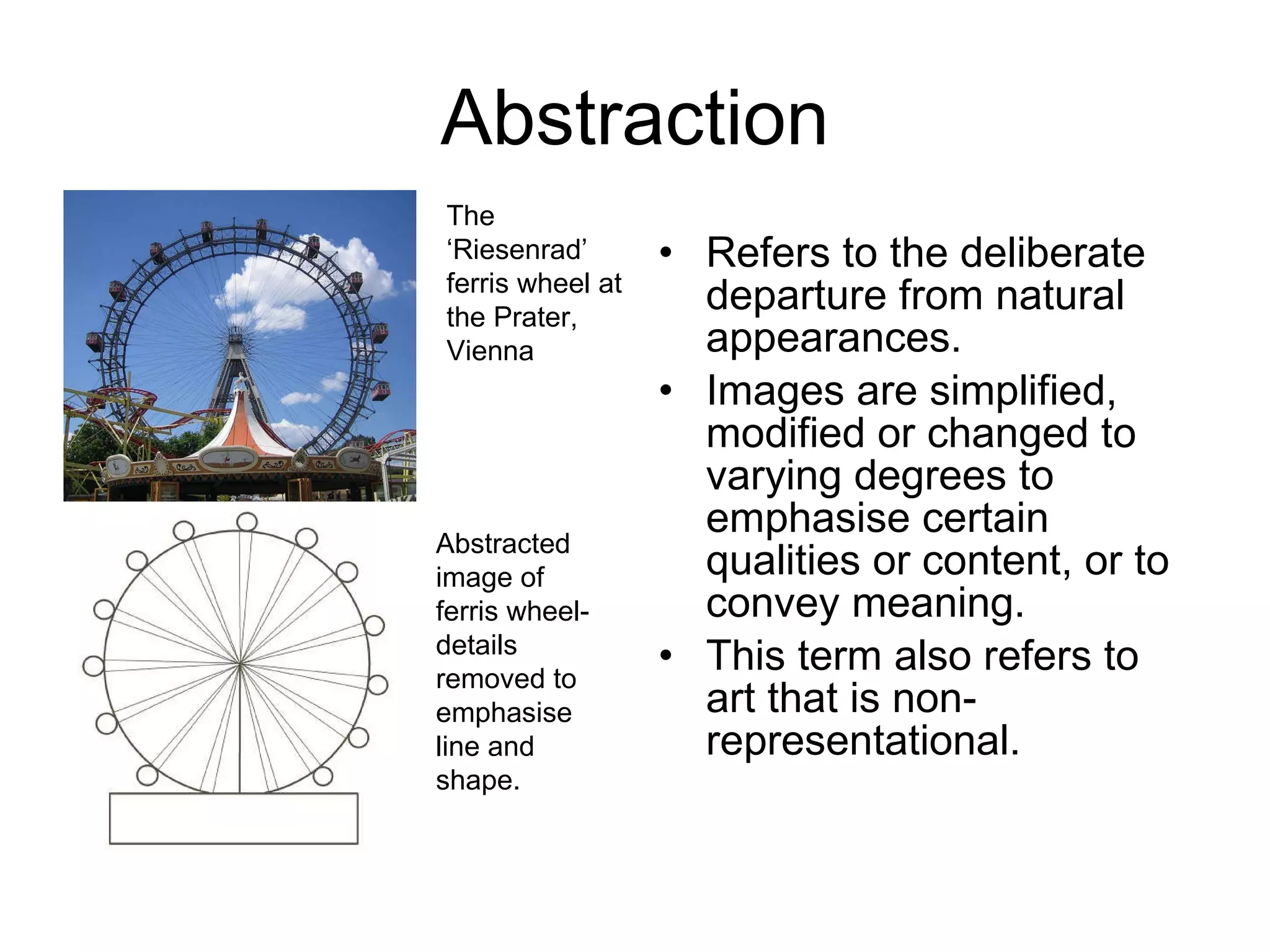
Abstraction Refers to the deliberate departure from natural appearances.  Images are simplified, modified or changed to varying degrees to emphasise certain qualities or content, or to convey meaning.  This term also refers to art that is non-representational.  The ‘Riesenrad’ ferris wheel at the Prater, Vienna Abstracted image of ferris wheel- details removed to emphasise line and shape.
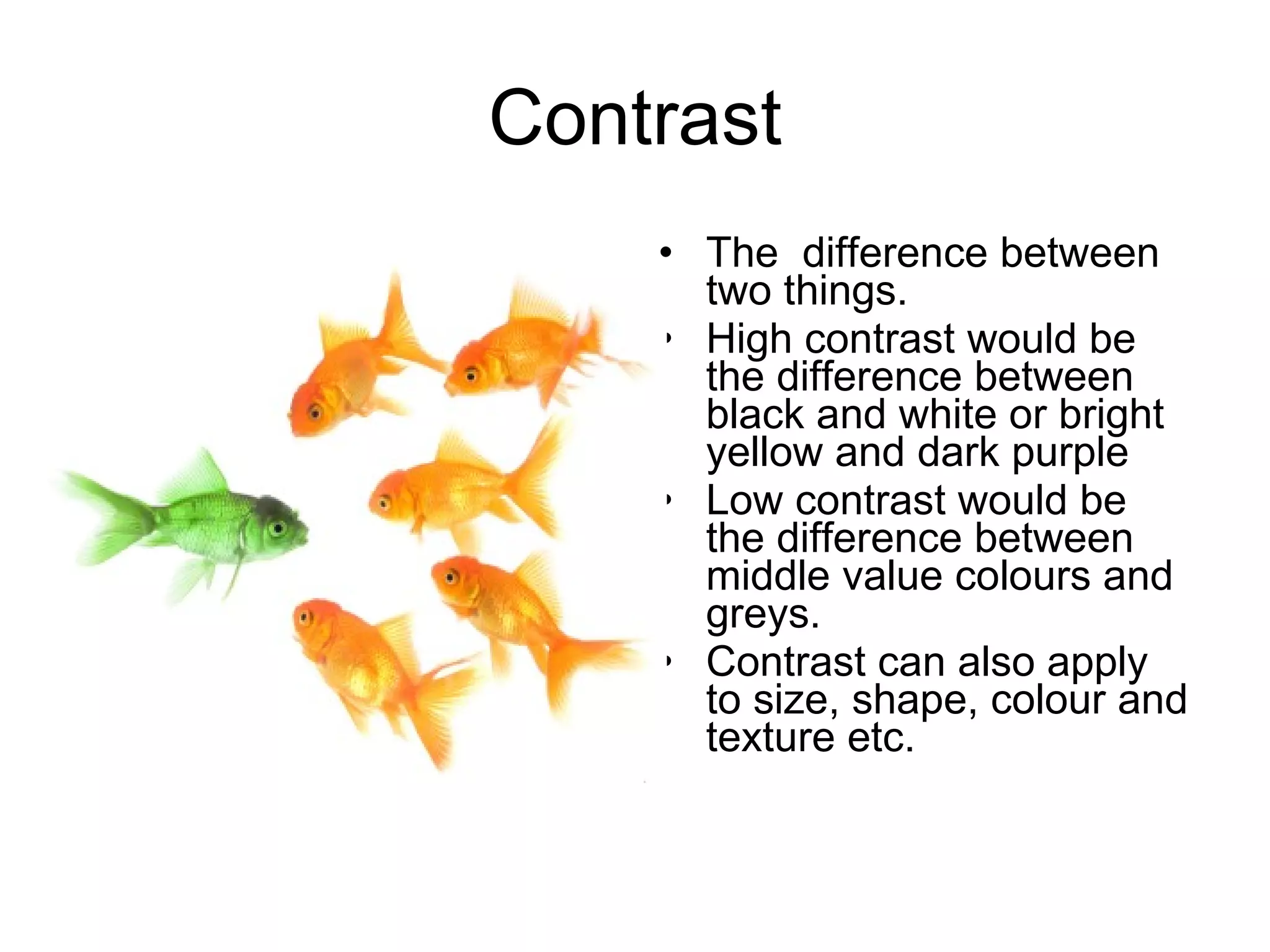
Contrast The  difference between two things.  High contrast would be the difference between black and white or bright yellow and dark purple Low contrast would be the difference between middle value colours and greys.  Contrast can also apply to size, shape, colour and texture etc.
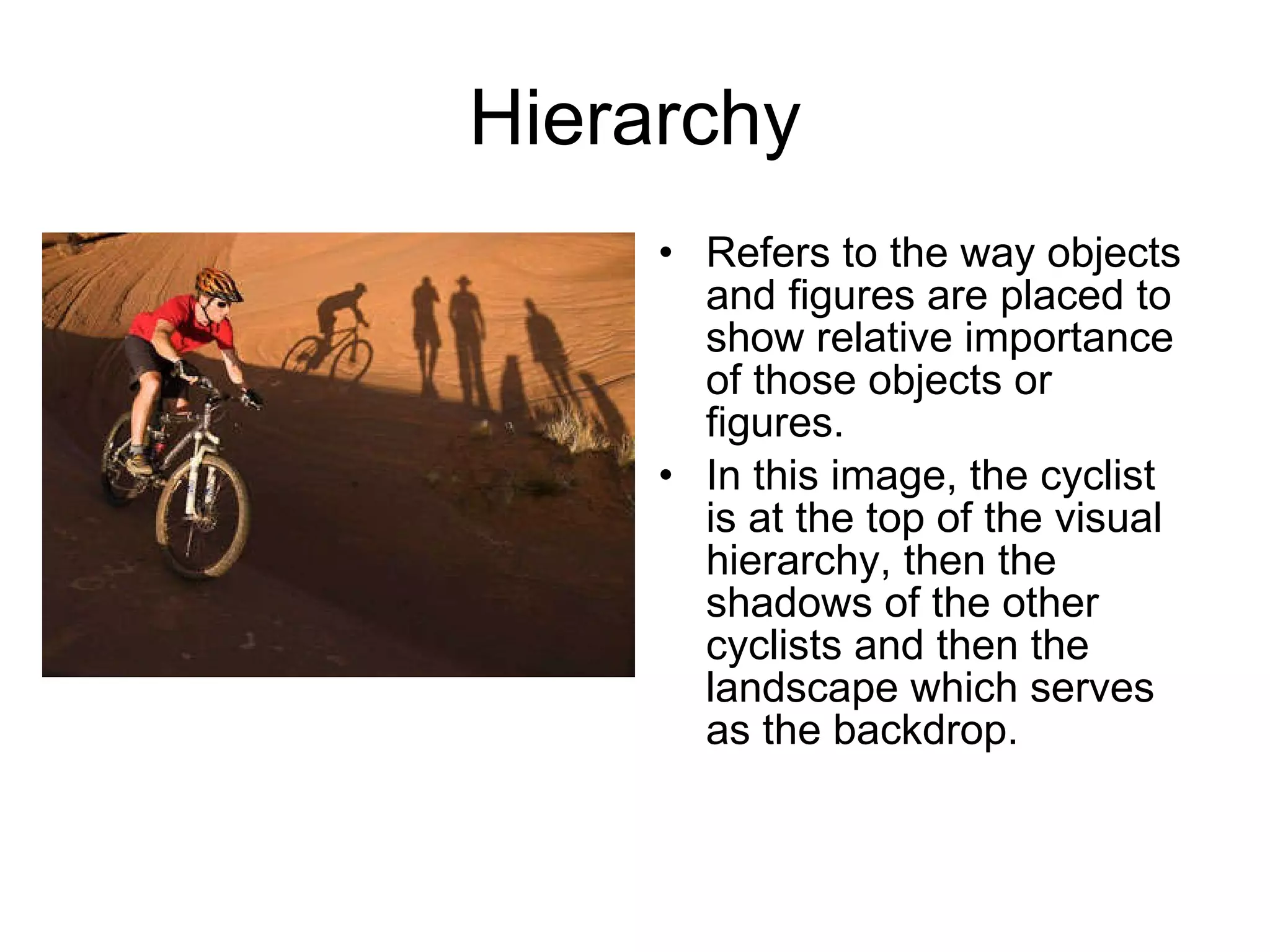
Hierarchy Refers to the way objects and figures are placed to show relative importance of those objects or figures.  In this image, the cyclist is at the top of the visual hierarchy, then the shadows of the other cyclists and then the landscape which serves as the backdrop.
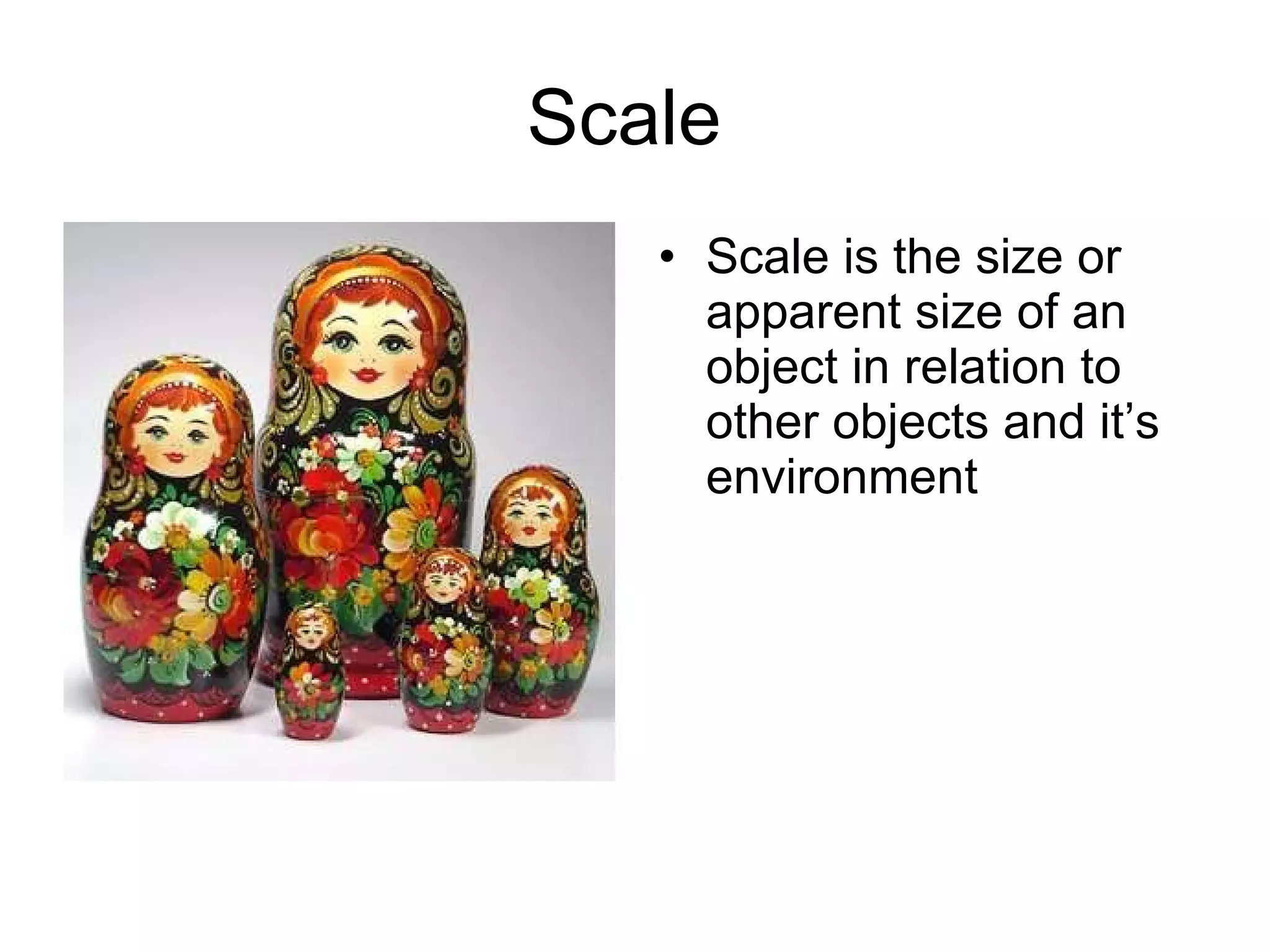
Scale  Scale is the size or apparent size of an object in relation to other objects and it’s environment
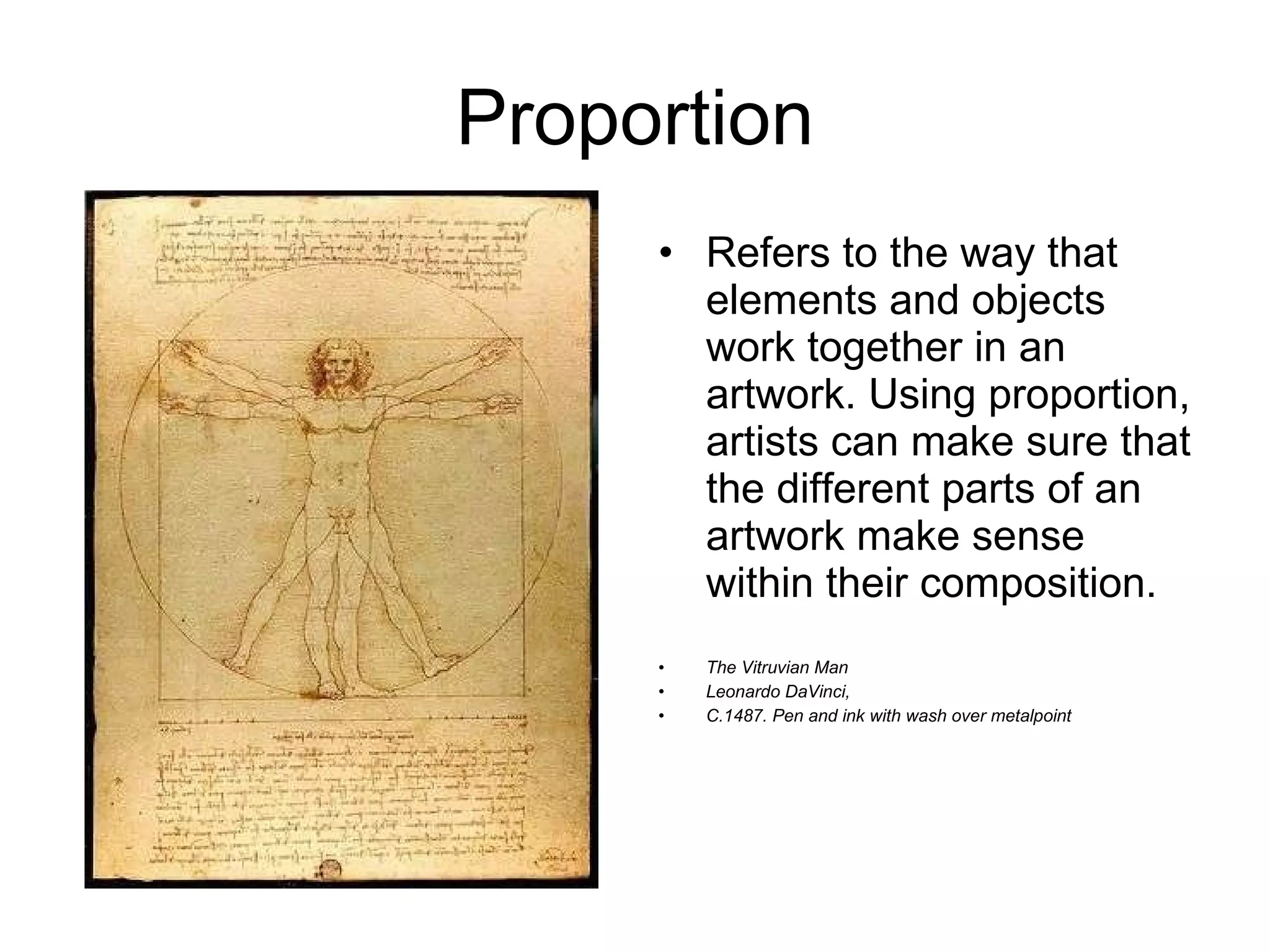
Proportion Refers to the way that elements and objects work together in an artwork. Using proportion, artists can make sure that the different parts of an artwork make sense within their composition.  The Vitruvian Man  Leonardo DaVinci,  C.1487. Pen and ink with wash over metalpoint
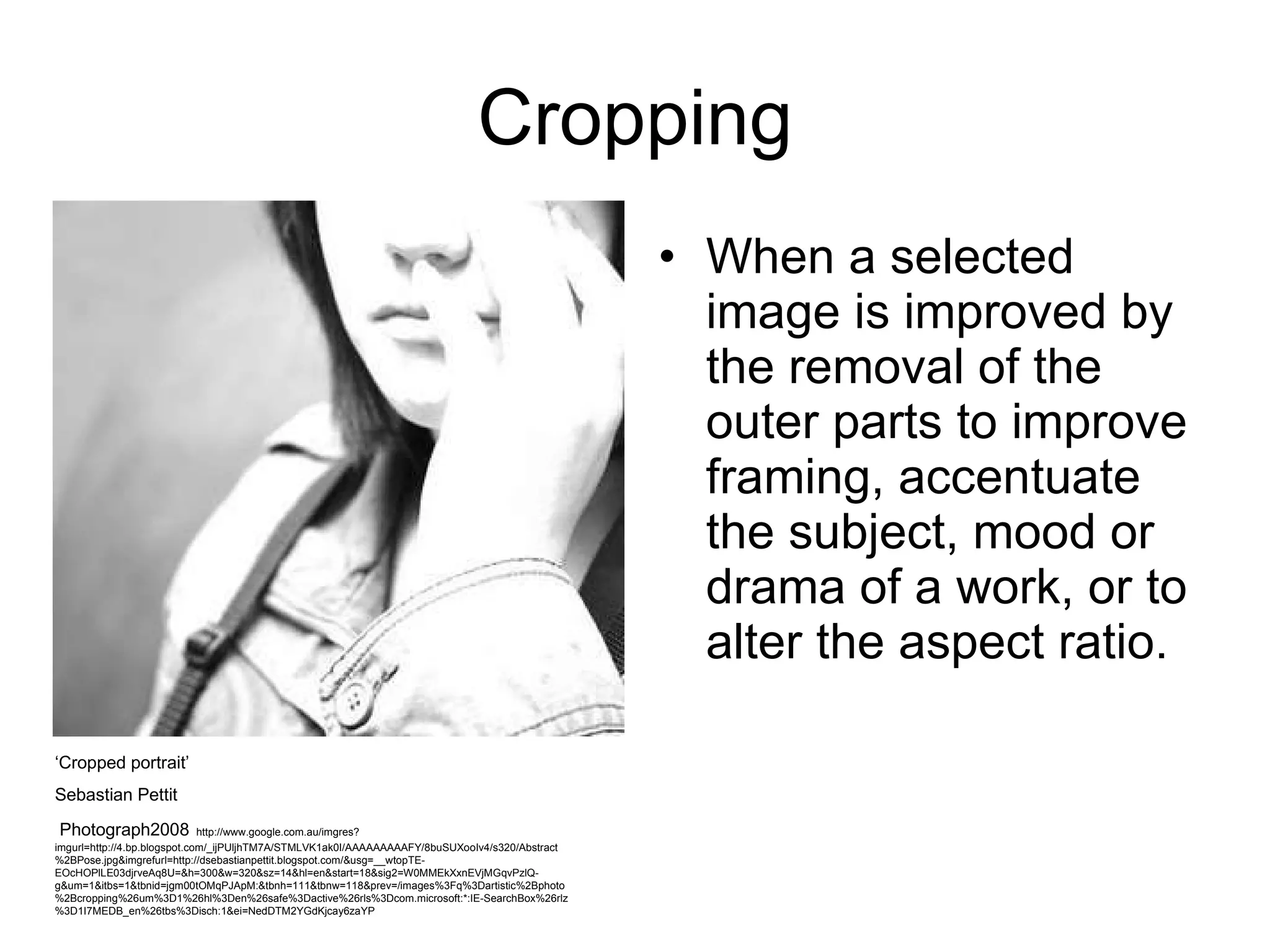
Cropping When a selected image is improved by the removal of the outer parts to improve framing, accentuate the subject, mood or drama of a work, or to alter the aspect ratio. ‘ Cropped portrait’  Sebastian Pettit Photograph2008   http://www.google.com.au/imgres?imgurl=http://4.bp.blogspot.com/_ijPUljhTM7A/STMLVK1ak0I/AAAAAAAAAFY/8buSUXooIv4/s320/Abstract%2BPose.jpg&imgrefurl=http://dsebastianpettit.blogspot.com/&usg=__wtopTE-EOcHOPlLE03djrveAq8U=&h=300&w=320&sz=14&hl=en&start=18&sig2=W0MMEkXxnEVjMGqvPzlQ-g&um=1&itbs=1&tbnid=jgm00tOMqPJApM:&tbnh=111&tbnw=118&prev=/images%3Fq%3Dartistic%2Bphoto%2Bcropping%26um%3D1%26hl%3Den%26safe%3Dactive%26rls%3Dcom.microsoft:*:IE-SearchBox%26rlz%3D1I7MEDB_en%26tbs%3Disch:1&ei=NedDTM2YGdKjcay6zaYP
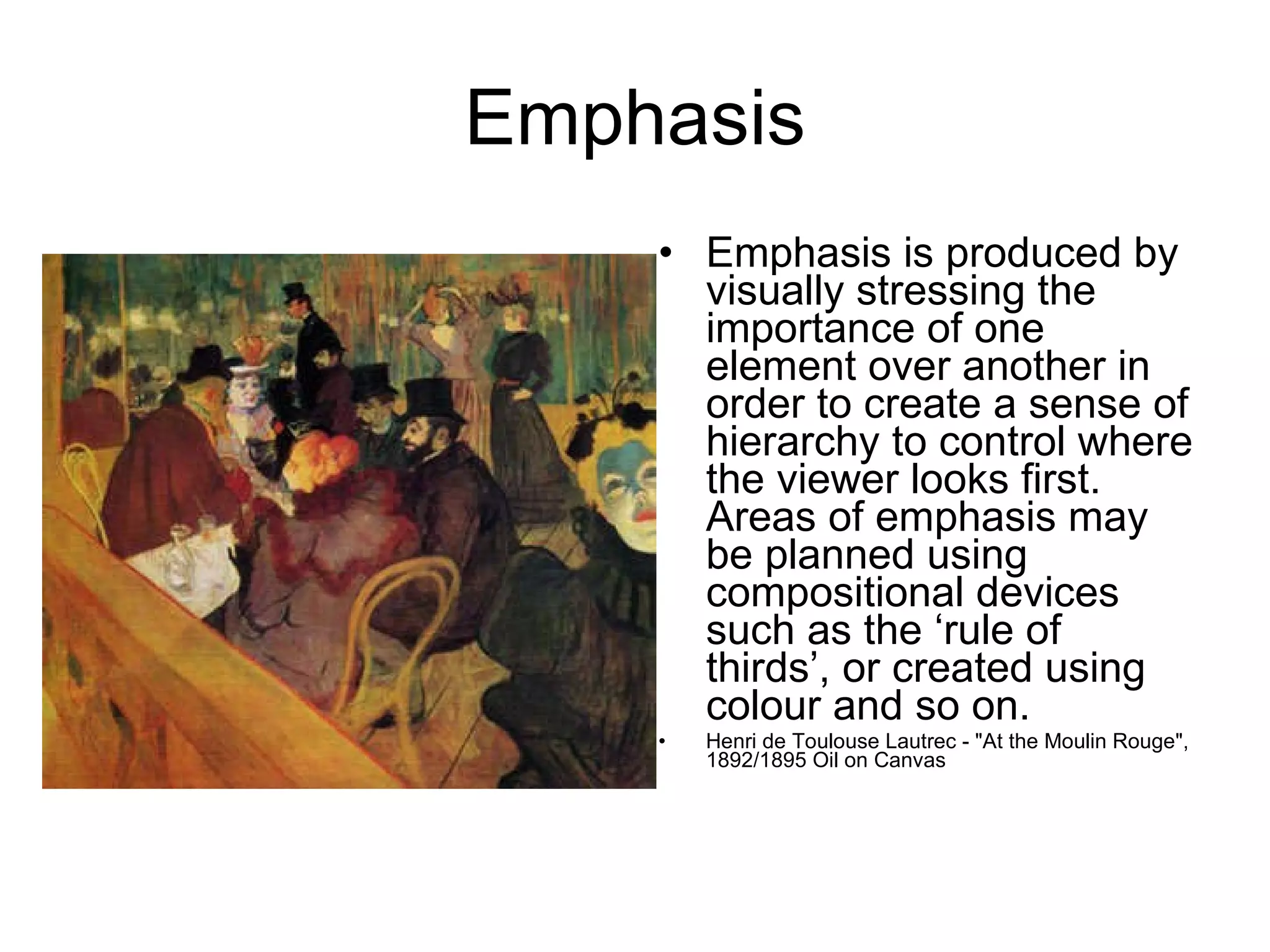
Emphasis Emphasis is produced by visually stressing the importance of one element over another in order to create a sense of hierarchy to control where the viewer looks first. Areas of emphasis may be planned using compositional devices such as the ‘rule of thirds’, or created using colour and so on.  Henri de Toulouse Lautrec - "At the Moulin Rouge", 1892/1895 Oil on Canvas
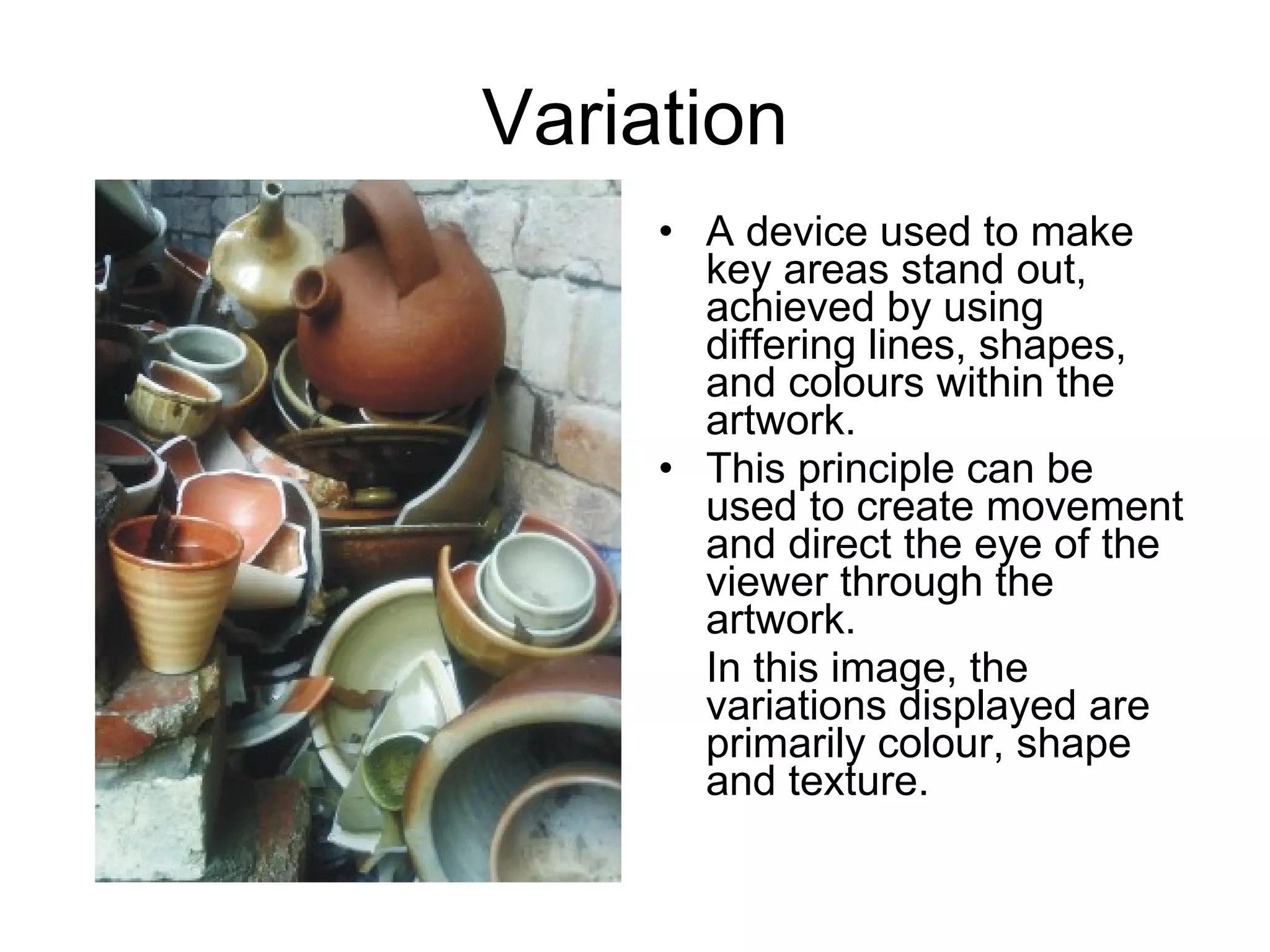
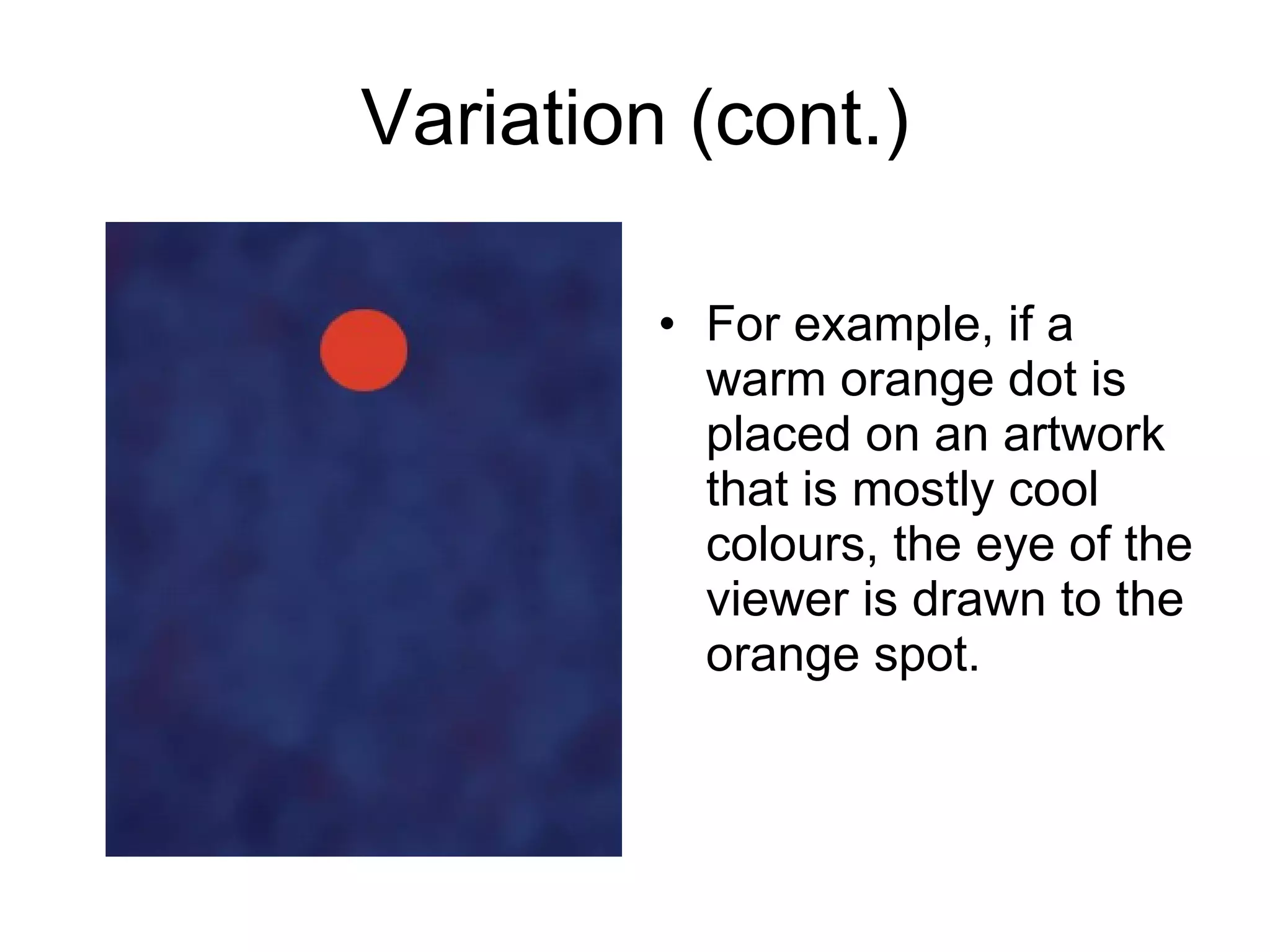
Variation A device used to make key areas stand out, achieved by using differing lines, shapes, and colours within the artwork. This principle can be used to create movement and direct the eye of the viewer through the artwork.  In this image, the variations displayed are primarily colour, shape and texture.
Variation (cont.) For example, if a warm orange dot is placed on an artwork that is mostly cool colours, the eye of the viewer is drawn to the orange spot.
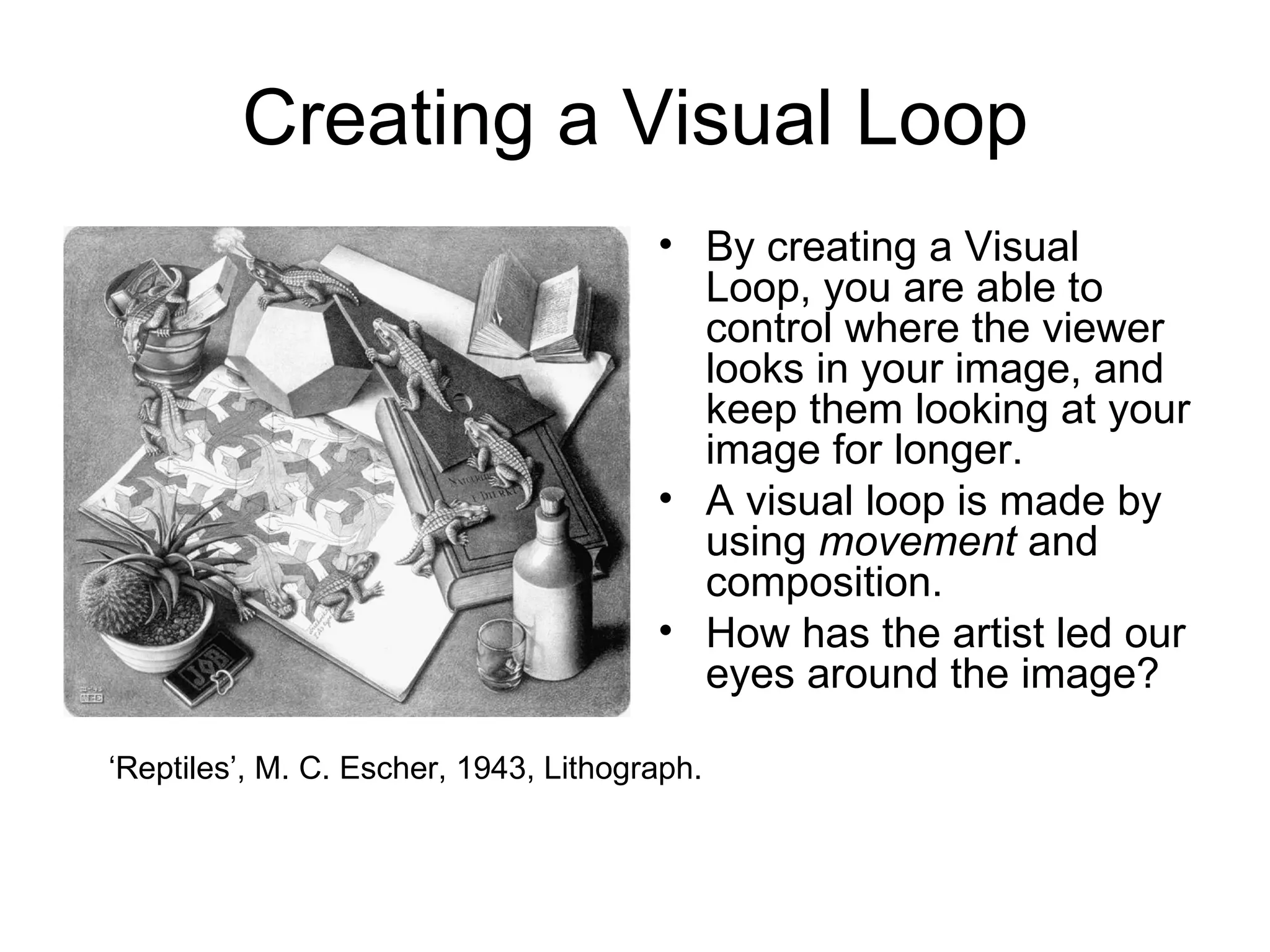
Creating a Visual Loop By creating a Visual Loop, you are able to control where the viewer looks in your image, and keep them looking at your image for longer.  A visual loop is made by using  movement  and composition.  How has the artist led our eyes around the image? ‘ Reptiles’, M. C. Escher, 1943, Lithograph.
What Arts Elements and Principles Can You Identify?
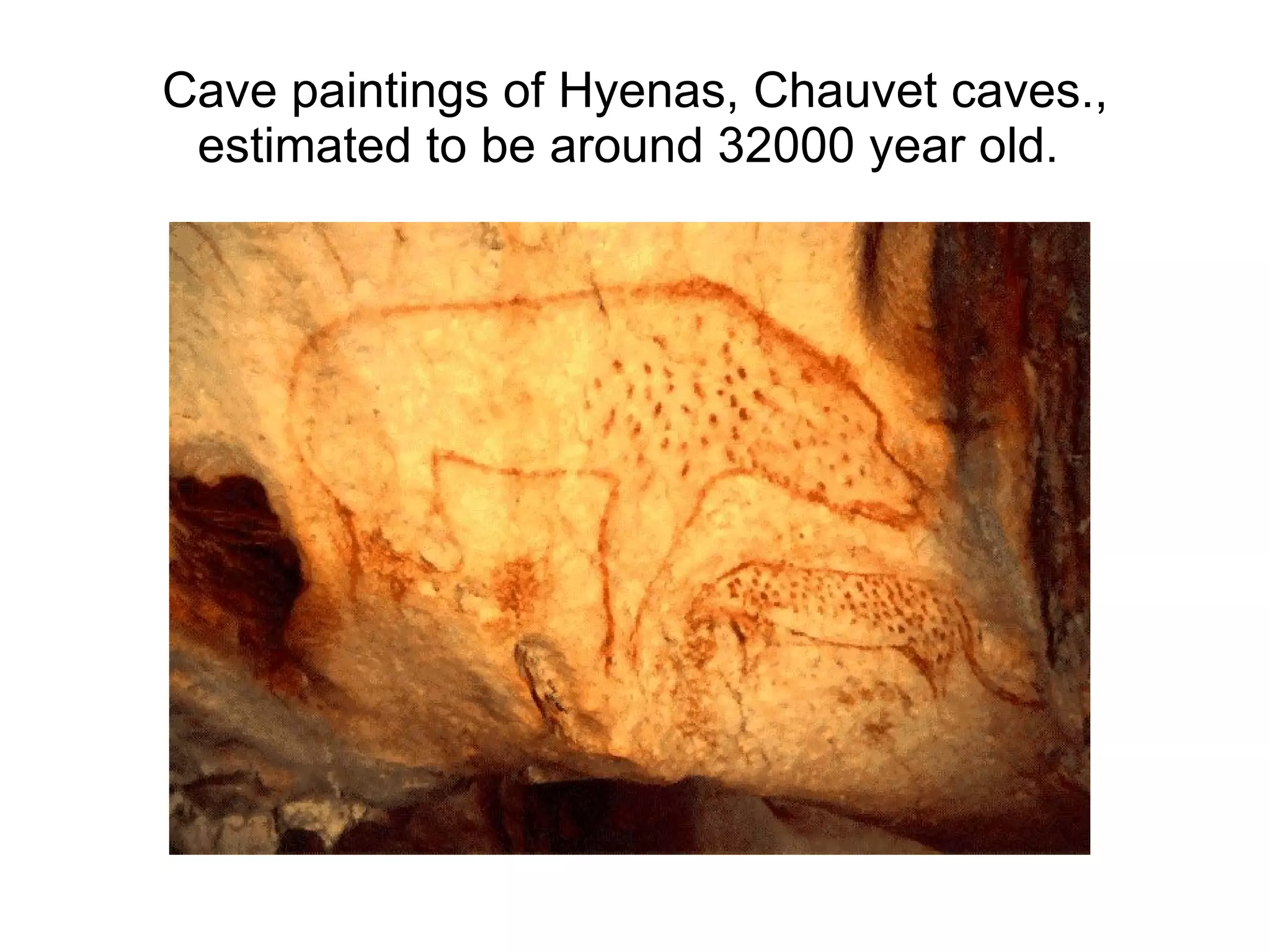
Cave paintings of Hyenas, Chauvet caves., estimated to be around 32000 year old.
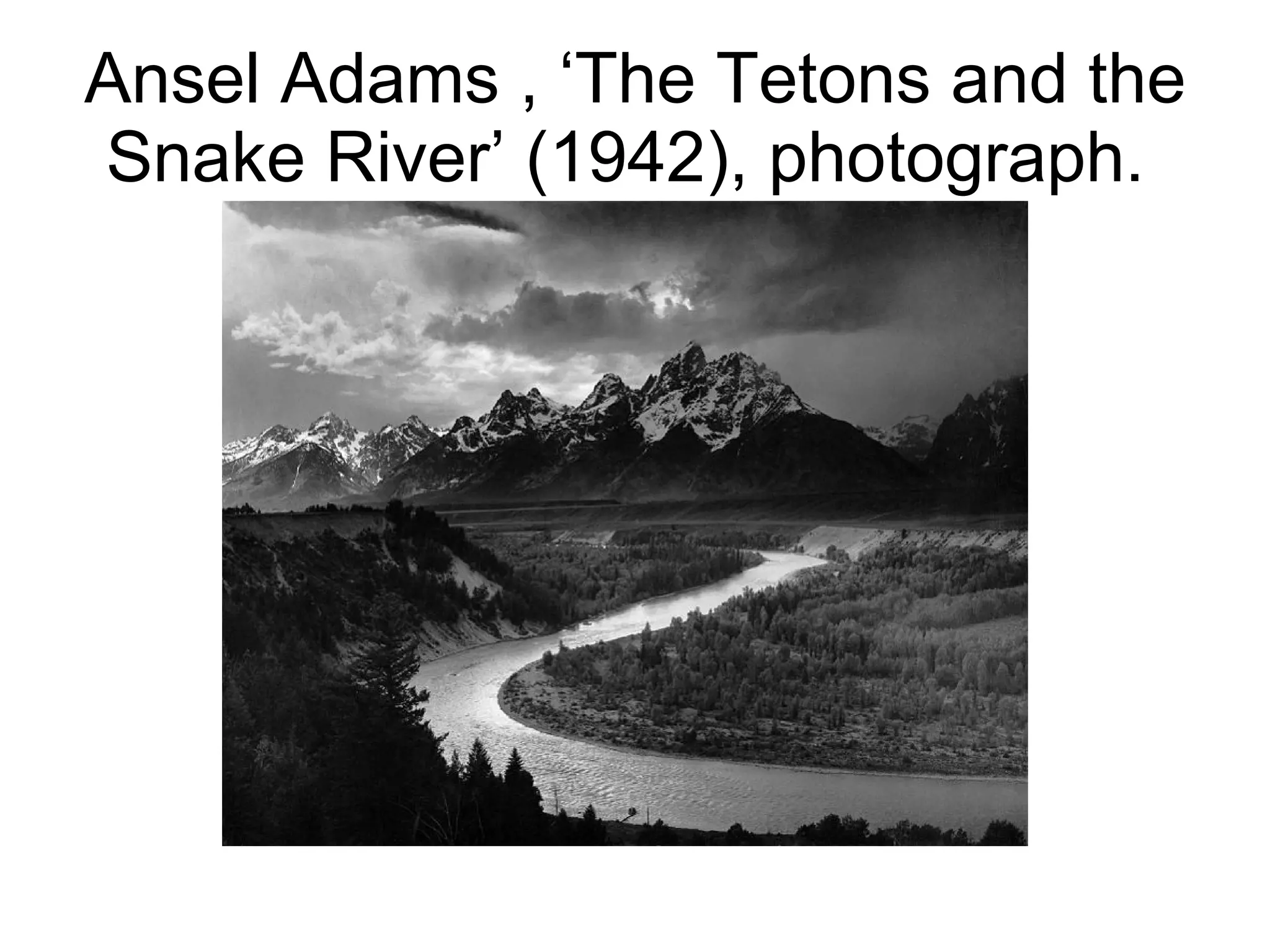
Ansel Adams , ‘The Tetons and the Snake River’ (1942), photograph.
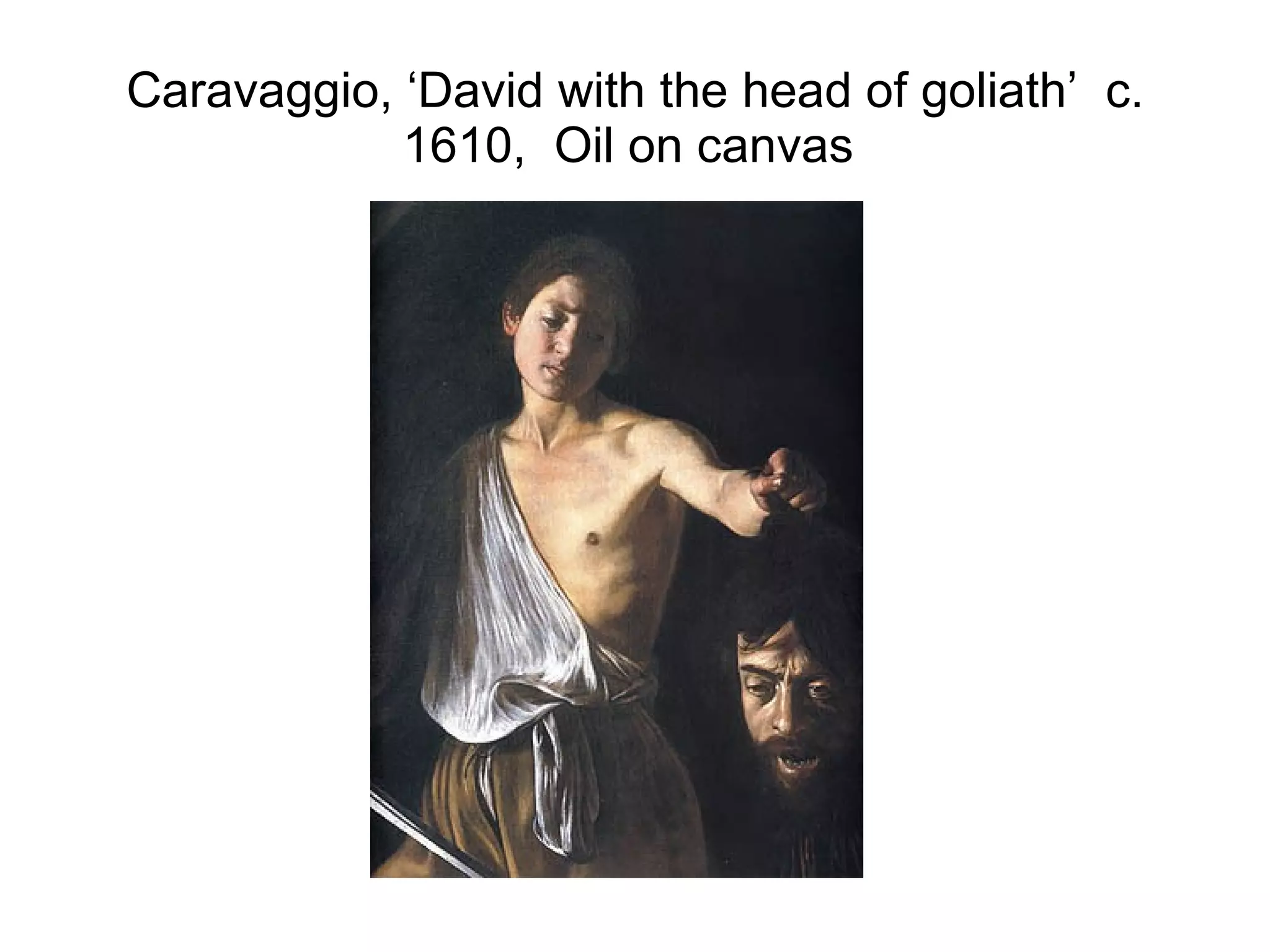
Caravaggio, ‘David with the head of goliath’  c. 1610,  Oil on canvas
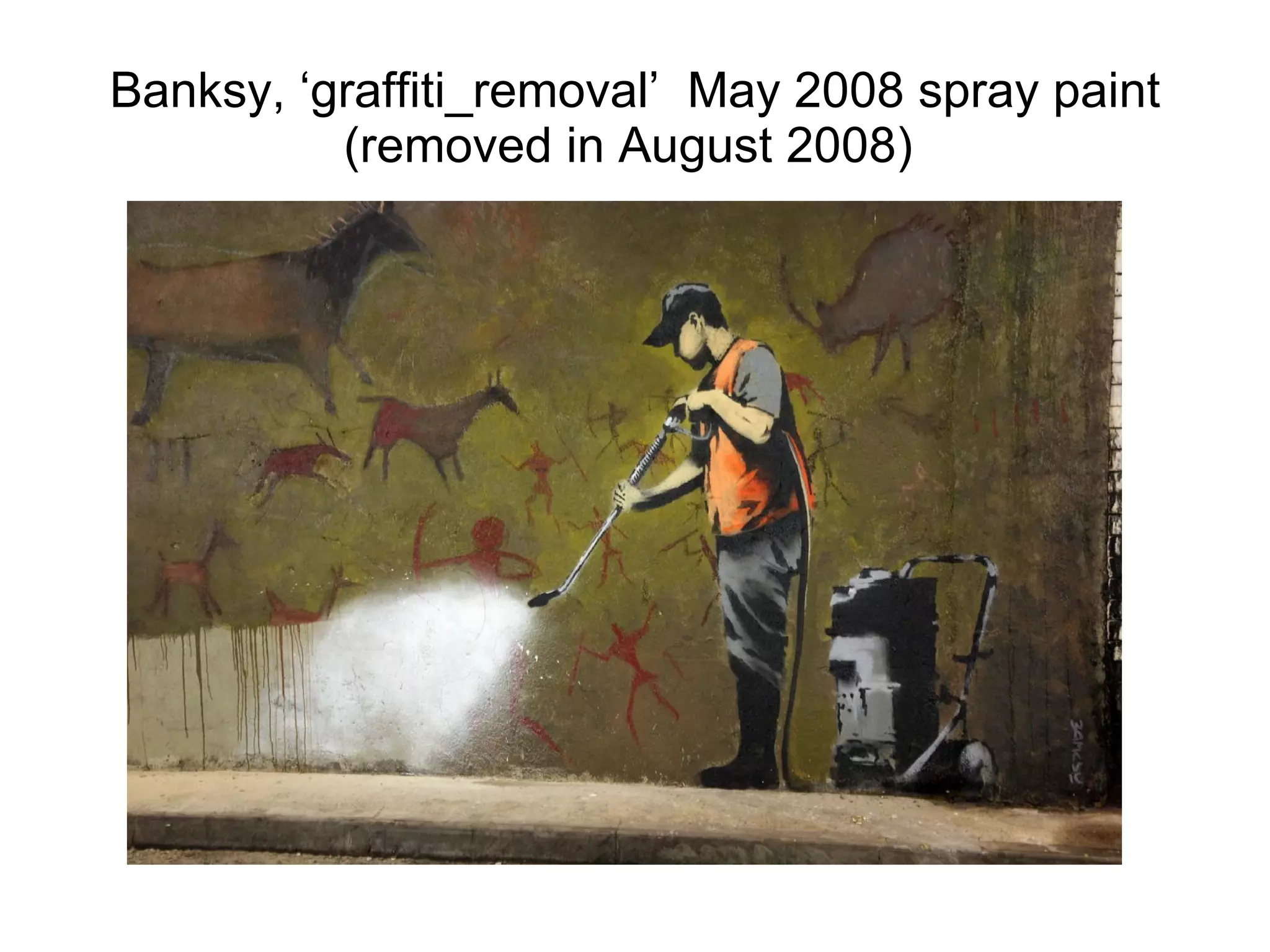
Banksy, ‘graffiti_removal’  May 2008 spray paint (removed in August 2008)
''Cataract 3'', Bridget Riley, 1967. PVA on canvas
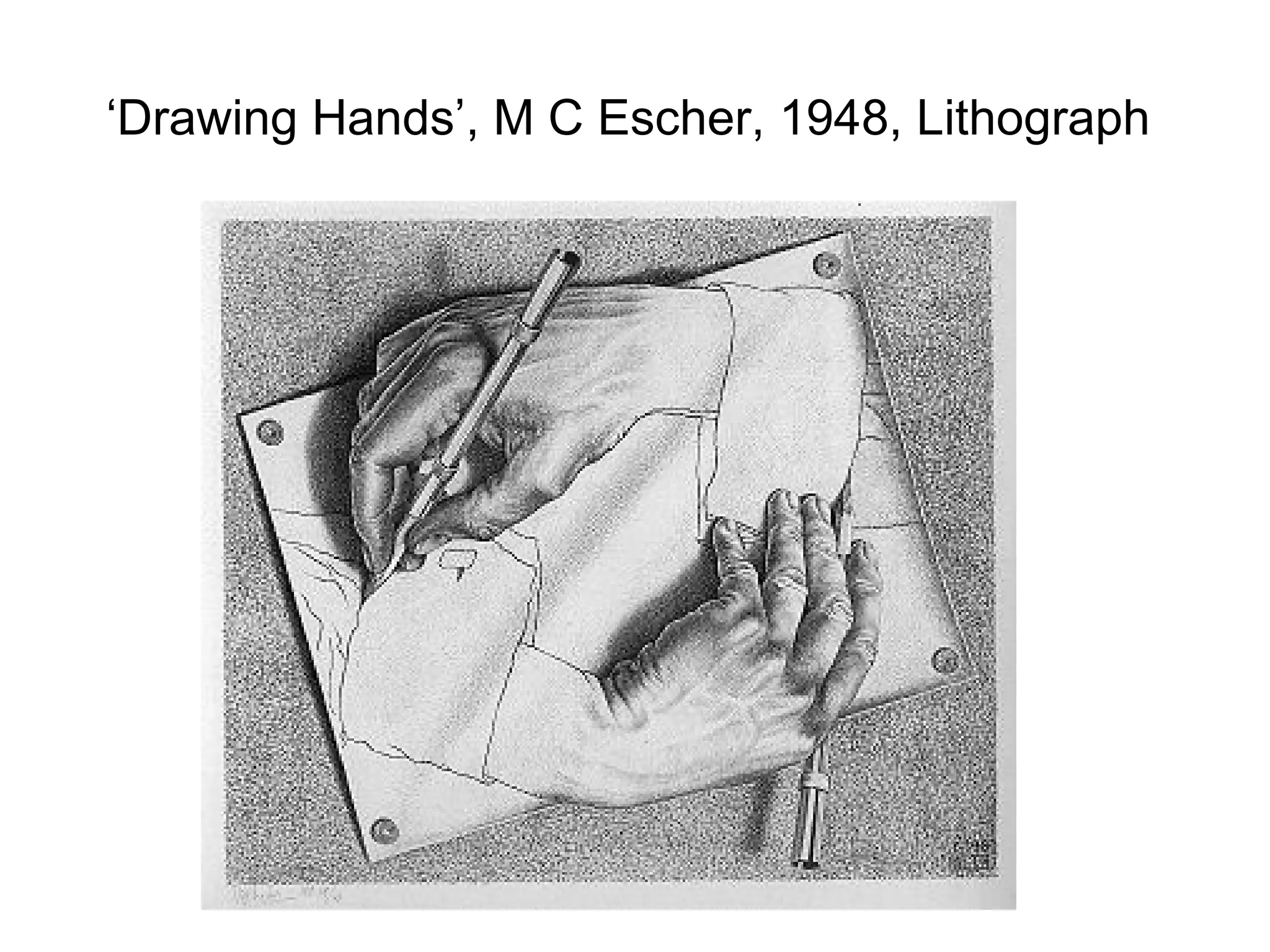
‘ Drawing Hands’, M C Escher, 1948, Lithograph
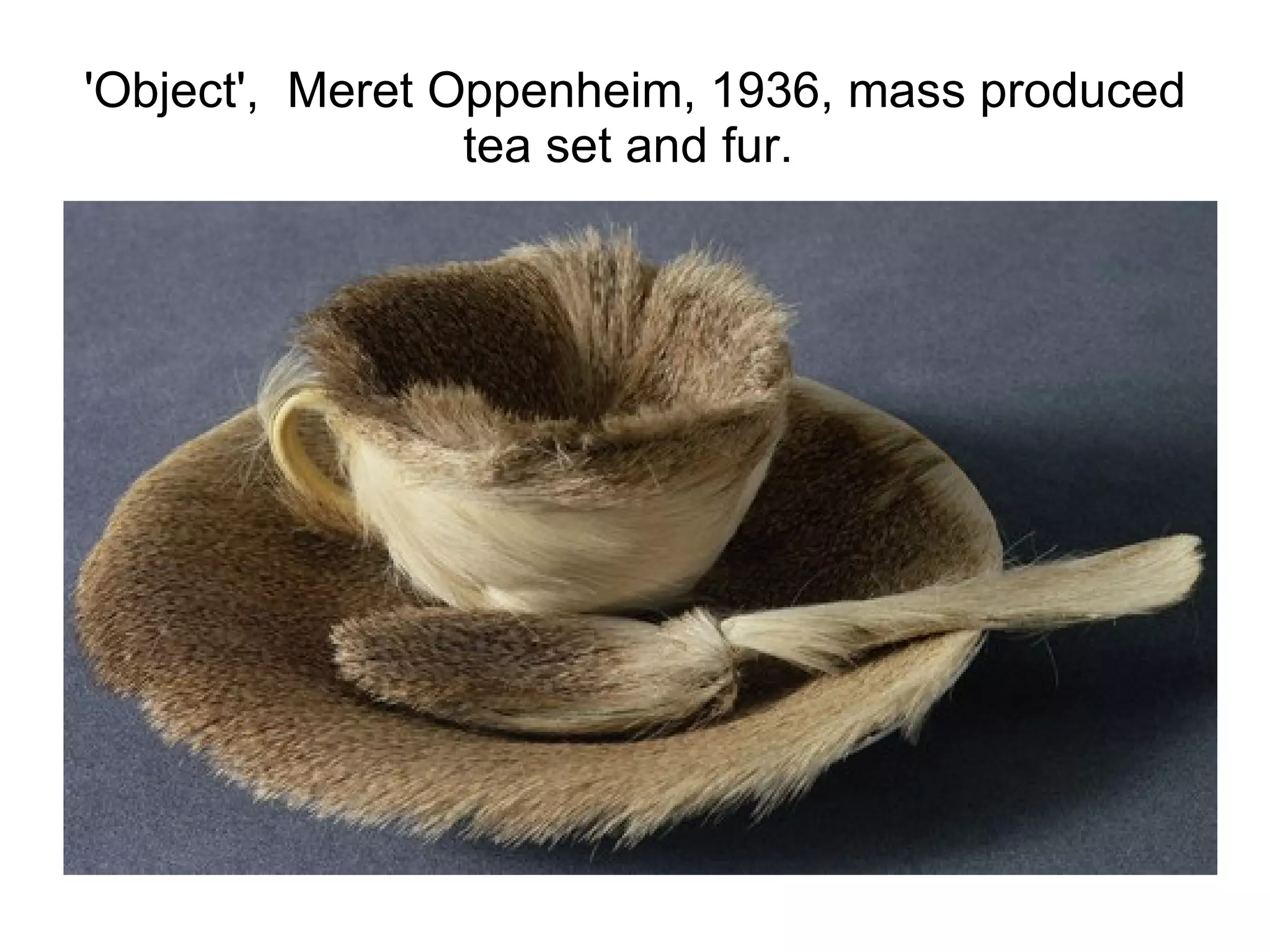
'Object',  Meret Oppenheim, 1936, mass produced tea set and fur.
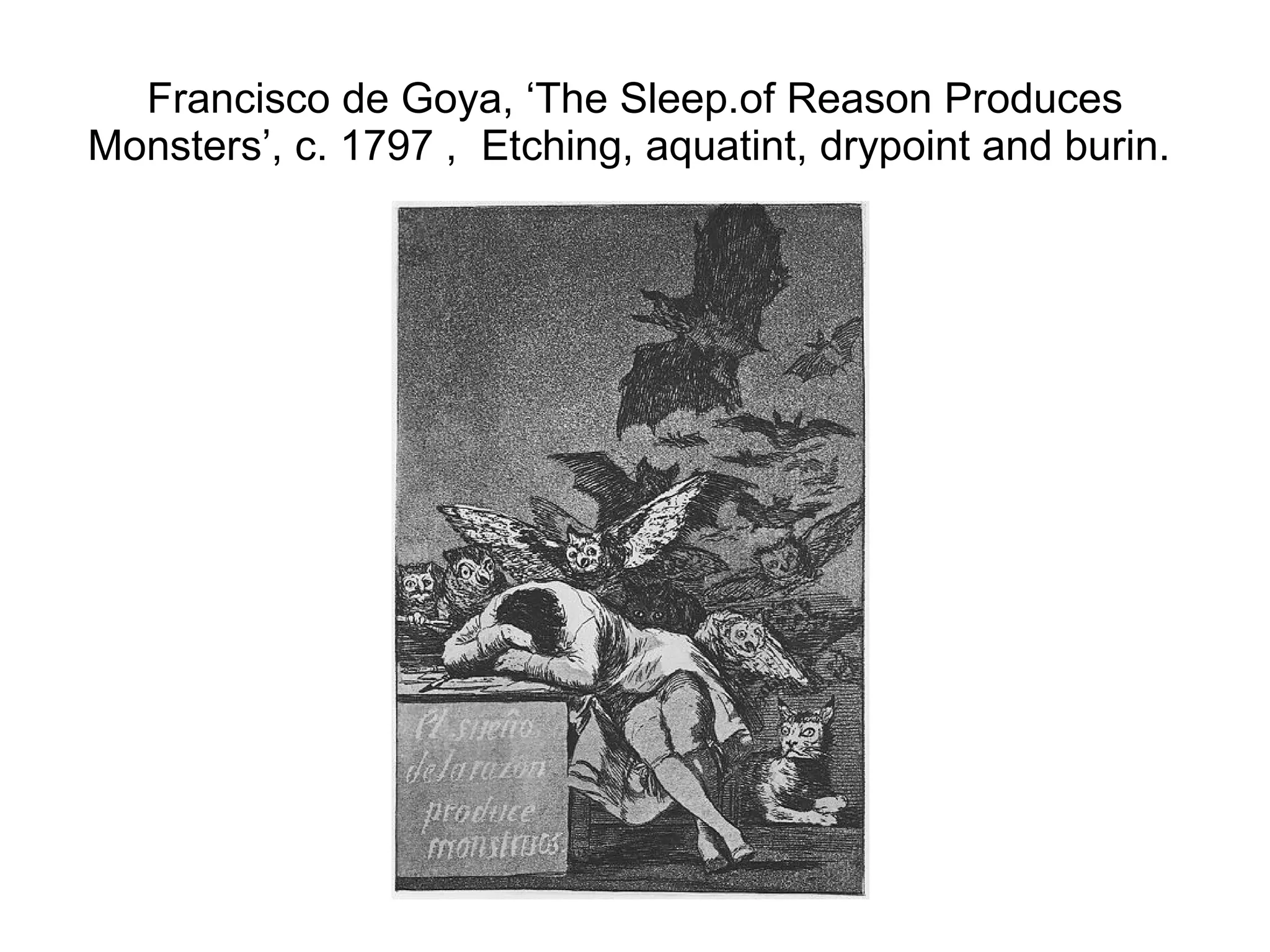
Francisco de Goya, ‘The Sleep.of Reason Produces Monsters’, c. 1797 ,  Etching, aquatint, drypoint and burin.
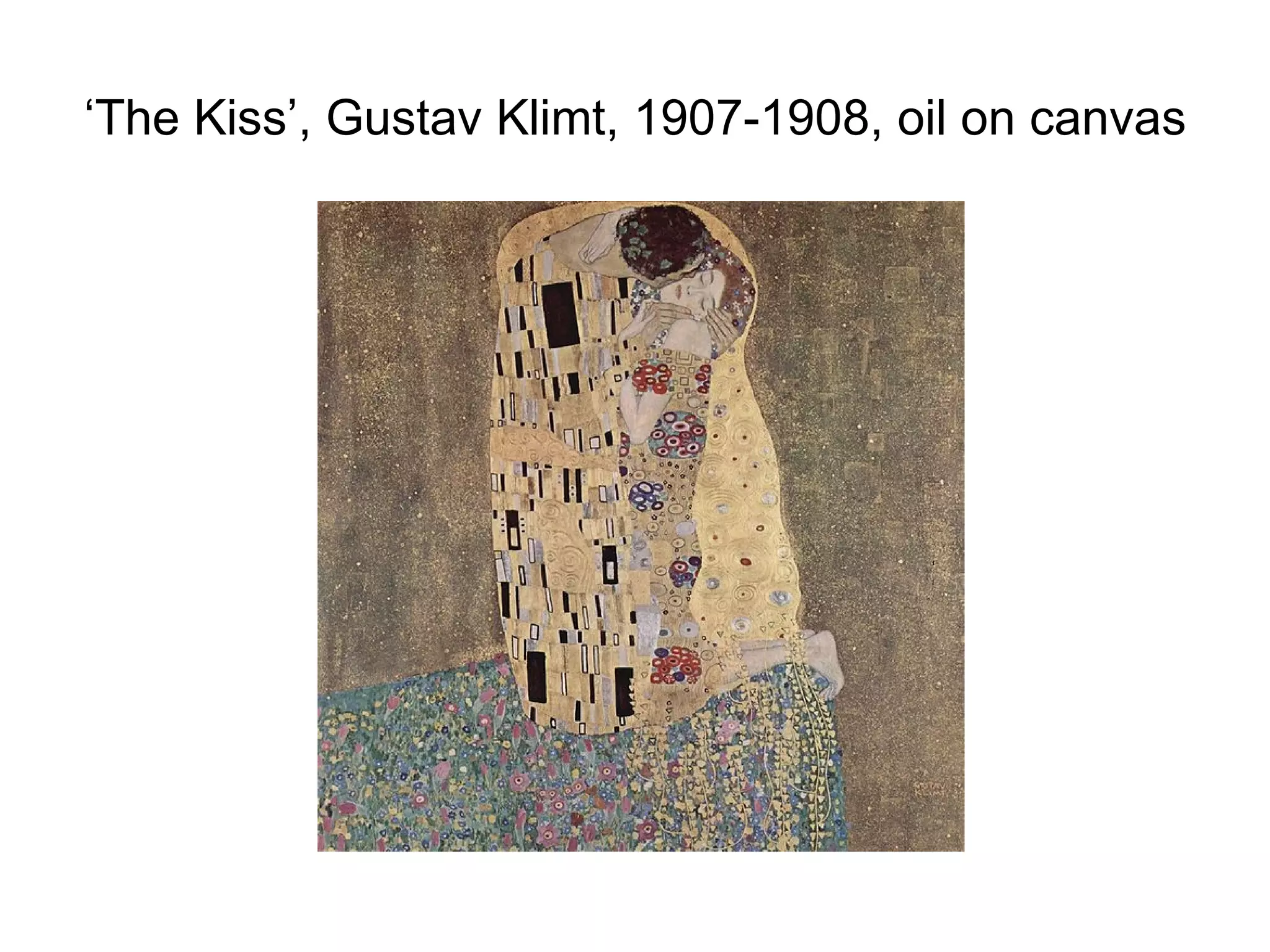
‘ The Kiss’, Gustav Klimt, 1907-1908, oil on canvas
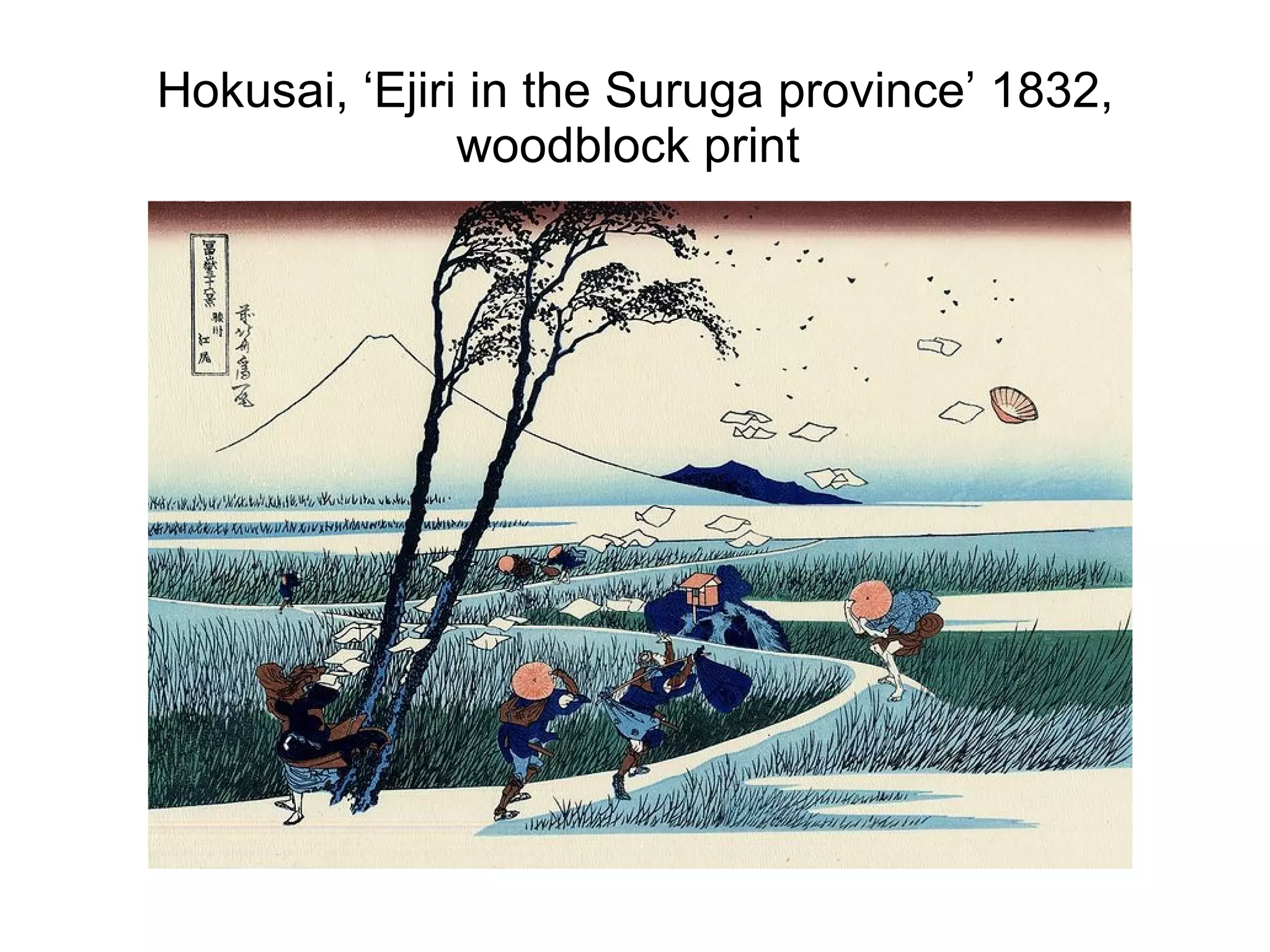
Hokusai, ‘Ejiri in the Suruga province’ 1832, woodblock print
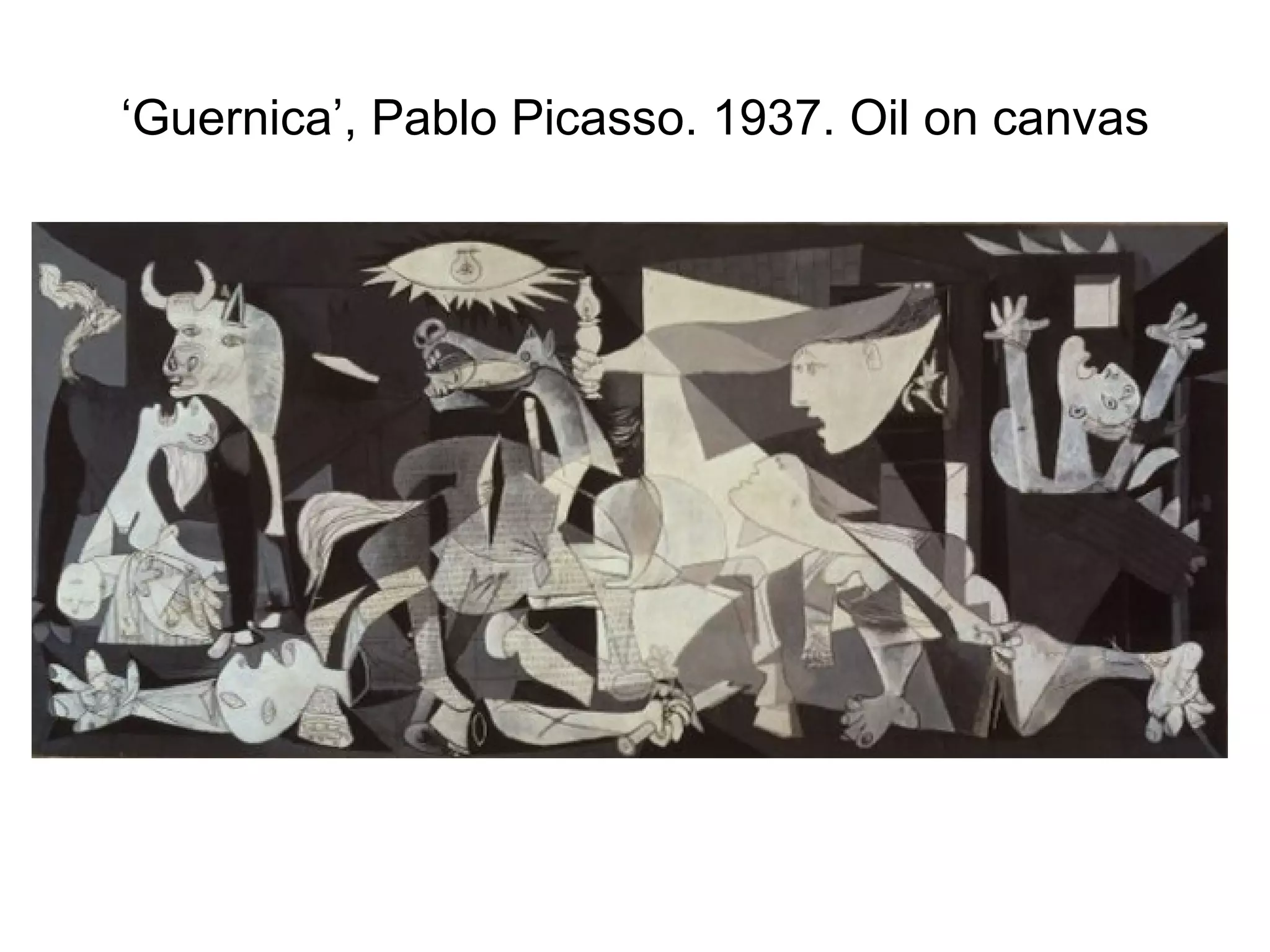
‘ Guernica’, Pablo Picasso. 1937. Oil on canvas
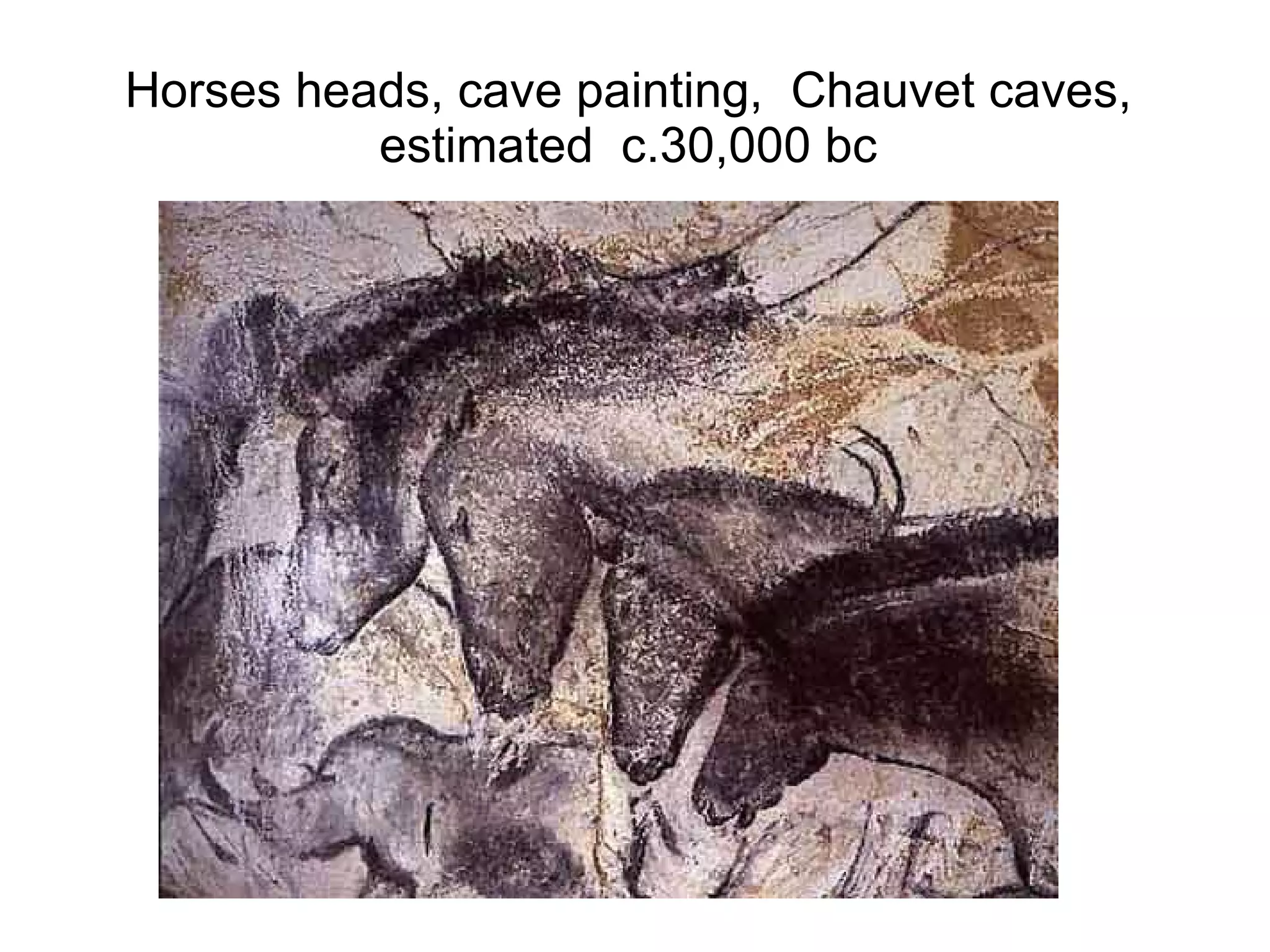
Horses heads, cave painting,  Chauvet caves,  estimated  c.30,000 bc
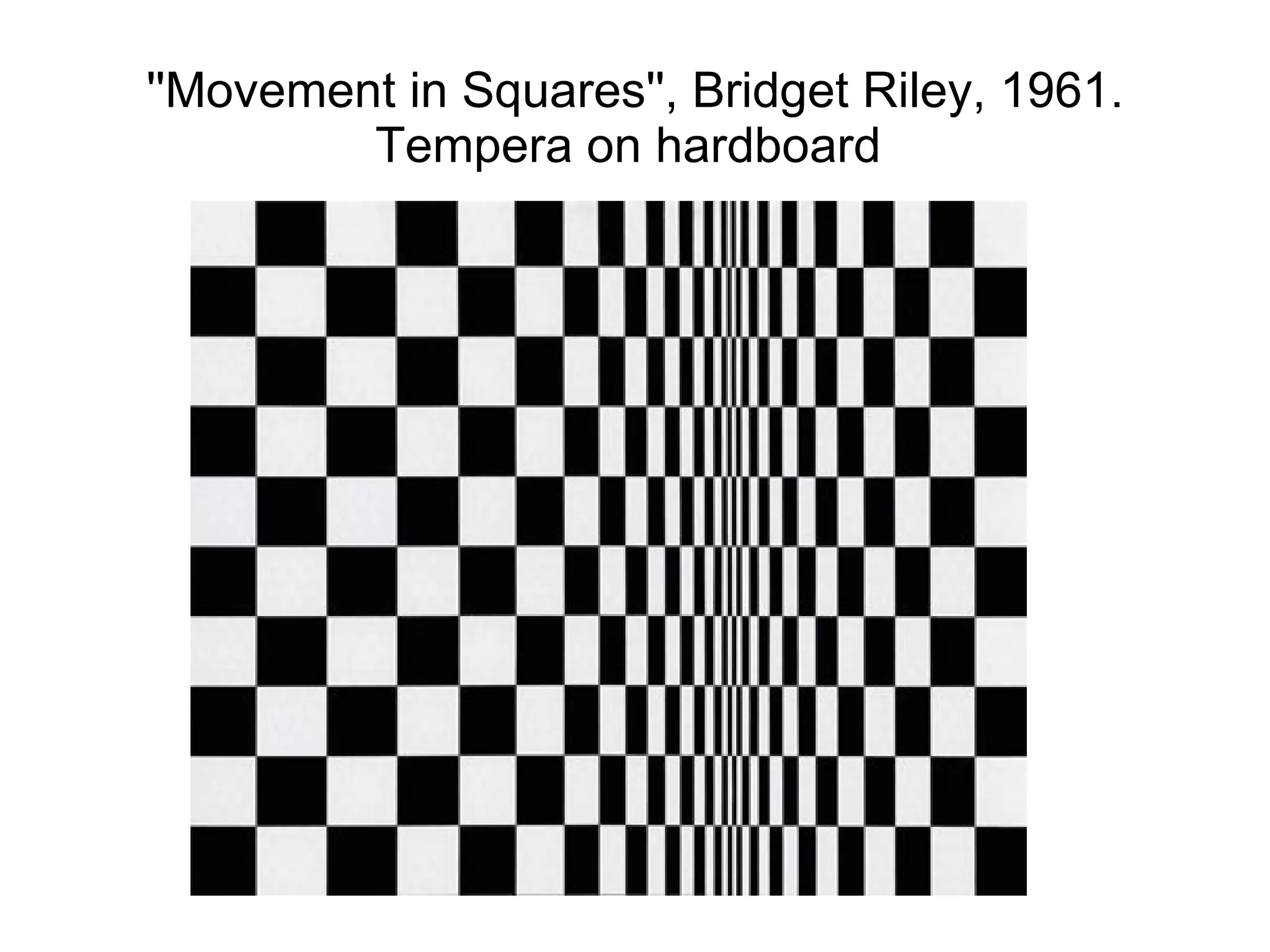
''Movement in Squares'', Bridget Riley, 1961. Tempera on hardboard
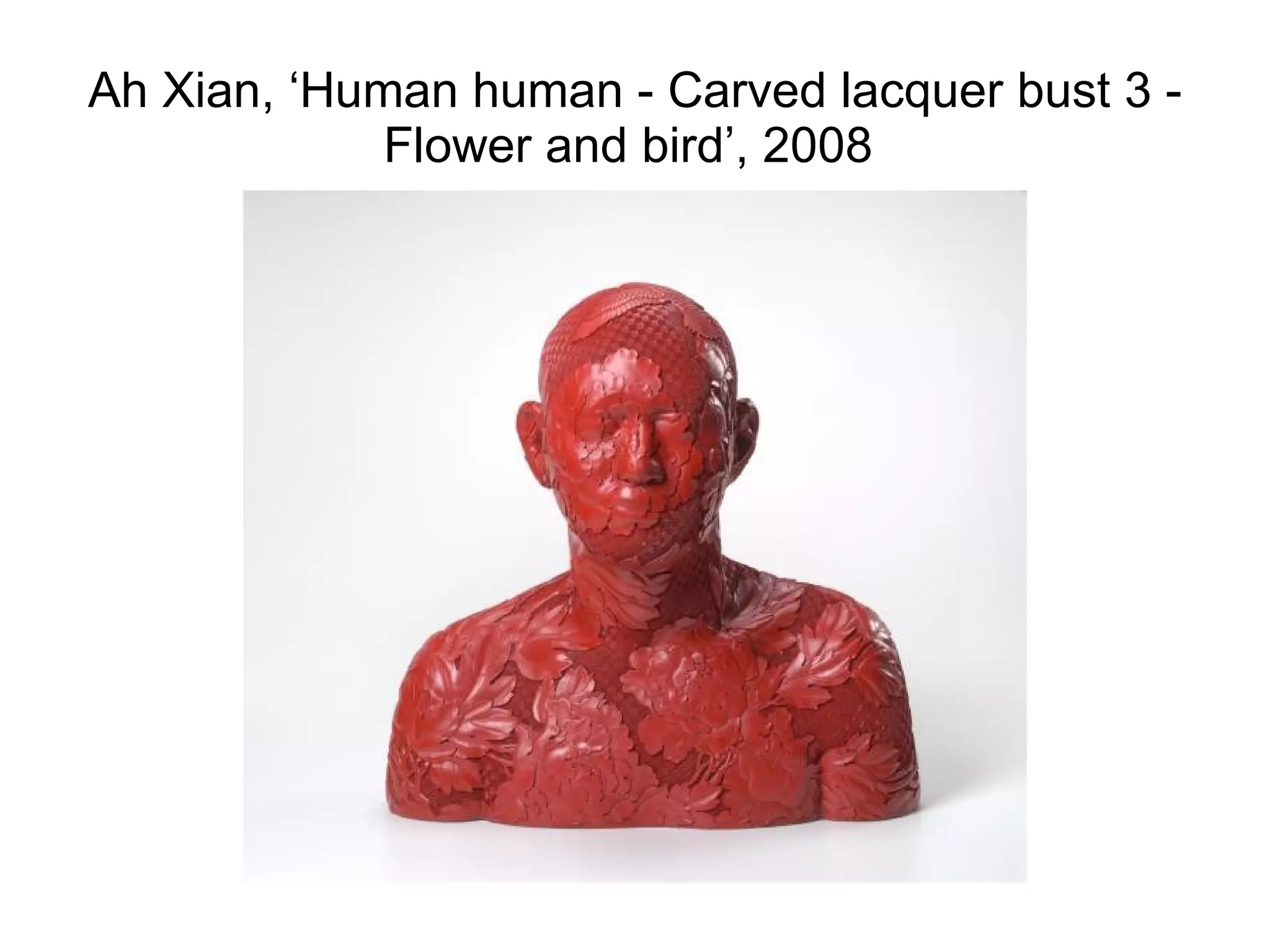
Ah Xian, ‘Human human - Carved lacquer bust 3 - Flower and bird’, 2008
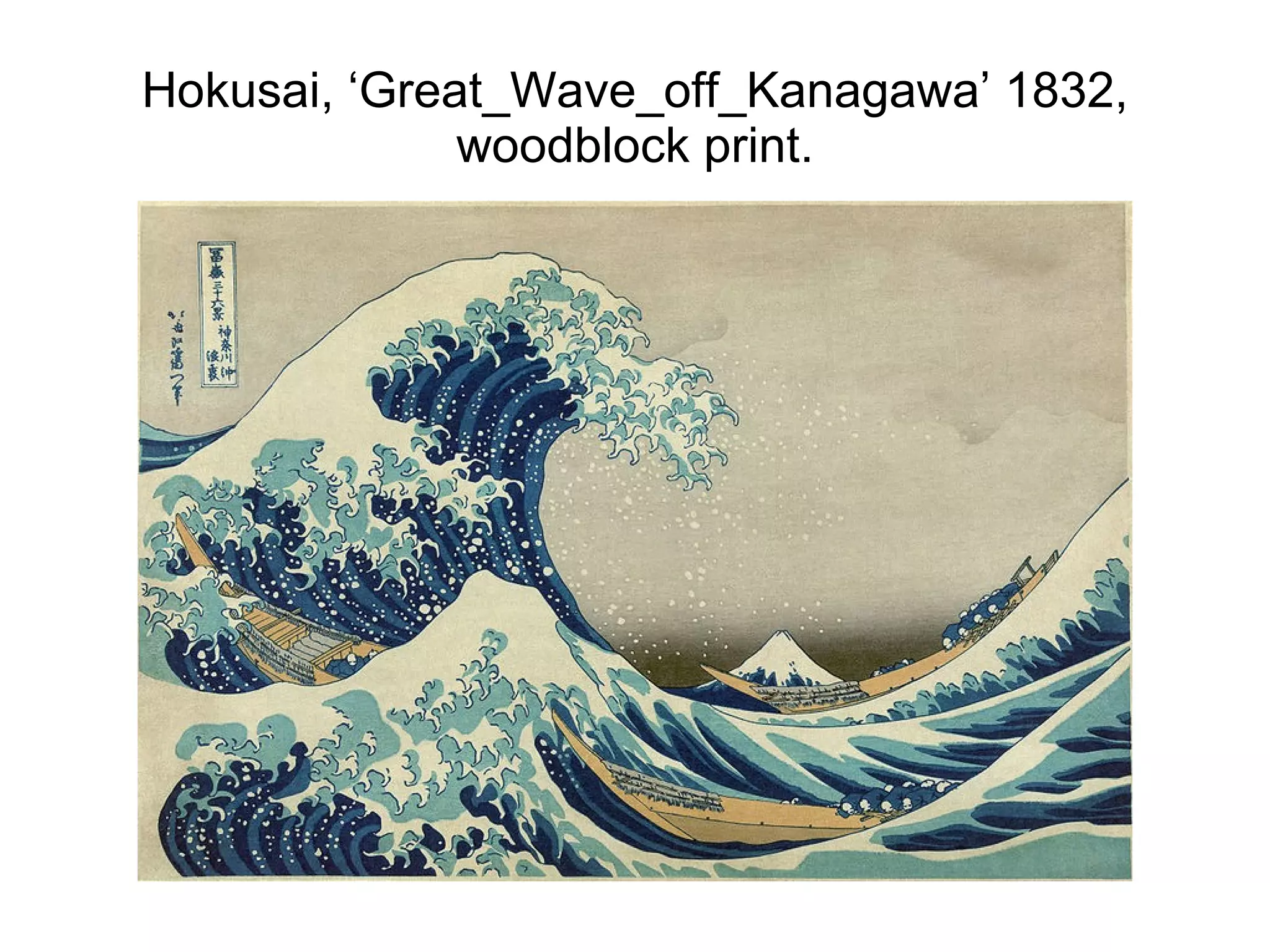
Hokusai, ‘Great_Wave_off_Kanagawa’ 1832, woodblock print.
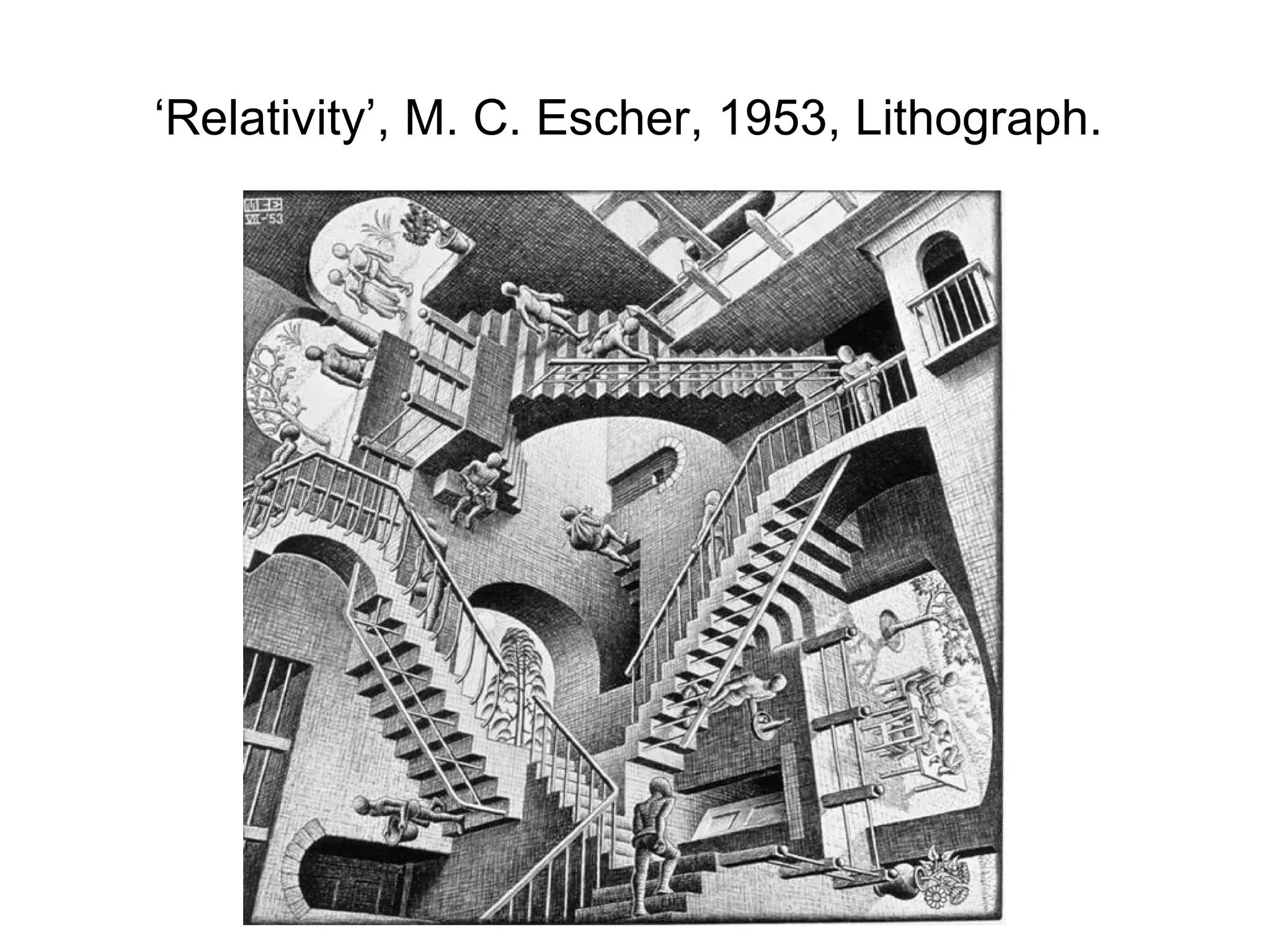
‘ Relativity’, M. C. Escher, 1953, Lithograph.
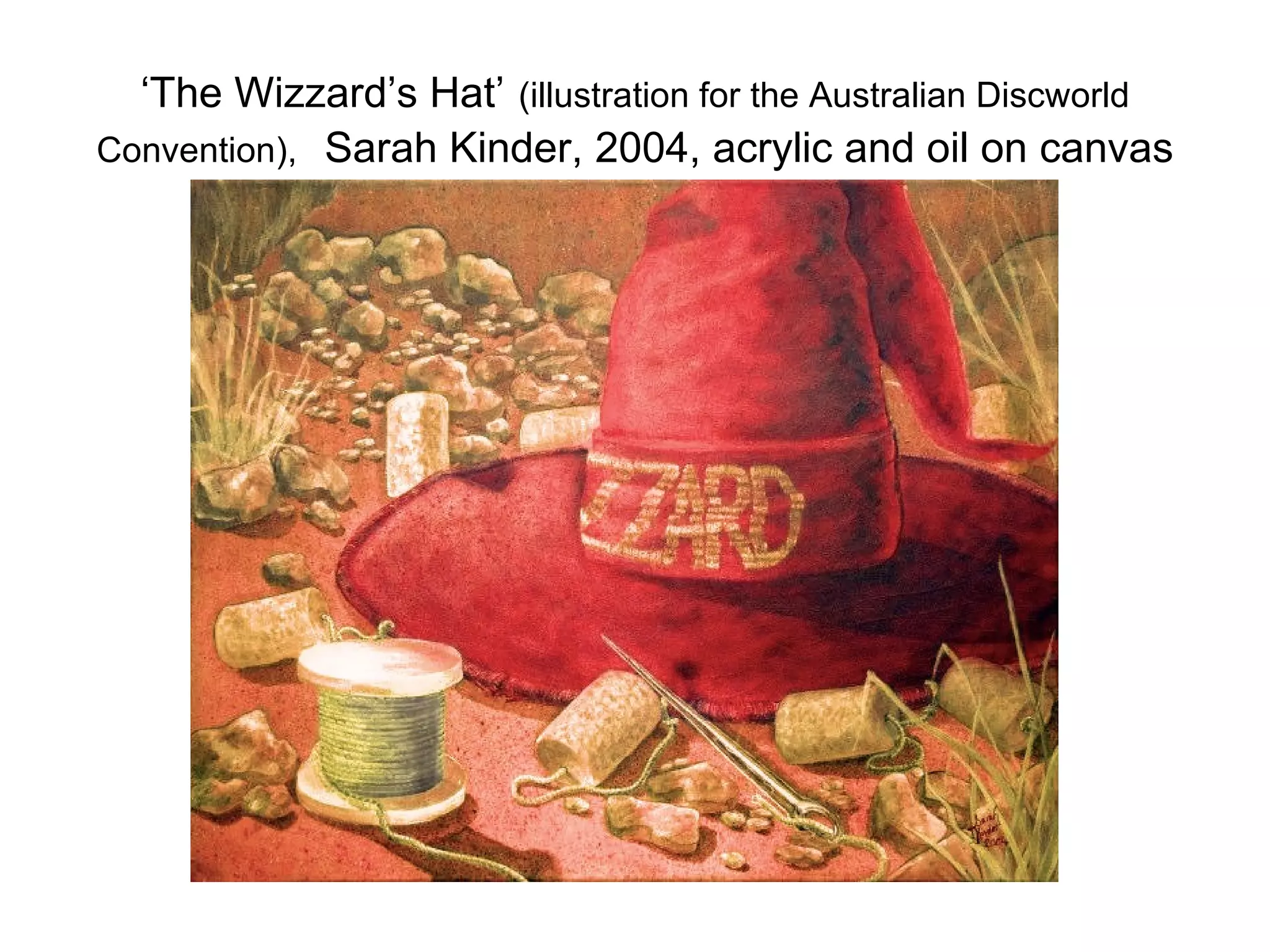
‘ The Wizzard’s Hat’   (illustration for the Australian Discworld Convention),   Sarah Kinder, 2004, acrylic and oil on canvas
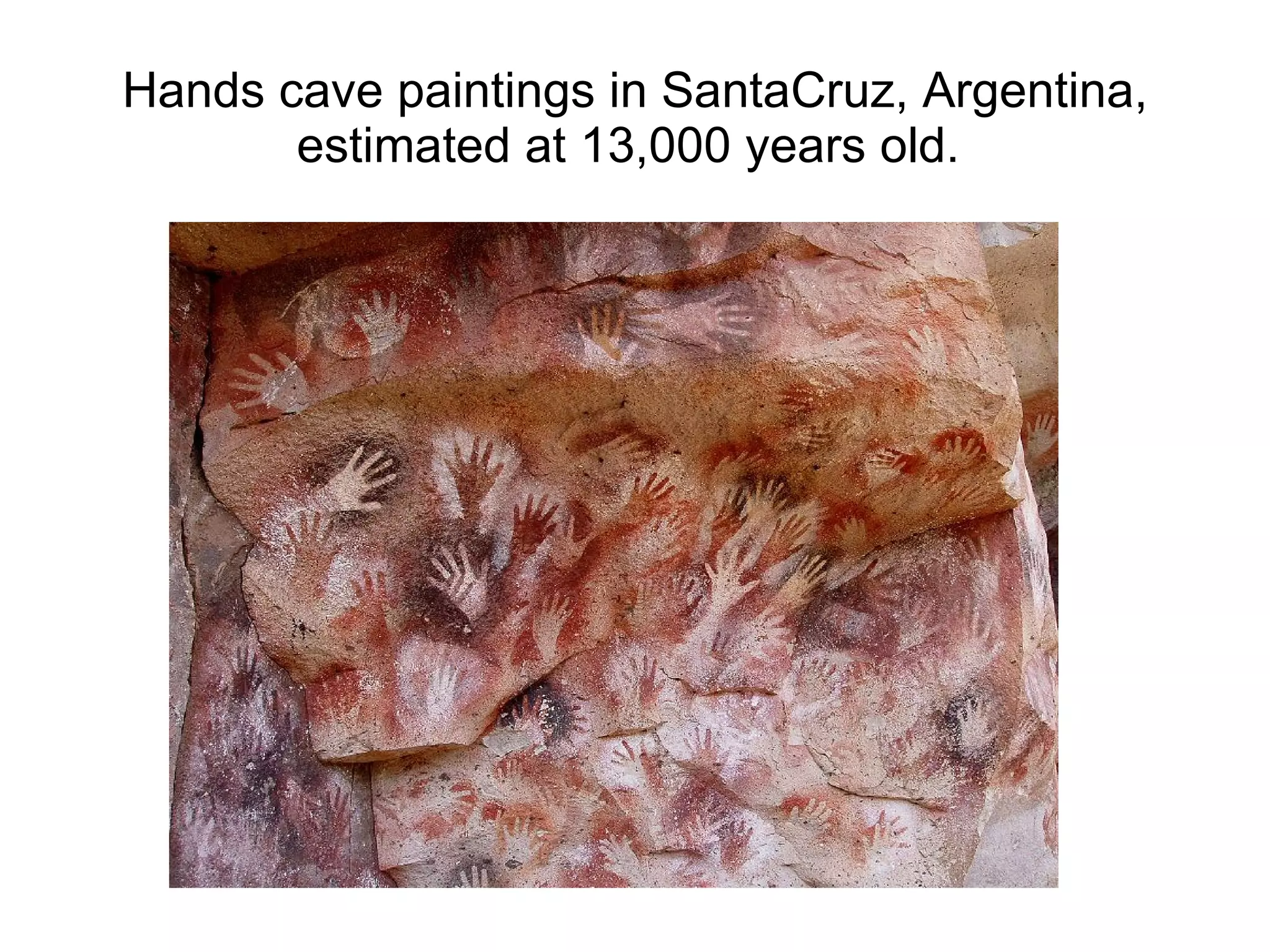
Hands cave paintings in SantaCruz, Argentina, estimated at 13,000 years old.
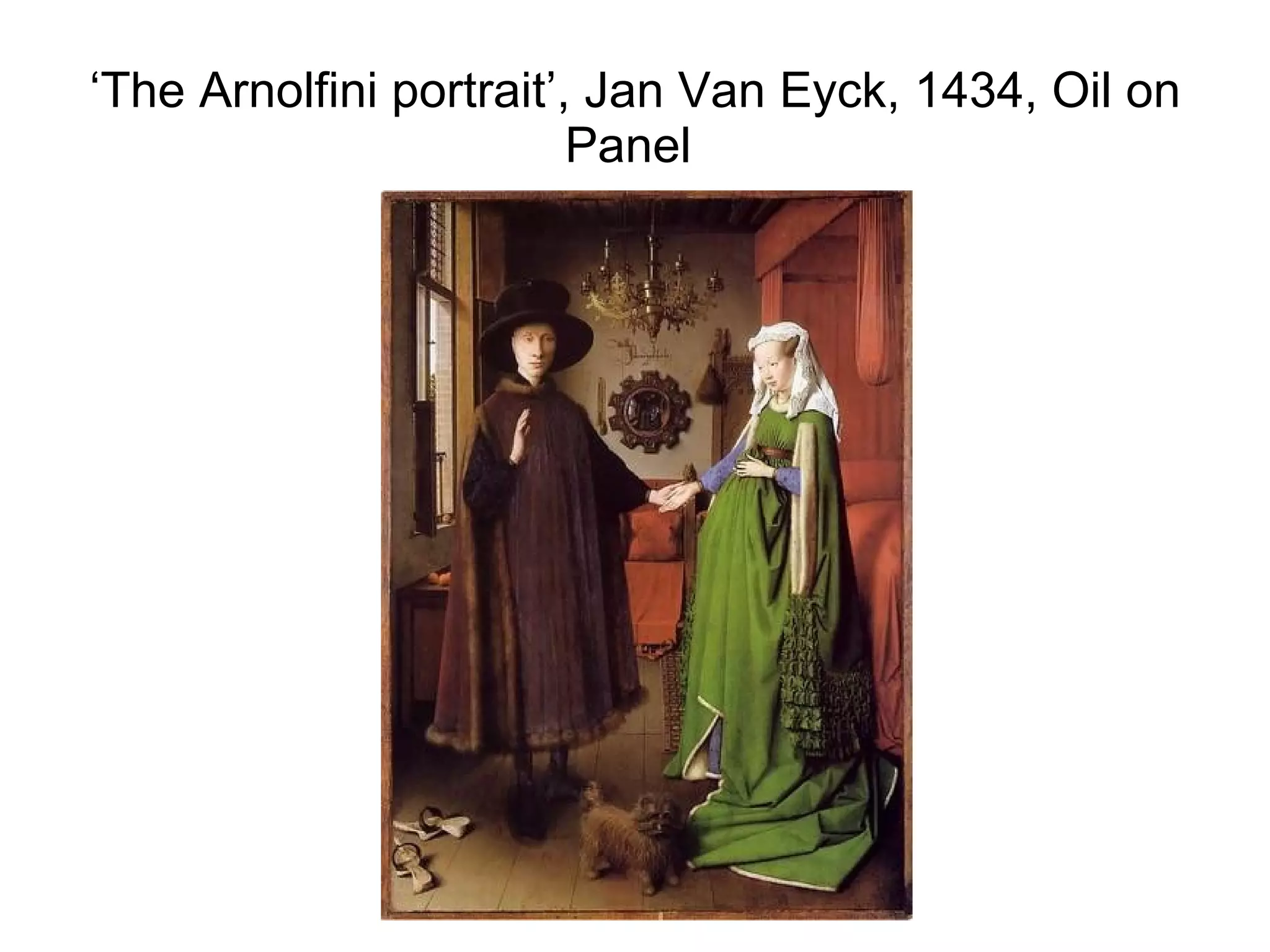
‘ The Arnolfini portrait’, Jan Van Eyck, 1434, Oil on Panel

Arts elements and principles v7

  • 1.
    Arts Elements andVisual Principles
  • 2.
    Arts Elements Arethe visual, tactile, spatial (and sometimes the sonic) sensory qualities used when creating or talking about 2D, 3D and time based artworks. Arts elements are traditionally associated with particular arts disciplines and art forms. In visual arts, these elements include…
  • 3.
    LINE Line isa mark on a surface that describes a shape or outline. It can create texture and can be thick and thin. ‘ Cataract 3’ by Bridget Riley, 1967. PVA on canvas.
  • 4.
    Shape Shape isa 2D line with no form or thickness. Shapes are flat and either ‘geometric’ (eg. a square) or ‘organic’ (eg. A swirl or ripple)
  • 5.
    Space . Thereare 2 types of space, positive and negative. Positive space is the space taken up an object in the area. Negative space is the space around the object, or space that is not taken up by an object.
  • 6.
    Depth Depth iscreated by a visual perspective used to give the illusion of depth or distance on a flat surface. Sometimes depth is included as part of space. Linear Perspective is a way of showing depth where distant objects are made proportionally smaller than nearer ones. Horizon Lines and Vanishing Points determine the scale of objects within the artwork. These images show two types of perspective linear perspective. Horizon lines and Vanishing points are marked with a H and V respectively
  • 7.
    Texture There are2 types of texture used to talk about the surface qualities of artworks, used to describe the roughness or smoothness in objects and surfaces Detail of ‘Sunflowers’ by Van Gogh, (1888, oil on canvas) showing texture of impasto technique.
  • 8.
    Optical Texture OpticalTexture Optical Texture is the illusion of texture, created on a flat surface. Graphite pencil drawings of fur by unidentified artist. Graphite pencil and charcoal drawing of glass by Koo Hyunhee, a year 12 student from Westfield High (America)
  • 9.
    Tactile Texture Tactiletexture is the roughness or smoothness of a surface. In this image the ridges and peaks of thickly applied paint in works using a technique called impasto . Detail of ‘Sunflowers’ by Van Gogh, (1888, oil on canvas) showing texture of impasto technique.
  • 10.
    Colour Refers tospecific hues (pure colours without tint or shade, which are created by adding white or black pigments respectively), and has three properties CHROMA INTENSITY VALUE
  • 11.
    Chroma Chroma is about how vivid colours are perceived to be. Essentially, it’s a measure of a colour’s purity compared to grey. Chroma Wheel:
  • 12.
    Intensity The brightnessor dullness of a colour is referred to as the colour’s intensity . A pure colour is high intensity, whereas a colour that has been mixed with it’s complementary colour is called a low intensity colour.
  • 13.
    Value Value (sometimes called ‘tone’) is concerned with the LIGHTNESS and DARKNESS of a colour and is achieved by adding white or black to a colour to create tints (by adding white) and shades (by adding black).
  • 14.
    Form Form isa 3D object having volume and thickness. The illusion of form (volume and thickness) can be implied with light and shade, but true 3D form can be viewed from multiple angles, as an object in physical space.
  • 15.
    Movement Refers toa visual sense of motion used to establish the flow of the composition from one area to another. In this sculpture the artist makes effective use of movement. The eye is drawn through the form by the angles of the arm, legs and torso, and the direction of the subjects eye line.
  • 16.
    Composition The arrangement/placementof arts elements according to visual principles. Examples of formal compositional devices are the ‘rule of thirds’, and the ‘golden section’. The image at the top depicts a photograph composed using the traditional ‘golden mean’ compositional framework. In this type of composition, places where the guidelines intersect are key points for placing important elements of your image. The image at the bottom depicts a photograph composed using the ‘rule of thirds’ compositional framework.
  • 17.
    VISUAL PRINCIPLES Arethe ways that art elements are used, arranged, or organised to create artworks. Arts principles are also referred to as ‘compositional’ or ‘structural’ devices or conventions. They include:
  • 18.
    Balance Refers tothe way in which visual weight is distributed throughout the art piece. A composition can be symmetrically or asymmetrically balanced, which means that both sides of an image are visually equal, or unequal, respectively. The top image shows the difference between symmetrical and asymmetrical balance, while the image at the bottom shows ‘approximate symmetry’
  • 19.
    Harmony When visualelements within an artwork interact well together in an aesthetically pleasing manner. This principle is closely related to unity , and often concerned with combining similar art elements to create a pleasing appearance
  • 20.
    Distortion The deliberatealteration or departure from a normal depiction of shapes, imagery and proportion. This image shows a bookcase photographed with a fish eye lens.
  • 21.
    Abstraction Refers tothe deliberate departure from natural appearances. Images are simplified, modified or changed to varying degrees to emphasise certain qualities or content, or to convey meaning. This term also refers to art that is non-representational. The ‘Riesenrad’ ferris wheel at the Prater, Vienna Abstracted image of ferris wheel- details removed to emphasise line and shape.
  • 22.
    Contrast The difference between two things. High contrast would be the difference between black and white or bright yellow and dark purple Low contrast would be the difference between middle value colours and greys. Contrast can also apply to size, shape, colour and texture etc.
  • 23.
    Hierarchy Refers tothe way objects and figures are placed to show relative importance of those objects or figures. In this image, the cyclist is at the top of the visual hierarchy, then the shadows of the other cyclists and then the landscape which serves as the backdrop.
  • 24.
    Scale Scaleis the size or apparent size of an object in relation to other objects and it’s environment
  • 25.
    Proportion Refers tothe way that elements and objects work together in an artwork. Using proportion, artists can make sure that the different parts of an artwork make sense within their composition. The Vitruvian Man Leonardo DaVinci, C.1487. Pen and ink with wash over metalpoint
  • 26.
    Cropping When aselected image is improved by the removal of the outer parts to improve framing, accentuate the subject, mood or drama of a work, or to alter the aspect ratio. ‘ Cropped portrait’ Sebastian Pettit Photograph2008 http://www.google.com.au/imgres?imgurl=http://4.bp.blogspot.com/_ijPUljhTM7A/STMLVK1ak0I/AAAAAAAAAFY/8buSUXooIv4/s320/Abstract%2BPose.jpg&imgrefurl=http://dsebastianpettit.blogspot.com/&usg=__wtopTE-EOcHOPlLE03djrveAq8U=&h=300&w=320&sz=14&hl=en&start=18&sig2=W0MMEkXxnEVjMGqvPzlQ-g&um=1&itbs=1&tbnid=jgm00tOMqPJApM:&tbnh=111&tbnw=118&prev=/images%3Fq%3Dartistic%2Bphoto%2Bcropping%26um%3D1%26hl%3Den%26safe%3Dactive%26rls%3Dcom.microsoft:*:IE-SearchBox%26rlz%3D1I7MEDB_en%26tbs%3Disch:1&ei=NedDTM2YGdKjcay6zaYP
  • 27.
    Emphasis Emphasis isproduced by visually stressing the importance of one element over another in order to create a sense of hierarchy to control where the viewer looks first. Areas of emphasis may be planned using compositional devices such as the ‘rule of thirds’, or created using colour and so on. Henri de Toulouse Lautrec - "At the Moulin Rouge", 1892/1895 Oil on Canvas
  • 28.
    Variation A deviceused to make key areas stand out, achieved by using differing lines, shapes, and colours within the artwork. This principle can be used to create movement and direct the eye of the viewer through the artwork. In this image, the variations displayed are primarily colour, shape and texture.
  • 29.
    Variation (cont.) Forexample, if a warm orange dot is placed on an artwork that is mostly cool colours, the eye of the viewer is drawn to the orange spot.
  • 30.
    Creating a VisualLoop By creating a Visual Loop, you are able to control where the viewer looks in your image, and keep them looking at your image for longer. A visual loop is made by using movement and composition. How has the artist led our eyes around the image? ‘ Reptiles’, M. C. Escher, 1943, Lithograph.
  • 31.
    What Arts Elementsand Principles Can You Identify?
  • 32.
    Cave paintings ofHyenas, Chauvet caves., estimated to be around 32000 year old.
  • 33.
    Ansel Adams ,‘The Tetons and the Snake River’ (1942), photograph.
  • 34.
    Caravaggio, ‘David withthe head of goliath’ c. 1610, Oil on canvas
  • 35.
    Banksy, ‘graffiti_removal’ May 2008 spray paint (removed in August 2008)
  • 36.
    ''Cataract 3'', BridgetRiley, 1967. PVA on canvas
  • 37.
    ‘ Drawing Hands’,M C Escher, 1948, Lithograph
  • 38.
    'Object', MeretOppenheim, 1936, mass produced tea set and fur.
  • 39.
    Francisco de Goya,‘The Sleep.of Reason Produces Monsters’, c. 1797 , Etching, aquatint, drypoint and burin.
  • 40.
    ‘ The Kiss’,Gustav Klimt, 1907-1908, oil on canvas
  • 41.
    Hokusai, ‘Ejiri inthe Suruga province’ 1832, woodblock print
  • 42.
    ‘ Guernica’, PabloPicasso. 1937. Oil on canvas
  • 43.
    Horses heads, cavepainting, Chauvet caves, estimated c.30,000 bc
  • 44.
    ''Movement in Squares'',Bridget Riley, 1961. Tempera on hardboard
  • 45.
    Ah Xian, ‘Humanhuman - Carved lacquer bust 3 - Flower and bird’, 2008
  • 46.
  • 47.
    ‘ Relativity’, M.C. Escher, 1953, Lithograph.
  • 48.
    ‘ The Wizzard’sHat’ (illustration for the Australian Discworld Convention), Sarah Kinder, 2004, acrylic and oil on canvas
  • 49.
    Hands cave paintingsin SantaCruz, Argentina, estimated at 13,000 years old.
  • 50.
    ‘ The Arnolfiniportrait’, Jan Van Eyck, 1434, Oil on Panel