
ART 100
Sp 2016
agenda 2.23.16
formal analysis
a technique that helps us to understand visual imagery
experience: your active and creative perception of what the
artist is putting out there for us to see
genre: what category (if any) does it fit into?
medium and materials: what is the image made of?
subject matter: what is it a picture of?
media
1. What is the medium of the work? Is it 2-dimensional?
• drawing—charcoal on paper
• painting—pigment on a prepared surface
• print—lithograph, silkscreen, etching
• photograph
2. Is it three-dimensional=existing in space?
• Sculpture
• Relief (bas-relief or low-relief)
• Sculpture in the round
• Installation
• Architecture and landscape architecture
• (4th Dimension—time)
• Film
Brief Nod to Subject Matter
DESCRIBE the subject.
What subject is depicted? (Major features only, at this point it
does not need to be too detailed.)
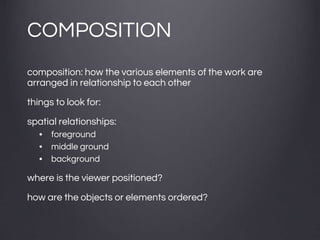
COMPOSITION
composition: how the various elements of the work are
arranged in relationship to each other
things to look for:
spatial relationships:
• foreground
• middle ground
• background
where is the viewer positioned?
how are the objects or elements ordered?
LINE
The literal lines that the artist uses to create shape, suggest
depth, etc. These lines can have a variety of characteristics,
for example; line can be fine and delicate, or bold and
chunky, it can be fluid or halting, precise or sketchy.
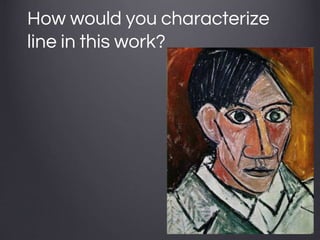
How would you characterize
line in this work?
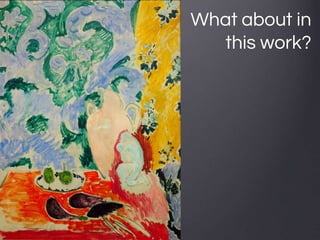
What about in
this work?
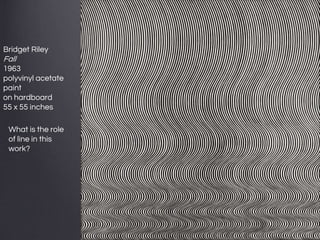
Bridget Riley
Fall
1963
polyvinyl acetate
paint
on hardboard
55 x 55 inches
What is the role
of line in this
work?
COLOR
1. Ask yourself, how important is color in this work?
2. In some works, color is quite significant; in others, far less
so.
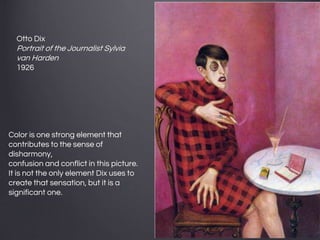
Otto Dix
Portrait of the Journalist Sylvia
van Harden
1926
Color is one strong element that
contributes to the sense of
disharmony,
confusion and conflict in this picture.
It is not the only element Dix uses to
create that sensation, but it is a
significant one.
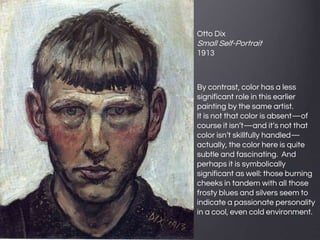
Otto Dix
Small Self-Portrait
1913
By contrast, color has a less
significant role in this earlier
painting by the same artist.
It is not that color is absent—of
course it isn’t—and it’s not that
color isn’t skillfully handled—
actually, the color here is quite
subtle and fascinating. And
perhaps it is symbolically
significant as well: those burning
cheeks in tandem with all those
frosty blues and silvers seem to
indicate a passionate personality
in a cool, even cold environment.
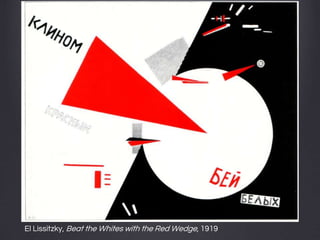
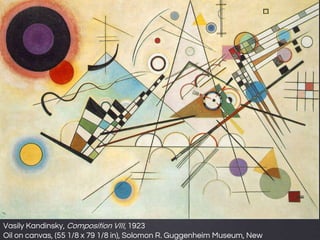
SHAPE
• Can be geometric (e.g., cube,
cylinder, cone, pyramid, circle,
square, triangle)
• Or “biomorphic” (sometimes called
organic); wiggly, blob-like shapes
with irregular outlines.
El Lissitzky, Beat the Whites with the Red Wedge, 1919
Vasily Kandinsky, Composition VIII, 1923
Oil on canvas, (55 1/8 x 79 1/8 in), Solomon R. Guggenheim Museum, New
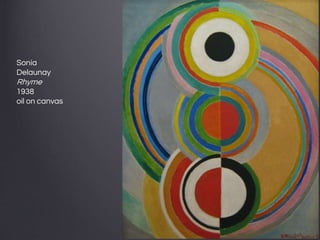
Sonia
Delaunay
Rhyme
1938
oil on canvas
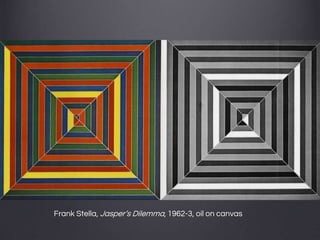
Frank Stella, Jasper’s Dilemma, 1962-3, oil on canvas
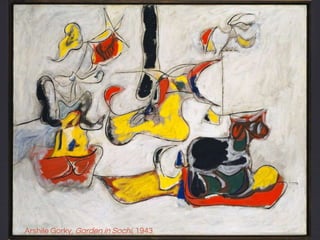
Arshile Gorky, Garden in Sochi, 1943
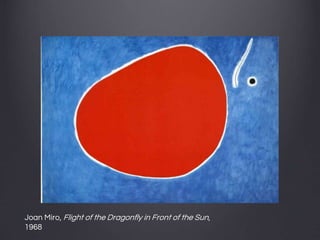
Joan Miro, Flight of the Dragonfly in Front of the Sun,
1968
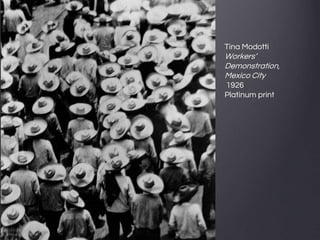
Tina Modotti
Workers’
Demonstration,
Mexico City
1926
Platinum print
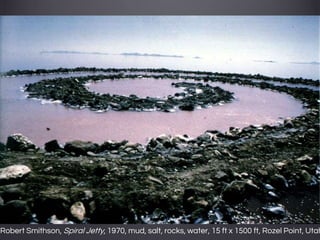
Robert Smithson, Spiral Jetty, 1970, mud, salt, rocks, water, 15 ft x 1500 ft, Rozel Point, Utah
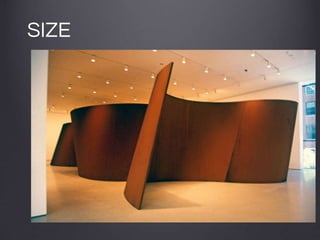
SIZE
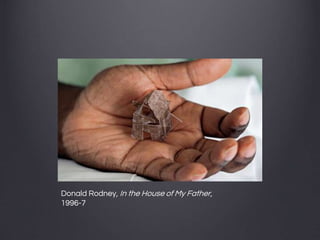
Donald Rodney, In the House of My Father,
1996-7
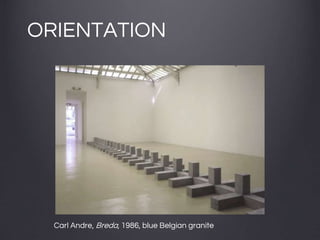
ORIENTATION
Carl Andre, Breda, 1986, blue Belgian granite
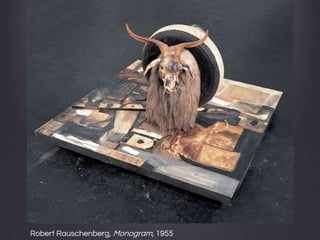
Robert Rauschenberg, Monogram, 1955
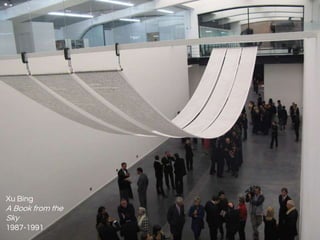
Xu Bing
A Book from the
Sky
1987-1991
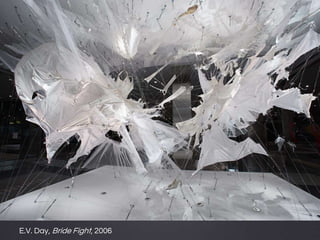
E.V. Day, Bride Fight, 2006
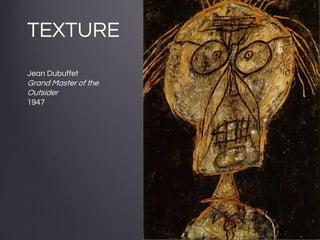
TEXTURE
Jean Dubuffet
Grand Master of the
Outsider
1947
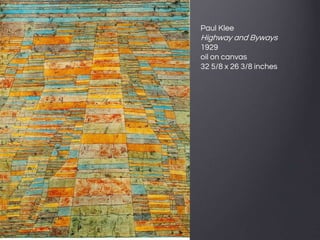
Paul Klee
Highway and Byways
1929
oil on canvas
32 5/8 x 26 3/8 inches
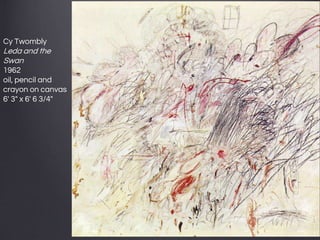
Cy Twombly
Leda and the
Swan
1962
oil, pencil and
crayon on canvas
6' 3" x 6' 6 3/4"
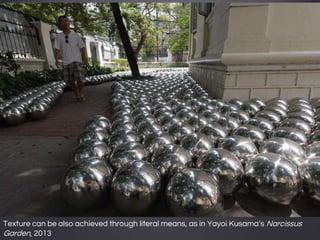
Texture can be also achieved through literal means, as in Yayoi Kusama’s Narcissus
Garden, 2013
IN MATTERS OF STYLE…
…nuance is key. You are training your eyes to detect subtle
differences, alongside the blatant ones.
The more fine-grained the differences you can observe, the
better you will have understood the work.
“God is in the details.”—Mies van der Rohe, 20th century
architect
“The details are not the details. They make the product.” —
Charles & Ray Eames, 20th century designers, educators,
filmmakers
HW: Analyzing a Painting
1. Start by asking yourself, what genre does this picture
belong to (if any)? As we discussed in class, identifying the
genre doesn't really take you all that far, but it is one way
to begin to get a handle on the object you are looking at.
Here are some possible genres:
● history painting (scenes from literature, mythology, the
Bible, historical subjects, etc.)
● portraiture (pictures of specific individuals)
● landscape (outdoor scenes)
● still-life (objects arranged on a tabletop)
2. Next, what is the MEDIUM?
is it a drawing? painting? watercolor? pastel? photograph?
sculpture? etc.
3. Third, what are the MATERIALS? These are usually listed
in the caption for the work (if the work is reproduced) or on
the wall label (if the work is displayed).
Some examples: charcoal on paper, oil on canvas. In
contemporary art, the materials can go far beyond the
typical artists' materials and can include a wild array of
substances, from vaseline, candy, and lipstick to cement,
steel and car parts.
In the case of this particular work, a lot of these questions
will be answered by the caption provided. Make sure you
read it and transcribe the information accurately (for
example, spell the artist's name correctly and consistently
and refer to the artist by their last name, not their first).
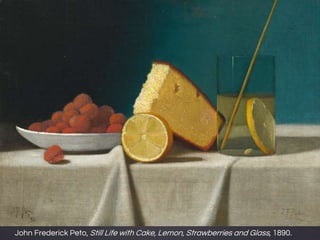
4. Analyze the composition of this work.
How is space divided from front to back, right to left? What
are the relative positions of the depicted objects?
John Frederick Peto, Still Life with Cake, Lemon, Strawberries and Glass, 1890.
HW: Writing a Description
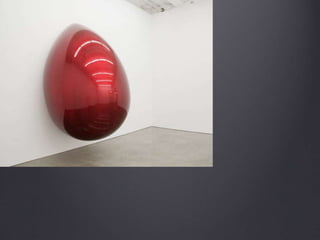
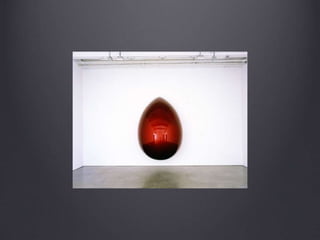
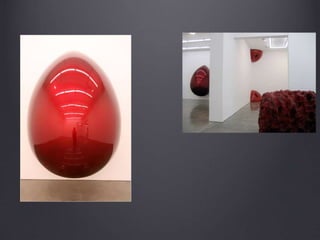
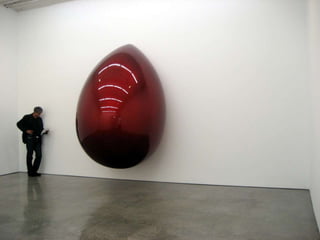
This artwork is teardrop
shaped, with a clear and
reflective surface. The
color is maroon, which
reminds me of a drop of
blood. The artwork itself
is very large, bigger than
an average person.
This work is titled Drip by
Anish Kapoor, which
was created in 2008. It
is in the shape of a very
large and smooth
droplet fixed on a wall.
The work is a beautiful
shiny crimson red color
and reflects everything
around it. These
characteristics together
make the work resemble
a drop of blood.
It is a wall-mounted sculpture
done by Anish Kapoor, titled
Drip, made in 2008 using resin
and paint. The art piece
seems to look like a large,
deep red droplet of blood,
which is also very polished to
the point it seems shiny. The
deep velvet and bloody color
makes me feel rather poised
and it specifically brings up
the image of a vampire biting
into a neck and the sculpture
is just a part of the trickle of
blood that seeps out from the
skin. Also, the extreme
polished surface enables
reflections to be seen on it.
This large bright red reflective
wall mounted sculpture is Drip
by Anish Kapoor completed in
2008, this huge sculpture is
106 x 76 x 59 inches. The
piece is an extremely polished
red rounded sculpture
emerging from the wall. It
looks as though it is a moment
suspended in time and this
drip is on the verge of falling
to the ground. It looks like an
almost cartoon-ish rain drop
in which you can see what is
in front of and around the
sculpture. To me it looks like
the wall itself is producing the
drip. The red color may be an
allusion to blood but also may
be a simple color choice to
enhance the reflective quality
of the piece.
This wall installation by Anish
Kapoor was created using
resin and paint in 2008. The
piece, called Drip, somewhat
resembles a drop of liquid in
the way that it is most bulbous
at the bottom of the piece.
The surface is shiny and
reflective and colored deep
red. The shape and the color
of the piece potentially
suggests a drip of blood.
Although blood can be
uncomfortable, the shape and
clean edges of this piece take
away any uneasiness that
blood may bring forth.
The Drip sculpted by Anish Kapoor in 2008
is a piece that resembles a "drip" of fluid
through the use of a metal that reflects
images very well, but it's dignifying
feature that changes it from a tear
shaped mirror is the red color it has. In
my opinion the reflective nature of The
Drip along with it's shape is used to
resemble blood. This sculpture
resembles a drop of blood as it comes
from the skin, and I think Kapoor's intent
was to create a product that was used to
reflect us all. Since the work has a
reflective nature to it, I think he wants to
show that all who look will be reflected off
of this blood shaped product, and that
we are all reflections of each other as all
people have this red blood inside of
them.

ART100Sp16Module6.1

  • 1.
  • 2.
    agenda 2.23.16 formal analysis atechnique that helps us to understand visual imagery experience: your active and creative perception of what the artist is putting out there for us to see genre: what category (if any) does it fit into? medium and materials: what is the image made of? subject matter: what is it a picture of?
  • 3.
    media 1. What isthe medium of the work? Is it 2-dimensional? • drawing—charcoal on paper • painting—pigment on a prepared surface • print—lithograph, silkscreen, etching • photograph 2. Is it three-dimensional=existing in space? • Sculpture • Relief (bas-relief or low-relief) • Sculpture in the round • Installation • Architecture and landscape architecture • (4th Dimension—time) • Film
  • 4.
    Brief Nod toSubject Matter DESCRIBE the subject. What subject is depicted? (Major features only, at this point it does not need to be too detailed.)
  • 5.
    COMPOSITION composition: how thevarious elements of the work are arranged in relationship to each other things to look for: spatial relationships: • foreground • middle ground • background where is the viewer positioned? how are the objects or elements ordered?
  • 6.
    LINE The literal linesthat the artist uses to create shape, suggest depth, etc. These lines can have a variety of characteristics, for example; line can be fine and delicate, or bold and chunky, it can be fluid or halting, precise or sketchy.
  • 7.
    How would youcharacterize line in this work?
  • 8.
  • 9.
    Bridget Riley Fall 1963 polyvinyl acetate paint onhardboard 55 x 55 inches What is the role of line in this work?
  • 10.
    COLOR 1. Ask yourself,how important is color in this work? 2. In some works, color is quite significant; in others, far less so.
  • 11.
    Otto Dix Portrait ofthe Journalist Sylvia van Harden 1926 Color is one strong element that contributes to the sense of disharmony, confusion and conflict in this picture. It is not the only element Dix uses to create that sensation, but it is a significant one.
  • 12.
    Otto Dix Small Self-Portrait 1913 Bycontrast, color has a less significant role in this earlier painting by the same artist. It is not that color is absent—of course it isn’t—and it’s not that color isn’t skillfully handled— actually, the color here is quite subtle and fascinating. And perhaps it is symbolically significant as well: those burning cheeks in tandem with all those frosty blues and silvers seem to indicate a passionate personality in a cool, even cold environment.
  • 13.
    SHAPE • Can begeometric (e.g., cube, cylinder, cone, pyramid, circle, square, triangle) • Or “biomorphic” (sometimes called organic); wiggly, blob-like shapes with irregular outlines.
  • 14.
    El Lissitzky, Beatthe Whites with the Red Wedge, 1919
  • 15.
    Vasily Kandinsky, CompositionVIII, 1923 Oil on canvas, (55 1/8 x 79 1/8 in), Solomon R. Guggenheim Museum, New
  • 16.
  • 17.
    Frank Stella, Jasper’sDilemma, 1962-3, oil on canvas
  • 18.
    Arshile Gorky, Gardenin Sochi, 1943
  • 19.
    Joan Miro, Flightof the Dragonfly in Front of the Sun, 1968
  • 20.
  • 21.
    Robert Smithson, SpiralJetty, 1970, mud, salt, rocks, water, 15 ft x 1500 ft, Rozel Point, Utah
  • 22.
  • 23.
    Donald Rodney, Inthe House of My Father, 1996-7
  • 24.
    ORIENTATION Carl Andre, Breda,1986, blue Belgian granite
  • 25.
  • 26.
    Xu Bing A Bookfrom the Sky 1987-1991
  • 27.
    E.V. Day, BrideFight, 2006
  • 28.
  • 29.
    Paul Klee Highway andByways 1929 oil on canvas 32 5/8 x 26 3/8 inches
  • 30.
    Cy Twombly Leda andthe Swan 1962 oil, pencil and crayon on canvas 6' 3" x 6' 6 3/4"
  • 31.
    Texture can bealso achieved through literal means, as in Yayoi Kusama’s Narcissus Garden, 2013
  • 32.
    IN MATTERS OFSTYLE… …nuance is key. You are training your eyes to detect subtle differences, alongside the blatant ones. The more fine-grained the differences you can observe, the better you will have understood the work. “God is in the details.”—Mies van der Rohe, 20th century architect “The details are not the details. They make the product.” — Charles & Ray Eames, 20th century designers, educators, filmmakers
  • 33.
    HW: Analyzing aPainting 1. Start by asking yourself, what genre does this picture belong to (if any)? As we discussed in class, identifying the genre doesn't really take you all that far, but it is one way to begin to get a handle on the object you are looking at. Here are some possible genres: ● history painting (scenes from literature, mythology, the Bible, historical subjects, etc.) ● portraiture (pictures of specific individuals) ● landscape (outdoor scenes) ● still-life (objects arranged on a tabletop)
  • 34.
    2. Next, whatis the MEDIUM? is it a drawing? painting? watercolor? pastel? photograph? sculpture? etc.
  • 35.
    3. Third, whatare the MATERIALS? These are usually listed in the caption for the work (if the work is reproduced) or on the wall label (if the work is displayed). Some examples: charcoal on paper, oil on canvas. In contemporary art, the materials can go far beyond the typical artists' materials and can include a wild array of substances, from vaseline, candy, and lipstick to cement, steel and car parts. In the case of this particular work, a lot of these questions will be answered by the caption provided. Make sure you read it and transcribe the information accurately (for example, spell the artist's name correctly and consistently and refer to the artist by their last name, not their first).
  • 36.
    4. Analyze thecomposition of this work. How is space divided from front to back, right to left? What are the relative positions of the depicted objects?
  • 37.
    John Frederick Peto,Still Life with Cake, Lemon, Strawberries and Glass, 1890.
  • 42.
    HW: Writing aDescription This artwork is teardrop shaped, with a clear and reflective surface. The color is maroon, which reminds me of a drop of blood. The artwork itself is very large, bigger than an average person. This work is titled Drip by Anish Kapoor, which was created in 2008. It is in the shape of a very large and smooth droplet fixed on a wall. The work is a beautiful shiny crimson red color and reflects everything around it. These characteristics together make the work resemble a drop of blood.
  • 43.
    It is awall-mounted sculpture done by Anish Kapoor, titled Drip, made in 2008 using resin and paint. The art piece seems to look like a large, deep red droplet of blood, which is also very polished to the point it seems shiny. The deep velvet and bloody color makes me feel rather poised and it specifically brings up the image of a vampire biting into a neck and the sculpture is just a part of the trickle of blood that seeps out from the skin. Also, the extreme polished surface enables reflections to be seen on it. This large bright red reflective wall mounted sculpture is Drip by Anish Kapoor completed in 2008, this huge sculpture is 106 x 76 x 59 inches. The piece is an extremely polished red rounded sculpture emerging from the wall. It looks as though it is a moment suspended in time and this drip is on the verge of falling to the ground. It looks like an almost cartoon-ish rain drop in which you can see what is in front of and around the sculpture. To me it looks like the wall itself is producing the drip. The red color may be an allusion to blood but also may be a simple color choice to enhance the reflective quality of the piece.
  • 44.
    This wall installationby Anish Kapoor was created using resin and paint in 2008. The piece, called Drip, somewhat resembles a drop of liquid in the way that it is most bulbous at the bottom of the piece. The surface is shiny and reflective and colored deep red. The shape and the color of the piece potentially suggests a drip of blood. Although blood can be uncomfortable, the shape and clean edges of this piece take away any uneasiness that blood may bring forth. The Drip sculpted by Anish Kapoor in 2008 is a piece that resembles a "drip" of fluid through the use of a metal that reflects images very well, but it's dignifying feature that changes it from a tear shaped mirror is the red color it has. In my opinion the reflective nature of The Drip along with it's shape is used to resemble blood. This sculpture resembles a drop of blood as it comes from the skin, and I think Kapoor's intent was to create a product that was used to reflect us all. Since the work has a reflective nature to it, I think he wants to show that all who look will be reflected off of this blood shaped product, and that we are all reflections of each other as all people have this red blood inside of them.