Class 7.1
REVIEW
agenda 10.4.16
• for test on Thursday, Oct 6 at 2 PM
• log into Compass
• there is no link to live class session
• instead, look for link to test at top of page
• if you need assistance, email me at:
jenbee60@illinois.edu
• I will be available over email through the test.
• Take the test only once. It is set to accept multiple
attempts only in case of glitches.
what is formal analysis?
• It is a way of focusing upon the visual structure of the
artwork in order to understand it better.
separate form from content
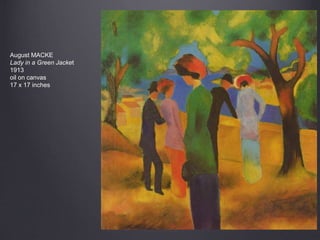
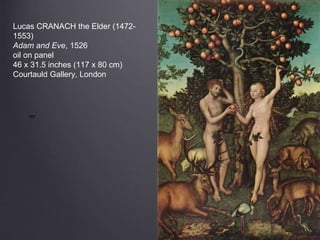
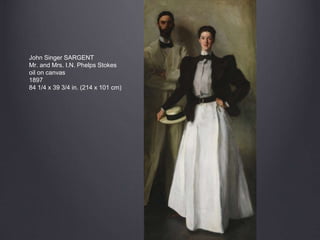
• To begin, identify the subject matter. E.g., it depicts a
woman centered between two couples. It depicts a pair of
naked figures centered around a tree. This is where you
can identify GENRE as well.
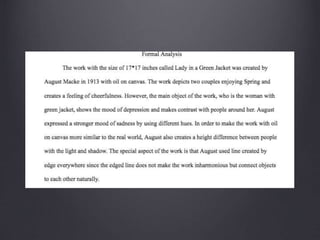
August MACKE
Lady in a Green Jacket
1913
oil on canvas
17 x 17 inches
Lucas CRANACH the Elder (1472-
1553)
Adam and Eve, 1526
oil on panel
46 x 31.5 inches (117 x 80 cm)
Courtauld Gallery, London
rrr
John Singer SARGENT
Mr. and Mrs. I.N. Phelps Stokes
oil on canvas
1897
84 1/4 x 39 3/4 in. (214 x 101 cm)
subject matter is then set
aside, for the moment
• In a formal analysis, the point is to focus upon the formal
construction of the picture. The picture is built from lines,
colors, textures, shapes, etc. Keep the focus on these.
• In a formal analysis proper, you do not need to provide an
interpretation, or account of the picture's meaning. You
only need to understand how the picture is put together
from visible elements.
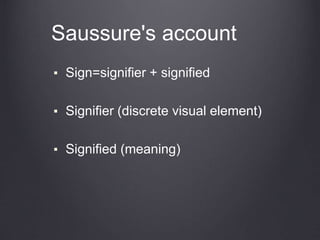
Saussure's account
▪ Sign=signifier + signified
▪ Signifier (discrete visual element)
▪ Signified (meaning)
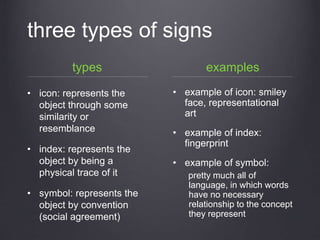
three types of signs
types
• icon: represents the
object through some
similarity or
resemblance
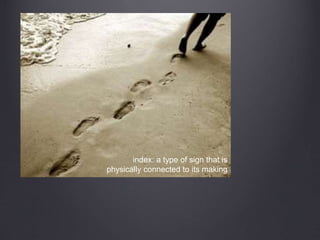
• index: represents the
object by being a
physical trace of it
• symbol: represents the
object by convention
(social agreement)
examples
• example of icon: smiley
face, representational
art
• example of index:
fingerprint
• example of symbol:
pretty much all of
language, in which words
have no necessary
relationship to the concept
they represent
index: a type of sign that is
physically connected to its making
quick review
• Saussure:
• it links sounds (or images) with mental concepts
• language is arbitrary and culturally bound
• terminology
• every sign consists of two parts:
• a signifier (pattern of letters, sounds, or forms)
• a signified (a set of concepts and associations that those
forms trigger in the viewer's mind
quick review
• Peirce ("Purse")
creates terminology for different types of signs
they are differentiated based upon the relationship of the sign
to reality
• symbol (all of language): arbitrary relationship to what it
represents; to understand you have to know the convention
• icon (would include a lot of imagery): in some way looks like
what it represents
• index: is a physical trace of the process that produced it
UVC100_Fall16_Class7.1

UVC100_Fall16_Class7.1

  • 1.
  • 2.
    agenda 10.4.16 • fortest on Thursday, Oct 6 at 2 PM • log into Compass • there is no link to live class session • instead, look for link to test at top of page • if you need assistance, email me at: jenbee60@illinois.edu • I will be available over email through the test. • Take the test only once. It is set to accept multiple attempts only in case of glitches.
  • 3.
    what is formalanalysis? • It is a way of focusing upon the visual structure of the artwork in order to understand it better.
  • 4.
    separate form fromcontent • To begin, identify the subject matter. E.g., it depicts a woman centered between two couples. It depicts a pair of naked figures centered around a tree. This is where you can identify GENRE as well.
  • 5.
    August MACKE Lady ina Green Jacket 1913 oil on canvas 17 x 17 inches
  • 6.
    Lucas CRANACH theElder (1472- 1553) Adam and Eve, 1526 oil on panel 46 x 31.5 inches (117 x 80 cm) Courtauld Gallery, London rrr
  • 7.
    John Singer SARGENT Mr.and Mrs. I.N. Phelps Stokes oil on canvas 1897 84 1/4 x 39 3/4 in. (214 x 101 cm)
  • 8.
    subject matter isthen set aside, for the moment • In a formal analysis, the point is to focus upon the formal construction of the picture. The picture is built from lines, colors, textures, shapes, etc. Keep the focus on these. • In a formal analysis proper, you do not need to provide an interpretation, or account of the picture's meaning. You only need to understand how the picture is put together from visible elements.
  • 9.
    Saussure's account ▪ Sign=signifier+ signified ▪ Signifier (discrete visual element) ▪ Signified (meaning)
  • 10.
    three types ofsigns types • icon: represents the object through some similarity or resemblance • index: represents the object by being a physical trace of it • symbol: represents the object by convention (social agreement) examples • example of icon: smiley face, representational art • example of index: fingerprint • example of symbol: pretty much all of language, in which words have no necessary relationship to the concept they represent
  • 11.
    index: a typeof sign that is physically connected to its making
  • 12.
    quick review • Saussure: •it links sounds (or images) with mental concepts • language is arbitrary and culturally bound • terminology • every sign consists of two parts: • a signifier (pattern of letters, sounds, or forms) • a signified (a set of concepts and associations that those forms trigger in the viewer's mind
  • 13.
    quick review • Peirce("Purse") creates terminology for different types of signs they are differentiated based upon the relationship of the sign to reality • symbol (all of language): arbitrary relationship to what it represents; to understand you have to know the convention • icon (would include a lot of imagery): in some way looks like what it represents • index: is a physical trace of the process that produced it