Assigned by: Dr Amjad Arain
Test
A procedure for critical evaluation; a means
of determining the presence, quality, or truth
of something.
Administration
A procedure for critical evaluation; a means
of determining the presence, quality, or truth
of something.
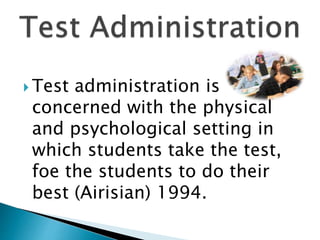
 Test administration is
concerned with the physical
and psychological setting in
which students take the test,
foe the students to do their
best (Airisian) 1994.
 Administering the written test is perhaps the
most important aspect of the examining
process. The atmosphere the test
administrator creates in the test room and
the attitude the test administrator displays in
performing his/her duties is extremely
important.
 The test administrator’s manner, bearing, and
attitude may well inspire confidence in
competitors and put them at ease while
participating in the testing process.
 Aim of test is to measure achievement of a student
or group of students. However, there are also tests
that are considered legitimate, but failed to provide
information needed to a teacher or a particular
party. Probably due to factors such as:
• The test was not conducted properly.
• Maybe the test can be a criterion reference test
or norm-referenced tests. Once the items are
perfectly ready for use and in line assessment
objectives, the next step is to administer the test to
students. In order to guarantee the validity of a
test, seat positioning and location of the
examination hall / room and etc.
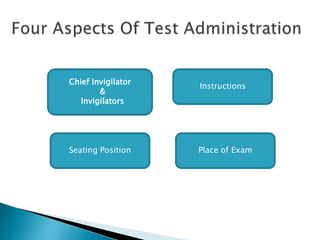
Place of ExamSeating Position
Instructions
Chief Invigilator
&
Invigilators
 A teachers test administration procedures can
have great impact on student test
performance.
 Before the test
 After Distributing Test Papers
 During the Test
 After the Test
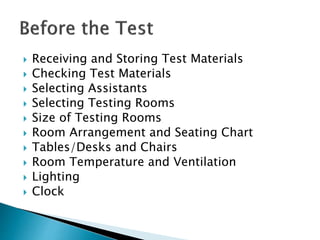
 Receiving and Storing Test Materials
 Checking Test Materials
 Selecting Assistants
 Selecting Testing Rooms
 Size of Testing Rooms
 Room Arrangement and Seating Chart
 Tables/Desks and Chairs
 Room Temperature and Ventilation
 Lighting
 Clock
 Humanizing the test
 Illegal recordings and requests for media coverage
 Visitors
 Before entering the testing room: materials checklist
 Inside the testing room
 Equipment/Facilities checklist
 Test center procedures and regulations
 Identifying and admitting examinees to the testing room
 Identification requirements
 Seating the examinees
 Close room
 Distributing test materials
 Preliminary information
 Maintaining security after the test begins
 Impersonation
 Conduct and prohibited materials
 Require students to remove unnecessary
materials from they desk.
 Have students sit in alternating seats.
 Go around the testing room and observe
students during testing.
 Prohibit the borrowing of materials like pen
and eraser.
 Prepare alternate from of the test
 Collecting Test Materials
 Dismissing Examinees
 Returning Materials
 (a) Before exam starts
• Candidates instructed to enter the examination hall / room
and seated at the table that had been set.
• Candidates are reminded not to perform any examination
misconduct, mimic answer or discuss with other candidates.
• Candidates are instructed to fill in the answer sheet, such as
the candidate's name, class and so on. • Candidates are directed
to review the examination papers so that there are no mistakes,
such as not enough pages, unclear printing or wrong question
paper.
 (b) During the exam.
• When its time to answer questions, the chief invigilator must
give instructions to the candidates to begin to answer questions
and time left to finished the last attempt.
 (c) Before exam ends.
• When the time is almost up, normally 15
minutes before time, chief invigilator must
inform candidates of the remaining time
left.
 (d) After exam ends
• Chief invigilator must instruct candidates
to stop answering, putting down their pen
on the table and stay put
• Chief invigilator must inform candidates
to be seated until all papers are collected
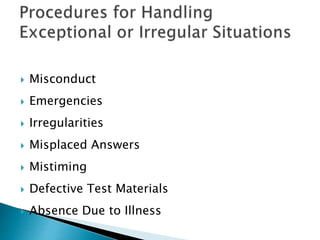
 Misconduct
 Emergencies
 Irregularities
 Misplaced Answers
 Mistiming
 Defective Test Materials
 Absence Due to Illness
 Avoid talking
 Keep interruption
 Avoid giving hints
 Discourage cheating
Thank You

Factors in Test Administeration

  • 1.
    Assigned by: DrAmjad Arain
  • 2.
    Test A procedure forcritical evaluation; a means of determining the presence, quality, or truth of something. Administration A procedure for critical evaluation; a means of determining the presence, quality, or truth of something.
  • 3.
     Test administrationis concerned with the physical and psychological setting in which students take the test, foe the students to do their best (Airisian) 1994.
  • 4.
     Administering thewritten test is perhaps the most important aspect of the examining process. The atmosphere the test administrator creates in the test room and the attitude the test administrator displays in performing his/her duties is extremely important.  The test administrator’s manner, bearing, and attitude may well inspire confidence in competitors and put them at ease while participating in the testing process.
  • 5.
     Aim oftest is to measure achievement of a student or group of students. However, there are also tests that are considered legitimate, but failed to provide information needed to a teacher or a particular party. Probably due to factors such as: • The test was not conducted properly. • Maybe the test can be a criterion reference test or norm-referenced tests. Once the items are perfectly ready for use and in line assessment objectives, the next step is to administer the test to students. In order to guarantee the validity of a test, seat positioning and location of the examination hall / room and etc.
  • 6.
    Place of ExamSeatingPosition Instructions Chief Invigilator & Invigilators
  • 7.
     A teacherstest administration procedures can have great impact on student test performance.  Before the test  After Distributing Test Papers  During the Test  After the Test
  • 8.
     Receiving andStoring Test Materials  Checking Test Materials  Selecting Assistants  Selecting Testing Rooms  Size of Testing Rooms  Room Arrangement and Seating Chart  Tables/Desks and Chairs  Room Temperature and Ventilation  Lighting  Clock
  • 9.
     Humanizing thetest  Illegal recordings and requests for media coverage  Visitors  Before entering the testing room: materials checklist  Inside the testing room  Equipment/Facilities checklist  Test center procedures and regulations  Identifying and admitting examinees to the testing room  Identification requirements  Seating the examinees  Close room  Distributing test materials  Preliminary information  Maintaining security after the test begins  Impersonation  Conduct and prohibited materials
  • 11.
     Require studentsto remove unnecessary materials from they desk.  Have students sit in alternating seats.  Go around the testing room and observe students during testing.  Prohibit the borrowing of materials like pen and eraser.  Prepare alternate from of the test
  • 12.
     Collecting TestMaterials  Dismissing Examinees  Returning Materials
  • 13.
     (a) Beforeexam starts • Candidates instructed to enter the examination hall / room and seated at the table that had been set. • Candidates are reminded not to perform any examination misconduct, mimic answer or discuss with other candidates. • Candidates are instructed to fill in the answer sheet, such as the candidate's name, class and so on. • Candidates are directed to review the examination papers so that there are no mistakes, such as not enough pages, unclear printing or wrong question paper.  (b) During the exam. • When its time to answer questions, the chief invigilator must give instructions to the candidates to begin to answer questions and time left to finished the last attempt.
  • 14.
     (c) Beforeexam ends. • When the time is almost up, normally 15 minutes before time, chief invigilator must inform candidates of the remaining time left.  (d) After exam ends • Chief invigilator must instruct candidates to stop answering, putting down their pen on the table and stay put • Chief invigilator must inform candidates to be seated until all papers are collected
  • 15.
     Misconduct  Emergencies Irregularities  Misplaced Answers  Mistiming  Defective Test Materials  Absence Due to Illness
  • 16.
     Avoid talking Keep interruption  Avoid giving hints  Discourage cheating
  • 17.