ACHIEVEMENT
TEST
Presented to:
DR UMMARA SAHER
Presented by
Muhammad Yasir Iqbal Qazi
Noman Bilal
Usama Sheikh
Contents:
• What is Achievement Tests
• Types of Achievement Tests
• Standardized Achievement Tests
• Features of Achievement Test
• Characteristics of Standardized Achievement Tests
• Standardized tests versus Informal Classroom Tests
• Classification of SAT
• Conclusion
Achievement Test
An Achievement test is an assessment of developed knowledge or
skill. Achievement tests are developed to measure skills and
knowledge learned in a given grade level, usually through planned
instruction.
There are two basic types of achievement tests:
I. Standardized Tests
II. Informal Tests
The most common type of achievement test is a standardized test,
such as the SAT.
Standardized Achievement Test
(SAT)
• Constructed by individual or by a group of
individuals
• Are being processed and universalized for all the
situations and for all the purposes
• Requires more thinking, planning, exact
preparation, scoring, analysis and refinement.
• It is a complex and multidimensional work
• Have the qualities that provides a systematic
procedure for describing behaviors.
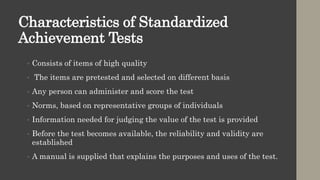
Characteristics of Standardized
Achievement Tests
• Consists of items of high quality
• The items are pretested and selected on different basis
• Any person can administer and score the test
• Norms, based on representative groups of individuals
• Information needed for judging the value of the test is provided
• Before the test becomes available, the reliability and validity are
established
• A manual is supplied that explains the purposes and uses of the test.
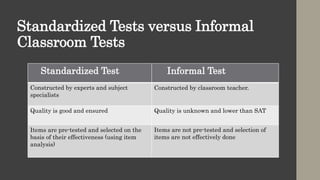
Standardized Tests versus Informal
Classroom Tests
Standardized Test Informal Test
Constructed by experts and subject
specialists
Constructed by classroom teacher.
Quality is good and ensured Quality is unknown and lower than SAT
Items are pre-tested and selected on the
basis of their effectiveness (using item
analysis)
Items are not pre-tested and selection of
items are not effectively done
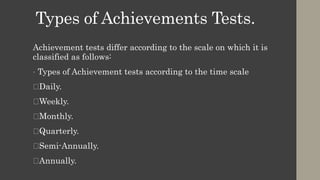
Types of Achievements Tests.
Achievement tests differ according to the scale on which it is
classified as follows:
• Types of Achievement tests according to the time scale
Daily.
Weekly.
Monthly.
Quarterly.
Semi-Annually.
Annually.
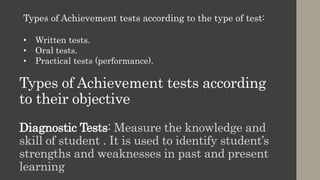
Types of Achievement tests according to the type of test:
• Written tests.
• Oral tests.
• Practical tests (performance).
Types of Achievement tests according
to their objective
Diagnostic Tests: Measure the knowledge and
skill of student . It is used to identify student’s
strengths and weaknesses in past and present
learning
• Speed Tests: They are determined by a specific response time
to measure how quickly the examinee can give the correct
answers.
• Competency Tests: They aim to assess the
examiner’s efficiency and ability to answer the questions
correctly.
• Performance Tests: They are not timed and aim to
measure the greatest percentage of correct answers that the
examinee can give.
• Predictive Tests: they aim to anticipate the level of
performance that the examinee will achieve in learning a
subject or performing a particular skill.
Features of Achievement Test
• Validity:
When the content of the test is appropriate to assess its specific
purpose and does not assess other purposes instead.
• Objectivity:
An objective test is one in which the same examiner receives the
same score, even if the correctors are different.
• Clarity:
Each test must be associated with a clear and specific purpose
before it is administered.
Standardized Achievement Test
Batteries:
• SAT is frequently used in the form of survey test batteries
• These test batteries often are used to document current
functioning levels or progress in many different areas
• The benefit of the battery approach is that it permits
comparison of individual performances across diverse
subjects
• This is why survey batteries are more popular than single
subject achievement tests
Supplements to Standardized Tests
• Direct writing assessment
• Stanford writing program
• Four different modes
1. Descriptive (students are asked to write about a place or thing of their
own experience)
2. Narrative(the prompt present a brief scenario and students are asked to
write a story)
3. Expository(students are asked to state an opinion regarding a topic and
define it)
4. Persuasive( students are asked to write about an issue from their own
point of view)
Diagnostic Batteries for Instructional
use
• Achievement Test batteries traditionally were
designed as survey test
• Stanford Achievement Test
• The California Achievement Test
• Terranova CTBS
Achievement Tests in Specific Areas
• It is designed to measure a person's level of skill, accomplishment,
or knowledge in a specific area.
Different Modes:
Separate Content – Oriented Tests ( all these tests of specific
course content are intended as end of course tests and used to
measure the students 'final levels of achievement' )
Reading Tests ( identifies the meaning of given words, use of
words, selection, purpose, main thought and the writers tone mood
and content)
• Basic achievement Skills individual screener (Grade 1 To
Adult)
• Peabody Individual Achievement Test – Revised ( K to Adult)
• KeyMath Diagnostic Arithmetic Test ( K to Grade 6)
• Woodcock Reading Mastery Tests – Revised ( K to Adult )
Ø Readiness Tests
• Early School Readiness Achievement Tests
• Reading Readiness Tests
Individual Achievement Tests
Each of these tests can be administered 30 to 60 minutes with
much of the scoring completed during the administration
Conclusion;
• Achievement tests and testing are part of education, business,
and the regulation of professions
• These tests are increasing in use internationally.
• The development of high-quality, accessible achievement tests
requires substantial knowledge of a content area – such as
mathematics, language arts, or science – and the design of test
items or tasks that are fair and valid measures of important
knowledge and skills in a given content area.
• The selection and sound use of achievement tests also requires
substantial skills to ensure they are appropriate for the purpose
intended and to avoid negative consequences.
• There are considerable resources and an abundance of
information on achievement tests and sound
testing practices.
• With appropriate attention and training, achievement tests
can provide users valuable information about learners'
achievement progress and status.
Thank You.. :)

Achievement Test for Assessment Presentation

  • 1.
    ACHIEVEMENT TEST Presented to: DR UMMARASAHER Presented by Muhammad Yasir Iqbal Qazi Noman Bilal Usama Sheikh
  • 2.
    Contents: • What isAchievement Tests • Types of Achievement Tests • Standardized Achievement Tests • Features of Achievement Test • Characteristics of Standardized Achievement Tests • Standardized tests versus Informal Classroom Tests • Classification of SAT • Conclusion
  • 3.
    Achievement Test An Achievementtest is an assessment of developed knowledge or skill. Achievement tests are developed to measure skills and knowledge learned in a given grade level, usually through planned instruction. There are two basic types of achievement tests: I. Standardized Tests II. Informal Tests The most common type of achievement test is a standardized test, such as the SAT.
  • 4.
    Standardized Achievement Test (SAT) •Constructed by individual or by a group of individuals • Are being processed and universalized for all the situations and for all the purposes • Requires more thinking, planning, exact preparation, scoring, analysis and refinement. • It is a complex and multidimensional work • Have the qualities that provides a systematic procedure for describing behaviors.
  • 5.
    Characteristics of Standardized AchievementTests • Consists of items of high quality • The items are pretested and selected on different basis • Any person can administer and score the test • Norms, based on representative groups of individuals • Information needed for judging the value of the test is provided • Before the test becomes available, the reliability and validity are established • A manual is supplied that explains the purposes and uses of the test.
  • 6.
    Standardized Tests versusInformal Classroom Tests Standardized Test Informal Test Constructed by experts and subject specialists Constructed by classroom teacher. Quality is good and ensured Quality is unknown and lower than SAT Items are pre-tested and selected on the basis of their effectiveness (using item analysis) Items are not pre-tested and selection of items are not effectively done
  • 7.
    Types of AchievementsTests. Achievement tests differ according to the scale on which it is classified as follows: • Types of Achievement tests according to the time scale Daily. Weekly. Monthly. Quarterly. Semi-Annually. Annually.
  • 8.
    Types of Achievementtests according to the type of test: • Written tests. • Oral tests. • Practical tests (performance). Types of Achievement tests according to their objective Diagnostic Tests: Measure the knowledge and skill of student . It is used to identify student’s strengths and weaknesses in past and present learning
  • 9.
    • Speed Tests:They are determined by a specific response time to measure how quickly the examinee can give the correct answers. • Competency Tests: They aim to assess the examiner’s efficiency and ability to answer the questions correctly. • Performance Tests: They are not timed and aim to measure the greatest percentage of correct answers that the examinee can give. • Predictive Tests: they aim to anticipate the level of performance that the examinee will achieve in learning a subject or performing a particular skill.
  • 10.
    Features of AchievementTest • Validity: When the content of the test is appropriate to assess its specific purpose and does not assess other purposes instead. • Objectivity: An objective test is one in which the same examiner receives the same score, even if the correctors are different. • Clarity: Each test must be associated with a clear and specific purpose before it is administered.
  • 11.
    Standardized Achievement Test Batteries: •SAT is frequently used in the form of survey test batteries • These test batteries often are used to document current functioning levels or progress in many different areas • The benefit of the battery approach is that it permits comparison of individual performances across diverse subjects • This is why survey batteries are more popular than single subject achievement tests
  • 12.
    Supplements to StandardizedTests • Direct writing assessment • Stanford writing program • Four different modes 1. Descriptive (students are asked to write about a place or thing of their own experience) 2. Narrative(the prompt present a brief scenario and students are asked to write a story) 3. Expository(students are asked to state an opinion regarding a topic and define it) 4. Persuasive( students are asked to write about an issue from their own point of view)
  • 13.
    Diagnostic Batteries forInstructional use • Achievement Test batteries traditionally were designed as survey test • Stanford Achievement Test • The California Achievement Test • Terranova CTBS
  • 14.
    Achievement Tests inSpecific Areas • It is designed to measure a person's level of skill, accomplishment, or knowledge in a specific area. Different Modes: Separate Content – Oriented Tests ( all these tests of specific course content are intended as end of course tests and used to measure the students 'final levels of achievement' ) Reading Tests ( identifies the meaning of given words, use of words, selection, purpose, main thought and the writers tone mood and content)
  • 15.
    • Basic achievementSkills individual screener (Grade 1 To Adult) • Peabody Individual Achievement Test – Revised ( K to Adult) • KeyMath Diagnostic Arithmetic Test ( K to Grade 6) • Woodcock Reading Mastery Tests – Revised ( K to Adult ) Ø Readiness Tests • Early School Readiness Achievement Tests • Reading Readiness Tests Individual Achievement Tests Each of these tests can be administered 30 to 60 minutes with much of the scoring completed during the administration
  • 16.
    Conclusion; • Achievement testsand testing are part of education, business, and the regulation of professions • These tests are increasing in use internationally. • The development of high-quality, accessible achievement tests requires substantial knowledge of a content area – such as mathematics, language arts, or science – and the design of test items or tasks that are fair and valid measures of important knowledge and skills in a given content area. • The selection and sound use of achievement tests also requires substantial skills to ensure they are appropriate for the purpose intended and to avoid negative consequences.
  • 17.
    • There areconsiderable resources and an abundance of information on achievement tests and sound testing practices. • With appropriate attention and training, achievement tests can provide users valuable information about learners' achievement progress and status.
  • 18.