19-03-2021
FACTORS CONSIDERING IN
ARCHITECTURAL DESIGN
PRINCIPLES OF PLANING
INTRODUCTION
Planning of building is the arrangements of various components or
units of a building in a systematic manner so as to form a
meaningful and homogeneous structure to meet its functional
purpose.
Before principles of planning of building are discussed in detail,
knowledge of the term “STRUCTURE “is essential.
19-03-2021
STRUCTURE
 Structure is the frame work on which elements of space enclosed
such as walls , column , beams, roofs, arches, dome, cantilevers etc.
 All the elements of the structure should full fill the foremost
requirement of safety and reliability.
CLASSIFICATION OF STRUCTURE
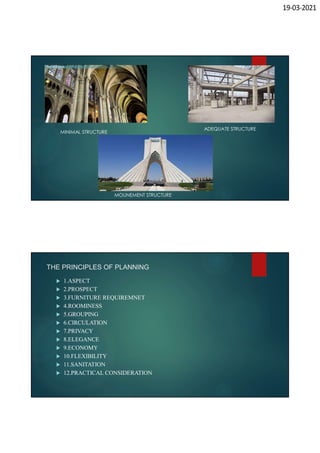
 MINIMAL : Structure which are designed using least amount of
material are known as minimal. Gothic structures are eg for minimal
structure. Minimal structure involves lots of labour, time and money.
 ADEQUATE:: In this types of design materials are loaded below
their maximum load bearing capacity and hence the factor of safety
is taken as more than 1.
 SCULPTURAL STRUCTURE: Closed and covered stadia,
monuments, airport terminal buildings are the eg for sculptural
structures. They are design to creature emotional impact.
19-03-2021
MINIMAL STRUCTURE
ADEQUATE STRUCTURE
MOUNEMENT STRUCTURE
THE PRINCIPLES OF PLANNING
 1.ASPECT
 2.PROSPECT
 3.FURNITURE REQUIREMNET
 4.ROOMINESS
 5.GROUPING
 6.CIRCULATION
 7.PRIVACY
 8.ELEGANCE
 9.ECONOMY
 10.FLEXIBILITY
 11.SANITATION
 12.PRACTICAL CONSIDERATION
19-03-2021
1.ASPECT
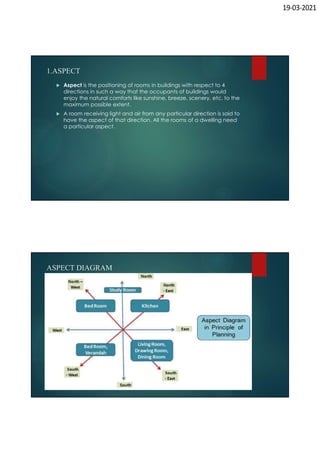
 Aspect is the positioning of rooms in buildings with respect to 4
directions in such a way that the occupants of buildings would
enjoy the natural comforts like sunshine, breeze, scenery, etc. to the
maximum possible extent.
 A room receiving light and air from any particular direction is said to
have the aspect of that direction. All the rooms of a dwelling need
a particular aspect.
ASPECT DIAGRAM
19-03-2021
1.ASPECT
 Living Room: It should have a southern or south-east aspect. The sun
is towards the south during winter and north during summer which
will provide sunshine during winter and cooler during summertime.
 Bedroom: It should have a west or south-west aspect, as the breeze
required particularly in summer would prevail from this side.
 Kitchen: It should have an eastern aspect so as to admit morning
sun refresh and purify the air.
 Gallery or Verandah: It should be north or north-east aspect.
 Classroom, Reading room: It should be laid with the north aspect as
light received from the north will be diffused and evenly distributed.
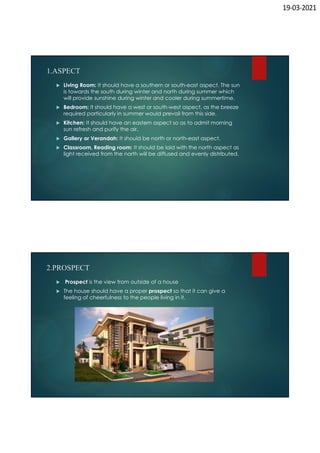
2.PROSPECT
 Prospect is the view from outside of a house
 The house should have a proper prospect so that it can give a
feeling of cheerfulness to the people living in it.
19-03-2021
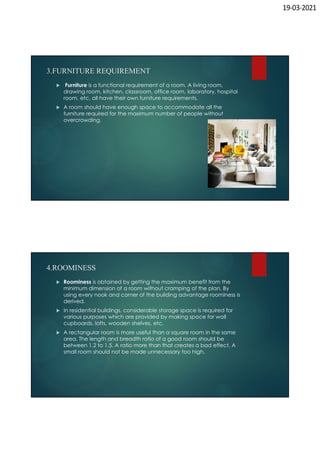
3.FURNITURE REQUIREMENT
 Furniture is a functional requirement of a room. A living room,
drawing room, kitchen, classroom, office room, laboratory, hospital
room, etc. all have their own furniture requirements.
 A room should have enough space to accommodate all the
furniture required for the maximum number of people without
overcrowding.
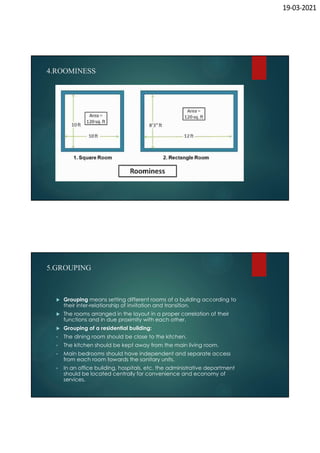
4.ROOMINESS
 Roominess is obtained by getting the maximum benefit from the
minimum dimension of a room without cramping of the plan. By
using every nook and corner of the building advantage roominess is
derived.
 In residential buildings, considerable storage space is required for
various purposes which are provided by making space for wall
cupboards, lofts, wooden shelves, etc.
 A rectangular room is more useful than a square room in the same
area. The length and breadth ratio of a good room should be
between 1.2 to 1.5. A ratio more than that creates a bad effect. A
small room should not be made unnecessary too high.
19-03-2021
4.ROOMINESS
5.GROUPING
 Grouping means setting different rooms of a building according to
their inter-relationship of invitation and transition.
 The rooms arranged in the layout in a proper correlation of their
functions and in due proximity with each other.
 Grouping of a residential building:
• The dining room should be close to the kitchen.
• The kitchen should be kept away from the main living room.
• Main bedrooms should have independent and separate access
from each room towards the sanitary units.
• In an office building, hospitals, etc. the administrative department
should be located centrally for convenience and economy of
services.
19-03-2021
6.CIRCULATION
 Access or internal connection between rooms on the same floor or
between floors is known a circulation.
 Circulation between rooms of the same floor is called horizontal
circulation like- passages, corridors, halls, etc. Circulation between
various floors is known as vertical circulation, like- stairs, lifts, etc.
 Horizontal circulation should be independent, short, and straight not
invade the property of any room. All the passages should be well
ventilated and lighted.
 Stairs should also be well lighted and ventilated and properly
planned in regard to width, rise, and tread. Stairs should not have
winder steps.

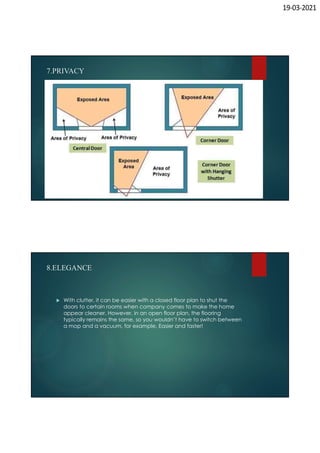
7.PRIVACY
 Privacy is an important part of building planning. Privacy may be
from one part to another of the same building or could be from
neighboring buildings, streets, etc
 In residential buildings, every room should have certain privacy
which can be secured carefully planning the entrance, path-ways,
and drives.
 Proper grouping of rooms, good positioning of doors and windows,
lobbies, or screens can give required internal privacy. Toilet rooms,
bedrooms, w.c. and urinals should have absolute privacy.
19-03-2021
7.PRIVACY
8.ELEGANCE
 With clutter, it can be easier with a closed floor plan to shut the
doors to certain rooms when company comes to make the home
appear cleaner. However, in an open floor plan, the flooring
typically remains the same, so you wouldn’t have to switch between
a mop and a vacuum, for example. Easier and faster!
19-03-2021
9.ECONOMY
 The economy is a major factor in building planning. To fit the
proposed scheme within the limitations of the resources and funds
certain alterations and omissions in the original plan have to make.
 But while considering the economy, the required strength and
durability of the structure should not be compromised.
 Some simple economy achieving approaches in buildings are:
 Simple elevation, dispensing of porches, lobbies etc.
 Steeper rise to the stair, wider steps in stair.
 Reducing the story height to bare-minimum.
 Standardization of sizes of various components and materials.
10.FLEXIBILITY
 Flexibility means planning the rooms in such a way that though
originally designed for a specific purpose, may be used for other
purposes also when desired.
 For designing houses for middle-class families or other buildings
where the economy is the main consideration flexibility should
always be considered.
 If large space needed in a certain time a house to accommodate
the gathering. It can be obtained by removing a removable
partition wall or curtain between the room and the dining room.
Alternatively, an open yard, garden, or verandah can also be
provided.
19-03-2021
11.SANITATION
 Sanitation of building not only associated with urinals, bath-rooms,
wash-basins, sinks but also the overall lighting and ventilation.
 All the parts of a building should have well lighting and ventilation to
maintain good hygienic conditions. This could be done in a natural
way or in an artificial way (air condition).
12.PRACTICAL CONSIDERATION
Besides all the fundamentals of planning discussed, the
following practical points should be additionally considered
 Strength, stability, convenience and comfort of the occupants of
the building, should be considered first.
 Provisions for future extensions without dismantling should be made
in the planning.
 Elevation should be simply yet attractive. Too many porches may
give good elevation for some time, but in the end, simple designs fit
better for generations.
 The building should be strong and capable to withstand the likely
adverse effects of natural agencies (earthquake, flood, storm etc.)
19-03-2021
CLOSED PLANNING and OPEN PLANNING
 In a traditional or closed floor plan, each designated area of the home
becomes a separate space or room, enclosed with walls.
 In an open floor plan, no walls exist between the different areas, so a
living room, kitchen, and dining area may all share one large space.
 Here are 7 things to consider about each floor plan.
1. Aesthetics
2. Space
3. Safety
4. Privacy
5. Smells
6. Cleanliness
7. Resale Value
1. Aesthetics
 Open floor plans are often associated with a more modern style,Bec
it is a larger area it should be compliment to each other , this make
little bit difficult for the designers
 a closed floor plan, each room can have an individual style, color,
or theme. So, while your interior design may be cohesive throughout
the entire home, not every detail needs to match, which provides
more options and can make designing easier.
19-03-2021
2. Space
 Without walls to break up the flow of the room in an open floor plan,
it allows people to move around more easily, both for accessibility
and socializing. Open floor plans also offer more flexibility when it
comes to how you use the space.
 Walls used in closed floor plans may make areas feel smaller and
chop up the home visually. On the other hand, this can also have
the effect of making rooms feel cozier and warmer.
3. Safety
 One of the biggest advantages to open floor plans is the line of sight
it offers to caregivers and parents. When there are no walls, it is
much easier to pay attention to small children or elderly relatives
who may need constant supervision.
19-03-2021
4.privacy
 When it comes to privacy, however, open floor plans have limits that
closed floor plans do not. Without doors or separate rooms, it can
be more difficult to carry out certain tasks without others seeing you.
Walls and doors offer more sound-proofing for the home, giving
greater privacy as well.

5. Smells
 Some people dislike cooking smells in the house. In an open floor
plan, the kitchen is open to the living areas of the home. This means
that strong cooking odors travel throughout the house. For some
people, this can be a drawback, particularly if you cook with spices
or are susceptible to smells.
19-03-2021
6.Cleanliness
 With clutter, it can be easier with a closed floor plan to shut the
doors to certain rooms when company comes to make the home
appear cleaner. However, in an open floor plan, the flooring
typically remains the same, so you wouldn’t have to switch between
a mop and a vacuum, for example. Easier and faster!
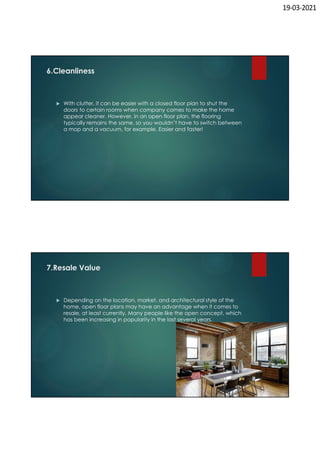
7.Resale Value
 Depending on the location, market, and architectural style of the
home, open floor plans may have an advantage when it comes to
resale, at least currently. Many people like the open concept, which
has been increasing in popularity in the last several years.

Factors considered in Architectural design.pdf

  • 1.
    19-03-2021 FACTORS CONSIDERING IN ARCHITECTURALDESIGN PRINCIPLES OF PLANING INTRODUCTION Planning of building is the arrangements of various components or units of a building in a systematic manner so as to form a meaningful and homogeneous structure to meet its functional purpose. Before principles of planning of building are discussed in detail, knowledge of the term “STRUCTURE “is essential.
  • 2.
    19-03-2021 STRUCTURE  Structure isthe frame work on which elements of space enclosed such as walls , column , beams, roofs, arches, dome, cantilevers etc.  All the elements of the structure should full fill the foremost requirement of safety and reliability. CLASSIFICATION OF STRUCTURE  MINIMAL : Structure which are designed using least amount of material are known as minimal. Gothic structures are eg for minimal structure. Minimal structure involves lots of labour, time and money.  ADEQUATE:: In this types of design materials are loaded below their maximum load bearing capacity and hence the factor of safety is taken as more than 1.  SCULPTURAL STRUCTURE: Closed and covered stadia, monuments, airport terminal buildings are the eg for sculptural structures. They are design to creature emotional impact.
  • 3.
    19-03-2021 MINIMAL STRUCTURE ADEQUATE STRUCTURE MOUNEMENTSTRUCTURE THE PRINCIPLES OF PLANNING  1.ASPECT  2.PROSPECT  3.FURNITURE REQUIREMNET  4.ROOMINESS  5.GROUPING  6.CIRCULATION  7.PRIVACY  8.ELEGANCE  9.ECONOMY  10.FLEXIBILITY  11.SANITATION  12.PRACTICAL CONSIDERATION
  • 4.
    19-03-2021 1.ASPECT  Aspect isthe positioning of rooms in buildings with respect to 4 directions in such a way that the occupants of buildings would enjoy the natural comforts like sunshine, breeze, scenery, etc. to the maximum possible extent.  A room receiving light and air from any particular direction is said to have the aspect of that direction. All the rooms of a dwelling need a particular aspect. ASPECT DIAGRAM
  • 5.
    19-03-2021 1.ASPECT  Living Room:It should have a southern or south-east aspect. The sun is towards the south during winter and north during summer which will provide sunshine during winter and cooler during summertime.  Bedroom: It should have a west or south-west aspect, as the breeze required particularly in summer would prevail from this side.  Kitchen: It should have an eastern aspect so as to admit morning sun refresh and purify the air.  Gallery or Verandah: It should be north or north-east aspect.  Classroom, Reading room: It should be laid with the north aspect as light received from the north will be diffused and evenly distributed. 2.PROSPECT  Prospect is the view from outside of a house  The house should have a proper prospect so that it can give a feeling of cheerfulness to the people living in it.
  • 6.
    19-03-2021 3.FURNITURE REQUIREMENT  Furnitureis a functional requirement of a room. A living room, drawing room, kitchen, classroom, office room, laboratory, hospital room, etc. all have their own furniture requirements.  A room should have enough space to accommodate all the furniture required for the maximum number of people without overcrowding. 4.ROOMINESS  Roominess is obtained by getting the maximum benefit from the minimum dimension of a room without cramping of the plan. By using every nook and corner of the building advantage roominess is derived.  In residential buildings, considerable storage space is required for various purposes which are provided by making space for wall cupboards, lofts, wooden shelves, etc.  A rectangular room is more useful than a square room in the same area. The length and breadth ratio of a good room should be between 1.2 to 1.5. A ratio more than that creates a bad effect. A small room should not be made unnecessary too high.
  • 7.
    19-03-2021 4.ROOMINESS 5.GROUPING  Grouping meanssetting different rooms of a building according to their inter-relationship of invitation and transition.  The rooms arranged in the layout in a proper correlation of their functions and in due proximity with each other.  Grouping of a residential building: • The dining room should be close to the kitchen. • The kitchen should be kept away from the main living room. • Main bedrooms should have independent and separate access from each room towards the sanitary units. • In an office building, hospitals, etc. the administrative department should be located centrally for convenience and economy of services.
  • 8.
    19-03-2021 6.CIRCULATION  Access orinternal connection between rooms on the same floor or between floors is known a circulation.  Circulation between rooms of the same floor is called horizontal circulation like- passages, corridors, halls, etc. Circulation between various floors is known as vertical circulation, like- stairs, lifts, etc.  Horizontal circulation should be independent, short, and straight not invade the property of any room. All the passages should be well ventilated and lighted.  Stairs should also be well lighted and ventilated and properly planned in regard to width, rise, and tread. Stairs should not have winder steps.  7.PRIVACY  Privacy is an important part of building planning. Privacy may be from one part to another of the same building or could be from neighboring buildings, streets, etc  In residential buildings, every room should have certain privacy which can be secured carefully planning the entrance, path-ways, and drives.  Proper grouping of rooms, good positioning of doors and windows, lobbies, or screens can give required internal privacy. Toilet rooms, bedrooms, w.c. and urinals should have absolute privacy.
  • 9.
    19-03-2021 7.PRIVACY 8.ELEGANCE  With clutter,it can be easier with a closed floor plan to shut the doors to certain rooms when company comes to make the home appear cleaner. However, in an open floor plan, the flooring typically remains the same, so you wouldn’t have to switch between a mop and a vacuum, for example. Easier and faster!
  • 10.
    19-03-2021 9.ECONOMY  The economyis a major factor in building planning. To fit the proposed scheme within the limitations of the resources and funds certain alterations and omissions in the original plan have to make.  But while considering the economy, the required strength and durability of the structure should not be compromised.  Some simple economy achieving approaches in buildings are:  Simple elevation, dispensing of porches, lobbies etc.  Steeper rise to the stair, wider steps in stair.  Reducing the story height to bare-minimum.  Standardization of sizes of various components and materials. 10.FLEXIBILITY  Flexibility means planning the rooms in such a way that though originally designed for a specific purpose, may be used for other purposes also when desired.  For designing houses for middle-class families or other buildings where the economy is the main consideration flexibility should always be considered.  If large space needed in a certain time a house to accommodate the gathering. It can be obtained by removing a removable partition wall or curtain between the room and the dining room. Alternatively, an open yard, garden, or verandah can also be provided.
  • 11.
    19-03-2021 11.SANITATION  Sanitation ofbuilding not only associated with urinals, bath-rooms, wash-basins, sinks but also the overall lighting and ventilation.  All the parts of a building should have well lighting and ventilation to maintain good hygienic conditions. This could be done in a natural way or in an artificial way (air condition). 12.PRACTICAL CONSIDERATION Besides all the fundamentals of planning discussed, the following practical points should be additionally considered  Strength, stability, convenience and comfort of the occupants of the building, should be considered first.  Provisions for future extensions without dismantling should be made in the planning.  Elevation should be simply yet attractive. Too many porches may give good elevation for some time, but in the end, simple designs fit better for generations.  The building should be strong and capable to withstand the likely adverse effects of natural agencies (earthquake, flood, storm etc.)
  • 12.
    19-03-2021 CLOSED PLANNING andOPEN PLANNING  In a traditional or closed floor plan, each designated area of the home becomes a separate space or room, enclosed with walls.  In an open floor plan, no walls exist between the different areas, so a living room, kitchen, and dining area may all share one large space.  Here are 7 things to consider about each floor plan. 1. Aesthetics 2. Space 3. Safety 4. Privacy 5. Smells 6. Cleanliness 7. Resale Value 1. Aesthetics  Open floor plans are often associated with a more modern style,Bec it is a larger area it should be compliment to each other , this make little bit difficult for the designers  a closed floor plan, each room can have an individual style, color, or theme. So, while your interior design may be cohesive throughout the entire home, not every detail needs to match, which provides more options and can make designing easier.
  • 13.
    19-03-2021 2. Space  Withoutwalls to break up the flow of the room in an open floor plan, it allows people to move around more easily, both for accessibility and socializing. Open floor plans also offer more flexibility when it comes to how you use the space.  Walls used in closed floor plans may make areas feel smaller and chop up the home visually. On the other hand, this can also have the effect of making rooms feel cozier and warmer. 3. Safety  One of the biggest advantages to open floor plans is the line of sight it offers to caregivers and parents. When there are no walls, it is much easier to pay attention to small children or elderly relatives who may need constant supervision.
  • 14.
    19-03-2021 4.privacy  When itcomes to privacy, however, open floor plans have limits that closed floor plans do not. Without doors or separate rooms, it can be more difficult to carry out certain tasks without others seeing you. Walls and doors offer more sound-proofing for the home, giving greater privacy as well.  5. Smells  Some people dislike cooking smells in the house. In an open floor plan, the kitchen is open to the living areas of the home. This means that strong cooking odors travel throughout the house. For some people, this can be a drawback, particularly if you cook with spices or are susceptible to smells.
  • 15.
    19-03-2021 6.Cleanliness  With clutter,it can be easier with a closed floor plan to shut the doors to certain rooms when company comes to make the home appear cleaner. However, in an open floor plan, the flooring typically remains the same, so you wouldn’t have to switch between a mop and a vacuum, for example. Easier and faster! 7.Resale Value  Depending on the location, market, and architectural style of the home, open floor plans may have an advantage when it comes to resale, at least currently. Many people like the open concept, which has been increasing in popularity in the last several years.