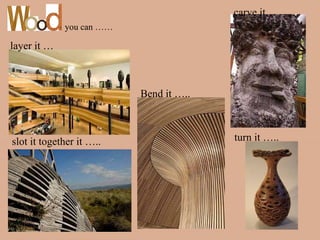
layer it …
carve it…
slot it together it …..
Bend it …..
you can ……
turn it …..
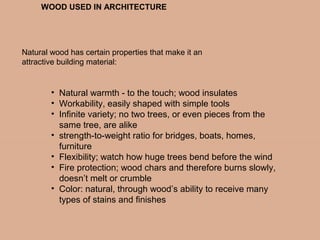
• Natural warmth - to the touch; wood insulates
• Workability, easily shaped with simple tools
• Infinite variety; no two trees, or even pieces from the
same tree, are alike
• strength-to-weight ratio for bridges, boats, homes,
furniture
• Flexibility; watch how huge trees bend before the wind
• Fire protection; wood chars and therefore burns slowly,
doesn’t melt or crumble
• Color: natural, through wood’s ability to receive many
types of stains and finishes
WOOD USED IN ARCHITECTURE
Natural wood has certain properties that make it an
attractive building material:
a. Softwoods come from the conifers (evergreens)
which have needles instead of leaves, e.g. pine
b. Hardwoods come from the broad-leaved or
deciduous trees. Most Philippine timber are of this
latter kind
CLASSIFICATION OF WOOD
Woods are generally classified into:
The terms “hardwood” and “softwood” are often
misleading because they have no direct relation to the
actual physical hardness or softness of the wood, so
that a hardwood may actually be softer than a
softwood.
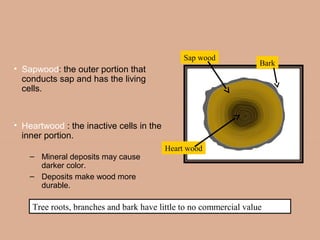
• Sapwood: the outer portion that
conducts sap and has the living
cells.
• Heartwood : the inactive cells in the
inner portion.
– Mineral deposits may cause
darker color.
– Deposits make wood more
durable.
Tree roots, branches and bark have little to no commercial value
Heart wood
Sap wood
Bark
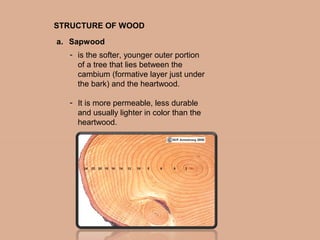
a. Sapwood
STRUCTURE OF WOOD
- is the softer, younger outer portion
of a tree that lies between the
cambium (formative layer just under
the bark) and the heartwood.
- It is more permeable, less durable
and usually lighter in color than the
heartwood.
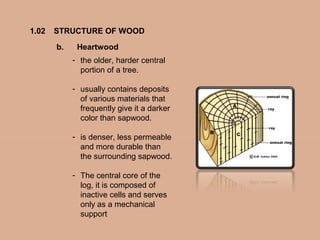
b. Heartwood
1.02 STRUCTURE OF WOOD
- the older, harder central
portion of a tree.
- usually contains deposits
of various materials that
frequently give it a darker
color than sapwood.
- is denser, less permeable
and more durable than
the surrounding sapwood.
- The central core of the
log, it is composed of
inactive cells and serves
only as a mechanical
support
PROPERTIES OF WOOD
a. Hardness. This is measured by the compression
which a piece of timber undergoes when a weight
is applied to it.
b.Flexibility. The amount of piece will bend before
breaking . Softwoods are generally brittle while
most hardwoods are flexible.
c. Strength
d.Durability.
DEFECTS OF WOOD
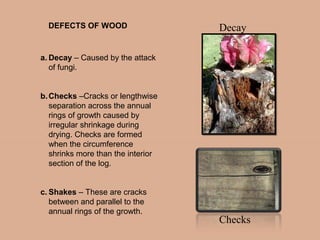
a. Decay – Caused by the attack
of fungi.
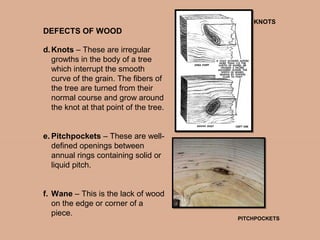
b.Checks –Cracks or lengthwise
separation across the annual
rings of growth caused by
irregular shrinkage during
drying. Checks are formed
when the circumference
shrinks more than the interior
section of the log.
c. Shakes – These are cracks
between and parallel to the
annual rings of the growth.
Checks
Decay
DEFECTS OF WOOD
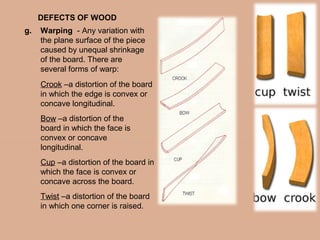
d.Knots – These are irregular
growths in the body of a tree
which interrupt the smooth
curve of the grain. The fibers of
the tree are turned from their
normal course and grow around
the knot at that point of the tree.
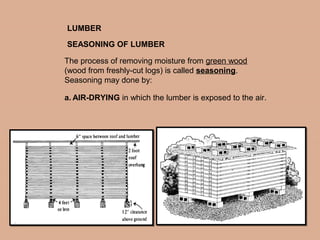
e. Pitchpockets – These are well-
defined openings between
annual rings containing solid or
liquid pitch.
f. Wane – This is the lack of wood
on the edge or corner of a
piece.
PITCHPOCKETS
KNOTS
DEFECTS OF WOOD
g. Warping - Any variation with
the plane surface of the piece
caused by unequal shrinkage
of the board. There are
several forms of warp:
Crook –a distortion of the board
in which the edge is convex or
concave longitudinal.
Bow –a distortion of the
board in which the face is
convex or concave
longitudinal.
Cup –a distortion of the board in
which the face is convex or
concave across the board.
Twist –a distortion of the board
in which one corner is raised.
Wood that is used in construction is called LUMBER.
CLASSIFICATION OF LUMBER
LUMBER
Lumber is classified by its size or dimensions measured
in inches, for example, a piece of lumber measuring 2
inches by 4 inches is called 2 x 4.
Generally, they are available in even-numbered widths:
4, 6, 8, 10,12 inches.
There are four available classifications of lumber:
a. Strips. Lumber less than 2” thick and less than 8”
wide.
b. Board Lumber. Pieces less than 2” thick and at
least 8” wide.
c. Dimension Lumber. Pieces more than 2” and less
than 5” in any dimension.
d. Timbers. Pieces 5” or more on the smallest
dimension
The process of removing moisture from green wood
(wood from freshly-cut logs) is called seasoning.
Seasoning may done by:
SEASONING OF LUMBER
LUMBER
a. AIR-DRYING in which the lumber is exposed to the air.
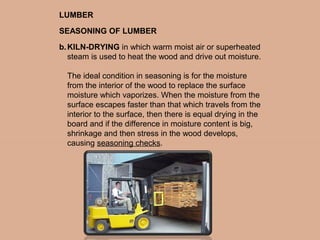
b.KILN-DRYING in which warm moist air or superheated
steam is used to heat the wood and drive out moisture.
The ideal condition in seasoning is for the moisture
from the interior of the wood to replace the surface
moisture which vaporizes. When the moisture from the
surface escapes faster than that which travels from the
interior to the surface, then there is equal drying in the
board and if the difference in moisture content is big,
shrinkage and then stress in the wood develops,
causing seasoning checks.
SEASONING OF LUMBER
LUMBER
Seasoned lumber has many advantages over green
lumber:
SEASONING OF LUMBER
LUMBER
a. It lessens the liability of the wood to be attacked by the
fungi causing blueing and decay, and by some wood-
boring insects.
b. Reduction of weight.
c. Increased strength.
d. Minimum shrinkage after the lumber is in place (thus
avoids opening up of joints in doors, windows, siding,
etc.).
e. Reduced checking and warping.
f. Increased nail-holding power of the wood (nails do not
hold well when driven into green or unseasoned lumber
because of its softness).
g. Improvement of the wood for the application of paint
and to receive wood preservatives, fire retardants.
PLYWOOD
WOOD COMPOSITES
Wood Composites are those products made from a
mixture of wood and other materials. Most wood
composites are produced in large sheets, usually
1220mm (4’) x 2440mm (8’).
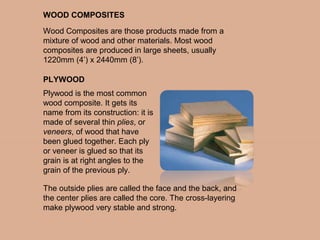
Plywood is the most common
wood composite. It gets its
name from its construction: it is
made of several thin plies, or
veneers, of wood that have
been glued together. Each ply
or veneer is glued so that its
grain is at right angles to the
grain of the previous ply.
The outside plies are called the face and the back, and
the center plies are called the core. The cross-layering
make plywood very stable and strong.
PLYWOOD
WOOD COMPOSITES
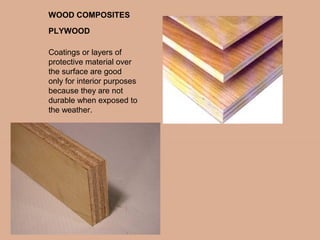
Coatings or layers of
protective material over
the surface are good
only for interior purposes
because they are not
durable when exposed to
the weather.
PLYWOOD
WOOD COMPOSITES
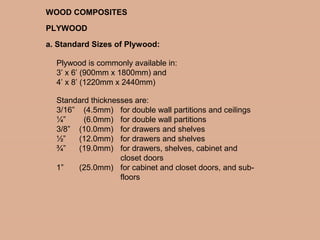
a. Standard Sizes of Plywood:
Plywood is commonly available in:
3’ x 6’ (900mm x 1800mm) and
4’ x 8’ (1220mm x 2440mm)
Standard thicknesses are:
3/16” (4.5mm) for double wall partitions and ceilings
¼” (6.0mm) for double wall partitions
3/8” (10.0mm) for drawers and shelves
½” (12.0mm) for drawers and shelves
¾” (19.0mm) for drawers, shelves, cabinet and
closet doors
1” (25.0mm) for cabinet and closet doors, and sub-
floors
PLYWOOD
WOOD COMPOSITES
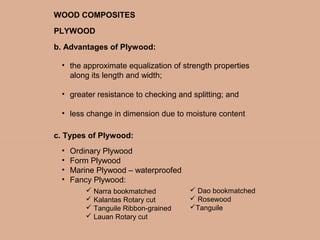
• the approximate equalization of strength properties
along its length and width;
• greater resistance to checking and splitting; and
• less change in dimension due to moisture content
• Ordinary Plywood
• Form Plywood
• Marine Plywood – waterproofed
• Fancy Plywood:
b. Advantages of Plywood:
c. Types of Plywood:
 Narra bookmatched
 Kalantas Rotary cut
 Tanguile Ribbon-grained
 Lauan Rotary cut
 Dao bookmatched
 Rosewood
Tanguile
HARDBOARD
WOOD COMPOSITES
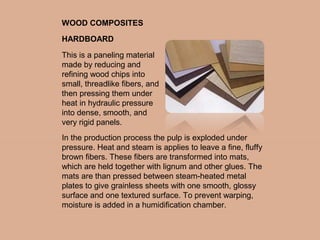
This is a paneling material
made by reducing and
refining wood chips into
small, threadlike fibers, and
then pressing them under
heat in hydraulic pressure
into dense, smooth, and
very rigid panels.
In the production process the pulp is exploded under
pressure. Heat and steam is applies to leave a fine, fluffy
brown fibers. These fibers are transformed into mats,
which are held together with lignum and other glues. The
mats are than pressed between steam-heated metal
plates to give grainless sheets with one smooth, glossy
surface and one textured surface. To prevent warping,
moisture is added in a humidification chamber.
HARDBOARD
WOOD COMPOSITES
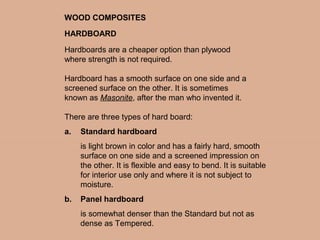
Hardboards are a cheaper option than plywood
where strength is not required.
Hardboard has a smooth surface on one side and a
screened surface on the other. It is sometimes
known as Masonite, after the man who invented it.
There are three types of hard board:
a. Standard hardboard
is light brown in color and has a fairly hard, smooth
surface on one side and a screened impression on
the other. It is flexible and easy to bend. It is suitable
for interior use only and where it is not subject to
moisture.
b. Panel hardboard
is somewhat denser than the Standard but not as
dense as Tempered.
HARDBOARD
WOOD COMPOSITES
c. Tempered hard board
is the densest type, made by impregnating standard
board with tempering compound of oils and resins and
baking it polymerize the tempering materials. It is dark
brown in color, brittle and stiff, with improved machining
qualities and greater resistance to moisture and water
penetration, making it ideal for exterior use
Hardboard is usually in panel size of 4’x8’ (1220mm x
2440mm) with thicknesses of 3mm 1/8” (), 3/16” (4.5mm)
or ¼” (6mm), and is obtainable either with a plain,
textured, or perforated surface.
Brand names of Hardboard:
LAWANIT standard and tempered boards
LAWANEX panel boards
MASONITE standard, panel and tempered hard board
CHIPBOARD
WOOD COMPOSITES
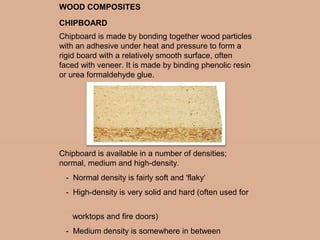
Chipboard is made by bonding together wood particles
with an adhesive under heat and pressure to form a
rigid board with a relatively smooth surface, often
faced with veneer. It is made by binding phenolic resin
or urea formaldehyde glue.
Chipboard is available in a number of densities;
normal, medium and high-density.
- Normal density is fairly soft and 'flaky‘
- High-density is very solid and hard (often used for
worktops and fire doors)
- Medium density is somewhere in between
FIBERBOARDS and MEDIUM DENSITY FIBERBOARDS
WOOD COMPOSITES
Fiberboards are finishing materials made from
vegetable fibers such as corn or sugarcane stalks
pressed into sheets. It is not very strong, but has
good insulating properties therefore it is usually used
for ceiling only.
It is generally 4’x8’ (1220mm x 2440mm) panel size, in
thicknesses of 3/16” (4.5mm) or ¼” (6mm), ½” (12mm)
and ¾ “ (19 mm).
Acoustic fiber board is manufactured from wood, straw,
bagasse pulp pressed into boards with or without holes or
slots. Thicknesses of acoustic fiber board vary from ½ “ to
2” (12 to 50mm) in ½” (12mm) increments.
Brand names of Fiberboard:
CELOTEX, CANEX, HOMASOTE, PHILTEX, BONOTEX
FIBERBOARDS and MEDIUM DENSITY FIBERBOARDS
WOOD COMPOSITES
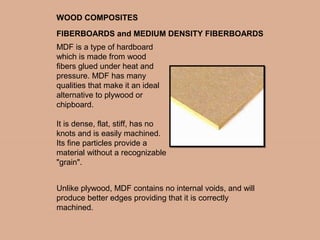
MDF is a type of hardboard
which is made from wood
fibers glued under heat and
pressure. MDF has many
qualities that make it an ideal
alternative to plywood or
chipboard.
It is dense, flat, stiff, has no
knots and is easily machined.
Its fine particles provide a
material without a recognizable
"grain".
Unlike plywood, MDF contains no internal voids, and will
produce better edges providing that it is correctly
machined.
GYPSUM BOARDS
WOOD COMPOSITES
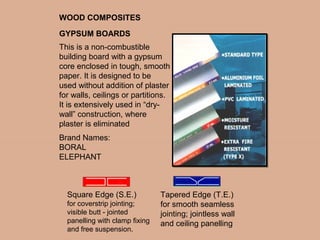
This is a non-combustible
building board with a gypsum
core enclosed in tough, smooth
paper. It is designed to be
used without addition of plaster
for walls, ceilings or partitions.
It is extensively used in “dry-
wall” construction, where
plaster is eliminated
Brand Names:
BORAL
ELEPHANT
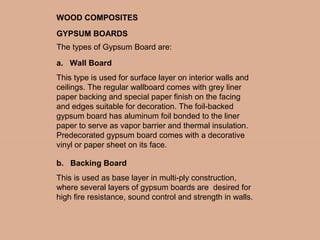
Square Edge (S.E.)
for coverstrip jointing;
visible butt - jointed
panelling with clamp fixing
and free suspension.
Tapered Edge (T.E.)
for smooth seamless
jointing; jointless wall
and ceiling panelling
GYPSUM BOARDS
WOOD COMPOSITES
The types of Gypsum Board are:
a. Wall Board
This type is used for surface layer on interior walls and
ceilings. The regular wallboard comes with grey liner
paper backing and special paper finish on the facing
and edges suitable for decoration. The foil-backed
gypsum board has aluminum foil bonded to the liner
paper to serve as vapor barrier and thermal insulation.
Predecorated gypsum board comes with a decorative
vinyl or paper sheet on its face.
b. Backing Board
This is used as base layer in multi-ply construction,
where several layers of gypsum boards are desired for
high fire resistance, sound control and strength in walls.
GYPSUM BOARDS
WOOD COMPOSITES
c. Core Board
To save space, this type is used as a base in a multi-ply
construction of self-supporting (studless) gypsum walls.
It comes in 1” (25mm) thickness or 2- factory-laminated,
½ “ thick layers of backing board .
d. Type X Gypsum Board
For use in fire-rated assemblies, this may be wallboard,
backing board, or coreboard made more fire-resistant
by addition of glass-fiber or other reinforcing materials
e. Water-Resistant Backing Gypsum Board
This type comes with water-resistant gypsum core and
water-repellant face paper. It maybe used as base for
walls of bathrooms, showers, and other areas exposed
to wetting.
GYPSUM BOARDS
WOOD COMPOSITES
g. Gypsum Formboard
This type is used as a permanent form in the casting of
gypsum concrete roof decks.
f. Gypsum Sheathing
This type is used as fire protection and bracing of
exterior frame walls. It must be protected from the
weather by an exterior facing.
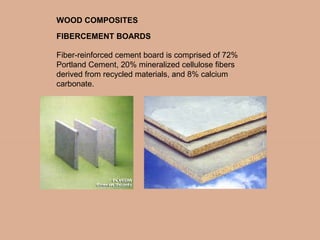
FIBERCEMENT BOARDS
WOOD COMPOSITES
Fiber-reinforced cement board is comprised of 72%
Portland Cement, 20% mineralized cellulose fibers
derived from recycled materials, and 8% calcium
carbonate.
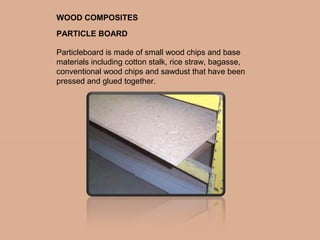
PARTICLE BOARD
WOOD COMPOSITES
Particleboard is made of small wood chips and base
materials including cotton stalk, rice straw, bagasse,
conventional wood chips and sawdust that have been
pressed and glued together.
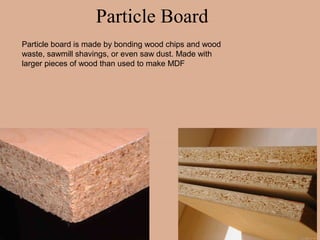
Particle Board
Particle board is made by bonding wood chips and wood
waste, sawmill shavings, or even saw dust. Made with
larger pieces of wood than used to make MDF
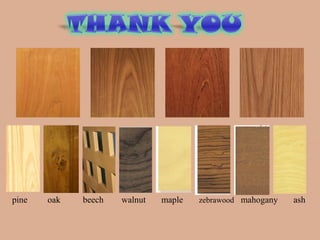
pine oak beech walnut maple zebrawood mahogany ash