Building Planning
Plan of Building:
• Grouping and arrangement of components of building in a systematic manner so as to form a
homogeneous body with a comprehensive look out to meet its functional purpose.
• Planning of a building depends on:
1. Human habitation and their requirements Component parts
2. Sizes and inter relationship
3. Topography
4. Shape of the plot
5. Climatic Condition
6. Location and neighbourhood
General Principles of Site Selection:
• The site should be selected keeping in view the general scope or the purpose
of building and on the basis of extent of privacy desired.
• The site should be situated in locality which is already fully developed or
which is fast developing.
• The plot should be in a locality where the various facilities like Community
services, police, fire protection, clearing of waste, street cleaning, utility
services such as water supply, gas, electricity, drainage, amenities like
schools, hospitals, libraries, recreation, telephone, shopping facilities and
means of transport are available.
• Area of the plot of land should be such that the house constructed, keeping
in view of restrictions of local authority, would meet the requirements of the
owner, preferably with possibilities of future extension.
• The site should be located on a elevated place.
• The soil surface of the site should be good enough to provide
economical foundations for the intended building without causing any
problems.
• The situation of the site should be such as to ensure unobstructed
natural light and air.
• The site should have a good landscape but away from quarries, kils,
factories etc.,.
• A site should be abandoned under adverse circumstances such as
unhealthy noises, crowded localities, immediate neighbourhood of
rivers carrying heavy floods, badly maintained drains, water logging
areas and industrial vicinity.
• Besides these factors, the legal and financial aspects, which dictate
upon ownership rights and costs, should be given due consideration
before purchase.
Planning regulations and By-Laws:
• There are certain rules and regulations laid down by the municipalities or
town planning authorities to be considered by an architect while planning
and designing the layout of the buildings.
• These bylaws and regulations govern the following building aspects:
1. Lines of building frontages
2. Built up area of buildings
3. Open spaces around buildings and their heights
4. Provisions of size, height and ventilation of rooms and apartments
5. Water supply and sanitary provisions.
6. Structural design or sizes and sections.
Building Lines:
• The building line refers to the line of building frontage i.e., the line up
to which the plinth of a building adjoining a street or an extension of
street or on a future street may lawfully extend.
• Certain buildings such as cinemas, business centres, factories etc
which attract large number of vehicles, should be further set back a
further distance apart from the building line. This line which accounts
for this extra margin is known as “ Control line”
Built-Up area:
• The built up or covered area equals to the plot area minus the area due
for open spaces.
• In a business area, the covered area shall not exceed 75% of the area
of the site, provided sufficient space for parking, etc.,. Is available on
the same site.
• In an industrial area, the built up area shall not exceed 60% of the site-
area.
Open space requirement around buildings:
• The national building code recommends the following open space
requirements for varying heights of the buildings.
1. For buildings having height less than 10m, the front yard, rear yard, side
yard open space width should be provided with 3m.
2. For buildings with height more than 10m but less than 25m, the value of
open spaces required for height of 10m, are increased at the rate of 1m for
every 3m or fraction thereof, for height above 10m.
3. For buildings with height more than 25m but less than 30m, there shall be
a minimum open space of 10m.
4. For buildings with height above 30m, the minimum open space of 10m
required required for heights of 30m, shall be increased at the rate of 1m
for every additional height of 5m or fraction thereof, subject to a
maximum of 16m.
Provision to Size, Height and Ventilation of
Rooms and Apartments:
• Size:
From the view of health and ventilation, certain absolute
minimum areas for individual rooms and apartments have been laid by
NBC as follows:
a)Habitable Rooms:
i. If there is only one room, then minimum area =9.5sq.m with
minimum width of room = 2.4m.
ii. If there are two rooms, the minimum area for one room = 9.5sq.m
and area for other room shall be equal to 7.5sq.m with a minimum
width of 2.4m.
b) kitchen:
i. For kitchen-cum-store, the minimum area = 5.5sq.m with a
minimum width of the kitchen = 1.8m.
ii. For kitchen having separate store, the minimum area for kitchen
=4.5sq.m.
iii. For kitchen-cum-dining room, the minimum area=9.5sq.m with a
minimum width =2.4m.
C) Bath Rooms and Water closets:
i. For bathroom, mini size = 1.5m x 1.2m or area = 1.8sq.m
ii. For combined bathroom and water closet, minimum floor
area=2.8sq.m with minimum width =1.2m.
iii. For water closet, minimum floor area = 1.1sq.m
B) Height of Buildings and Rooms:
• The maximum height generally limited on the basis of the width of the
street is given as follows
C) Lightning and ventilation of rooms:
• The area of window openings, exclusive of doors and inclusive of
frames is specified as below:
a) 1/10th of the flow area for dry hot climate, and
b) 1/6th of the flow area for wet hot climate.
• In addition to the above means of ventilation, every such room shall
have ventilation of at least 0.3sq.m in area near the top of each of two
of the walls of such room and these ventilators preferably placed
opposite to each other, for through ventilation.
Water supply and sanitary conveniences:
• Sanitary conveniences or sanitation requirements means the water closets (or Latrines),
urinals and wash basins etc.
• NBC part IX provides standards of above water supply and sanitation requirements.
• Some of the sanitary fittings are given below..,
Structural Design or sizes and sections:
• Depth of Foundation: The minimum depth of foundation should be taken as
below:
a) For single storeyed building = 0.75 to 1.0m below finished G.L
b) For double – storeyed building = 1.0 to 1.30m below finished G.L
• Plinth: This is the portion of building between the surface of the
surrounding ground and ground floor level. The plinth level of a building is
kept higher(generally 30cm or more) than the surrounding ground level
such that adequate drainage of the site is assured.
• Damp Proof Course(D.P.C): D.P.C is provided to prevent moisture rising up
the wall. The horizontal D.P.C usually 4cm thick of CC(1:2:4) is provided
about 10 to 20cm above final G.L.
Principle of Planning:
Aspect:
Prospects:
• It is the impression that house is likely to make on person who looks at
it from the out side.
Privacy:
• Privacy is one of the important principles in the planning of building
of all types in general and residential building in particular. It
considers two points.
a. Privacy of one room from another.
b. Privacy of all parts of a building from the neighbouring buildings,
public streets and by-ways.
Roominess:
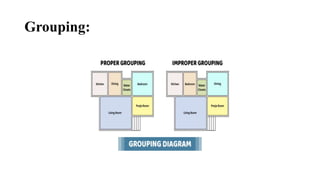
Grouping:
Furniture Requirements:
• In case of buildings other than residential, the furniture requirements
are generally planned.
• In case of residential buildings a room whether intended for a bed
room or kitchen or drawing room, the architect should take into
account the furniture positions of all types likely to be accommodated,
so that the doors, windows and circulation space do not prevent from
placing of sufficient number of pieces.
Sanitation:
• Sanitation consists of providing ample light, ventilation, facilities for
cleaning and sanitary conveniences.
Flexibility:
• It means planning a room in such a way which, though originally
designed for a specific purpose, may be used to serve other
overlapping purposes also, as and when desired.
Circulation:
• Circulation means the movement space provided on the same floor
either between the rooms or within the room called horizontal
circulation through passage, corridors, halls, lobbies and between the
different floors through stairs or lifts called vertical circulation.
Elegance:
• Elegance is the effect produced by the elevation and general layout of
the plan.
Economy:
• The economy may not be a principle of planning but it is certainly a
factor which affects planning.
Practical Considerations:
• The following practical points should be given due consideration in
the planning of buildings:
a. Strength and stability
b. Simplicity
c. Building should last for several generations.
Orientation of Buildings:
• It is defined as a method of setting or fixing the direction of the plan of
the building in such a way that it derives maximum benefit from the
elements of nature such as sun, wind and rain.
• Orientation is indicated by the direction of the normal to the long axis.
Eg: if the length of the building is East-West, its orientation is North-
South.
Factors affecting Orientation:
1. Solar heat gain, for which it is essential to know sun’s path
throughout the year and its relative position with respect to the
locality.
2. Prevalent breeze or wind, i.e., the direction of prevailing wind in
summer when it its required and in winter when it is to be avoided.
3. Rainfall, ie., the direction and intensity of rain.
4. Site conditions, i.e., location of site either rural, urban or sub urban,
and surroundings.
Orientation criteria under Indian
Conditions:
• Indian climatic conditions can be divided into Hot arid zones( Dry arid zones) and
Hot Humid zones (Wet zones).
Hot arid Zones:(High summer day-time temperature, Low humidity)
Northern India: Orientation should be done along East and West, facing North.
Central India: Orientation should be done along the direction E-SE and W-NW,
facing N-NE.
Hot- Humid Zones: ( Low summer day-time temperature and high relative
humidity)
West Coast Regions: Orientation should be along the direction S-E and N-W facing
S-W.
East Coast Regions: Orientation should be along the direction S-E and N-W facing
N-W.
Building Components:
• Following are the basic building components,
1. Foundation
2. Plinth
3. Super structure
4. Ground, Basement and Upper Floors
5. Doors and Windows
6. Sills, lintels and weather shades
7. Roofs
8. Steps and stairs
9. Finishes for walls
10. Utility Fixtures
FUNCTIONAL Planning AND BUILDING SERVICES.pptx

FUNCTIONAL Planning AND BUILDING SERVICES.pptx

  • 1.
  • 2.
    Plan of Building: •Grouping and arrangement of components of building in a systematic manner so as to form a homogeneous body with a comprehensive look out to meet its functional purpose. • Planning of a building depends on: 1. Human habitation and their requirements Component parts 2. Sizes and inter relationship 3. Topography 4. Shape of the plot 5. Climatic Condition 6. Location and neighbourhood
  • 3.
    General Principles ofSite Selection: • The site should be selected keeping in view the general scope or the purpose of building and on the basis of extent of privacy desired. • The site should be situated in locality which is already fully developed or which is fast developing. • The plot should be in a locality where the various facilities like Community services, police, fire protection, clearing of waste, street cleaning, utility services such as water supply, gas, electricity, drainage, amenities like schools, hospitals, libraries, recreation, telephone, shopping facilities and means of transport are available. • Area of the plot of land should be such that the house constructed, keeping in view of restrictions of local authority, would meet the requirements of the owner, preferably with possibilities of future extension.
  • 4.
    • The siteshould be located on a elevated place. • The soil surface of the site should be good enough to provide economical foundations for the intended building without causing any problems. • The situation of the site should be such as to ensure unobstructed natural light and air. • The site should have a good landscape but away from quarries, kils, factories etc.,. • A site should be abandoned under adverse circumstances such as unhealthy noises, crowded localities, immediate neighbourhood of rivers carrying heavy floods, badly maintained drains, water logging areas and industrial vicinity. • Besides these factors, the legal and financial aspects, which dictate upon ownership rights and costs, should be given due consideration before purchase.
  • 6.
    Planning regulations andBy-Laws: • There are certain rules and regulations laid down by the municipalities or town planning authorities to be considered by an architect while planning and designing the layout of the buildings. • These bylaws and regulations govern the following building aspects: 1. Lines of building frontages 2. Built up area of buildings 3. Open spaces around buildings and their heights 4. Provisions of size, height and ventilation of rooms and apartments 5. Water supply and sanitary provisions. 6. Structural design or sizes and sections.
  • 7.
    Building Lines: • Thebuilding line refers to the line of building frontage i.e., the line up to which the plinth of a building adjoining a street or an extension of street or on a future street may lawfully extend. • Certain buildings such as cinemas, business centres, factories etc which attract large number of vehicles, should be further set back a further distance apart from the building line. This line which accounts for this extra margin is known as “ Control line”
  • 10.
    Built-Up area: • Thebuilt up or covered area equals to the plot area minus the area due for open spaces. • In a business area, the covered area shall not exceed 75% of the area of the site, provided sufficient space for parking, etc.,. Is available on the same site. • In an industrial area, the built up area shall not exceed 60% of the site- area.
  • 13.
    Open space requirementaround buildings: • The national building code recommends the following open space requirements for varying heights of the buildings. 1. For buildings having height less than 10m, the front yard, rear yard, side yard open space width should be provided with 3m. 2. For buildings with height more than 10m but less than 25m, the value of open spaces required for height of 10m, are increased at the rate of 1m for every 3m or fraction thereof, for height above 10m. 3. For buildings with height more than 25m but less than 30m, there shall be a minimum open space of 10m. 4. For buildings with height above 30m, the minimum open space of 10m required required for heights of 30m, shall be increased at the rate of 1m for every additional height of 5m or fraction thereof, subject to a maximum of 16m.
  • 14.
    Provision to Size,Height and Ventilation of Rooms and Apartments: • Size: From the view of health and ventilation, certain absolute minimum areas for individual rooms and apartments have been laid by NBC as follows: a)Habitable Rooms: i. If there is only one room, then minimum area =9.5sq.m with minimum width of room = 2.4m. ii. If there are two rooms, the minimum area for one room = 9.5sq.m and area for other room shall be equal to 7.5sq.m with a minimum width of 2.4m.
  • 15.
    b) kitchen: i. Forkitchen-cum-store, the minimum area = 5.5sq.m with a minimum width of the kitchen = 1.8m. ii. For kitchen having separate store, the minimum area for kitchen =4.5sq.m. iii. For kitchen-cum-dining room, the minimum area=9.5sq.m with a minimum width =2.4m. C) Bath Rooms and Water closets: i. For bathroom, mini size = 1.5m x 1.2m or area = 1.8sq.m ii. For combined bathroom and water closet, minimum floor area=2.8sq.m with minimum width =1.2m. iii. For water closet, minimum floor area = 1.1sq.m
  • 16.
    B) Height ofBuildings and Rooms: • The maximum height generally limited on the basis of the width of the street is given as follows
  • 17.
    C) Lightning andventilation of rooms: • The area of window openings, exclusive of doors and inclusive of frames is specified as below: a) 1/10th of the flow area for dry hot climate, and b) 1/6th of the flow area for wet hot climate. • In addition to the above means of ventilation, every such room shall have ventilation of at least 0.3sq.m in area near the top of each of two of the walls of such room and these ventilators preferably placed opposite to each other, for through ventilation.
  • 18.
    Water supply andsanitary conveniences: • Sanitary conveniences or sanitation requirements means the water closets (or Latrines), urinals and wash basins etc. • NBC part IX provides standards of above water supply and sanitation requirements. • Some of the sanitary fittings are given below..,
  • 21.
    Structural Design orsizes and sections: • Depth of Foundation: The minimum depth of foundation should be taken as below: a) For single storeyed building = 0.75 to 1.0m below finished G.L b) For double – storeyed building = 1.0 to 1.30m below finished G.L • Plinth: This is the portion of building between the surface of the surrounding ground and ground floor level. The plinth level of a building is kept higher(generally 30cm or more) than the surrounding ground level such that adequate drainage of the site is assured. • Damp Proof Course(D.P.C): D.P.C is provided to prevent moisture rising up the wall. The horizontal D.P.C usually 4cm thick of CC(1:2:4) is provided about 10 to 20cm above final G.L.
  • 22.
  • 23.
  • 24.
    Prospects: • It isthe impression that house is likely to make on person who looks at it from the out side.
  • 25.
    Privacy: • Privacy isone of the important principles in the planning of building of all types in general and residential building in particular. It considers two points. a. Privacy of one room from another. b. Privacy of all parts of a building from the neighbouring buildings, public streets and by-ways.
  • 26.
  • 27.
  • 28.
    Furniture Requirements: • Incase of buildings other than residential, the furniture requirements are generally planned. • In case of residential buildings a room whether intended for a bed room or kitchen or drawing room, the architect should take into account the furniture positions of all types likely to be accommodated, so that the doors, windows and circulation space do not prevent from placing of sufficient number of pieces.
  • 29.
    Sanitation: • Sanitation consistsof providing ample light, ventilation, facilities for cleaning and sanitary conveniences. Flexibility: • It means planning a room in such a way which, though originally designed for a specific purpose, may be used to serve other overlapping purposes also, as and when desired.
  • 30.
    Circulation: • Circulation meansthe movement space provided on the same floor either between the rooms or within the room called horizontal circulation through passage, corridors, halls, lobbies and between the different floors through stairs or lifts called vertical circulation. Elegance: • Elegance is the effect produced by the elevation and general layout of the plan.
  • 31.
    Economy: • The economymay not be a principle of planning but it is certainly a factor which affects planning. Practical Considerations: • The following practical points should be given due consideration in the planning of buildings: a. Strength and stability b. Simplicity c. Building should last for several generations.
  • 32.
    Orientation of Buildings: •It is defined as a method of setting or fixing the direction of the plan of the building in such a way that it derives maximum benefit from the elements of nature such as sun, wind and rain. • Orientation is indicated by the direction of the normal to the long axis. Eg: if the length of the building is East-West, its orientation is North- South.
  • 33.
    Factors affecting Orientation: 1.Solar heat gain, for which it is essential to know sun’s path throughout the year and its relative position with respect to the locality. 2. Prevalent breeze or wind, i.e., the direction of prevailing wind in summer when it its required and in winter when it is to be avoided. 3. Rainfall, ie., the direction and intensity of rain. 4. Site conditions, i.e., location of site either rural, urban or sub urban, and surroundings.
  • 34.
    Orientation criteria underIndian Conditions: • Indian climatic conditions can be divided into Hot arid zones( Dry arid zones) and Hot Humid zones (Wet zones). Hot arid Zones:(High summer day-time temperature, Low humidity) Northern India: Orientation should be done along East and West, facing North. Central India: Orientation should be done along the direction E-SE and W-NW, facing N-NE. Hot- Humid Zones: ( Low summer day-time temperature and high relative humidity) West Coast Regions: Orientation should be along the direction S-E and N-W facing S-W. East Coast Regions: Orientation should be along the direction S-E and N-W facing N-W.
  • 35.
    Building Components: • Followingare the basic building components, 1. Foundation 2. Plinth 3. Super structure 4. Ground, Basement and Upper Floors 5. Doors and Windows 6. Sills, lintels and weather shades 7. Roofs 8. Steps and stairs 9. Finishes for walls 10. Utility Fixtures