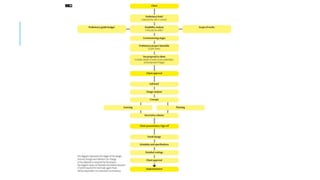
INTERIOR DESIGN
PROCESS
Ar. & Env. Designer
M.Tariq
Lecture 2nd, Ar-2016
Oct 15, 2019
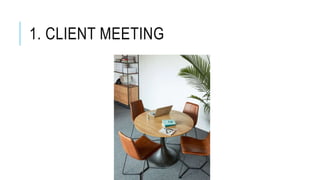
1. CLIENT MEETING
PROGRAMMING
Programming is the process of defining the needs of those who will
use the space, in advance of creating the design. Whether for a home
kitchen renovation or for a newly constructed restaurant, this
exercise should evaluate the functional performance, opportunities,
and constraints of the existing space.
The programmatic goals should be precisely qualified in a brief, the
written document that outlines all functional, dimensional, and
relational requirements.
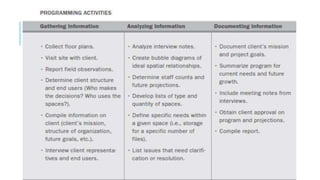
Programming can be broken down into three central types of
activities: gathering, analyzing,and documenting information.
Thus, programming might consist of a filled-in questionnaire, a
detailed interview, or a inventory that defines various issues, such as
the number and type of shoes within a closet or the amount of
cupboard space needed to accommodate everyday dishes.
Good communication is key to articulating the program and
managing expectations for the design phase.
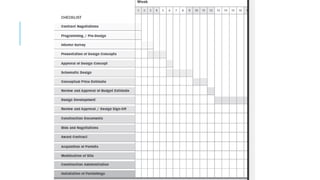
SCHEDULE
the schedule should address all of the project milestones, in the form
of a checklist, and assign to a team member the primary
responsibility for oversight.
Schedules include, but are not limited to, establishing the timeframe
for executing contracts.
BUDGET
Project budgets are divided into hard and soft costs. For an interior
project, hard costs cover the cost of construction and
fixtures,furniture, and equipment (FF&E).
A typical assumption for an FF&E budget is 10 percent of the overall
construction cost.
Soft costs include, but are not limited to, designer’s fees, consultant’s
fees, project management fees, permitting fees, insurance, and
project contingencies.
So for early pricing studies or ballpark assumptions, it is important to
include contingencies for unknown factors.
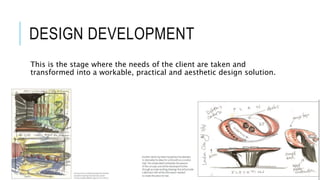
DESIGN DEVELOPMENT
This is the stage where the needs of the client are taken and
transformed into a workable, practical and aesthetic design solution.
MOOD BOARD
There are dozens of ideas in our head may be even more ideas than
described.
There are various things which needs to be considered while we
design the interior such as the colors, fabrics,
walls, furniture, lighting, floor and not to forget the accessories
associated with them.
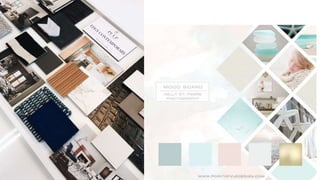
A mood board (or inspiration board) is a physical or digital collage of
ideas that's commonly used in fields like interior design, fashion, and
graphic design.
A mood board is a collection of things that inspire you for a design
project. The purpose is to help you identify the items you like and
may want to include in your design.
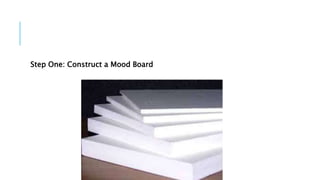
Step One: Construct a Mood Board
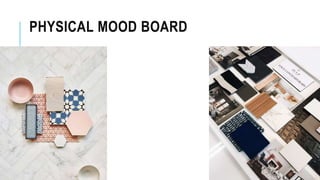
PHYSICAL MOOD BOARD
add actual samples of materials, such as:
Fabric swatches: Most online and brick and mortar stores sell fabric
swatches.
Carpet samples: Carpet stores often provide small swatches of carpet
samples or sell discontinued carpet samples you can use as a guide
for texture and color.
Tile samples: Most tile stores sell individual tiles.
Paint chips: Paint stores always have paint chip samples.
2.interior  design process

2.interior design process

  • 1.
    INTERIOR DESIGN PROCESS Ar. &Env. Designer M.Tariq Lecture 2nd, Ar-2016 Oct 15, 2019
  • 3.
  • 4.
    PROGRAMMING Programming is theprocess of defining the needs of those who will use the space, in advance of creating the design. Whether for a home kitchen renovation or for a newly constructed restaurant, this exercise should evaluate the functional performance, opportunities, and constraints of the existing space. The programmatic goals should be precisely qualified in a brief, the written document that outlines all functional, dimensional, and relational requirements.
  • 5.
    Programming can bebroken down into three central types of activities: gathering, analyzing,and documenting information. Thus, programming might consist of a filled-in questionnaire, a detailed interview, or a inventory that defines various issues, such as the number and type of shoes within a closet or the amount of cupboard space needed to accommodate everyday dishes. Good communication is key to articulating the program and managing expectations for the design phase.
  • 7.
    SCHEDULE the schedule shouldaddress all of the project milestones, in the form of a checklist, and assign to a team member the primary responsibility for oversight. Schedules include, but are not limited to, establishing the timeframe for executing contracts.
  • 9.
    BUDGET Project budgets aredivided into hard and soft costs. For an interior project, hard costs cover the cost of construction and fixtures,furniture, and equipment (FF&E). A typical assumption for an FF&E budget is 10 percent of the overall construction cost. Soft costs include, but are not limited to, designer’s fees, consultant’s fees, project management fees, permitting fees, insurance, and project contingencies. So for early pricing studies or ballpark assumptions, it is important to include contingencies for unknown factors.
  • 10.
    DESIGN DEVELOPMENT This isthe stage where the needs of the client are taken and transformed into a workable, practical and aesthetic design solution.
  • 11.
    MOOD BOARD There aredozens of ideas in our head may be even more ideas than described. There are various things which needs to be considered while we design the interior such as the colors, fabrics, walls, furniture, lighting, floor and not to forget the accessories associated with them. A mood board (or inspiration board) is a physical or digital collage of ideas that's commonly used in fields like interior design, fashion, and graphic design. A mood board is a collection of things that inspire you for a design project. The purpose is to help you identify the items you like and may want to include in your design.
  • 12.
    Step One: Constructa Mood Board
  • 13.
  • 14.
    add actual samplesof materials, such as: Fabric swatches: Most online and brick and mortar stores sell fabric swatches. Carpet samples: Carpet stores often provide small swatches of carpet samples or sell discontinued carpet samples you can use as a guide for texture and color. Tile samples: Most tile stores sell individual tiles. Paint chips: Paint stores always have paint chip samples.