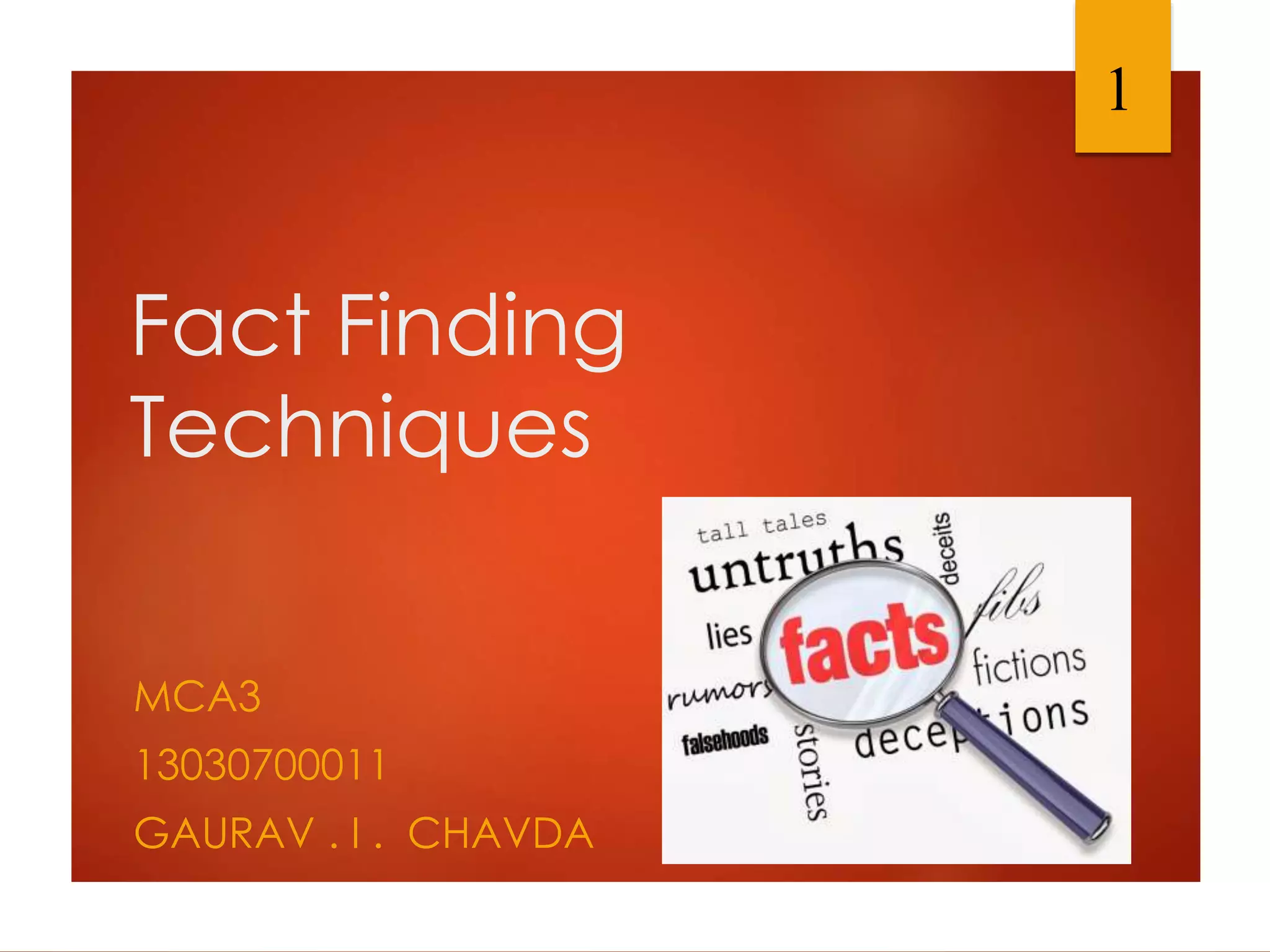
Fact Finding
Techniques
MCA3
13030700011
GAURAV . I . CHAVDA
1
“
”
Collecting Information -
Fact Finding Techniques
There are four methods of doing this:
2
Fact Finding Techniques
 Fact-Finding Overview
 The first step is to identify the information you need
 Develop a fact-finding plan
 Who, What, Where, When, How, and Why?
 Difference between asking what is being done and
what could or should be done
3
1 - Observation
 The aim of
observation is to find
out what actually
happens, not what
the workers think
observers expect to
see.
4
Observation
Advantages
 Data gathered can be very
reliable
 Can see exactly what is
being done in complex
tasks
 Relatively inexpensive
compared with other
techniques
 Can do work
measurements
Disadvantages
 People may perform
differently when being
observed
 Timing can be inconvenient
 Interruptions
 Some tasks not always
performed the same way
 May observe wrong way of
doing things
5
2 - Examination
of documents
 All documents which
are used within a
system need to be
examined. These will
be eventually
duplicated or
replaced with
alternative versions
or even discarded in
the new system.
6
The types of document which
need to be examined are:
 Data capture forms
 System documentation
 Business reports
 Invoices
 Bills
 Letters etc.
7
3 - Questionnaires  The use of
questionnaires is a very
popular method of
fact finding.
 A great deal of time is
spent on preparing
questionnaires in order
that the right type of
question is asked in
order that the most
relevant information is
gathered.
8
Questionnaires
Free-format
questionnaire
 a questionnaire designed
to offer the respondent
greater latitude in the
answer. A question is asked,
and the respondent
records the answer in the
space provided after the
question.
Fixed-format
questionnaire
 a questionnaire containing
questions that require
selecting an answer from
predefined
9
Questionnaires
Advantages
 Often can be answered
quickly
 People can complete at
their convenience
 Relatively inexpensive way
to gather data from a large
number
 Allow for anonymity
 Responses can be
tabulated quickly
Disadvantages
 Return rate is often low
 No guarantee that an
individual will answer all
questions
 No opportunity to reword or
explain misunderstood
questions
 Cannot observe body
language
 Difficult to prepare
10
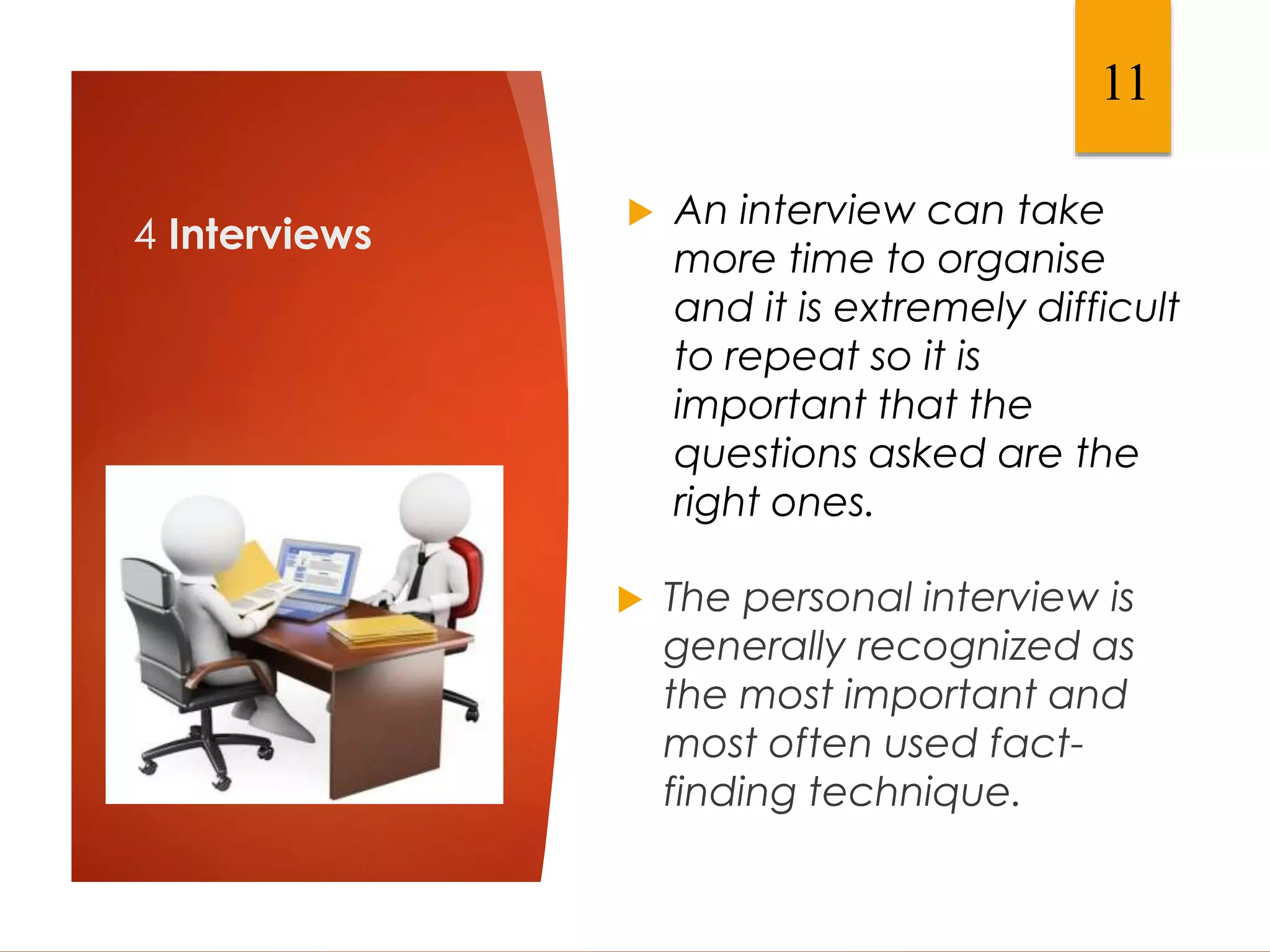
4 Interviews
 The personal interview is
generally recognized as
the most important and
most often used fact-
finding technique.
 An interview can take
more time to organise
and it is extremely difficult
to repeat so it is
important that the
questions asked are the
right ones.
11
Types of Interviews and
Questions
Unstructured interview –conducted with only a general
goal or subject in mind and with few, if any, specific
questions. The interviewer counts on the interviewee
to provide a framework and direct the
conversation.
Structured interview –interviewer has a specific set of
questions to ask of the interviewee.
Open-ended question – question that allows the
interviewee to respond in any way.
Closed-ended question – a question that restricts
answers to either specific choices or short, direct
responses.
12
Interviews
Advantages
 Give analyst opportunity
to motivate interviewee
to respond freely and
openly
 Allow analyst to probe
for more feedback
 Permit analyst to adapt
or reword questions for
each individual
 Can observe nonverbal
communication
Disadvantages
 Time-consuming
 Success highly
dependent on analyst's
human relations skills
 May be impractical due
to location of
interviewees
13
A Fact-Finding Strategy
1. Learn from existing documents, forms, reports, and
files.
2. If appropriate, observe the system in action.
3. Given all the facts that already collected, design and
distribute questionnaires to clear up things that aren’t
fully understood.
4. Conduct interviews (or group work sessions).
5. (Optional). Build discovery prototypes for any
functional requirements that are not understood or for
requirements that need to be validated.
6. Follow up to verify facts.
14
Fact - Finding Techniques

Fact - Finding Techniques

  • 1.
  • 2.
    “ ” Collecting Information - FactFinding Techniques There are four methods of doing this: 2
  • 3.
    Fact Finding Techniques Fact-Finding Overview  The first step is to identify the information you need  Develop a fact-finding plan  Who, What, Where, When, How, and Why?  Difference between asking what is being done and what could or should be done 3
  • 4.
    1 - Observation The aim of observation is to find out what actually happens, not what the workers think observers expect to see. 4
  • 5.
    Observation Advantages  Data gatheredcan be very reliable  Can see exactly what is being done in complex tasks  Relatively inexpensive compared with other techniques  Can do work measurements Disadvantages  People may perform differently when being observed  Timing can be inconvenient  Interruptions  Some tasks not always performed the same way  May observe wrong way of doing things 5
  • 6.
    2 - Examination ofdocuments  All documents which are used within a system need to be examined. These will be eventually duplicated or replaced with alternative versions or even discarded in the new system. 6
  • 7.
    The types ofdocument which need to be examined are:  Data capture forms  System documentation  Business reports  Invoices  Bills  Letters etc. 7
  • 8.
    3 - Questionnaires The use of questionnaires is a very popular method of fact finding.  A great deal of time is spent on preparing questionnaires in order that the right type of question is asked in order that the most relevant information is gathered. 8
  • 9.
    Questionnaires Free-format questionnaire  a questionnairedesigned to offer the respondent greater latitude in the answer. A question is asked, and the respondent records the answer in the space provided after the question. Fixed-format questionnaire  a questionnaire containing questions that require selecting an answer from predefined 9
  • 10.
    Questionnaires Advantages  Often canbe answered quickly  People can complete at their convenience  Relatively inexpensive way to gather data from a large number  Allow for anonymity  Responses can be tabulated quickly Disadvantages  Return rate is often low  No guarantee that an individual will answer all questions  No opportunity to reword or explain misunderstood questions  Cannot observe body language  Difficult to prepare 10
  • 11.
    4 Interviews  Thepersonal interview is generally recognized as the most important and most often used fact- finding technique.  An interview can take more time to organise and it is extremely difficult to repeat so it is important that the questions asked are the right ones. 11
  • 12.
    Types of Interviewsand Questions Unstructured interview –conducted with only a general goal or subject in mind and with few, if any, specific questions. The interviewer counts on the interviewee to provide a framework and direct the conversation. Structured interview –interviewer has a specific set of questions to ask of the interviewee. Open-ended question – question that allows the interviewee to respond in any way. Closed-ended question – a question that restricts answers to either specific choices or short, direct responses. 12
  • 13.
    Interviews Advantages  Give analystopportunity to motivate interviewee to respond freely and openly  Allow analyst to probe for more feedback  Permit analyst to adapt or reword questions for each individual  Can observe nonverbal communication Disadvantages  Time-consuming  Success highly dependent on analyst's human relations skills  May be impractical due to location of interviewees 13
  • 14.
    A Fact-Finding Strategy 1.Learn from existing documents, forms, reports, and files. 2. If appropriate, observe the system in action. 3. Given all the facts that already collected, design and distribute questionnaires to clear up things that aren’t fully understood. 4. Conduct interviews (or group work sessions). 5. (Optional). Build discovery prototypes for any functional requirements that are not understood or for requirements that need to be validated. 6. Follow up to verify facts. 14