Prepared by-
Name : Vardhil Patel
Guided by: Prof. _____________
Gandhinagar Institute of
Technology
Subject: DBMS
Deadlock
Contents
1. What is Deadlock?
2. Deadlock Prevention
3. Deadlock Detection
4. Recovery of Deadlock
What is Deadlock?



A system is in a deadlock state if there exists a set of transactions such that
every transaction in the set is waiting for another transaction in the set.
None of the transaction can make progress in such a situation.
The only remedy to this undesirable condition is for system to invoke some
drastic action,such as rolling back some of the transactions involved in the
deadlock.

There are two methods for dealing with deadlock
1.Deadlock Prevention.
2.Deadlock detection & Recovery.
Dead Lock Prevention
●
●
●
●
●
There are two approaches to deadlock prevention.
One approach ensures that no cyclic waits can occur by ordering the
requests for locks.
Second Approach is the rollback of transaction.
The simplest scheme under the first approach requires that each
transaction locks all its data before execution.
Moreover,either all are locked or none.
●
Another Approach for preventing deadlocks is to impose an ordering of
all data items,and to require that transaction lock data items in
sequence.
Preemption-Prevention to
Deadlock
●
●
●
The second approach for prevention of deadlock is preemption and
transaction rollback.
In preemption when a transaction,when a transaction T2 requests a lock
that transaction T1 holds,the lock granted to T1 may be preempted
by rolling back of T1 and granting of lock to T2.
Two different deadlock prevention Technique using Timestamps
1.Wait-Die Scheme
When a tranasaction Ti requests a data item currently held by Tj ,Ti is
allowed to wait only if it has a timestamp smaller than Tj.Otherwise
Ti is rolled back.
2.Wound-Wait Scheme
When transaction Ti requests a data item currently held by Tj ,Ti is
allowed to wait only if it has timestamp larger than that of Tj.
Otherwise Tj is rolled back.
Dead Lock Detection
●
●
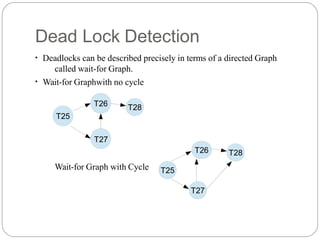
Deadlocks can be described precisely in terms of a directed Graph
called wait-for Graph.
Wait-for Graphwith no cycle
Wait-for Graph with Cycle
T26
T25
T27
T28
T25
T26
T27
T28
Recovery From Deadlock
●
●
●
When a detection algorithm determines that a dead lock exist,the system
must recover from the deadlock.
The most common solution is to rollback the transaction to break the
deadlock.The following three actions should be taken:
1.Selection Of Victim
Given a set of deadlocked transactions,we should determine which
transaction to rollback to break the deadlock.
Following should be kept in mind for determining the roll back of
transaction
a)How many data items the transaction has used?
b)How many more data items the transaction needs for it to complete?
c)How many transactions will be involved in rollback?
b)Rollback
●
●
●
Once we have decided that a particular transaction must be rolled back,we
must determine how far this transaction should be rolled back.
The simplest solution is total roll back.Abort the transaction and restart it.
However it is efficient to roll back the transaction to break the deadlock.
●
The deadlock detection mechanism should decide which locks the selected
transaction needs to release in order to break the deadlock.
●
●
●
c)Starvation
In a system where the selection of victims is based primarily on cost factors.
It may happen that the same transaction is always picked as a victim.
As a result,the transaction never completes its designated task,thus there is a
transaction.
We must be ensure that a particular transaction is rolled back for finite
times.
Deadlock dbms

Deadlock dbms

  • 1.
    Prepared by- Name :Vardhil Patel Guided by: Prof. _____________ Gandhinagar Institute of Technology Subject: DBMS Deadlock
  • 2.
    Contents 1. What isDeadlock? 2. Deadlock Prevention 3. Deadlock Detection 4. Recovery of Deadlock
  • 3.
    What is Deadlock?    Asystem is in a deadlock state if there exists a set of transactions such that every transaction in the set is waiting for another transaction in the set. None of the transaction can make progress in such a situation. The only remedy to this undesirable condition is for system to invoke some drastic action,such as rolling back some of the transactions involved in the deadlock.  There are two methods for dealing with deadlock 1.Deadlock Prevention. 2.Deadlock detection & Recovery.
  • 4.
    Dead Lock Prevention ● ● ● ● ● Thereare two approaches to deadlock prevention. One approach ensures that no cyclic waits can occur by ordering the requests for locks. Second Approach is the rollback of transaction. The simplest scheme under the first approach requires that each transaction locks all its data before execution. Moreover,either all are locked or none. ● Another Approach for preventing deadlocks is to impose an ordering of all data items,and to require that transaction lock data items in sequence.
  • 5.
    Preemption-Prevention to Deadlock ● ● ● The secondapproach for prevention of deadlock is preemption and transaction rollback. In preemption when a transaction,when a transaction T2 requests a lock that transaction T1 holds,the lock granted to T1 may be preempted by rolling back of T1 and granting of lock to T2. Two different deadlock prevention Technique using Timestamps 1.Wait-Die Scheme When a tranasaction Ti requests a data item currently held by Tj ,Ti is allowed to wait only if it has a timestamp smaller than Tj.Otherwise Ti is rolled back. 2.Wound-Wait Scheme When transaction Ti requests a data item currently held by Tj ,Ti is allowed to wait only if it has timestamp larger than that of Tj. Otherwise Tj is rolled back.
  • 6.
    Dead Lock Detection ● ● Deadlockscan be described precisely in terms of a directed Graph called wait-for Graph. Wait-for Graphwith no cycle Wait-for Graph with Cycle T26 T25 T27 T28 T25 T26 T27 T28
  • 7.
    Recovery From Deadlock ● ● ● Whena detection algorithm determines that a dead lock exist,the system must recover from the deadlock. The most common solution is to rollback the transaction to break the deadlock.The following three actions should be taken: 1.Selection Of Victim Given a set of deadlocked transactions,we should determine which transaction to rollback to break the deadlock. Following should be kept in mind for determining the roll back of transaction a)How many data items the transaction has used? b)How many more data items the transaction needs for it to complete? c)How many transactions will be involved in rollback?
  • 8.
    b)Rollback ● ● ● Once we havedecided that a particular transaction must be rolled back,we must determine how far this transaction should be rolled back. The simplest solution is total roll back.Abort the transaction and restart it. However it is efficient to roll back the transaction to break the deadlock. ● The deadlock detection mechanism should decide which locks the selected transaction needs to release in order to break the deadlock. ● ● ● c)Starvation In a system where the selection of victims is based primarily on cost factors. It may happen that the same transaction is always picked as a victim. As a result,the transaction never completes its designated task,thus there is a transaction. We must be ensure that a particular transaction is rolled back for finite times.