
Determining Requirements
Learning Objectives
• Learn how to create a requirements definition
• Learn various requirements analysis techniques
• Learn when to use each requirements analysis techniques
• Learn how to gather requirements using interviews, JAD sessions, questionnaires, document
analysis & observation
• Learn various requirements documentation techniques such as concept maps, story cards & task-
lists
• Understand when to use each requirements-gathering technique
• Be able to begin the creation of a system proposal
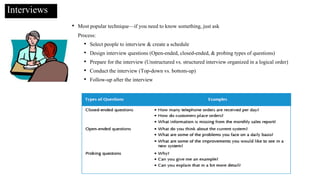
Interviews
• Most popular technique—if you need to know something, just ask
• Process:
• Select people to interview & create a schedule
• Design interview questions (Open-ended, closed-ended, & probing types of questions)
• Prepare for the interview (Unstructured vs. structured interview organized in a logical order)
• Conduct the interview (Top-down vs. bottom-up)
• Follow-up after the interview
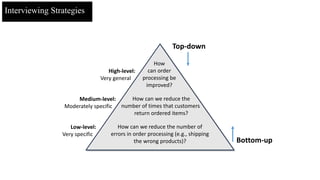
Interviewing Strategies
How
can order
processing be
improved?
How can we reduce the
number of times that customers
return ordered items?
How can we reduce the number of
errors in order processing (e.g., shipping
the wrong products)?
Top-down
Bottom-up
High-level:
Very general
Medium-level:
Moderately specific
Low-level:
Very specific
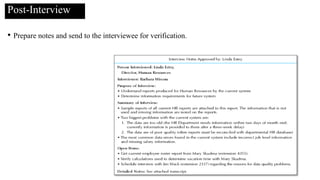
Post-Interview
• Prepare notes and send to the interviewee for verification.
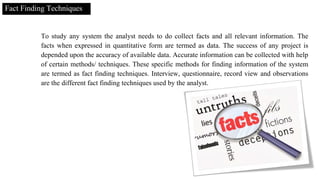
Fact Finding Techniques
To study any system the analyst needs to do collect facts and all relevant information. The
facts when expressed in quantitative form are termed as data. The success of any project is
depended upon the accuracy of available data. Accurate information can be collected with help
of certain methods/ techniques. These specific methods for finding information of the system
are termed as fact finding techniques. Interview, questionnaire, record view and observations
are the different fact finding techniques used by the analyst.
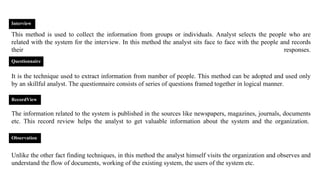
This method is used to collect the information from groups or individuals. Analyst selects the people who are
related with the system for the interview. In this method the analyst sits face to face with the people and records
their responses.
It is the technique used to extract information from number of people. This method can be adopted and used only
by an skillful analyst. The questionnaire consists of series of questions framed together in logical manner.
The information related to the system is published in the sources like newspapers, magazines, journals, documents
etc. This record review helps the analyst to get valuable information about the system and the organization.
Unlike the other fact finding techniques, in this method the analyst himself visits the organization and observes and
understand the flow of documents, working of the existing system, the users of the system etc.
Interview
Questionnaire
RecordView
Observation
JAD &RAD
• Application Development, Adaptation, & Selection
• Requirements
• External Design/Prototypes
• User Test Cases
• Training
• Post-Implementation Reviews
• Strategic Planning
• Customer Satisfaction Session
• Organization Changes
• Request for Proposal Development
• Curriculum Design/Development
aaaaaaaa
aaaaaaaa
aaaaaaaa
aaaaaaaa
aaaaaaaa
aaaaaaaa
aaaaaa
aaaaaa
User for JAD
Why JAD Works
USERS
• Educates Users About Development Process
• Gives Users More Input & Accountability for
Design
• Leverages User's Subject Matter Expertise at
Right Time
I/S
• Ensures I/S and Users Come to Consensus Early
• Provides I/S Subject Matter Expertise at Right Time
• Educates I/S About Business Process
MANAGEMENT
 Ensures Management Communications & Participation
Through Executive Sponsor
 Enforces Top-Down Design to Ensure Business Objectives
Are Met
 Educates Management On Both I/S and Business Area Detail
 Leverages Management Subject Matter Expertise at Right Time
Rapid Application Development (RAD) Methodology:
1.Using workshops or focus groups to gather requirements
2.Prototyping and user testing of designs.
3.Re-using software components.
4.Following a schedule that defers design improvements to the next product version.
5.Keeping review meetings and other team communication informal.
Rapid application development (rad):
This system employs tools, techniques, andmethodologies designed to speed application development. Rapid application
developmentmakes extensive use of joint application development (JAD) for data collection andrequirements analysis.
JAD involves group meetings in which users, and IS professionals worktogether to analyze existing systems, propose
possible solutions, and define the requirementsof a new or modified system. JAD often uses group support systems (GSS)
software to fosterpositive group interactions, while suppressing negative group behavior.
The keys to effective data recording are a reverence for facts and knowing how to look for them. You do not
go into data collection with a preconceived notion of the design of the final procedure. You let the facts tell
you what shape the procedure should take. But, you must be able to find facts and know how to record
them.
There are two authority systems in every organization. One is a social authority set up for the convenience
of arranging people and desks and telephones, dividing up the work and making decisions. The other
authority system is reality itself. Too often the former is revered and feared and attended to constantly, while
the latter is attended to when time permits.
Recording Technique
The Authority of the Facts
As covered earlier while explaining the description pattern, you can gather facts but not skill. If you attempt to
gather enough information to redesign a procedure without the help of experienced employees, your data collection
will be interminably delayed. For instance, if you are studying a procedure that crosses five desks, and the five
people who do the work each have five years of experience, together they have a quarter of a century of first-hand
experience. There is no way to match that experience by interviewing. No matter how many times you go back, there
will still be new things coming up. Then, if you redesign the procedure based solely on your scanty information,
your results will be deficient in the eyes of these more experienced people. It doesn't do any good to complain that
they didn't tell you about that after you have designed a defective procedure.
When people who have been doing work for years are ignored while their work is being improved, there is a clear
statement that their experience is not considered of value. These people tend to feel slighted. When the organization
then pays consultants who have never done the work to develop improvements, this slight becomes an insult. When
the consultants arrive at the workplace trying to glean information from the employees so that they can use it to
develop their own answers,
Level of Detail
Defused resentment
Information Gathering Tools
There are a number of different kinds of tools for collecting information about the thoughts and beliefs that different
groups have about your organization. We focus on three: surveys, interviews and focus groups. You can use one or more,
or a combination, of the following tools for different groups. Review the descriptions of the following tools, and keep
them in mind as you work through this section
Surveys can be widely disseminated and are the most time-efficient method of collecting information from
respondents.People generally respond to surveys anonymously.Most surveys include some yes/no questions, some
questions on a likert scale (a commonly used numerical rating scale) (e.G., Rate on a scale of 1 to 5), and a few open-
ended questions.The disadvantage of surveys is that you may need someone with fairly sophisticated computer skills
to compile the information.If you have the resources, you may wish to use consultants to administer and analyze
surveys.Online resources can help you to survey your staff, volunteers, clients, or board members. We do not
specifically endorse any particular product.
Surveys
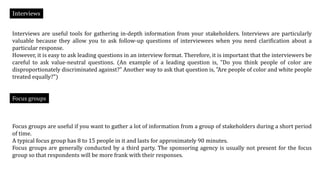
Interviews are useful tools for gathering in-depth information from your stakeholders. Interviews are particularly
valuable because they allow you to ask follow-up questions of interviewees when you need clarification about a
particular response.
However, it is easy to ask leading questions in an interview format. Therefore, it is important that the interviewers be
careful to ask value-neutral questions. (An example of a leading question is, "Do you think people of color are
disproportionately discriminated against?" Another way to ask that question is, "Are people of color and white people
treated equally?")
Focus groups are useful if you want to gather a lot of information from a group of stakeholders during a short period
of time.
A typical focus group has 8 to 15 people in it and lasts for approximately 90 minutes.
Focus groups are generally conducted by a third party. The sponsoring agency is usually not present for the focus
group so that respondents will be more frank with their responses.
Interviews
Focus groups
Determining Requirements In System Analysis And Dsign

Determining Requirements In System Analysis And Dsign

  • 1.
  • 2.
    Learning Objectives • Learnhow to create a requirements definition • Learn various requirements analysis techniques • Learn when to use each requirements analysis techniques • Learn how to gather requirements using interviews, JAD sessions, questionnaires, document analysis & observation • Learn various requirements documentation techniques such as concept maps, story cards & task- lists • Understand when to use each requirements-gathering technique • Be able to begin the creation of a system proposal
  • 3.
    Interviews • Most populartechnique—if you need to know something, just ask • Process: • Select people to interview & create a schedule • Design interview questions (Open-ended, closed-ended, & probing types of questions) • Prepare for the interview (Unstructured vs. structured interview organized in a logical order) • Conduct the interview (Top-down vs. bottom-up) • Follow-up after the interview
  • 4.
    Interviewing Strategies How can order processingbe improved? How can we reduce the number of times that customers return ordered items? How can we reduce the number of errors in order processing (e.g., shipping the wrong products)? Top-down Bottom-up High-level: Very general Medium-level: Moderately specific Low-level: Very specific
  • 5.
    Post-Interview • Prepare notesand send to the interviewee for verification.
  • 6.
    Fact Finding Techniques Tostudy any system the analyst needs to do collect facts and all relevant information. The facts when expressed in quantitative form are termed as data. The success of any project is depended upon the accuracy of available data. Accurate information can be collected with help of certain methods/ techniques. These specific methods for finding information of the system are termed as fact finding techniques. Interview, questionnaire, record view and observations are the different fact finding techniques used by the analyst.
  • 7.
    This method isused to collect the information from groups or individuals. Analyst selects the people who are related with the system for the interview. In this method the analyst sits face to face with the people and records their responses. It is the technique used to extract information from number of people. This method can be adopted and used only by an skillful analyst. The questionnaire consists of series of questions framed together in logical manner. The information related to the system is published in the sources like newspapers, magazines, journals, documents etc. This record review helps the analyst to get valuable information about the system and the organization. Unlike the other fact finding techniques, in this method the analyst himself visits the organization and observes and understand the flow of documents, working of the existing system, the users of the system etc. Interview Questionnaire RecordView Observation
  • 8.
    JAD &RAD • ApplicationDevelopment, Adaptation, & Selection • Requirements • External Design/Prototypes • User Test Cases • Training • Post-Implementation Reviews • Strategic Planning • Customer Satisfaction Session • Organization Changes • Request for Proposal Development • Curriculum Design/Development aaaaaaaa aaaaaaaa aaaaaaaa aaaaaaaa aaaaaaaa aaaaaaaa aaaaaa aaaaaa User for JAD
  • 9.
    Why JAD Works USERS •Educates Users About Development Process • Gives Users More Input & Accountability for Design • Leverages User's Subject Matter Expertise at Right Time I/S • Ensures I/S and Users Come to Consensus Early • Provides I/S Subject Matter Expertise at Right Time • Educates I/S About Business Process MANAGEMENT  Ensures Management Communications & Participation Through Executive Sponsor  Enforces Top-Down Design to Ensure Business Objectives Are Met  Educates Management On Both I/S and Business Area Detail  Leverages Management Subject Matter Expertise at Right Time
  • 10.
    Rapid Application Development(RAD) Methodology: 1.Using workshops or focus groups to gather requirements 2.Prototyping and user testing of designs. 3.Re-using software components. 4.Following a schedule that defers design improvements to the next product version. 5.Keeping review meetings and other team communication informal. Rapid application development (rad): This system employs tools, techniques, andmethodologies designed to speed application development. Rapid application developmentmakes extensive use of joint application development (JAD) for data collection andrequirements analysis. JAD involves group meetings in which users, and IS professionals worktogether to analyze existing systems, propose possible solutions, and define the requirementsof a new or modified system. JAD often uses group support systems (GSS) software to fosterpositive group interactions, while suppressing negative group behavior.
  • 11.
    The keys toeffective data recording are a reverence for facts and knowing how to look for them. You do not go into data collection with a preconceived notion of the design of the final procedure. You let the facts tell you what shape the procedure should take. But, you must be able to find facts and know how to record them. There are two authority systems in every organization. One is a social authority set up for the convenience of arranging people and desks and telephones, dividing up the work and making decisions. The other authority system is reality itself. Too often the former is revered and feared and attended to constantly, while the latter is attended to when time permits. Recording Technique The Authority of the Facts
  • 12.
    As covered earlierwhile explaining the description pattern, you can gather facts but not skill. If you attempt to gather enough information to redesign a procedure without the help of experienced employees, your data collection will be interminably delayed. For instance, if you are studying a procedure that crosses five desks, and the five people who do the work each have five years of experience, together they have a quarter of a century of first-hand experience. There is no way to match that experience by interviewing. No matter how many times you go back, there will still be new things coming up. Then, if you redesign the procedure based solely on your scanty information, your results will be deficient in the eyes of these more experienced people. It doesn't do any good to complain that they didn't tell you about that after you have designed a defective procedure. When people who have been doing work for years are ignored while their work is being improved, there is a clear statement that their experience is not considered of value. These people tend to feel slighted. When the organization then pays consultants who have never done the work to develop improvements, this slight becomes an insult. When the consultants arrive at the workplace trying to glean information from the employees so that they can use it to develop their own answers, Level of Detail Defused resentment
  • 13.
    Information Gathering Tools Thereare a number of different kinds of tools for collecting information about the thoughts and beliefs that different groups have about your organization. We focus on three: surveys, interviews and focus groups. You can use one or more, or a combination, of the following tools for different groups. Review the descriptions of the following tools, and keep them in mind as you work through this section Surveys can be widely disseminated and are the most time-efficient method of collecting information from respondents.People generally respond to surveys anonymously.Most surveys include some yes/no questions, some questions on a likert scale (a commonly used numerical rating scale) (e.G., Rate on a scale of 1 to 5), and a few open- ended questions.The disadvantage of surveys is that you may need someone with fairly sophisticated computer skills to compile the information.If you have the resources, you may wish to use consultants to administer and analyze surveys.Online resources can help you to survey your staff, volunteers, clients, or board members. We do not specifically endorse any particular product. Surveys
  • 14.
    Interviews are usefultools for gathering in-depth information from your stakeholders. Interviews are particularly valuable because they allow you to ask follow-up questions of interviewees when you need clarification about a particular response. However, it is easy to ask leading questions in an interview format. Therefore, it is important that the interviewers be careful to ask value-neutral questions. (An example of a leading question is, "Do you think people of color are disproportionately discriminated against?" Another way to ask that question is, "Are people of color and white people treated equally?") Focus groups are useful if you want to gather a lot of information from a group of stakeholders during a short period of time. A typical focus group has 8 to 15 people in it and lasts for approximately 90 minutes. Focus groups are generally conducted by a third party. The sponsoring agency is usually not present for the focus group so that respondents will be more frank with their responses. Interviews Focus groups