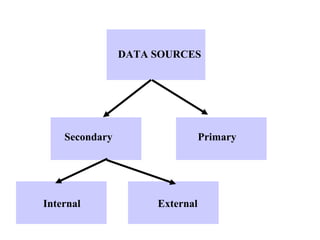
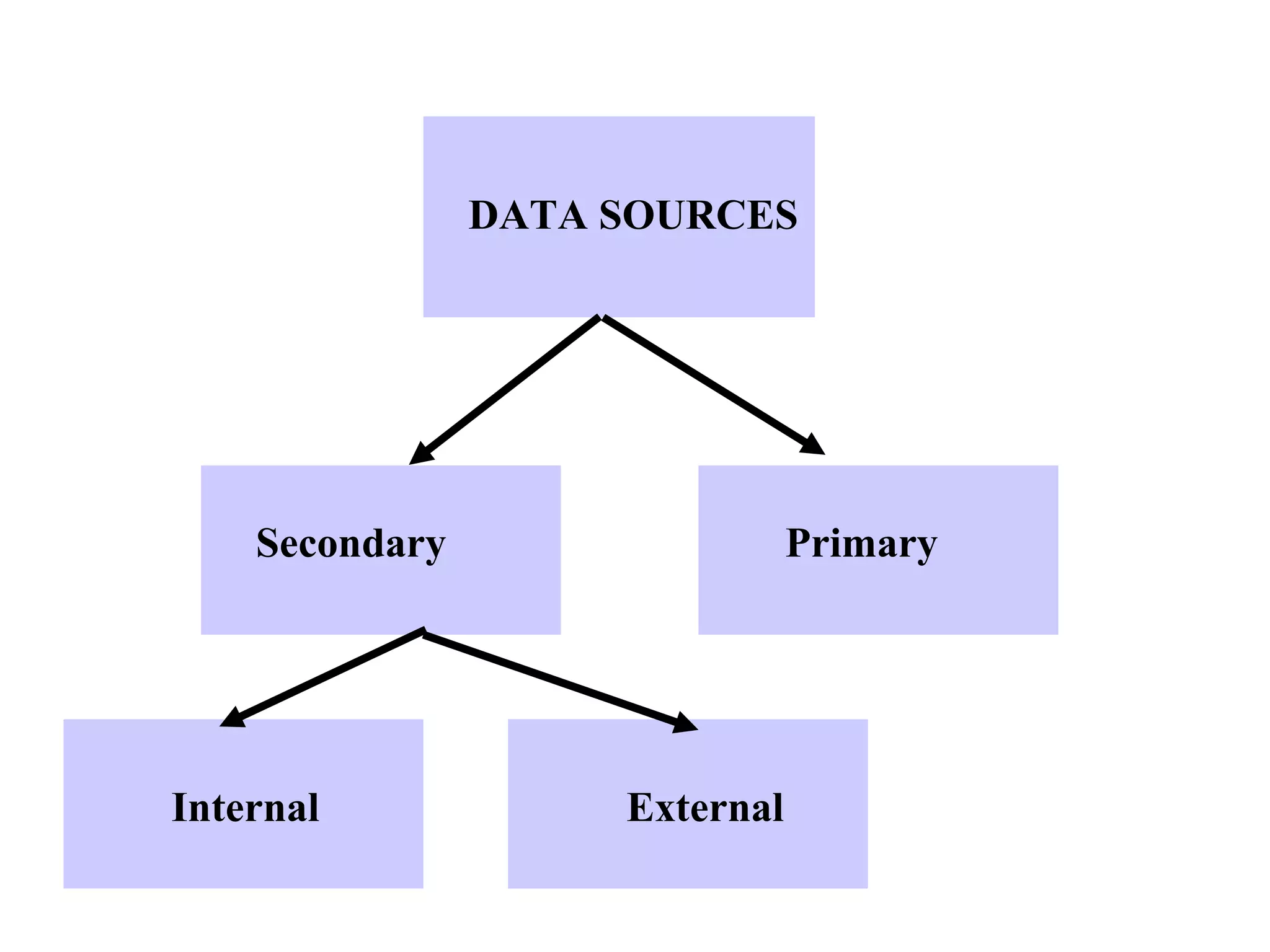
DATA SOURCES
PrimarySecondary
Internal External
Secondary Data
Data gathered and recorded by
someone else prior to and for a purpose
other than the current project.
Is often:
• Historical
• Already assembled
• Internal to corporation
Advantages of Secondary Data
 Inexpensive
 Obtained Rapidly
 Needs no access to respondents (convenient)
 Information is not otherwise accessible
 Can provide Insights into problem during
exploratory phase
 Can provide background data on trends etc.
which lends credibility to the report
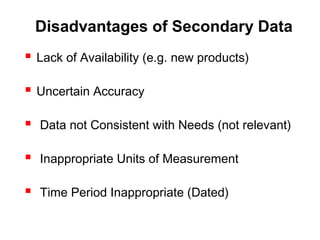
Disadvantages of Secondary Data
 Lack of Availability (e.g. new products)
 Uncertain Accuracy
 Data not Consistent with Needs (not relevant)
 Inappropriate Units of Measurement
 Time Period Inappropriate (Dated)
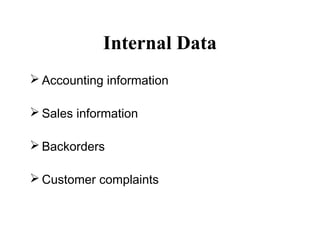
Internal Data
 Accounting information
 Sales information
 Backorders
 Customer complaints
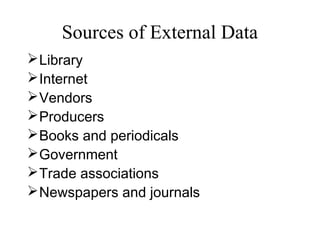
Sources of External Data
Library
Internet
Vendors
Producers
Books and periodicals
Government
Trade associations
Newspapers and journals
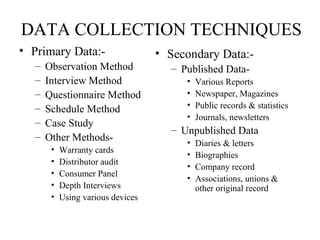
DATA COLLECTION TECHNIQUES
• Primary Data:-
– Observation Method
– Interview Method
– Questionnaire Method
– Schedule Method
– Case Study
– Other Methods-
• Warranty cards
• Distributor audit
• Consumer Panel
• Depth Interviews
• Using various devices
• Secondary Data:-
– Published Data-
• Various Reports
• Newspaper, Magazines
• Public records & statistics
• Journals, newsletters
– Unpublished Data
• Diaries & letters
• Biographies
• Company record
• Associations, unions &
other original record
• It is mostly used for studies related to
behavioral science.
• In this method the information is sought by
way of investigator’s own direct observation
without asking from respondent.
• Example
• Investigator can see the brand of car used by
the respondent , no need to ask him
(respondent) about the brand.
• No subjective biasing, if observation is made
accurately.
• The information collated gives the idea which is
currently happening.
• Data is not complicated as it do not have any
relation with either past or future.
• Method is independent of respondents attitude
and intentions.
• Applicable for those respondents who are not
capable of giving verbal responses, like animals.
• It is an expensive method.
• Information provided by this method is very
limited.
• Some time unforeseen factors may interfere
with the observational task.
• In case of rare respondents the method
becomes tedious.
Questionnaire method
• A questionnaire is a means of eliciting the
feelings, beliefs, experiences, perceptions,
or attitudes of some sample of individuals.
As a data collecting instrument, it could be
structured or unstructured
Two types of questionnaires
• Closed or restricted form - calls for a "yes"
or "no" answer, short response, or item
checking; is fairly easy to interpret,
tabulate, and summarize.
• Open or unrestricted form - calls for free
response from the respondent; allows for
greater depth of response; is difficult to
interpret, tabulate, and summarize.
Interview method
An interview is a direct face-to-face attempt
to obtain reliable and valid measures in the
form of verbal responses from one or more
respondents. It is a conversation in which
the roles of the interviewer and the
respondent change continually.
Types of Interview: Structured interviews
• Rigidly standardized and formal.
• The same questions are presented in the same
manner and order to each subject.
• The choice of alternative answers is restricted to a
predetermined list.
• They are more scientific in nature than unstructured
interviews.
• They introduce controls that permit the formulation
of scientific generalizations
Unstructured interviews are flexible.
They have few restrictions.
If preplanned questions are asked, they are altered to
suit the situation and subjects.
Subjects are encouraged to express their thoughts
freely.
Only a few questions are asked to direct their answers.
In some instances, the information is obtained in such a
casual manner that the respondents are not aware they
are being interviewed
Types of Interview: Unstructured interviews
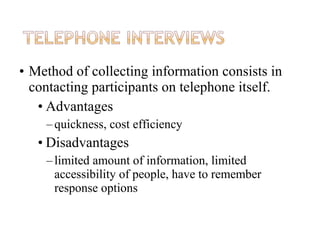
• Method of collecting information consists in
contacting participants on telephone itself.
• Advantages
–quickness, cost efficiency
• Disadvantages
–limited amount of information, limited
accessibility of people, have to remember
response options
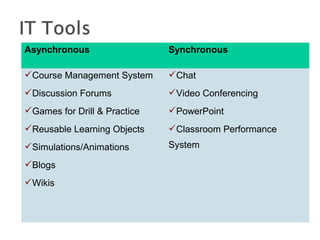
Asynchronous Synchronous
Course Management System
Discussion Forums
Games for Drill & Practice
Reusable Learning Objects
Simulations/Animations
Blogs
Wikis
Chat
Video Conferencing
PowerPoint
Classroom Performance
System

Data collection

  • 1.
  • 2.
    Secondary Data Data gatheredand recorded by someone else prior to and for a purpose other than the current project. Is often: • Historical • Already assembled • Internal to corporation
  • 3.
    Advantages of SecondaryData  Inexpensive  Obtained Rapidly  Needs no access to respondents (convenient)  Information is not otherwise accessible  Can provide Insights into problem during exploratory phase  Can provide background data on trends etc. which lends credibility to the report
  • 4.
    Disadvantages of SecondaryData  Lack of Availability (e.g. new products)  Uncertain Accuracy  Data not Consistent with Needs (not relevant)  Inappropriate Units of Measurement  Time Period Inappropriate (Dated)
  • 5.
    Internal Data  Accountinginformation  Sales information  Backorders  Customer complaints
  • 6.
    Sources of ExternalData Library Internet Vendors Producers Books and periodicals Government Trade associations Newspapers and journals
  • 7.
    DATA COLLECTION TECHNIQUES •Primary Data:- – Observation Method – Interview Method – Questionnaire Method – Schedule Method – Case Study – Other Methods- • Warranty cards • Distributor audit • Consumer Panel • Depth Interviews • Using various devices • Secondary Data:- – Published Data- • Various Reports • Newspaper, Magazines • Public records & statistics • Journals, newsletters – Unpublished Data • Diaries & letters • Biographies • Company record • Associations, unions & other original record
  • 8.
    • It ismostly used for studies related to behavioral science. • In this method the information is sought by way of investigator’s own direct observation without asking from respondent. • Example • Investigator can see the brand of car used by the respondent , no need to ask him (respondent) about the brand.
  • 9.
    • No subjectivebiasing, if observation is made accurately. • The information collated gives the idea which is currently happening. • Data is not complicated as it do not have any relation with either past or future. • Method is independent of respondents attitude and intentions. • Applicable for those respondents who are not capable of giving verbal responses, like animals.
  • 10.
    • It isan expensive method. • Information provided by this method is very limited. • Some time unforeseen factors may interfere with the observational task. • In case of rare respondents the method becomes tedious.
  • 11.
    Questionnaire method • Aquestionnaire is a means of eliciting the feelings, beliefs, experiences, perceptions, or attitudes of some sample of individuals. As a data collecting instrument, it could be structured or unstructured
  • 12.
    Two types ofquestionnaires • Closed or restricted form - calls for a "yes" or "no" answer, short response, or item checking; is fairly easy to interpret, tabulate, and summarize. • Open or unrestricted form - calls for free response from the respondent; allows for greater depth of response; is difficult to interpret, tabulate, and summarize.
  • 13.
    Interview method An interviewis a direct face-to-face attempt to obtain reliable and valid measures in the form of verbal responses from one or more respondents. It is a conversation in which the roles of the interviewer and the respondent change continually.
  • 14.
    Types of Interview:Structured interviews • Rigidly standardized and formal. • The same questions are presented in the same manner and order to each subject. • The choice of alternative answers is restricted to a predetermined list. • They are more scientific in nature than unstructured interviews. • They introduce controls that permit the formulation of scientific generalizations
  • 15.
    Unstructured interviews areflexible. They have few restrictions. If preplanned questions are asked, they are altered to suit the situation and subjects. Subjects are encouraged to express their thoughts freely. Only a few questions are asked to direct their answers. In some instances, the information is obtained in such a casual manner that the respondents are not aware they are being interviewed Types of Interview: Unstructured interviews
  • 16.
    • Method ofcollecting information consists in contacting participants on telephone itself. • Advantages –quickness, cost efficiency • Disadvantages –limited amount of information, limited accessibility of people, have to remember response options
  • 17.
    Asynchronous Synchronous Course ManagementSystem Discussion Forums Games for Drill & Practice Reusable Learning Objects Simulations/Animations Blogs Wikis Chat Video Conferencing PowerPoint Classroom Performance System