Fact Finding for Requirement
         Discovery
 Organized By: Vinay Arora
               Assistant Professor
              CSED, Thapar University
              www.slideshare.net/aroravinay
Disclaimer


            This is NOT A COPYRIGHT                   MATERIAL

            Content has been taken mainly from the following books:
System Analysis and Design Methods By Jeffrey L Whitten & Lonnie D Bentley , Analysis &
                      Design of Information Systems By James A. Senn,
                      System Analysis & Design By Elias M. Awad,
Modern System Analysis & Design By Jeffrey A. Hoffer, Joey F.George & Joseph S. Valacich


                                       Vinay Arora
                                          CSED
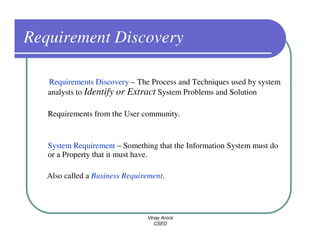
Requirement Discovery

   Requirements Discovery – The Process and Techniques used by system
   analysts to Identify or Extract System Problems and Solution

   Requirements from the User community.


   System Requirement – Something that the Information System must do
   or a Property that it must have.

   Also called a Business Requirement.


                                Vinay Arora
                                   CSED
SYSTEM ANALYSIS
CheckPoints


              Vinay Arora
                 CSED
Result of Incorrect Requirement
 The system may Cost more than projected.

 The system may be Delivered Later than promised
 .
 The system may not meet the users’ expectations and that Dissatisfaction
 may cause them not to use it.

 Once in production, the costs of maintaining and enhancing the system
 may be excessively high.

 The system may be Unreliable and prone to errors and downtime.

 The Reputation of the IT staff on the team is tarnished because any
 failure, regardless of who is at fault, will be perceived as a mistake by the
 team.
                                    Vinay Arora
                                       CSED
Relative Cost to Fix an Error


                 Vinay Arora
                    CSED
Criteria to Define System Requirement
  Consistent – Requirements are not conflicting or ambiguous.

  Complete – Requirements describe all possible system inputs and
  responses.

  Feasible – Requirements can be satisfied based on the available resources
  and constraints.

  Required – Requirements are truly needed and fulfill the purpose of the
  system.

  Accurate – Requirements are stated correctly.


                                    Vinay Arora
                                       CSED
Criteria to Define System Requirement

   Traceable – Requirements directly map to the functions and features of
   the system.

   Verifiable – Requirements are defined so they can be demonstrated
   during testing.


                                 Vinay Arora
                                    CSED
Process of Requirement Discovery
   Problem Discovery and Analysis

   Requirements Discovery

   Documenting and Analyzing Requirements

   Requirements Management


                               Vinay Arora
                                  CSED
Ishikawa Diagram
  The Ishikawa Diagram is a graphical tool used to identify, explore,
  and depict problems and the causes and effects of those problems. It
  is often referred to as a cause-and-effect diagram or a fishbone
  diagram.


                                 Vinay Arora
                                    CSED
Ishikawa Diagram (contd.)


                Vinay Arora
                   CSED
Ishikawa Diagram (contd.)


                Vinay Arora
                   CSED
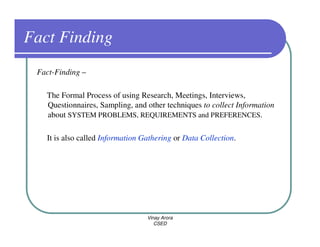
Fact Finding
 Fact-Finding –

   The Formal Process of using Research, Meetings, Interviews,
   Questionnaires, Sampling, and other techniques to collect Information
   about SYSTEM PROBLEMS, REQUIREMENTS and PREFERENCES.

   It is also called Information Gathering or Data Collection.


                                  Vinay Arora
                                     CSED
Fact Finding
   FACT-FINDING often brings Systems Analysts into contact with sensitive
   information.

       Company Plans
       Employee Salaries or Medical History
       Customer Credit Card, Social Security, or Other Information

   ETHICAL BEHAVIOR includes:

       Systems Analysts must not misuse that Information.

   Otherwise:

       Systems Analyst loses Respect, Credibility, and Confidence of Users and
       management, Impairing ability to do job
       Organization and Systems Analyst could have LEGAL LIABILITY
       Systems Analyst could lose job

                                   Vinay Arora
                                      CSED
7 Fact Finding Methods
   Sampling of Existing Documentation, Forms and Databases

   Research and Site Visits

   Observation of the Work Environment

   Questionnaires

   Interviews

   Prototyping

   Joint Requirements Planning (JRP)

                               Vinay Arora
                                  CSED
Documenting and Analyzing
        Requirements
Documenting the Draft Requirements with Various Tools:

   Use Cases

   Decision Tables

   Requirements Tables

Analyzing Requirements to Resolve Problems of:

   Missing Requirements

   Conflicting Requirements

   Infeasible Requirements
                              Vinay Arora
                                 CSED
Documenting and Analyzing
        Requirements
Analyzing Requirements to Resolve Problems of:

   Overlapping Requirements

   Ambiguous Requirements

Formalizing Requirements

   Requirements Definition Document

   Communicated to Stakeholders or Steering Body


                            Vinay Arora
                               CSED
Sampling of Existing Documentation,
       Forms and Databases
  SAMPLING – The Process of Collecting a Sample (representative data)
  of Documents, Forms and Records.

     Organization Chart
     Memos and Other Documents that describe the Problem
     Standard Operating procedures for Current System
     Completed Forms
     Manual and Computerized Screens and Reports
     Samples of Databases
     Flowcharts and other System Documentation


                              Vinay Arora
                                 CSED
Why to Sample Completed Rather than
           Blank Forms
 Can determine the Type of Data going into each blank
 Can determine the Size of Data going into each blank
 Can determine which blanks are not used or not always used
 Can see Data Relationships


                              Vinay Arora
                                 CSED
Sampling Techniques
 RANDOMIZATION –


   A Sampling Technique characterized by having NO PREDETERMINED
   PATTERN or PLAN for selecting Sample Data.


 STRATIFICATION –


   A Systematic Sampling Technique that attempts to reduce the variance of
   the estimates by spreading out the sampling — For Example,
   CHOOSING DOCUMENTS OR RECORDS BY FORMULA and by avoiding
   very high or low estimates.


                                 Vinay Arora
                                    CSED
Observation (At Work Site)


                 Vinay Arora
                    CSED
Observation during Discussion


                Vinay Arora
                   CSED
Observation
   OBSERVATION – A Fact-Finding Technique wherein the Systems
   Analyst either Participates In or Watches a person perform activities to
   learn about the System.

   Advantages – Reliable Information, Identify tasks that are inaccurately
   described or missed, Work Measurements.

   Disadvantages – People feel uncomfortable, Perform Differently,
   Scheduling Inconvenience.

   WORK SAMPLING - A Fact-Finding Technique that involves a large
   number of Observations taken at random Intervals.


                                  Vinay Arora
                                     CSED
Observation Guidelines
   Determine the who, what, where, when, why, and how of the observation.

   Obtain permission from appropriate supervisors or managers.

   Inform those who will be observed of the purpose of the Observation.

   Keep a Low Profile.

   Take notes during or immediately following the Observation.

   Review Observation notes with appropriate Individuals.

   Don't Interrupt the Individuals at Work.

   Don't Focus heavily on Trivial Activities.

   Don't make Assumptions.
                                     Vinay Arora
                                        CSED
Questionnaire
   Questionnaire – A Special-purpose Document that allows the Analyst to
   collect Information and Opinions from Respondents.


   Free-Format Questionnaire – A Questionnaire designed to offer the
   respondent GREATER LATITUDE in the answer. A question is asked,
   and the respondent records the answer in the space provided after the
   question.


   Fixed-Format Questionnaire – A Questionnaire Containing Questions
   that require Selecting an answer from Predefined Available Responses.


                                Vinay Arora
                                   CSED
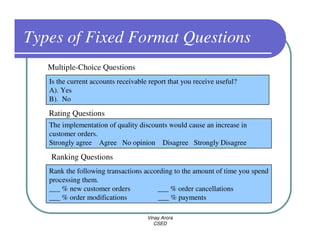
Types of Fixed Format Questions
   Multiple-Choice Questions
   Is the current accounts receivable report that you receive useful?
   A). Yes
   B). No
   Rating Questions
   The implementation of quality discounts would cause an increase in
   customer orders.
   Strongly agree Agree No opinion Disagree Strongly Disagree
    Ranking Questions
   Rank the following transactions according to the amount of time you spend
   processing them.
   ___ % new customer orders           ___ % order cancellations
   ___ % order modifications           ___ % payments

                                     Vinay Arora
                                        CSED
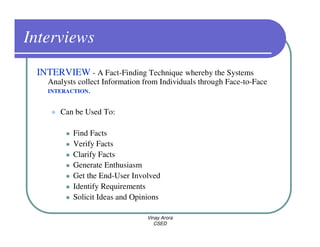
Interviews
 INTERVIEW - A Fact-Finding Technique whereby the Systems
   Analysts collect Information from Individuals through Face-to-Face
   INTERACTION.


       Can be Used To:

          Find Facts
          Verify Facts
          Clarify Facts
          Generate Enthusiasm
          Get the End-User Involved
          Identify Requirements
          Solicit Ideas and Opinions

                                Vinay Arora
                                   CSED
Types of Interview & Questions
   Unstructured Interview – An Interview that is conducted with only a
   general Goal or Subject in mind and with few, if any, Specific
   Questions.

   The Interviewer Counts on the Interviewee to provide a Framework and
   direct the Conversation.

   Structured Interview – An Interview in which the Interviewer has a
   Specific Set Of Questions to ask of the Interviewee.

   Open-Ended Question – Question that allows the Interviewee to
   RESPOND IN ANY WAY that seems appropriate.

   Closed-Ended Question – A Question that RESTRICTS ANSWERS to
   either Specific Choices or Short, Direct Responses.

                                 Vinay Arora
                                    CSED
Procedure to Conduct Interview
 1.   Select Interviewees
          End Users
          Learn about Individual prior to the Interview

 2.   Prepare for the Interview
         An INTERVIEW GUIDE is a Checklist Of Specific Questions the
         Interviewer will ask the Interviewee.

 3.   Conduct the Interview
         Summarize the Problem
         Offer an Incentive for Participation
         Ask the Interviewee for assistance

 4.   Follow Up on the Interview
          Memo that summarizes the Interview
                                  Vinay Arora
                                     CSED
SAMPLE INTERVIEW GUIDE


Vinay Arora
   CSED
Do                                       Avoid
Be Courteous                         Continuing an Interview
                                     unnecessarily
Listen Carefully
                                     Assuming an answer is Finished
                                     or Leading nowhere
Maintain Control
                                     Revealing your Personal Biases
Observe mannerisms and
Nonverbal Communication
                                     Talking instead of Listening
Be Patient
                                     Assuming anything about the
                                     topic and the Interviewee
Keep Interviewee at ease

                           Vinay Arora
                              CSED
Body Language
 BODY LANGUAGE - The Nonverbal Information we communicate.

      Facial Disclosure

      Eye Contact

      Posture


                            Vinay Arora
                               CSED
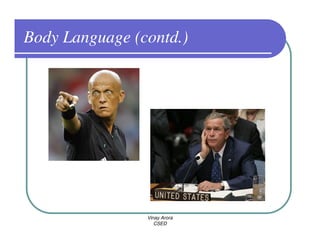
Body Language (contd.)


                Vinay Arora
                   CSED
Body Language (contd.)


                Vinay Arora
                   CSED
Body Language (contd.)


                Vinay Arora
                   CSED
Body Language (contd.)


                Vinay Arora
                   CSED
Body Language (In Animals)


                Vinay Arora
                   CSED
Ref. Book


            Vinay Arora
               CSED
Discovery Prototyping
   DISCOVERY PROTOTYPING –
   The Act of building a Small-scale, REPRESENTATIVE or WORKING
   MODEL of the users’ requirements in order TO DISCOVER OR
   VERIFY those Requirements.

   Advantages:- Ease in Determining Feasibility & Usefulness, Serve as
   Training Mechanism, Building Test Plans, More Stable Requirements.

   Disadvantages:- Trained Developer for Prototyped Approach, Increased
   Development Cost.


                                Vinay Arora
                                   CSED
JRP & Participants
   JOINT REQUIREMENTS PLANNING (JRP) – A Process whereby highly
    Structured group meetings are conducted for the purpose of ANALYZING
    PROBLEMS AND DEFINING REQUIREMENTS.


       JRP is a Subset of a more comprehensive Joint Application Development or
       JAD Technique that encompasses the Entire Systems Development Process.


   Sponsor
   Facilitator
   Users and Managers
   Scribes
   IT staff


                                   Vinay Arora
                                      CSED
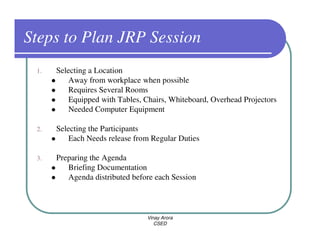
Steps to Plan JRP Session
 1.   Selecting a Location
          Away from workplace when possible
          Requires Several Rooms
          Equipped with Tables, Chairs, Whiteboard, Overhead Projectors
          Needed Computer Equipment

 2.   Selecting the Participants
          Each Needs release from Regular Duties

 3.   Preparing the Agenda
         Briefing Documentation
         Agenda distributed before each Session


                                Vinay Arora
                                   CSED
Vinay Arora
   CSED
Guidelines for Conducting JRP Session
   Do not unreasonably deviate from the Agenda

   Stay on Schedule

   Ensure that the SCRIBE is able to take notes

   Avoid the use of Technical Jargon

   Apply Conflict Resolution Skills

   Allow for ample BREAKS

   Encourage group Consensus

   Encourage User and Management Participation without allowing Individuals to
   dominate the Session

   Make sure that attendees abide by the established ground Rules for the Session

                                      Vinay Arora
                                         CSED
A Fact Finding Strategy
 1.   Learn from Existing Documents, Forms, Reports and Files.

 2.   If appropriate, Observe the System in action.

 3.   Given all the facts that already collected, design and distribute
      questionnaires to clear up things that aren’t fully understood.

 4.   Conduct Interviews (or Group Work Sessions).

 5.   (Optional) Build Discovery Prototypes for any Functional
      Requirements that are not understood or for requirements that need to
      be validated.

 6.   Follow up to Verify Facts.


                                   Vinay Arora
                                      CSED
Reference List

1. System Analysis and Design Methods By Jeffrey L Whitten & Lonnie D Bentley
2. Analysis & Design of Information Systems By James A. Senn
3. System Analysis & Design By Elias M. Awad
4. Modern System Analysis & Design By Jeffrey A. Hoffer, Joey F.George & Joseph S. Valacich

                                        etc…….


                                        Vinay Arora
                                           CSED
Thnx…


  Vinay Arora
     CSED

A&D - Fact Finding Techniques

  • 1.
    Fact Finding forRequirement Discovery Organized By: Vinay Arora Assistant Professor CSED, Thapar University www.slideshare.net/aroravinay
  • 2.
    Disclaimer This is NOT A COPYRIGHT MATERIAL Content has been taken mainly from the following books: System Analysis and Design Methods By Jeffrey L Whitten & Lonnie D Bentley , Analysis & Design of Information Systems By James A. Senn, System Analysis & Design By Elias M. Awad, Modern System Analysis & Design By Jeffrey A. Hoffer, Joey F.George & Joseph S. Valacich Vinay Arora CSED
  • 3.
    Requirement Discovery Requirements Discovery – The Process and Techniques used by system analysts to Identify or Extract System Problems and Solution Requirements from the User community. System Requirement – Something that the Information System must do or a Property that it must have. Also called a Business Requirement. Vinay Arora CSED
  • 4.
  • 5.
    Result of IncorrectRequirement The system may Cost more than projected. The system may be Delivered Later than promised . The system may not meet the users’ expectations and that Dissatisfaction may cause them not to use it. Once in production, the costs of maintaining and enhancing the system may be excessively high. The system may be Unreliable and prone to errors and downtime. The Reputation of the IT staff on the team is tarnished because any failure, regardless of who is at fault, will be perceived as a mistake by the team. Vinay Arora CSED
  • 6.
    Relative Cost toFix an Error Vinay Arora CSED
  • 7.
    Criteria to DefineSystem Requirement Consistent – Requirements are not conflicting or ambiguous. Complete – Requirements describe all possible system inputs and responses. Feasible – Requirements can be satisfied based on the available resources and constraints. Required – Requirements are truly needed and fulfill the purpose of the system. Accurate – Requirements are stated correctly. Vinay Arora CSED
  • 8.
    Criteria to DefineSystem Requirement Traceable – Requirements directly map to the functions and features of the system. Verifiable – Requirements are defined so they can be demonstrated during testing. Vinay Arora CSED
  • 9.
    Process of RequirementDiscovery Problem Discovery and Analysis Requirements Discovery Documenting and Analyzing Requirements Requirements Management Vinay Arora CSED
  • 10.
    Ishikawa Diagram The Ishikawa Diagram is a graphical tool used to identify, explore, and depict problems and the causes and effects of those problems. It is often referred to as a cause-and-effect diagram or a fishbone diagram. Vinay Arora CSED
  • 11.
  • 12.
  • 13.
    Fact Finding Fact-Finding– The Formal Process of using Research, Meetings, Interviews, Questionnaires, Sampling, and other techniques to collect Information about SYSTEM PROBLEMS, REQUIREMENTS and PREFERENCES. It is also called Information Gathering or Data Collection. Vinay Arora CSED
  • 14.
    Fact Finding FACT-FINDING often brings Systems Analysts into contact with sensitive information. Company Plans Employee Salaries or Medical History Customer Credit Card, Social Security, or Other Information ETHICAL BEHAVIOR includes: Systems Analysts must not misuse that Information. Otherwise: Systems Analyst loses Respect, Credibility, and Confidence of Users and management, Impairing ability to do job Organization and Systems Analyst could have LEGAL LIABILITY Systems Analyst could lose job Vinay Arora CSED
  • 15.
    7 Fact FindingMethods Sampling of Existing Documentation, Forms and Databases Research and Site Visits Observation of the Work Environment Questionnaires Interviews Prototyping Joint Requirements Planning (JRP) Vinay Arora CSED
  • 16.
    Documenting and Analyzing Requirements Documenting the Draft Requirements with Various Tools: Use Cases Decision Tables Requirements Tables Analyzing Requirements to Resolve Problems of: Missing Requirements Conflicting Requirements Infeasible Requirements Vinay Arora CSED
  • 17.
    Documenting and Analyzing Requirements Analyzing Requirements to Resolve Problems of: Overlapping Requirements Ambiguous Requirements Formalizing Requirements Requirements Definition Document Communicated to Stakeholders or Steering Body Vinay Arora CSED
  • 18.
    Sampling of ExistingDocumentation, Forms and Databases SAMPLING – The Process of Collecting a Sample (representative data) of Documents, Forms and Records. Organization Chart Memos and Other Documents that describe the Problem Standard Operating procedures for Current System Completed Forms Manual and Computerized Screens and Reports Samples of Databases Flowcharts and other System Documentation Vinay Arora CSED
  • 19.
    Why to SampleCompleted Rather than Blank Forms Can determine the Type of Data going into each blank Can determine the Size of Data going into each blank Can determine which blanks are not used or not always used Can see Data Relationships Vinay Arora CSED
  • 20.
    Sampling Techniques RANDOMIZATION– A Sampling Technique characterized by having NO PREDETERMINED PATTERN or PLAN for selecting Sample Data. STRATIFICATION – A Systematic Sampling Technique that attempts to reduce the variance of the estimates by spreading out the sampling — For Example, CHOOSING DOCUMENTS OR RECORDS BY FORMULA and by avoiding very high or low estimates. Vinay Arora CSED
  • 21.
    Observation (At WorkSite) Vinay Arora CSED
  • 22.
  • 23.
    Observation OBSERVATION – A Fact-Finding Technique wherein the Systems Analyst either Participates In or Watches a person perform activities to learn about the System. Advantages – Reliable Information, Identify tasks that are inaccurately described or missed, Work Measurements. Disadvantages – People feel uncomfortable, Perform Differently, Scheduling Inconvenience. WORK SAMPLING - A Fact-Finding Technique that involves a large number of Observations taken at random Intervals. Vinay Arora CSED
  • 24.
    Observation Guidelines Determine the who, what, where, when, why, and how of the observation. Obtain permission from appropriate supervisors or managers. Inform those who will be observed of the purpose of the Observation. Keep a Low Profile. Take notes during or immediately following the Observation. Review Observation notes with appropriate Individuals. Don't Interrupt the Individuals at Work. Don't Focus heavily on Trivial Activities. Don't make Assumptions. Vinay Arora CSED
  • 25.
    Questionnaire Questionnaire – A Special-purpose Document that allows the Analyst to collect Information and Opinions from Respondents. Free-Format Questionnaire – A Questionnaire designed to offer the respondent GREATER LATITUDE in the answer. A question is asked, and the respondent records the answer in the space provided after the question. Fixed-Format Questionnaire – A Questionnaire Containing Questions that require Selecting an answer from Predefined Available Responses. Vinay Arora CSED
  • 26.
    Types of FixedFormat Questions Multiple-Choice Questions Is the current accounts receivable report that you receive useful? A). Yes B). No Rating Questions The implementation of quality discounts would cause an increase in customer orders. Strongly agree Agree No opinion Disagree Strongly Disagree Ranking Questions Rank the following transactions according to the amount of time you spend processing them. ___ % new customer orders ___ % order cancellations ___ % order modifications ___ % payments Vinay Arora CSED
  • 27.
    Interviews INTERVIEW -A Fact-Finding Technique whereby the Systems Analysts collect Information from Individuals through Face-to-Face INTERACTION. Can be Used To: Find Facts Verify Facts Clarify Facts Generate Enthusiasm Get the End-User Involved Identify Requirements Solicit Ideas and Opinions Vinay Arora CSED
  • 28.
    Types of Interview& Questions Unstructured Interview – An Interview that is conducted with only a general Goal or Subject in mind and with few, if any, Specific Questions. The Interviewer Counts on the Interviewee to provide a Framework and direct the Conversation. Structured Interview – An Interview in which the Interviewer has a Specific Set Of Questions to ask of the Interviewee. Open-Ended Question – Question that allows the Interviewee to RESPOND IN ANY WAY that seems appropriate. Closed-Ended Question – A Question that RESTRICTS ANSWERS to either Specific Choices or Short, Direct Responses. Vinay Arora CSED
  • 29.
    Procedure to ConductInterview 1. Select Interviewees End Users Learn about Individual prior to the Interview 2. Prepare for the Interview An INTERVIEW GUIDE is a Checklist Of Specific Questions the Interviewer will ask the Interviewee. 3. Conduct the Interview Summarize the Problem Offer an Incentive for Participation Ask the Interviewee for assistance 4. Follow Up on the Interview Memo that summarizes the Interview Vinay Arora CSED
  • 30.
  • 31.
    Do Avoid Be Courteous Continuing an Interview unnecessarily Listen Carefully Assuming an answer is Finished or Leading nowhere Maintain Control Revealing your Personal Biases Observe mannerisms and Nonverbal Communication Talking instead of Listening Be Patient Assuming anything about the topic and the Interviewee Keep Interviewee at ease Vinay Arora CSED
  • 32.
    Body Language BODYLANGUAGE - The Nonverbal Information we communicate. Facial Disclosure Eye Contact Posture Vinay Arora CSED
  • 33.
    Body Language (contd.) Vinay Arora CSED
  • 34.
    Body Language (contd.) Vinay Arora CSED
  • 35.
    Body Language (contd.) Vinay Arora CSED
  • 36.
    Body Language (contd.) Vinay Arora CSED
  • 37.
    Body Language (InAnimals) Vinay Arora CSED
  • 38.
    Ref. Book Vinay Arora CSED
  • 39.
    Discovery Prototyping DISCOVERY PROTOTYPING – The Act of building a Small-scale, REPRESENTATIVE or WORKING MODEL of the users’ requirements in order TO DISCOVER OR VERIFY those Requirements. Advantages:- Ease in Determining Feasibility & Usefulness, Serve as Training Mechanism, Building Test Plans, More Stable Requirements. Disadvantages:- Trained Developer for Prototyped Approach, Increased Development Cost. Vinay Arora CSED
  • 40.
    JRP & Participants JOINT REQUIREMENTS PLANNING (JRP) – A Process whereby highly Structured group meetings are conducted for the purpose of ANALYZING PROBLEMS AND DEFINING REQUIREMENTS. JRP is a Subset of a more comprehensive Joint Application Development or JAD Technique that encompasses the Entire Systems Development Process. Sponsor Facilitator Users and Managers Scribes IT staff Vinay Arora CSED
  • 41.
    Steps to PlanJRP Session 1. Selecting a Location Away from workplace when possible Requires Several Rooms Equipped with Tables, Chairs, Whiteboard, Overhead Projectors Needed Computer Equipment 2. Selecting the Participants Each Needs release from Regular Duties 3. Preparing the Agenda Briefing Documentation Agenda distributed before each Session Vinay Arora CSED
  • 42.
  • 43.
    Guidelines for ConductingJRP Session Do not unreasonably deviate from the Agenda Stay on Schedule Ensure that the SCRIBE is able to take notes Avoid the use of Technical Jargon Apply Conflict Resolution Skills Allow for ample BREAKS Encourage group Consensus Encourage User and Management Participation without allowing Individuals to dominate the Session Make sure that attendees abide by the established ground Rules for the Session Vinay Arora CSED
  • 44.
    A Fact FindingStrategy 1. Learn from Existing Documents, Forms, Reports and Files. 2. If appropriate, Observe the System in action. 3. Given all the facts that already collected, design and distribute questionnaires to clear up things that aren’t fully understood. 4. Conduct Interviews (or Group Work Sessions). 5. (Optional) Build Discovery Prototypes for any Functional Requirements that are not understood or for requirements that need to be validated. 6. Follow up to Verify Facts. Vinay Arora CSED
  • 45.
    Reference List 1. SystemAnalysis and Design Methods By Jeffrey L Whitten & Lonnie D Bentley 2. Analysis & Design of Information Systems By James A. Senn 3. System Analysis & Design By Elias M. Awad 4. Modern System Analysis & Design By Jeffrey A. Hoffer, Joey F.George & Joseph S. Valacich etc……. Vinay Arora CSED
  • 46.
    Thnx… VinayArora CSED