




WELCOME
TO OUR PRESENTATION
PRESENTED BY GROUP 1
The Fact-finding Stage : Assessing
Societal Factors
• Curriculum & Materials Development
By:
M. Abdurrahman 201112500576
Yulia Eolia Putri 201112500635
Setya Aprilia 201112500633
Hanifah Dwi Andari P. 201112500609
Desi Mitra Dewi 201112500601
Presentation Outline
• Introduction
• The Curriculum Development Process
• Societal Factors
The Language Setting
Patterns of Language Use in Society
Group and Individual Attitudes Toward Langua
The Political and National Context
• Practical Application
• Conclusion
The Curriculum Development
Process
• The language
curriculum includes
specifications for providing
inputs to syllabus design
and for measuring
outcomes of syllabus-
based instruction
• Robert Keith Johnson (1989:28)
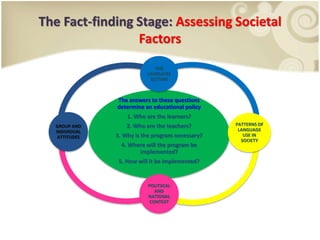
The Fact-finding Stage: Assessing Societal
Factors
The answers to these questions
determine an educational policy
1. Who are the learners?
2. Who are the teachers?
3. Why is the program necessary?
4. Where will the program be
implemented?
5. How will it be implemented?
THE
LANGUAGE
SETTING
PATTERNS OF
LANGUAGE
USE IN
SOCIETY
POLITIICAL
AND
NATIONAL
CONTEXT
GROUP AND
INDIVIDUAL
ATTITUDES
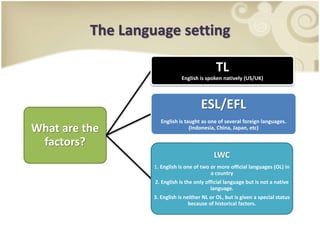
The Language setting
What are the
factors?
TL
English is spoken natively (US/UK)
ESL/EFL
English is taught as one of several foreign languages.
(Indonesia, China, Japan, etc)
LWC
1. English is one of two or more official languages (OL) in
a country
2. English is the only official language but is not a native
language.
3. English is neither NL or OL, but is given a special status
because of historical factors.
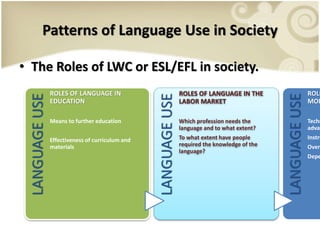
Patterns of Language Use in Society
• The Roles of LWC or ESL/EFL in society.
LANGUAGEUSE
ROLES OF LANGUAGE IN
EDUCATION
Means to further education
Effectiveness of curriculum and
materials
LANGUAGEUSE
ROLES OF LANGUAGE IN THE
LABOR MARKET
Which profession needs the
language and to what extent?
To what extent have people
required the knowledge of the
language?
LANGUAGEUSE
ROLE
MOD
Techn
advan
Instru
Overs
Depe
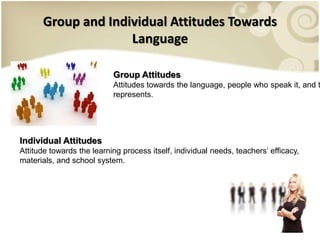
Group and Individual Attitudes Towards
Language
Group Attitudes
Attitudes towards the language, people who speak it, and t
represents.
Individual Attitudes
Attitude towards the learning process itself, individual needs, teachers’ efficacy,
materials, and school system.
The Attitudes Towards the Language
The positive attitudes will reflect a high regard a
appreciation to language and culture, high perso
motivation, feeling of self fulfillment, success, a
enthusiasm.
The negative attitudes are often related to
historical factors, political and national trends,
social conflicts. They create psychological
distance affecting learning-teaching process.
The Political and National Context
Political, national and
economic considerations are
closely interlaced with each
other, but in fact finding stage,
it is necessary to devote
attention to each of these
factors separately.
The Political and National Context
POLITICAL CONSIDERATIONS
The administration in power and its views of the language
NATIONAL CONSIDERATIONS
Promoting nationhood, patriotism, development of
national language
Different languages may prevail in different
domain.
For example:
a. local languages for early education,
b. the preferred national language for intermediate
education,
c. an international language for government and higher
education
The Political and National Context
When initiating new curriculum
design or launching a materials
development project, planners
must be fully aware of the
political and national priorities
prevailing in the community at
that particular time.
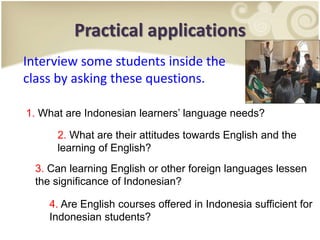
Practical applications
Interview some students inside the
class by asking these questions.
1. What are Indonesian learners’ language needs?
2. What are their attitudes towards English and the
learning of English?
3. Can learning English or other foreign languages lessen
the significance of Indonesian?
4. Are English courses offered in Indonesia sufficient for
Indonesian students?
Conclusion
To make a good design for a new language program, as a
planner (teacher), we should know all the information about the
program and gather it all in one. The process of it is called Fact-
finding Stage: Assessing Societal Factors which consist
of four major sections:
a) The language setting
b) Patterns of language use
c) Attitudes towards language
d) Political and national context
The Fact-finding Stage : Assessing Societal Factors

The Fact-finding Stage : Assessing Societal Factors

  • 1.
  • 2.
    The Fact-finding Stage: Assessing Societal Factors • Curriculum & Materials Development By: M. Abdurrahman 201112500576 Yulia Eolia Putri 201112500635 Setya Aprilia 201112500633 Hanifah Dwi Andari P. 201112500609 Desi Mitra Dewi 201112500601
  • 3.
    Presentation Outline • Introduction •The Curriculum Development Process • Societal Factors The Language Setting Patterns of Language Use in Society Group and Individual Attitudes Toward Langua The Political and National Context • Practical Application • Conclusion
  • 4.
    The Curriculum Development Process •The language curriculum includes specifications for providing inputs to syllabus design and for measuring outcomes of syllabus- based instruction • Robert Keith Johnson (1989:28)
  • 5.
    The Fact-finding Stage:Assessing Societal Factors The answers to these questions determine an educational policy 1. Who are the learners? 2. Who are the teachers? 3. Why is the program necessary? 4. Where will the program be implemented? 5. How will it be implemented? THE LANGUAGE SETTING PATTERNS OF LANGUAGE USE IN SOCIETY POLITIICAL AND NATIONAL CONTEXT GROUP AND INDIVIDUAL ATTITUDES
  • 6.
    The Language setting Whatare the factors? TL English is spoken natively (US/UK) ESL/EFL English is taught as one of several foreign languages. (Indonesia, China, Japan, etc) LWC 1. English is one of two or more official languages (OL) in a country 2. English is the only official language but is not a native language. 3. English is neither NL or OL, but is given a special status because of historical factors.
  • 7.
    Patterns of LanguageUse in Society • The Roles of LWC or ESL/EFL in society. LANGUAGEUSE ROLES OF LANGUAGE IN EDUCATION Means to further education Effectiveness of curriculum and materials LANGUAGEUSE ROLES OF LANGUAGE IN THE LABOR MARKET Which profession needs the language and to what extent? To what extent have people required the knowledge of the language? LANGUAGEUSE ROLE MOD Techn advan Instru Overs Depe
  • 8.
    Group and IndividualAttitudes Towards Language Group Attitudes Attitudes towards the language, people who speak it, and t represents. Individual Attitudes Attitude towards the learning process itself, individual needs, teachers’ efficacy, materials, and school system.
  • 9.
    The Attitudes Towardsthe Language The positive attitudes will reflect a high regard a appreciation to language and culture, high perso motivation, feeling of self fulfillment, success, a enthusiasm. The negative attitudes are often related to historical factors, political and national trends, social conflicts. They create psychological distance affecting learning-teaching process.
  • 10.
    The Political andNational Context Political, national and economic considerations are closely interlaced with each other, but in fact finding stage, it is necessary to devote attention to each of these factors separately.
  • 11.
    The Political andNational Context POLITICAL CONSIDERATIONS The administration in power and its views of the language NATIONAL CONSIDERATIONS Promoting nationhood, patriotism, development of national language Different languages may prevail in different domain. For example: a. local languages for early education, b. the preferred national language for intermediate education, c. an international language for government and higher education
  • 12.
    The Political andNational Context When initiating new curriculum design or launching a materials development project, planners must be fully aware of the political and national priorities prevailing in the community at that particular time.
  • 13.
    Practical applications Interview somestudents inside the class by asking these questions. 1. What are Indonesian learners’ language needs? 2. What are their attitudes towards English and the learning of English? 3. Can learning English or other foreign languages lessen the significance of Indonesian? 4. Are English courses offered in Indonesia sufficient for Indonesian students?
  • 14.
    Conclusion To make agood design for a new language program, as a planner (teacher), we should know all the information about the program and gather it all in one. The process of it is called Fact- finding Stage: Assessing Societal Factors which consist of four major sections: a) The language setting b) Patterns of language use c) Attitudes towards language d) Political and national context