REPORT ON METHODS OF PRIMARY
        DATA COLLECTION


                       MBA-001
          RESEARCH METHODOLOGY

UNDER THE SUPERVISION OF -
PROF.SALINI NIGAM AND            SUBMITTED BY-
PROF.AKSHAY KUMAR SATSANGI       BIMAL YADAV
DEPARMENT OF MANAGEMENT          ROLL-NO -117611
FACULTY OF SOCIAL SCIENCE        MBA-3 SEMESTER
INTRODUCTION-

The Primary Data are those which are collected
afresh and for the first time and thus happen to be
original in character. Primary data are first-hand
information collected through various methods
such as observation, interviewing, mailing etc.
We collect primary data during the course of doing
experiments in an experimental research. The
primary data are to be originally collected.
METHODS OF PRIMARY DATA
           COLLETION

There are many methods of collecting primary data
and the main methods are:
 Questionnaires
 Interviews
 Focus Group Interviews
 Observation
 Case studies
 Diaries
 Critical incidents
 Portfolios
Questionnaires-
Questionnaires are a popular means of collecting
data, but are difficult to design and often require
many rewrites before an acceptable questionnaire is
produced.
Advantage-
 Can cover a large number of people or
  organizations.
 Wide Geographic coverage
 Relatively cheap etc.
Disadvantage-
 ● Design problems

 ● Time delay etc
Interviews-

 Interviewing is a technique that is primarily used to
  gain an understanding of the underlying reasons and
  motivations for people’s attitudes, preferences or
  behaviour.
 It involves not only conversation, but also learning
  from the respondents’ gestures, facial expressions
  and pauses, and his environment. Interviewing
  requires face-to-face contact or contact over
  telephone and calls for interviewing skills.
Types of interview-

 Structured- Based on a carefully worded interview
  schedule. Frequently require short answers.
 Semi-structured-
  The interview is focused by asking certain
  questions but with scope for the respondent to
  express him or herself at length.
 Unstructured-
  This also called an in-depth interview. The
  interviewer begins by asking a general question. The
  interviewer uses an unstructured format
Focus group interviews-

A focus group is an interview conducted by a trained
moderator in a non-structured and natural manner
with a small group of respondents. The moderator
leads the discussion. The main purpose of focus
groups is to gain insights by listening to a group of
people from the appropriate target market talk about
specific issues of interest.
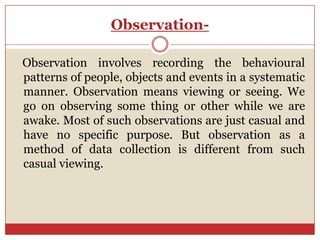
Observation-

Observation involves recording the behavioural
patterns of people, objects and events in a systematic
manner. Observation means viewing or seeing. We
go on observing some thing or other while we are
awake. Most of such observations are just casual and
have no specific purpose. But observation as a
method of data collection is different from such
casual viewing.
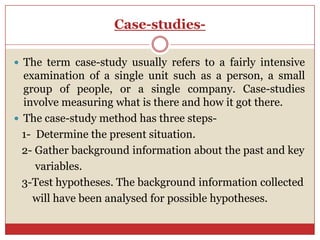
Case-studies-

 The term case-study usually refers to a fairly intensive
  examination of a single unit such as a person, a small
  group of people, or a single company. Case-studies
  involve measuring what is there and how it got there.
 The case-study method has three steps-
  1- Determine the present situation.
  2- Gather background information about the past and key
     variables.
  3-Test hypotheses. The background information collected
    will have been analysed for possible hypotheses.
Critical incidents-

The critical incident technique is an attempt to
identify the more ‘noteworthy’ aspects of job
behaviour and is based on the assumption that jobs
are composed of critical and non-critical tasks. For
example, a critical task might be defined as one that
makes the difference between success and failure in
carrying out important parts of the job. The idea is to
collect reports about what people do that is
particularly effective in contributing to good
performance.
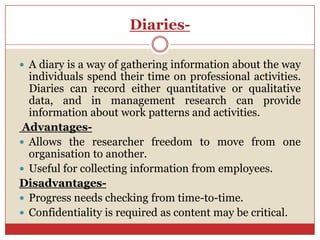
Diaries-

 A diary is a way of gathering information about the way
  individuals spend their time on professional activities.
  Diaries can record either quantitative or qualitative
  data, and in management research can provide
  information about work patterns and activities.
 Advantages-
 Allows the researcher freedom to move from one
  organisation to another.
 Useful for collecting information from employees.
Disadvantages-
 Progress needs checking from time-to-time.
 Confidentiality is required as content may be critical.
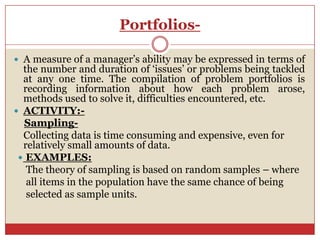
Portfolios-

 A measure of a manager’s ability may be expressed in terms of
  the number and duration of ‘issues’ or problems being tackled
  at any one time. The compilation of problem portfolios is
  recording information about how each problem arose,
  methods used to solve it, difficulties encountered, etc.
 ACTIVITY:-
  Sampling-
  Collecting data is time consuming and expensive, even for
  relatively small amounts of data.
  EXAMPLES:
   The theory of sampling is based on random samples – where
   all items in the population have the same chance of being
   selected as sample units.
REFERENCES:-

● Various sites-
 www.dmstudy.info/dmstudy.info
 www.ptsyst.com/
 www.datasheetarchive.com/datasheetarchive.com
 www.google.com
 www.yahoo.com.

● Various Books-

   C.R. Kothari Research Methodology
   Sharma, B.A.V. et al., Research Methods in Social Sciences, New Delhi:
   Sterling Publishers Pvt.Ltd., 1983.
   Tandon, B.C. Research Methodology in Social Sciences, Allahabad:
   Chaitanya Publishing House, 1979.
   Denzin, Norman, The Research Act, Chicago: Aldine, 1973
   Oppenheim,A.N.. Questionnaire Design and Attitude Measurement, New York:
    Basic Books 1966
Report on methods of primary data.bimal.doc.x

Report on methods of primary data.bimal.doc.x

  • 1.
    REPORT ON METHODSOF PRIMARY DATA COLLECTION MBA-001 RESEARCH METHODOLOGY UNDER THE SUPERVISION OF - PROF.SALINI NIGAM AND SUBMITTED BY- PROF.AKSHAY KUMAR SATSANGI BIMAL YADAV DEPARMENT OF MANAGEMENT ROLL-NO -117611 FACULTY OF SOCIAL SCIENCE MBA-3 SEMESTER
  • 2.
    INTRODUCTION- The Primary Dataare those which are collected afresh and for the first time and thus happen to be original in character. Primary data are first-hand information collected through various methods such as observation, interviewing, mailing etc. We collect primary data during the course of doing experiments in an experimental research. The primary data are to be originally collected.
  • 3.
    METHODS OF PRIMARYDATA COLLETION There are many methods of collecting primary data and the main methods are:  Questionnaires  Interviews  Focus Group Interviews  Observation  Case studies  Diaries  Critical incidents  Portfolios
  • 4.
    Questionnaires- Questionnaires are apopular means of collecting data, but are difficult to design and often require many rewrites before an acceptable questionnaire is produced. Advantage-  Can cover a large number of people or organizations.  Wide Geographic coverage  Relatively cheap etc. Disadvantage- ● Design problems ● Time delay etc
  • 5.
    Interviews-  Interviewing isa technique that is primarily used to gain an understanding of the underlying reasons and motivations for people’s attitudes, preferences or behaviour.  It involves not only conversation, but also learning from the respondents’ gestures, facial expressions and pauses, and his environment. Interviewing requires face-to-face contact or contact over telephone and calls for interviewing skills.
  • 6.
    Types of interview- Structured- Based on a carefully worded interview schedule. Frequently require short answers.  Semi-structured- The interview is focused by asking certain questions but with scope for the respondent to express him or herself at length.  Unstructured- This also called an in-depth interview. The interviewer begins by asking a general question. The interviewer uses an unstructured format
  • 7.
    Focus group interviews- Afocus group is an interview conducted by a trained moderator in a non-structured and natural manner with a small group of respondents. The moderator leads the discussion. The main purpose of focus groups is to gain insights by listening to a group of people from the appropriate target market talk about specific issues of interest.
  • 8.
    Observation- Observation involves recordingthe behavioural patterns of people, objects and events in a systematic manner. Observation means viewing or seeing. We go on observing some thing or other while we are awake. Most of such observations are just casual and have no specific purpose. But observation as a method of data collection is different from such casual viewing.
  • 9.
    Case-studies-  The termcase-study usually refers to a fairly intensive examination of a single unit such as a person, a small group of people, or a single company. Case-studies involve measuring what is there and how it got there.  The case-study method has three steps- 1- Determine the present situation. 2- Gather background information about the past and key variables. 3-Test hypotheses. The background information collected will have been analysed for possible hypotheses.
  • 10.
    Critical incidents- The criticalincident technique is an attempt to identify the more ‘noteworthy’ aspects of job behaviour and is based on the assumption that jobs are composed of critical and non-critical tasks. For example, a critical task might be defined as one that makes the difference between success and failure in carrying out important parts of the job. The idea is to collect reports about what people do that is particularly effective in contributing to good performance.
  • 11.
    Diaries-  A diaryis a way of gathering information about the way individuals spend their time on professional activities. Diaries can record either quantitative or qualitative data, and in management research can provide information about work patterns and activities. Advantages-  Allows the researcher freedom to move from one organisation to another.  Useful for collecting information from employees. Disadvantages-  Progress needs checking from time-to-time.  Confidentiality is required as content may be critical.
  • 12.
    Portfolios-  A measureof a manager’s ability may be expressed in terms of the number and duration of ‘issues’ or problems being tackled at any one time. The compilation of problem portfolios is recording information about how each problem arose, methods used to solve it, difficulties encountered, etc.  ACTIVITY:- Sampling- Collecting data is time consuming and expensive, even for relatively small amounts of data.  EXAMPLES: The theory of sampling is based on random samples – where all items in the population have the same chance of being selected as sample units.
  • 13.
    REFERENCES:- ● Various sites- www.dmstudy.info/dmstudy.info  www.ptsyst.com/  www.datasheetarchive.com/datasheetarchive.com  www.google.com  www.yahoo.com. ● Various Books-   C.R. Kothari Research Methodology  Sharma, B.A.V. et al., Research Methods in Social Sciences, New Delhi:  Sterling Publishers Pvt.Ltd., 1983.  Tandon, B.C. Research Methodology in Social Sciences, Allahabad:  Chaitanya Publishing House, 1979.  Denzin, Norman, The Research Act, Chicago: Aldine, 1973  Oppenheim,A.N.. Questionnaire Design and Attitude Measurement, New York: Basic Books 1966