COMPETENCY
BASED
TRAINING
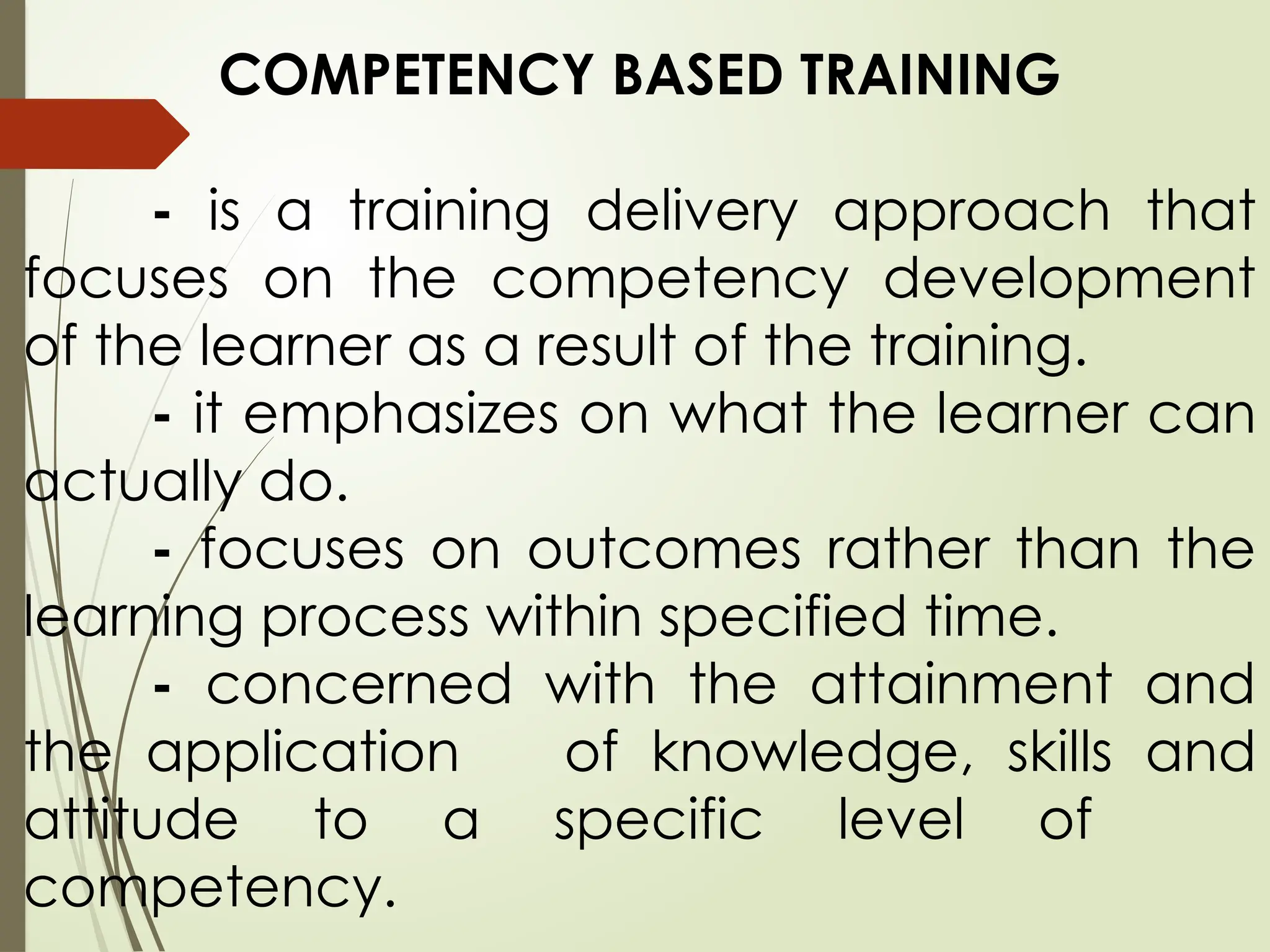
COMPETENCY BASED TRAINING
- is a training delivery approach that
focuses on the competency development
of the learner as a result of the training.
- it emphasizes on what the learner can
actually do.
- focuses on outcomes rather than the
learning process within specified time.
- concerned with the attainment and
the application of knowledge, skills and
attitude to a specific level of
competency.
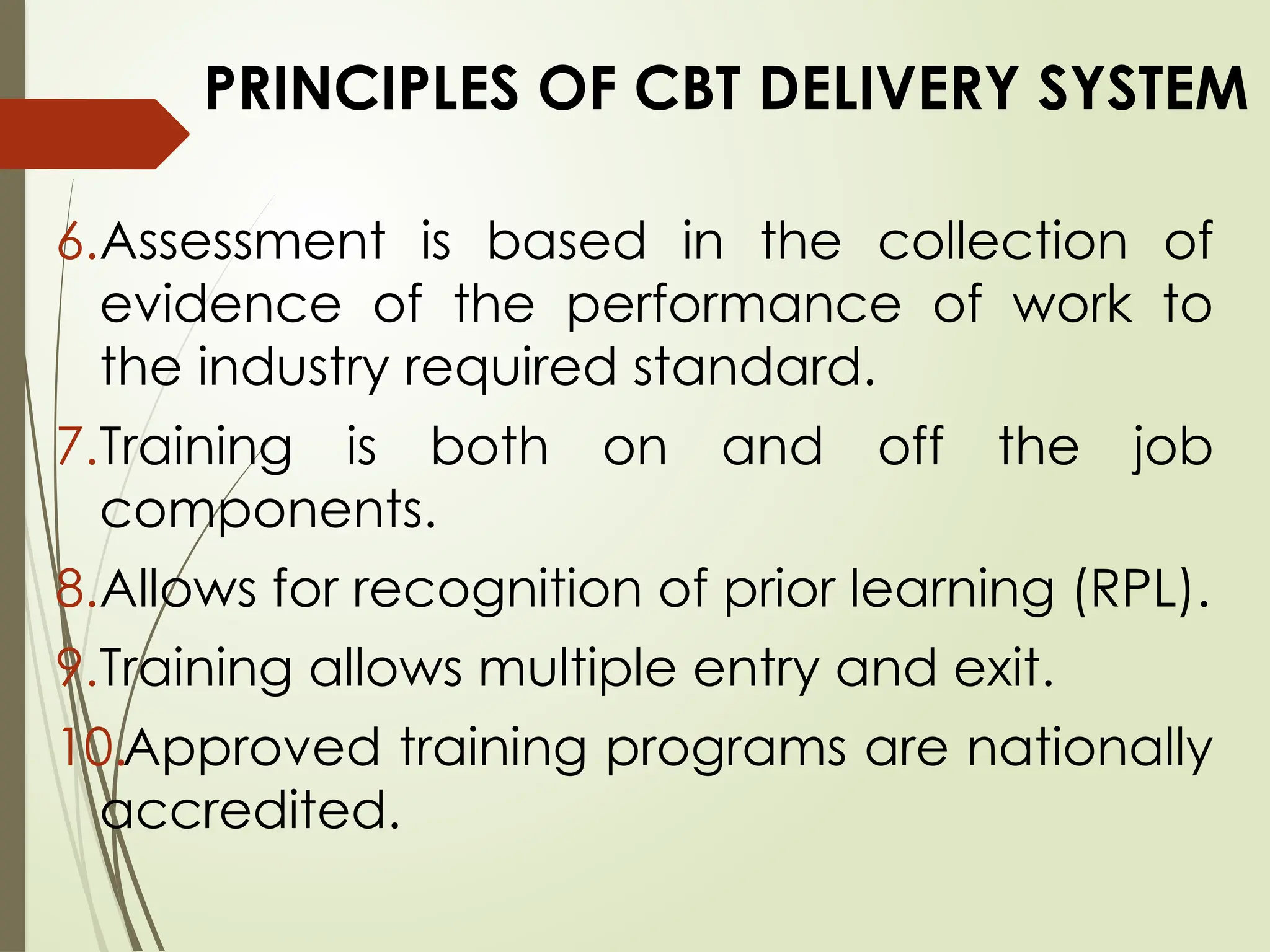
PRINCIPLES OF CBT DELIVERY SYSTEM
1.Training is based on the curriculum
developed from the competency standards.
2.Learning is modular in its structure.
3.Training delivery is self-paced and
individualized.
4.Training is based on work that must be
performed.
5.Training materials are directly related to the
competency standards and the curriculum
modules
6.Assessment is based in the collection of
evidence of the performance of work to
the industry required standard.
7.Training is both on and off the job
components.
8.Allows for recognition of prior learning (RPL).
9.Training allows multiple entry and exit.
10.Approved training programs are nationally
accredited.
PRINCIPLES OF CBT DELIVERY SYSTEM
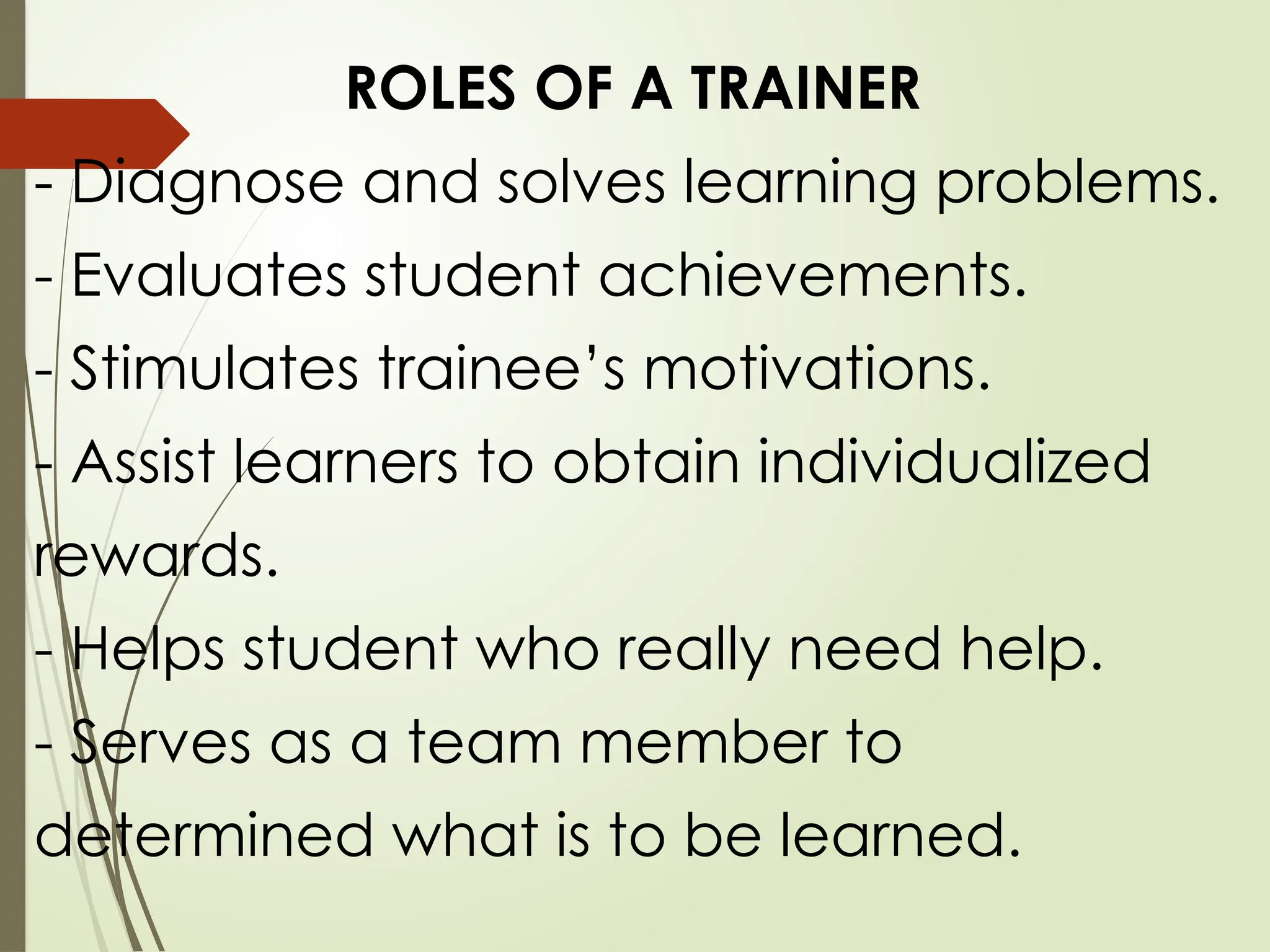
ROLES OF A TRAINER
- Diagnose and solves learning problems.
- Evaluates student achievements.
- Stimulates trainee’s motivations.
- Assist learners to obtain individualized
rewards.
- Helps student who really need help.
- Serves as a team member to
determined what is to be learned.
ROLES OF A TRAINEE
- Trainees may select what they want to learn
and when they want to learn it, within reason.
- Trainees learn at their own rate within
program guidelines. They may speed up, slow
down, stop or even repeat the task.
- Trainees move freely in the workshop,
laboratory and or training center.
- Trainees learn according to their interest
needs and abilities.
- Trainees are responsible for what they learn
and when they learn it.
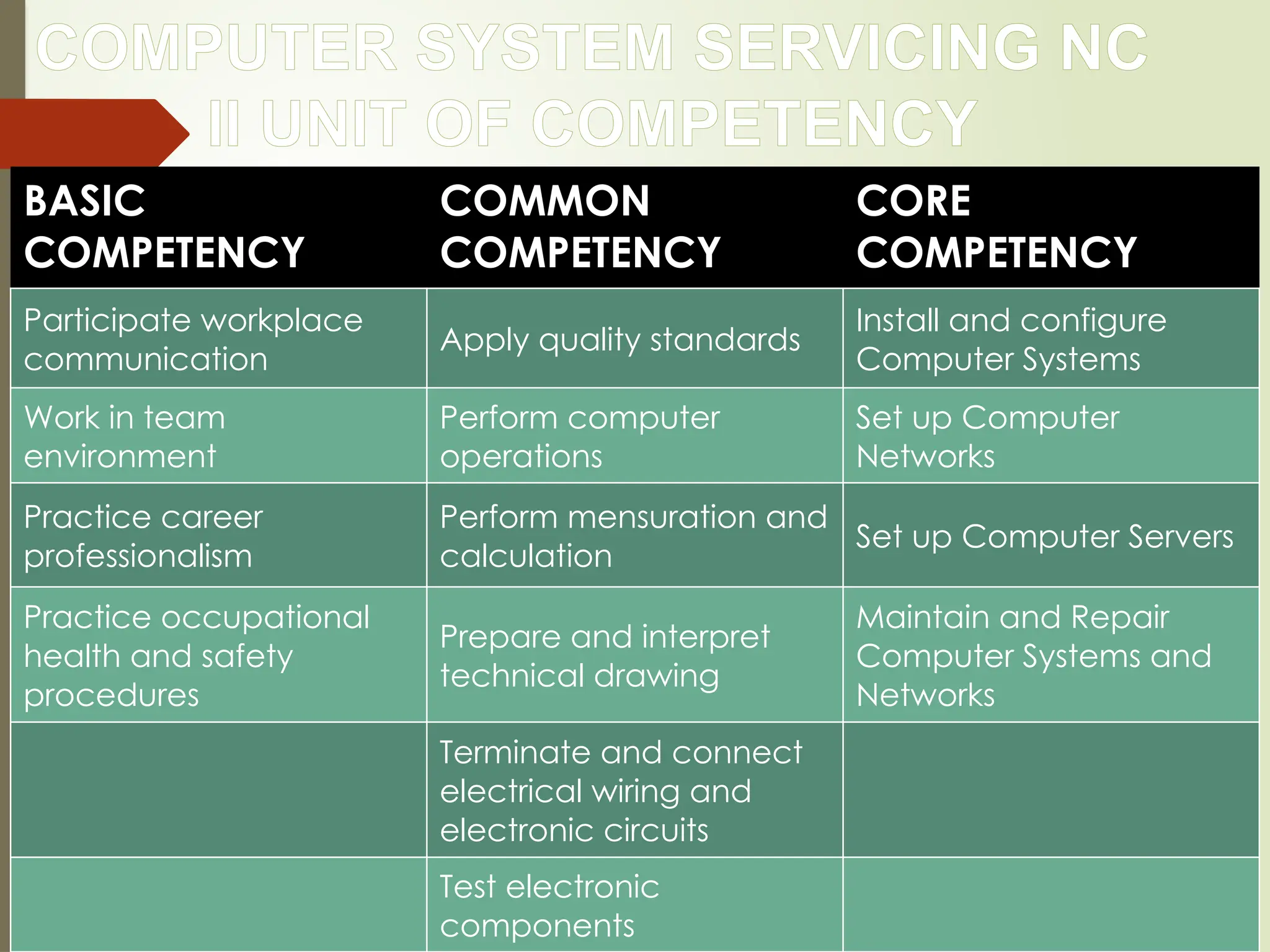
BASIC
COMPETENCY
COMMON
COMPETENCY
CORE
COMPETENCY
Participate workplace
communication
Apply quality standards
Install and configure
Computer Systems
Work in team
environment
Perform computer
operations
Set up Computer
Networks
Practice career
professionalism
Perform mensuration and
calculation
Set up Computer Servers
Practice occupational
health and safety
procedures
Prepare and interpret
technical drawing
Maintain and Repair
Computer Systems and
Networks
Terminate and connect
electrical wiring and
electronic circuits
Test electronic
components
COMPUTER SYSTEM SERVICING NC
II UNIT OF COMPETENCY
TRADITIONAL APPROACH VS.
CBT APPROACH
TRADITIONAL CBT
Instructors focus on
managing instructions.
Trainers focus on
managing learning.
Most students enter at
about the same time.
Trainees enter various
times throughout the year.
Students all cover the
same materials.
Different trainees may be
training for different
occupations within the
same program.
Students all proceed from
one topic to the next at
the same time.
Each trainee on to next
task only after mastering
the task he/she is currently
working on.
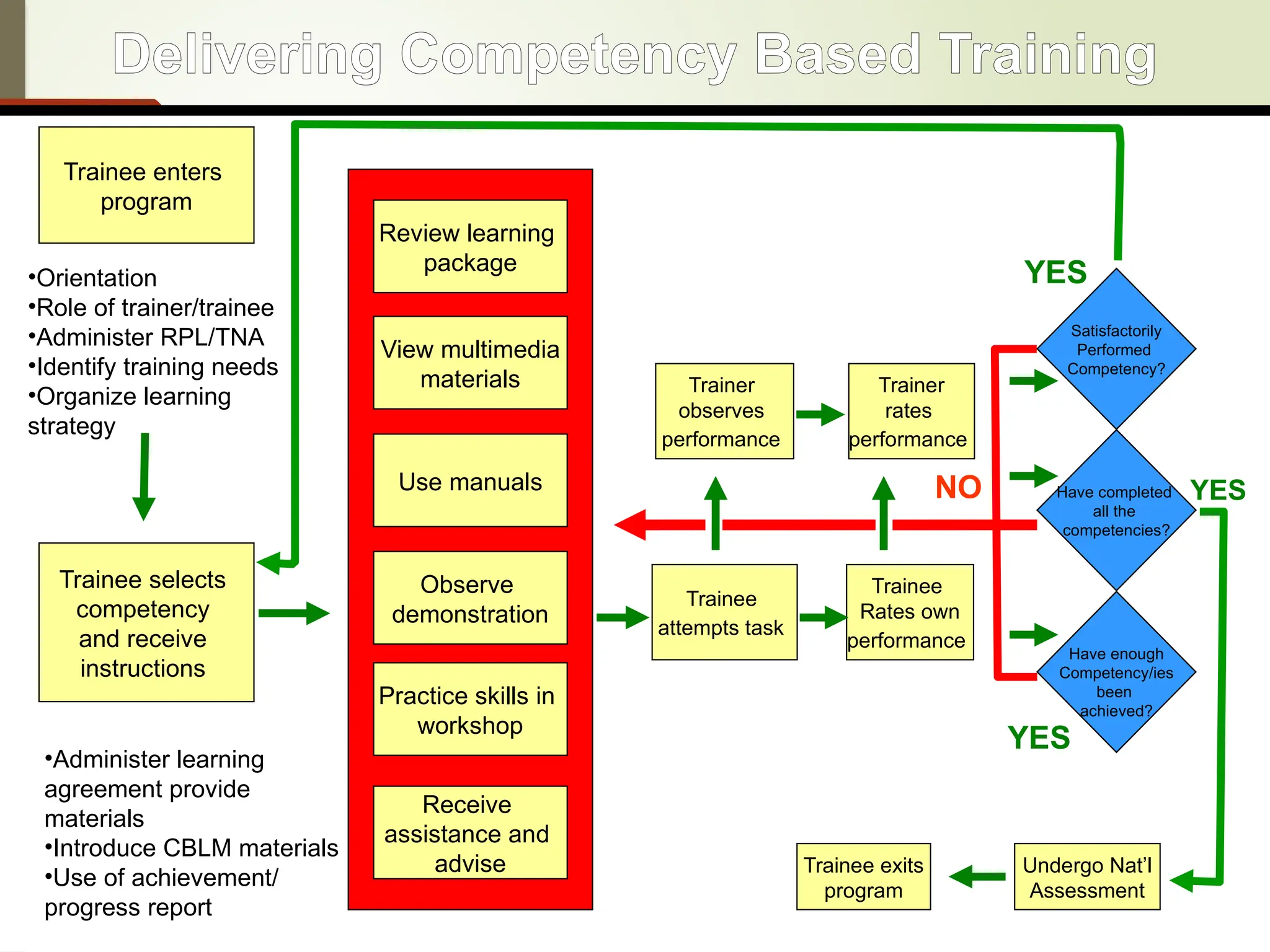
Delivering Competency Based Training
Have enough
Competency/ies
been
achieved?
YES
YES
Trainer
observes
performance
Trainee
attempts task
Trainee
Rates own
performance
Trainer
rates
performance
Trainee enters
program
Trainee selects
competency
and receive
instructions
Review learning
package
View multimedia
materials
Use manuals
Observe
demonstration
Practice skills in
workshop
Receive
assistance and
advise
NO YES
Trainee exits
program
Have completed
all the
competencies?
Satisfactorily
Performed
Competency?
Undergo Nat’l
Assessment
•Orientation
•Role of trainer/trainee
•Administer RPL/TNA
•Identify training needs
•Organize learning
strategy
•Administer learning
agreement provide
materials
•Introduce CBLM materials
•Use of achievement/
progress report
CBLM – COMPETENCY BASED
LEARNING MATERIALS
- Simply a well-designed and
carefully develop a learning
materials that gives trainees
detailed instructions to guide
them throughout the learning
process.
PARTS OF CBLM
A. PRELIMINARY PAGES B. INSTRUCTION SHEETS
• Front Page • Information Sheet
• Trainee’s Guide on How To Use
the CBLM
• Self-Check
• List of Competencies • Task Sheet
• Competency Summary • Operation Sheet
• Learning Outcome Summary • Job Sheet
• Learning Experiences • Performance Criteria Checklist
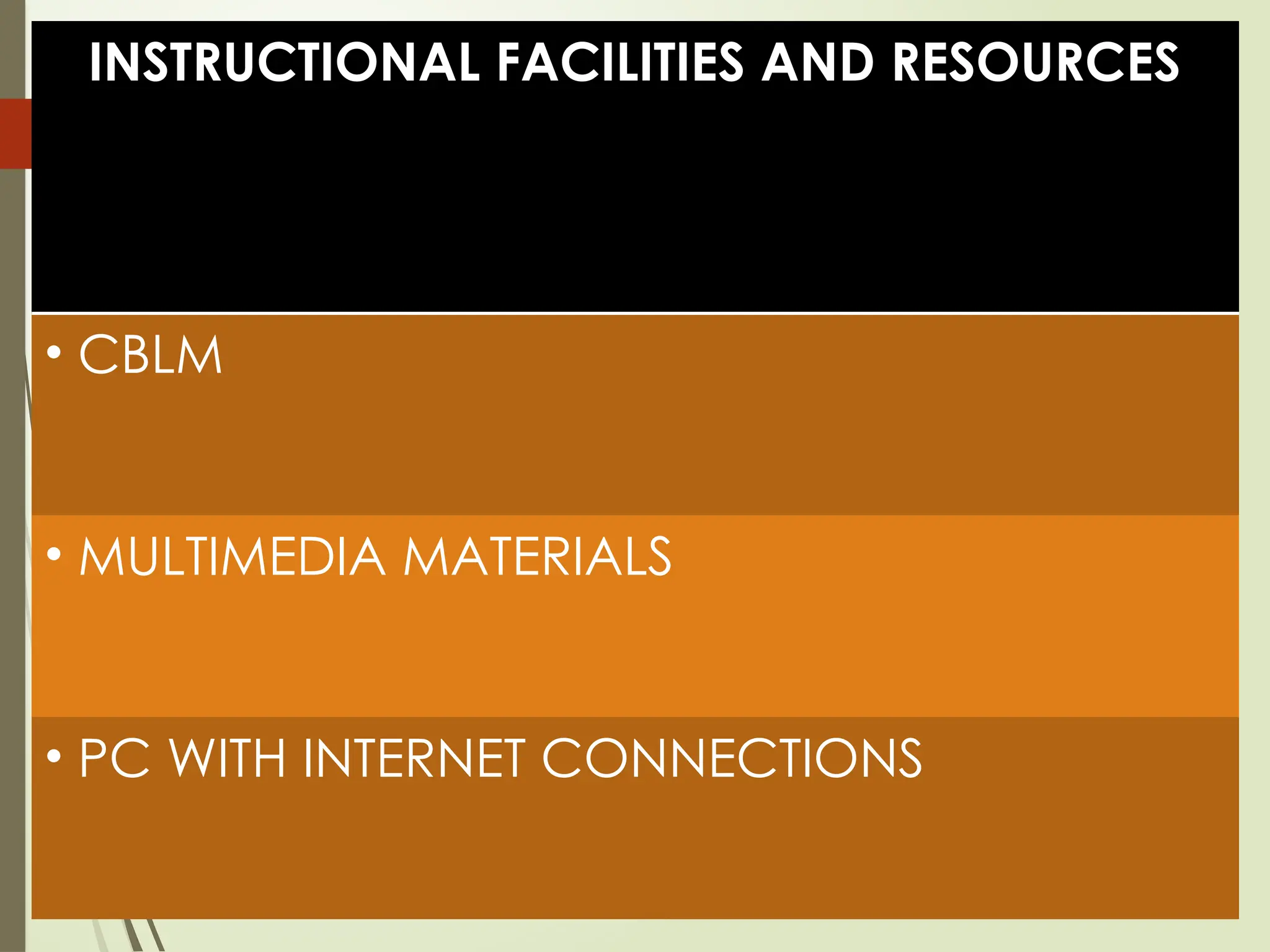
INSTRUCTIONAL FACILITIES AND RESOURCES
• CBLM
• MULTIMEDIA MATERIALS
• PC WITH INTERNET CONNECTIONS
THE MONITORING SYSTEM
• ACHIEVEMENT CHART
• PROGRESS CHART
• TRAINEE’S RECORD BOOK
THE EVALUATION SYSTEM
• PERFORMANCE CRITERIA
CHECKLIST
• RATING SHEETS
COMPUTER SYSTEMS SERVICING NC II
SHOP LAYOUT
JEA M. BANZAWAN
THANK
YOU

FACILITATE LEARNING SESSION (FLS) DEMO.pptx

  • 1.
  • 2.
    COMPETENCY BASED TRAINING -is a training delivery approach that focuses on the competency development of the learner as a result of the training. - it emphasizes on what the learner can actually do. - focuses on outcomes rather than the learning process within specified time. - concerned with the attainment and the application of knowledge, skills and attitude to a specific level of competency.
  • 3.
    PRINCIPLES OF CBTDELIVERY SYSTEM 1.Training is based on the curriculum developed from the competency standards. 2.Learning is modular in its structure. 3.Training delivery is self-paced and individualized. 4.Training is based on work that must be performed. 5.Training materials are directly related to the competency standards and the curriculum modules
  • 4.
    6.Assessment is basedin the collection of evidence of the performance of work to the industry required standard. 7.Training is both on and off the job components. 8.Allows for recognition of prior learning (RPL). 9.Training allows multiple entry and exit. 10.Approved training programs are nationally accredited. PRINCIPLES OF CBT DELIVERY SYSTEM
  • 5.
    ROLES OF ATRAINER - Diagnose and solves learning problems. - Evaluates student achievements. - Stimulates trainee’s motivations. - Assist learners to obtain individualized rewards. - Helps student who really need help. - Serves as a team member to determined what is to be learned.
  • 6.
    ROLES OF ATRAINEE - Trainees may select what they want to learn and when they want to learn it, within reason. - Trainees learn at their own rate within program guidelines. They may speed up, slow down, stop or even repeat the task. - Trainees move freely in the workshop, laboratory and or training center. - Trainees learn according to their interest needs and abilities. - Trainees are responsible for what they learn and when they learn it.
  • 7.
    BASIC COMPETENCY COMMON COMPETENCY CORE COMPETENCY Participate workplace communication Apply qualitystandards Install and configure Computer Systems Work in team environment Perform computer operations Set up Computer Networks Practice career professionalism Perform mensuration and calculation Set up Computer Servers Practice occupational health and safety procedures Prepare and interpret technical drawing Maintain and Repair Computer Systems and Networks Terminate and connect electrical wiring and electronic circuits Test electronic components COMPUTER SYSTEM SERVICING NC II UNIT OF COMPETENCY
  • 8.
    TRADITIONAL APPROACH VS. CBTAPPROACH TRADITIONAL CBT Instructors focus on managing instructions. Trainers focus on managing learning. Most students enter at about the same time. Trainees enter various times throughout the year. Students all cover the same materials. Different trainees may be training for different occupations within the same program. Students all proceed from one topic to the next at the same time. Each trainee on to next task only after mastering the task he/she is currently working on.
  • 9.
    Delivering Competency BasedTraining Have enough Competency/ies been achieved? YES YES Trainer observes performance Trainee attempts task Trainee Rates own performance Trainer rates performance Trainee enters program Trainee selects competency and receive instructions Review learning package View multimedia materials Use manuals Observe demonstration Practice skills in workshop Receive assistance and advise NO YES Trainee exits program Have completed all the competencies? Satisfactorily Performed Competency? Undergo Nat’l Assessment •Orientation •Role of trainer/trainee •Administer RPL/TNA •Identify training needs •Organize learning strategy •Administer learning agreement provide materials •Introduce CBLM materials •Use of achievement/ progress report
  • 10.
    CBLM – COMPETENCYBASED LEARNING MATERIALS - Simply a well-designed and carefully develop a learning materials that gives trainees detailed instructions to guide them throughout the learning process.
  • 11.
    PARTS OF CBLM A.PRELIMINARY PAGES B. INSTRUCTION SHEETS • Front Page • Information Sheet • Trainee’s Guide on How To Use the CBLM • Self-Check • List of Competencies • Task Sheet • Competency Summary • Operation Sheet • Learning Outcome Summary • Job Sheet • Learning Experiences • Performance Criteria Checklist
  • 12.
    INSTRUCTIONAL FACILITIES ANDRESOURCES • CBLM • MULTIMEDIA MATERIALS • PC WITH INTERNET CONNECTIONS
  • 13.
    THE MONITORING SYSTEM •ACHIEVEMENT CHART • PROGRESS CHART • TRAINEE’S RECORD BOOK
  • 14.
    THE EVALUATION SYSTEM •PERFORMANCE CRITERIA CHECKLIST • RATING SHEETS
  • 15.
    COMPUTER SYSTEMS SERVICINGNC II SHOP LAYOUT JEA M. BANZAWAN
  • 16.

Editor's Notes

  • #9 Flowchart in delivering CBT CONDUCT PRE ASSESSMENT Trainee enters the program. Recognition of prior learning should be administered in-order to determine if he/she needs to undergo all the competencies or he/she should proceed with the assessment. For instance if he has previous work experience and he can provide portfolio and other documents sufficient enough to support his claim, then he can proceed with the assessment. In the orientation, the trainer explains the CBT. The trainees will also be orient to familiarize the locations of different facilities and equipment, know whom to ask for assistance, what are the necessary tools to be used for learning, (tools pertains to different materials such as modules, books as reference, the internet if necessary, hand held gears and others.) WORKSHOP RULES AND REGULATIONS. Explain the role of trainers and trainees. (Explain that the training is competency based and it is self-paced). The trainer is there to guide, facilitate, check his work and evaluate his performance. Training is trainee-centered. FACILITATE TRAINNG SESSION The student selects one competency he wants to undergo first. Then instructions will be given. Trainer will administer learning contract, trainee to read the contract. Trainer and trainee will sign the contract (binding agreement) Strategies for learning should properly organized and explained to the trainee. Provide and explain the use of learning materials needed (curriculum based learning modules). Introduce and explain the use of Achievement Progress Report. The trainer and trainee monitor the progress per Los/Unit of Competency Learning takes place (View multimedia materials, Use manuals, Observe demonstrations, Practice skills in workshop and if necessary receive assistance and advice). CONDUCT INSTITUTIONAL ASSESSMENT Once trainee feels that he is ready to perform the task, then he can proceed. Two ways: While performing, the trainer observes his performance, check if the procedure is correct and appropriate in-order for him not to commit mistakes that will lead to equipment damage or injury to the trainee. Trainee attempts the task and rates himself and then the trainer rates the trainee. OUTPUT Competency 1: competent, selects competency 2 Completed all competencies: Undergo mandatory national assessment Whatever the result of national assessment, the trainee may exit the program Competency 1 and 2 completed: may exit the program (work experience). Enter again to take remaining competencies (may take RPL again) Not yet competent-perform/practice the activities/tasks then undergo institutional assessment